Wind Damage vs Structural Tree Failure: Chicago Homeowner Guide
Wind Damage vs Structural Tree Failure
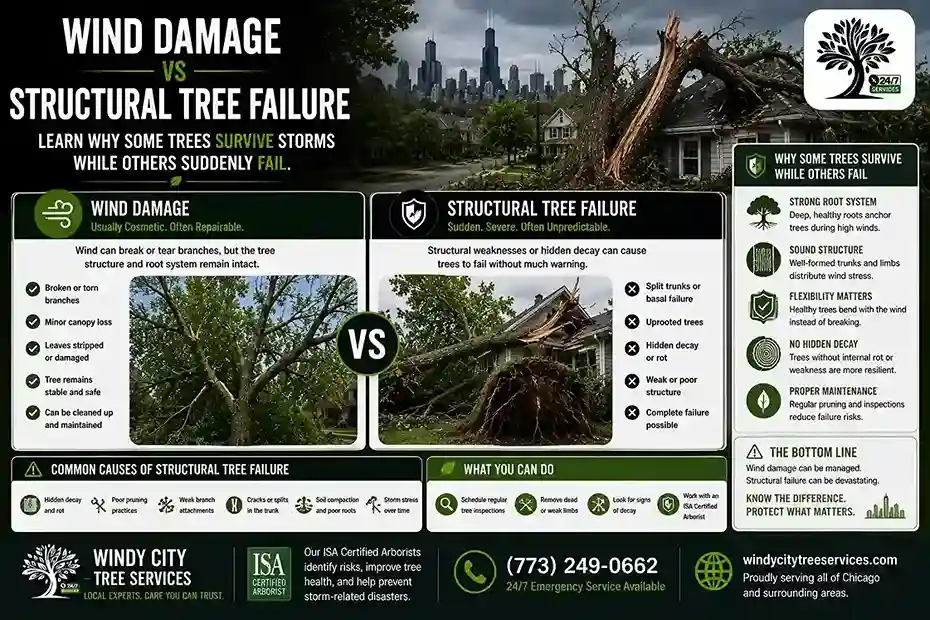
Learn why some trees survive storms while others suddenly fail.
Schedule a Tree Risk AssessmentWhen a tree comes down during a Chicago storm, it’s tempting to blame the wind and leave it at that. But not every tree that fails was simply overpowered by weather. Many storm failures trace back to structural weaknesses that existed long before the wind ever picked up, hidden decay, a weak branch union, a compromised root system, that finally gave way once wind provided the trigger.
Understanding the difference between wind damage and structural tree failure matters because it changes how homeowners should think about tree care. Wind damage can happen to almost any tree in a severe enough storm. Structural failure, on the other hand, is often predictable and preventable, which is exactly why professional tree risk assessments exist.
This guide breaks down how trees actually respond to wind, what separates ordinary storm damage from a structural failure years in the making, which defects arborists look for during an inspection, and what homeowners can do to catch problems before the next severe weather event exposes them.
What is the difference between wind damage and structural tree failure?
Wind damage occurs when strong winds break or uproot otherwise healthy trees or branches. Structural tree failure happens when internal defects, such as decay, weak branch unions, root problems, or cracks, cause a tree to fail, often with wind acting as the triggering event rather than the sole cause. Professional inspections can identify many structural defects before storms expose them.
How Trees Respond to Wind
Healthy trees are built to move. Wind loading pushes against the canopy, and a tree’s trunk and branches flex and sway to absorb that force rather than resist it rigidly. This dynamic loading response is a normal, expected part of how trees have evolved to survive storms, not a sign of weakness.
Diagram: Sway and Flex Under Wind Load
Illustration comparing a healthy tree flexing and dissipating wind energy through its canopy against a rigid, structurally compromised tree concentrating stress at a single failure point.
Root anchorage plays just as large a role as canopy flexibility. A wide, well-developed root system spreads the load of a swaying trunk across a broad area of soil, which is why trees grown in open, undisturbed ground generally handle wind better than trees in compacted urban soil with restricted root space, a common condition throughout Chicago according to University of Illinois Extension research on urban tree stress.
Species differences matter too. Some species, like oaks, have evolved dense, strong wood that resists breaking under load. Others, like silver maple and cottonwood, grow fast by producing weaker, more brittle wood, trading structural strength for rapid growth. Neither strategy is inherently wrong in a forest setting, but it means some species carry more inherent storm risk in a yard or parkway.
What Is Wind Damage?
Wind damage describes the direct mechanical harm wind causes to an otherwise sound tree. It’s the category most people picture when they think about storm damage.
- Broken branches: Even healthy limbs can snap under extreme gusts, especially long, leafy branches that catch significant wind.
- Twisted limbs: Shifting, gusty wind can twist branches in ways a steady wind wouldn’t, tearing bark and fibers at the point of attachment.
- Canopy damage: Leaves and small twigs stripped from the canopy are common and usually cosmetic rather than structural.
- Uprooted trees: Also called windthrow, this happens when wind force exceeds what the root system can anchor, more common in saturated soil after heavy rain.
- Torn bark: Wind-driven debris or branch friction can tear bark, creating an entry point for pests and decay organisms.
A real-world example: a healthy honey locust in an open yard loses a mid-sized branch during a severe thunderstorm because the gust exceeded what any tree could reasonably withstand. The tree itself is otherwise sound, and the damage is a straightforward case of wind overpowering healthy wood.
What Is Structural Tree Failure?
Structural tree failure describes a different situation: the tree fails because of an underlying defect that existed before the storm, not because the wind itself was extraordinary.
- Internal decay: Fungal decay hollows out wood from the inside, often invisible from the outside until the tree fails.
- Hollow trunks: A trunk can lose significant structural strength long before it becomes visibly hollow at the base.
- Root failure: Decayed, girdling, or severely restricted roots can’t anchor a tree properly, regardless of how healthy the canopy looks.
- Weak branch unions: Poorly attached branches, especially those with included bark, are prone to splitting under stress a well-attached branch would handle easily.
- Included bark: Bark trapped between two branches instead of forming a solid union creates one of the most common failure points in mature trees.
- Cracks: Visible or hidden cracks in the trunk or major limbs signal active structural compromise.
- Codominant stems: Two competing leaders of similar size create a naturally weak point where they meet, especially when included bark is also present.
- Previous storm injuries: Unrepaired wounds from earlier storms often become the starting point for decay that eventually causes failure.
A real-world example: a mature silver maple with a codominant trunk and included bark at the union looks full and healthy from the ground. During a moderate wind event, well within what a sound tree of that size should handle, the weak union splits and half the tree comes down. The wind was the trigger, but the structural defect determined the outcome.
Why Healthy Trees Usually Survive Storms
Strong Root Systems
Wide, undamaged root systems anchor the tree and distribute wind load across a broad area of soil.
Balanced Canopies
Evenly distributed weight prevents concentrated stress on any single side of the trunk.
Good Branch Architecture
Well-spaced branches with strong attachment points handle wind loading without competing for the same structural space.
Healthy Wood
Sound, decay-free wood flexes and absorbs stress instead of snapping or splitting.
Species Adaptations
Some species have evolved flexible branches or deep taproots specifically suited to resisting wind stress.
Common Structural Defects in Chicago Trees
Species characteristics play a real role in how likely a tree is to develop structural problems over time.
| Species | Common Structural Concern |
|---|---|
| Silver Maple | Codominant stems and included bark from fast, poorly structured growth. |
| Ash | Emerald ash borer tunneling weakens wood structurally well before visible canopy decline. |
| Cottonwood | Brittle wood combined with large limb size increases failure risk at branch unions. |
| Bradford Pear | Tight-angled codominant branching is prone to splitting apart as the tree matures. |
| Willow | Weak wood and shallow, wide root systems reduce both limb and whole-tree stability. |
| Elm | Older elms often carry internal decay from past Dutch elm disease damage. |
| Honey Locust | Generally strong, but poorly pruned specimens can develop weak codominant leaders. |
| Oak | Long-lived and structurally strong, though oak wilt and old wounds create hidden decay pockets. |
| Spruce | Shallow roots and dense, top-heavy canopies increase whole-tree wind exposure. |
Wind Alone Isn’t Always the Cause
It’s tempting to treat every storm failure as proof the wind was simply too strong. In reality, wind is often the trigger that exposes a weakness that was already there, not the root cause on its own.
- Wind exposes existing weaknesses: A structurally sound tree and a defective tree can experience the exact same gust with very different outcomes.
- Structural defects often determine where failure occurs: Trees rarely fail at random points. They fail at the weakest point in the structure, which is usually a known type of defect.
- Storm intensity, soil saturation, and tree health all interact: A moderate storm after weeks of heavy rain can cause more failures than a stronger storm on dry ground, because saturated soil weakens root anchorage.
No single factor explains every tree failure. Wind speed, tree health, species, soil conditions, and site exposure all combine to determine the outcome of any given storm.
How Arborists Perform Tree Risk Assessments
ISA Certified Arborists trained in Tree Risk Assessment Qualification, known as TRAQ, follow a standardized methodology rather than a subjective guess. A TRAQ-based assessment typically evaluates:
- Root flare: Checking the base of the trunk for girdling roots, decay, or signs of soil movement.
- Trunk condition: Identifying cracks, cavities, included bark, and old wounds.
- Branch attachments: Evaluating union strength throughout the canopy.
- Canopy balance: Assessing whether the tree’s weight is evenly distributed or concentrated.
- Soil: Considering compaction, drainage, and available root space.
- Site exposure: Factoring in wind exposure based on nearby buildings, other trees, and topography.
- Defects: Cataloging every structural concern found during the inspection.
- Overall vitality: Reviewing foliage density, growth rate, and general tree health.
TRAQ methodology combines the likelihood of failure with the likelihood of impact and the consequences of failure to produce a defensible risk rating, giving homeowners real information instead of a guess based on how a tree looks from the sidewalk.
Can Structural Problems Be Corrected?
Some structural defects can be managed or corrected. Others can only be monitored, and a few mean removal is the responsible choice.
Structural Pruning
Correcting codominant stems and weak unions early can prevent many defects from ever fully developing.
Cabling & Bracing
Steel support systems redistribute stress across weak unions, reducing failure risk without removing the tree.
Crown Reduction
Reducing weight and leverage on a defective limb can lower failure risk on trees that are otherwise worth preserving.
Soil Improvement
Addressing compaction and drainage supports root health and can improve anchoring over time.
Root Care
Air Spade excavation allows arborists to assess and correct girdling roots without cutting healthy roots.
Monitoring
Some defects require ongoing observation rather than immediate action, especially in trees with low-consequence targets nearby.
It’s important to be honest about limits. Advanced internal decay, severe root loss, and large trunk cavities often can’t be fully corrected. In those cases, the right answer is usually tree removal rather than a treatment that only delays an eventual failure.
When Removal Is the Safest Option
- Severe decay: When internal decay compromises a large percentage of the trunk’s structural wood.
- Extensive root damage: When root loss is significant enough that anchoring can’t be reliably restored.
- High-risk targets: When a defective tree stands near a home, driveway, or area with regular foot traffic.
- Advanced instability: When a tree shows a new or worsening lean combined with other defects.
- Repeated failures: When a tree has already lost major limbs or sections in previous storms.
Removal decisions should always be based on a professional assessment that weighs the likelihood of failure, the potential targets nearby, and the consequences if failure occurs, not a snap judgment made from the sidewalk. Our tree health inspection service provides that documented evaluation before any removal decision is made.
How to Reduce Storm Damage
- Annual inspections: Catch developing defects before they become failures.
- Structural pruning: Corrects weak branch architecture while a tree is still young enough to respond well.
- Crown cleaning: Removes dead and weakly attached wood most likely to fail first.
- Deadwood removal: Eliminates branches with zero living tissue holding them in place.
- Cabling: Supports weak unions on valuable, otherwise healthy trees.
- Fertilization: Supports overall vitality, helping trees better resist and recover from stress.
- Air Spade root inspections: Reveals hidden root problems without damaging the root system in the process.
Chicago Storm Conditions
Chicago’s position on Lake Michigan produces a wide range of storm conditions across the year, according to National Weather Service climate summaries for the region.
Thunderstorms
Frequent in spring and summer, often bringing sudden, intense wind gusts.
Straight-Line Winds
Can produce damage similar to a weak tornado across a wide, linear path.
Tornadoes
Less frequent than in the Plains states but a real seasonal risk across the Chicago area.
Heavy Snow
Wet, heavy snowfall adds significant weight to branches already stressed by wind.
Ice Storms
Ice accumulation multiplies limb weight and is a leading cause of winter tree failure.
Lake Michigan Weather
Lake-effect moisture and temperature swings intensify storm activity across the region.
Common Homeowner Mistakes
- Ignoring warning signs: Small cracks, minor leans, or a bit of fungal growth often get dismissed until they become serious.
- Topping trees: A quick way to reduce height that creates weak, poorly attached regrowth and more risk long-term.
- DIY pruning: Improper cuts and unsafe equipment use can create new wounds that invite decay.
- Delaying inspections: Structural defects develop gradually, and waiting for obvious symptoms means missing the cheapest window for correction.
- Ignoring fungal growth: Mushrooms or conks near the base or trunk are a direct sign of internal decay that shouldn’t be overlooked.
Wind Damage vs. Structural Tree Failure
| Factor | Wind Damage | Structural Tree Failure |
|---|---|---|
| Primary Cause | Extreme wind force on a healthy tree | Pre-existing internal defect exposed by wind |
| Common Symptoms | Broken branches, torn bark, stripped canopy | Cracks, cavities, decay, weak unions, leaning |
| Can Be Prevented? | Only partially, extreme wind can affect healthy trees | Often preventable with early detection and correction |
| Inspection Needed | Post-storm cleanup and safety check | Proactive risk assessment before storms occur |
| Emergency Risk | Usually limited to the damaged limb or tree | Can involve sudden, catastrophic whole-tree failure |
| Long-Term Solutions | Standard pruning and canopy maintenance | Structural pruning, cabling, or removal depending on severity |
Common Structural Defects
| Defect | Risk Level | Typical Recommendation |
|---|---|---|
| Included Bark | Moderate to High | Structural pruning early, cabling if mature |
| Dead Branches | Moderate | Crown cleaning and deadwood removal |
| Hollow Trunk | High | Full risk assessment, often removal |
| Root Decay | High | Air Spade evaluation, monitoring, or removal |
| Codominant Stems | Moderate to High | Structural pruning or cabling |
| Trunk Crack | High | Immediate professional assessment |
Tree Failure Prevention Checklist
- Schedule annual professional inspections
- Watch for new or worsening cracks in the trunk or limbs
- Inspect the root flare for girdling roots or soil heaving
- Remove dead branches before they become hazards
- Monitor any tree with a new or worsening lean
- Look for fungal growth or mushrooms near the base
- Avoid topping trees under any circumstances
- Schedule structural pruning for young and mature trees alike
Frequently Asked Questions
Can healthy trees fall during storms?
Yes, though it’s less common. Extreme wind, saturated soil, or a direct lightning strike can bring down even a structurally sound tree. Healthy trees fail far less often than defective ones, but no tree is completely immune to extreme weather.
What causes structural tree failure?
Structural failure typically results from internal decay, weak branch unions, root problems, or trunk cracks that existed before a storm. Wind or snow load often acts as the trigger that exposes an underlying defect.
How do arborists detect hidden decay?
Arborists look for external indicators like fungal growth, cavities, and changes in bark texture, and may use tools like resistance drills or sonic tomography for a closer look at internal wood condition when decay is suspected.
Can pruning prevent tree failure?
Structural pruning can prevent many defects from developing, especially when done on young trees, and it can reduce risk on mature trees by removing weak or overextended limbs. It can’t correct advanced internal decay or major root loss.
What are codominant stems?
Codominant stems are two or more main stems of similar size and vigor competing for dominance at the same point on a tree. They often form a structurally weak union, especially when combined with included bark.
Is a hollow tree dangerous?
Not automatically, some trees survive for years with a hollow trunk if enough sound wood remains around the outer shell. A professional assessment can estimate remaining structural strength and determine whether the tree is safe to keep.
Can root damage be repaired?
Some root problems, like girdling roots, can be corrected if caught early. Severe root loss or extensive decay generally can’t be reversed, and monitoring or removal becomes the more realistic path forward.
Does cabling prevent failure?
Cabling significantly reduces the risk of failure at weak branch unions by redistributing structural stress, but it doesn’t eliminate risk entirely. It works best as part of an ongoing monitoring and maintenance plan.
When should a tree be removed?
Removal is typically recommended when a tree has severe decay, extensive root damage, or advanced instability, especially near high-risk targets like a home or driveway. The decision should always follow a professional risk assessment.
Should trees be inspected after every major storm?
It’s a good idea, especially for large or mature trees. A storm can create hidden stress fractures or root movement that isn’t obvious from the ground but could develop into a hazard before the next storm.
What is included bark, and why does it matter?
Included bark forms when bark grows inward between two branches instead of forming a solid wood union. It’s one of the most common structural weaknesses arborists look for, since it creates a natural split point under stress.
Does tree species affect storm risk?
Yes. Fast-growing species like silver maple and cottonwood tend to produce weaker wood and are more prone to structural defects than slower-growing species like oak, though any species can develop problems without proper care.
Can a tree look healthy and still be structurally unsound?
Yes, this is one of the most important things homeowners should understand. A full, green canopy doesn’t rule out internal decay, root damage, or a weak branch union, which is exactly why a visual inspection from the ground isn’t enough for high-value or high-risk trees.
What is a TRAQ-based tree risk assessment?
TRAQ, or Tree Risk Assessment Qualification, is a standardized ISA methodology that evaluates the likelihood of failure, likelihood of impact, and consequences of failure to produce a defensible risk rating for a tree.
Can soil conditions cause tree failure?
Yes. Saturated soil after heavy rain reduces root anchorage, and compacted urban soil limits root development over time, both of which increase the chance of windthrow even in a tree with a sound canopy.
Is it safe to remove a hazardous tree myself?
No. Structurally compromised trees are unpredictable and dangerous to remove without professional training, rigging equipment, and safety practices. This work should always go to a trained crew.
Can fertilization help a structurally weak tree?
Fertilization supports overall vitality and can help a tree better resist stress, but it doesn’t correct existing structural defects like decay or weak branch unions. It works best alongside structural pruning or cabling, not as a standalone fix.
What should I do if my tree falls during a storm?
Stay away from the tree and any downed power lines, photograph the damage for insurance, and contact emergency tree removal professionals. Avoid attempting cleanup yourself near large limbs or an unstable trunk.
How much does a tree risk assessment cost?
Cost depends on the number of trees, their size, and the depth of assessment needed. We provide a written, no-obligation estimate after understanding the scope of what you’d like evaluated.
How do I schedule a tree risk assessment in Chicago?
Call (773) 249-0662, email info@windycitytreeservices.com, or request an estimate online. We’ll schedule an on-site evaluation and follow up with a written risk assessment and recommendations.
Key Takeaways
- Wind damage vs. structural failure: Wind damage happens to otherwise healthy trees under extreme force. Structural failure happens when a pre-existing defect is exposed by wind, often at moderate storm intensity.
- Importance of inspections: Many of the most dangerous defects, like internal decay and root problems, are invisible from the ground and only surface through a professional evaluation.
- Preventive maintenance works: Structural pruning, cabling, and regular monitoring meaningfully reduce the risk of catastrophic failure, especially when started early in a tree’s life.
- Professional evaluations matter: Tree failure can’t be predicted with total certainty, but a TRAQ-based risk assessment narrows the uncertainty and gives homeowners real information for decision-making.