
Professional Tree Cabling & Bracing in Chicago
Protect Valuable Trees with Expert Structural Support Systems
Not every tree showing signs of structural stress needs to come down. Many can be stabilized, preserved, and kept safely in your landscape for years with a properly designed cabling or bracing system — installed by certified arborists who understand Chicago’s specific tree challenges.
Tree Preservation & Stability
When Removal Isn’t the Only Answer
A tree doesn’t have to be healthy-looking to be in trouble — and it doesn’t have to be in trouble to need removal. Some of the most structurally risky trees in Chicago are large, mature, and apparently thriving. The issue isn’t disease. It’s geometry.
Co-dominant stems, heavy lateral limbs, and overextended canopies create mechanical stress points that can fail under the loads Chicago weather regularly delivers — high straight-line winds, ice accumulation, sudden heavy snow. The consequences of a major limb failure aren’t just cosmetic. They’re structural, financial, and sometimes dangerous.
Tree cabling and bracing give arborists a way to address those risks without removing trees that are otherwise worth keeping. The right structural support system — designed for the specific tree and installed correctly — reduces failure probability, distributes canopy load more safely, and buys that tree years of additional life in your landscape.
For Windy City Tree Services, structural tree support is part of a broader commitment to complete tree care — finding the solution that’s right for the tree and right for you, not just the easiest one.
Understanding the Service
What Is Tree Cabling & Bracing?
Two distinct systems, often used together, that address different types of structural weakness in trees.
Tree Cabling
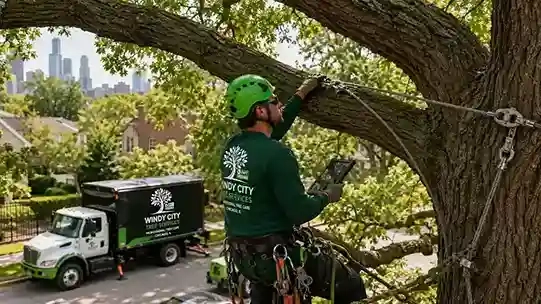
Flexible steel or synthetic rope cable is installed high in the canopy — typically between two co-dominant stems or between a heavy lateral limb and the main trunk. The cable limits how far those limbs can spread under load, reducing the stress on the union between them.
It doesn’t lock the tree in place. Good cabling allows natural sway, which is actually important: trees that can’t move in the wind stop building the internal wood fiber that makes them stronger. The cable simply sets an outer limit on that movement.
Tree Bracing
Where cabling supports from above, bracing works from within. A threaded steel rod is drilled through a split trunk or structurally weak branch union, then secured with nuts and washers on both sides. This physically holds cracked or separating wood together.
Bracing is typically used for split crotches, cracked branch bases, or older wounds that have weakened a union point. Cables and bracing rods are often combined — the rod stabilizes the immediate crack while the cable controls movement that would put stress back on that joint.
Modern tree support systems are designed to work with natural tree physiology, not against it. Unlike old-style rigid wire wraps that could cut into bark and restrict growth, contemporary dynamic cabling hardware and properly tensioned rods respect the tree’s need to flex and grow while still reducing the specific failure risks that make certain trees dangerous.
Warning Indicators
Signs Your Tree May Need Cabling or Bracing
Some of these are obvious from the ground. Others take a trained eye to catch before they become a problem.
Two or more main trunks growing upward from a shared point, often with a V-shaped union that’s mechanically weaker than a wide-angled branch junction.
Heavy lateral branches that have grown long and aren’t well-supported by the surrounding canopy structure — particularly those extending over rooftops or driveways.
Visible cracks at a branch junction — sometimes with visible bark separation, seeping sap, or evidence of movement after storms.
Bark embedded between two stems at their union (rather than rolled outward) signals a structurally weak connection. This is one of the most common failure points arborists look for.
Older trees that have developed structural quirks over decades — but are otherwise healthy and worth preserving for their landscape, ecological, or historic value.
Trees that survived a major wind or ice event but now have partially separated unions, leaning stems, or canopy sections that shifted out of position.
Limbs that have developed a pronounced lean, or canopies that are heavily weighted to one side, creating uneven stress on the attachment point.
A tree that’s already lost a large limb often has remaining limbs under increased stress — and sometimes has internal decay that changes the risk calculus for the whole tree.
Specimen trees — prized for their size, form, rarity, or age — where the cost of structural support is clearly justified by what the tree is worth to the landscape.
Any tree whose canopy or major limbs extend over a home, garage, deck, pool, parked vehicles, or pedestrian areas — where a failure would have immediate consequences.
What We Offer
Our Tree Cabling & Bracing Services
Every service starts with an honest arborist evaluation — because the best structural support system is the one that’s actually right for the tree.
Tree Risk Evaluation
A structured assessment of structural failure probability and consequence — the foundation of every support system recommendation.
Dynamic Cabling Systems
Flexible cable installations that limit dangerous movement while allowing natural sway — ideal for most residential and commercial trees.
Static Cabling Systems
More rigid systems for trees with immediate instability requiring controlled restriction rather than limited-movement support.
Steel Rod Bracing
Threaded rod installation through split trunks or cracked unions — physically holding compromised wood together from the inside.
Storm Damage Stabilization
Emergency structural support after weather events that shifted canopies, partially separated unions, or created new failure risks.
Preventive Tree Support
Proactive installation on trees that show early structural risk indicators — before a failure event makes the situation more urgent.
Mature Tree Preservation
Specialized support system design for established large trees where off-the-shelf approaches won’t fit the specific structure.
Historic Tree Protection
Support systems for trees of recognized historic, ecological, or community significance — with documentation for property records.
Support System Inspections
Annual checks on existing cable and bracing installations — confirming hardware condition, cable tension, and appropriate positioning as trees grow.
Why It Matters
Benefits of Tree Cabling & Bracing
Structural tree support does more than reduce the immediate risk of a falling limb — it changes the long-term trajectory of the tree in your landscape.
This is the primary purpose — limiting the movement and load on weak unions so the forces that would cause a split or failure never fully develop.
A tree that doesn’t lose major structural limbs to failure keeps more of its canopy, continues photosynthesizing efficiently, and stays healthier over time.
For trees near homes, garages, power lines, and other infrastructure, structural support reduces the probability of the most costly kind of failure event.
Chicago weather is hard on trees. Cables and rods give structurally compromised trees a better chance of coming through severe wind, ice, and snow events intact.
Mature trees are decades-long investments. A structural support system that costs a few hundred dollars protects what might be thousands of dollars in landscape value.
Not every structurally weak tree needs to come down. For those that are good candidates, cabling and bracing can change the decision from “remove it now” to “monitor and maintain.”
Property owners can be held liable for damage caused by trees they knew were hazardous. Documented structural support shows you acted on the risk — and often changes the risk profile itself.
Mature trees provide measurable energy savings through cooling and windbreak, wildlife habitat, and neighborhood character. Keeping them is worth real effort.
How We Work
Our Installation Process
Every installation follows the same structured process — from first look to final inspection.
Tree Inspection
A certified arborist conducts a complete on-site evaluation — assessing branch unions, canopy distribution, root zone condition, bark integrity, and any existing damage. This is an actual arboricultural inspection, not a sales call.
Risk Assessment
We evaluate failure probability (how likely is a specific limb or union to fail?) and failure consequence (what happens if it does?). This two-factor assessment determines whether cabling or bracing is appropriate, or whether other interventions — including tree removal — make more sense for the specific situation.
Support System Design
We design the specific system for the tree — cable placement height, hardware type, number of attachment points, whether static or dynamic cable is more appropriate, and whether rod bracing is also needed. You’ll know exactly what we’re installing and why before we begin.
Equipment Setup
Our team sets up rigging, climbing equipment, and any necessary ground-based safety measures. We work fully insured on every job, and we coordinate with you on access and site protection before work begins.
Cable & Brace Installation
Hardware is positioned at the designated attachment points. Cables are tensioned correctly — tight enough to limit dangerous movement, not so tight that they prevent beneficial sway. Rod bracing, where included, is installed through the union and secured on both sides.
Safety Inspection
The completed installation is inspected for correct tension, hardware seating, and overall system integrity. We don’t leave until we’re confident the system is doing what it’s supposed to do.
Long-Term Monitoring Recommendations
You receive a written maintenance schedule with recommended inspection intervals, what signs to watch for between arborist visits, and any associated tree health care recommendations that would support the tree’s long-term stability.
Making the Right Call
Tree Cabling vs. Tree Removal: When Does Each Make Sense?
There’s no universal answer — it depends on the tree’s overall health, structural condition, location, and the specific risk it poses. Here’s how the decision usually breaks down.
| Factor | Cabling & Bracing May Be Right | Removal May Be the Safer Option |
|---|---|---|
| Overall tree health | Tree is healthy; structural issue is localized | Significant internal decay, disease, or pest damage throughout |
| Root system | Root zone is intact and stable | Root rot, significant girdling, or major root damage from construction |
| Structural weakness type | Co-dominant stems, cracked union, heavy lateral limb | Hollowing trunk, multiple failed scaffold limbs, full lean from root zone |
| Target zone below tree | Failure consequence is moderate and manageable | Direct over a frequently occupied space or critical structure |
| Tree value | Historic, mature, or high landscape value worth preserving | Young replacement would quickly re-establish the function the tree serves |
| Previous interventions | No prior support system; first-time evaluation | Prior cabling failed or decline has continued despite interventions |
| Arborist recommendation | Risk is manageable with structural support | Structural support cannot adequately address the failure risk |
When removal is the right answer, Windy City Tree Services handles that too — safely and completely. Learn more about our tree removal services.
Species & Situations
Trees That Commonly Benefit from Structural Support
Species matters — but it’s not the whole story. Structural condition, site context, and overall health determine candidacy more than tree type alone. These are common candidates in Chicago’s urban forest.
Not every tree of these species is a candidate — and some species not listed may have individual trees that are. An arborist evaluation gives you a definitive answer for the specific tree on your property.
Who We Serve
Structural Tree Support for Every Property Type
Whether it’s a single backyard oak or a campus-wide mature tree inventory, the process starts the same way: with an honest assessment from an arborist who’ll tell you what the tree actually needs.
🏡 Residential Tree Cabling
For homeowners protecting their property and their landscape investment. We work around your schedule, explain every step of what we’re doing and why, and leave the site clean.
- Trees over homes and attached garages
- Limbs extending over driveways
- Canopy near patios, decks, and pools
- Backyard trees close to fencing or outbuildings
- Specimen and ornamental trees
- Front yard trees near pedestrian areas
- Historic landscape trees
🏢 Commercial Tree Support
For property managers, municipalities, and organizations with tree inventories, liability considerations, and high foot traffic areas that need documented arborist care. Learn more about our commercial tree services.
- Businesses and retail centers
- Homeowner associations (HOAs)
- Municipalities and park districts
- Schools and university campuses
- Apartment and condo complexes
- Office parks and corporate campuses
- Historic properties and landmark sites
- Public spaces and streetscapes
Why Windy City Tree Services
What Makes Us Different
There’s no shortage of tree services in Chicago. Here’s why property owners and facility managers keep calling us back.
Certified Arborists
Structural tree support recommendations come from trained arborists, not salespeople. You get an honest assessment, not a pitch.
Fully Insured
All work is performed under comprehensive liability and workers’ compensation coverage — protecting you and your property on every job.
Transparent Pricing
Free on-site estimates with no pressure. You know the full cost before any work begins, with no hidden fees after the fact.
Modern Equipment
We use current hardware standards for cabling and bracing — not outdated rigid wire methods that can damage trees long-term.
Safety-First Approach
Every job follows established safety protocols from setup to cleanup — for our crew and for your property.
Complete Site Cleanup
When we leave, the job site looks better than when we arrived — no hardware packaging, rope scraps, or wood debris left behind.
Local Chicago Experience
We know which tree species are common in Chicago neighborhoods, which failure patterns are typical after our specific storm types, and what realistic long-term tree care looks like here.
Long-Term Tree Care
Our relationship doesn’t end at installation. We provide ongoing tree health care and annual inspection services to keep your support systems working effectively.
Common Questions
Frequently Asked Questions About Tree Cabling & Bracing
Answers to the questions we hear most often from Chicago property owners considering structural tree support.
Where We Work
Serving Chicago and Surrounding Communities
Windy City Tree Services provides professional tree cabling and bracing throughout the Chicago metro area — from established North Side neighborhoods to South Side communities, western suburbs, and beyond. If you’re not sure whether we serve your area, just call.
Protect Your Valuable Trees Today
If you have a tree that’s showing structural stress, a co-dominant stem you’ve been watching, or a large limb near your home — get an arborist’s assessment before the next storm makes the decision for you.
Also explore: Tree Trimming · Storm Prep · About Us