Safe Tree Removal Near Homes & Power Lines | Chicago Guide
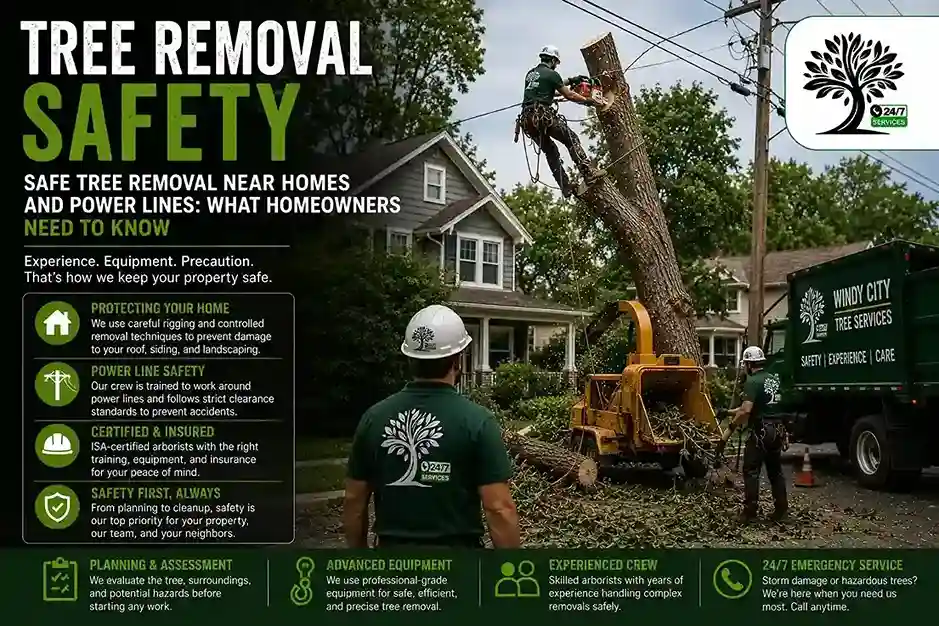
Safe Tree Removal Near Homes and Power Lines: What Homeowners Need to Know
Protect your property while removing hazardous trees safely and professionally.
Request a Free Tree Removal EstimateA tree growing close to your house or brushing against a utility line isn’t automatically dangerous, but the moment it needs to come down, everything about the job changes. Removal near structures and overhead electrical lines requires planning, specialized rigging, and crews trained to work safely in confined, high-risk spaces. Even a perfectly healthy tree becomes a serious hazard once its trunk or canopy interferes with a roof, a fence line, or an energized power line.
This guide walks through exactly how professional arborists assess, plan, and execute safe tree removal near homes and power lines in Chicago, what equipment and techniques they use, and why homeowners should never attempt this work themselves. By the end, you’ll understand the real risks involved, what a professional crew actually does on-site, and how to know when it’s time to call an ISA Certified Arborist.
⚠️ Never Attempt DIY Removal Near Energized Lines
If any part of a tree is touching, or close to, an energized power line, do not touch the tree, use a ladder, or attempt to trim it yourself. Contact your utility company or a qualified tree care company immediately.
How are trees safely removed near homes and power lines?
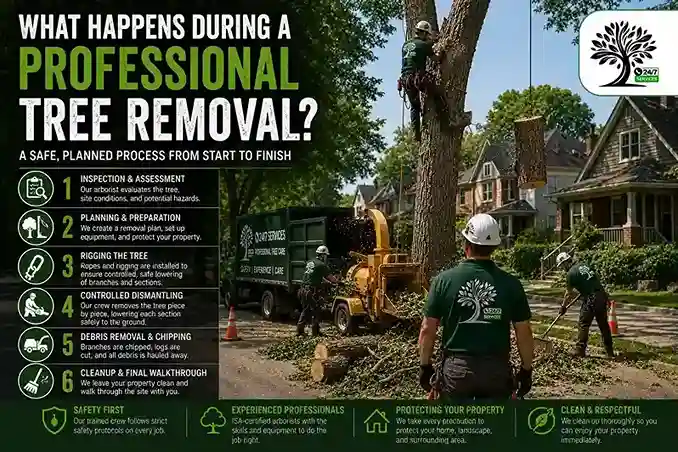
Professional arborists inspect the site, assess electrical and structural hazards, and establish clear safety zones before work begins. They coordinate with the utility company when a tree is near energized lines, then use ropes, rigging, bucket trucks, or cranes to remove the tree in controlled sections rather than felling it whole. The crew lowers each section to a pre-planned drop zone, protects the property throughout, and finishes with a complete cleanup, all while prioritizing worker and public safety at every step.
1. Why Tree Removal Near Homes and Power Lines Is Dangerous
Removing a tree in an open field is straightforward. Removing the same tree three feet from a garage, leaning over a roofline, or tangled in a service drop is a different job entirely. Several factors combine to make this work genuinely hazardous:
Falling Limbs
Even a small branch can cause serious injury or property damage when dropped from height without controlled rigging.
Electrical Hazards
Trees and tree parts conduct electricity. Contact with an energized line can be fatal, even without direct skin contact.
Structural Damage
An uncontrolled section drop can crack a roof, shatter a window, or crush a fence in seconds.
Limited Work Space
Narrow gangways, small yards, and tight setbacks leave little margin for error during rigging and lowering.
Confined Urban Environments
Dense city lots mean neighboring structures, fences, and vehicles are often within striking distance.
Heavy Tree Weight
A single large limb can weigh hundreds of pounds, requiring calculated rigging loads and proper anchor points.
Add in wind movement, which can shift a partially cut section unpredictably mid-drop, and it’s easy to see why tree removal ranks among the more hazardous trades tracked by federal labor statistics. That risk profile is exactly why ANSI Z133, the national safety standard for arboricultural operations, and OSHA’s electrical safety regulations exist, and why this work should always go to trained, insured professionals.
2. Trees Commonly Found Near Homes in Chicago
Certain species show up again and again close to Chicago homes, often because they were planted decades ago without today’s canopy spread in mind. Here’s what we see most often growing over roofs, garages, fences, sidewalks, and utility corridors:
Silver Maple
Fast-growing with weak branch unions, a common cause of storm-related limb failure over roofs.
Oak (Red, White, Bur)
Large, long-lived shade trees that often outgrow their original planting location near a house.
Elm
Mature elms near older homes are frequently at risk from Dutch elm disease and structural decline.
Honey Locust
A popular street and yard tree, generally low-maintenance but still capable of overhanging structures.
Ash
Widespread emerald ash borer damage has left many untreated ash trees structurally unsound near homes.
Cottonwood
Extremely fast growth and brittle wood make cottonwoods a frequent hazard near structures and lines.
Spruce
Dense evergreen canopies near power lines require careful clearance pruning to avoid outages.
Ornamental Trees
Crabapples, ornamental pears, and similar species planted close to entryways and driveways.
Mature canopies on any of these species can extend well beyond the trunk’s original footprint, eventually growing over rooflines, brushing against garages and fences, shading out sidewalks, or reaching into overhead utility corridors. That gradual encroachment is exactly why periodic tree risk assessments matter, even for a tree that looked perfectly fine five years ago.
3. Risks of Trees Growing Near Power Lines
Not all power lines carry the same risk, and understanding the difference helps explain why utility coordination matters so much in this work.
- Service drop lines connect the utility grid to your home and typically carry lower voltage, though they still pose a real shock hazard.
- Primary distribution lines run along the street and carry much higher voltage, the most dangerous line type a tree can contact.
- Secondary lines step voltage down for local distribution but remain energized and hazardous to contact.
When a tree or limb contacts an energized line, the results can include electrical arcing, localized power outages, fire hazards from arcing or overheating, and serious or fatal injury risks to anyone who touches the tree, a wet branch, or even the ground near a downed conductor. The human body conducts electricity efficiently, and a tree limb in contact with a live wire can carry current to anyone touching that limb, even from several feet away in some conditions.
⚠️ Homeowner Rule of Thumb
Never approach, touch, or attempt to trim a tree that is touching or near an energized power line. Contact your electric utility to report the hazard, and call a qualified tree care company to coordinate safe removal. Only trained line-clearance professionals are qualified to work within the minimum approach distances OSHA establishes for energized conductors.
4. Professional Tree Risk Assessment
Before any removal plan gets drawn up, a qualified arborist evaluates the tree using a structured process consistent with ANSI A300 Part 9, the tree care industry’s standard covering tree risk assessment. This isn’t a quick glance from the sidewalk. It’s a methodical look at:
Tree Health
Signs of disease, pest damage, or decline that might weaken the tree’s structure.
Structural Defects
Cracks, cavities, included bark, and co-dominant stems that increase failure risk.
Lean
Whether a lean is long-standing and stable, or new and indicative of root failure.
Root Stability
Signs of root plate lifting, soil heaving, or decay at the root collar.
Decay
Internal decay assessed through sounding, probing, or advanced diagnostic tools where needed.
Clearance From Buildings
How close branches and the trunk are to roofs, walls, and other structures.
Clearance From Utility Lines
Distance from primary, secondary, and service lines, and how fast that clearance is closing.
Access Limitations
Gate widths, fence lines, and yard access that shape what equipment can realistically be used.
This assessment considers the likelihood that a tree or tree part will fail, the likelihood it would strike a person or structure if it did, and the severity of that outcome. Together, those factors determine whether a tree needs monitoring, pruning, structural support, or full removal.
5. Planning the Removal
Once a tree is confirmed for removal, planning starts well before a chainsaw ever gets started. A proper removal plan covers:
Crew Assignments
Every crew member has a defined role, from the climber or bucket operator to ground crew managing rigging lines.
Escape Routes
Clear, unobstructed paths are identified so ground crew can move away quickly during each section drop.
Rigging Plan
Anchor points, rope angles, and load calculations are mapped out to control exactly how each section comes down.
Drop Zones
A designated, cleared area receives each cut section, positioned to avoid structures, vehicles, and landscaping.
Equipment Selection
The crew decides between climbing, bucket truck access, or crane assistance based on site conditions.
Traffic Control
Cones, barriers, and sometimes temporary street closures keep pedestrians and vehicles clear of the work zone.
Weather Conditions
Wind speed and precipitation are checked before and during the job, since conditions can force a work stoppage.
6. Equipment Used
Professional tree removal relies on purpose-built equipment, each piece serving a specific role in keeping the job controlled and safe.
Chainsaws
Sized and maintained for precise, controlled cuts at every stage of sectional dismantling.
Climbing Gear
Harnesses, saddles, and spurs (where appropriate) that let arborists move safely through the canopy.
Ropes & Rigging Systems
Control the direction and speed of every cut section as it’s lowered.
Lowering Devices
Friction devices that manage the speed of a descending section, preventing sudden drops.
Bucket Trucks
Provide stable aerial access for pruning and removal without climbing the tree itself.
Hydraulic Cranes
Lift and place entire tree sections with precision, ideal for large trees or tight-access properties.
Wood Chippers
Process brush and small limbs on-site for efficient cleanup and debris removal.
Stump Grinders
Grind the remaining stump below grade once the tree is down.
Crane-assisted removal becomes the right call when a tree is too large, too close to structures, or too limited in ground access for traditional rigging alone. We cover that decision in more detail in Section 9.
💡 Did You Know?
ANSI Z133 requires a documented job briefing before every tree removal, covering site hazards, crew roles, and emergency procedures, before a single cut is made.
7. How Arborists Protect Homes During Removal
A well-run removal protects everything around the tree, not just the tree itself. Crews plan around:
Roofs & Gutters
Controlled lowering keeps sections from ever swinging toward the roofline.
Windows & Siding
Rigging angles are chosen to direct sections away from the building envelope entirely.
Decks & Driveways
Padding and careful drop zone placement prevent surface damage from falling sections.
Landscaping
Plywood and mats protect lawns, garden beds, and irrigation lines from equipment traffic.
Swimming Pools
Pools are covered or fenced off, and rigging is planned to keep debris well clear of the water.
Fences
Sectional cuts and directional rigging keep weight off fence lines throughout the job.
Controlled rigging and sectional dismantling, cutting the tree into manageable pieces and lowering each one to a chosen spot, rather than felling the whole tree at once, is the core technique that makes all of this possible near a home.
8. Working Around Power Lines
Work near energized lines involves an added layer of coordination and qualification beyond standard tree removal:
- Utility coordination: the utility company may need to de-energize a line or send a representative before work can proceed safely.
- Line-clearance arborists: specially trained professionals who understand the additional qualifications required to work near energized conductors.
- Minimum approach distances: OSHA establishes required clearance distances from energized lines based on voltage, and only qualified personnel may work within them.
- Temporary road closures: sometimes necessary to safely stage equipment and manage drop zones near overhead lines.
- Site safety: barriers and spotters keep the public well clear of any work happening near live electrical infrastructure.
⚠️ This Work Is Not for Homeowners
Only qualified personnel trained in electrical hazard awareness should work within the minimum approach distances OSHA establishes for energized conductors. Homeowners should never attempt to trim, cut, or remove any part of a tree in contact with a power line.
9. Crane-Assisted Tree Removal
Crane-assisted removal isn’t used on every job, but for the right situation, it’s the safest and most efficient option available.
When Cranes Are Used
Large trees, limited backyard access, high-risk lean, or proximity to structures and power lines that make traditional rigging riskier.
Benefits
Precise placement of each section, reduced time working at height, and less reliance on tree-supported rigging.
Safety Improvements
Removes the need to lower heavy sections through the canopy by rope alone, cutting down on unpredictable swing and load stress.
Best For
Very large or hazardous trees, tight urban lots, and removals directly adjacent to homes or utility corridors.
10. Emergency Tree Removal
Storms create situations where waiting for a scheduled appointment isn’t an option. Common emergency scenarios include:
Storm-Damaged Trees
Trees weakened or partially uprooted during high winds or severe thunderstorms.
Trees on Homes
A tree that has already fallen onto a roof, requiring careful, load-aware removal.
Broken Limbs
Hanging or partially attached limbs, sometimes called widowmakers, that can fall without warning.
Trees Touching Power Lines
Situations requiring immediate utility notification before any tree work can safely begin.
Wind Damage
Uprooted or leaning trees after a high-wind event, often with compromised root plates.
Ice Storms
Heavy ice loads that snap limbs and stress weak branch unions throughout the canopy.
Emergency response prioritizes life safety first: securing the site, keeping people away from hazards, and identifying whether power lines are involved, before moving on to stabilizing or removing the tree itself.
11. Chicago-Specific Challenges
Chicago’s neighborhoods add a distinct set of challenges to tree removal near homes and power lines:
Narrow Gangways
Tight side-yard access common in Chicago’s older housing stock limits equipment options.
Historic Homes
Older structures with delicate facades and landscaping require extra care during rigging.
Dense Neighborhoods
Close lot lines mean neighboring properties are often within the work zone’s potential impact radius.
Lake Michigan Winds
Strong, sometimes sudden wind events add unpredictability to canopy work at height.
Mature Urban Canopy
Decades-old trees throughout the city often have significant structural defects that need careful evaluation.
Limited Backyard Access
Many properties have no vehicle access to the backyard, making crane placement and rigging plans critical.
Utility Corridors
Overhead lines running through alleys and along streets intersect with mature canopy throughout the city.
Winter Ice Storms
Seasonal ice accumulation adds sudden, unpredictable load to already stressed limbs.
12. Insurance Considerations
Tree removal near a home carries real financial exposure if something goes wrong, which is why insurance coverage matters as much as technical skill.
Contractor Liability Insurance
Covers property damage that could occur during the job, protecting both the homeowner and the crew.
Workers’ Compensation
Protects crew members if an injury occurs, and protects homeowners from liability for on-site injuries.
Documentation
Photos, written scope of work, and site notes help clarify expectations before work begins.
Estimates
A detailed written estimate should outline the scope, equipment, and cleanup included in the price.
We’re not insurance professionals or attorneys, and every homeowner’s policy and situation differs. Ask any tree service for proof of current liability and workers’ compensation coverage before work begins, and check with your own homeowner’s insurance provider about any coverage questions specific to your property.
13. Preparing Your Property Before Removal Day
A little preparation on your end helps the crew work efficiently and safely:
- Move vehicles away from the driveway, street, and work zone.
- Secure pets indoors or in a separate, enclosed area for the day.
- Notify neighbors if the job may affect shared fence lines or access.
- Clear access routes to the backyard or work area of obstacles.
- Protect outdoor furniture, grills, and planters near the drop zone.
- Keep children away from the work zone at all times during active removal.
14. Common Mistakes Homeowners Make
DIY Removal
Attempting removal without training or equipment is one of the leading causes of serious tree-work injuries.
Ladder Use
Climbing a ladder to reach limbs is unstable and dangerous, especially near a roofline or power line.
Improper Pruning
Topping or over-pruning weakens a tree’s structure and often creates a bigger hazard later.
Working Near Electrical Lines
Any contact between a person, tool, or tree limb and an energized line can be fatal.
Hiring Uninsured Contractors
An uninsured crew leaves homeowners exposed to liability if something goes wrong.
Ignoring Warning Signs
Cracks, sudden lean, or dead limbs are signals that a professional assessment shouldn’t wait.
15. Choosing the Right Tree Removal Company
Not every tree service is equipped to handle removal near homes and power lines. Look for:
DIY vs. Professional Tree Removal
| Feature | DIY | Professional Arborist |
|---|---|---|
| Safety | High risk of serious injury or worse | Trained crews follow ANSI Z133 safety protocols |
| Equipment | Limited to consumer-grade tools | Professional rigging, cranes, and bucket trucks |
| Insurance | Homeowner bears all liability | Contractor liability and workers’ comp coverage |
| Property Protection | Uncontrolled drops risk major damage | Controlled rigging protects structures |
| Risk | Very high, especially near power lines | Managed through training and planning |
| Efficiency | Slow, often incomplete | Planned, section-by-section execution |
Traditional vs. Crane-Assisted Removal Near Homes
| Feature | Traditional Rigging | Crane-Assisted |
|---|---|---|
| Tight Spaces | Workable with careful rigging | Excellent, especially with limited ground access |
| Large Trees | Possible but slower and higher effort | Efficient for very large or heavy sections |
| Property Protection | Good with skilled rigging | Excellent, precise section placement |
| Equipment Needed | Ropes, saddles, rigging blocks | Hydraulic crane plus rigging crew |
| Best Use Cases | Moderate-sized trees with reasonable access | Large, hazardous, or hard-to-access trees near structures |
Homeowner Safety Checklist Before Tree Removal Begins
- Confirm the company’s current liability and workers’ compensation insurance.
- Request a detailed written estimate covering scope and cleanup.
- Discuss cleanup expectations, including debris and stump handling.
- Identify nearby utility lines and confirm the crew’s plan for them.
- Keep family, pets, and neighbors clear of the work zone.
- Verify emergency contact information for the crew on-site.
Visual Guides Worth Creating
📍 Tree Removal Safety Zones
An overhead diagram showing the drop zone, exclusion zone, and equipment staging area around a home.
⚡ Power Line Clearance Illustration
A side-view graphic showing service drops, secondary, and primary lines with relative clearance requirements.
🪜 Step-by-Step Removal Process
A numbered visual walkthrough from assessment to final cleanup.
🪢 Rigging System Diagram
An illustration of anchor points, rope angles, and a lowering device in action.
🏗️ Crane Removal Workflow
A flowchart from site assessment through crane placement, lift, and section removal.
🛡️ Property Protection Techniques
A visual comparing padded surfaces, directional rigging, and drop zone placement around a home.
Frequently Asked Questions
Can I remove a tree touching power lines myself?
No. Any tree touching or near an energized power line should only be handled by the utility company or a qualified line-clearance professional. Contact between a person, tool, or tree part and a live line can be fatal.
Who is responsible for trees near utility lines?
Responsibility can depend on whether the tree is on private property or a public parkway, and which portion of the line is involved. Your utility company can clarify jurisdiction, and a qualified tree service can coordinate with them directly.
Is crane-assisted removal safer than traditional rigging?
For large trees, hazardous leans, or tight-access properties, cranes often reduce risk by precisely placing sections instead of relying solely on rope-based lowering.
Can branches damage my roof if not removed properly?
Yes. Overhanging limbs can scrape shingles, clog gutters, and cause serious damage if a section falls uncontrolled during removal or a storm.
Do arborists coordinate with utility companies?
Yes, especially when a tree is near primary or secondary lines. Coordination may involve de-energizing a line or having a utility representative present during the work.
How close can a tree safely be to my house?
There’s no single safe distance for every species and tree size. A professional risk assessment considers the specific tree’s height, health, lean, and structure relative to your home.
Should I remove a leaning tree?
Not automatically. Some leans are old and stable, while others indicate active root failure. An arborist can determine which situation you’re dealing with.
What happens if a tree falls unexpectedly during removal?
This is exactly why planning, rigging, and escape routes matter so much. Professional crews plan for controlled, predictable section drops specifically to prevent this outcome.
Is emergency tree removal available in Chicago?
Yes, our crews respond to storm damage, trees on homes, and trees interfering with power lines across the Chicago area.
Will my landscaping be protected during removal?
Reputable crews use padding, mats, and careful drop zone planning to minimize impact on lawns, garden beds, and hardscaping.
Do I need a permit to remove a tree in Chicago?
Requirements vary depending on whether the tree is on a public parkway or private property. Check with the City of Chicago or ask your tree service to confirm before work begins.
What is a tree risk assessment?
A structured evaluation, consistent with ANSI A300 Part 9, that examines a tree’s health, structural defects, and the likelihood it could fail and impact a person or structure.
How long does tree removal near a house typically take?
It depends on the tree’s size, access, and whether utility coordination is needed. Larger or more complex removals near structures generally take longer than open-yard removals.
Can a dead or dying tree near power lines wait until spring?
Dead trees near power lines carry ongoing risk regardless of season. A prompt professional assessment is the safest way to determine urgency.
What is ANSI Z133?
ANSI Z133 is the national safety standard covering arboricultural operations, including electrical hazard awareness, equipment use, and job-site safety procedures.
Does homeowner’s insurance cover tree removal?
Coverage varies by policy and circumstances. Check directly with your insurance provider, since we can’t make coverage guarantees.
What should I look for in a tree removal company?
ISA Certified Arborists on staff, proof of insurance, positive reviews, written estimates, and clear communication about safety practices near structures and power lines.
Can storm damage make a healthy tree suddenly hazardous?
Yes. Wind, ice, and heavy rain can crack limbs or destabilize roots even in a previously healthy tree, which is why post-storm inspections matter.
Do arborists remove the stump too?
Stump removal is typically a separate service. Ask your tree company whether stump grinding is included or needs to be scheduled separately.
How do I know if a tree needs to come down versus just trimming?
A professional risk assessment weighs the tree’s health, structural condition, and proximity to targets like your home to recommend pruning, support systems, or removal.
Explore More From Windy City Tree Services
Windy City Tree Services is Chicago’s trusted Chicago tree service, staffed by Certified Arborists delivering professional tree care across the city. Learn more about our tree removal services, emergency tree removal, tree trimming and pruning, tree cabling and bracing, tree health inspection, stump grinding, air spade root excavation, commercial tree service, storm prep and support systems, and land clearing.