Why Immediate Tree Removal Matters: Protecting Your Home, Family, and Property After Tree Damage
Some tree problems can wait for a convenient afternoon. Others can’t wait an hour. Knowing the difference is one of the most important, and most overlooked, parts of tree ownership.
A damaged tree doesn’t always announce itself clearly. A split trunk might look stable enough to leave until next week. A leaning tree might have been leaning for years, or it might have started leaning yesterday. Telling those situations apart, safely, from the ground, without professional training, is genuinely difficult.
This guide walks through when immediate tree removal actually matters, the real risks of waiting, and how ISA Certified Arborists decide whether a tree needs to come down right away or can be safely managed on a normal schedule. The goal isn’t to make every damaged tree sound like an emergency. It’s to help you recognize the ones that actually are.
Why is immediate tree removal important? Immediate removal may be necessary when a tree presents an immediate risk to people or property due to storm damage, structural failure, severe leaning, root instability, extensive decay, or contact with structures or utility lines. Prompt professional assessment reduces the risk of further damage and supports safer property management. Only an on-site inspection can confirm whether a specific tree requires urgent action.
1. What Is Immediate Tree Removal?
Immediate tree removal refers to urgent, often same-day, removal of a tree that poses a direct, active threat to people or property. This is different from routine removal, which is scheduled maintenance for a tree that’s declining, unwanted, or in the way of a project, with no urgent timeline attached.
The distinction comes down to hazard mitigation and public safety. A tree qualifies as an emergency when structural instability, active failure, or contact with a structure or utility line means every additional hour of delay adds real risk. Determining that status accurately requires a professional, on-site evaluation. It’s not something that can be reliably assessed from a photo or a phone call alone.
2. Signs a Tree Should Be Removed Immediately
Some tree conditions cross the line from “worth watching” to “needs action now.” Watch for:
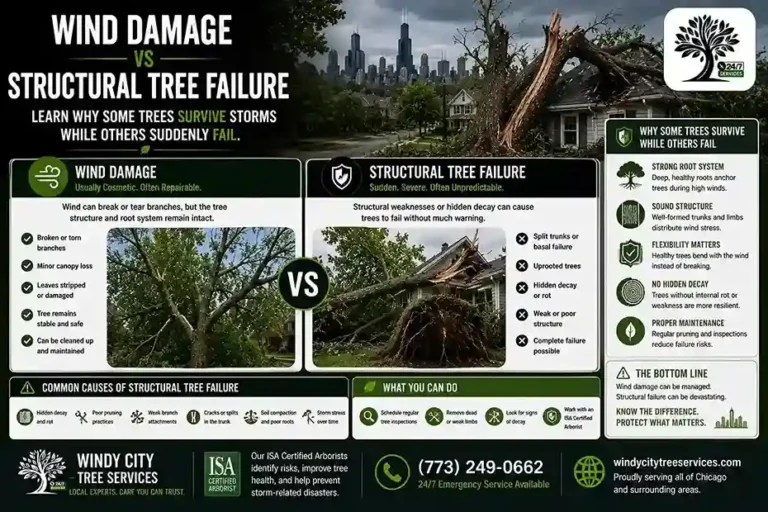
- Split trunks. A trunk that’s visibly split or cracked has lost significant structural integrity and can fail with little additional force.
- Large trunk cracks. Even without a full split, a deep crack running vertically through the trunk is a serious structural warning sign.
- Sudden lean. A tree that has newly started leaning, especially after a storm, may have compromised roots and be at risk of falling.
- Root plate lifting. Soil cracking or heaving around the base is often a sign the root system is failing to anchor the tree.
- Hanging limbs. Large broken branches caught in the canopy, sometimes called widow makers, can fall without warning.
- Extensive decay. Large cavities or soft, crumbling wood can mean a tree no longer has the structural strength to stand safely.
- Trees resting on structures. A tree already leaning or resting on a roof, garage, or fence is an active, ongoing hazard, not a one-time event.
- Trees contacting power lines. This is an electrical hazard in addition to a structural one, and requires immediate utility coordination.
- Lightning damage. A recent strike can cause hidden internal damage that compromises structural integrity even when the tree looks intact.
- Storm failures generally. Any storm-damaged tree with visible structural compromise should be professionally evaluated promptly.
3. Risks of Delaying Tree Removal
Waiting on a genuinely hazardous tree rarely makes the situation better. The risks tend to compound the longer a hazard sits unaddressed:
- Personal injury. The most serious risk, and the reason emergency response prioritizes safety above everything else.
- Property damage. A tree that’s already partially failed can shift or fall further, expanding the damage well beyond its initial position.
- Vehicle damage. A tree hanging over a driveway or street remains a risk to any vehicle parked or passing beneath it.
- Utility interruptions. Trees in contact with power lines can cause outages, and continued contact increases fire and electrocution risk.
- Liability concerns. A known hazard that isn’t addressed can create legal exposure if it eventually causes injury or damage.
- Increased cleanup complexity. A tree that fails further while waiting is often more complicated, and more expensive, to remove than if it had been addressed promptly.
- Progressive structural failure. Some defects worsen over time rather than staying static, meaning a “wait and see” tree can become a genuine emergency without further storm activity.
Every situation is unique, and not every damaged tree needs same-day removal. But when in doubt, a prompt professional evaluation costs far less than guessing wrong.
4. Common Emergency Situations in Chicago
Chicago’s weather creates a fairly predictable set of conditions that trigger emergency tree situations throughout the year:
- Severe thunderstorms. Fast-developing storms with intense rainfall and wind gusts are common in the warmer months.
- Straight-line winds. Powerful, fast-moving wind events, tracked by the National Weather Service (NWS), can cause damage comparable to more dramatic storm types.
- Tornadoes. Less frequent but a genuine risk in the broader Chicago region during severe weather season.
- Heavy snow. Wet, heavy snow adds substantial weight loading to branches, especially early or late in the season when trees still have leaves.
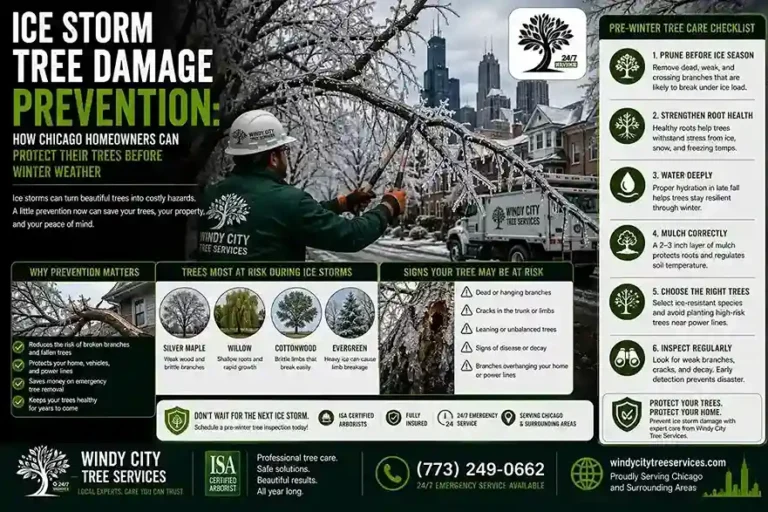
- Ice storms. Ice accumulation adds weight and brittleness simultaneously, a particularly damaging combination.
- Flooding. Saturated soil reduces root anchoring, increasing the risk of uprooting even in moderate wind.
- Lightning. Direct strikes cause immediate damage, and sometimes hidden internal injury that surfaces later.
This combination of weather types, more varied than many regions see, is part of why Chicago homeowners benefit from knowing the warning signs covered in this guide year-round, not just during one storm season.
5. How ISA Certified Arborists Assess Immediate Risk
Professional risk assessment follows a structured process rather than a quick visual guess. Arborists trained under the ISA’s Tree Risk Assessment Qualification (TRAQ) framework evaluate several categories systematically:
- Root inspection. Checking for heaving soil, exposed or damaged roots, and signs of decay at the root flare.
- Trunk evaluation. Looking for cracks, cavities, decay, and included bark at major unions.
- Canopy inspection. Identifying dead limbs, storm damage, and structural imbalance in the crown.
- Structural defects. Assessing how existing defects interact with the tree’s overall load-bearing capacity.
- Site hazards. Considering slope, soil conditions, and exposure that could affect the tree’s stability.
- Targets. Identifying what’s within striking distance if the tree or a section of it fails, homes, sidewalks, vehicles, power lines, or people.
This combination of tree condition and target exposure is what actually determines urgency. A significantly compromised tree in a remote corner of a large property carries different risk than a moderately compromised tree hanging directly over a bedroom window.
6. Trees Near Homes and Buildings
Proximity to a structure changes the stakes considerably. A tree that fails near a home can cause:
- Roof damage, from punctures to complete structural collapse depending on the tree’s size and the force of impact
- Broken windows, a common secondary damage point even from smaller branch failures
- Chimney damage, particularly vulnerable to falling limbs due to its exposed position
- Garage damage, often less structurally reinforced than the main house
- Fence and deck damage, lower-cost individually but common in storm claims
A tree already leaning toward or resting on any of these structures should be treated as an active hazard warranting prompt professional evaluation, not something to monitor casually over the following weeks.
7. Trees Near Power Lines
Trees in contact with power lines combine two hazard types at once: falling debris and electrocution risk. The Occupational Safety and Health Administration (OSHA) treats tree work near power lines as specialized, high-hazard work for a reason. Even branches that aren’t directly touching a line can arc electricity across a gap under the right conditions.
Never attempt to remove or trim a tree that’s touching an energized power line yourself. Stay well clear of the tree and the surrounding area, and contact the utility company (ComEd in the Chicago area) immediately. Only after the utility confirms the line is de-energized or the tree is clear should removal proceed, and that removal should always go to a licensed, insured professional.
Emergency response for power-line-related tree hazards typically requires coordination between the utility company and the tree service, since each handles a different part of the hazard.
8. Emergency Tree Removal Process
Step 1: Site Safety
Securing the work zone with barriers, cones, or caution tape, and confirming there are no active electrical hazards before work begins.
Step 2: Hazard Assessment
A trained arborist evaluates the tree’s condition, remaining structural integrity, and the safest approach for removal.
Step 3: Equipment Selection
Choosing the right tools for the job, climbing gear, rigging, or a crane for larger or more complex removals.
Step 4: Controlled Dismantling
Removing the tree in carefully planned sections rather than allowing it to fall uncontrolled, particularly important near structures.
Step 5: Debris Removal
Clearing branches, trunk sections, and other material from the property.
Step 6: Stump Options
Discussing whether stump grinding or removal is wanted as part of the job or a separate future step.
Step 7: Final Safety Inspection
Confirming the site is clear, safe, and any nearby trees or structures haven’t been affected during the removal.
9. Can the Tree Be Saved Instead?
Not every damaged tree needs to come down. Part of a proper professional evaluation is determining whether preservation is a realistic, safe option. Depending on the specific damage, an arborist may recommend:
- Structural pruning to remove compromised sections while preserving the rest of the tree
- Cabling and bracing to physically support a weak union or split trunk
- Crown reduction to reduce wind load on a structurally compromised but salvageable tree
- Monitoring for trees with moderate damage where immediate removal isn’t clearly necessary
- Disease treatment when the underlying issue is pathogen-related rather than purely structural
This is exactly why a professional assessment matters more than guessing based on appearance. A tree that looks alarming might be salvageable, and a tree that looks fine might not be. Only an on-site evaluation from a qualified arborist can make that call reliably.
10. Insurance Considerations
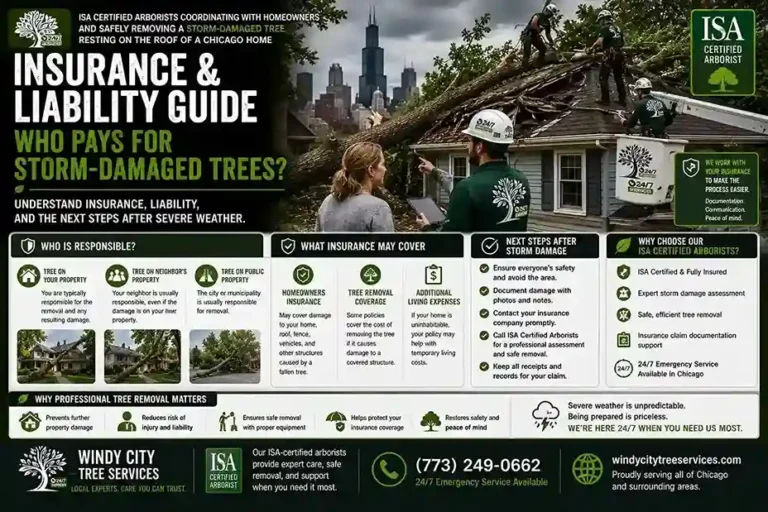
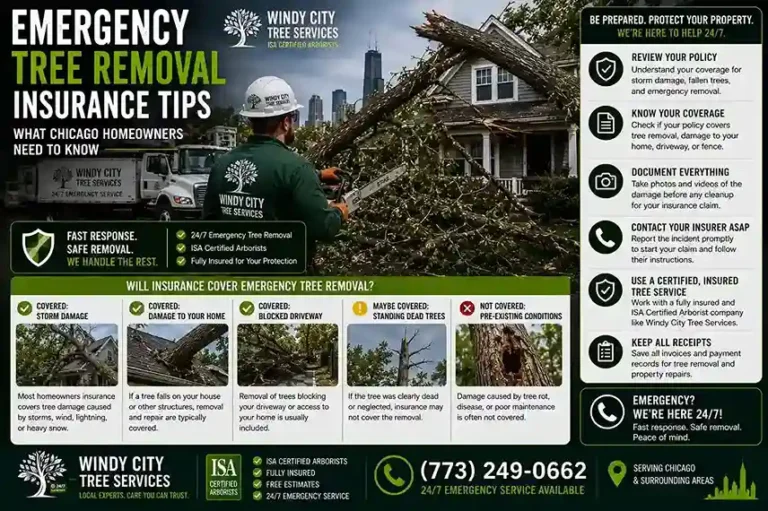
Emergency tree removal costs may be covered under your homeowners insurance policy, particularly when the tree has damaged, or is actively threatening, an insured structure. Coverage specifics vary significantly by policy, so this is general guidance, not a guarantee for your situation.
Documentation supports the process regardless of outcome:
- Photos and video of the hazard and any resulting damage
- A written estimate for the removal work
- An arborist report documenting the tree’s condition and the reason removal was necessary
- Direct communication with your insurer about coverage specifics for your policy
For a deeper look at how insurance and liability typically work for storm-damaged trees, see our guide on who pays for storm-damaged trees.
11. Preventing Emergency Tree Removal
Most emergencies have a history behind them, a defect that existed long before the storm that finally exposed it. Preventive practices that reduce the odds of a future emergency:
- Annual inspections to catch developing problems while they’re still manageable
- Structural pruning following ANSI A300 standards to correct weak growth patterns early
- Crown cleaning to remove dead wood before it becomes a falling hazard
- Tree health care to keep trees resilient against disease and stress
- Root protection during any nearby construction or grading work
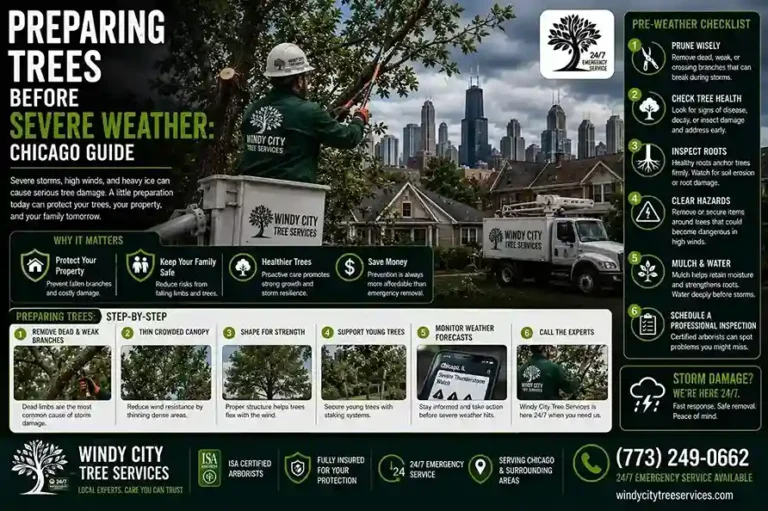
- Storm preparation services focused specifically on wind and load resistance
- Cabling and bracing for large, valuable trees with existing structural weaknesses worth preserving
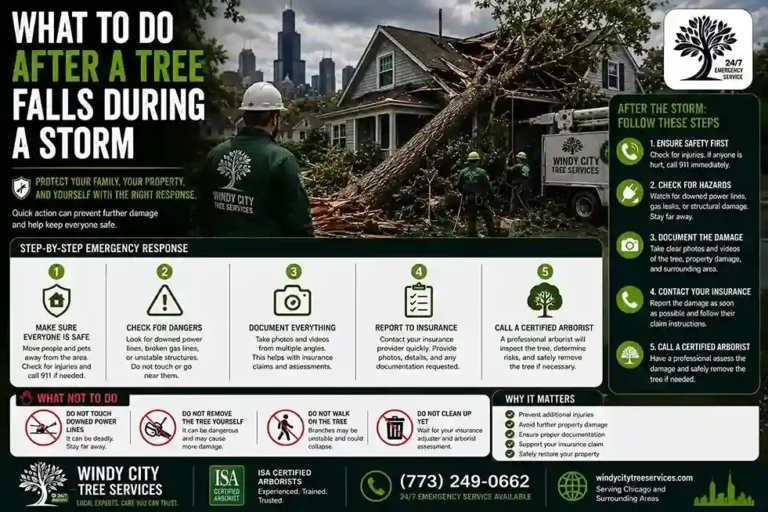
12. What Homeowners Should Do Before Help Arrives
- Stay away from damaged or unstable trees, even if they look like they’ve stopped moving.
- Keep children and pets indoors and away from the affected area.
- Avoid power lines completely, including any branches touching or near them.
- Photograph the damage if it’s safe to do so, without approaching the hazard.
- Secure the area with cones, tape, or a barrier if you can do so without getting close to the tree.
- Contact emergency tree professionals promptly rather than waiting to see what happens.
Tree Condition vs. Recommended Professional Response
These are general patterns. Actual recommendations always depend on an on-site professional inspection.
| Tree Condition | Possible Recommendation |
|---|---|
| Hanging limb | Prompt removal of the specific hazard limb |
| Leaning tree (new or worsening) | Urgent evaluation; may require removal or stabilization |
| Split trunk | Often removal, depending on severity and location |
| Root failure | Urgent evaluation; frequently removal due to anchoring loss |
| Lightning damage | Evaluation for hidden internal damage before deciding |
| Dead tree | Removal, timeline depends on proximity to targets |
| Tree on structure | Immediate professional response |
Emergency vs. Routine Tree Removal
| Emergency Removal | Routine Removal |
|---|---|
| Immediate hazard | Planned maintenance |
| Storm damage | Declining health over time |
| Public safety concerns | Landscape improvement goals |
| Time-sensitive response | Flexible scheduling |
Immediate Tree Hazard Checklist
- Stay away from unstable or visibly damaged trees.
- Never climb a damaged tree, even to inspect it more closely.
- Watch for hanging branches that could fall without warning.
- Stay clear of any tree touching or near utility lines.
- Take photos if it’s safe to do so from a distance.
- Contact an ISA Certified Arborist for a professional assessment.
- Notify your insurance company if the situation may involve a claim.
- Schedule inspections for any nearby trees that may have also been stressed by the same event.
Frequently Asked Questions
When should a tree be removed immediately?
When it shows signs like a split trunk, sudden lean, root plate lifting, large hanging limbs, or contact with a structure or power line. A professional on-site evaluation confirms whether urgent removal is actually needed.
What makes a tree hazardous?
A combination of structural condition (decay, cracks, root damage) and target exposure (what’s nearby that could be damaged if it fails) determines hazard level.
Can a leaning tree suddenly fall?
Yes, particularly if the lean is new or worsening, which often indicates root failure. A long-standing, stable lean is a different situation than a sudden one.
Should I remove a tree after lightning strikes it?
Have it evaluated by a certified arborist, even if it looks fine. Lightning can cause hidden internal damage that leads to gradual decline or unexpected failure later.
Can emergency tree removal wait until morning?
It depends on the specific hazard. Active threats to people, structures, or power lines generally shouldn’t wait. Less urgent situations may be safely secured and addressed the next day. When uncertain, call for a professional opinion.
What if a tree falls on my house?
Ensure everyone’s safety, stay away from the affected area, and contact both your insurer and a licensed emergency tree service. Avoid entering rooms directly under the damaged section until it’s been assessed.
Do arborists inspect roots as part of a risk assessment?
Yes. Root inspection, including checking for heaving soil and signs of decay near the root flare, is a standard part of a thorough tree risk assessment.
What happens during emergency tree removal?
The process typically includes securing the site, assessing the hazard, selecting the right equipment, removing the tree in controlled sections, clearing debris, and a final safety inspection.
Does homeowners insurance cover emergency tree removal?
Often, particularly when the tree has damaged or is actively threatening an insured structure. Coverage specifics vary by policy, so confirm with your insurer directly.
Can storm-damaged trees recover?
Some can, especially with moderate damage and proper follow-up pruning. Trees with major structural failure, like a split trunk or significant root loss, are less likely to be safely preserved.
Is it safe to remove a hanging branch myself?
Generally not recommended, especially for large branches or anything requiring a ladder or overhead cutting. This is a common source of DIY tree work injuries.
How quickly can an emergency tree service respond?
Response times vary based on the severity of the situation, current demand during widespread storm events, and location. Genuine emergencies are typically prioritized.
What’s the difference between a hazardous tree and an unattractive tree?
A hazardous tree has a structural or health issue that creates real risk of failure. An unattractive tree may simply need cosmetic pruning with no safety concern involved.
Should I try to move debris myself after a tree falls?
Only if it’s clearly safe and unrelated to the hazard itself. Avoid moving anything near a still-unstable tree or anything that could be under tension.
Can a dead tree be saved instead of removed?
No, once a tree is fully dead, removal is generally the only option, since dead wood only becomes more brittle and hazardous over time. Prompt removal is usually recommended.
What should I do if I see a downed power line near a tree?
Stay far away, treat it as energized regardless of appearance, and contact the utility company immediately. Never attempt to move the tree or the line yourself.
How much does emergency tree removal typically cost?
Costs vary by tree size, damage severity, and accessibility. A licensed provider can give you a specific estimate, which also serves as useful documentation for insurance purposes.
Why does target proximity matter in a risk assessment?
A tree’s actual risk depends on both its condition and what’s within range if it fails. The same defect carries very different urgency depending on whether it’s near a home or in an open field.
Can neighboring trees be affected by the same storm event?
Yes. It’s common for multiple trees on a property to be stressed by the same storm, which is why inspecting nearby trees after an emergency removal is a good practice.
Who decides whether a tree needs immediate removal?
A qualified, on-site professional, typically an ISA Certified Arborist using structured risk assessment principles, makes that determination based on the tree’s condition and surrounding hazards.
Key Takeaways
- Not every damaged tree is an emergency, but several specific warning signs, split trunks, sudden leaning, root lifting, and contact with structures or power lines, do warrant urgent attention.
- Delaying action on a genuine hazard tends to increase risk, not reduce it, as conditions can worsen even without another storm.
- Only a qualified, on-site assessment can reliably determine whether a specific tree needs immediate removal or can be preserved.
- Trees near power lines are never a DIY situation. Stay away and contact the utility company immediately.
- Prevention through regular inspections and structural pruning reduces how often emergencies happen in the first place.
Sources & Further Reading
- International Society of Arboriculture (ISA), Best Management Practices & TRAQ
- ANSI A300 Tree Care Standards
- Occupational Safety and Health Administration (OSHA), Tree Care Safety
- National Weather Service (NWS)
- The Morton Arboretum, Tree & Plant Advice
This article is provided for general educational purposes. Only a qualified, on-site professional inspection can determine whether a specific tree requires immediate removal.