Crown Cleaning, Raising & Reduction Explained | Chicago IL
Crown Cleaning, Crown Raising, and Crown Reduction Explained: A Complete Guide for Chicago Homeowners
Learn which pruning technique is right for your trees, straight from ISA Certified Arborists who prune according to ANSI A300 standards every day across Chicago.
Not all tree pruning is the same. A certified arborist chooses between several distinct pruning methods depending on a tree’s health, its structure, the clearance a property needs, and the long-term goals for that specific tree. Three of the most common methods, crown cleaning, crown raising, and crown reduction, get confused constantly, and that confusion leads homeowners to request the wrong service or, worse, ask for something like topping that can permanently damage a healthy tree.
This guide breaks down exactly what each technique involves, when a professional arborist recommends it, and how it benefits both the tree and the property around it. By the end, you will know which pruning conversation to have the next time you call a tree service, and why the answer is rarely as simple as “just trim it back.”
What is the difference between crown cleaning, crown raising, and crown reduction?
Crown cleaning removes dead, diseased, broken, or weak branches to improve tree health and safety. Crown raising removes lower branches to increase clearance for pedestrians, vehicles, buildings, or visibility. Crown reduction decreases the overall height or spread of the canopy by selectively shortening branches while preserving the tree’s natural structure and health.
Understanding Tree Crowns
A tree’s crown is the entire mass of branches, twigs, and leaves that grows above the trunk. It is where photosynthesis happens, where the tree produces the sugars it needs to grow, defend itself, and heal wounds. Everything an arborist does to a crown affects the tree’s ability to feed itself, which is why pruning decisions are never just cosmetic.
Branches attach to the trunk and to each other in a hierarchy. Large scaffold branches grow directly from the trunk and form the tree’s basic structure, while smaller lateral branches grow from those scaffolds, and twigs grow from the laterals. A tree’s crown develops this branching pattern over decades, and the way branches are spaced and attached determines how strong the structure will be as the tree matures.
Basic tree crown anatomy: scaffold branches form the structure, laterals branch off scaffolds, and the branch collar is where proper pruning cuts are made.
💡 Did You Know?
The branch collar, the slightly swollen ring of tissue where a branch meets the trunk, contains the cells a tree uses to seal off a pruning wound. Cutting into or removing the collar (a “flush cut”) destroys that natural defense and leaves a wound the tree cannot close properly.
What Is Crown Cleaning?
Crown cleaning is the selective removal of dead, dying, diseased, broken, and weak or crossing branches from a tree’s canopy. It does not change the tree’s overall size or shape. Instead, it removes the parts of the crown that no longer contribute to the tree’s health and that pose the greatest risk of failure.
A typical crown cleaning visit addresses several categories of problem branches. Deadwood, meaning branches that have already died, gets removed because dead wood decays and eventually falls regardless of weather. Broken branches from a past storm are cut back to a healthy union before decay can spread into the trunk. Diseased branches are removed to slow the spread of infection to healthy wood nearby, and branches that rub or cross against each other are thinned out, since that constant friction wears away bark and creates entry points for pests and pathogens.
The benefits go beyond appearance. A cleaned crown carries less dead weight, which means fewer branches are likely to snap during high wind, heavy snow, or ice. Removing diseased tissue slows the progression of infections like oak wilt or fungal decay. Over time, regular crown cleaning extends a tree’s functional lifespan by keeping its energy focused on healthy growth instead of supporting branches that are already in decline.
What Is Crown Raising?
Crown raising removes the lowest branches in a tree’s canopy to create clearance underneath. It is the pruning method used any time a tree’s lower limbs are in the way, whether that means blocking a sidewalk, hanging over a driveway, scraping the roof of a passing truck, or crowding a building’s entrance.
Common clearance targets include pedestrian pathways, where branches need to sit high enough that people can walk underneath without ducking, and streets or driveways, where clearance has to account for the height of trucks and delivery vehicles, not just passenger cars. Crown raising near buildings prevents branches from rubbing against siding, gutters, or roofing, and raising a crown along a sightline, such as a street corner or a stop sign, is often requested specifically to improve visibility and safety for drivers.
Arborists follow general clearance guidance when raising a crown rather than pruning to an arbitrary height. Most residential sidewalk clearance targets roughly eight feet, while clearance over streets typically needs to be higher to accommodate vehicles. Crown raising should always be done gradually and proportionally. Removing too many lower branches at once, especially on a young tree, can leave the canopy top-heavy and reduce the leaf area the tree needs to grow strong.
What Is Crown Reduction?
Crown reduction decreases a tree’s overall height or spread by cutting selected branches back to a lateral branch large enough to take over as the new terminal growth point. Done correctly, the tree keeps its natural branching pattern and rounded silhouette, just at a smaller overall size.
Arborists use crown reduction to address several specific problems. Reducing the length of a long, heavy limb decreases end weight, which lowers the chance that limb will fail under its own weight or under snow load. Reducing overall canopy height or spread can bring a tree back into scale with a property when it has grown into utility lines, a roofline, or a neighboring tree. Reduction cuts also lower a tree’s wind resistance, since a smaller sail area means less force acting on the branch during a storm.
The technique that separates a proper reduction cut from a damaging one comes down to where the cut lands. A correct reduction cut removes a branch back to a lateral that is large enough, generally at least one-third the diameter of the branch being removed, to physiologically take over as the new leader. This keeps the tree’s hormonal growth signals intact and allows it to heal the wound naturally, without the surge of weak regrowth that comes from cutting into a branch with no living lateral to redirect growth.
Crown Reduction vs. Tree Topping
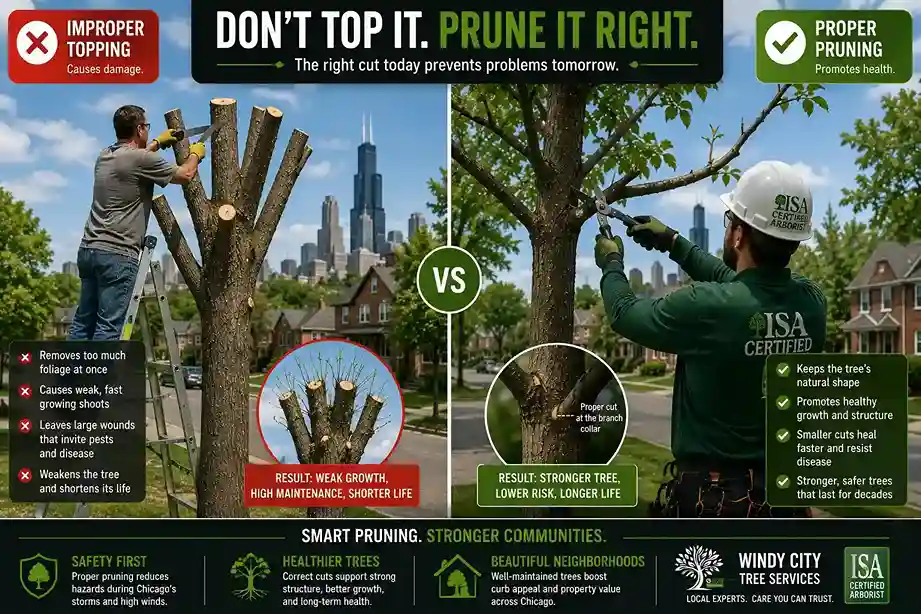
Crown reduction and tree topping can look similar to an untrained eye since both reduce a tree’s size, but they are fundamentally different practices with very different outcomes. Crown reduction is a recognized ANSI A300 pruning method. Topping is not, and it is explicitly discouraged by the International Society of Arboriculture and by ANSI A300 itself.
Topping cuts branches or the main trunk back to stubs or arbitrary points with no regard for the tree’s natural branching structure. Because the tree has no living lateral branch to redirect its growth, it responds by producing a dense cluster of weakly attached shoots, commonly called water sprouts, just below each cut. These sprouts grow rapidly but attach only to the outer layers of wood rather than growing from deep within the branch, which makes them far more prone to breaking in wind or ice than a naturally formed branch.
Topping cuts also create large, exposed wounds in the middle of a limb rather than at a branch collar, and a tree has no natural mechanism to seal a wound in that location. That open wound becomes a long-term entry point for decay fungi and boring insects, and the resulting internal rot can compromise the tree’s structural stability for the rest of its life. A topped tree often ends up taller and more hazardous within just a few years, the opposite of what most homeowners are trying to achieve.
Crown reduction preserves natural form and branch collars, while topping leaves stub cuts that trigger weak, decay-prone regrowth.
| Feature | Crown Reduction | Tree Topping |
|---|---|---|
| ANSI A300 Compliant | Yes | No |
| Effect on Tree Health | Preserves health when done correctly | Weakens the tree, often long term |
| Regrowth Pattern | Slower, structurally sound growth from a living lateral | Fast, weakly attached water sprouts |
| Appearance | Natural, rounded silhouette | Disfigured, stub-like, “broom” shape |
| Structural Integrity | Maintained | Compromised by decay and weak unions |
| Long-Term Results | Tree remains healthy and manageable | Tree often becomes taller and more hazardous within years |
When Arborists Recommend Crown Cleaning
Crown cleaning is usually the first thing an arborist recommends, since a clean crown is the baseline for evaluating everything else a tree needs. It is the right call whenever deadwood has accumulated in the canopy, which happens naturally as a tree matures and its lower or interior branches lose access to sunlight.
Storm damage is another common trigger. A tree that has lost limbs to wind or ice often has torn bark and broken branch ends that need clean cuts to heal properly. Signs of disease, such as oak wilt symptoms in an oak tree or fungal cankers on a maple, call for prompt crown cleaning to remove infected material and slow the spread. Pest damage, including branches weakened by boring insects, follows the same logic.
Beyond addressing an active problem, crown cleaning is also a core part of preventive maintenance for mature trees. A property owner who schedules routine crown cleaning every few years catches deadwood and minor issues early, long before they become the kind of hazard that requires emergency response after a storm.
When Crown Raising Is Appropriate
Crown raising comes up constantly in dense urban settings like Chicago, where trees, sidewalks, driveways, and roads all compete for the same narrow strip of space. Any time low branches interfere with pedestrians on a sidewalk or block a driveway, crown raising restores safe clearance without removing the tree’s upper canopy.
Roads present a related but distinct clearance need, since delivery trucks, buses, and emergency vehicles all require more overhead room than passenger cars. Buildings benefit from crown raising when branches are close enough to scrape siding or clog gutters during wind. Utility companies request crown raising, sometimes combined with more aggressive clearance pruning, to keep branches away from service lines. Parks and commercial properties often schedule crown raising across multiple trees at once as part of a broader maintenance plan focused on public safety and clear sightlines.
When Crown Reduction Is Necessary
Crown reduction becomes necessary when a tree has outgrown the space available to it. A mature shade tree growing directly against a home’s roofline or siding is a common example, where a full reduction on the side facing the structure relieves pressure without removing the whole tree.
Utility conflicts are another frequent trigger, particularly for trees planted decades ago in a narrow parkway strip that has since grown into overhead lines. Trees in highly exposed, windy locations, such as an open lot near the lakefront, often benefit from reduction to lower their wind resistance and the leverage a storm can exert on long limbs. Mature and historic trees sometimes need reduction simply to manage their scale over time, keeping a valued heritage tree healthy and structurally sound rather than letting it grow into a liability. Space limitations on smaller urban lots round out the list, where a reduction can keep a tree in scale with its surroundings for years longer than the property would otherwise allow.
Chicago Tree Care Considerations
Local growing conditions shape which pruning technique makes sense and when to schedule it. Chicago’s exposure to high winds off Lake Michigan means trees with excess end weight or dense, unbalanced canopies face real risk during a storm, which is exactly the kind of problem crown reduction and crown cleaning are designed to address.
Heavy snowfall and ice accumulation add significant load to branches every winter, and deadwood or weakly attached limbs are the first to fail under that added weight. Summer heat and the drought stress that sometimes follows it can weaken a tree’s overall vigor, which is worth factoring into how aggressively a tree can tolerate pruning in a given year.
Chicago’s dense neighborhoods and narrow planting strips create constant clearance pressure, which is why crown raising is one of the most frequently requested services citywide. Historic districts add another layer of consideration, since heritage trees on landmark properties often call for a more conservative, preservation-focused pruning plan rather than aggressive reduction. Salt exposure along heavily treated streets and sidewalks in winter can stress root systems and lower branches near the ground, another reason routine health inspections matter as much as the pruning itself.
Which Chicago Tree Species Commonly Need These Services?
Different species respond differently to pruning, and an experienced arborist adjusts technique and timing based on what is actually growing on the property.
| Species | Typical Pruning Needs |
|---|---|
| Oak | Crown cleaning for deadwood; avoid pruning between April and July due to oak wilt risk |
| Maple | Crown raising for sidewalk clearance; reduction tolerated well on mature specimens |
| Honey Locust | Light, frequent crown cleaning; responds well to structural pruning while young |
| Elm | Crown cleaning to monitor for Dutch elm disease; prompt removal of symptomatic limbs |
| Ash | Health inspection first given emerald ash borer risk; pruning decisions depend on treatment status |
| Cottonwood | Frequent crown cleaning due to brittle wood and rapid deadwood buildup |
| Sycamore | Crown raising common along streets; tolerates reduction reasonably well |
| Linden | Crown cleaning and thinning to manage dense inner growth |
| Birch | Conservative pruning; avoid heavy reduction, which stresses the species |
| Pine | Crown cleaning only; conifers do not recover well from reduction cuts into old wood |
💡 Did You Know?
Most conifers, including the pines common throughout Chicago yards, cannot regenerate new growth from old wood the way many deciduous trees can. Reduction cuts made too far back on a pine can leave a bare, permanent gap in the canopy.
Benefits of Professional Crown Maintenance
Professional crown maintenance pays off in ways that go well beyond a single visit. Healthier trees resist pests and disease more effectively, and a well-maintained canopy simply looks better, framing a home or a commercial property with an intentional, cared-for appearance instead of an overgrown one.
Storm resistance improves measurably once deadwood and structurally weak branches are removed, which also means better public safety for anyone walking or parking beneath the tree. Trees that receive regular, correct pruning tend to live longer and stay structurally sound into old age, and that longevity translates directly into property value, since mature, healthy trees are a real selling point for any home. Perhaps most practically, a tree maintained on a proper schedule needs less emergency intervention later, which usually saves money over the tree’s lifetime compared to reactive, last-minute tree work.
Common Homeowner Mistakes
Removing too many lower limbs at once is one of the most frequent mistakes homeowners make when trying to raise a crown themselves. Stripping away too much canopy in a single season reduces the leaf area a tree needs to produce energy, which can stress the tree for years afterward.
Excessive crown reduction runs into the same problem from a different direction, removing more of the canopy than the tree can recover from in one growing season. Topping remains the single most damaging mistake, and it is worth repeating that no reputable, ISA Certified Arborist will perform it on a healthy tree. Improper cuts, meaning flush cuts that remove the branch collar or stub cuts that leave no lateral to redirect growth, create wounds that heal poorly regardless of which pruning method was intended.
Incorrect timing causes problems too. Pruning an oak during the warm months when beetles spread oak wilt, or pruning a spring-flowering tree before it blooms, wastes an opportunity or introduces unnecessary risk. Finally, DIY pruning with a ladder, a chainsaw, or any work near power lines carries real safety risk and often produces worse results than hiring a trained professional in the first place.
How ISA Certified Arborists Choose the Right Technique
A certified arborist starts every job with a full inspection of the tree rather than jumping straight to cutting. That inspection begins with species identification, since the right pruning approach and timing depend heavily on what kind of tree is being evaluated.
From there, a health assessment looks for signs of disease, pest activity, and decay, while a structural evaluation examines branch attachments, weight distribution, and any existing damage. A risk assessment weighs the likelihood of branch or whole-tree failure against what sits nearby, whether that is a home, a sidewalk, or a parking area. Clearance needs specific to the property, from sidewalk height to sightline requirements, factor into where cuts are made. Finally, an arborist thinks beyond the current visit, building a long-term maintenance plan that spaces out future pruning, health monitoring, and any additional care the tree will need as it continues to grow.
Frequently Combined Pruning Services
In practice, arborists rarely perform just one pruning technique in isolation. Crown cleaning and crown raising are commonly combined on a single visit, since removing deadwood first makes it much easier to see which lower limbs actually need to come out for clearance.
Crown cleaning paired with crown reduction follows similar logic. Clearing out dead and weak wood first gives the arborist a clearer picture of the tree’s true structure before deciding exactly where reduction cuts should land. Structural pruning, which shapes a young tree’s branch architecture for the long term, is often combined with crown cleaning on the same visit to address both immediate issues and future growth. After a major storm, crews frequently pair storm damage pruning with crown reduction on a tree that has lost significant limbs, restoring both safety and a balanced shape in one appointment.
Long-Term Canopy Management
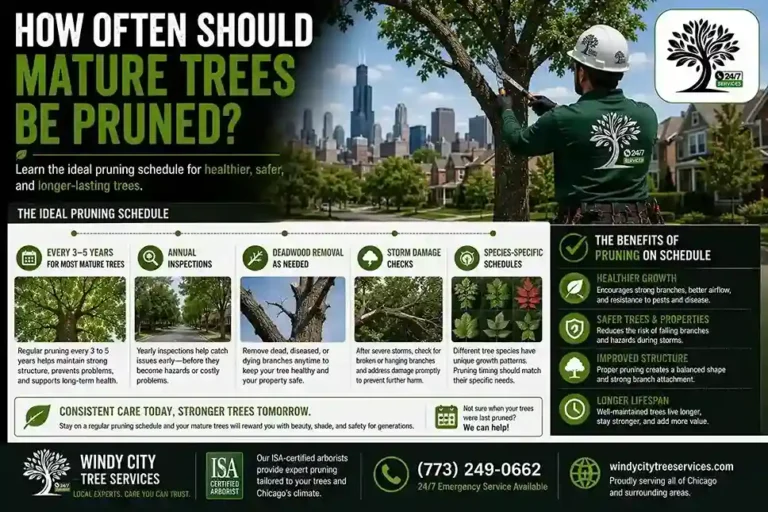
A single pruning visit solves an immediate problem, but a tree’s long-term health depends on an ongoing plan. Routine inspections, ideally every one to three years for mature trees, catch developing issues while they are still minor and inexpensive to address.
Scheduled pruning on a predictable cycle keeps deadwood from accumulating and keeps clearance issues from building back up year after year. Ongoing tree health monitoring tracks how a tree responds to pruning, weather, and any pest or disease pressure in the area. Fertilization supports recovery after significant pruning and helps trees growing in compacted urban soil access the nutrients they need. Cabling and bracing extend the life of structurally valuable trees that have a specific weak point but are otherwise healthy, and preventive maintenance, meaning addressing small issues before they become emergencies, ties all of these practices together into a coherent long-term strategy.
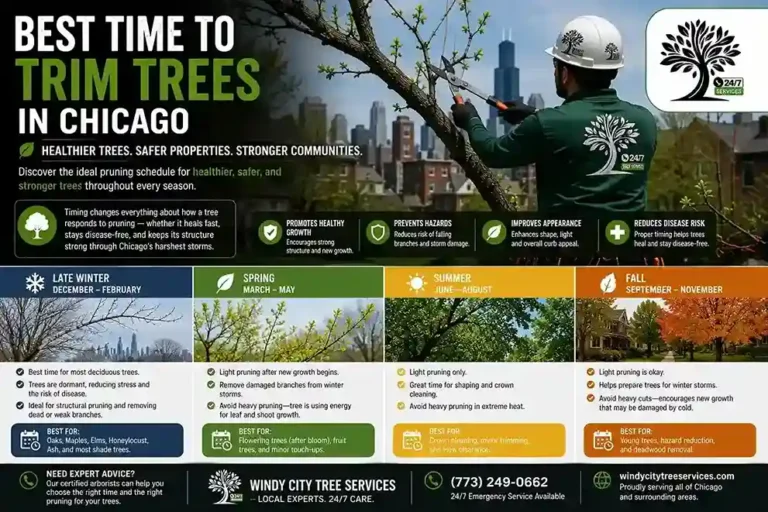
A general annual pruning timeline. Specific timing always depends on species and current tree health.
Not Sure Which Crown Pruning Service Your Tree Needs?
Our ISA Certified Arborists evaluate your tree’s health, structure, and surroundings to recommend the safest and most effective pruning method.
📞 Book a Professional Tree Evaluation (773) 249-0662Homeowner Checklist: Which Crown Service Does Your Tree Need?
Walk around your property and answer these questions honestly. Your answers point toward the service most likely to apply, though a certified arborist should always confirm before any cutting begins.
- Are there dead or broken branches visible anywhere in the canopy?
- Are limbs hanging low enough to interfere with people walking on the sidewalk?
- Are branches blocking or scraping a driveway or garage?
- Does the canopy feel too large for the space around your home?
- Has storm damage occurred recently, with broken limbs or torn bark?
- Is the tree growing into a roofline, siding, or utility line?
- Does the tree look unbalanced or lopsided on one side?
Improve Tree Safety, Health, and Appearance
Whether your trees need crown cleaning, crown raising, or crown reduction, our experienced arborists provide expert pruning tailored to Chicago’s unique growing conditions.
Request a Free EstimateFrequently Asked Questions
What is crown cleaning?
Crown cleaning is the removal of dead, dying, diseased, broken, and weak or crossing branches from a tree’s canopy. It does not change the tree’s size or shape and is usually the first pruning step an arborist performs.
What is crown raising?
Crown raising removes lower branches to create clearance above sidewalks, driveways, roads, buildings, or sightlines. It is commonly used near streets, parking areas, and building entrances where low limbs interfere with pedestrians or vehicles.
What is crown reduction?
Crown reduction decreases the height or spread of a tree’s canopy by cutting selected branches back to a healthy lateral branch large enough to assume the terminal role. Done correctly, it preserves the tree’s natural form and health.
Does crown reduction hurt trees?
Performed correctly by a certified arborist following ANSI A300 standards, crown reduction does not harm a healthy tree. Cuts are made back to lateral branches large enough to take over growth, allowing the tree to heal properly.
Is crown reduction the same as topping?
No. Crown reduction cuts back to healthy lateral branches and preserves natural form, while topping cuts branches back to stubs with no regard for structure, triggering weak regrowth and decay.
How often should crown cleaning be performed?
Most mature shade trees benefit from crown cleaning every three to five years. Younger trees or trees that have recently experienced storm damage may need more frequent attention.
Can crown raising improve visibility?
Yes. Removing low branches along a street corner, driveway, or building entrance improves sightlines for drivers and pedestrians, a common reason municipalities and commercial properties request crown raising.
Which trees benefit from crown reduction?
Mature shade trees growing too close to a home, trees with heavy end weight on long limbs, and trees exposed to strong wind often benefit from crown reduction. An arborist evaluates the specific tree first.
Can I perform crown pruning myself?
Small, low branches on young trees can often be pruned safely by a homeowner with the right tools. Any work involving a ladder, a chainsaw, or branches near power lines should be left to a trained, insured professional.
How much does crown pruning cost?
Cost depends on tree size, condition, accessibility, and how much work is needed. We provide free, written, on-site estimates before any work begins so you know the price up front.
What is the difference between crown thinning and crown reduction?
Crown thinning selectively removes branches throughout the canopy to reduce density without changing the tree’s overall size. Crown reduction specifically decreases the height or spread of the canopy.
When is the best time of year for crown pruning in Chicago?
Late winter, while most trees are dormant, is generally best for structural pruning. Deadwood removal can be done any time of year, while flowering species are often pruned right after they bloom.
How much of a tree’s canopy can be removed at once?
ANSI A300 guidance generally limits pruning to no more than 25 percent of a tree’s live canopy in a single growing season, with more conservative limits for stressed or mature trees.
Will crown reduction make my tree grow back faster?
Proper crown reduction cuts back to a lateral branch that grows at a natural rate, unlike topping, which triggers a burst of weak, fast-growing water sprouts. Reduction results in slower, healthier regrowth.
Do young trees need crown raising?
Young trees planted near sidewalks or driveways often need gradual, structural crown raising over several years, removing only a small percentage of lower branches at a time.
Can crown cleaning prevent storm damage?
Yes. Removing dead, weak, and crossing branches before a storm significantly reduces the number of limbs likely to fail in high wind, heavy snow, or ice.
Does crown reduction help with wind resistance?
Yes. Reducing the length of long, heavy limbs decreases the leverage wind can exert on a branch, lowering the chance of failure during high-wind events and spring storms.
Why do arborists avoid flush cuts?
Flush cuts remove the branch collar, the tissue that allows a tree to seal a wound. Cutting flush to the trunk creates a larger wound that heals slowly and invites decay.
How do I know if my tree has already been topped?
Signs of past topping include large flat stubs, dense clusters of thin upright branches sprouting just below old cuts, and an unnatural, broom-like canopy shape. An arborist can assess the damage and recommend a recovery plan.
Should I combine crown cleaning with other pruning services?
Often, yes. Arborists frequently combine crown cleaning with crown raising or crown reduction in a single visit, since removing deadwood first makes the tree’s true structure easier to evaluate.
Related Tree Care Guides
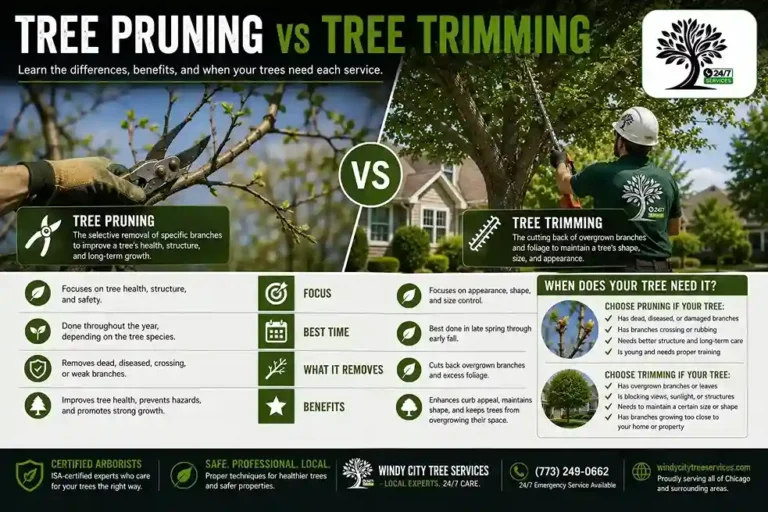
Tree Pruning vs. Tree Trimming
Read the guide →Best Time to Trim Trees in Chicago
Read the guide →How Often Should Mature Trees Be Pruned?
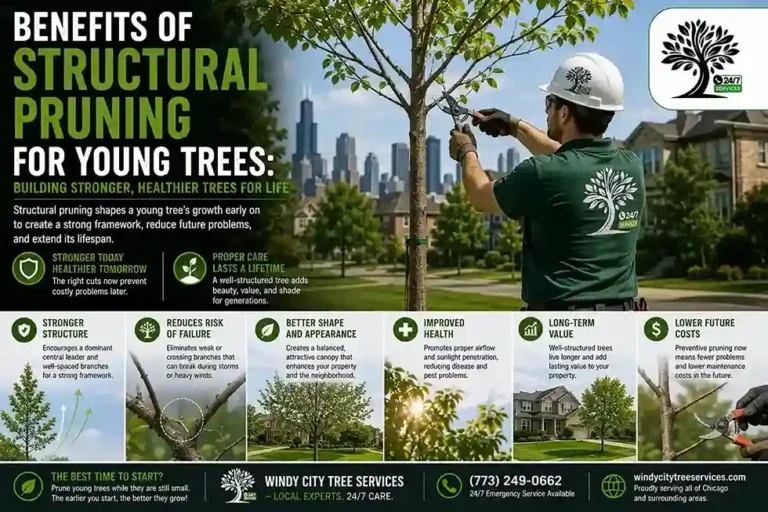
Read the guide →Benefits of Structural Pruning for Young Trees
Read the guide →Common Tree Pruning Mistakes Homeowners Make
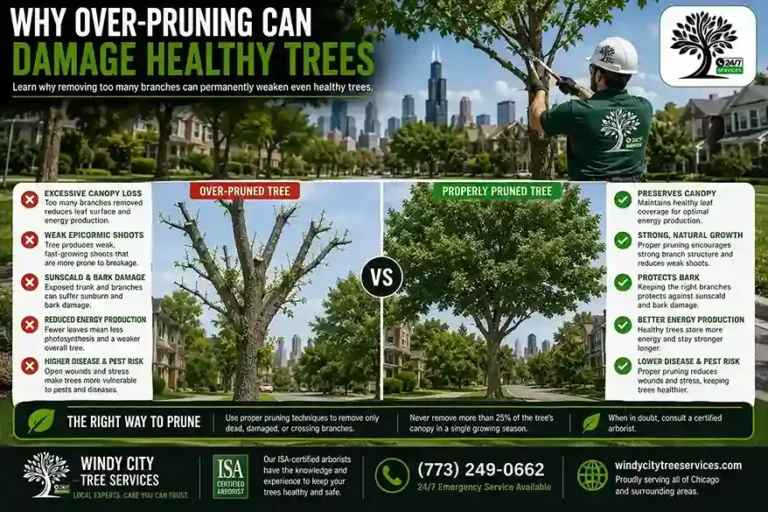
Read the guide →Why Over-Pruning Can Damage Healthy Trees
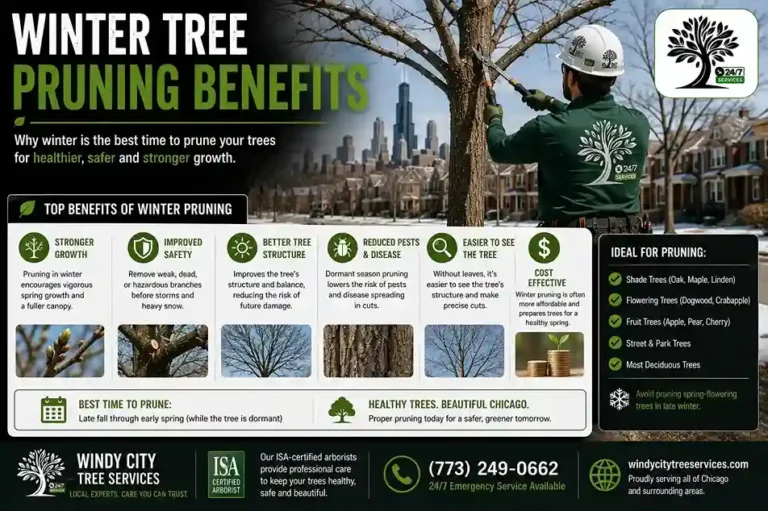
Read the guide →Winter Tree Pruning Benefits
Read the guide →How Tree Trimming Improves Property Value
Read the guide →Tree Trimming Before Storm Season
Read the guide →Common Reasons Trees Fail During Chicago Storms
Read the guide →Safe Tree Removal Near Homes and Power Lines
Read the guide →Ready to put any of this into practice? Our Chicago Tree Service team includes Certified Arborists providing professional tree care across the city, from routine crown maintenance to full tree removal.
Professional Crown Pruning Services in Chicago
Proper crown maintenance keeps trees healthier, safer, and more attractive for years to come. Windy City Tree Services performs crown cleaning, crown raising, and crown reduction according to ANSI A300 standards and ISA Best Management Practices.