
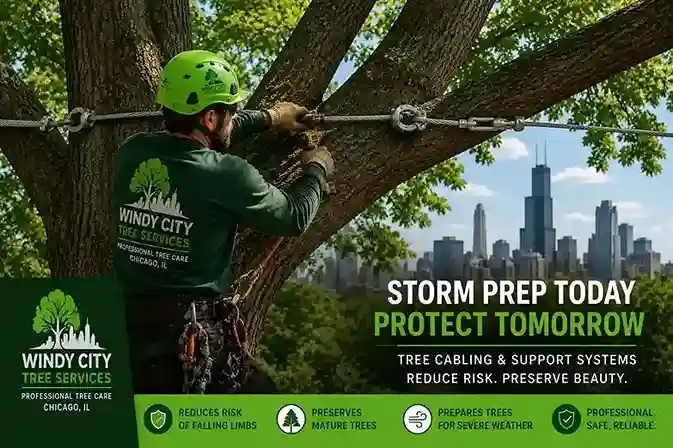
Why Chicago Trees Need a Storm Prep Plan
Chicago doesn’t get a quiet stretch between storm seasons. Lake-effect wind gusts top 50 mph during summer thunderstorms, freezing rain coats branches in ice each winter, and saturated clay soil loosens root systems just enough to tip a tree over in a strong gust. A tree that looks healthy in July can become a liability the moment a derecho rolls through in August.
Most storm damage isn’t random. It follows a pattern: weak branch unions split, codominant stems tear apart, overextended limbs snap under wind load, and trees with compromised roots lean further with every storm until they fail. Storm prep for trees Chicago property owners can count on means finding those weak points before a storm does, not after.
Emergency tree removal after a storm typically costs two to four times what proactive structural pruning and tree cabling would have cost beforehand, and that’s before factoring in roof repairs, fence replacement, or a totaled car. A documented storm preparation plan from a certified crew is one of the few home and commercial maintenance investments that consistently pays for itself.
There’s also a seasonal rhythm to storm risk that’s worth understanding. Spring brings fast-moving thunderstorm systems and the first heavy winds after a winter of root dormancy, which is exactly when soggy soil offers the least resistance to a leaning trunk. Summer adds straight-line wind events and the occasional derecho, capable of producing gusts well above 70 mph across a wide swath of the region in a matter of minutes. Fall sheds leaves that once provided some flexibility in the canopy, leaving bare branches more rigid and prone to snapping. Winter brings ice storms that can add hundreds of pounds of extra weight to a single limb, on top of heavy, wet snow that compounds the load further. A storm prep plan accounts for all four seasons, not just the obvious summer storm window.
Insurance carriers have also taken notice. More policies now ask whether trees near a structure have been professionally inspected, and some adjusters reduce or deny claims tied to trees with documented, pre-existing defects that were never addressed. A written risk assessment and maintenance record protects you twice: once by reducing the odds of failure, and again by giving you paperwork if a claim ever needs to be filed.
What Is Storm Preparation for Trees?
Storm preparation for trees is a structured, ANSI A300-guided maintenance process that identifies structural weaknesses in a tree and corrects or supports them before severe weather arrives. It’s preventive arboriculture, not reactive cleanup.
A complete storm prep program typically includes:
- Tree inspections that document trunk, canopy, and root health
- Structural pruning to reduce wind resistance and remove competing growth
- Cabling to limit movement between major limbs or codominant stems
- Bracing with steel rods through cracked or split unions
- Deadwood removal to eliminate limbs that fail in even moderate wind
- Crown management to balance canopy weight and reduce sail effect
- Root inspections to check for decay, girdling roots, and soil compaction
- Soil improvement through aeration and fertility correction
- Ongoing monitoring so changes are caught between major storms
Done well, this work follows ANSI A300 pruning standards and ISA best management practices rather than guesswork, and it’s documented so you have a record for insurance and future reference.
It’s also worth being clear about what storm prep is not. It isn’t topping a tree to make it shorter, which actually weakens the structure and creates dense, poorly attached regrowth that’s more storm-prone than what was removed. It isn’t a one-time service either. Trees grow, weather patterns shift, and a defect that was minor two years ago can become a structural liability today. The most effective storm prep programs run on a recurring cycle, typically every one to three years depending on species, age, and site conditions, with adjustments made any time a major storm passes through.
Our Storm Prep Services
Every property is different, so we build storm readiness plans around the trees you actually have, not a one-size template.
Tree Risk Assessments
A certified arborist evaluates trunk, canopy, and root flare for defects that increase storm failure risk.
Structural Pruning
Targeted cuts that reduce wind load, improve branch spacing, and correct poor growth habits early.
Tree Cabling
Static or dynamic cables installed high in the canopy to limit movement at weak branch unions.
Tree Bracing
Steel rods placed through split or cracked unions to add rigid, mechanical support.
Deadwood Removal
Dead, dying, or decayed limbs removed before wind or ice turns them into falling hazards.
Crown Reduction
Selective thinning that lowers canopy weight and wind resistance without disfiguring the tree.
Hazard Limb Removal
Overextended or cracked limbs removed before they become a falling-branch liability.
Root Zone Inspections
Checks for root decay, girdling roots, and soil compaction that compromise anchorage.
Air Spade Root Evaluation
Compressed air exposes roots without cutting them, revealing decay or structural defects below grade. Learn about air spade service.
Signs Your Tree Needs Storm Preparation
Most failures give warning signs months or years ahead of time. If you see any of the following, schedule a tree risk assessment before the next round of severe weather.
- Cracked or split limbs
- Heavy, overextended branches
- Codominant stems with included bark
- Visible cavities or hollow sections
- A tree leaning more than it used to
- Dead or bare branches in an otherwise full canopy
- Exposed, damaged, or heaving roots
- Previous storm injuries that were never corrected
- Weak branch unions with V-shaped crotches
- A dense, overcrowded canopy that catches wind like a sail
Our Storm Preparation Process
We follow the same seven-step process on every property, whether it’s a single backyard maple or a 40-acre commercial campus.
Property Consultation
We walk the property with you to understand priority trees, structures at risk, and past storm history.
Tree Inspection
A certified arborist examines trunk, canopy, and visible root structure for defects.
Risk Assessment
Defects are scored against likelihood of failure and what’s nearby, like a roof, driveway, or play area.
Customized Protection Plan
You receive a written plan with recommended pruning, cabling, bracing, or removal, ranked by urgency.
Pruning & Structural Support
Our crew performs the approved work using ANSI A300-compliant techniques and equipment.
Final Safety Review
We walk the property again to confirm the work meets the plan and answer any questions.
Ongoing Maintenance Recommendations
You get a simple monitoring schedule so new issues are caught long before the next storm season.
Tree Cabling & Bracing
Cabling and bracing are mechanical support systems that let a structurally compromised tree stay standing rather than coming down entirely.
Static cabling uses rigid, high-strength steel cable installed in the upper canopy to restrict how far two limbs can move apart in wind. It’s the standard choice for codominant stems with included bark, where the union itself has no real structural strength.
Dynamic cabling uses a synthetic, slightly elastic rope system that allows more natural movement while still limiting the worst-case spread. Arborists choose dynamic systems when some flexibility actually helps the tree stay healthy, particularly on younger or fast-growing species.
Steel bracing rods go a step further. They’re threaded through the trunk or major limbs at a split or crack to physically hold the wood together, often paired with cabling above for redundancy.
Together, these systems are about preserving mature trees rather than removing them. A 60-year-old oak provides shade, property value, and curb appeal that no replacement sapling matches for decades. Structural support, properly engineered, can add 10 to 20 years of safe service life to a tree that would otherwise be a removal candidate.
For a deeper look at installation methods and inspection intervals, see our dedicated tree cabling and bracing page.
Structural Pruning
Structural pruning is the single most cost-effective storm prep service available, and it’s most powerful when started while a tree is young.
Correct pruning reduces wind resistance by thinning the outer canopy instead of stripping interior growth. It removes deadwood before it becomes a falling hazard and improves branch spacing so limbs aren’t competing for the same light and rubbing against each other. Reducing canopy weight on the outermost branches takes leverage off the trunk during high wind events, which directly improves tree stability.
Beyond storm readiness, structural pruning promotes healthy growth by directing the tree’s energy toward a stronger, more balanced form rather than excess foliage. Trees pruned on a regular three- to five-year cycle develop fewer structural defects over their lifetime than trees left unpruned until something breaks.
See our full tree trimming and pruning services for routine maintenance options beyond storm prep.
Tree Risk Assessments
A tree risk assessment is a documented inspection that scores the likelihood of failure against the consequences if it happens. It’s the foundation every storm prep plan is built on.
Our assessments cover visual inspection of the trunk, canopy, and major limbs for cracks, cavities, and decay; structural defect identification including codominant stems and weak unions; root flare evaluation to check for girdling roots or soil heaving; soil condition review for compaction and drainage problems; and target analysis, meaning what’s within striking distance if the tree or a limb fails. We close every assessment with a long-term maintenance plan, not just a one-time fix.
This process mirrors the TRAQ (Tree Risk Assessment Qualification) framework used by ISA-certified arborists nationwide, giving you a defensible, professional record rather than a verbal opinion.
Not every defect carries the same urgency. A small cavity in a low-traffic side yard might warrant monitoring rather than immediate action, while the same cavity above a driveway or play structure moves to the top of the priority list. That’s why target analysis matters as much as the defect itself: risk is a function of likelihood of failure and consequence of failure together, not either one alone. We score both, then build the maintenance plan around what’s genuinely urgent versus what can wait for the next scheduled visit.
Residential Storm Preparation
Homeowners call us most often after a neighbor’s tree comes down, but the better time is before that happens to yours. Storm prep protects the structures and spaces you actually use every day: your home and garage roofline, the driveway where your car sits overnight, fences and outdoor living spaces, pools, and the mature landscape trees that took decades to grow and can’t be replaced overnight.
A single large limb failure can cause five figures in roof and gutter damage. A full assessment usually costs less than a basic insurance deductible, which makes the math straightforward for most homeowners.
We also hear from homeowners who inherited a mature tree from a previous owner with no maintenance history at all. In that situation, a baseline risk assessment gives you a starting point: which trees are structurally sound, which need pruning or cabling, and which may already be past saving. It’s far easier to plan a budget around that information than to find out the hard way during the next big storm.
Commercial Storm Preparation
Commercial and institutional properties carry more liability exposure per tree because of foot traffic, parking, and occupancy. We work with HOAs, apartment communities, office buildings, schools, hospitals, municipalities, parks, shopping centers, and industrial properties to build documented, scheduled storm prep programs that satisfy both safety obligations and insurance requirements.
For multi-tree properties, we typically phase work by risk priority so the highest-liability trees are addressed first, then build a recurring inspection cycle around your budget. See our commercial tree service page for program details.
Property managers also benefit from a single point of contact who tracks tree condition across an entire site over time. Rather than reacting to one complaint or one fallen limb at a time, you get a running inventory of every significant tree on the property, ranked by risk, with a clear record of what’s been addressed and what’s scheduled next.
Why Choose Windy City Tree Services?
Plenty of companies will trim a tree. Fewer can explain why a specific branch union is a structural risk, recommend the right support system for the species and site, and document the work so it holds up for insurance purposes. That distinction is where storm prep lives or dies.
Experienced, Credentialed Arborists
Our crews bring years of hands-on experience with Chicago’s specific mix of species, soil, and storm patterns.
Science-Based Recommendations
Every plan follows ANSI A300 standards and ISA best practices, not guesswork or upselling.
Modern Equipment
From air spade root evaluation to precision rigging, we use the right tool for the tree, not the easiest one for us.
Safety-First Approach
Fully licensed and insured crews working under strict safety protocols on every job, residential or commercial.
Honest Assessments
We tell you when a tree can be saved with cabling or pruning and when removal is genuinely the safer call.
Local Chicago Experience
We know how lake-effect wind, clay soil, and salt exposure affect tree health differently than anywhere else.
Frequently Asked Questions
When should storm preparation be scheduled?
Late winter through early spring is ideal, before storm season ramps up and while trees are still dormant, which makes structural defects easier to see and pruning easier on the tree.
Can cabling prevent tree failure?
Cabling significantly reduces the risk of a weak union splitting apart in wind, but it doesn’t eliminate risk entirely. It’s a support system, not a guarantee.
What trees benefit from support systems?
Trees with codominant stems, included bark, prior cracks, or large overextended limbs benefit most, especially mature specimens worth preserving.
Is storm preparation worth the investment?
Yes. Preventive pruning and cabling typically cost a fraction of emergency removal plus storm-related property repairs.
How often should trees be inspected?
Annually for most mature trees, and after any significant storm event regardless of when the last inspection happened.
Can mature trees be saved?
Often, yes. Structural pruning, cabling, and bracing can extend a mature tree’s safe service life by a decade or more in many cases.
Do you inspect commercial properties?
Yes. We work with HOAs, schools, hospitals, municipalities, and other commercial properties throughout Chicago.
What happens during a risk assessment?
A certified arborist inspects the trunk, canopy, and visible root structure, documents defects, and delivers a written plan ranked by urgency.
Is pruning enough to prevent storm damage?
For many trees, yes. Others with structural defects like codominant stems also need cabling or bracing for full protection.
Can you inspect trees after construction?
Yes. Construction often damages roots and soil structure near trees, and we recommend an inspection any time grading or excavation happens nearby.
Do you provide emergency services after storms?
Yes. See our emergency tree removal services for rapid response after a storm.
How much does tree cabling cost in Chicago?
Cost depends on tree size, height, and the number of support points needed. We provide a written quote after an on-site inspection.
What is the difference between cabling and bracing?
Cabling restricts movement between limbs from above using steel or synthetic cable. Bracing uses rigid steel rods through the wood itself to hold a crack or split together.
Will pruning hurt my tree?
Correct structural pruning, done within ANSI A300 guidelines, supports long-term health. Over-pruning or topping, which we don’t practice, is what causes harm.
Do you remove trees that can’t be saved?
Yes. If a risk assessment shows a tree is beyond saving, we offer tree removal services as part of the same visit.
What is included in a storm readiness plan?
A prioritized list of recommended pruning, cabling, bracing, or removal, along with a monitoring schedule, so you know what to do and when.
Do you serve HOAs and apartment communities?
Yes, we build recurring inspection and maintenance programs designed around HOA budgets and liability needs.
How long does a tree risk assessment take?
Most single-property residential assessments take 30 to 60 minutes. Larger commercial properties take longer depending on tree count.
Storm Prep Service Area
Windy City Tree Services proudly provides storm preparation and tree support services throughout Chicago and surrounding communities, including the Loop, Lincoln Park, Lakeview, Logan Square, Bridgeport, Pilsen, and neighborhoods across ZIP codes 60601 through 60661, plus nearby suburbs. Learn more about our team or contact us to confirm service in your area.