Emergency Tree Removal Insurance Tips for Homeowners
Emergency Tree Removal Insurance Tips
A storm can leave a tree dangerously damaged in minutes, and most homeowners aren’t sure whether insurance will cover what happens next. The right documentation and a prompt professional assessment can make the claims process considerably smoother. Here’s what to know before you’re standing in your yard looking at a downed tree.
Homeowners insurance often covers emergency tree removal when a covered event, like a storm, causes a tree to damage an insured structure or create a covered loss. Coverage depends on your specific policy, deductible, and the circumstances of the damage. Review your policy and contact your insurer to confirm what applies to your situation.
⚖️ A Note Before You Continue
This article provides general, educational information about how emergency tree removal insurance claims typically work. It is not legal or insurance advice. Coverage varies significantly by policy, insurer, and state regulation. Always review your specific policy and speak directly with your insurance company, or a qualified legal or insurance professional, for guidance on your situation.
A storm passes through, and now there’s a tree resting on your roof, blocking your driveway, or hanging precariously over a fence. In the middle of that stress, one of the first questions most homeowners ask is simple: will insurance cover this?
The honest answer is that it depends. Homeowners insurance policies vary widely in what they cover, and a lot depends on what caused the tree to fall, what it damaged, and the specific terms of your policy. What doesn’t vary as much is the value of good documentation and a prompt, professional assessment. Both make the claims process smoother no matter which insurer you’re working with.
This guide walks through what emergency tree removal typically involves, what insurance companies generally look for, and how ISA Certified Arborists can support, though not determine, your insurance claim.
None of this replaces reading your actual policy documents or talking directly with your insurance company. Policy language varies enormously between insurers, and even between different tiers of coverage from the same company. What this guide can do is help you understand the general shape of the process, what questions to ask, and what kind of documentation tends to matter most, so that when you do call your insurer, you’re asking informed questions instead of starting from zero.
“We can tell you exactly what happened to the tree and why. Whether your policy covers it is a conversation between you and your insurer.” Windy City Tree Services Arborist Team
1. What Is Emergency Tree Removal?
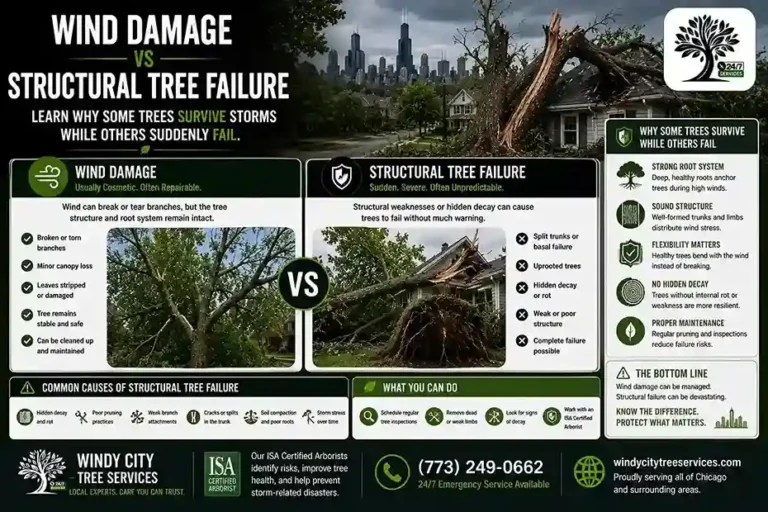
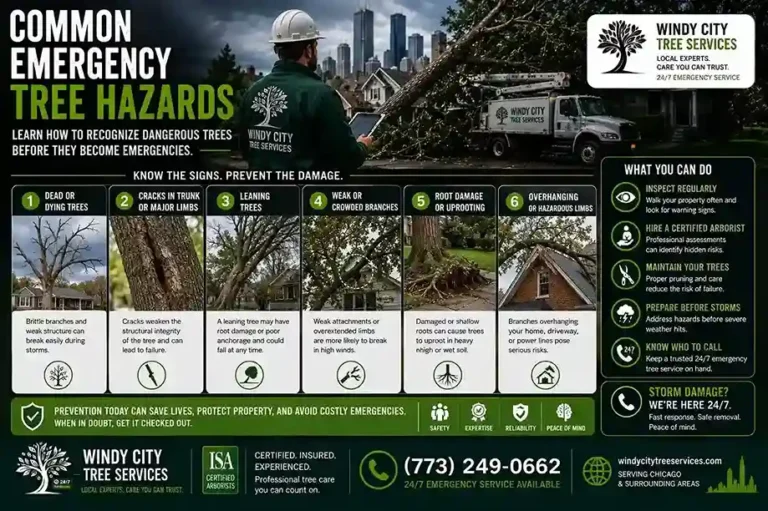
Emergency tree removal addresses an immediate, active hazard, not routine maintenance. It typically involves one of these situations:
- Storm damage: A tree damaged during severe weather that poses an ongoing risk.
- Fallen trees: A tree that’s already come down, whether or not it caused property damage.
- Split trunks: Structural failure that leaves the tree unstable and unpredictable.
- Hanging limbs: Broken branches caught in the canopy that could fall at any time.
- Trees blocking access: A tree across a driveway, walkway, or the only route in or out of a property.
- Utility hazards: Trees or limbs in contact with power lines.
Understanding which category your situation falls into helps set expectations for both the emergency tree removal process and how your insurer is likely to evaluate the claim.
2. When Insurance May Cover Emergency Tree Removal
Coverage tends to be more likely in certain circumstances, though every policy is different.
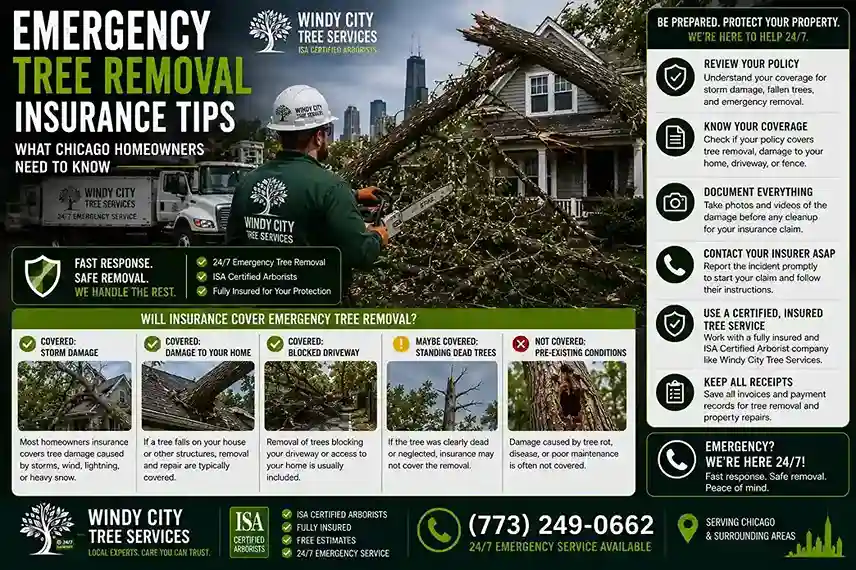
- Storm-related damage: Trees that fall due to wind, ice, or other covered weather events are more commonly covered than trees that fail for unrelated reasons.
- Covered perils: Your policy typically lists specific covered events; tree damage tied to one of these is more likely to be included.
- Trees on homes: Damage to your primary dwelling structure is one of the more commonly covered scenarios.
- Trees on garages: Detached structures are often covered too, though policy terms vary.
- Driveway access: Some policies include limited coverage for removing a tree blocking a driveway, even without direct structural damage.
- Policy limitations: Many policies cap the amount paid for tree removal specifically, separate from structural repair costs.
- Deductibles: Your standard deductible typically applies before coverage kicks in.
Avoid assuming coverage either way before checking. The best next step is always a direct conversation with your insurer about your specific policy.
3. Situations Where Coverage May Be Limited
⚠️ Coverage Is Not Guaranteed in These Situations
Insurance companies often scrutinize these circumstances more closely, and coverage can be limited or denied depending on your policy:
- A tree that was already dead or visibly hazardous before the storm
- Damage linked to neglected tree maintenance
- Purely cosmetic cleanup with no property damage involved
- A tree that fell without damaging any insured structure
- Specific exclusions written into your individual policy
Every policy differs on these points. Some insurers treat a driveway-blocking tree as a covered inconvenience; others don’t cover removal at all without structural damage. This is exactly the kind of detail worth confirming with your insurer before you need it.
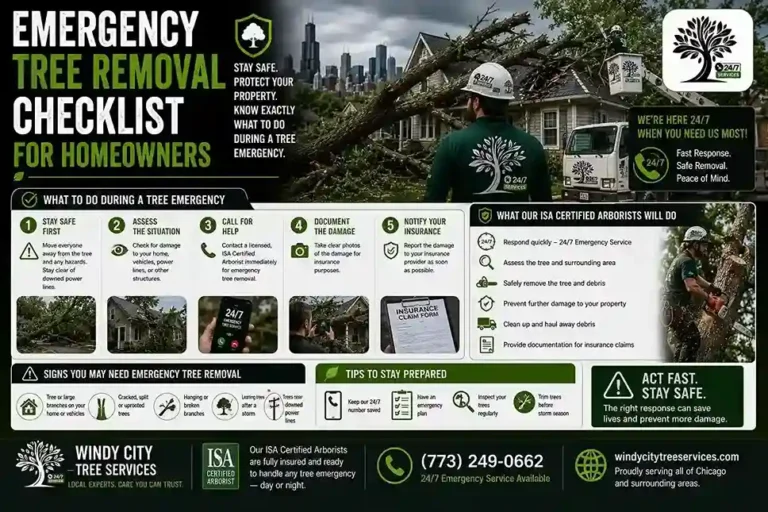
4. What to Do Immediately After Storm Damage
1. Ensure Everyone Is Safe
Check for injuries and evacuate if the structure seems compromised.
2. Stay Away From Power Lines
Treat any downed or damaged line as energized and contact your utility company.
3. Call Emergency Services If Needed
Dial 911 for injuries, trapped occupants, or active electrical hazards.
4. Photograph the Damage
Document everything from a safe distance before anything is moved or cleaned up.
5. Prevent Further Damage If Safe
Reasonable steps like tarping a roof can help, if it can be done without risk.
6. Contact Your Insurance Company
Start the claims process as soon as it’s practical to do so.
7. Schedule Emergency Tree Service
A qualified arborist can safely remove the hazard and document the tree’s condition.
5. Documentation Insurance Companies Usually Request
📸 What to Gather
- Clear photos of the damage from multiple angles
- Video walkthroughs describing what happened
- Photos of any affected property, roof, vehicle, fence, or landscaping
- Local weather information confirming the storm event
- A professional arborist report describing the tree’s condition
- Written estimates for removal and any related repairs
- Emergency service invoices
- Receipts for any temporary protective measures
💡 Did You Know?
Insurance adjusters often rely heavily on timestamped photos and video taken immediately after an event. Documentation gathered before any cleanup begins tends to carry the most weight in a claims review.
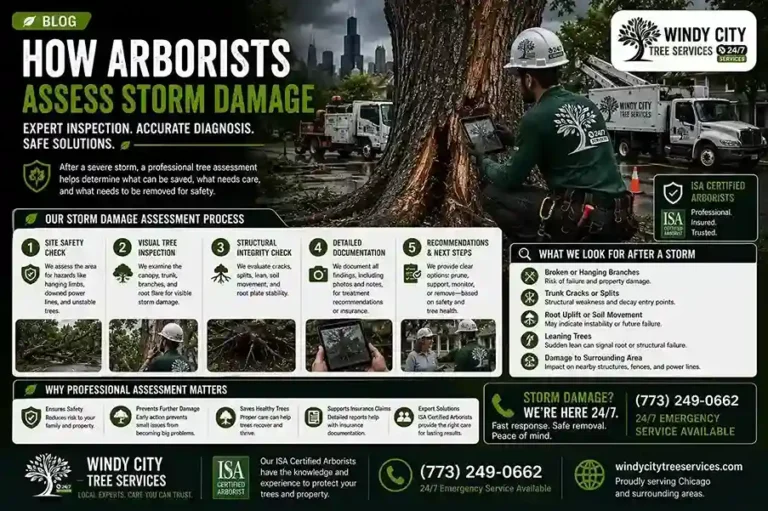
6. How ISA Certified Arborists Help with Insurance Claims
A certified arborist can’t tell you whether your policy covers a specific claim, that’s between you and your insurer, but professional documentation of the tree’s condition genuinely helps support the process.
- Tree condition reports: A written assessment describing the tree’s health and structural condition at the time of failure.
- Hazard evaluations: Documentation of what made the tree or its remnants dangerous.
- Removal estimates: A detailed, written cost estimate for the work performed.
- Damage documentation: Photos and notes capturing the scope of the tree-related damage.
- Emergency stabilization: Records of any immediate safety work performed before full removal.
- Professional recommendations: Guidance on whether remaining trees need inspection following the storm.
An arborist provides professional tree assessment, not an insurance coverage determination. Your insurer makes the final call on what your policy covers.
7. Working with the Insurance Adjuster
- Site visits: Most claims involve an adjuster visiting the property to assess damage directly.
- Questions to ask: What’s covered, what your deductible is, and what documentation they still need.
- Providing documentation: Share your photos, video, and any arborist report directly and promptly.
- Understanding estimates: Ask for a clear breakdown if the adjuster’s estimate differs from your contractor’s quote.
- Keeping records: Save copies of every communication, email, letter, and claim number, throughout the process.
8. Emergency Tree Removal Timeline
Secure the Area
Keep people and pets away from the hazard until it’s professionally assessed.
Contact Emergency Professionals
Call for emergency tree service and, if needed, your utility company or 911.
Notify Your Insurer
Begin the claims process as soon as it’s practical.
Photograph the Damage
Complete thorough documentation before cleanup begins wherever possible.
Obtain Estimates
Get a written removal estimate from your tree service.
Adjuster Inspection
Your insurer typically schedules a site visit to assess the claim.
Tree Removal
Completed as appropriate once safety needs and documentation are addressed.
Repairs
Structural repairs proceed based on the adjuster’s assessment and your policy.
Preventive Inspection
Remaining trees on the property should be checked for hidden storm damage.
9. Common Insurance Claim Mistakes
⚠️ Mistakes That Slow Down Claims
Delaying the claim can complicate the process, since most policies expect prompt notification. Throwing away evidence, like removed branches or damaged materials, before documentation is complete removes information the adjuster may need. Poor documentation, blurry photos or missing angles, can slow down a claim’s review. Hiring uninsured contractors creates liability risk if something goes wrong during cleanup or removal. Ignoring additional tree hazards nearby means a second storm could cause a second, avoidable claim.
10. Emergency Tree Removal Costs
Emergency removal pricing depends on several factors, and costs vary considerably based on the specific situation.
- Tree size: Larger trees require more labor and equipment.
- Accessibility: Storm debris and property damage can complicate normal access.
- Equipment needs: Some jobs require specialized rigging beyond standard tools.
- Crane removal: Trees resting on structures often need a crane for safe, controlled removal.
- Utility hazards: Work near power lines requires additional coordination.
- Time of day: After-hours emergency response typically costs more than daytime work.
- Weather: Ongoing severe weather can affect scheduling and safety planning.
- Cleanup scope: Full debris removal adds to the overall project cost.
A written estimate remains the only accurate way to know your specific cost. See our companion guide on average tree removal costs in Chicago for more detail on general pricing factors.
11. Chicago Storm Risks
Chicago sees a full range of severe weather that contributes to storm-related tree claims throughout the year. Severe thunderstorms bring straight-line winds strong enough to topple trees with compromised root systems. The region also sees occasional tornado activity, along with heavy snow and ice storms that load down limbs beyond their structural capacity.
Lightning strikes, while less frequent, can cause sudden, severe tree failure with little warning. The city’s mature urban tree canopy, much of it decades old, means Chicago has an unusually high number of large, structurally significant trees that can cause substantial damage when they fail. According to the National Weather Service, the Chicago area experiences regular severe thunderstorm activity through the spring and summer, making storm-related tree claims a recurring, predictable seasonal pattern rather than a rare event.
That predictability cuts both ways. It means insurers in the region are generally familiar with processing storm-related tree claims, since they see a steady volume of them every year. It also means Chicago homeowners have a real opportunity to get ahead of the problem: reviewing your policy’s tree coverage terms before storm season, rather than during an active emergency, gives you a much clearer picture of what to expect if a tree does come down on your property.
12. Preventing Future Insurance Claims
- Annual inspections: Catching structural weaknesses before they become storm-related failures.
- Structural pruning: Correcting weak branch unions that are more likely to fail under wind load.
- Cabling and bracing: Support systems for valuable trees with existing structural concerns.
- Crown cleaning: Removing dead wood, the most common source of storm-related limb failure.
- Tree health care: Ongoing monitoring for disease or decline that could weaken structural integrity.
- Storm preparation: A seasonal maintenance plan built around Chicago’s specific storm patterns.
Preventive care doesn’t just protect your property, it can also reduce the likelihood of the kind of emergency claim this guide covers in the first place.
🎨 Infographic Suggestions for This Guide
Insurance claim process flowchart
Emergency response timeline
Documentation checklist graphic
Storm damage decision tree
Arborist inspection workflow
Preventive maintenance calendar
Comparison Tables
Common Emergency Scenarios
| Situation | Immediate Priority | Insurance May Be Involved?* |
|---|---|---|
| Tree on home | Safety, structural assessment | Often, subject to policy terms |
| Tree on garage | Safety, structural assessment | Often, subject to policy terms |
| Hanging branch | Secure the area, avoid the hazard | Varies by outcome and policy |
| Tree blocking driveway | Access and safety | Sometimes, depending on policy |
| Tree on vehicle | Safety, vehicle assessment | Often, under comprehensive auto coverage |
| Tree on power lines | Utility contact, stay clear | Coordination with utility, policy dependent |
*Coverage depends on your specific policy and circumstances. Confirm details directly with your insurer.
Insurance Documentation Checklist
| Item | Why It Matters |
|---|---|
| Photos | Provides visual evidence of the damage at the time it occurred |
| Videos | Captures context and scope that photos alone might miss |
| Arborist report | Professional documentation of the tree’s condition and hazard |
| Emergency invoice | Records the cost and scope of emergency work performed |
| Insurance claim number | Keeps all communication and documentation organized |
| Weather information | Confirms the storm event tied to the damage |
Frequently Asked Questions
Does insurance cover emergency tree removal?
Often, when a covered event like a storm causes a tree to damage an insured structure. Coverage depends on your specific policy, deductible, and circumstances. Confirm with your insurer.
What documents should I collect after a tree falls?
Photos, video, an arborist report if available, written estimates, emergency invoices, and any weather information confirming the storm event.
Can an arborist help with my insurance claim?
Yes, by providing professional documentation of the tree’s condition, hazard level, and removal costs. An arborist doesn’t determine coverage, that’s your insurer’s decision.
Should I remove the tree before the adjuster arrives?
If the tree poses an active safety hazard, address the immediate danger first, but document everything thoroughly beforehand if possible. Check with your insurer about their preferred process when you can.
What if my driveway is blocked by a fallen tree?
Some policies include limited coverage for driveway-blocking trees even without structural damage, though this varies. Confirm with your insurer.
Does insurance cover crane removal?
Sometimes, particularly when a crane is genuinely necessary for safe removal. Coverage of specific equipment costs depends on your policy.
What if a tree falls on my car?
Comprehensive auto insurance coverage often applies in this situation, separate from your homeowners policy. Check with your auto insurer.
What if my neighbor’s tree falls on my property?
This can involve your policy, your neighbor’s policy, or both, depending on the circumstances and local regulations. Contact your insurer to understand your specific situation.
Does homeowners insurance cover stump removal?
Sometimes, particularly if the stump resulted from a covered tree failure, though many policies treat this as a separate, often excluded, cost. Confirm with your insurer.
How soon should I file a claim?
As soon as reasonably possible. Most policies expect prompt notification, and delays can complicate the claims process.
Will my premium increase after filing a tree damage claim?
It’s possible, depending on your insurer and claims history. This is a question best directed to your insurance company or agent.
What if the tree was already dead before the storm?
Coverage can be more limited in this scenario, since insurers may view it as a maintenance issue rather than storm damage. Every policy differs on this point.
Can I choose my own tree removal company for an insurance claim?
In most cases, yes. You’re generally free to hire a licensed, insured tree service of your choice rather than one selected by the insurer.
What should I do if the adjuster’s estimate seems too low?
Ask for a detailed breakdown and share your own written estimate for comparison. You can also request a re-inspection if you believe damage was missed.
Do I need a permit for emergency tree removal in Chicago?
Emergency removals addressing an active hazard are typically handled without standard permitting delays, though it’s worth confirming specifics with the city.
How does an arborist report support my claim?
It provides an independent, professional description of the tree’s condition and the cause of failure, which can support your documentation without determining coverage itself.
What if I can’t reach my insurance company right away?
Address immediate safety needs first, document the damage as thoroughly as possible, and contact your insurer as soon as you’re able.
Are there state resources for insurance questions in Illinois?
The Illinois Department of Insurance and the National Association of Insurance Commissioners both offer general consumer resources on homeowners insurance and claims.
Should I get multiple estimates for tree removal?
It’s often a good practice, both for your own comparison and to support your insurance documentation with a clear, itemized quote.
How do I schedule emergency tree removal with Windy City Tree Services?
Call (773) 249-0662 any time for emergency response, or email info@windycitytreeservices.com for non-urgent scheduling.
Key Takeaways
📌 Summary
- Safety comes first, always, before any documentation or cleanup.
- Insurance coverage for emergency tree removal varies by policy, insurer, and circumstances.
- Thorough, timely photo and video documentation strengthens any claim.
- ISA Certified Arborists document tree condition but don’t determine coverage.
- Confirm details directly with your insurer rather than assuming coverage either way.
- Preventive tree care reduces the likelihood of future storm-related claims.
Emergency Tree Removal Insurance Checklist
✅ Printable Checklist
- Ensure everyone is safe
- Avoid hazardous or unstable trees
- Stay away from power lines
- Photograph and video all damage
- Contact your insurance provider
- Save all receipts and invoices
- Hire a licensed, insured, qualified arborist
- Keep copies of all documents and communications
- Schedule an inspection of remaining trees on the property
Related Articles
Trusted Emergency Tree Removal Services in Chicago
When storms strike, every minute matters. Windy City Tree Services provides emergency tree removal, storm damage cleanup, tree risk assessments, and preventive maintenance to help homeowners respond safely and protect their property.
info@windycitytreeservices.com · 323 W Carroll Ave, Chicago, IL 60612 · Serving Chicago 24/7