How Arborists Assess Storm Damage | Windy City Tree Services
A tree can look fine after a storm and still be dangerous. Wind, ice, and heavy rain don’t always leave damage where you can see it. A trunk can carry a hidden crack. A root plate can shift underground without a single visible sign at the surface. That gap between how a tree looks and how a tree actually is happens to be exactly why storm damage assessment is a professional skill and not a quick glance from the sidewalk.
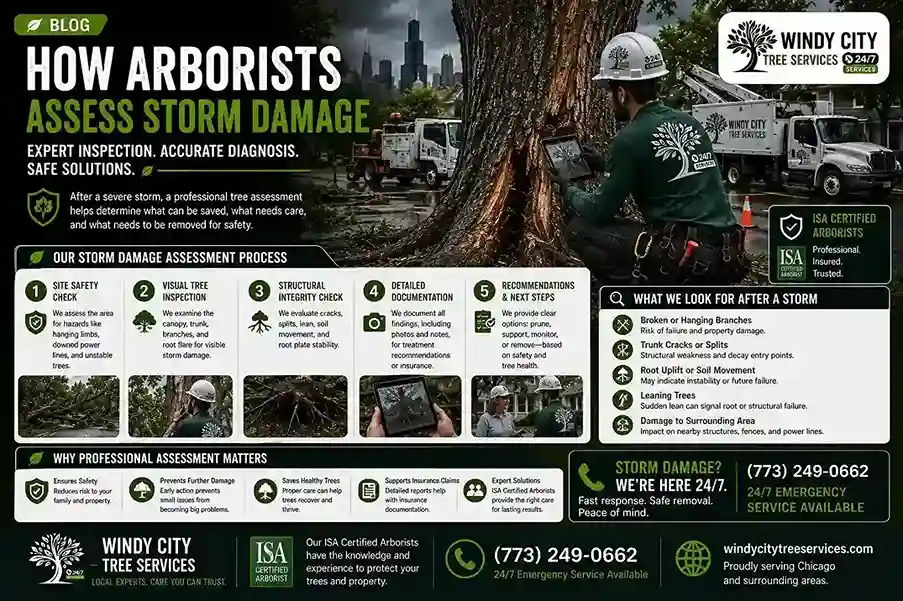
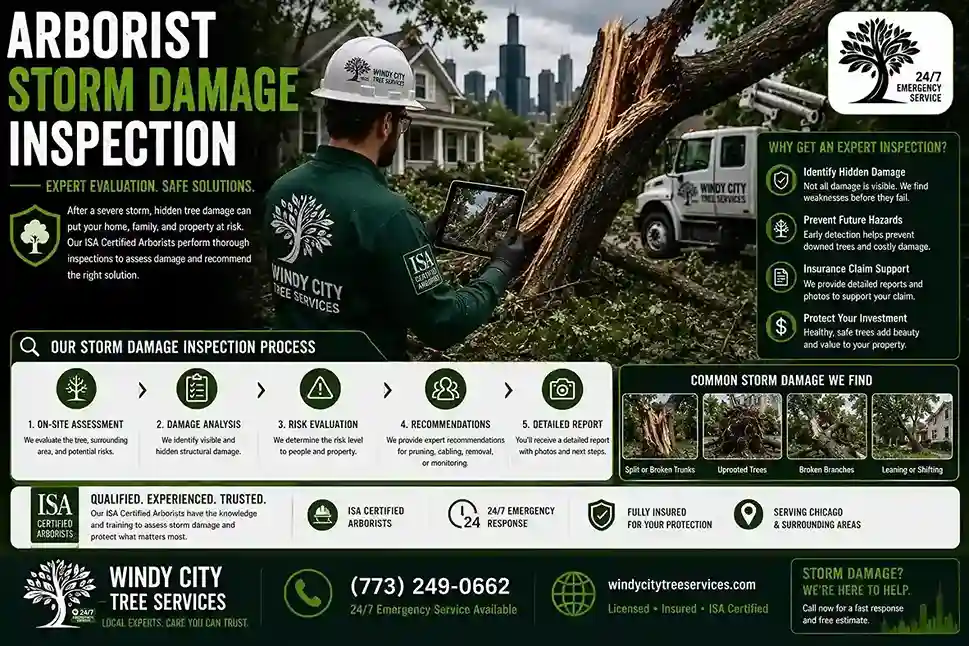
ISA Certified Arborists use a systematic, root-to-canopy inspection method to evaluate a tree’s safety, health, and structural integrity after severe weather. It’s not guesswork. It follows a consistent process built on arboricultural science, informed by standards from the International Society of Arboriculture (ISA) and supported by research from institutions like the USDA Forest Service and the Morton Arboretum.
By the end of this guide, you’ll know exactly what a professional storm damage inspection covers, from root plate movement to canopy asymmetry, what tools arborists use and why, and how they decide whether a tree should be pruned, cabled, monitored, or removed. That knowledge helps you act quickly and safely after your own property takes storm damage, and it helps you understand the reasoning behind whatever your arborist ultimately recommends.
Quick Answer: How Do Arborists Assess Storm Damage?
Arborists inspect a tree from the roots to the canopy, evaluating root stability, trunk condition, branch attachments, structural defects, canopy damage, soil conditions, and surrounding hazards. They combine visual assessment with professional experience and, when needed, diagnostic tools like sounding mallets or resistographs to determine whether a tree can be preserved, pruned, supported with cabling, or should be removed.
1. Why Storm Damage Assessments Matter
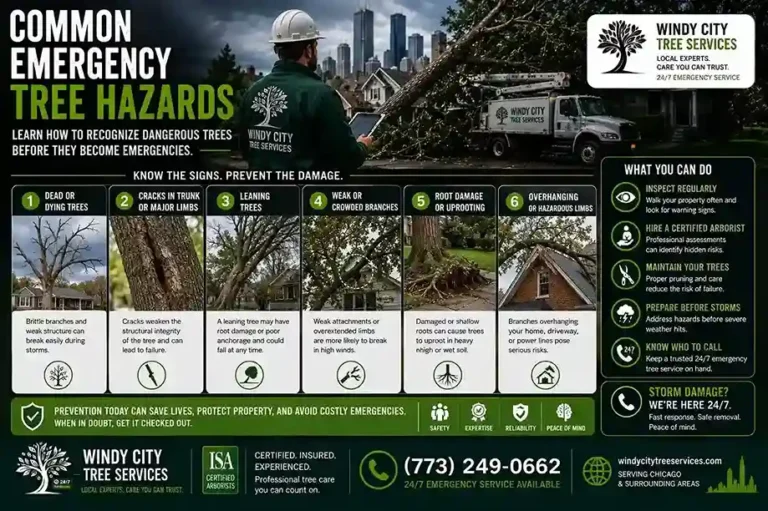
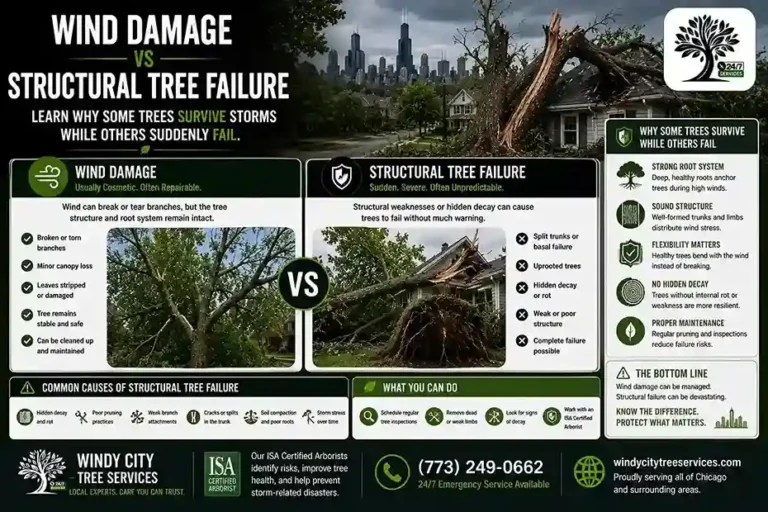
A storm-damaged tree that looks stable can still fail weeks or months later. That delay is what makes post-storm inspection so important, and it’s also what makes DIY assessment risky. A homeowner walking the yard after a storm is looking for obvious problems: snapped branches, an obvious lean, bark stripped off the trunk. An arborist is looking for all of that plus the hidden failure points that develop underground and inside the wood itself.
- Hidden hazards: Internal cracks, root plate movement, and early decay rarely show visible symptoms right away.
- Delayed failures: A tree stressed by one storm can fail during the next, even a much milder one, because the first event already compromised its structure.
- Public safety: Trees near sidewalks, streets, and neighboring properties carry liability if they fail and cause injury or damage.
- Property protection: Catching a hazard early is almost always cheaper and safer than dealing with an emergency failure later.
- Long-term tree health: Some storm damage responds well to pruning and care. Left untreated, the same damage can invite decay organisms and pests.
- Insurance documentation: A written arborist report gives homeowners and property managers the documentation insurers often ask for after storm claims.
💡 Did You Know?
According to the USDA Forest Service, most storm-related tree failures involve pre-existing structural defects that simply weren’t visible until the storm applied enough load to expose them. The storm rarely creates the weakness from nothing. It reveals a weakness that was already there.
2. The First Safety Inspection
Before any arborist evaluates root health or branch structure, they run a fast safety check of the entire scene. This step exists to protect the crew and anyone else nearby, and it happens within the first few minutes on site.
⚠️ Safety First
Never approach a storm-damaged tree that’s touching or near a downed power line. Treat every downed line as energized until the utility company confirms otherwise, and keep everyone, including pets, well clear of the area.
The initial walk-through covers:
- Power lines: Any contact between branches, the trunk, or downed limbs and utility lines gets flagged immediately, and utility crews get called before any tree work begins.
- Hanging limbs: Broken branches caught in the canopy, sometimes called widowmakers, pose a serious overhead risk and often need to come down before a full inspection can safely continue.
- Leaning trees: A new or worsening lean, especially with soil cracking or heaving at the base, can signal a root plate that’s already failing.
- Split trunks: A visible split or crack running down the trunk suggests the tree’s structural integrity is seriously compromised.
- Unsafe work zones: Debris, unstable ground, and nearby structures all factor into where the crew can safely stand and work.
- Emergency stabilization: If a hazard needs immediate attention, temporary bracing, hazard tape, or partial removal happens before the detailed assessment.
3. Step 1: Root System Evaluation
Roots anchor the tree, and root damage is one of the most common causes of delayed storm failure, in part because so much of it happens out of sight. Arborists start at the base of the tree and work outward.
A tree’s root flare, structural roots, and root plate zone are the first things an arborist checks after a storm.
Root system evaluation looks at:
- Root flare condition: The point where trunk meets roots should be visible and intact. Buried or damaged root flares are a red flag.
- Soil heaving: Cracked or lifted soil on one side of the trunk is one of the clearest signs of a root plate that’s already shifting.
- Root plate movement: Arborists gently check for rocking at the base, which indicates the root system is no longer holding the tree firmly in place.
- Construction damage: Recent digging, grading, or trenching near the root zone can compromise stability well before a storm ever hits.
- Root decay: Soft, spongy, or missing wood at the root flare suggests decay organisms have already been active.
- Saturated soils: Waterlogged ground reduces root-to-soil friction, which is part of why trees fail more often during and after heavy, prolonged rain events.
An Air Spade tool lets arborists expose roots with compressed air rather than digging, so they can inspect for girdling, decay, and structural roots without cutting into living tissue. Learn more about how this works on our Air Spade service page.
4. Step 2: Trunk Inspection
The trunk carries the structural load of the entire canopy, so any compromise here is significant. Arborists walk the full circumference of the trunk, from root flare to first major branches, looking closely at the bark and wood.
| What’s Checked | Why It Matters |
|---|---|
| Cracks | Vertical or horizontal cracks indicate the wood fibers have already separated under stress |
| Cavities | Open cavities often mean significant internal decay behind an otherwise solid-looking wall of wood |
| Lightning scars | A spiral or vertical scar from a lightning strike can weaken the trunk even without an obvious break |
| Bark separation | Loose or peeling bark can expose the cambium layer and signal internal trauma |
| Decay | Soft or discolored wood reduces the trunk’s load-bearing capacity |
| Hollow sections | A hollow trunk can still be structurally sound depending on the remaining wall thickness, which is why sounding tests matter |
| Fungal fruiting bodies | Mushrooms or conks growing on the trunk are a visible sign that internal decay fungi are already established |
🔍 Arborist Insight
A hollow tree isn’t automatically a hazard. Trees can compartmentalize decay and remain structurally stable for years with a hollow core, provided enough sound wood remains around the outside. That’s exactly why trained assessment matters more than a rule of thumb.
5. Step 3: Branch Structure Assessment
Branches take the brunt of wind and ice loading, and this is where storm damage is often most visible, but not always most obvious. Arborists assess:
- Broken limbs: Snapped branches still attached to the tree are unstable and often need removal for safety.
- Hanging branches: Limbs caught in the canopy above can fall without warning and are treated as an immediate hazard.
- Weak branch unions: Some branch attachments are inherently weaker than others, and storms expose that weakness fast.
- Included bark: When bark grows inward between two branches instead of forming a strong union, it creates a structurally weak point prone to splitting.
- Codominant stems: Two main stems of similar size competing for dominance often have a weak attachment and split more easily in storms.
- Deadwood: Dead branches are more brittle than living wood and fail more easily under wind load.
- Canopy balance: Uneven weight distribution after storm damage can change how a tree handles wind loading going forward.
Structural pruning during a routine inspection can correct many of these issues before a storm ever tests them. Our tree trimming and pruning service follows ANSI A300 pruning standards for exactly this reason.
6. Step 4: Canopy Evaluation
Stepping back from the tree, arborists assess the canopy as a whole. This bigger-picture view catches patterns that aren’t obvious when you’re looking at individual branches up close.
- Leaf loss: Sudden, uneven leaf drop can point to root damage, vascular injury, or both.
- Crown dieback: Dead branch tips scattered through the upper canopy often reflect stress somewhere in the root system.
- Broken leaders: A snapped main leader changes how the tree will grow going forward and may need corrective pruning.
- Asymmetrical canopy: A canopy that’s suddenly lopsided after a storm changes the tree’s wind resistance and center of gravity.
- Wind loading: Arborists consider how the current canopy shape will catch wind in future storms, not just how it looks today.
- Crown reduction needs: Sometimes selectively thinning or reducing the canopy is the right move to reduce future storm stress on a compromised tree.
7. Step 5: Site Conditions
A tree doesn’t exist in isolation, and neither does the risk it poses. Arborists evaluate everything around the tree that could be affected if it or a part of it were to fail.
- Nearby buildings: A tree’s proximity to a house, garage, or shed changes the urgency and approach of any needed work.
- Vehicles: Cars parked under a compromised tree are part of the risk calculation, even temporarily.
- Utility lines: Overhead and underground utilities affect both the hazard level and how removal or pruning work can safely be done.
- Sidewalks: Public walkways near a hazardous tree raise the priority level of the inspection and any recommended work.
- Public areas: Trees near streets, parks, or other high-traffic areas carry added liability considerations.
- Neighboring trees: Damage to one tree can affect the stability of trees growing close by, especially where root systems overlap.
- Soil drainage: Poor drainage around the site increases the odds of root problems developing after future storms.
8. Tree Risk Assessment
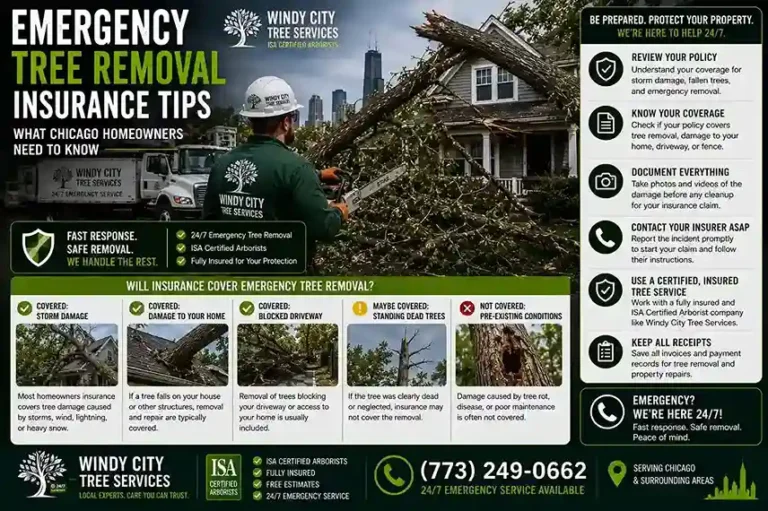
Once the inspection findings are in, arborists trained in the ISA’s Tree Risk Assessment Qualification (TRAQ) framework combine three factors to reach an overall risk rating:
- Likelihood of failure: Based on the specific structural defects found during inspection, how likely is this tree or branch to fail?
- Likelihood of impact: If failure happens, how likely is it to hit a person, vehicle, or structure?
- Potential consequences: How severe would the outcome be if failure and impact both occurred?
Combining these three factors produces an overall risk level that guides the recommendation, whether that’s monitoring, pruning, structural support, or removal. This is a professional judgment based on training and site-specific evidence, not a generic checklist score, and findings are always specific to the individual tree being assessed.
9. Diagnostic Tools Arborists May Use
Most of a storm damage inspection is visual, but some situations call for additional tools to confirm what the arborist suspects. The tools used depend on the tree, the site conditions, and the specific questions the inspection needs to answer.
| Tool | What It Helps Determine |
|---|---|
| Rubber mallet (sounding) | A hollow-sounding thump can indicate internal decay behind solid-looking bark |
| Increment borer | Where appropriate, provides a small core sample to check wood density and confirm decay |
| Resistograph | When available, measures drilling resistance through the trunk to map internal decay without major injury to the tree |
| Binoculars | Allows close inspection of upper canopy defects from the ground |
| Drone inspection | When appropriate, provides a closer look at large or hard-to-reach canopies |
| Soil probe | Checks soil compaction and depth around the root zone |
| Moisture meter | Helps assess soil saturation levels that affect root stability |
10. Can the Tree Be Saved?
This is the question every homeowner wants answered, and it depends on more than one factor. Arborists weigh:
- Structural stability: Can remaining defects be managed with pruning, cabling, or bracing, or is the damage too extensive?
- Species: Some species compartmentalize decay and recover from damage better than others.
- Age: A younger tree often has more capacity to recover than a very old, already-declining specimen.
- Health before the storm: A tree that was already stressed or diseased has less reserve capacity to recover.
- Root damage: Significant root plate movement or root loss is often the deciding factor toward removal, since roots are difficult or impossible to fully repair.
- Decay: The extent and location of decay determine how much structural strength remains.
- Location: A tree with real risk near a home, driveway, or public sidewalk faces a higher bar than the same damage on a tree in an open yard.
- Restoration potential: Does the tree have a realistic path back to a stable, healthy structure with reasonable care?
Depending on those factors, an arborist may recommend structural pruning, cabling and bracing to support a weak union, ongoing monitoring, or removal when the risk is too high to responsibly manage. No inspection can promise that a preserved tree will never fail in a future storm. It can only reduce known, identifiable risk based on the tree’s current condition.
11. Common Storm Damage Found in Chicago
Chicago’s weather pattern creates a specific mix of storm damage types throughout the year, and local arborists see the same patterns repeat season after season.
💨 Wind Damage
Fast-moving thunderstorm cells produce straight-line winds that snap weak limbs and topple trees with compromised root systems.
⚡ Lightning Strikes
Lightning can scar bark in a spiral pattern, split wood explosively, or cause damage that isn’t visible until decay sets in weeks later.
🧊 Ice Damage
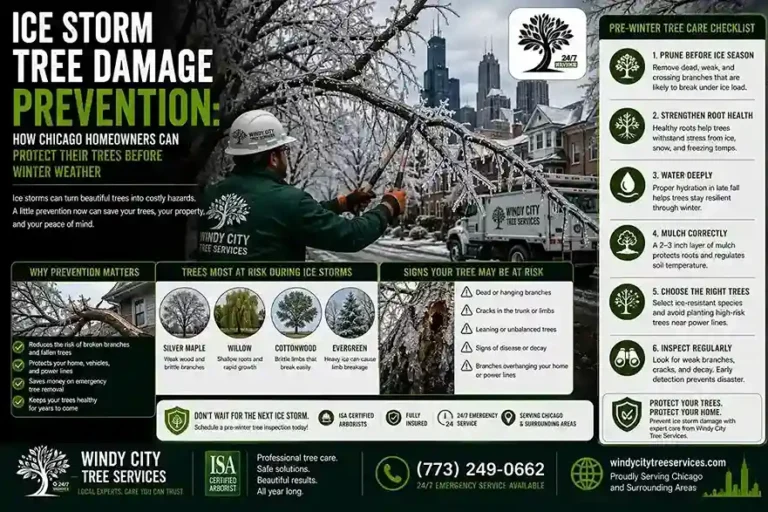
Ice accumulation adds significant weight to branches, often causing breakage well before wind becomes a factor.
❄️ Snow Loading
Wet, heavy snow stresses branch unions in much the same way ice does, especially on trees that missed a fall pruning.
🌳 Root Failures
Saturated soil after heavy rain reduces root-to-soil grip, a leading cause of whole-tree failure in Chicago storms.
🪓 Split Trunks & Broken Scaffolds
Trees with included bark or codominant stems are especially prone to splitting at the union during high wind events.
The National Weather Service Chicago office tracks the severe thunderstorm and high wind events that drive most of this damage across the region each year.
12. What Homeowners Should Do Before the Arborist Arrives
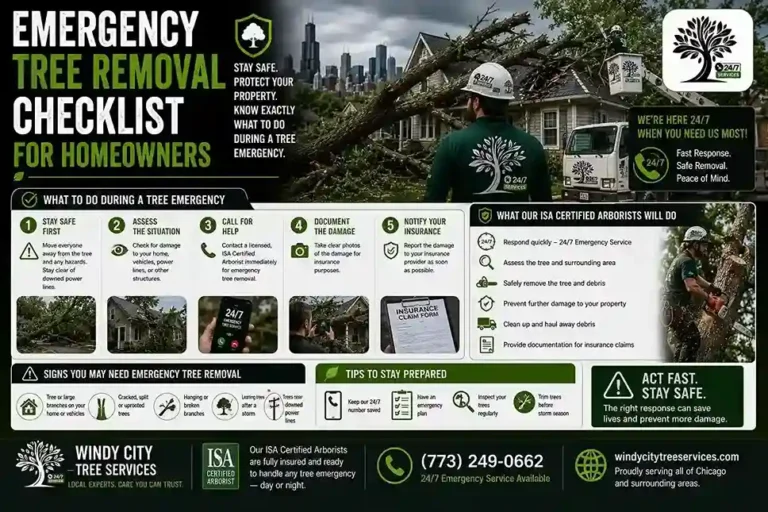
What you do in the hours right after a storm can affect both your safety and how quickly the situation gets resolved.
- Stay away from any tree with visible damage until it’s been inspected
- Keep pets and children inside and away from the affected area
- Photograph the damage from multiple angles for your records and any insurance claim
- Avoid DIY pruning or cutting, especially on anything larger than a small branch
- Mark hazards with tape or cones only if you can do so without approaching the tree
- Gather your homeowner’s insurance information in case documentation is needed
13. Preventing Future Storm Damage
The best storm response is prevention long before the next storm arrives. Regular, proactive tree care meaningfully reduces the odds of a serious failure.
- Annual inspections: A yearly health check catches developing problems while they’re still manageable.
- Structural pruning: Correcting weak branch unions early reduces the odds of failure in a future storm.
- Cabling and bracing: Supporting weak unions in otherwise healthy, valuable trees can prevent splitting altogether. Learn more about our tree cabling and bracing service.
- Crown cleaning: Removing deadwood before storm season eliminates some of the most likely failure points.
- Soil management: Addressing compaction and drainage issues supports stronger root systems over time.
- Tree health care: Fertilization and pest management keep trees resilient enough to handle storm stress. See our tree and shrub fertilization service.
- Storm preparation: Our storm prep and support systems service targets known weak points before severe weather hits.
A simple seasonal rhythm for proactive tree care throughout the year.
📋 Design Note: Additional Infographic Concepts
Beyond the diagrams above, this article is built to support a full arborist inspection process graphic (walking through the safety check, root evaluation, trunk inspection, branch and canopy assessment in sequence), a tree anatomy overlay showing common storm damage points, and a storm damage decision tree connecting inspection findings to recommendations. These can be produced as branded illustrations using the Forest Green, Bright Green Accent, and Charcoal Gray palette for future visual refreshes of this page.
Storm Damage Decision Flow
Here’s a simplified look at how inspection findings typically lead to a recommendation. Every tree is different, so this is a general guide, not a substitute for an on-site assessment.
Possible Inspection Outcomes
The table below shows how common findings typically map to a recommendation. Actual outcomes always depend on the individual tree and site conditions.
| Finding | Possible Recommendation |
|---|---|
| Minor branch damage | Prune the affected limbs and continue routine monitoring |
| Deadwood | Remove during crown cleaning to reduce failure risk |
| Structural defects (weak unions, included bark) | Consider cabling or bracing to support the affected area |
| Root instability | Further evaluation, possible support systems, or removal depending on severity |
| Extensive decay | Assess remaining sound wood; removal often recommended if structural integrity is significantly compromised |
| Split trunk | Typically requires removal, since trunk splits rarely heal into a stable structure |
Arborist Inspection Checklist
| Inspection Area | What Is Evaluated |
|---|---|
| Root System | Root flare, soil heaving, root plate movement, decay, saturation |
| Trunk | Cracks, cavities, lightning scars, decay, fungal growth |
| Branch Structure | Broken limbs, weak unions, included bark, deadwood |
| Canopy | Leaf loss, dieback, broken leaders, asymmetry, wind loading |
| Soil Conditions | Compaction, drainage, moisture levels around the root zone |
| Site Hazards | Buildings, vehicles, utility lines, sidewalks, neighboring trees |
Storm Damage Inspection Checklist for Homeowners
- Stay away from damaged trees until they’ve been inspected
- Watch for hanging branches caught in the canopy overhead
- Check for a new or worsening lean at the base of the tree
- Photograph all visible damage for your records
- Keep children away from the affected area
- Contact an emergency tree professional right away if you see downed power lines or major hazards
- Schedule a professional inspection even if the damage looks minor
- Monitor nearby trees for delayed symptoms in the weeks after severe weather
Frequently Asked Questions
What do arborists look for after a storm?+
Arborists check the root system, trunk, branch structure, and canopy for signs of damage, including cracks, decay, weak unions, root plate movement, and soil heaving, then combine those findings into an overall risk assessment.
Can hidden storm damage kill a tree?+
Yes. Root damage and internal trunk cracks aren’t always visible from the ground, and untreated damage can lead to decay, pest invasion, or eventual structural failure months after the original storm.
How soon should a tree be inspected after a storm?+
As soon as it’s safe to do so. Trees with obvious hazards like hanging limbs or a new lean need same-day attention, while trees with less obvious damage should still be inspected within a few days.
Can a split tree recover?+
A minor split in a branch union can sometimes be supported with cabling. A split running through the main trunk is much more serious and usually leads to a removal recommendation, since trunk splits rarely heal into a stable structure.
Are hanging branches dangerous?+
Yes. Branches caught in the canopy above, sometimes called widowmakers, can fall without warning and are treated as an immediate safety hazard during inspection.
What is a Tree Risk Assessment?
A Tree Risk Assessment evaluates the likelihood of a tree or branch failing, the likelihood that failure would hit a person or property, and the potential consequences, combining all three into an overall risk rating based on ISA TRAQ principles.
Do arborists inspect roots?
Yes. Root inspection is a core part of every storm damage assessment, since root damage is a leading cause of delayed tree failure and often isn’t visible without a trained eye.
How do professionals detect decay?
Arborists look for visible signs like fungal fruiting bodies and soft wood, and use sounding techniques with a mallet, or tools like a resistograph when appropriate, to detect decay that isn’t visible from the outside.
When is emergency removal necessary?
Emergency removal is typically necessary when a tree poses an immediate risk to people or property, such as a severely leaning tree, a split trunk, or major root failure that could result in sudden collapse.
Can storm-damaged trees be saved?
Many can, especially when damage is limited to branches rather than the trunk or root system. The final decision depends on species, age, prior health, and the extent of structural damage found during inspection.
Do I need a permit to remove a storm-damaged tree in Chicago?
Trees on public parkways generally require a City of Chicago permit before removal, while trees fully on private property typically don’t. An arborist can help confirm which category applies to your tree.
How much does a storm damage tree inspection cost?
Cost varies based on tree size, number of trees, and site complexity. Windy City Tree Services provides free, written estimates so you know the cost before any work begins.
What’s the difference between an arborist and a general tree removal crew?
An ISA Certified Arborist has specific training in tree biology, structure, and risk assessment. A general tree removal crew may be skilled at cutting and hauling but isn’t necessarily trained to diagnose hidden structural problems.
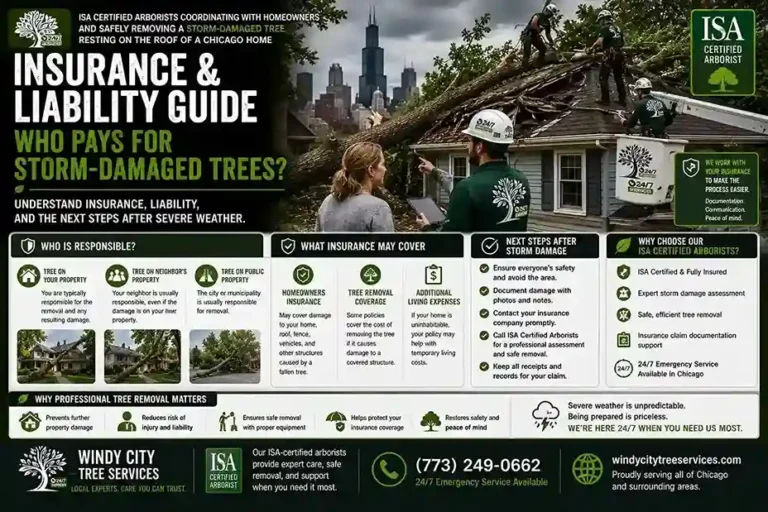
Will homeowner’s insurance cover storm-damaged tree removal?
Coverage varies by policy and situation, especially when a tree has damaged a structure. A written arborist assessment can support your claim, but you’ll need to confirm specific coverage details with your insurance provider.
Can lightning damage a tree without leaving visible signs?
Yes. Lightning can cause internal damage to a tree’s vascular system without an obvious external scar, which is why a tree struck by lightning should still be professionally assessed even if it looks fine.
How often should trees be inspected, even without a storm?
An annual health check is a reasonable baseline for most mature trees, with more frequent monitoring recommended for trees with known structural issues or trees near high-value targets like homes and driveways.
What is included bark and why does it matter?
Included bark forms when bark grows inward between two branches instead of forming a strong wood-to-wood union. It creates a structurally weak attachment point that’s more prone to splitting during storms.
Can a leaning tree be straightened?
A slight, long-standing lean that’s part of a tree’s natural growth pattern usually isn’t a concern. A new or rapidly worsening lean, especially with soil heaving at the base, is a serious warning sign that typically points toward removal rather than correction.
Should I remove a tree myself after a storm?
DIY removal of a storm-damaged tree is genuinely dangerous, especially with hidden internal stress, hanging limbs, or nearby power lines. Professional crews have the training and equipment to do this work safely.
Does Windy City Tree Services offer emergency storm response?
Yes. Our emergency tree removal team is available around the clock for hazardous storm damage throughout Chicago.
How do I schedule a storm damage inspection?
Call (773) 249-0662 or email info@windycitytreeservices.com to schedule a free, on-site assessment with one of our ISA Certified Arborists.
15. Key Takeaways
- Storm damage isn’t always visible. Hidden root and trunk damage can lead to delayed tree failure weeks or months later.
- Professional inspection follows a systematic root-to-canopy process, not a quick visual scan.
- Risk assessment weighs likelihood of failure, likelihood of impact, and potential consequences together, following ISA TRAQ principles.
- Whether a tree can be saved depends on species, age, prior health, and the type and extent of damage found.
- No inspection can guarantee a tree will never fail in the future. It can only reduce known, identifiable risk based on current condition.
- Prompt inspection after a storm protects your family, your property, and the long-term health of your trees.
Expert Storm Damage Tree Assessments in Chicago
A professional inspection can reveal hidden structural defects that homeowners may overlook after severe weather. Windy City Tree Services provides comprehensive storm damage assessments, tree risk evaluations, structural pruning, emergency tree removal, and long-term tree health care to help protect your family, property, and landscape.
☎️ (773) 249-0662 · 📧 info@windycitytreeservices.com
Windy City Tree Services is a full-service Chicago tree service staffed by ISA Certified Arborists offering professional tree inspections throughout the city. For a specific health concern, see our tree health inspection and treatment service, or explore tree removal, stump grinding and removal, and the rest of our tree care services.