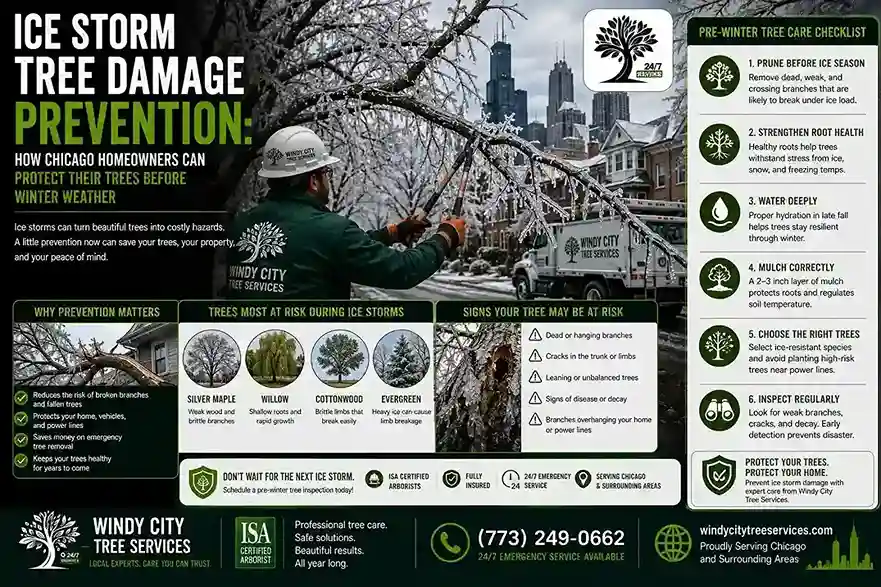
Ice Storm Tree Damage Prevention | Chicago Winter Care
Ice Storm Tree Damage Prevention: How Chicago Homeowners Can Protect Their Trees Before Winter Weather
Prepare your trees before winter weather strikes, with guidance from ISA Certified Arborists who prune and inspect trees across Chicago every winter.
Ice storms are one of the most destructive winter weather events a tree can face. Even a healthy, structurally sound tree can lose major limbs, or fail entirely, once heavy ice accumulates across its canopy. The damage often happens fast, and it frequently happens to trees that looked perfectly fine the day before.
Preventive maintenance before winter arrives is the single most effective tool homeowners have against this risk. Regular inspections and professional pruning cannot guarantee a tree will survive every storm, but they significantly lower the likelihood of branch failure, property damage, and the kind of emergency tree removal that costs far more than routine care ever would. This guide walks through how ice storms actually damage trees, how to spot a tree at high risk before winter hits, and exactly what to do, and not do, when the ice arrives.
How can you prevent tree damage during an ice storm?
Homeowners can reduce ice storm damage by scheduling professional tree inspections, removing dead or weak branches, improving tree structure through proper pruning, and supporting vulnerable trees with cabling or bracing where appropriate. Avoiding harmful practices such as topping also matters. Preventive care is most effective before winter weather arrives.
⚠️ Important Safety Note
No maintenance program can completely eliminate the risk of storm-related tree failure. Even well-maintained, healthy trees can be damaged during a severe ice event, especially when high winds add extra force. The goal of preventive care is to reduce risk significantly, not to guarantee a specific outcome.
Why Ice Storms Are So Damaging
Freezing rain is the specific weather event behind most severe tree damage in winter. Unlike snow, which falls as a solid and tends to shed off branches or pile with relatively predictable weight, freezing rain falls as liquid and freezes on contact with anything below freezing, including every twig, branch, and trunk surface it touches.
That process, ice accumulation, builds a solid coating around branches rather than a loose pile on top of them. Because ice wraps around the entire surface of a branch, even a coating that looks thin can add dramatic added branch weight once it covers the full length and surface area of a tree’s twigs and branches. Estimates commonly cited by arborists suggest that a modest ice coating can multiply a branch’s normal weight many times over.
Wind combined with ice makes an already dangerous situation worse. A branch that might hold steady under ice alone can fail once even moderate wind gusts add lateral force to an already overloaded limb. The combination frequently causes branch splitting at weak unions, and in more severe cases, trunk failure or root instability, where an entire tree can lean or topple if its root system cannot hold against the combined weight and wind load.
How Ice Forms on Trees
Freezing rain happens when rain falls through a layer of air below freezing near the ground, even though the precipitation started as rain higher in the atmosphere. Instead of freezing into snow or sleet before reaching the ground, the rain remains liquid until it strikes a cold surface, such as a tree branch, and freezes almost instantly on contact.
Ice thickness builds gradually as freezing rain continues, and even a relatively short duration event can leave a substantial coating if temperatures stay in the right range. Weight distribution across a canopy is uneven by nature. Branches with more surface area, more twigs, or a broader spread accumulate more ice than a single thick limb with fewer branching points, which is part of why crown shape and species matter so much to a tree’s ice storm outcome.
Wind loading adds a dynamic stress on top of the static weight of the ice itself, since a gust pushes against the added surface area created by the ice coating far more forcefully than it would against a bare branch. Repeated freeze-thaw cycles across a winter season add another layer of stress over time, since expanding and contracting ice and moisture inside cracks or wounds can widen existing weaknesses in bark or wood.
Ice wraps around the full surface of a branch, adding weight along its whole length. Wind then adds extra lateral force on top of that static load.
💡 Did You Know?
Because ice accumulates along the entire length and surface of a branch rather than piling on top of it the way snow does, even light freezing rain events can create loads that heavier wet snow sometimes does not, which is part of why ice storms are considered especially dangerous for trees.
Trees Most Vulnerable to Ice Damage in Chicago
Branch structure and wood strength are the two biggest factors that determine how well a tree holds up under ice. Species with brittle wood, weak branch unions, or a growth habit that packs on a lot of thin, twiggy branches tend to accumulate more ice and fail more easily than species with tougher wood and coarser branching.
| Species | Why It Is Vulnerable |
|---|---|
| Silver Maple | Brittle wood that snaps rather than bends under load |
| Bradford Pear | Tight, V-shaped branch unions with included bark prone to splitting |
| Willow | Fast-growing but structurally weak wood, prone to catastrophic limb failure |
| Ash | Already weakened wood in emerald ash borer-affected trees fails without warning |
| Cottonwood | Brittle wood and rapid growth combine for higher failure rates |
| American Elm | Broad crowns and weak branch attachments common in mature specimens |
| Birch | Thin bark and multi-trunked forms with included bark, especially prone to splitting |
| Pine | Retains needles year-round, accumulating more ice surface area than bare branches |
| Spruce | Similar year-round foliage retention increases ice load compared to deciduous trees |
| Ornamental Flowering Trees | Many share the same tight branch angles that make Bradford pear vulnerable |
Species with coarse branching, meaning fewer and thicker branches with less overall surface area, and wood known for flexibility rather than rigidity tend to fare better. Oaks, for instance, are generally considered more resistant thanks to strong branch attachments and durable wood, though even a resistant species can still fail under a severe enough ice load, particularly if the tree is already stressed, diseased, or has existing structural defects.
Warning Signs Before Winter
Dead branches are one of the clearest hazards a tree can carry into winter, since dead wood has already lost the flexibility that helps a living branch bend rather than break. Cracks in a trunk or major limb, even small ones, indicate a structural weak point that ice loading can widen into a full failure.
Weak branch unions, particularly ones with included bark where the connection between branch and trunk never fully solidified, are especially prone to splitting apart under added weight. Leaning trees deserve close attention too, since a lean can indicate root damage or instability that ice and wind loading will only make worse. Internal decay is harder to spot from the outside but often shows up as cavities, fungal growth at the base, or soft, punky wood revealed by a probe or sounding test. Previous storm damage that was never properly addressed, including torn bark or a poorly healed wound, often becomes the exact point where a tree fails during the next major event.
Structural Pruning Before Winter
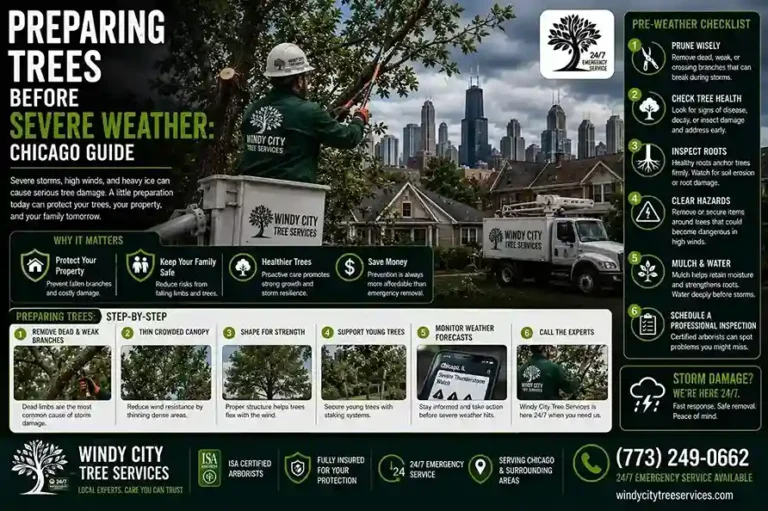
Structural pruning ahead of winter focuses on reducing the specific vulnerabilities that make a tree more likely to fail under ice. Weight reduction on long, overextended limbs lowers the leverage that both ice and wind can exert at the point where the branch meets the trunk.
Crown balancing addresses trees that have grown unevenly, correcting a canopy that is heavier on one side and therefore more prone to leaning or splitting under uneven load. Deadwood removal eliminates the branches most likely to fail first, since dead wood carries none of the flexibility living wood has. Improving branch spacing reduces the density of thin, closely packed branches that collectively catch and hold more ice than a well-spaced canopy. All of these techniques work toward the same underlying goal, reducing failure points, following ANSI A300 pruning standards that guide where and how much to cut without compromising the tree’s long-term health.
Crown Cleaning for Winter Safety
Crown cleaning removes the branches most likely to become a hazard once ice accumulates. Dead limbs are the top priority, since they carry no living flexibility and are essentially guaranteed to fail at some point once enough weight builds on them.
Broken branches from earlier in the year, if left unaddressed, often hang by a thread of remaining wood or bark, and that thread is exactly the kind of weak point ice loading exploits. Diseased wood similarly loses structural integrity as decay progresses, making it far more likely to snap under load than healthy tissue. Crossing branches that rub against each other create wounds over time that weaken the point of contact, and weak attachments throughout the canopy, wherever included bark or a poor union exists, are worth identifying and addressing before winter rather than after a storm has already made the decision for you.
Cabling and Bracing for High-Value Trees
Cabling and bracing give a structurally weak but otherwise valuable tree extra support at its most vulnerable point. Dynamic cabling uses a flexible synthetic system installed higher in the canopy that allows some natural movement while still limiting how far a weak union can spread under load.
Steel cabling, a more traditional rigid system, is typically installed to restrict movement more directly between two major limbs or leaders that share a weak union. Supplemental support systems like these are most often considered for large, mature, or historically or emotionally significant trees where removal is not the preferred option, but a real structural risk still exists. Not every tree is a good candidate. An arborist evaluates the tree’s overall health, the specific defect being addressed, and the tree’s surroundings before recommending a support system.
⚠️ Important Limitation
Cabling and bracing reduce risk, but they do not eliminate it, and they are not a substitute for proper pruning or, in some cases, removal. These systems should always be designed and installed by a qualified, ISA Certified Arborist who can assess whether a given tree is actually a good candidate for support.
Trees Near Homes, Driveways, and Power Lines
Roof clearance matters most for large limbs directly over a home, since ice-laden branches that fail above a roofline cause some of the most expensive and dangerous property damage of any storm event. Vehicle protection depends on similar logic, whether that means a driveway, a street parking spot, or a garage positioned beneath overhanging limbs.
Walkways used regularly by residents, delivery drivers, or pedestrians deserve particular attention, since a falling limb over a well-traveled path creates direct injury risk. Utility lines present one of the most serious hazards of all, both because a falling limb can cause an outage and because a branch resting against an energized line becomes dangerous in ways that are not always obvious from the ground. Neighboring properties matter too, since a tree that fails toward a shared fence line, a neighbor’s roof, or a neighbor’s parked car can create liability questions on top of the physical damage itself.
⚠️ Never Approach Power Lines
Homeowners should never attempt to remove ice-laden limbs anywhere near energized power lines. Contact your utility company immediately if you see a branch touching or resting on a power line, and treat any downed line as live until a utility crew confirms otherwise.
Winter Tree Inspection Checklist
ISA Certified Arborists follow a structured process when evaluating a tree’s readiness for winter, rather than a quick visual glance. Root systems are checked for signs of heaving, decay, or damage near the base of the trunk, since root problems often precede a visible lean.
Trunks are examined for cracks, cavities, and signs of decay, including fungal growth that can indicate internal weakness not obvious from a distance. Branch attachments throughout the canopy are checked specifically for included bark and other weak unions likely to fail under ice load. Canopy balance gets evaluated to identify any lopsided growth that concentrates weight unevenly. Soil conditions around the root zone factor into overall tree health and stability, particularly in urban settings where compaction is common. Finally, an arborist reviews any previous storm damage, checking that old wounds have healed properly and did not leave behind a hidden weak point.
What NOT to Do During an Ice Storm
⚠️ Avoid These Actions
- Do not shake tree branches to try to remove ice. Frozen wood is brittle and this often causes the exact failure you are trying to prevent.
- Do not hit limbs with a pole, bat, or any object to knock ice off. The sudden force can snap a branch that would have otherwise held.
- Do not climb an ice-covered tree for any reason. Icy bark and branches are extremely dangerous underfoot.
- Do not attempt DIY pruning during an active storm. Visibility, footing, and branch stability are all compromised.
- Do not park vehicles under damaged, leaning, or heavily ice-laden trees, even temporarily.
Ice-covered wood is far more brittle than the same wood at normal temperatures, which means the impulse to physically remove ice from branches almost always backfires. The safest approach during an active ice storm is to stay indoors, keep vehicles and people away from vulnerable trees, and let the ice melt naturally once temperatures rise.
What To Do After an Ice Storm
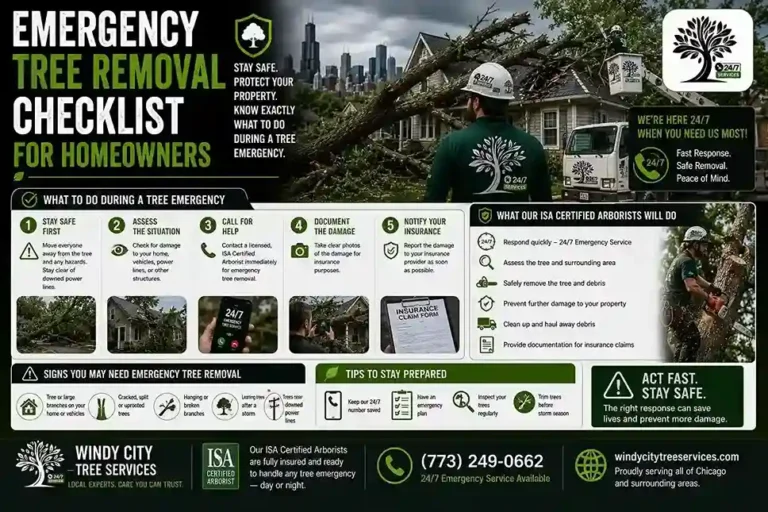
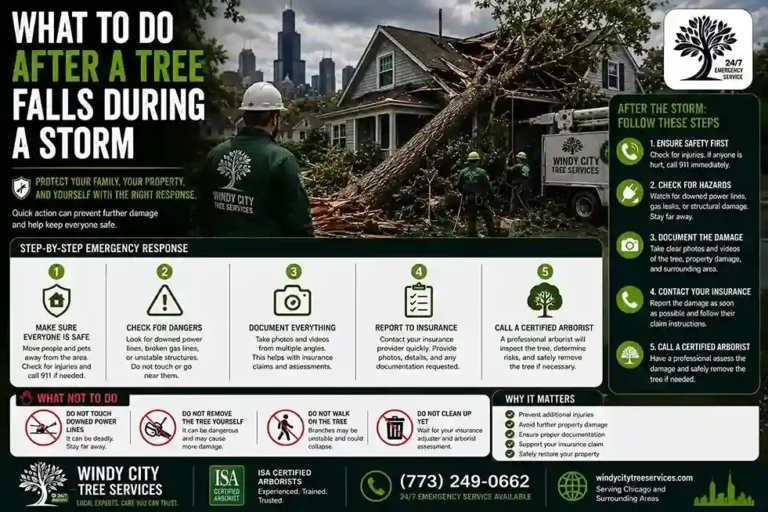
Stay away from hanging limbs first and foremost. A partially attached branch, sometimes called a widowmaker, can fall with no warning at all, even well after the storm has passed and the ice has started to melt.
Inspect from a safe distance rather than walking directly underneath a damaged canopy. Photograph any visible damage for your own records and for insurance purposes, capturing both the tree and any affected structures or vehicles. Contact emergency tree professionals for anything beyond minor, ground-level debris, since assessing a damaged tree’s remaining stability requires training most homeowners do not have. Schedule a full tree risk assessment once conditions are safe, even for trees that look fine, since hidden internal damage is common after a major ice event. Finally, monitor nearby trees for hidden damage over the following weeks, since some stress responses, including slow leaning or gradual dieback, take time to become visible.
Prepare Your Trees Before the Next Ice Storm
Preventive inspections and professional pruning can reduce the risk of winter tree failures and costly property damage.
📞 Schedule a Winter Tree Inspection (773) 249-0662Preparing Trees Year-Round
Winter readiness actually starts long before the first freeze. Annual inspections catch developing problems early, well before they become the kind of hazard that surfaces during a storm. Preventive pruning on a regular schedule keeps deadwood from accumulating and keeps a tree’s structure sound year after year.
Ongoing tree health care, including monitoring for pests and disease, supports the overall vigor that helps a tree resist stress of all kinds, storms included. Soil management and deep root fertilization address the below-ground conditions that are easy to overlook but directly affect a tree’s stability and resilience. Mulching supports moisture retention and root health, particularly for trees growing in Chicago’s compacted urban soils. Air spade root inspections let an arborist examine root health and correct issues like girdling roots without damaging the root system itself, supporting the kind of long-term stability that pays off most clearly during a severe winter storm.
Chicago’s Winter Weather Challenges
Chicago’s position near Lake Michigan creates distinctive winter weather patterns that directly affect tree risk. The interaction between lake-driven air and colder continental air masses contributes to the freezing rain events the National Weather Service tracks and warns about each winter across the region.
Heavy snow adds its own weight burden throughout the season, often compounding with ice in the same storm system. Freeze-thaw cycles, common in Chicago’s variable winter temperatures, stress trees repeatedly as moisture in cracks and wounds expands and contracts. High winter winds off the lake add force on top of any accumulated ice or snow, frequently pushing already-stressed limbs past their breaking point. Even Chicago’s urban heat island effect, which keeps city center temperatures slightly warmer than surrounding areas, plays a role, sometimes shifting precipitation type or timing in ways that affect which neighborhoods see the heaviest ice accumulation during a given storm.
Why Hire ISA Certified Arborists?
ANSI A300 standards give a certified arborist a consistent, professional framework for every pruning decision, ensuring cuts support the tree’s long-term structure rather than just addressing an immediate concern.
Tree Risk Assessment, guided by principles from the ISA Tree Risk Assessment Qualification, gives arborists a structured way to evaluate the likelihood and consequences of a tree failing, rather than relying on guesswork. Safe climbing and rigging techniques matter enormously for winter work specifically, since ice-covered trees present real hazards that require specialized training and equipment to manage safely. Winter tree care expertise means understanding how dormancy, freezing temperatures, and ice loading interact, knowledge that general landscaping crews typically do not have. Proper equipment, from aerial lifts to specialized rigging gear, allows safe work in conditions that would be genuinely dangerous for an untrained homeowner. Insurance coverage protects the property owner if anything goes wrong during the job, a critical consideration during winter work when conditions are already more hazardous than average.
Prepared Trees vs. Unmaintained Trees
| Feature | Professionally Maintained | Unmaintained |
|---|---|---|
| Ice Resistance | Improved through weight reduction and balanced structure | Higher risk from excess weight and uneven canopy |
| Dead Branches | Removed proactively before winter | Often present and prone to early failure |
| Structural Integrity | Weak unions identified and addressed | Hidden defects go unaddressed until failure |
| Risk of Failure | Meaningfully reduced, though never zero | Significantly higher during severe ice events |
| Property Protection | Fewer hazards positioned over roofs, driveways, lines | Greater exposure to falling limb damage |
| Winter Safety | Lower likelihood of emergency, after-hours response | Higher likelihood of storm-related emergencies |
Winter Tree Maintenance Calendar
| Season | Recommended Services |
|---|---|
| Fall | Full inspection, deadwood removal, structural pruning, mulching |
| Early Winter | Final pre-freeze inspection, cabling or bracing installation if needed |
| Mid-Winter | Storm monitoring, emergency response after ice or heavy snow events |
| Late Winter | Dormant-season structural pruning while trees are still leafless |
| Spring Inspection | Post-winter health check, storm damage follow-up, fertilization planning |
A general winter maintenance timeline. Actual scheduling depends on species, tree condition, and current weather patterns.
Ice Storm Damage? We Can Help.
If winter weather has damaged your trees, our ISA Certified Arborists provide safe emergency tree removal, storm cleanup, and tree risk assessments throughout Chicago.
Request Emergency Tree ServiceIce Storm Preparation Checklist
Work through this list each fall, well before the season’s first hard freeze, to lower your property’s risk heading into winter.
- Schedule a professional inspection with a certified arborist
- Remove dead branches identified during the inspection
- Trim hazardous limbs positioned over the roof, driveway, or walkways
- Inspect any existing support cables for wear or damage
- Keep trees appropriately trimmed away from structures
- Identify emergency tree service contacts ahead of time
- Monitor weather forecasts closely as winter storms approach
- Avoid parking beneath large trees during active ice events
Frequently Asked Questions
How do ice storms damage trees?
Freezing rain coats branches in ice, adding enormous extra weight. That added load, combined with wind, causes branches to bend, split, or snap, and can pull entire trees over at the roots.
Should I remove ice from tree branches?
No. Shaking, hitting, or knocking ice off branches almost always causes more damage than leaving it alone, since frozen wood is brittle. Let ice melt naturally and call a professional if a limb looks like it is about to fail.
Which trees are most vulnerable to ice damage?
Species with brittle wood or weak branch unions are most vulnerable, including silver maple, Bradford pear, willow, American elm, ash, and river birch. Evergreens also accumulate more ice since they retain foliage through winter.
Can pruning reduce ice storm damage?
Yes. Removing deadwood, correcting weak unions, and reducing excess weight on long limbs before winter significantly lowers the chance of failure, though no amount of pruning eliminates risk entirely.
Should trees be inspected before winter?
Yes. A pre-winter inspection identifies deadwood, cracks, weak unions, and structural issues while there is still time to address them, rather than discovering a hazard after an ice storm has already caused damage.
What should I do after an ice storm?
Stay well away from hanging or broken limbs, inspect your trees only from a safe distance, photograph any visible damage, and contact a professional tree service for an assessment before attempting cleanup yourself.
Can cabling prevent branch failure?
Cabling and bracing can reduce the risk of failure in a structurally weak but otherwise valuable tree. It reduces risk but does not eliminate it and should always be designed by a qualified arborist.
Should I remove hanging limbs immediately?
Not yourself. A hanging limb, sometimes called a widowmaker, can fall without warning and is extremely dangerous to approach. Contact a professional tree service with the right equipment and training.
Are evergreens more susceptible to ice damage?
In some ways, yes. Because evergreens keep their needles through winter, they have more surface area to catch and hold ice compared to bare deciduous branches.
When should I call an arborist?
Call before winter for a preventive inspection, and call immediately after any storm that causes visible damage, leaning, or hanging limbs. Cracks, cavities, or dead branches at any time also warrant a professional look.
Can a healthy tree fail during an ice storm?
Yes. Even a structurally sound, healthy tree can lose limbs or fail entirely under a severe enough ice load, especially when wind adds extra force. Preventive care lowers the odds but cannot guarantee survival.
How much weight can ice add to a tree branch?
Even a modest coating of ice, around a quarter to half an inch, can add many times a branch’s normal weight once it covers the twigs, leaves, and branch surface throughout the canopy.
Is it safe to walk near trees during an ice storm?
No. Ice-covered branches can fail without warning, and falling limbs are a leading cause of injury during winter storms. Stay indoors or well clear of tree canopies until the storm passes.
What is included bark, and why does it matter for ice storms?
Included bark forms when bark grows inward between two branches meeting at a tight angle, creating a weak connection. Branches with included bark are far more likely to split under the added weight of ice.
Can I prune my own trees before winter?
Small, low branches on young trees can often be pruned safely by a homeowner. Structural pruning on a mature tree, especially anything requiring a ladder or work near power lines, should be left to a professional.
Does mulching help trees survive winter storms?
Mulching supports root health and moisture retention, contributing to a tree’s overall vigor. A healthier tree with a strong root system is generally better equipped to withstand storm stress.
Why do trees fail even after they survive the ice itself?
Wind is often the deciding factor. A tree can hold significant ice weight in calm conditions, but even moderate wind gusts add extra force that can push a strained branch past its breaking point.
How does Chicago’s climate make ice storms more likely?
Chicago’s position near Lake Michigan creates conditions where warm and cold air masses frequently interact in winter, contributing to freezing rain events tracked by the National Weather Service each season.
What is a tree risk assessment?
A tree risk assessment is a structured evaluation, following principles from the ISA Tree Risk Assessment Qualification, that examines a tree’s health, structure, and surroundings to estimate the likelihood and consequences of failure.
Can insurance cover ice storm tree damage?
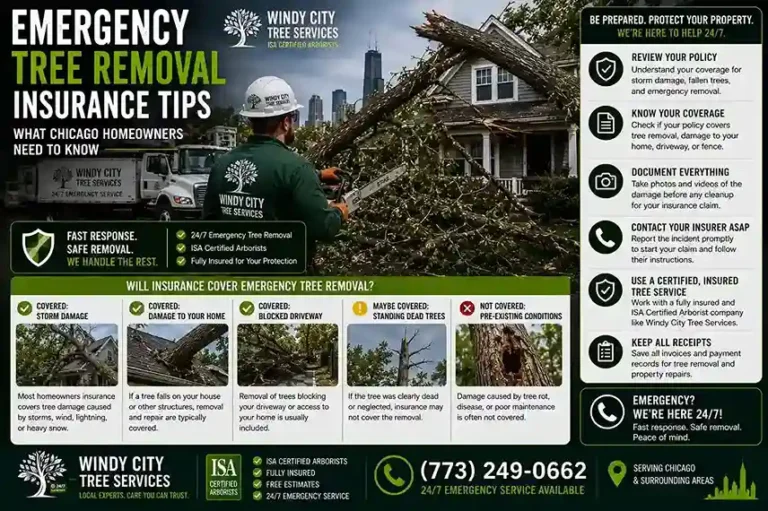
Often, yes, particularly when a tree falls and damages a covered structure like a home, garage, or fence. Coverage details vary by policy, so document damage thoroughly and contact your insurer.
Related Tree Care Guides
Winter Tree Pruning Benefits
Read the guide →Tree Trimming Before Storm Season
Read the guide →Common Reasons Trees Fail During Chicago Storms
Read the guide →What to Do After a Tree Falls During a Storm
Read the guide →Emergency Tree Removal Checklist for Homeowners
Read the guide →Tree Removal After Lightning Damage
Read the guide →Safe Tree Removal Near Homes and Power Lines
Read the guide →Benefits of Structural Pruning for Young Trees
Read the guide →Crown Cleaning, Crown Raising & Crown Reduction Explained
Read the guide →10 Signs a Tree Is Dangerous on Your Property
Read the guide →Ready to prepare your trees for winter? Our Chicago Tree Service team of Winter Tree Care Experts and Certified Arborists is ready to help, from a routine pre-winter inspection to emergency response after the storm.
Professional Winter Tree Care & Ice Storm Preparation in Chicago
Ice storms can place tremendous stress on trees, but proactive care helps reduce risk. Windy City Tree Services provides professional winter inspections, structural pruning, cabling and bracing, emergency tree removal, and year-round tree care tailored to Chicago’s challenging climate.