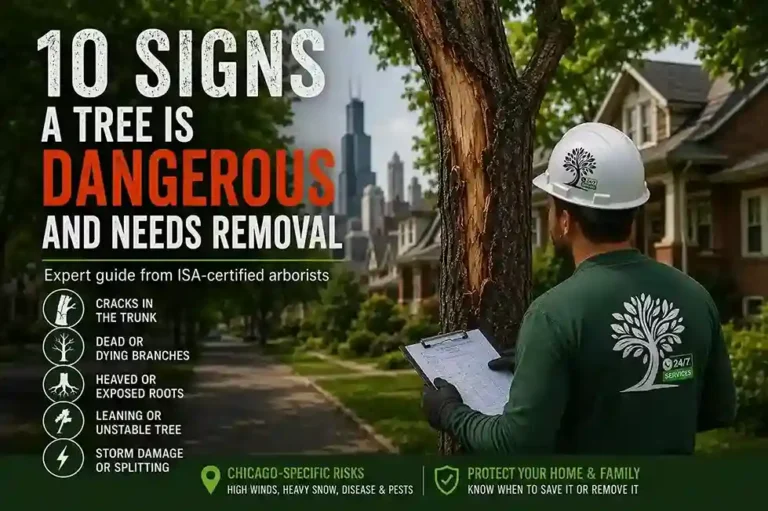
Common Reasons Trees Fail During Chicago Storms (And How to Prevent It)
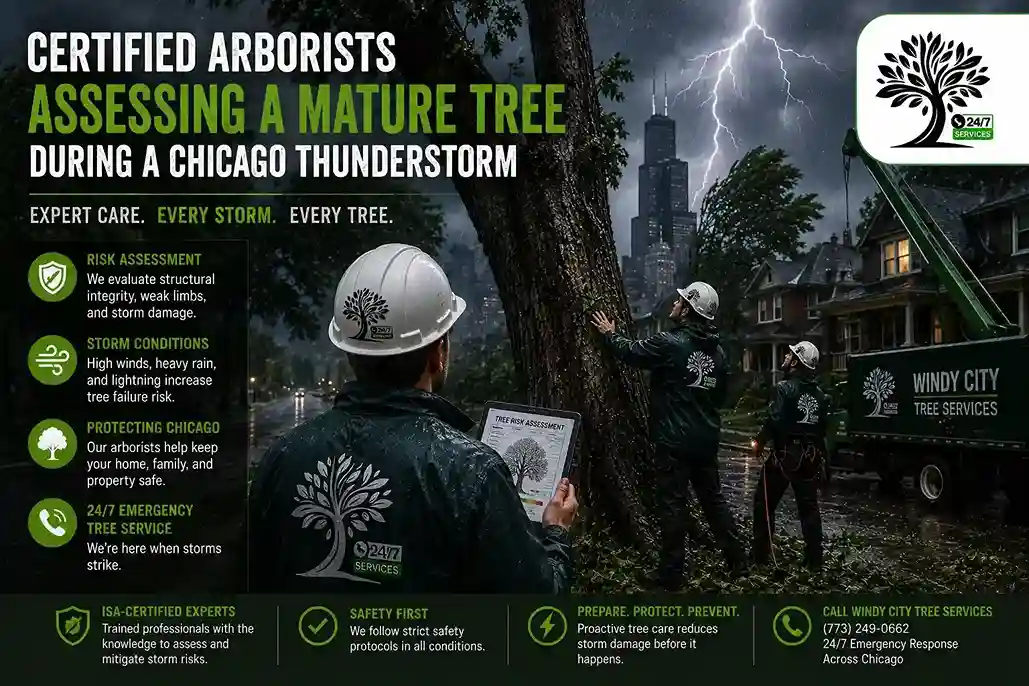
Chicago doesn’t get a quiet storm season. Between summer thunderstorms rolling off the plains, straight-line winds that snap branches without warning, and winter ice loads that turn a healthy canopy into a hazard overnight, local trees take a beating almost every month of the year.
Here’s the part that surprises most homeowners: a tree can look completely fine and still come down in a storm. The damage that actually causes failure, decay inside the trunk, a compromised root system, a weak branch union, is often invisible from the ground. You water the lawn, mow around the trunk, maybe rake the leaves, and never see the problem building underneath.
The good news is that most tree failures aren’t random. They follow patterns that a trained eye can catch well before a storm ever arrives. This guide breaks down exactly why trees fail in Chicago, what warning signs to watch for, and what you can do now to reduce the risk before the next severe weather event.
Why do trees fail during Chicago storms? Tree failure is usually caused by a combination of structural defects, root problems, internal decay, storm intensity, saturated soil, poor pruning history, and species-specific weaknesses. Most failures involve a pre-existing weakness that storm winds simply expose. Regular inspections and preventive care from a certified arborist significantly reduce the risk.
1. How Chicago Weather Affects Trees
Chicago sits in a spot that stacks several kinds of severe weather on top of each other over the course of a year. Summer brings fast-moving thunderstorms and straight-line wind events, sometimes strong enough to mimic tornado damage even without a confirmed touchdown. Heavy rain saturates soil quickly, especially in the city’s clay-heavy ground. Winter swaps that for ice accumulation and wet, heavy snow, both of which load extra weight onto branches that were never designed to carry it.
Lake Michigan adds its own layer on top. Wind funneling off the lake hits waterfront and near-lake neighborhoods harder than inland areas, and that exposure compounds over years, gradually stressing trees that face it season after season.
Urban trees also deal with stress that rural trees rarely see. Compacted soil from sidewalks and driveways, restricted root space, reflected heat from pavement, and root damage from utility work all chip away at a tree’s structural reserves. A tree already weakened by urban stress has a lot less margin left when a storm shows up.
3. Weak Root Systems
Roots are a tree’s anchor, and root problems are one of the most common reasons trees uproot entirely during storms rather than just losing a limb. Root rot, soil compaction, restricted root zones from nearby paving, and poor drainage all reduce how firmly a tree is anchored in the ground.
Construction damage is a frequent, underrated cause. Trenching for utilities, grading changes, or heavy equipment driving over root zones can sever or crush roots that took decades to grow, and the tree may show no visible symptoms for a year or more afterward.
Because root problems happen underground, they’re notoriously hard to diagnose without disturbing the soil. That’s where Air Spade root excavation comes in. Using compressed air instead of a shovel, an arborist can expose the root system without damaging it, making it possible to spot rot, girdling roots, or construction injury that would otherwise stay hidden until the tree goes down.
4. Dead or Diseased Trees
Disease doesn’t just kill a tree, it weakens the wood structurally long before the tree is fully dead. In Chicago, a handful of diseases and pests show up again and again:
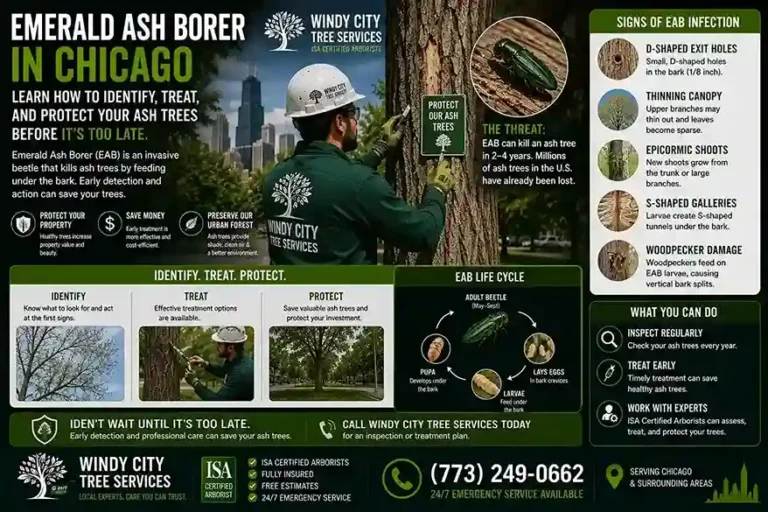
- Emerald Ash Borer (EAB). This invasive beetle has devastated the city’s ash population over the past two decades. Ash trees killed by EAB become brittle and prone to sudden limb failure remarkably fast.
- Oak Wilt. A fungal disease that blocks a tree’s water-conducting tissue, causing rapid canopy decline, especially in red oak species.
- Dutch Elm Disease. Still a threat to Chicago’s surviving elm population, though disease-resistant cultivars have helped slow its spread.
- Cankers. Localized areas of dead bark and wood that weaken the specific limb or trunk section where they form.
- Advanced decline. A tree doesn’t need a named disease to be structurally compromised; general decline from age, stress, or repeated damage has the same weakening effect.
A dead or severely diseased tree loses the flexibility that lets healthy wood bend in the wind. Instead, it snaps. That’s part of why dead trees are disproportionately represented in storm damage reports.
5. Poor Tree Structure
Some trees are built to fail long before any storm hits, simply because of how they grew. Co-dominant stems, where two trunks of similar size grow from the same point instead of one dominant leader, create a naturally weak union. When bark grows inward between those stems instead of forming a solid connection, arborists call it included bark, and it’s one of the most common failure points in storm-damaged trees.
Multiple trunks, weak branch unions, and other structural defects share the same underlying issue: the wood connecting two major sections of the tree isn’t as strong as the wood within each section. Under normal conditions, that might never matter. Under storm-force wind loading, it’s often exactly where the tree splits.
6. Large Dead Limbs
Arborists sometimes call large dead branches “widow makers” for a reason. A big limb can hang in a canopy looking stable for months, then drop without warning the moment wind or added weight pushes it past its breaking point.
Wind loading during a storm puts direct pressure on every branch in the canopy, and dead wood, already brittle and disconnected from the tree’s living support system, is the first to go. Snow loading works the same way in winter, adding weight that a healthy branch could handle but a dead one can’t.
Removing large dead limbs proactively through professional tree trimming is one of the simplest, most cost-effective ways to reduce storm risk on an otherwise healthy tree.
7. Poor Pruning Practices
Bad pruning doesn’t just look rough. It actively increases storm risk, sometimes for years after the cuts were made. A few practices to watch for if a tree on your property has been pruned before:
- Topping. Cutting main branches back to stubs forces weak, fast-growing regrowth that’s poorly attached and prone to breaking in future storms.
- Flush cuts. Cutting too close to the trunk removes the branch collar the tree needs to seal the wound properly, inviting decay into the trunk itself.
- Lion tailing. Stripping interior foliage and leaving growth only at branch tips shifts weight outward, increasing leverage and wind stress on each limb.
- Improper branch removal. Cuts made at the wrong angle or location can leave stubs that die back and create new entry points for decay.
Proper pruning follows ISA Best Management Practices and ANSI A300 standards, which specify correct cut locations, timing, and the maximum amount of live canopy that should be removed in a single season. A poorly pruned tree today can become tomorrow’s storm damage claim.
8. Oversized Tree Canopies
A dense, overgrown canopy acts like a sail in high wind. The more surface area a canopy presents, the more force the wind transfers into the trunk and root system, a phenomenon arborists sometimes just call the sail effect.
Unbalanced canopies make this worse. A tree with most of its weight concentrated on one side, often from growing toward a light source or losing limbs on the opposite side, creates uneven leverage that’s more likely to fail in a specific direction. Excessive end weight, heavy growth concentrated at the tips of long branches, adds the same kind of leverage problem on individual limbs.
Selective, structural pruning that reduces canopy density and rebalances weight distribution helps a tree flex with wind instead of fighting it, which is exactly what keeps healthy trees standing through storms that take down poorly maintained ones nearby.
9. Saturated Soil
Heavy rainfall doesn’t just stress a tree’s roots directly, it changes how firmly the whole root system holds the tree in place. Saturated soil loses much of its structural strength, which means roots that normally anchor a tree solidly can shift or pull loose entirely when wind hits a tree standing in waterlogged ground.
Chicago’s clay-heavy soils make this worse than sandier soil would. Clay drains slowly, so it stays saturated longer after a storm, extending the window where a tree’s anchoring is compromised. Flooding and standing water add to the problem, and repeated saturation cycles can also lead to long-term soil erosion around the root zone.
This is part of why so many trees uproot, rather than snap, during wet, windy storms. The wood itself might be perfectly healthy. The ground underneath it just isn’t holding on anymore.
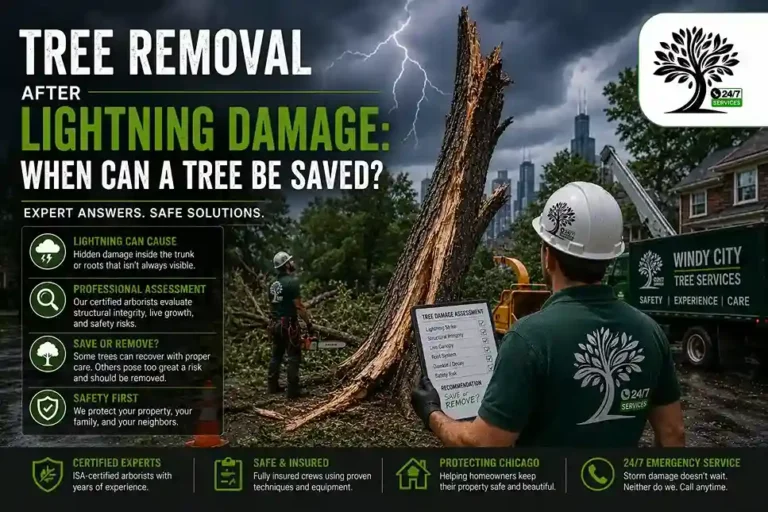
10. Lightning Damage
A direct lightning strike can split bark, blow out sections of trunk, or in severe cases, kill a tree outright. But some of the most dangerous lightning damage isn’t visible right away.
Internal damage from a strike can heat sap and moisture inside the trunk fast enough to cause hidden cracking or tissue death that doesn’t show up on the surface. A tree can survive a strike and appear to recover, only to decline gradually over the following months or years as that hidden injury compromises its structure.
If a tree on your property has been struck by lightning, even if it still looks healthy, it’s worth having a certified arborist evaluate it. Long-term decline from lightning injury is a real pattern, not just an occasional exception.
11. Tree Species Most Vulnerable in Chicago
Species matters, but it’s not the whole story. A well-maintained tree of a “weaker” species can outlast a neglected tree of a naturally stronger one. That said, certain species common in Chicago tend to show up more often in storm damage:
- Silver Maple. Fast growing but structurally weak wood, prone to branch failure and splitting.
- Bradford Pear. Notorious for narrow branch angles and included bark, which lead to whole-canopy splitting in wind and ice.
- Ash. Structurally decent when healthy, but Chicago’s ash population has been devastated by Emerald Ash Borer, leaving many standing trees dead and brittle.
- Cottonwood. Large, fast-growing, and prone to dropping big limbs with little warning.
- Willow. Soft, weak wood that breaks easily under wind and ice loading.
On the other end, species that generally hold up better in storms, when healthy, include White Oak, Bur Oak, Swamp White Oak, and Kentucky Coffeetree, all valued in Chicago’s urban forestry programs partly for their structural durability. That said, condition and maintenance history matter as much as species. A poorly maintained oak can still fail, and a well-cared-for silver maple can outperform expectations.
12. Warning Signs Before a Tree Fails
Most tree failures give some kind of warning, even if it’s subtle. Here’s what to watch for:
- A lean that’s new or getting more pronounced, especially if it developed quickly
- Cracks in the trunk or major limbs
- Soil lifting or cracking near the base, a sign roots may be pulling loose
- Mushrooms or fungal growth at the base of the trunk or on exposed roots
- A canopy that’s partially or fully dead while nearby trees are still leafed out
- Bark loss or large areas of missing bark
- Visible cavities or hollow sections in the trunk
- Branches that have already fallen without an obvious cause
Any single item on this list is worth a professional look. More than one at the same time is a strong signal to schedule an inspection before the next storm, not after.
13. What to Do Immediately After a Storm
- Stay away from damaged trees. A tree that’s partially failed can still come down further without warning.
- Avoid downed power lines completely. Treat every downed line as energized until a utility crew confirms otherwise, and keep pets and kids away from the area.
- Document the damage. Photos help with insurance claims and give an arborist useful context before they arrive.
- Contact emergency services if necessary. A tree blocking a road, touching power lines, or resting on a structure with people inside warrants an emergency call, not a wait-and-see approach.
- Schedule an arborist inspection. Even trees that look fine after a major storm can have hidden new damage worth checking.
- Avoid DIY removal. Storm-damaged trees are under unpredictable tension and are one of the more dangerous situations in tree work, even for experienced homeowners with the right tools.
14. Preventing Storm Damage
Most of what causes tree failure is preventable, or at least manageable, with the right maintenance schedule. The core pieces:
- Annual inspections. A yearly check from a certified arborist catches problems while they’re still small and fixable.
- Structural pruning. Correcting weak branch unions and reducing canopy density while a tree is young prevents many failures decades later.
- Cabling and bracing. Physical support systems reduce movement in weak unions on large, valuable trees worth preserving.
- Air Spade root inspections. Catching hidden root problems before they become uprooting risks.
- Deep root fertilization. Improving overall tree vigor makes a tree more resilient to storm stress generally.
- Disease management. Early treatment of infections like oak wilt or cankers limits how much structural damage they cause.
- Storm prep services. A dedicated pre-storm-season assessment focused specifically on wind and load resistance.
15. Emergency Tree Removal
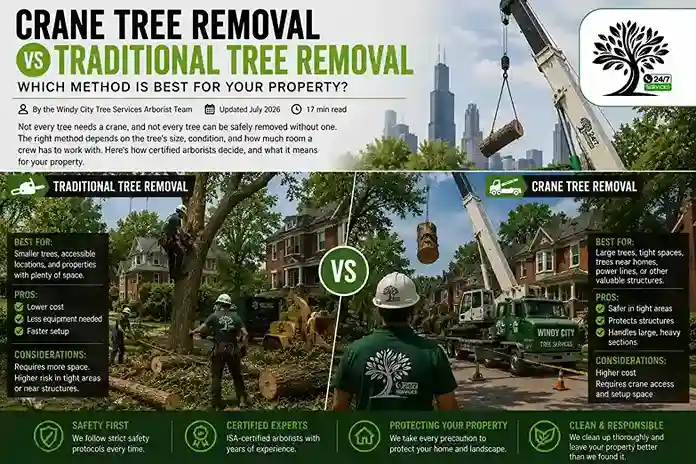
Sometimes prevention comes too late, and immediate removal is the only safe option. That’s typically the case when a tree has already partially failed, is actively leaning onto a structure, or is blocking access to a home or road.
Emergency removal follows strict safety protocols: securing the area, assessing remaining tension and load in the damaged tree, and using the right rigging and equipment to bring it down in sections rather than letting gravity finish the job unpredictably.
If the damage affected your home or another structure, document everything for your insurance company before cleanup begins, and keep any invoices from the tree service, since many policies cover storm-related tree removal when it’s damaged property. A licensed, insured emergency tree removal crew can also provide the documentation insurers typically request.
16. Chicago-Specific Storm Challenges
A few local factors make Chicago’s storm risk a bit different from a generic Midwest suburb. Lake Michigan’s weather patterns bring both stronger straight-line wind events near the shoreline and lake-effect snow that can dump heavy, wet accumulation quickly in winter.
Downtown high-rises create wind tunnel effects that funnel and accelerate gusts through narrow corridors between buildings, a factor that matters for trees planted near the city’s denser commercial blocks. Narrow residential lots throughout the city mean trees often grow close to homes, garages, and fences, so even moderate failures can cause real property damage.
Mature neighborhood canopy, especially in historic districts with century-old trees, adds real character to the city but also real risk, since older trees have had more time to accumulate the kind of decay and structural issues covered earlier in this guide. Ice storms and heavy snow loads round out the list, adding a second major stress season on top of summer’s severe thunderstorms.
Cause of Failure, Warning Signs & Prevention
| Cause of Tree Failure | Warning Signs | Prevention |
|---|---|---|
| Internal decay | Cavities, conks/mushrooms, soft wood near old wounds | Regular inspections; sonic/resistance testing when suspected |
| Weak root system | Lean, soil cracking or lifting, thinning canopy | Air Spade evaluation; avoid soil compaction near root zone |
| Disease or dead wood | Canopy dieback, bark loss, cankers, brittle limbs | Early disease treatment; prompt removal of dead trees |
| Poor branch structure | Co-dominant stems, tight V-shaped unions, visible cracks at unions | Structural pruning while young; cabling for mature trees |
| Large dead limbs | Bare, brittle branches with no live growth | Routine deadwood removal via professional trimming |
| Poor pruning history | Stub cuts, dense regrowth at cut points, topped branches | Hire ISA-certified arborists following ANSI A300 standards |
| Saturated soil | Standing water, visible root heaving after heavy rain | Improve drainage; monitor after prolonged rainfall |
| Lightning strike | Bark splitting, scorch marks, gradual post-strike decline | Post-strike arborist evaluation; lightning protection systems for high-value trees |
Storm Readiness Checklist
Before storm season ramps up, work through this list for every mature tree on your property:
- Schedule a professional inspection with a certified arborist.
- Remove dead limbs before they become falling hazards.
- Inspect roots, or request an Air Spade evaluation for trees showing lean or dieback.
- Monitor any leaning trees closely, especially new or worsening leans.
- Check for decay, including fungal growth at the base of the trunk.
- Install cabling or bracing on large trees with weak unions worth preserving.
- Update your emergency contacts, including a trusted tree service, before severe weather hits.
Frequently Asked Questions
Why do healthy-looking trees fall in storms?
Many trees that look healthy from the outside have hidden internal decay, root damage, or structural weaknesses that only become apparent under the extreme force of storm winds.
Can wind uproot a completely healthy tree?
It’s uncommon but possible in extreme wind events, especially in saturated soil. Most uprooting failures, though, involve some pre-existing root weakness or compromised soil condition.
Should a leaning tree always be removed?
Not always. Some trees have a natural, long-standing lean that’s stable. A new or rapidly increasing lean is a more serious warning sign and should be evaluated by a certified arborist right away.
Does pruning actually reduce storm damage?
Yes. Removing dead wood and reducing canopy density lowers wind resistance and weight, which directly reduces the load a tree has to withstand during a storm.
What should I do if lightning strikes a tree on my property?
Keep people and pets away from the tree, and have a certified arborist evaluate it, even if it looks fine. Hidden internal damage from a strike can cause gradual decline over months or years.
Are dead trees actually dangerous, or just unsightly?
Dead trees are genuinely dangerous. Dead wood loses the flexibility that lets healthy branches bend in wind, so it tends to snap and fall with little warning.
Which tree species fail most often in Chicago storms?
Silver maple, Bradford pear, ash (especially EAB-killed trees), cottonwood, and willow show up disproportionately in storm damage due to weaker wood or structural tendencies. Maintenance and condition still matter as much as species.
Does homeowners insurance cover storm-damaged trees?
It depends on the policy and the specifics. Coverage is more likely when a tree damages a structure, and less likely for standing tree removal alone. Check directly with your insurer.
When should I call an arborist instead of waiting?
Call promptly if you notice a new lean, cracks, fungal growth at the base, large dead limbs, or a canopy that’s declining faster than nearby trees. These are all signals worth checking before, not after, the next storm.
Can a tree recover after storm damage?
Many trees do recover from moderate damage, especially broken limbs, with proper pruning and follow-up care. Trees with major trunk splits or significant root failure are less likely to recover safely.
How often should I have my trees inspected?
An annual inspection is a reasonable baseline for most mature trees, with additional checks after any major storm or visible change in the tree’s condition.
What is a tree risk assessment?
It’s a structured evaluation, following ISA methodology, that examines a tree’s condition, site factors, and potential targets to categorize its likelihood of failure and the consequences if it did fail.
Is cabling a permanent fix for a weak tree?
Cabling reduces movement and risk at a weak union, but it’s a support measure, not a permanent structural fix. Cabled trees still need periodic reinspection.
Why does soil type matter for storm risk?
Clay-heavy soils common in Chicago drain slowly and stay saturated longer after rain, which weakens root anchoring for an extended period compared to faster-draining soils.
Can construction near my property damage tree roots?
Yes. Trenching, grading, and heavy equipment can sever or compact roots, and symptoms often don’t appear until a year or more later, sometimes as sudden failure during a storm.
What is topping, and why is it a problem?
Topping means cutting main branches back to stubs. It forces weak, poorly attached regrowth that’s more likely to fail in future storms, and it’s considered outside accepted arboricultural best practice.
Do I need to worry about trees near power lines during storms?
Yes, significantly. A tree or limb contacting a power line during a storm creates both a fire and electrocution risk. This work should always go through a professional, coordinated with the utility company.
How much does storm damage tree removal typically cost?
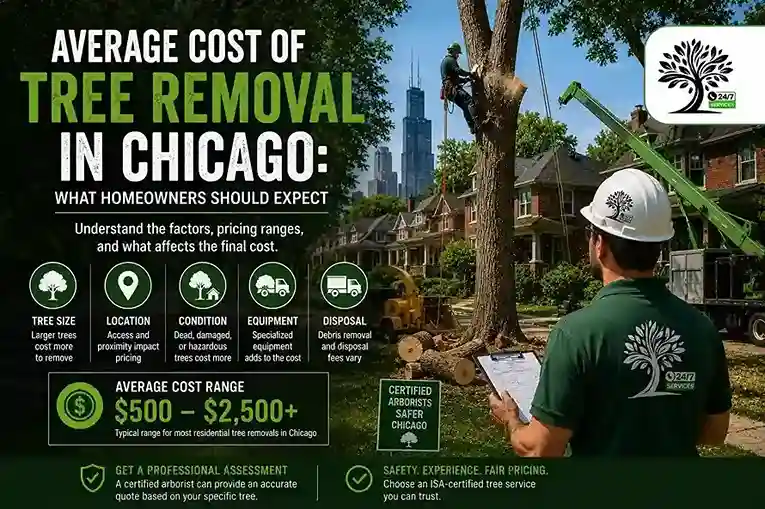
Costs vary widely based on tree size, damage severity, and accessibility. A free on-site estimate is the most reliable way to get an accurate number for your specific situation.
Can I remove a fallen tree myself?
It’s not recommended. Storm-damaged trees are often under unpredictable tension, and cutting into them without proper training and equipment is genuinely dangerous, even for small trees.
What’s the single most important thing I can do before storm season?
Schedule a professional inspection. Most of the causes covered in this guide, decay, weak roots, poor structure, dead limbs, can be identified and addressed before they turn into an emergency.
Sources & Further Reading
- International Society of Arboriculture (ISA), Best Management Practices & Tree Risk Assessment
- ANSI A300 Tree Care Standards
- USDA Forest Service, Urban Forestry Resources
- Arboriculture & Urban Forestry Journal, Risk Assessment Research
This article is provided for general educational purposes and is not a substitute for an on-site professional evaluation. Every tree and property is different; schedule an inspection for guidance specific to your situation.