Emergency Tree Removal Checklist for Homeowners, Chicago, IL
Storm Response · Chicago Emergency Guide
Emergency Tree Removal Checklist for Homeowners
Stay safe, protect your property, and know exactly what to do during a tree emergency.
A fallen tree, a split trunk, or a limb resting on a power line changes the rules. Here’s exactly what to do, step by step, before help arrives.
Introduction
Tree emergencies never come with a warning. A wind gust, a lightning strike, a heavy snow load, or simply years of hidden decay can bring a large limb, or an entire tree, down in seconds. What happens in the minutes right after matters as much as anything a professional crew does later.
Storms, straight-line winds, ice, and root failure are the most common triggers we see across Chicago, and every one of them can create a genuinely dangerous situation, not just a messy one. A tree resting on a power line, a split trunk still under tension, or a limb hanging loosely overhead are all live hazards, not cleanup jobs.
A clear plan, worked out before disaster strikes, measurably reduces the odds of injury and unnecessary property damage. Knowing what to check, what to avoid, and when to call for professional emergency tree removal turns a chaotic moment into a manageable one.
This guide gives you a complete, step-by-step checklist for before, during, and after a tree emergency, plus a printable version you can keep on hand. It also explains exactly when a situation calls for a trained crew rather than a homeowner with a chainsaw.
During a tree emergency, homeowners should prioritize personal safety first: stay away from fallen trees and any downed power lines, secure the area, and contact emergency services or the utility company if there’s an electrical hazard. Document the damage for insurance, then hire an ISA Certified Arborist for safe removal. Hazardous trees should never be removed by untrained individuals.
1. What Is Considered a Tree Emergency?
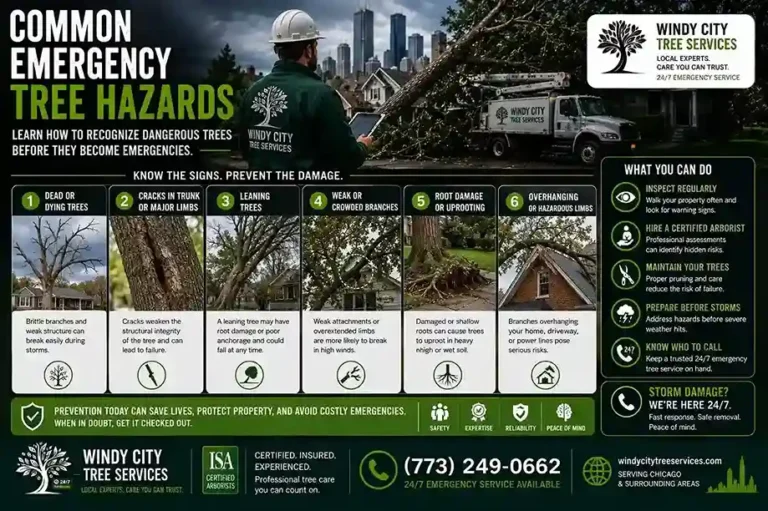
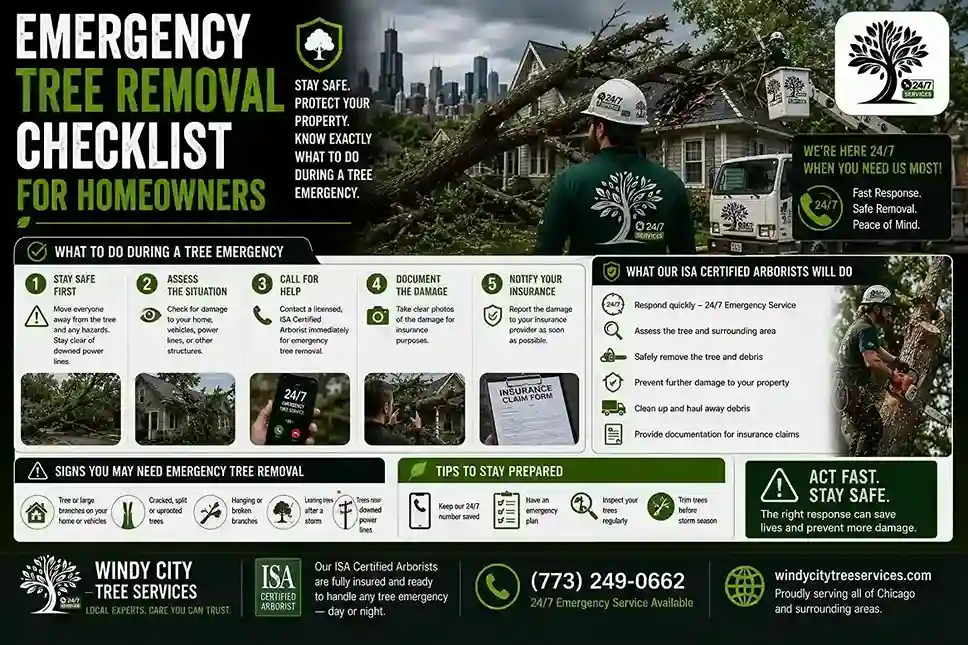
Not every fallen branch is an emergency, but several situations clearly are:
- Tree fell on house: Structural risk to the building, and possibly to people inside.
- Tree fell on vehicle: Risk of fuel leaks, broken glass, and further shifting weight.
- Leaning tree: A sudden or worsening lean often signals root failure already in progress.
- Split trunk: A partially failed trunk can still be under significant tension.
- Hanging limbs: Broken branches caught in the canopy above, sometimes called “widowmakers,” that can fall without warning.
- Root failure: Visible soil heaving or exposed roots at the base signal the tree may topple further.
- Tree blocking a driveway or roadway: An access and safety issue, especially if emergency vehicles need the route.
- Storm damage: Broken limbs, torn bark, or partial uprooting from wind or ice.
- Lightning damage: A direct strike can compromise a tree’s structural integrity even without visible collapse.
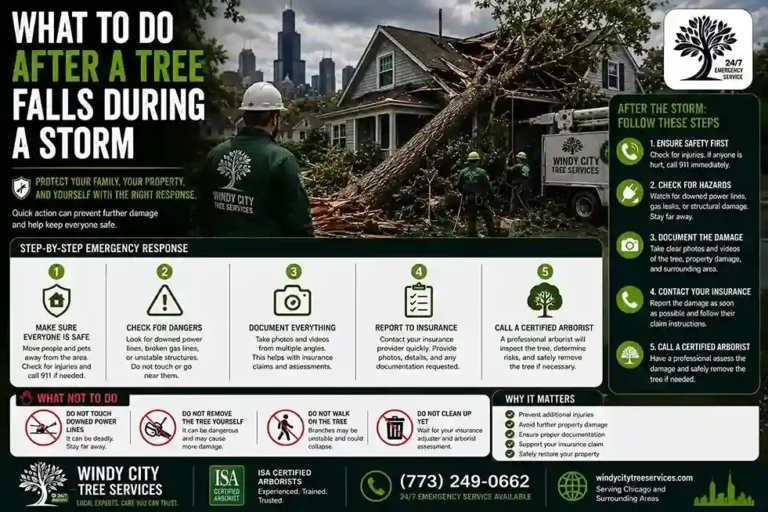
2. Emergency Checklist: The First 5 Minutes
- Stay calm. Clear thinking in the first few minutes prevents most avoidable injuries.
- Check for injuries to yourself, family members, or anyone nearby.
- Call 911 immediately if anyone is injured, trapped, or if the situation involves a downed power line.
- Evacuate unsafe structures if a tree has compromised the roof or walls of your home.
- Stay away from the damaged tree itself — it may still be shifting or under tension.
- Avoid power lines completely, whether they’re on the ground or tangled in branches.
- Keep pets and children away from the area until it’s been assessed by a professional.
3. Secure the Area
Once immediate safety is confirmed, the next step is containing the hazard so no one wanders into it.
- Safety perimeter: Keep a wide buffer around the tree, especially in the direction it could still fall or shift.
- Warning tape or cones: Mark the area clearly, particularly if it’s visible from a sidewalk or street.
- Vehicle relocation: Only move vehicles if it’s clearly safe to do so without approaching the hazard directly.
- Neighbor notification: Let neighbors know if the tree or debris affects a shared property line or view from their yard.
- Utility hazards: Treat any tree in contact with wiring as energized until the utility company confirms otherwise.
4. Watch for Electrical Hazards
Critical Safety Warning
- Downed power lines should be treated as live at all times, even if they appear dead or the power seems out.
- Energized branches touching a power line can carry current through the whole tree, including the ground around it.
- Utility poles that are leaning or damaged should be given a wide berth.
- Transformers near a fallen tree can pose additional fire or electrical risk.
- Generator safety: Never run a generator indoors or in an enclosed space, and never connect one directly to your home’s wiring without a proper transfer switch.
Never approach or attempt to move a tree that is touching an energized line. Call 911 and your utility company immediately, then wait at a safe distance for confirmation the line is de-energized.
5. Document Everything
Good documentation now makes the insurance process significantly smoother later.
- Photos from multiple angles of the tree, the damage, and the surrounding area.
- Videos that capture the full scope of the damage in context.
- Roof damage, including any visible penetration, missing shingles, or structural sag.
- Fence damage along the affected property line.
- Vehicle damage, photographed before anything is moved if it’s safe to do so.
- Landscaping impacted by the fall, including gardens, irrigation, and hardscape.
- Time stamps on every photo and video, either automatic or noted separately.
- Written notes describing what happened, when, and any relevant weather conditions.
Did You Know?
FEMA’s disaster preparedness guidance recommends documenting damage before any cleanup or repairs begin, since insurers and disaster assistance programs generally rely on this documentation to process claims accurately.
6. Contact Your Insurance Provider
- Homeowners insurance often covers tree removal when the tree damages a covered structure, though routine removal of a healthy tree typically isn’t covered.
- Auto insurance, specifically comprehensive coverage, often applies if a tree falls on a vehicle.
- Emergency mitigation: Many policies cover reasonable steps taken to prevent further damage, like tarping a roof, but keep receipts and documentation.
- Claims process: Report the incident promptly and follow your insurer’s specific documentation requirements.
- Adjuster visits: An adjuster may need to inspect the damage before certain repairs proceed.
- Temporary repairs: Tarps or boarding are usually acceptable and often expected before a full repair is scheduled.
Coverage always depends on your specific policy, the cause of the damage, and your insurer’s terms. This is general information, not insurance advice — confirm details directly with your provider.
7. Call a Professional Emergency Tree Service
Emergency tree work is not the place to save money with an unlicensed crew or a DIY attempt. Look for:
- ISA Certified Arborists trained in hazard assessment and safe removal techniques.
- Fully insured contractors carrying general liability and workers’ compensation coverage.
- Specialized equipment suited to the specific hazard, whether that’s a tree on a roof or one tangled in power lines.
- Crane operators for situations where sectional rigging alone isn’t safe or practical.
- Emergency response teams available outside normal business hours, since storms rarely wait for daylight.
Ask about licensing, insurance, and experience with emergency conditions specifically, not just routine tree work. Emergency removal involves unpredictable loads and tension that require real judgment.
8. What NOT to Do
Do Not Attempt These Actions
- Climbing damaged trees: Compromised wood can fail unpredictably under any added weight.
- DIY chainsaw work on large limbs or trunks: Improper technique on tensioned wood is a leading cause of serious tree-related injuries.
- Pulling trees with vehicles: This can cause sudden, uncontrolled movement and has caused serious accidents.
- Standing beneath hanging limbs: A “widowmaker” can fall with no warning at all.
- Entering damaged homes before a structural assessment, especially if the roof or walls show visible compromise.
- Cutting tensioned branches without training, since stored energy can release violently and unpredictably.
- Working near utilities of any kind without utility company confirmation that lines are de-energized.
Following OSHA’s general work-zone safety guidance, professional crews train specifically for these hazards. A homeowner without that training faces meaningfully higher injury risk attempting the same tasks.
9. How Emergency Tree Removal Works
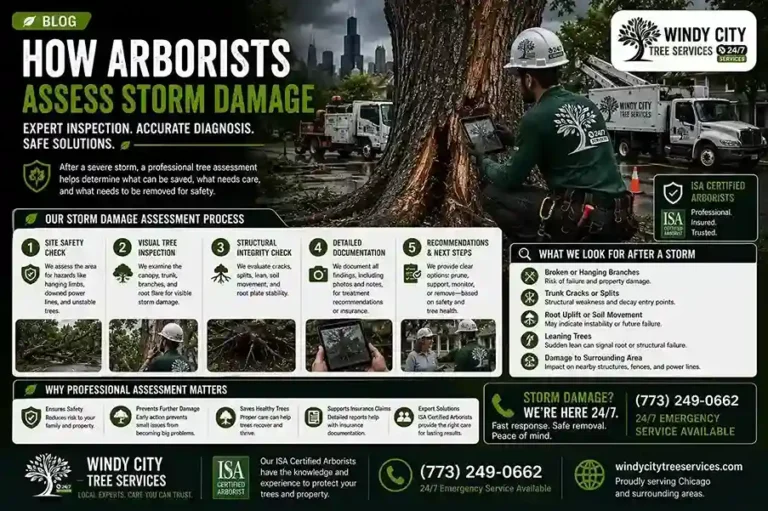
- Initial inspection: Arriving crews assess the full hazard before touching any equipment.
- Hazard assessment: Following ISA Tree Risk Assessment Qualification (TRAQ) principles to evaluate load, tension, and failure risk.
- Utility coordination: Confirming with the utility company that any involved lines are de-energized before work begins.
- Site protection: Marking work zones and protecting remaining structures and landscaping.
- Rigging plan: Determining how to safely release tension and control each section as it’s cut.
- Crane removal, if needed: Used for particularly large, hazardous, or hard-to-access situations.
- Debris removal: Clearing cut sections and brush from the property.
- Stump options: Discussing whether stump grinding is part of the immediate job or a follow-up service.
- Final cleanup: A full site walkthrough before the crew leaves.
10. Hidden Damage After Tree Failures
The visible damage is often only part of the story.
- Root plate movement: A partially uprooted tree can leave disturbed soil that affects nearby structures or utility lines.
- Soil instability: Heaved or loosened soil near the root zone can remain unstable for some time.
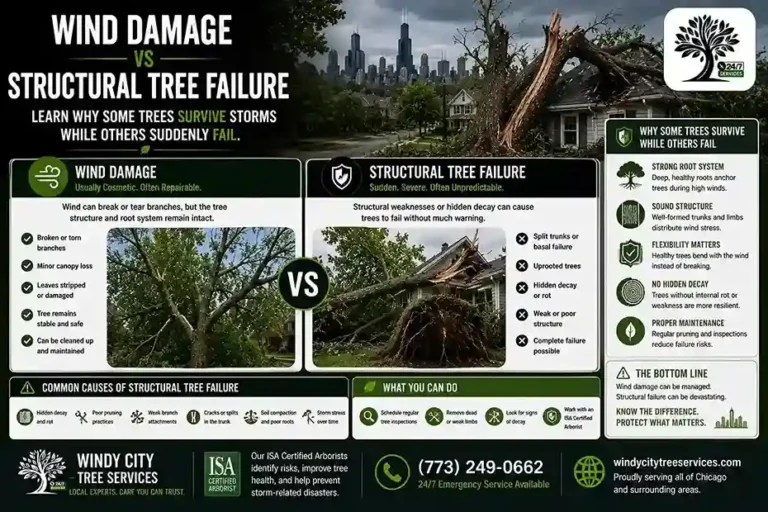
- Trunk fractures: Internal cracking isn’t always visible from the outside immediately after a failure.
- Neighboring tree damage: A falling tree can crack or wound trees nearby, creating a second problem that gets missed in the initial cleanup.
- Underground utility risks: Root systems can be intertwined with buried lines, which a professional inspection can help identify.
- Internal decay: Sometimes the original cause of the failure, and worth understanding for the trees still standing nearby.
11. How to Prevent Future Emergencies
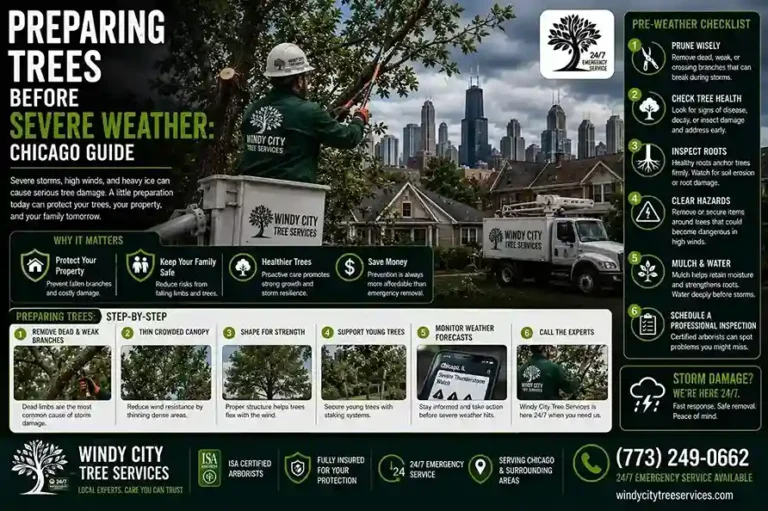
- Annual inspections: Catching structural weaknesses before they become emergencies.
- Structural pruning: Correcting weak branch unions well ahead of storm season.
- Deadwood removal: Eliminating the branches most likely to fail under wind or ice load.
- Cabling and bracing: Supporting weak unions that can’t be corrected through pruning alone.
- Tree health monitoring: Ongoing awareness of disease, pests, or decline that could compromise structural integrity.
- Storm preparation: Scheduled pruning ahead of Chicago’s high-risk storm seasons.
- Preventive maintenance: A consistent schedule that catches small problems before they become large ones.
12. Chicago Weather and Tree Emergencies
- Thunderstorms: A leading cause of sudden limb failure and downed trees across the region each year.
- Straight-line winds: Can cause damage comparable to weaker tornadoes across a wide area.
- Heavy snow: Rapid, heavy accumulation adds significant, sudden weight to canopies.
- Ice storms: Among the most damaging events for tree structure in the Chicago region.
- Tornadoes: Less frequent than straight-line wind events but capable of catastrophic, concentrated tree damage.
- Lake Michigan weather influences: Lakefront exposure creates higher wind loads in some neighborhoods than others.
The National Weather Service issues advance warnings for many of these events, and signing up for local alerts is one of the simplest ways to get ahead of a tree emergency before it happens.
13. Emergency Tree Removal Equipment
| Equipment | Role in Emergency Response |
|---|---|
| Bucket trucks | Rapid canopy access without climbing, useful for street-facing hazards |
| Cranes | Lifting large, unstable, or hard-to-access sections safely |
| Rigging systems | Controlling tensioned or partially failed sections during cutting |
| Chainsaws | Sectioning limbs and trunk material once tension is controlled |
| Wood chippers | Processing brush and debris on-site for rapid cleanup |
| Climbing gear | Accessing canopy sections that trucks or cranes can’t reach |
| Personal protective equipment (PPE) | Helmets, chainsaw chaps, eye and ear protection for the entire crew |
Emergency Response Flowchart
15. Printable Emergency Tree Removal Checklist
Emergency Tree Removal Checklist
Before the Crew Arrives
- Ensure everyone is safe and accounted for
- Stay away from hazards, including the tree itself
- Call the utility company if power lines are involved
- Photograph and video all visible damage
- Contact your insurance provider
- Gather emergency contact information for your household
During Removal
- Stay well outside the marked work zone
- Keep pets inside and secured
- Follow all crew instructions immediately
- Do not approach equipment or cut material
After Removal
- Inspect remaining trees on the property
- Schedule preventive pruning for storm season
- Save all invoices and documentation
- Complete any remaining insurance paperwork
- Plan a future tree maintenance schedule
Safe Response vs. Unsafe Response
| Safe Actions | Unsafe Actions |
|---|---|
| Call professionals | Attempt DIY removal of large or hazardous trees |
| Stay away from power lines | Touch or move electrical wires |
| Photograph damage from a safe distance | Climb a damaged or unstable tree |
| Secure the area with tape or cones | Allow children or pets near debris |
| Wait for professional clearance | Enter a structurally unstable building |
Emergency Contact Checklist
| Contact | Reason to Call |
|---|---|
| 911 | Injuries, downed power lines, or immediate life-safety risk |
| Electric utility company | Any tree contact with power lines, poles, or transformers |
| Insurance company | Reporting damage and starting the claims process |
| Emergency tree service | Safe assessment and removal of the hazardous tree |
| Roofing contractor | Structural damage assessment and temporary repairs |
Frequently Asked Questions
A tree fallen on a structure or vehicle, a leaning or split trunk, hanging limbs, contact with power lines, or any tree posing an immediate safety risk all qualify as emergencies.
Not if it’s large, under tension, near a structure, or anywhere close to power lines. Untrained removal attempts are a leading cause of serious tree-related injuries.
Treat it as energized no matter what it looks like. Call 911 and your electric utility immediately, and stay far away until they confirm the line is de-energized.
Often, if the tree damaged a covered structure or vehicle. Coverage depends on your specific policy, so confirm details directly with your insurer.
Reputable emergency tree services typically aim to respond within hours for genuine hazards, especially those blocking access or threatening a structure.
Sometimes, if the lean is minor and caught early. A sudden or worsening lean often signals root failure, which usually means removal is the safer path.
Ensure everyone’s safety, stay away from hazards, contact the utility company if needed, photograph the damage, and reach out to your insurance provider.
Only if the structure hasn’t been compromised. If a tree has damaged your roof or walls, evacuate the affected area until a professional confirms it’s structurally safe.
Depending on the situation, crews may use bucket trucks, cranes, rigging systems, chainsaws, wood chippers, and full personal protective equipment.
Yes. A fallen tree can damage or destabilize trees nearby, and the same storm conditions that brought one tree down may have weakened others on the property.
Cost depends on tree size, hazard level, and equipment needed, such as a crane. Many companies offer free estimates for non-emergency follow-up work.
Only outdoors, well away from windows and doors, and never connected directly to home wiring without a proper transfer switch. Generator misuse is a leading cause of carbon monoxide poisoning after storms.
It’s still worth prompt professional attention, especially if it limits emergency vehicle access, but it typically carries lower urgency than a tree touching a structure or power line.
Yes. Root plate movement, soil instability, and internal trunk fractures aren’t always visible immediately and are worth a professional assessment after any major failure.
Emergency hazard removal is typically handled differently than routine removal permitting, but requirements can vary. A local tree service can advise on your specific situation.
Emergency removal addresses an immediate hazard, often under time pressure and unpredictable conditions. Routine removal is planned in advance with a full inspection and standard scheduling.
Call 911 if there’s an injury, a downed power line, or an immediate life-safety concern. For non-urgent fallen trees, a certified emergency tree service is the appropriate call.
Visible leaning, cracking sounds, exposed or heaved roots, and hanging limbs are all signs a tree remains hazardous. When in doubt, stay away and have a professional assess it.
The tree itself, all affected structures, vehicles, fencing, and landscaping, along with wide shots showing the full context of the damage.
Learn more from our Chicago Tree Service homepage, meet our Certified Arborists, and see our full Emergency Tree Experts team. Related services include emergency tree removal, tree removal, tree trimming & pruning, tree cabling & bracing, tree health inspections, storm prep & support systems, stump grinding, air spade root excavation, and commercial tree service.