Who Pays for Storm Damaged Trees? A Homeowner’s Guide
Before you read further: Insurance coverage, liability, and legal responsibility vary by insurance policy, local law, property ownership, and the specific facts of each incident. This article provides general, educational information only, not legal or insurance advice. Always review your policy and talk with your insurer or a qualified attorney about your specific situation.
A storm rolls through, and by morning a tree that stood for decades is lying across your yard, your roof, or worse, your neighbor’s fence. Once everyone’s safe, the next question is almost always the same: who’s actually paying for this?
The honest answer is that it depends on a few specific factors: where the tree landed, who owns the property that was damaged, whether negligence played a role, and exactly what your insurance policy says. Most homeowners have never read the fine print on tree damage until the moment they need it.
This guide walks through how storm-damaged tree claims generally work, what typically happens in the most common scenarios, and what to do in the hours and days after a tree comes down. Acting quickly and documenting everything is often the single biggest factor in how smoothly a claim goes.
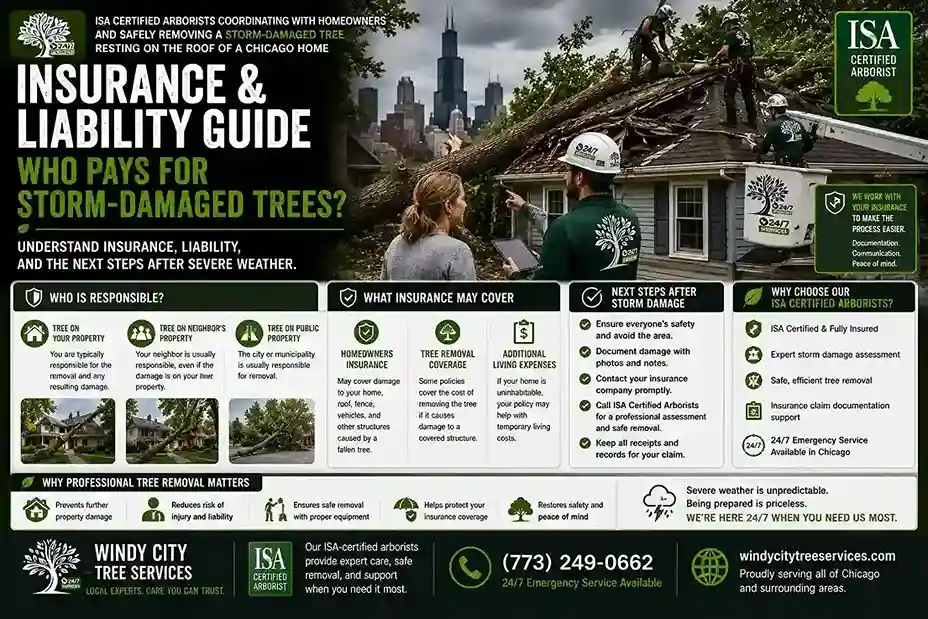
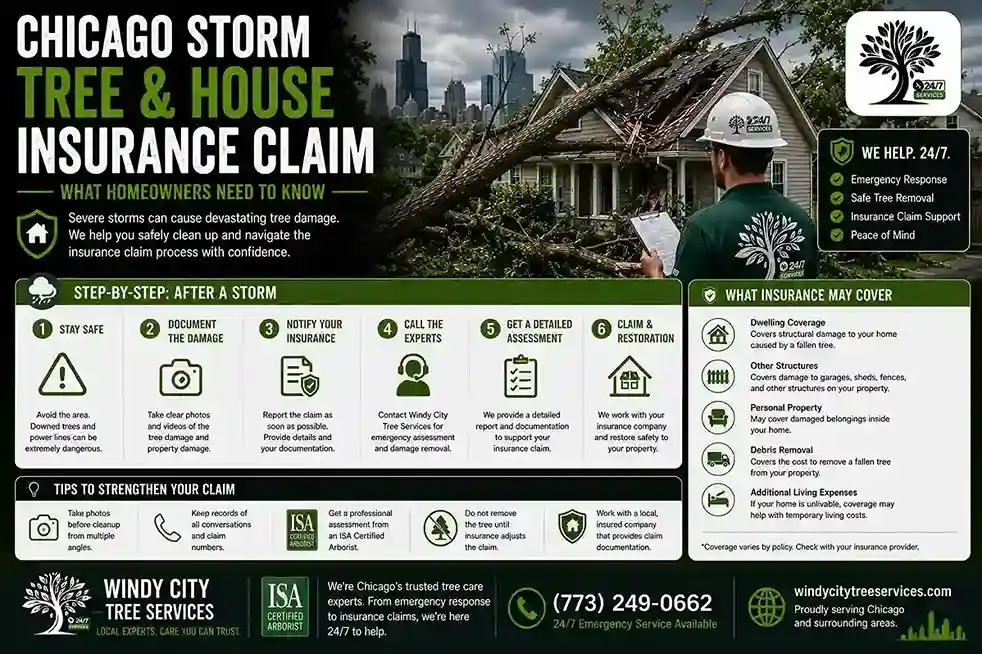
Who pays for storm-damaged trees? Responsibility generally depends on where the tree fell, who owns the damaged property, whether negligence contributed to the failure, and the terms of the applicable insurance policies. In many storm-related cases, each property owner’s own insurance covers damage to their insured property, regardless of whose tree caused it, though exceptions can apply. Review your policy and speak with your insurance provider for guidance specific to your situation.
1. How Storm-Damaged Tree Insurance Typically Works
Most standard homeowners insurance policies cover damage from what insurers call “covered perils,” which usually includes windstorms and other severe weather events. When a tree falls due to a storm and damages your home or another insured structure, that damage is typically treated the same as any other storm-related claim.
A few concepts show up in nearly every policy:
- Deductibles. You’ll generally pay the deductible amount out of pocket before insurance coverage kicks in for the rest.
- Tree removal coverage. Many policies include limited coverage for removing a fallen tree, but often with a modest cap, sometimes a few hundred to around a thousand dollars, separate from structural repair coverage.
- Policy limitations. Coverage almost always requires that the tree damaged an insured structure. A tree that simply falls in your yard without hitting anything is frequently treated as a homeowner maintenance issue rather than an insurable loss.
- The claims process. Filing typically involves reporting the loss, an adjuster reviewing the damage, and an agreed scope of repair or replacement before payment is issued.
Coverage details vary meaningfully by insurer and by policy, so the details above are general patterns, not guarantees. The National Association of Insurance Commissioners (NAIC) and the Illinois Department of Insurance both offer consumer resources if you want to understand your specific coverage better.
2. If Your Tree Falls on Your Own House
If a tree on your property, whether it’s your tree or one that’s technically your responsibility, falls on your own home during a storm, your homeowners policy is typically the first place to look. This applies whether the damage hits the roof, the garage, a fence, or a shed, since most policies cover both the main dwelling and “other structures” on the property, often under separate coverage limits.
After the damage is stabilized, a few practical steps matter:
- Cleanup. Debris removal is often included, sometimes up to a specific dollar cap, as part of the same claim.
- Temporary repairs. Tarping a roof or boarding a window to prevent further damage is usually expected by insurers, and reasonable costs for doing so are often reimbursable. Keep every receipt.
- Insurance documentation. Photograph everything before cleanup begins, and again as work progresses.
3. If Your Neighbor’s Tree Falls on Your Property
This is the scenario that surprises the most homeowners. In many storm-related cases, if a healthy tree from a neighbor’s yard falls onto your property due to wind or another weather event, your own homeowners insurance is typically the policy that responds, not your neighbor’s. Insurers commonly refer to this as an “act of nature,” and the general industry pattern is that each property owner’s insurance covers damage to their own insured property.
That said, this isn’t an absolute rule. If it can be shown that the tree was already dead, diseased, or otherwise hazardous, and the neighbor knew or reasonably should have known about the risk, their liability coverage may come into play instead. Negligence is the key variable, not simply which yard the tree started in.
Good communication with your neighbor still matters here, even when insurance is handling the financial side. A quick, friendly conversation about what happened and how each of you is proceeding tends to prevent the kind of dispute that turns a storm cleanup into a lasting neighborhood conflict.
General Pattern
Storm-related fall, no known prior hazard: your own insurance typically covers your damage. Known dead or hazardous tree, ignored: neighbor’s liability coverage may apply instead. Always confirm with your insurer, since policy language varies.
4. If Your Tree Falls on Your Neighbor’s Property
The same general pattern applies in reverse. If your tree falls on your neighbor’s property during a storm and there’s no indication of prior neglect, your neighbor’s own insurance is typically what responds to their damage, following the same “each property covers its own” logic described above.
Where this can change is tree ownership and known condition. If you were aware the tree was dead, severely diseased, or structurally compromised and didn’t address it, you could carry more direct responsibility, potentially through your liability coverage, if that neglect can be shown to have contributed to the failure.
Documentation helps regardless of which side of the fence you’re on. If you’ve had a tree inspected or maintained proactively, records of that inspection can support your position if a dispute ever comes up. This is one more reason routine tree health inspections pay for themselves beyond just tree care.
5. What If a Dead or Hazardous Tree Was Ignored?
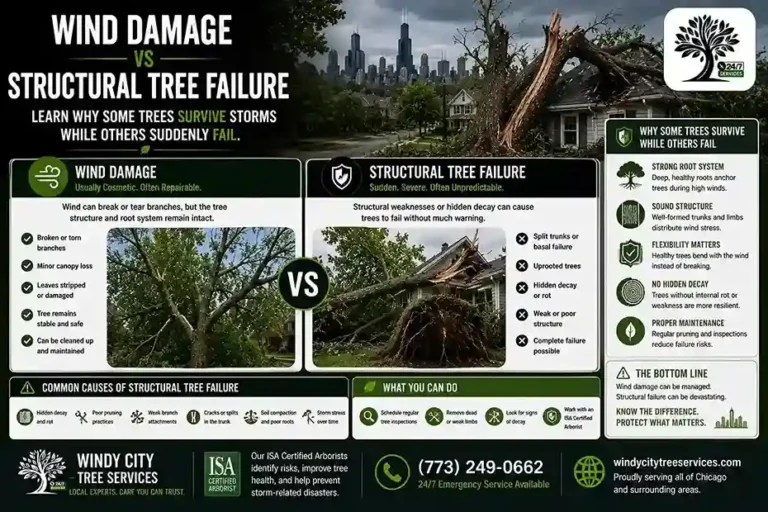
This is where “act of nature” protection tends to break down. If a tree was visibly dead, had documented structural defects, or a property owner had received a prior warning about its condition and took no action, that can shift the situation from a weather event to a negligence question.
Common factors that can weigh into a negligence determination include:
- Whether the tree showed obvious, visible signs of hazard (large dead sections, visible decay, an existing lean)
- Whether the property owner had prior notice, from a neighbor, an inspection, or a city notice
- Whether reasonable action was available and simply wasn’t taken
Legal outcomes in these situations depend heavily on the specific facts, state and local law, and the language of the applicable insurance policies. This is genuinely a case where consulting an attorney or your insurer directly is the right move, not general online guidance. What’s worth noting from a prevention standpoint: regular inspections create the kind of documented history that helps demonstrate reasonable care was taken, regardless of how a specific storm event plays out.
6. Fallen Trees on Vehicles
Vehicle damage from a fallen tree follows a different insurance path entirely. Homeowners insurance generally does not cover vehicle damage. Instead, comprehensive auto coverage, an optional part of most auto policies, typically handles tree damage to a car, whether it happened in your driveway, a parking lot, or on a public street.
If you only carry liability auto coverage, without comprehensive, tree damage to your vehicle likely won’t be covered, regardless of whose tree it was or where the car was parked. This is worth checking now, before a storm, rather than finding out during a claim.
7. Trees Blocking Roads or Sidewalks
When a tree comes down across a public street or sidewalk, response responsibility generally shifts toward the municipality, at least for the immediate safety and access issue. City crews typically prioritize clearing travel lanes and coordinating with emergency services and utility companies if power lines are involved.
Removal of the tree itself, along with any cost, can still depend on whether the tree was on public or private property, which loops back to the ownership questions covered earlier in this guide. Procedures and response times vary by jurisdiction, so if a downed tree is blocking public access, reporting it to the city (in Chicago, typically through 311) is the right first step alongside your own insurance process.
8. Trees on Power Lines
A tree that’s fallen onto or is resting against power lines is a genuine emergency, not just a property damage situation. Treat every downed or entangled line as energized, and keep people and pets well away from both the tree and the surrounding area until the utility company confirms it’s safe.
Utility companies, ComEd in the Chicago area, handle de-energizing and clearing lines themselves. Never attempt to move, cut, or otherwise interact with a tree that’s touching power lines, even if it seems like a small branch. Once the utility confirms the area is safe, a licensed emergency tree removal crew can safely finish clearing the tree itself.
9. What Insurance Companies Usually Want
Insurance adjusters work from documentation, and the more organized yours is, the smoother the process tends to go. Common items insurers ask for include:
- Photos and videos of the damage, ideally taken before any cleanup or repair begins
- Damage reports describing what was affected and the extent of the damage
- Receipts for any emergency mitigation work, like tarping or temporary repairs
- Estimates from licensed contractors for repair or removal costs
- Records of emergency mitigation you performed to prevent further damage
- An arborist report, when available, documenting the tree’s condition and cause of failure
10. How ISA Certified Arborists Help Insurance Claims
A certified arborist’s documentation can carry real weight in a claims process, especially in cases where the cause of failure or the tree’s prior condition is relevant. Specific ways an arborist can help:
- Hazard assessments. A professional evaluation of whether the tree showed signs of prior decline before the storm.
- Tree condition reports. Written documentation of species, size, health, and structural condition.
- Damage documentation. Photos and notes taken specifically for insurance purposes, in addition to whatever you capture yourself.
- Removal estimates. A clear, itemized cost estimate that adjusters can review directly.
- Professional recommendations. Guidance on next steps for any remaining trees on the property that may also need attention after a storm.
11. Common Insurance Mistakes Homeowners Make
- Delaying documentation. Waiting even a day or two to photograph damage can mean losing details that matter for the claim.
- Throwing away debris too soon. Clear paths for safety, but don’t fully clean up until the adjuster has had a chance to review, or at minimum, until you have thorough photos and video.
- Waiting too long to report damage. Most policies have reporting windows, and prompt notification generally supports a smoother claim.
- Hiring uninsured contractors. If the contractor doing cleanup or removal isn’t properly licensed and insured, you could be exposed to additional liability if something goes wrong during the work itself.
- Making unsafe temporary repairs. DIY roof or structural fixes can create new hazards, and poorly done temporary work can sometimes complicate a claim rather than help it.
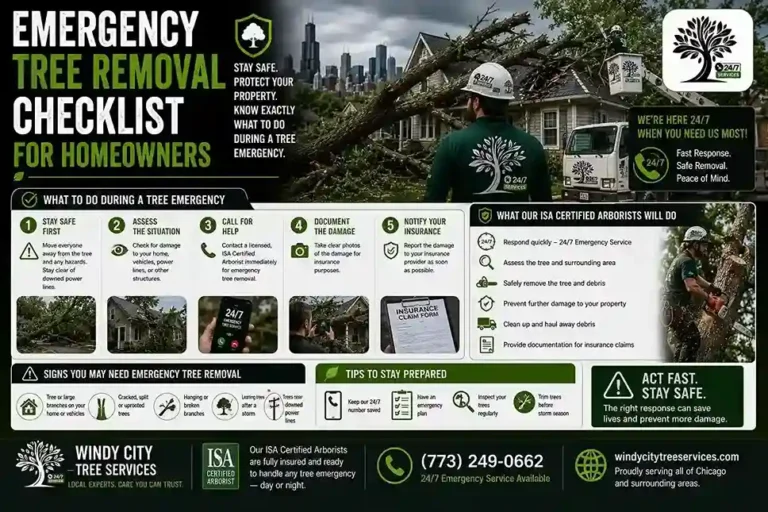
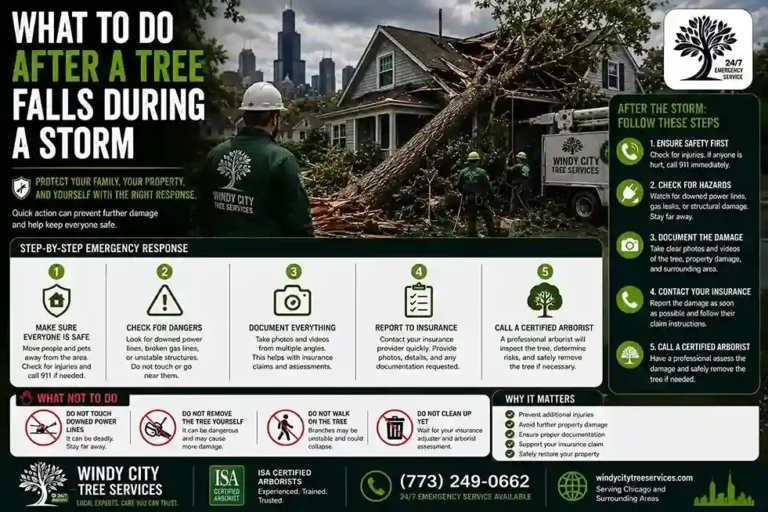
12. Emergency Tree Removal Timeline
Immediately
- Ensure everyone is safe and away from the damaged tree and any debris.
- Call emergency services if there’s an injury, fire risk, or immediate life-safety hazard.
- Stay away from any part of the tree touching power lines.
First 24 Hours
- Photograph and video all visible damage from multiple angles.
- Notify your insurer to begin the claims process.
- Contact a licensed emergency tree service to stabilize or remove the immediate hazard.
Following Days
- An adjuster typically inspects the damage in person or reviews submitted documentation.
- Full tree removal and debris cleanup are completed.
- Structural repairs begin once approved.
- Schedule a preventive inspection of any remaining trees on the property, since storms often stress trees beyond the one that actually failed.
13. How to Reduce Future Insurance Claims
The best claim is the one you never have to file. A handful of preventive practices meaningfully reduce storm-related tree risk:
- Annual inspections. Catching decay, root problems, or structural defects early, well before a storm exposes them.
- Structural pruning. Following ANSI A300 pruning standards to correct weak branch unions before they become failure points.
- Crown cleaning. Removing dead and diseased wood that’s most likely to fail first in high wind.
- Cabling and bracing. Physical support for large, valuable trees with structural weaknesses worth preserving through tree cabling and bracing.
- Tree health care. Addressing disease and stress factors that compound structural risk over time.
- Preventive maintenance overall. Following ISA Best Management Practices consistently, rather than reacting only after damage has already occurred.
14. Chicago Storm Risks
Chicago sees a wide range of severe weather that puts trees, and by extension, property, at risk throughout the year. Summer brings thunderstorms and high straight-line winds, sometimes strong enough to cause tree damage comparable to more dramatic storm events. Lightning strikes add another risk layer, sometimes causing damage that isn’t obvious until a tree declines gradually afterward.
Winter shifts the risk profile toward ice storms and heavy, wet snow, both of which add significant weight loading to branches and trunks. The city’s mature urban canopy, particularly in older, established neighborhoods, includes decades-old trees that have accumulated more structural risk over time simply by virtue of their age, making proactive inspection especially valuable in these areas.
Common Storm Scenarios
This table reflects general patterns, not guaranteed outcomes. Always confirm specifics with your insurer.
| Situation | Typical First Step | May Insurance Be Involved? |
|---|---|---|
| Tree falls on your home | Ensure safety, then contact your homeowners insurer | Often yes, your own policy |
| Neighbor’s tree falls on your property | Document damage, contact your own insurer | Often yes, typically your own policy first |
| Your tree falls on neighbor’s property | Communicate with your neighbor, contact insurers | Often yes, typically their own policy first |
| Tree falls on vehicle | Contact your auto insurer | Only with comprehensive auto coverage |
| Tree blocks driveway (no structural damage) | Contact your insurer to confirm removal coverage | Sometimes, often subject to a modest coverage cap |
| Tree contacts power lines | Stay away, contact the utility company immediately | Separate from the property insurance claim |
Documentation Checklist
| Item | Why It Matters |
|---|---|
| Photos | Visual proof of the damage’s extent and location, taken before cleanup |
| Videos | Capture context and scale that still photos sometimes miss |
| Receipts | Support reimbursement for any mitigation or temporary repair costs |
| Emergency invoices | Document what emergency tree or repair work was performed and when |
| Arborist report | Provides professional documentation of the tree’s condition and cause of failure |
| Insurance claim number | Keeps all communication and follow-up organized under one reference |
Storm Damage Insurance Checklist
- Ensure everyone is safe before doing anything else.
- Stay away from any electrical hazards, including trees touching power lines.
- Photograph all damage from multiple angles before cleanup begins.
- Contact your insurance provider promptly to start the claims process.
- Save every receipt related to emergency work or temporary repairs.
- Hire qualified, licensed, and insured arborists for removal and cleanup.
- Schedule an inspection of any remaining trees on the property.
- Keep copies of all communications with your insurer, your neighbor, and any contractors.
Frequently Asked Questions
Does homeowners insurance pay for tree removal?
Often, yes, if the tree damaged an insured structure. Many policies also include limited standalone removal coverage even without structural damage, though usually with a modest cap. Check your specific policy.
Who pays if my neighbor’s tree falls on my house?
In many storm-related cases, your own homeowners insurance covers the damage first, following the general industry pattern that each policy covers its own insured property. Negligence, if provable, can change this.
What if a healthy tree falls during a storm and there was no warning sign?
This is typically treated as an act of nature, and standard homeowners coverage generally applies to the property that was damaged, regardless of whose yard the tree came from.
Does insurance pay for tree removal if nothing was damaged?
Sometimes, but coverage for a tree that fell without hitting a structure is often more limited or excluded entirely, and may be treated as routine property maintenance instead.
What if a tree falls on my car?
Vehicle damage typically falls under comprehensive auto insurance, not homeowners insurance. If you don’t carry comprehensive coverage, the damage may not be covered.
Should I remove the tree before the insurance adjuster arrives?
Only if it’s an active safety hazard. Otherwise, thorough documentation first, photos and video from multiple angles, helps support your claim before cleanup or removal begins.
What evidence should I collect after a tree falls?
Photos, video, receipts for any emergency work, and ideally a written report from a certified arborist documenting the tree’s condition and cause of failure.
Does insurance cover stump removal?
Coverage for stump removal varies significantly by policy and is often more limited than coverage for the tree removal itself. Confirm directly with your insurer.
Can an arborist help with my insurance claim?
Yes. A written arborist report documenting the tree’s condition, likely cause of failure, and removal cost can support and often speed up the claims process.
What happens if negligence is involved?
If a property owner knew, or reasonably should have known, that a tree was hazardous and took no action, they may bear more direct responsibility, potentially through their liability coverage. This depends heavily on the specific facts and applicable law.
Do I need to report storm damage right away?
Most policies have reporting windows, and prompt notification generally supports a smoother claims process. When in doubt, report sooner rather than later.
Will my premiums go up after filing a tree damage claim?
It’s possible, depending on your insurer and claims history, but this varies by company and policy. Ask your agent directly about how a specific claim might affect your premium.
What if my tree falls on a shared property line?
Trees on a boundary line can involve shared ownership questions under local property law. A survey or municipal records may help clarify ownership if it’s unclear.
Can I be liable if I knew my tree was dead and didn’t remove it?
Potentially, yes. Known, ignored hazards are one of the clearest paths toward a negligence finding, which can shift financial responsibility away from a simple “act of nature” outcome.
Does insurance cover damage from a tree struck by lightning?
Lightning-related damage is commonly covered under standard homeowners policies as a named peril, though specifics vary by insurer.
Who is responsible for a tree blocking a public street?
Immediate clearing for public safety and access typically falls to the municipality, especially for trees in the public right-of-way. Report it to the city, in Chicago, typically through 311.
What should I do if a fallen tree is touching power lines?
Stay away from the tree and the surrounding area, and contact the utility company immediately. Never attempt to move or cut a tree in contact with power lines yourself.
How much does emergency tree removal typically cost?
Costs vary based on tree size, damage complexity, and accessibility. A licensed tree service can provide a specific estimate, which is also useful documentation for an insurance claim.
Is it safe to make temporary repairs myself after a storm?
Simple, low-risk mitigation like placing a tarp is often reasonable, but anything involving structural or electrical risk should go to a professional to avoid creating additional hazards or complications for your claim.
Who should I call first after a tree falls on my house?
Ensure everyone’s safety first, then contact your insurer and a licensed emergency tree service. Both can generally be contacted around the same time.
Sources & Further Reading
- National Association of Insurance Commissioners (NAIC), Consumer Insurance Resources
- Illinois Department of Insurance, Consumer Information
- International Society of Arboriculture (ISA), Best Management Practices
- ANSI A300 Tree Care Standards
- The Morton Arboretum, Tree & Plant Advice
This article is provided for general educational purposes and is not legal or insurance advice. Coverage, liability, and legal responsibility depend on your specific policy, local law, and the facts of your situation. Review your policy and consult your insurer or a qualified attorney for guidance specific to you.