
Winter Tree Pruning Benefits: Dormant Season Guide
Tree Care · Chicago Arborist Guide
Winter Tree Pruning Benefits
Discover why dormant-season pruning helps trees grow stronger, healthier, and safer.
Cold weather isn’t a reason to put off tree care — for many species, it’s exactly the right window. Here’s the science behind why.
Introduction
Most homeowners think of tree care as a spring and summer job. For many deciduous species, that instinct has it backwards. Winter, while a tree sits dormant and bare, is one of the best windows of the entire year for pruning — and the reasons come down to plant physiology, not scheduling convenience.
A dormant tree isn’t actively growing, flowering, or fighting off summer heat stress. It’s essentially paused, which means a pruning cut creates far less physiological disruption than the same cut would during the growing season. That lower stress translates directly into healthier spring growth once the tree wakes back up.
Winter also strips away the leaves that hide a tree’s actual structure the rest of the year. An arborist can see codominant stems, crossing branches, and weak unions clearly against a bare winter sky — problems that are much harder to spot through a full summer canopy.
Dormant-season pruning also tends to reduce certain disease and pest risks, since many pathogens and insect vectors are far less active in cold weather. By the end of this guide, you’ll understand exactly why winter pruning works the way it does, which Chicago trees benefit most, which ones need a different schedule, and when to book your own dormant-season inspection.
Winter pruning is often recommended because many deciduous trees are dormant, which makes branch structure much easier to evaluate. Pruning during dormancy can reduce stress on the tree, support healthier spring growth, improve structural development, and in some cases lower the risk of disease and insect transmission. The right timing still depends on tree species and site conditions.
1. What Is Dormant Season Pruning?
Dormancy is a tree’s annual rest period, triggered by shortening daylight and falling temperatures in autumn. During this stage, deciduous trees shed their leaves and shift into an energy-conservation mode: growth slows dramatically, and the tree stops directing resources toward leaf and fruit production.
- Tree dormancy: A survival strategy that protects the tree from freezing temperatures and water scarcity in winter.
- Seasonal growth cycle: Growth in spring and summer, resource storage in fall, and near-total rest in winter.
- Winter physiology: Reduced metabolic activity throughout the tree, including slower cell division at wound sites.
- Energy conservation: Stored carbohydrates in the roots and trunk sustain the tree through winter without new production.
- Branch development: The tree’s existing branch structure is essentially locked in place until spring growth resumes.
“Dormant season pruning” simply means making cuts during this rest period, typically from late fall through late winter, depending on the species and local climate.
2. Why Winter Is an Ideal Time for Many Trees
Dormancy
The tree isn’t actively growing, so pruning cuts create less physiological disruption than during the growing season.
Reduced stress
Without leaves to support and water to actively move through the canopy, the tree handles wound response more efficiently.
Easier structure evaluation
A bare canopy reveals every branch, so arborists can plan cuts around the tree’s actual architecture rather than guessing under foliage.
Faster spring response
Trees pruned in late winter typically leaf out vigorously, redirecting stored energy to the buds that remain.
Improved visibility & better planning
Crews can see the whole crown at once, which supports a more precise, complete pruning plan in a single visit.
3. Benefits of Winter Tree Pruning
- Better tree health: Lower stress cuts support the tree’s overall vigor going into the growing season.
- Improved branch structure: Clear sightlines let arborists correct weak unions and competing leaders precisely.
- Stronger spring growth: Energy redirected to remaining buds often produces a fuller, more vigorous canopy.
- Easier defect identification: Cracks, cavities, and decay are far easier to spot without leaf cover in the way.
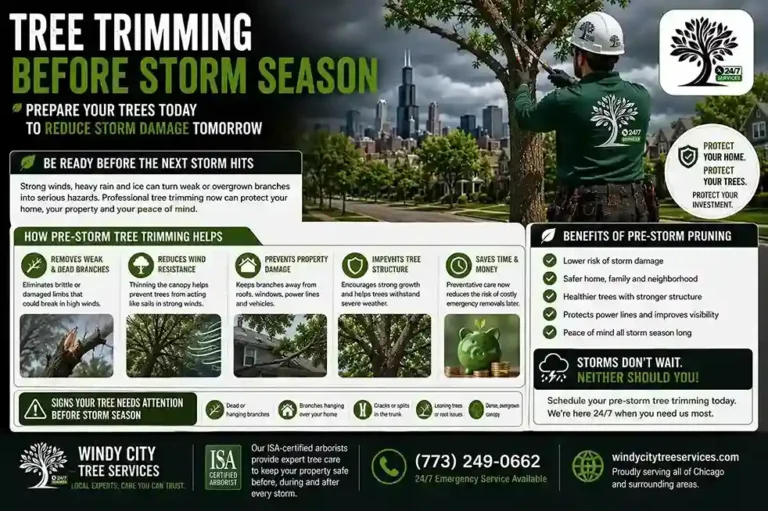
- Improved storm resistance: Correcting structural weaknesses before spring and summer storm season reduces failure risk.
- Better wound response: Cool, dry winter air supports cleaner compartmentalization of pruning wounds for many species.
- Increased safety: Frozen or snow-covered ground reduces soil compaction and equipment damage to lawns during the work.
- More efficient pruning operations: Crews can move through a property faster with full visibility and typically calmer scheduling windows.
Did You Know?
The Morton Arboretum and University of Illinois Extension both note that dormant-season pruning is a standard, widely recommended practice for shade trees in the Chicago region, largely because it limits stress and supports strong spring growth.
4. Trees That Benefit Most from Winter Pruning
| Species | Winter Pruning Recommended? | Notes |
|---|---|---|
| Oak | Yes | Dormant timing reduces exposure to insects associated with oak wilt transmission |
| Maple | Yes | Late winter avoids the heavy sap “bleeding” common with spring cuts |
| Elm | Yes | Lower activity of beetles associated with Dutch Elm Disease in cold months |
| Honey Locust | Yes | Dormant structural pruning supports strong scaffold branching |
| Ash | Yes | Standard dormant timing, alongside ongoing emerald ash borer monitoring |
| Sycamore | Yes | Bare structure makes large-canopy planning much easier in winter |
| Cottonwood | Yes | Dormant pruning reduces stress on this fast-growing, brittle-wooded species |
| Linden | Yes | Responds well to dormant structural correction |
| Birch | Prefer summer | Late-winter cuts cause heavy sap bleeding; mid-to-late summer is better |
| Hackberry | Yes | Tolerates dormant pruning well with minimal stress response |
5. Trees That Should Not Be Pruned in Winter
Winter pruning is broadly beneficial, but it isn’t universal. A few categories call for a different schedule.
- Spring-flowering ornamental trees: Species like crabapple, redbud, and magnolia set their flower buds the previous season. Pruning them in winter removes those buds before they ever open. If preserving blooms is the goal, prune shortly after flowering instead.
- Trees with species-specific disease considerations: A handful of species carry timing-sensitive disease risks that may call for a narrower or different pruning window; a certified arborist can confirm current guidance for your specific tree.
- Newly planted trees: Young, recently transplanted trees often benefit from a customized care plan rather than a standard dormant-pruning schedule, since their root systems are still establishing.
The right schedule ultimately depends on your objectives, whether that’s flowering, structure, health, or hazard reduction, as much as it depends on species.
6. Winter Pruning and Disease Prevention
- Reduced insect activity: Cold temperatures suppress most insect populations that spread disease through fresh wounds.
- Lower disease transmission for some pathogens: Certain fungal pathogens spread far less effectively in cold, dry winter air.
- Importance of clean pruning tools: Sanitizing blades between cuts, and between trees, limits the spread of pathogens regardless of season.
- Species-specific timing: Disease risk profiles differ by species, which is why a one-size-fits-all calendar isn’t quite right.
A Note on Oak Wilt
Oak wilt is a serious fungal disease, and part of its spread is linked to beetles attracted to fresh wounds during warmer months. General best practice favors pruning oaks during dormancy to reduce this risk. Because guidance can evolve, confirm current recommendations with a certified arborist or your local extension office before scheduling oak work.
7. Why Arborists Prefer Winter Inspections
- Visible branch architecture: The entire structure is visible at once, without leaves obscuring the view.
- Codominant stems: Competing leaders of similar size, a common structural weak point, are far easier to spot.
- Deadwood identification: Dead branches stand out clearly against a backdrop of living, bud-bearing wood.
- Structural defects: Cracks, cavities, and included bark at branch unions are more visible without foliage.
- Crossing branches: Easy to identify and correct before they rub and create wounds later in the season.
- Hazard detection: A full winter assessment often catches risks that would otherwise go unnoticed until a summer storm exposes them.
8. Winter Storm Preparation
Chicago winters bring their own hazards, and proactive pruning directly reduces several of them.
- Removing hazardous limbs: Weak or dead branches are the most likely to fail under winter conditions.
- Reducing snow load risks: Thinning dense or overextended limbs lowers the weight burden during heavy snowfall.
- Improving wind resistance: A well-structured canopy handles winter wind gusts off Lake Michigan better than a dense, poorly maintained one.
- Preventing ice damage: Structurally sound branches are less likely to snap under ice accumulation.
- Emergency preparedness: Addressing weak points before winter storms arrive reduces the odds of an emergency call mid-storm.
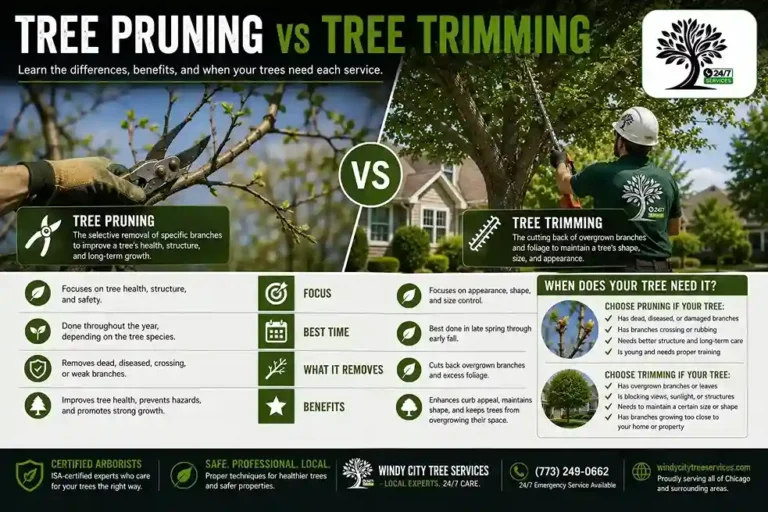
9. Winter Tree Pruning vs. Summer Pruning
| Feature | Winter Pruning | Summer Pruning |
|---|---|---|
| Tree condition | Dormant, minimal active growth | Actively growing, under seasonal stress |
| Visibility | Full branch structure visible | Limited by full leaf canopy |
| Stress level | Generally lower | Generally higher, especially in heat or drought |
| Growth response | Vigorous regrowth once spring arrives | Slower recovery during active growing season |
| Disease pressure | Lower for many pathogens | Higher for many pathogens and insect vectors |
| Primary goals | Structural pruning, major corrective work | Hazard removal, deadwood, and corrective touch-ups |
10. Chicago Winter Challenges
- Heavy snowfall: Adds significant, sometimes sudden weight to tree canopies.
- Ice accumulation: One of the more damaging seasonal risks to branch structure across the region.
- Freeze-thaw cycles: Repeated freezing and thawing can stress bark and root zones over the course of a winter.
- Wind: Lakefront exposure means some neighborhoods see considerably higher wind loads than others.
- Salt exposure: De-icing salt near sidewalks and streets can affect root health, particularly for parkway trees.
- Urban conditions: Compacted soil and limited rooting space shape how well urban trees tolerate pruning and winter stress overall.
These conditions are exactly why a Chicago-specific pruning schedule, rather than a generic national guide, matters for local trees.
11. Common Homeowner Mistakes
- Pruning during extreme cold: Wood can become brittle in very low temperatures, making clean cuts harder to achieve.
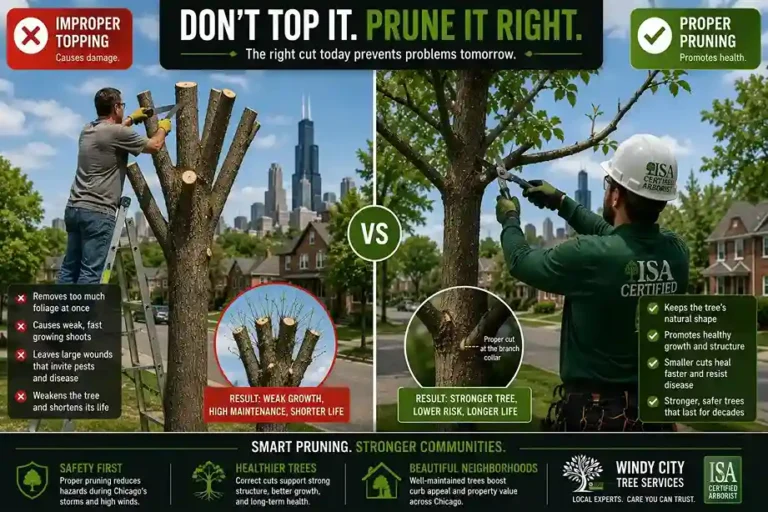
- Improper cuts: Flush cuts or leaving stubs both interfere with proper wound closure.
- Removing excessive canopy: Taking too much at once stresses the tree, even during dormancy.
- Using dull tools: Ragged cuts heal more slowly and create easier entry points for pathogens.
- DIY ladder accidents: Icy conditions make ladder work considerably more dangerous in winter.
- Pruning without understanding species: Applying a generic pruning approach to a species with different needs can do more harm than good.
12. How ISA Certified Arborists Perform Winter Pruning
- Tree inspection: A full assessment of the dormant structure, health indicators, and any visible defects.
- Species identification: Confirming the tree’s species and any timing-specific considerations.
- Hazard assessment: Flagging any immediate safety concerns that need prompt attention.
- Structural pruning plan: Mapping out specific cuts to correct weak unions, competing leaders, and deadwood.
- Proper pruning cuts: Following ANSI A300 standards and ISA Best Management Practices throughout.
- Cleanup: Full removal of cut material and debris from the property.
- Follow-up monitoring: Checking spring growth response to confirm the pruning achieved its intended goals.
13. Winter Tree Care Beyond Pruning
- Mulching: Insulates roots against freeze-thaw temperature swings.
- Watering during dry winters: Chicago winters with little snow cover can still leave roots dry; occasional deep watering helps in prolonged dry stretches.
- Tree protection: Wrapping or shielding young or thin-barked trees from sunscald and frost cracking.
- Salt damage prevention: Using barriers or alternative de-icing products near vulnerable root zones.
- Cabling and bracing: Installing structural support for weak unions identified during winter inspection.
- Health monitoring: Tracking any changes through the dormant season ahead of spring assessment.
Homeowner Checklist: Is Winter the Right Time to Prune Your Trees?
- Is the tree currently dormant, with no active leaf growth?
- Are dead branches visible anywhere in the canopy?
- Has storm damage occurred that hasn’t yet been addressed?
- Are any limbs extending over your roof or driveway?
- Are branches crossing or rubbing against each other?
- Does the tree appear structurally sound, without major cracks or lean?
- Has the tree been inspected by a certified arborist in the past few years?
15. Planning Ahead for Spring Growth
Winter pruning isn’t just about the tree’s condition right now — it’s an investment in how the tree performs once the growing season starts.
- Spring bud development: Trees redirect stored energy to remaining buds, often producing fuller, more vigorous new growth.
- Stronger branch architecture: Corrections made during dormancy set the tree up with a more resilient structure heading into storm season.
- Healthier canopy: Removing deadwood and crossing limbs in winter reduces competition for light and airflow once leaves return.
- Long-term maintenance plans: A winter inspection is a natural checkpoint for scheduling the next few years of care.
- Annual inspections: Pairing dormant-season pruning with a yearly check-in keeps small issues from becoming bigger ones.
Frequently Asked Questions
For many deciduous species, yes. Dormancy reduces stress, improves visibility, and supports healthier spring growth. Some species, particularly spring-flowering ornamentals, follow a different schedule.
Done correctly, winter pruning is generally low-stress for dormant trees. Pruning during extreme cold snaps or removing too much canopy at once can still cause unnecessary stress, regardless of season.
Dormancy means the tree isn’t actively growing, which lowers stress from pruning cuts. Bare branches also make it much easier to evaluate structure and plan precise cuts.
Spring-flowering ornamentals like crabapple and redbud are better pruned right after they bloom, to preserve next season’s flower buds. Newly planted trees often need a customized schedule as well.
For many pathogens, yes. Cold weather suppresses insect activity and slows the spread of certain fungal diseases, though tool sanitation still matters year-round.
Generally yes, though extremely cold, brittle wood can be harder to cut cleanly. Most professional winter pruning happens during more moderate cold rather than extreme sub-zero conditions.
Active snowfall can affect visibility and footing, so many crews prefer to work between snow events rather than during them, for both safety and precision.
Yes. Removing certain branches during dormancy redirects stored energy to the remaining buds, often producing fuller, more vigorous growth once the growing season begins.
Late winter to early spring, before new growth starts, works well for many evergreens like spruce and arborvitae. Pines are typically pruned later, during their spring candle growth stage.
Cost depends on tree size, species, and the scope of work needed. Request a free estimate for pricing specific to your property.
Not the pruning itself, though snow-covered or frozen ground can actually help protect your lawn from equipment traffic during the work.
It reduces the odds. Removing weak, dead, or overextended limbs before spring and summer storm season improves a tree’s overall wind and load resistance.
Deciduous trees are dormant once they’ve fully dropped their leaves and show no new growth. A certified arborist can confirm dormancy status and appropriate timing during an inspection.
Pricing varies by company and project scope rather than season alone, though some companies do offer winter scheduling availability that can work in a homeowner’s favor.
Small, low branches carry manageable risk for confident homeowners. Larger limbs, ladder work, or anything near power lines is safer left to a trained crew, especially with icy footing involved.
Most deciduous shade trees respond well, though species like birch are better pruned in summer to avoid heavy sap bleeding from late-winter cuts.
Moderate winter cold works well for most species. Extremely low temperatures can make wood more brittle and harder to cut cleanly, so crews often plan around milder cold snaps.
Pruning can reduce canopy weight and improve balance in some cases, but a significant lean often points to root or structural issues that need a full risk assessment, not pruning alone.
Most trees show new growth response within the first spring following dormant-season pruning, though the pace varies by species and overall tree health.
Learn more from our Chicago Tree Service homepage, meet our Certified Arborists, and explore our Professional Tree Care services. Related services include tree trimming & pruning, tree health inspections, tree cabling & bracing, tree removal, storm prep & support systems, tree & shrub fertilization, air spade root excavation, and emergency tree removal.