Common Emergency Tree Hazards | Windy City Tree Services
Common Emergency Tree Hazards
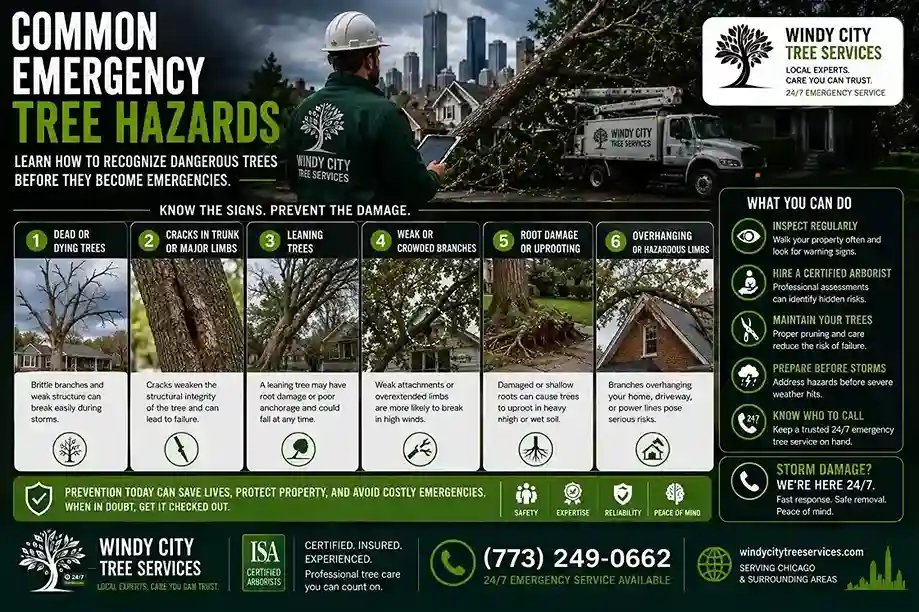
Learn how to recognize dangerous trees before they become emergencies.
📋 In This Guide
Most dangerous trees don’t announce themselves. A hazard can develop over years, hidden inside a trunk that looks perfectly healthy, or it can appear in seconds, the moment a storm front rolls through and finds the one weak point a tree has been carrying quietly for a decade.
Severe weather is often the moment hidden structural weaknesses get exposed, not created. A tree that’s been slowly decaying, leaning a little further each year, or hosting fungal decay in its roots often looks fine until wind, rain, or ice tips the balance. Recognizing the warning signs early, well before that tipping point, is one of the most effective ways homeowners can prevent injuries and property damage.
This guide walks through the most common emergency tree hazards we see across Chicago properties, how ISA Certified Arborists assess them using a standardized risk framework, and when emergency removal is genuinely the right call. A professional inspection remains the only reliable way to evaluate a hazardous tree; this guide is here to help you recognize when it’s time to make that call.
What are the most common emergency tree hazards? Common emergency tree hazards include hanging branches, split trunks, severely leaning trees, uprooted trees, large dead limbs, lightning-damaged trees, root failure, trees contacting power lines, and trees with extensive decay. These conditions raise the risk of unexpected failure and should be evaluated by a qualified arborist as soon as possible.
1. What Is an Emergency Tree Hazard?
An emergency tree hazard is a condition that creates an immediate or near-term danger to people or property, not a cosmetic issue that can wait for the next scheduled pruning visit. A few things define this category:
- Immediate danger. The hazard could cause harm within hours or days, not years.
- Public safety. Sidewalks, streets, and shared spaces raise the stakes when a tree or limb is unstable.
- Property risk. Homes, vehicles, fences, and other structures within striking distance turn a tree problem into a financial one.
- Structural instability. The tree or a major part of it has lost the integrity needed to reliably hold its position.
- Emergency response. The situation calls for prompt professional attention rather than routine scheduling.
Not every damaged or imperfect tree qualifies as an emergency. But the hazards below share one thing in common: they should be assessed quickly, not left for “someday.”
2. Hanging Broken Limbs (Widowmakers)
🪓 Hanging Broken Limbs Extreme Risk
Arborists sometimes call these “widowmakers,” a grim but accurate nickname for a limb that’s broken but still partially attached or caught in the canopy above. Storm winds are the most common cause, but a hidden crack that’s been developing for months can also let go without any storm at all.
The danger is unpredictability. A hanging limb can drop without warning, with no wind needed, at any time of day. Hidden internal cracks mean the limb can look more stable than it actually is.
- Never attempt to remove a hanging limb yourself, even a small one.
- Keep the area below clear until a professional arrives.
- Safe removal typically uses rigging and controlled lowering, not cutting from underneath the load.
3. Split Trunks
🪵 Split Trunks Extreme Risk
A split trunk is a serious structural failure, whether it comes from storm wind, a lightning strike, or a weak union with included bark (bark trapped between two codominant stems instead of forming a normal, strong attachment) finally giving way under load.
A trunk split compromises the structure holding up the entire canopy above it. Emergency stabilization, cabling in some cases, removal in others, needs a professional assessment of how much of the trunk’s structural integrity remains intact.
- Stay well clear of any tree with a visible trunk split.
- Photograph the damage from a safe distance for documentation.
- Treat any split that runs into a visible gap as an emergency, not a wait-and-see situation.
4. Leaning Trees
📐 Leaning Trees High Risk
Not every leaning tree is an emergency; some trees have grown at an angle their whole lives and are perfectly stable. The real warning sign is a sudden lean, a tree that wasn’t tilted last week and is now visibly off vertical, or a progressive lean that’s clearly gotten worse over recent months.
Both patterns often point to root failure or soil movement, especially after heavy rain saturates the ground. Signs of instability to watch for include soil heaving or cracking on the side opposite the lean, and exposed or lifted roots at the base.
- A sudden lean after a storm should be treated as an emergency.
- A gradual lean still warrants a professional root and structural assessment.
- Check the soil around the base for heaving or cracking, a sign the root plate is shifting.
5. Uprooted Trees
🌪️ Uprooted Trees Extreme Risk
A fully uprooted tree, sometimes called wind throw when caused by storm gusts, usually results from root plate failure: the root system loses its grip on the soil and the whole tree tips over, often with a large disc of soil and roots lifted right along with it.
Saturated soil after heavy rain is a major contributing factor, since wet soil holds roots far less securely than dry, compacted ground. Construction activity that severs or damages roots nearby can also set up a tree for wind throw months or years later.
- Stay away from an uprooted tree entirely; the root plate can shift further or the tree can settle unpredictably.
- Watch for entangled utility lines before anyone approaches.
- Emergency response typically involves securing the area first, then a planned, equipment-based removal.
6. Dead or Dying Trees
🍂 Dead or Dying Trees High Risk
A dead tree doesn’t announce a timeline for failure. It can stand for another season or come down in the next moderate wind. Warning signs include significant deadwood throughout the canopy, extensive decay in the trunk, bark that’s sloughing off in sheets, visible fungal growth, and insect activity like exit holes or boring dust.
Each of these signs increases failure risk, and they tend to compound: a dead tree with decay and fungal growth is a meaningfully bigger hazard than a dead tree with none of those additional issues.
- Not every dead tree needs to come down immediately, but every dead tree near a target (a home, walkway, or parking area) does warrant a professional look.
- Fungal conks or mushrooms growing directly from the trunk or root flare are a reliable sign of internal decay.
7. Large Broken Scaffold Limbs
🌿 Large Broken Scaffold Limbs Moderate to High Risk
Scaffold limbs are the large primary branches that make up a tree’s main framework. A partial failure, where a scaffold limb cracks but doesn’t fully detach, is especially tricky because the crack is often hidden inside the union and invisible from the ground.
A partial scaffold failure also throws off the canopy’s balance, adding uneven weight distribution that can stress the rest of the tree. Hazard reduction pruning, carefully removing the compromised section without over-thinning the remaining canopy, is often the right response when the rest of the tree remains structurally sound.
8. Trees Touching Power Lines
Any tree or limb in contact with a power line should be treated as energized and lethal until a utility company or trained professional confirms otherwise.
Electrical hazards from trees touching power lines are among the most dangerous situations in tree care, and homeowners should never attempt to address them personally. This work requires coordination with the local utility company, specialized training, and often line-clearance certification that goes beyond standard arborist credentials.
- Call your utility company or 911 immediately if a tree is touching a power line, especially if the line is down.
- Keep everyone, including pets, well away from the area.
- Never attempt to move, cut, or shake a tree that’s in contact with any line.
9. Lightning-Damaged Trees
⚡ Lightning-Damaged Trees High Risk
Lightning damage deserves its own category because the internal damage is so often invisible from the outside. A strike can cause vertical trunk cracks, explosive bark loss, or root damage with almost no external sign, and canopy decline can show up weeks or months after the actual strike.
We cover this topic in full detail in our guide on Tree Removal After Lightning Damage, including how to tell whether a struck tree can recover.
- Any lightning-struck tree needs a professional inspection, even if the damage looks minor.
- Delayed decline is common; a follow-up check the next growing season is worth scheduling.
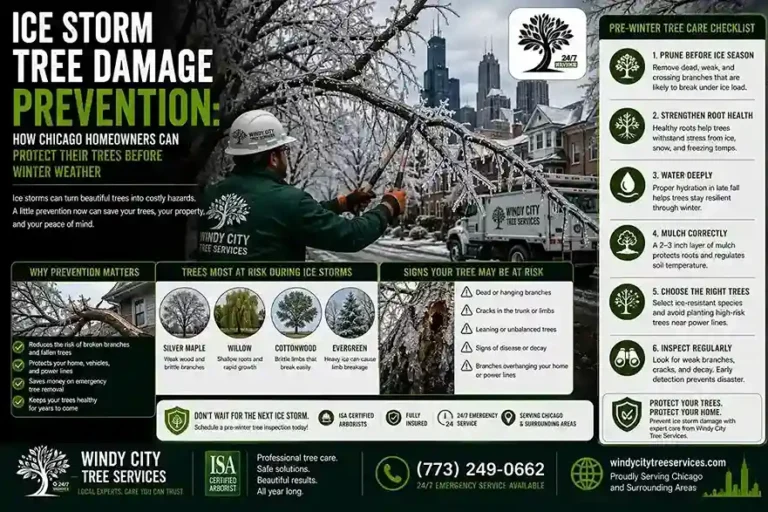
10. Trees Damaged by Ice and Heavy Snow
🧊 Ice and Snow Damage Moderate to High Risk
Chicago winters bring both heavy wet snow and freezing rain, and both add substantial weight to a canopy fast. Ice loading in particular can double or triple the effective weight of a branch in a matter of hours, and branches that survive one ice storm can still be weakened enough to fail in the next.
- Deadwood and weakly attached limbs fail first under ice and snow load.
- Trees already carrying storm or lightning damage are at higher risk during winter loading events.
- Winter hazards often develop quietly overnight; a morning walk-around after any significant snow or ice event is worth doing.
11. Root Problems That Create Emergencies
Root issues are the hardest hazard category to spot, since most of the damage happens underground, out of view.
- Root decay. Fungal decay in the root system weakens a tree’s anchor point long before the canopy shows any sign of stress.
- Soil erosion. Heavy rain or grading changes can wash away soil that was holding roots in place, exposing them and reducing stability.
- Construction damage. Excavation, trenching, or grade changes near a tree can sever major roots without anyone realizing the tree’s stability has changed.
- Root severing. Cutting through structural roots, even unintentionally during a landscaping project, can leave a tree with far less anchoring than it appears to have.
- Poor drainage. Chronically saturated soil promotes root decay and reduces the soil’s ability to hold roots firmly during wind events.
Mushrooms or fungal conks growing from a tree’s trunk or root flare are considered a definite indicator of internal decay under ISA risk assessment guidance. Fungal growth found in the surrounding mulch or turf, away from the tree itself, is usually a different, harmless soil fungus and not necessarily a sign of tree decay.
12. Hazardous Trees Near Homes and Public Areas
Location changes the stakes dramatically. The same structural defect on a tree deep in a forest preserve and on a tree next to a school playground carries very different levels of real-world risk.
Houses & Garages
Direct property damage risk, plus the chance of injury to occupants during a failure.
Schools
High foot traffic and young children raise the consequences of any tree failure significantly.
Churches
Gathering spaces and parking areas mean periodic high-occupancy risk windows.
Sidewalks
Constant pedestrian traffic means a hazardous tree here is rarely a low priority.
Roads
Vehicle traffic adds speed and force to the consequences of any tree or limb failure.
Parks
High public use, especially in playground and picnic areas, raises consequence ratings.
Parking Lots
Concentrated vehicles and pedestrians make hazardous trees here a priority for commercial property owners.
Neighboring Properties
A hazard tree doesn’t respect property lines; failure risk often extends next door.
This is exactly why professional risk assessment considers not just the tree’s condition, but what (and who) sits within range if it fails.
13. How ISA Certified Arborists Evaluate Hazards
A structured hazard evaluation follows the Tree Risk Assessment Qualification (TRAQ) framework developed by the International Society of Arboriculture, built on ANSI A300 Part 9 standards for tree risk assessment.
- Visual inspection. A full walk-around examining the crown, trunk, and visible roots for the defects covered throughout this guide.
- Root evaluation. Checking the root collar and surrounding soil for decay, damage, heaving, or exposed roots.
- Structural assessment. Evaluating branch unions, lean, cavities, cracks, and included bark for defects that affect stability.
- Canopy inspection. Assessing crown vigor, density, and dieback as indicators of overall tree health.
- Tree Risk Assessment. Combining the likelihood of failure with the likelihood of striking a target and the potential consequences, producing a defensible risk rating.
- Professional recommendations. A clear, documented plan: monitor, treat, prune, or remove, with the reasoning spelled out.
That final risk rating typically falls into one of four categories:
| Risk Level | What It Means | Typical Response |
|---|---|---|
| Low | Failure is unlikely, and consequences would be minor | Monitor; basic maintenance as needed |
| Moderate | Some defects present, but failure isn’t imminent | Pruning, cabling, or other mitigation |
| High | Failure is likely in the near term with significant consequences | Prompt action strongly recommended |
| Extreme | Immediate danger to people or property | Removal usually advised without delay |
14. Preventing Emergency Tree Hazards
Most emergency tree calls trace back to a hazard that had been developing, visibly or invisibly, for months or years. Regular, proactive care catches these problems long before they become emergencies.
- Annual inspections for mature or high-risk trees catch new defects before the next storm tests them.
- Structural pruning corrects weak branch architecture while it’s still manageable.
- Crown cleaning removes deadwood before it becomes a falling hazard.
- Cabling and bracing support trees with valuable but structurally weak unions.
- Deep root fertilization supports overall vigor, which improves a tree’s resilience to stress and pests.
- Soil improvement addresses compaction and drainage issues that contribute to root problems.
- Storm preparation ahead of Chicago’s peak storm season addresses known weak points before wind or ice tests them.
15. What Homeowners Should Never Do
Tree work consistently ranks among the more hazardous trades, per general OSHA workplace safety principles. Untrained work around damaged or unstable trees carries real risk of serious injury.
- Never climb a damaged tree. A compromised structure can fail under far less weight than it originally supported.
- Never remove hanging limbs yourself. These loads are unpredictable and require rigging techniques, not a ladder and a handsaw.
- Never cut trees near power lines. This work should go to the utility company or specially trained, line-clearance certified professionals.
- Never work during active storms. Wait until weather clears and conditions are stable before any inspection or work begins.
- Never ignore warning signs. A tree that “seems fine” despite visible cracks, lean, or fungal growth is still a tree that needs professional evaluation.
Common Emergency Tree Hazards at a Glance
| Hazard | Risk Level | Typical Professional Response |
|---|---|---|
| Hanging limb | Extreme | Immediate rigged removal; area secured first |
| Leaning tree (sudden) | High | Emergency root and structural assessment |
| Split trunk | Extreme | Stabilization assessment; removal in most cases |
| Dead tree near a target | High | Prompt inspection; removal if decay is extensive |
| Root failure | High | Structural assessment; may require removal |
| Tree on power line | Extreme | Utility coordination; specially trained crews only |
| Lightning damage | High | Full inspection; treatment or removal based on findings |
| Fallen tree | Extreme | Emergency cleanup and safety perimeter |
Warning Signs Checklist
| Warning Sign | Why It Matters |
|---|---|
| New lean | Often indicates root plate movement or failure, especially after heavy rain |
| Large cracks | A structural defect that can progress to full failure under load |
| Hanging branches | Unpredictable failure risk regardless of wind conditions |
| Mushrooms near roots | A definite indicator of internal decay in the root system |
| Bark separation | Can signal internal decay, disease, or storm/lightning damage |
| Soil heaving | A sign the root plate is shifting, often preceding a full uprooting event |
Emergency Response Flowchart
Think You Have a Hazardous Tree?
Don’t wait until a small problem becomes a dangerous emergency. Our ISA Certified Arborists can inspect your trees and recommend the safest solution.
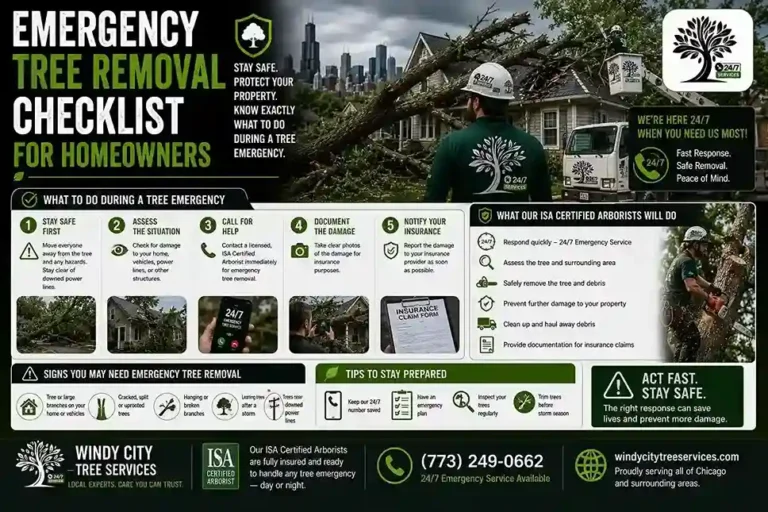
Emergency Tree Hazard Checklist
- 1Stay away from damaged trees.
- 2Keep children and pets away from the area.
- 3Watch for hanging limbs before letting anyone near a tree.
- 4Never touch trees on power lines.
- 5Photograph visible damage for your records.
- 6Call emergency tree professionals for anything extreme or high risk.
- 7Schedule a tree risk assessment for anything less urgent.
- 8Inspect nearby trees after any major storm, not just the obviously damaged one.
Emergency Tree Removal Available Across Chicago
Whether your tree is storm-damaged, leaning, split, or threatening your home, Windy City Tree Services is ready to respond with safe, professional emergency tree care.
Frequently Asked Questions
What is considered an emergency tree hazard?
A tree hazard becomes an emergency when it creates an immediate or near-term danger to people or property, such as a hanging limb, split trunk, sudden lean, or a tree in contact with a power line.
Are hanging branches dangerous?
Yes, extremely. Hanging branches can fall without warning, with or without wind, and should never be approached or removed without professional rigging equipment.
Can a leaning tree suddenly fall?
Yes. A sudden lean, especially after heavy rain, often signals root plate failure and can precede a full uprooting event within hours or days.
Is a split trunk repairable?
A shallow surface crack may heal over time, but a deep split that runs through a significant portion of the trunk usually cannot be repaired and often requires removal.
Should dead trees always be removed?
Not always, but any dead tree near a home, sidewalk, or other target should be professionally assessed, since dead trees carry meaningfully higher failure risk.
What if a tree is touching power lines?
Treat it as an electrical hazard immediately. Call your utility company or 911, keep everyone away, and never attempt to move or cut the tree yourself.
Can lightning damage kill a tree?
Yes. Lightning can cause fatal internal damage that isn’t visible externally, including root damage and cambium loss. Learn more in our guide on Tree Removal After Lightning Damage.
How do arborists inspect hazardous trees?
Following ISA TRAQ principles, arborists evaluate the crown, trunk, and roots for structural defects, then combine likelihood of failure with potential consequences to reach a documented risk rating.
When should I call an emergency tree service?
Call immediately for hanging limbs, split trunks, sudden leans, uprooted trees, or any tree involved with power lines. For less urgent defects, schedule a standard risk assessment.
What trees fail most often during storms?
Trees with existing defects, deadwood, decay, weak branch unions, or shallow or damaged root systems fail most often, regardless of species, though certain species are more prone to specific weaknesses.
What are mushrooms on a tree trunk a sign of?
Fungal conks or mushrooms growing directly from a trunk or root flare are a reliable indicator of internal decay and should prompt a professional evaluation.
Is it safe to remove a small hanging branch myself?
We don’t recommend it. Even small hanging branches can carry more tension or weight than they appear to, and working underneath a suspended load is genuinely risky without training.
How much does an emergency tree removal cost?
Costs vary based on tree size, hazard level, and access. We provide a clear estimate before work begins whenever possible, even in emergency situations.
Can a tree be dangerous even if it looks healthy?
Yes. Root decay, internal trunk decay, and hidden branch cracks often show no visible external symptoms until the tree is already at meaningful risk of failure.
Do I need a permit for emergency tree removal in Chicago?
Emergency removals involving an immediate hazard are typically handled first, with documentation, and permit requirements addressed alongside the process. We can walk you through what applies to your situation.
What should I do immediately after a tree falls near my house?
Stay clear of the area, check for downed power lines, and call for emergency tree service. See our related guide, What to Do After a Tree Falls During a Storm, for a full step-by-step walkthrough.
How often should I have my trees checked for hazards?
Most mature trees benefit from an inspection every 1 to 3 years, with additional checks after major storms, heavy snow, or ice events.
Can construction near a tree cause a future emergency?
Yes. Excavation, grading, and trenching can sever structural roots without any visible sign, sometimes leading to instability that shows up months or years later.
Are certain tree species more prone to emergency hazards?
Some species, like cottonwood and silver maple, have naturally weaker wood and fail more often in storms, but condition, site factors, and maintenance history matter as much as species.
What does “risk rating” mean in a tree assessment report?
Under ISA TRAQ methodology, a risk rating (Low, Moderate, High, or Extreme) combines the likelihood a tree part will fail with the likely consequences if it does, giving a clear, documented basis for a removal or treatment recommendation.
Key Takeaways
- Emergency tree hazards include hanging limbs, split trunks, sudden leans, uprooted trees, dead trees, lightning damage, ice and snow damage, root failure, and trees touching power lines.
- Severe weather usually exposes hazards that were already developing, not new ones created out of nowhere.
- Hazard severity depends on species, condition, location, and site factors; only an on-site professional inspection can determine the right response.
- ISA TRAQ-based risk assessment gives a defensible, documented risk rating: Low, Moderate, High, or Extreme.
- Homeowners should never climb damaged trees, remove hanging limbs, work near power lines, or work during active storms.
- Prevention, through regular inspections, structural pruning, and storm preparation, is far less costly than emergency response after a failure.
Related Tree Services
Emergency Tree Removal
24/7 response for hazardous and storm-damaged trees.
Learn more →Tree Removal
Safe removal of dead or unrecoverable hazardous trees.
Learn more →Tree Health Inspection & Treatment
ISA TRAQ-based risk assessments for hazardous trees.
Learn more →Tree Trimming & Pruning
Hazard reduction pruning for weak or broken limbs.
Learn more →Tree Cabling & Bracing
Structural support for split trunks and weak unions.
Learn more →Storm Prep & Support Systems
Preventive pruning and bracing before severe weather.
Learn more →Air Spade
Root zone investigation for suspected root failure.
Learn more →Stump Grinding
Complete stump removal after an emergency takedown.
Learn more →Commercial Tree Service
Hazard assessments for schools, churches, and businesses.
Learn more →Chicago’s Trusted Emergency Tree Hazard Specialists
Dangerous trees require prompt attention and expert care. Windy City Tree Services provides emergency tree removal, hazard assessments, structural pruning, cabling and bracing, storm damage cleanup, and long-term tree health services to help protect your home, family, and property.
✅ ISA Certified Arborists
🛡️ Licensed & Fully Insured
📐 ANSI A300 Tree Care Standards
📊 ISA TRAQ-Based Risk Assessment
⚡ Emergency Tree Removal Available
🌩️ Storm Damage Specialists
🏠 Residential & Commercial Care
🧹 Complete Cleanup
📋 Free Estimates
Share This Guide
Related Articles
10 Signs a Tree Is Dangerous on Your Chicago Property
The warning signs every Chicago homeowner should know before a tree becomes a hazard.
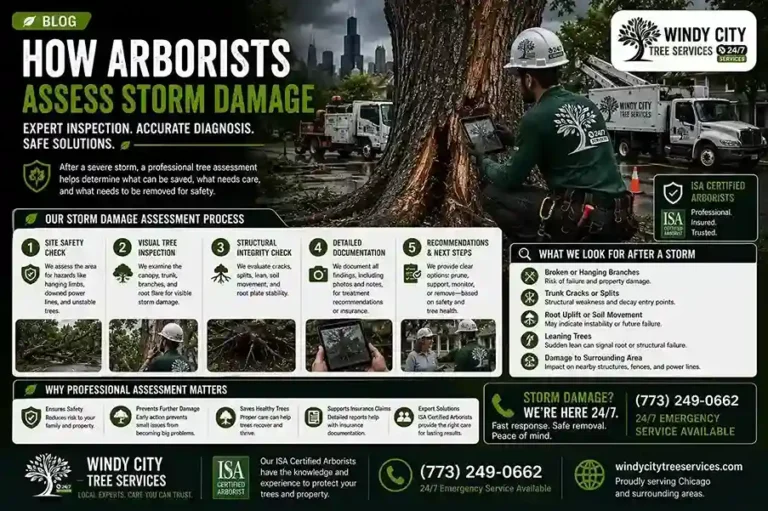
How Arborists Assess Storm Damage
A look inside the inspection process after wind, ice, or heavy rain hits a property.
Wind Damage vs Structural Tree Failure
Two different failure patterns, and why the distinction changes the response.
Common Reasons Trees Fail During Chicago Storms
The structural weak points that turn a summer storm into a fallen-tree emergency.
Preparing Trees Before Severe Weather
The proactive checklist that reduces emergency calls when storms roll in.
Emergency Tree Removal Checklist for Homeowners
What to do, and what to avoid, in the first hour after a tree becomes a hazard.
What to Do After a Tree Falls During a Storm
The first steps to take, and the ones to avoid, right after a tree comes down.
Ice Storm Tree Damage Prevention
How to reduce ice loading risk on mature trees before winter hits.
Tree Removal After Lightning Damage
How to tell whether a lightning-struck tree can recover or needs to come down.
Safe Tree Removal Near Homes and Power Lines
How professional crews handle the trickiest, highest-stakes removal jobs.
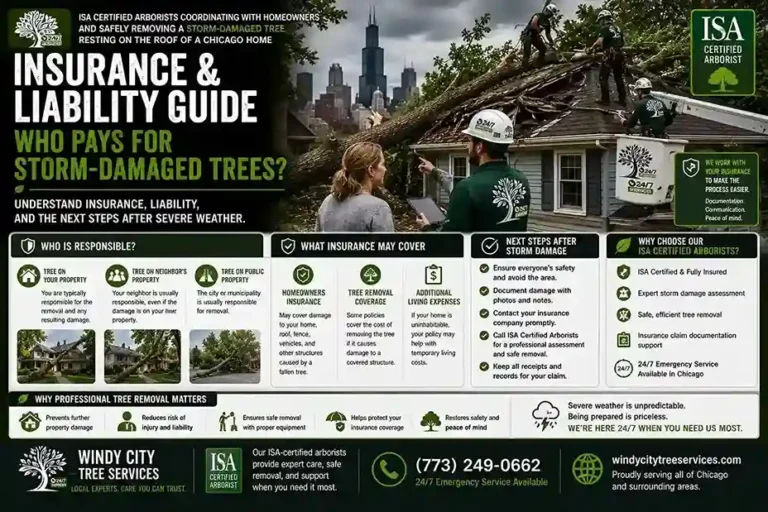
Emergency Tree Removal Insurance Tips
What documentation helps most when filing a claim after tree damage.
Can a Dead Tree Be Saved?
What “dead” actually means for a tree, and when recovery is still possible.
When Should a Tree Be Removed?
A practical framework for deciding between saving and removing a struggling tree.
Sources referenced in this guide include publications and best management practices from the International Society of Arboriculture (ISA), the USDA Forest Service, University of Illinois Extension, The Morton Arboretum, the National Weather Service (NWS), and general workplace safety principles from the Occupational Safety and Health Administration (OSHA). This article is intended for general educational purposes and does not replace an on-site professional tree risk assessment.