Why Trees Suddenly Lose Branches | Windy City Tree Services
A calm, sunny afternoon. No storm, no wind, nothing that looks like a warning. And then a large limb crashes down from a tree that looked completely healthy the day before. It’s one of the more unsettling things a homeowner can witness, and it happens more often than most people realize.
Sudden branch failure isn’t random, even when it looks that way. Something changed inside that branch, or that tree, well before it hit the ground: decay progressing quietly, a crack forming under stress, a weak union finally giving out under its own weight. The tricky part is that these problems often aren’t visible from the ground, which is exactly why “the tree looked fine” and “the branch was structurally sound” aren’t always the same thing.
This guide covers the real causes behind sudden branch loss, the warning signs worth watching for, and how ISA Certified Arborists assess risk before it turns into an emergency. No inspection can eliminate all risk entirely, but a professional evaluation catches far more than an untrained eye ever will.
Why do trees suddenly lose branches? Trees may suddenly lose branches due to decay, internal cracks, weak branch attachments, storm damage, drought stress, heavy foliage, excessive moisture, or a poorly understood phenomenon called Sudden Summer Branch Drop. No single cause explains every incident, and some failures occur with little visible warning, but routine inspections and structural pruning meaningfully reduce many branch failure risks.
1. What Is Sudden Branch Drop?
Sudden branch drop refers to a large limb failing and falling with no obvious external trigger, no storm, no strong wind, sometimes not even a breeze. A specific version of this phenomenon, known as Sudden Summer Branch Drop (SSBD), refers specifically to large, healthy-looking limbs failing during hot, calm, humid summer conditions.
Researchers don’t fully understand the exact mechanism behind SSBD yet, and it remains an active area of study in arboriculture and forestry science. Leading theories point toward internal moisture pressure changes, heat stress on wood fibers, or a combination of factors that weaken a branch from the inside without producing visible external symptoms beforehand.
A common misconception is that SSBD only affects unhealthy or old trees. In reality, some documented cases involve large, apparently vigorous limbs on otherwise healthy trees, which is part of why the phenomenon gets so much attention despite being relatively uncommon. It’s also worth being clear: SSBD is one specific, less-understood cause among several well-documented ones, not the explanation for every unexpected branch failure.
2. Common Causes of Sudden Branch Failure
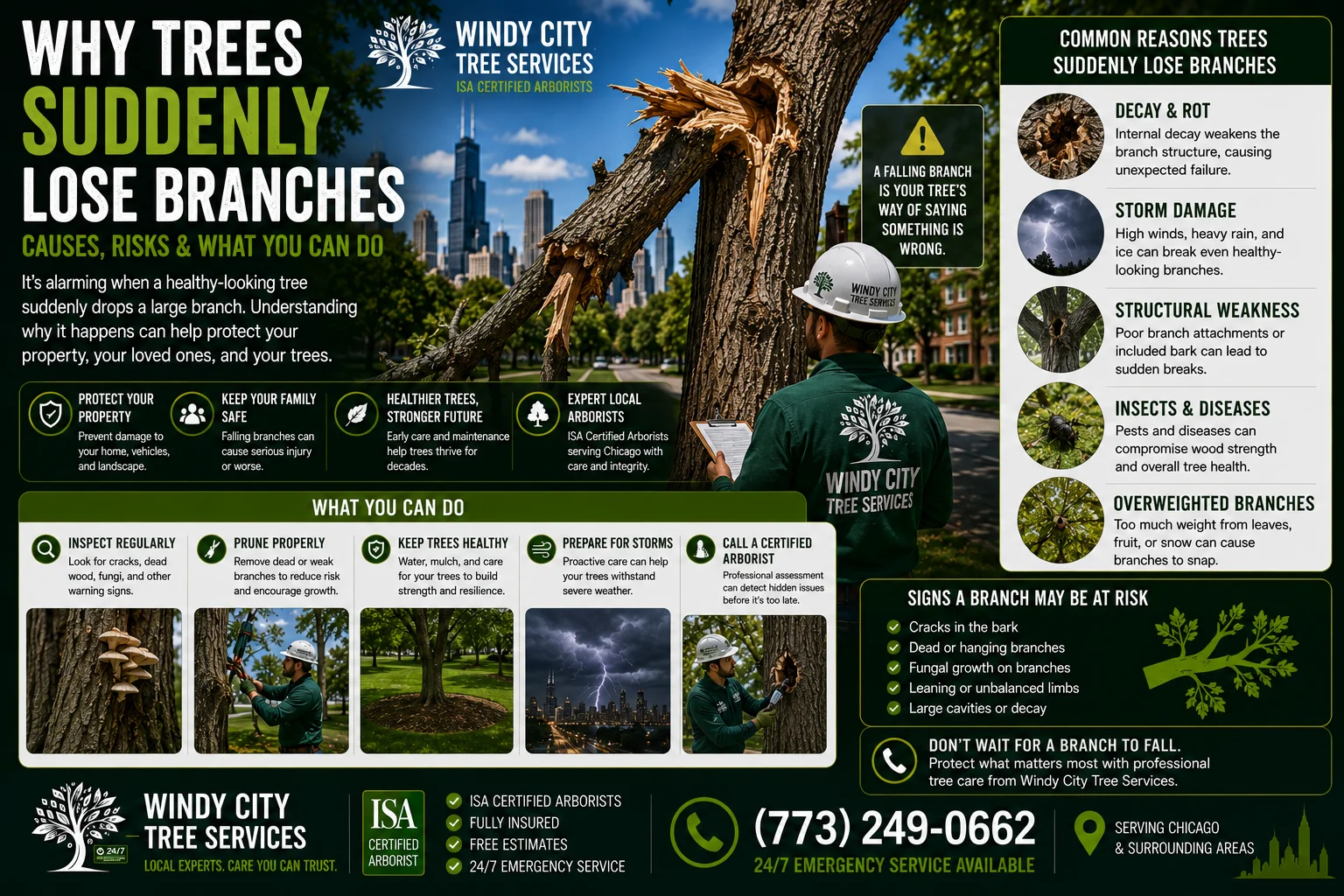
Most branch failures trace back to one or more of these underlying issues:
- Dead wood. Dead branches lose the flexibility living wood has, making them prone to snapping under load with little warning.
- Internal decay. Fungal decay inside a branch or at its attachment point can hollow out structural wood long before any external sign appears.
- Cracks. Internal or surface cracks weaken a branch’s ability to bend and flex under wind or weight.
- Weak branch unions. Poorly attached branches, especially those growing at narrow angles, carry inherently less structural strength.
- Included bark. Bark trapped between two closely growing stems or branches prevents a strong wood-to-wood connection at the union.
- Heavy limbs. Large, long branches carry more leverage and stress at their attachment point, especially as they age and gain weight.
- Wind loading. Even moderate wind adds real force to a canopy, and a compromised branch may fail well below what a healthy one could withstand.
- Excessive canopy weight. Dense, overgrown foliage adds weight and wind resistance that a structurally weak limb may not be able to support.
3. Summer Branch Drop
SSBD deserves its own closer look because of how counterintuitive it is. Reported incidents cluster around a specific combination of conditions:
- Hot weather, often during extended summer heat
- High humidity, which may affect internal moisture dynamics within the branch
- Heavy leaf loads, peak-season foliage adding maximum weight to limbs
- Calm days, notably absent of the wind that typically gets blamed for branch failure
- Large, mature trees, with long, heavy limbs extending well beyond the trunk
Species commonly reported in SSBD incidents include oak, elm, maple, beech, sycamore, and poplar, though susceptibility appears to vary by individual tree, site conditions, and specific circumstances rather than being a fixed trait of any one species. This is an area where the science is still developing, and homeowners with large, mature trees of these species may simply want to be extra attentive to warning signs during hot, calm summer stretches.
Did you know? Some SSBD incidents have occurred on trees with no visible prior defects, which is why researchers suspect an internal, moisture- or heat-related mechanism rather than a purely structural cause in every case.
4. Storm Damage
Storms remain the most common and best-understood cause of branch failure. Wind adds direct mechanical stress to every branch in a canopy, and lightning can cause both immediate breakage and hidden internal damage that surfaces later. Heavy rain adds weight, and when combined with wind, dramatically increases the load on already-stressed limbs.
Winter conditions bring their own version of the same problem. Ice accumulation adds weight while simultaneously making wood more brittle, and heavy snow loading can be enough on its own to snap weakly attached branches. Saturated soil, meanwhile, affects the whole tree’s stability, sometimes contributing to broader failure beyond just individual limbs. For a deeper look at these storm-specific mechanisms, see our guide on common reasons trees fail during Chicago storms.
5. Tree Diseases That Increase Branch Failure
Disease weakens wood structurally, often well before it visibly kills the branch or tree. A few diseases relevant to the Chicago area:
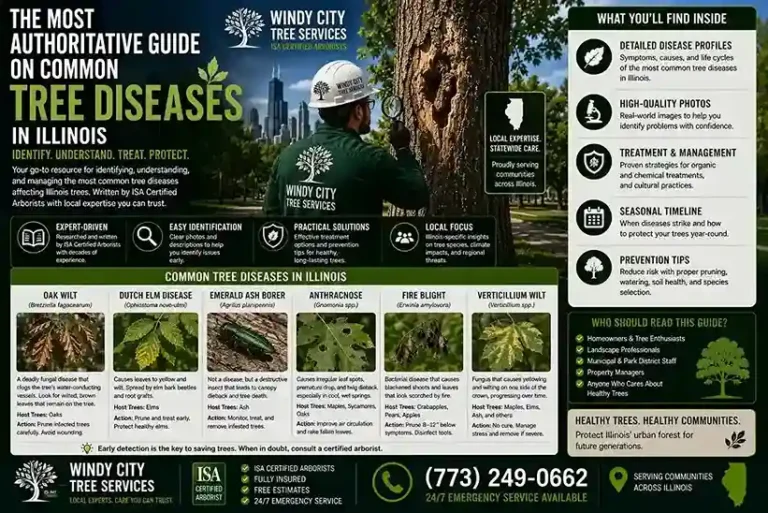
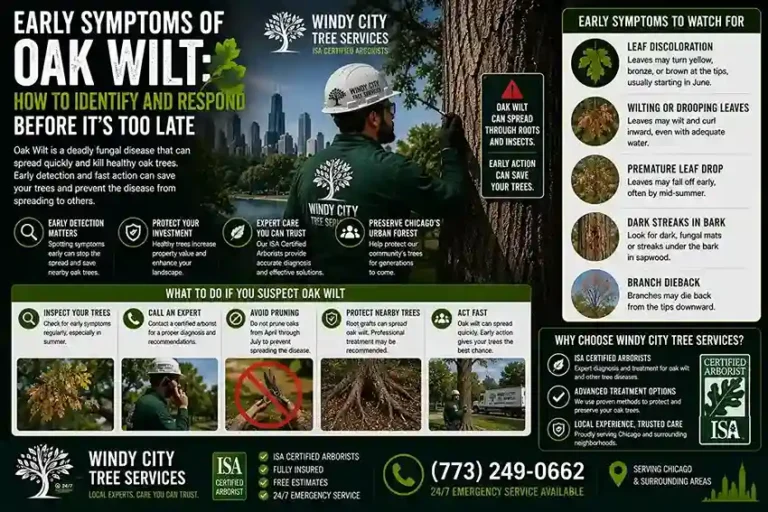
- Oak Wilt. Blocks water-conducting tissue, causing rapid decline and structurally weakening affected branches.
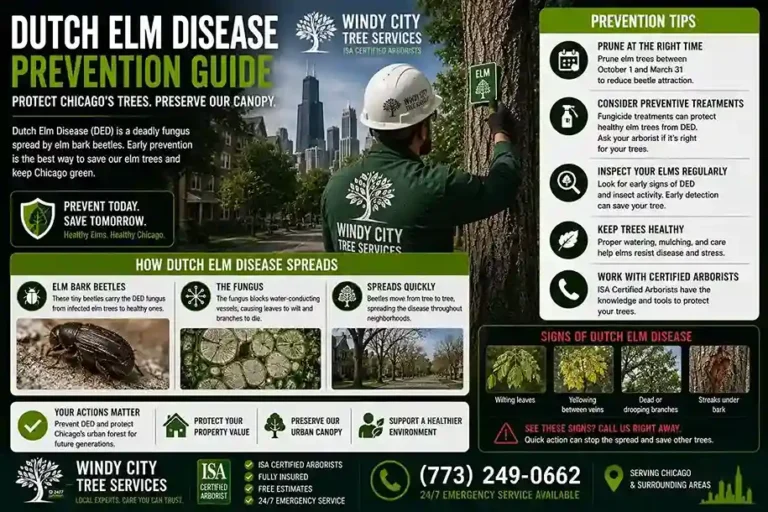
- Dutch Elm Disease. Still present in the region’s remaining elm population, causing progressive canopy dieback and branch weakness.
- Root rot. Weakens the whole tree’s stability from below, which can affect how well the canopy is supported overall.
- Canker diseases. Create localized areas of dead, weakened bark and wood exactly where a branch needs strength most.
- Decay fungi. Various species colonize damaged or stressed wood, hollowing it out from the inside over time.
The common thread across all of these is that disease damage is frequently invisible from a casual glance, which is part of why unexpected branch failure and undiagnosed disease so often go hand in hand.
6. Structural Defects
Some branches are simply built to fail eventually, based on how they grew. Included bark, where bark grows inward between two closely spaced stems instead of forming a solid wood connection, creates one of the weakest possible union types. Codominant stems, two trunks or major branches of similar size competing for dominance, often develop this exact defect at their point of attachment.
Long horizontal limbs carry more leverage stress than upright branches of the same size, simply due to how gravity and wind act on their geometry. Poor branch attachment generally, whether from included bark or simply a narrow growth angle, and overextended branches that have grown well beyond what their attachment point can comfortably support, round out the most common structural risk factors.
8. How Arborists Assess Tree Risk
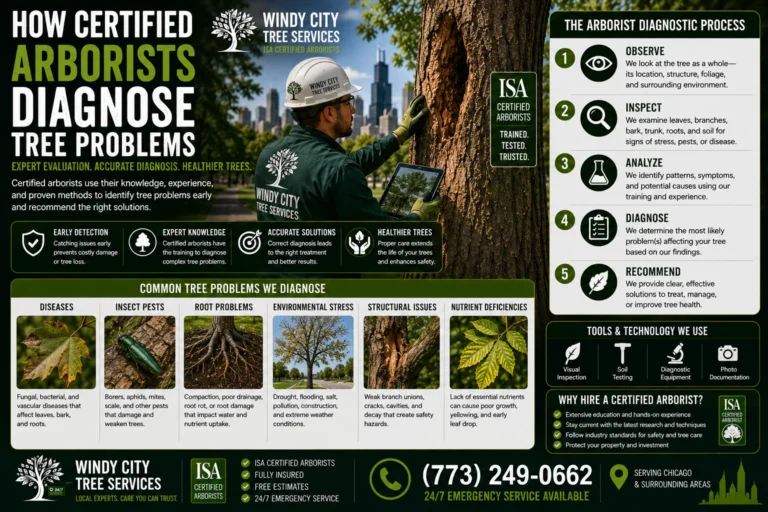
Professional risk assessment goes well beyond a glance from the sidewalk. Arborists trained under ISA’s Tree Risk Assessment Qualification (TRAQ) framework use a structured process that typically includes:
- Visual Tree Assessment (VTA). A systematic visual review of the tree’s crown, trunk, and visible root area for signs of stress or defect.
- Sounding and probing. Tapping or probing suspect areas of wood to detect hollow or decayed sections that aren’t visible externally.
- Root collar inspection. Checking the base of the tree for decay, girdling roots, or other issues that affect overall stability.
- Air Spade excavation when appropriate. Using compressed air to expose roots without damaging them, useful when root-related risk is suspected.
- Advanced diagnostic tools. In some cases, resistance drilling or sonic tomography can assess internal wood condition with more precision than sounding alone.
This kind of formal assessment should be performed by a qualified professional. It’s genuinely difficult, and often unsafe, to reliably diagnose internal decay or structural risk without training and the right tools.
9. Can Sudden Branch Failure Be Prevented?
Not entirely, but risk can be meaningfully reduced. The main preventive tools:
- Structural pruning. Correcting weak unions and overextended growth before they become failure points, following ANSI A300 standards.
- Crown reduction. Selectively reducing canopy size and weight on trees carrying excessive limb length or density.
- Crown cleaning. Removing dead and weakened wood before it becomes a falling hazard.
- Cabling and bracing. Providing physical support at weak unions in large, valuable limbs worth preserving.
- Disease management. Early treatment of infections that would otherwise progressively weaken branch structure.
- Regular inspections. The single most effective tool for catching developing problems before they result in failure.
10. Warning Signs Homeowners Should Never Ignore
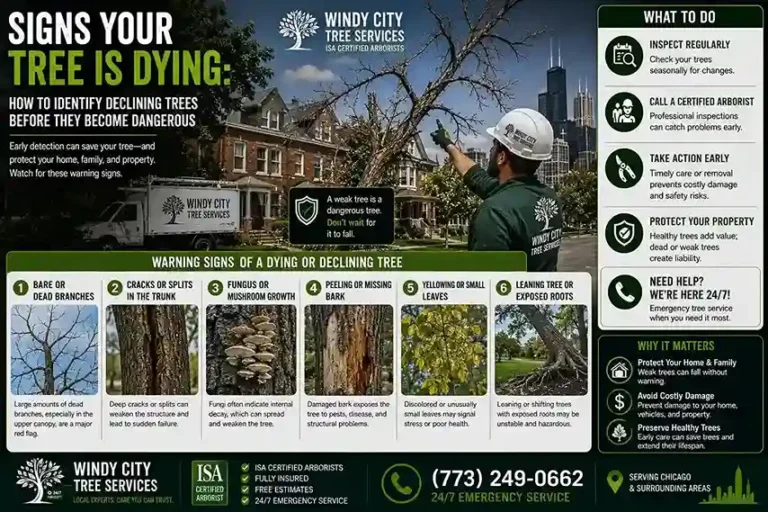
- Hanging or partially broken branches still caught in the canopy
- Visible cracks or splits in a branch or at its attachment point
- Peeling or missing bark, especially around a branch union
- Mushrooms or fungal growth on the trunk or major limbs
- Dead limbs with no leaves while the rest of the canopy is healthy
- A tree that’s leaning, particularly with a new or worsening lean
- Canopy dieback concentrated in one section of the tree
- Noticeable branch movement or flexing that seems unusual for the wind conditions
Any of these on their own is worth a look. More than one at the same time is a good reason to schedule a professional inspection soon rather than waiting.
11. When Emergency Tree Removal Is Necessary
Some branch and tree situations call for immediate professional response rather than routine scheduling:
- A branch resting on a home or other structure, an active, ongoing hazard
- Utility hazards, including branches touching or near power lines
- Broken limbs still hanging in the canopy, at risk of falling further
- Split trunks, indicating significant loss of structural integrity
- Public safety concerns, like a hazard overhanging a sidewalk or street
- Storm emergencies generally, where multiple hazards may need addressing quickly
For a deeper breakdown of when urgency is warranted, see our guide on why immediate tree removal matters.
Healthy Branch vs. Hazardous Branch
| Healthy Branch | Hazardous Branch |
|---|---|
| Strong attachment | Included bark |
| Sound wood | Internal decay |
| Balanced canopy | Overextended limb |
| Healthy bark | Cracks and splits |
| Good vigor | Dead wood |
Sudden Summer Branch Drop vs. Storm Damage
| Characteristic | Summer Branch Drop | Storm Damage |
|---|---|---|
| Typical weather | Hot, calm, humid conditions | Wind, rain, ice, or heavy snow |
| Warning signs | Often minimal or absent | Visible wind stress, storm activity |
| Branch size | Typically large, mature limbs | Varies widely by storm severity |
| Primary cause | Not fully understood; possibly heat/moisture-related | Direct mechanical force from wind, ice, or snow |
| Prevention | Inspections, structural pruning of large limbs | Structural pruning, storm prep, cabling and bracing |
Tree Branch Safety Checklist
- Inspect large limbs periodically, especially on mature trees.
- Look for cracks in branches or at their attachment points.
- Watch for dead branches with no leaves while the rest of the canopy is healthy.
- Check branch unions for included bark or narrow attachment angles.
- Inspect trees after any storm, even if damage isn’t immediately obvious.
- Monitor any leaning trees closely, especially new or worsening leans.
- Schedule annual professional inspections for mature or high-value trees.
- Keep people and pets away from trees showing signs of hazard.
- Contact an ISA Certified Arborist immediately if major defects are observed.
Frequently Asked Questions
Why did my tree suddenly lose a branch?
It could be internal decay, a hidden crack, a weak branch union, storm stress, or in some cases, Sudden Summer Branch Drop, a phenomenon researchers don’t fully understand yet. A professional inspection can help identify the specific cause.
What is Sudden Summer Branch Drop?
It’s a phenomenon where large, often healthy-looking limbs fail during hot, calm, humid summer conditions with no obvious external trigger. The exact mechanism is still being studied.
Can healthy trees lose branches without warning?
Yes, in some documented cases, though internal issues like hidden decay or structural defects are often present even when a tree appears healthy from the outside.
Which trees are most susceptible to sudden branch failure?
Large, mature trees with long limbs are generally more susceptible. Oak, elm, maple, beech, sycamore, and poplar are commonly reported in Sudden Summer Branch Drop cases, though individual tree condition matters as much as species.
Can pruning prevent branch failure?
Structural pruning significantly reduces risk by correcting weak unions and reducing excessive limb weight, though it can’t eliminate all risk, particularly for less-understood causes like SSBD.
Should I remove a tree after it loses a large limb?
Not necessarily. A professional assessment can determine whether the failure indicates a broader structural problem or was a more isolated event. Many trees remain safe after proper corrective pruning.
What causes branch cracks?
Cracks can result from wind stress, ice or snow loading, included bark at a weak union, or internal decay that has compromised the wood’s structural integrity.
How often should trees be inspected?
An annual inspection is a reasonable baseline for mature trees, with additional checks after major storms or any noticeable change in the tree’s condition.
What should I do after a branch falls?
Stay away from the area, check for any remaining hanging debris in the canopy, and contact a certified arborist to assess whether the failure indicates a broader issue.
When should I call an arborist about a branch concern?
Call promptly if you notice cracks, dead wood, fungal growth, a new lean, or any branch that seems unusually heavy or overextended relative to the rest of the tree.
Can dead branches be safely left on a tree?
Small deadwood high in the canopy carries lower risk, but any large dead limb near a home, walkway, or parking area should be removed promptly due to its unpredictable failure point.
Does wind always cause branch failure?
No. While wind is a common trigger, some branch failures, including Sudden Summer Branch Drop, occur on calm days with no significant wind involved.
What is included bark, and why does it matter?
It’s bark that grows inward between two closely spaced stems or branches instead of forming a solid wood connection, creating one of the weakest possible branch union types.
Can carpenter ants cause branch failure?
Carpenter ants typically nest in wood that’s already softened by decay rather than causing decay themselves, but their presence is a useful indicator that internal decay may already be present.
Is Air Spade excavation useful for branch failure diagnosis?
It’s more directly useful for root-related issues, though root problems can sometimes contribute to overall tree stress that affects branch health as well.
Can a tree with one major branch failure still be structurally sound overall?
Often yes, especially if the failure was isolated to a specific defect. A professional assessment of the remaining structure is the best way to confirm this.
Does tree age increase the risk of sudden branch drop?
Generally, yes. Older, larger trees have had more time to accumulate decay, structural stress, and long, heavy limbs, all of which contribute to branch failure risk.
Should I be more cautious during hot, humid summer days?
If you have large, mature trees of species commonly associated with Sudden Summer Branch Drop, extra attentiveness during hot, calm summer stretches is a reasonable precaution.
Can insurance help cover damage from a fallen branch?
Often, if the branch damaged an insured structure. Coverage specifics vary by policy, so check with your insurer directly. Our guide on who pays for storm-damaged trees covers this in more depth.
What’s the most reliable way to catch hidden branch problems before they fail?
Regular professional inspections remain the most reliable tool, since trained arborists can identify defects and decay that aren’t visible to an untrained eye from the ground.
Key Takeaways
- Sudden branch failure has multiple possible causes, including decay, structural defects, disease, storm stress, and the less-understood Sudden Summer Branch Drop.
- A healthy-looking tree can still carry hidden risk, since many defects, especially internal decay, aren’t visible from the ground.
- Warning signs are worth taking seriously, particularly cracks, dead wood, fungal growth, and new or worsening leans.
- Professional risk assessment, using structured methods like TRAQ, catches far more than a casual visual check.
- Prevention through structural pruning and regular inspection meaningfully reduces risk, even though it can’t eliminate every possibility.
Sources & Further Reading
- International Society of Arboriculture (ISA), Best Management Practices & TRAQ
- Tree Care Industry Association (TCIA)
- ANSI A300 Tree Care Standards
- USDA Forest Service, Urban Forestry Resources
- University of Illinois Extension, Tree Care Publications
- The Morton Arboretum, Tree & Plant Advice
- Illinois Department of Natural Resources
This article is provided for general educational purposes. Sudden branch failure can result from multiple interacting factors, and no visual inspection can eliminate all risk, though routine professional assessment significantly improves hazard identification.