Tree Stress After Construction Guide | Windy City Tree Services
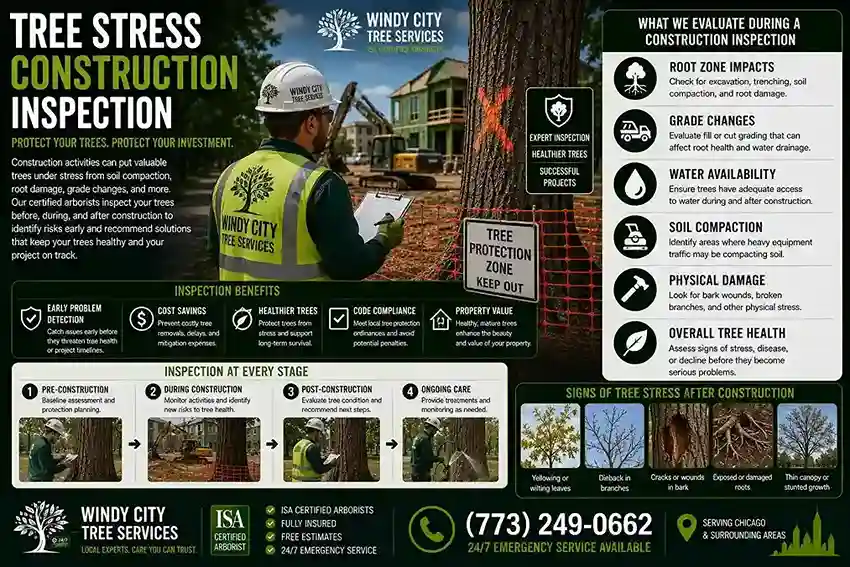
Construction projects frequently damage trees without any immediately visible symptoms. A crew can dig a trench, grade a yard, or park equipment on a lawn, and the tree nearby can look completely normal the following spring. That appearance is misleading. Most tree roots grow within the upper 12 to 18 inches of soil, spreading out well beyond the canopy’s edge, which puts them directly in the path of excavation, trenching, and heavy equipment traffic.
Trees often appear healthy immediately after construction and decline months or even years later. That delay is exactly what makes construction damage so easy to miss and so hard to trace back to its cause once symptoms finally show up. By the time a homeowner notices a thinning canopy or dead branches, the root damage that caused it may already be two or three years old.
The good news is that early intervention meaningfully improves outcomes. This guide explains how construction affects trees, how to recognize the warning signs before decline becomes severe, what treatment options exist, and when it’s time to bring in an ISA Certified Arborist. It draws on preservation guidance from the International Society of Arboriculture (ISA), the Tree Care Industry Association (TCIA), and the USDA Forest Service.
Quick Answer: How Does Construction Stress Affect Trees?
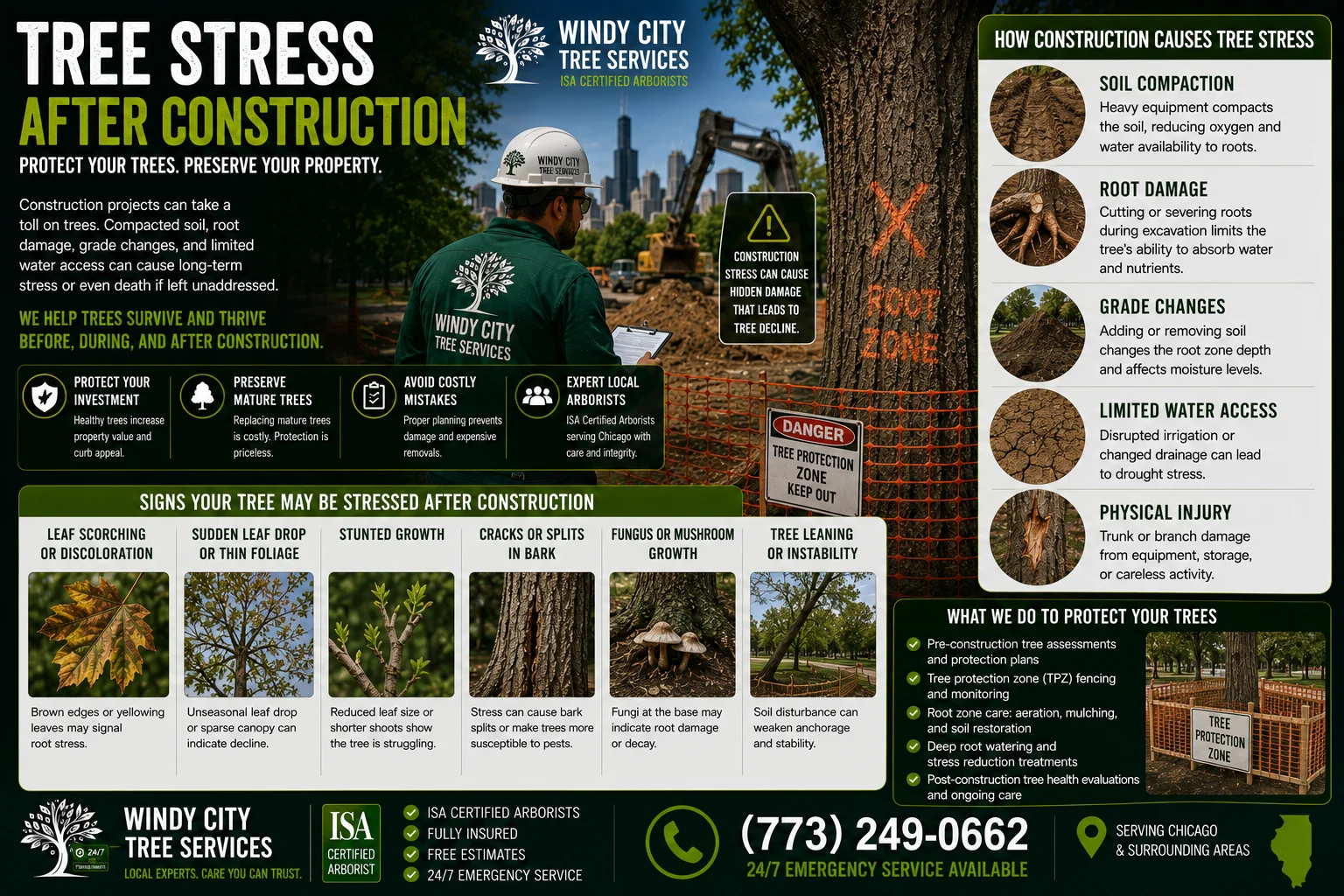
Construction can damage roots, compact soil, change drainage patterns, injure trunks, and reduce oxygen available to roots. These stresses often lead to canopy thinning, leaf discoloration, branch dieback, slow growth, and long-term decline. Professional inspections help identify problems before they become irreversible.
1. Why Construction Is Harmful to Trees
A tree’s health depends on a root system most people never see and rarely think about. Understanding why construction is so disruptive starts with understanding that root system.
- Root systems: Roughly 90 percent of a tree’s roots grow in the top 12 to 18 inches of soil, and they extend well past the canopy’s dripline, often two to three times the canopy’s radius.
- Soil disturbance: Digging, grading, and compaction all disrupt the delicate balance of air, water, and nutrients that roots depend on.
- Urban development: Chicago’s dense residential lots put mature trees close to nearly every renovation, addition, and utility project, so the odds of some root zone impact are high.
- Delayed decline: Trees rely on stored energy reserves, so a tree can coast on those reserves for a season or two even after significant root loss, masking the true extent of the damage.
- Hidden damage: Most construction damage happens below ground, where it’s invisible without excavation or specialized inspection tools.
2. How Construction Damages Tree Roots
Several common construction activities cause root damage, often without anyone involved realizing the extent of it at the time.
| Construction Activity | Possible Tree Impact |
|---|---|
| Excavation | Direct root severing, sometimes removing a significant share of the root system in one pass |
| Trenching | Cuts a straight line through roots regardless of size, often more damaging than a wider, shallower dig |
| Heavy equipment | Compacts soil and can crush surface roots even without direct digging |
| Soil grading | Changes root depth relative to grade, which can bury the root flare or expose roots to injury |
| Material storage | Compacts soil under stored supplies and blocks water and oxygen from reaching roots below |
| Utility installation | Often involves narrow trenches that pass directly through a tree’s root zone |
Foundation work, sidewalk replacement, and driveway construction all carry similar risk, since they typically require excavation within a few feet of the trunk on at least one side of the tree. Even losing a modest portion of the root system can significantly reduce a tree’s ability to take up water and nutrients, especially during the stressful first growing season after construction, and repeated or extensive root loss compounds that effect substantially.
3. Soil Compaction
Soil compaction is one of the most underrated forms of construction damage, because it doesn’t cut anything, it simply squeezes the life out of the soil structure roots depend on.
- Heavy equipment: Repeated passes from trucks, excavators, and skid steers compress soil particles together, closing the pore spaces roots need.
- Foot traffic: Even a construction crew walking the same path day after day gradually compacts soil in the root zone.
- Storage of materials: Piled lumber, dirt, or equipment concentrates weight on a small area over an extended period.
- Reduced oxygen: Compacted soil holds less air, and roots need oxygen just as much as they need water.
- Reduced water infiltration: Water runs off compacted soil instead of soaking in, leaving roots chronically dry even during a rainy season.
- Restricted root growth: Dense, compacted soil physically blocks new root growth, limiting a tree’s ability to recover and expand its root system after construction ends.
⚠️ Compaction Is Often Invisible
Soil compaction doesn’t leave an obvious visual sign the way a severed root does. A lawn can look completely normal on the surface while the soil underneath has lost most of its ability to support healthy root growth.
4. Changes to Drainage
Construction frequently changes how water moves across a property, and roots are sensitive to both too much water and too little.
- Excess water: New hardscaping or grading can redirect runoff toward a tree’s root zone, saturating soil that used to drain normally.
- Standing water: Pooling water displaces the oxygen roots need and can lead to root rot over time.
- Drought conditions: The opposite problem, grading that diverts water away from a tree, can leave roots chronically underwatered even in a normal rainfall year.
- Grade changes: Raising or lowering the soil level around a tree, even by just a few inches, changes how much oxygen and water reach the root system.
- Root suffocation: Adding fill soil over an existing root zone is one of the most damaging and most common construction mistakes, since it can suffocate roots that were previously at the correct depth.
5. Trunk & Bark Damage
Above-ground damage matters too, and it’s often more visible but no less serious than root damage.
- Equipment impacts: Trucks, excavators, and materials frequently scrape or strike trunks in tight residential work sites.
- Mechanical wounds: Even a single significant impact can damage the cambium layer just under the bark, disrupting the tree’s ability to move nutrients at that point.
- Bark loss: Stripped or gouged bark exposes the underlying wood and removes the tree’s natural protective barrier.
- Disease entry points: Open wounds give decay fungi and disease organisms a direct path into the tree.
- Decay development: Untreated wounds can develop internal decay over subsequent years, sometimes well after the construction project itself is long finished.
6. Signs of Tree Stress After Construction
Symptoms may appear one to five years after construction, which is exactly why so many homeowners don’t connect the dots. Watch for:
- Small leaves: New leaf growth noticeably smaller than in previous years signals reduced root capacity.
- Yellowing leaves: Chlorosis can indicate the roots aren’t delivering adequate nutrients to the canopy.
- Brown leaves: Leaf scorch or premature browning often points to water stress from root damage.
- Early leaf drop: Losing leaves well ahead of normal fall timing is a common stress response.
- Sparse canopy: A canopy that’s visibly thinner than in past years reflects reduced overall vigor.
- Dead branches: Isolated branch death, especially in the upper canopy, often follows root loss.
- Slow growth: Noticeably shorter annual growth on branch tips compared to prior years.
- Epicormic sprouts: Clusters of small shoots sprouting from the trunk or major limbs are a classic stress response as the tree tries to compensate for lost canopy capacity.
- Branch dieback: Progressive death working inward from branch tips toward the trunk over multiple seasons.
💡 Did You Know?
According to guidance from the Morton Arboretum, trees can draw on stored carbohydrate reserves for one to several years after root damage before visible canopy symptoms appear, which is exactly why a tree that looked fine the first summer after construction can decline noticeably by the third or fourth year.
7. Tree Species Most Sensitive to Construction Damage
Species tolerance for construction disturbance varies considerably, and knowing where your tree falls on that spectrum helps set realistic expectations.
| Species | Construction Sensitivity |
|---|---|
| Oak | Highly sensitive; especially vulnerable to root disturbance and grade changes |
| Maple | Sensitive, particularly to soil compaction and changes in drainage |
| Elm | Moderately sensitive; construction stress can also increase susceptibility to Dutch Elm Disease |
| Ash | Sensitive, and already vulnerable independently to emerald ash borer pressure |
| Birch | Highly sensitive to root disturbance and soil compaction |
| Beech | Very sensitive to grade changes and soil compaction around the root zone |
| Honey Locust | More tolerant than most, though still vulnerable to major root loss |
| Spruce | Sensitive to soil compaction and changes in drainage patterns |
8. How Arborists Diagnose Construction Damage
Diagnosing construction-related stress means combining several inspection methods, since the damage is largely underground and out of sight.
- Tree health inspection: A full canopy and structural assessment establishes a baseline and tracks changes over time.
- Root collar inspection: Checking the root flare for burial, girdling, or mechanical damage near the base of the trunk.
- Air Spade excavation: Compressed air exposes roots without cutting or damaging them, letting an arborist directly assess root health, depth, and extent of loss.
- Soil testing: Evaluating compaction levels, drainage, and nutrient availability in the root zone.
- Root mapping: Documenting where healthy roots remain after construction helps target treatment to where it will do the most good.
- Tree Risk Assessment: Evaluating whether root loss has created a structural stability concern, not just a health concern.
- Canopy evaluation: Tracking dieback, leaf size, and overall vigor season over season to gauge trajectory.
Air Spade technology is particularly valuable here, since it lets an arborist inspect roots directly rather than guessing based on canopy symptoms alone. Learn more about our Air Spade root inspection service.
9. Can Trees Recover?
Many trees can recover meaningfully from construction stress, though outcomes depend on how much root loss occurred, the tree’s species, its age and prior health, and how quickly treatment begins. No arborist can guarantee recovery, since every tree’s response depends on factors that aren’t always fully visible even with a thorough inspection.
- Root regeneration: Healthy remaining roots can grow new feeder roots over time, gradually rebuilding capacity.
- Mulching: A proper mulch layer over the root zone improves soil moisture retention and moderates temperature, supporting recovery.
- Deep root fertilization: Delivering nutrients directly to the root zone can support a stressed tree’s recovery, though it isn’t a substitute for addressing the underlying root damage. Learn more about our tree and shrub fertilization service.
- Proper watering: Consistent, deep watering during dry periods reduces additional stress while the root system recovers.
- Structural pruning: Reducing canopy demand to better match a reduced root system can help a stressed tree conserve energy. See our tree trimming and pruning service.
- Soil aeration: Relieving compaction improves oxygen and water infiltration in the root zone.
- Long-term monitoring: Construction-stressed trees often need several years of follow-up assessment to confirm they’re on a stable recovery path.
10. Preventing Construction Damage
Prevention is dramatically more effective, and far less expensive, than trying to correct severe root damage after the fact. Planning ahead protects both the tree and the project budget.
- Tree Protection Zones (TPZ): Establishing a protected radius around a tree’s root zone before any equipment arrives on site, following ISA Best Management Practices for construction protection.
- Protective fencing: Physical barriers keep equipment, materials, and foot traffic out of the protected root zone throughout the project.
- Root pruning before excavation: Cleanly cutting roots at the edge of an excavation zone ahead of time produces a much better outcome than letting equipment tear them.
- Air Spade excavation: Using compressed air instead of mechanical digging near roots preserves root structure during necessary utility work close to a tree.
- Equipment restrictions: Routing heavy equipment away from the root zone whenever the site layout allows it.
- Arborist supervision: Having a certified arborist present during critical phases of construction near valuable trees catches problems before they become serious.
- Construction planning: Involving an arborist during the design phase, before permits are even filed, is the single most effective step toward preserving mature trees through a project.
A Tree Protection Zone keeps equipment, materials, and foot traffic away from a tree’s most sensitive root area throughout a project.
11. When Tree Removal Becomes Necessary
Not every construction-stressed tree can be saved. Removal becomes the responsible recommendation when:
- Severe root loss: A tree that lost a large majority of its root system often can’t recover enough structural support or vigor to remain safe long term.
- Structural instability: Root damage that compromises anchoring creates a genuine risk of the tree failing, especially in wind.
- Extensive decay: Trunk wounds from construction that developed significant internal decay over time can leave a tree structurally unsound.
- Safety hazards: A tree near a home, driveway, or walkway with compromised structural integrity poses a risk that generally outweighs preservation efforts.
- Dead trees: Once a tree has died from construction stress, prompt removal prevents the safety and pest issues a standing dead tree can create.
If removal is the right call, our tree removal service and emergency tree removal service handle the work safely.
Construction Damage Timeline
Decline from construction stress typically unfolds in stages, though the timeline varies by species, tree health, and the extent of damage.
During Construction
Roots are cut, soil is compacted, or the trunk is wounded. The tree often shows no visible symptoms at this stage.
Year One
The tree draws on stored energy reserves. Subtle signs like slightly smaller leaves may appear but are easy to miss.
Years Two to Three
Reserves begin to run low. Canopy thinning, early leaf drop, and slower growth typically become more noticeable.
Years Three to Five
Without intervention, branch dieback and epicormic sprouting often appear, signaling the tree is struggling to compensate for lost capacity.
Beyond Five Years
Trees with severe, untreated damage may continue declining toward mortality, while trees that received early treatment often stabilize well before this stage.
Healthy Tree vs. Construction-Stressed Tree
| Healthy Tree | Construction-Stressed Tree |
|---|---|
| Dense canopy | Sparse canopy |
| Normal leaf size | Small leaves |
| Stable growth | Slow growth |
| Healthy roots | Damaged roots |
| Strong annual growth | Progressive decline |
Construction Tree Protection Checklist
- Install tree protection fencing before construction begins
- Keep equipment outside the designated root protection zone
- Avoid soil compaction from foot traffic and material storage
- Protect any exposed roots with mulch or damp burlap
- Water trees consistently throughout the construction period
- Inspect trees for damage promptly after construction wraps up
- Schedule a professional arborist evaluation post-construction
- Monitor tree health annually for at least the following several years
📋 Design Note: Additional Infographic Concepts
This article is also built to support a full root protection zone infographic, a construction damage timeline graphic, a healthy-versus-damaged root system illustration, a soil compaction effects diagram, an Air Spade excavation process visual, and a printable construction tree protection checklist card. These can be produced as branded illustrations using the Forest Green, Bright Green Accent, and Charcoal Gray palette for future visual refreshes of this page.
Frequently Asked Questions
Can construction kill a tree?+
Yes. Severe root loss, soil compaction, or trunk damage from construction can be significant enough to kill a tree, sometimes years after the project is finished, once stored energy reserves run out.
Why did my tree die after construction?+
Delayed tree death after construction usually traces back to root damage, soil compaction, or a change in drainage that occurred during the project. Trees can survive on stored reserves for a year or more before decline becomes visible.
How long does construction damage take to appear?+
Symptoms commonly appear anywhere from one to five years after construction, depending on the tree’s species, age, overall health, and how much of the root system was affected.
Can damaged roots recover?+
Often, yes, particularly when enough healthy root system remains and treatment begins promptly. Recovery isn’t guaranteed and depends heavily on the extent of the original damage.
What is soil compaction?
Soil compaction happens when repeated weight from equipment, foot traffic, or material storage presses soil particles together, closing the pore spaces roots need for oxygen and water.
What is a Tree Protection Zone?
A Tree Protection Zone is a fenced-off area around a tree’s root system, established before construction begins, that keeps equipment, materials, and foot traffic away from the tree’s most sensitive root area.
How can an Air Spade help?
An Air Spade uses compressed air to expose roots without cutting or damaging them, letting an arborist directly inspect root health and perform root pruning or excavation near a tree without harming its root system.
Can fertilization help stressed trees?
Deep root fertilization can support a stressed tree’s recovery by supplying nutrients the damaged root system may struggle to access, though it works best alongside other treatments, not as a stand-alone fix.
Should I remove a construction-damaged tree?
It depends on the extent of the damage. Trees with moderate stress often recover with proper care, while trees with severe root loss, structural instability, or extensive decay are usually safer to remove.
When should I call an arborist?
Ideally before construction begins, so a protection plan can be put in place. If construction has already happened, schedule an inspection as soon as you notice any canopy thinning, leaf discoloration, or slow growth.
How close can construction equipment safely work to a tree?
This varies by tree size and species, but a good general guideline is keeping equipment outside a radius of roughly one foot for every inch of trunk diameter. An arborist can recommend a specific protection zone for your tree.
Does adding soil around a tree’s base harm it?
Yes, in most cases. Adding fill soil over an existing root zone can suffocate roots that were previously at the correct depth and is one of the most common and most damaging construction mistakes.
Can trenching for utilities be done safely near trees?
Yes, with the right approach. Routing trenches around the critical root zone when possible, or using Air Spade excavation instead of mechanical digging, significantly reduces root damage during utility installation.
Do all tree species respond to construction stress the same way?
No. Species like oak, birch, and beech are highly sensitive to root disturbance, while species like honey locust tend to be more tolerant, though still vulnerable to major root loss.
Is a tree that survived construction automatically safe long term?
Not necessarily. A tree that shows no symptoms in the first year or two after construction can still decline later as stored energy reserves are used up, which is why ongoing monitoring matters even when a tree looks fine initially.
Can a construction-damaged tree become a liability?
Yes. Root damage that compromises structural stability can create a real safety hazard, particularly during high winds, which is one reason prompt post-construction inspection matters.
Should trees be pruned after construction stress?
Often, yes. Reducing canopy demand to better match a reduced root system can help a stressed tree conserve energy, though the right approach depends on the specific tree and should be guided by an arborist’s assessment.
How much does a post-construction tree health evaluation cost?
Cost varies based on tree size, number of trees, and the diagnostic tools needed. Windy City Tree Services provides free, written estimates so you know the cost before any work begins.
Can I prevent construction damage on a project I’m already planning?
Yes, and the earlier you involve an arborist in the planning process, ideally before permits are filed, the more options you have to protect mature trees on the property.
Does Windy City Tree Services work with contractors on tree protection plans?
Yes. We regularly coordinate with homeowners, contractors, and property managers to develop Tree Protection Zone plans before construction begins.
How do I schedule a tree health inspection?
Call (773) 249-0662 or email info@windycitytreeservices.com to schedule a free, on-site assessment with one of our ISA Certified Arborists.
Key Takeaways
- Most tree roots grow in the top 12 to 18 inches of soil, putting them directly in the path of common construction activities.
- Trees often look healthy immediately after construction and decline one to five years later, as stored energy reserves run out.
- Soil compaction and drainage changes can be just as damaging as direct root cutting, and are often harder to spot.
- Species like oak, birch, and beech are especially sensitive to construction disturbance.
- Air Spade excavation allows non-destructive root inspection and targeted root care near construction sites.
- Prevention, Tree Protection Zones, root pruning, and arborist supervision, is far more effective than treating severe damage after the fact.
- Recovery is possible for many construction-stressed trees, but it depends on the extent of damage and how quickly treatment begins.
Professional Tree Preservation & Post-Construction Tree Care in Chicago
Construction projects don’t have to cost you mature trees. Windy City Tree Services provides construction tree protection plans, Air Spade root inspections, tree health evaluations, soil improvement, structural pruning, deep root fertilization, tree preservation, and safe tree removal when necessary.
☎️ (773) 249-0662 · 📧 info@windycitytreeservices.com
Windy City Tree Services is a full-service Chicago tree service and a team of tree preservation experts staffed by ISA Certified Arborists. Explore our tree cabling and bracing, tree health inspection and treatment, and storm prep and support systems services, or contact us to plan tree protection for your next project.