Why Leaves Turn Brown in Summer | Windy City Tree Services
Why Leaves Turn Brown in Summer
Learn what brown leaves mean and how to protect your trees during hot Chicago summers.
📋 In This Guide
Every July and August, the same question shows up in our inbox and on our phones: why are my tree’s leaves turning brown? It’s one of the most common tree health concerns we see all summer, and for good reason. Brown leaves are visible, they show up fast, and they look alarming even when the underlying cause is minor.
Here’s the reassuring part: not every tree with brown leaves is dying. Heat, drought, pests, disease, soil problems, and root damage can all cause browning, and each one looks slightly different once you know what to check. The tricky part is that several of these causes can look nearly identical from a distance, and getting the diagnosis wrong means applying the wrong fix.
This guide walks through the most common causes of summer leaf browning, how to tell them apart, and when the smartest move is calling an ISA Certified Arborist instead of guessing. We’ll cover the specific stresses that hit Chicago’s urban trees hardest, along with a practical watering and prevention plan you can start using this season.
Why do tree leaves turn brown in summer? Leaves may turn brown due to drought stress, excessive heat, insufficient watering, root damage, compacted soil, nutrient deficiencies, insect infestations, diseases, or leaf scorch. Identifying the underlying cause matters because treatment varies significantly depending on what’s actually behind the problem.
1. Is It Normal for Tree Leaves to Turn Brown in Summer?
Some summer browning is completely normal. A few older, interior leaves shading each other out and browning as the canopy fills in isn’t cause for concern. What separates normal seasonal stress from a real problem is scale, timing, and pattern.
- Normal seasonal stress shows up as scattered, minor browning on a small percentage of leaves, usually older growth low in the canopy.
- Premature browning, meaning significant browning well before fall color would normally begin, points to an active stressor that needs attention.
- Species differences matter. Some species, like river birch and certain maples, show stress symptoms more readily than tougher species like oak or honey locust.
- Weather impacts compound quickly. A hot, dry stretch can turn a borderline situation into visible browning within days.
As a rule of thumb, browning affecting more than a small fraction of the canopy, appearing earlier than late summer, or spreading rapidly deserves a closer look.
2. Drought Stress
💧 Drought Stress
Drought is the single most common cause of summer leaf browning in Chicago. According to The Morton Arboretum, drought stress symptoms include marginal leaf scorch, wilting, tip dieback, premature leaf drop, and chlorosis (yellowing), with plant death possible in severe, prolonged cases.
Water-stressed trees also lose much of their natural resistance to opportunistic pests and pathogens, which is why a drought-stressed tree often develops secondary problems on top of the original stress.
- Newly planted trees are especially vulnerable, since their root systems haven’t spread far enough to reach reliable soil moisture yet.
- Mature trees are generally more drought-tolerant thanks to established, wide-spreading root systems, but even they suffer during unusually severe or prolonged dry spells.
- Deep watering matters more than frequent shallow watering. The Morton Arboretum recommends watering established trees deeply every 10 to 14 days during dry periods, using a soaker hose or drip irrigation so water reaches the root zone rather than just wetting the surface.
3. Leaf Scorch
🔥 Leaf Scorch
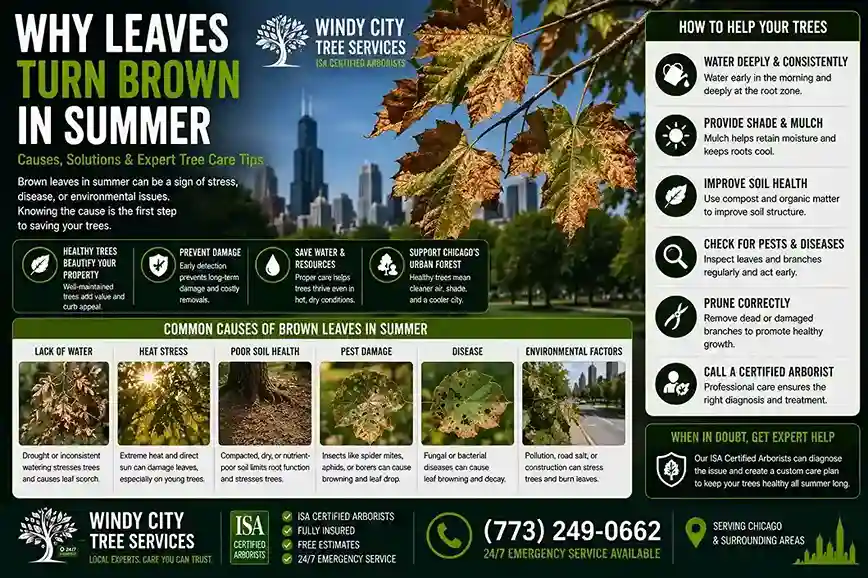
Leaf scorch is a specific, recognizable symptom pattern rather than a single disease. It typically appears in July and August, when high temperatures combine with low rainfall.
- Symptoms usually begin as yellowing along the leaf margins and tips, since these tissues are the last to receive water from the roots and the first to show stress.
- Brown edges develop as that yellowed tissue dries out, often starting at the leaf margin and moving inward.
- Curling leaves and entire leaves withering can occur during prolonged heat and drought.
- Wind exposure makes scorch worse; leaves facing prevailing winds, strong sun, or reflected heat from brick walls and asphalt often scorch first and worst.
Scorch damage alone generally isn’t enough to kill an otherwise healthy tree, but it’s a clear signal that the tree needs supplemental water and improved growing conditions.
4. Root Problems
🌱 Root Problems
Roots are where a lot of browning problems actually start, even though the symptoms show up in the leaves.
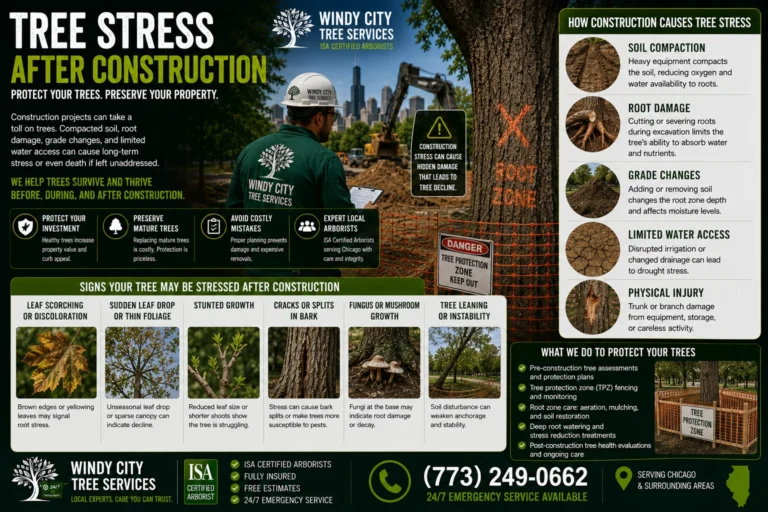
- Soil compaction from foot traffic, vehicles, or construction squeezes out the air pockets roots need, restricting both water uptake and oxygen availability.
- Construction damage, including excavation, grading, and trenching, can sever significant portions of a tree’s root system without any immediate visible sign.
- Root pruning done incorrectly, or too close to the trunk, can remove more of the root system than a tree can compensate for.
- Poor drainage creates chronically saturated soil, which drowns roots by cutting off their oxygen supply just as effectively as drought cuts off water.
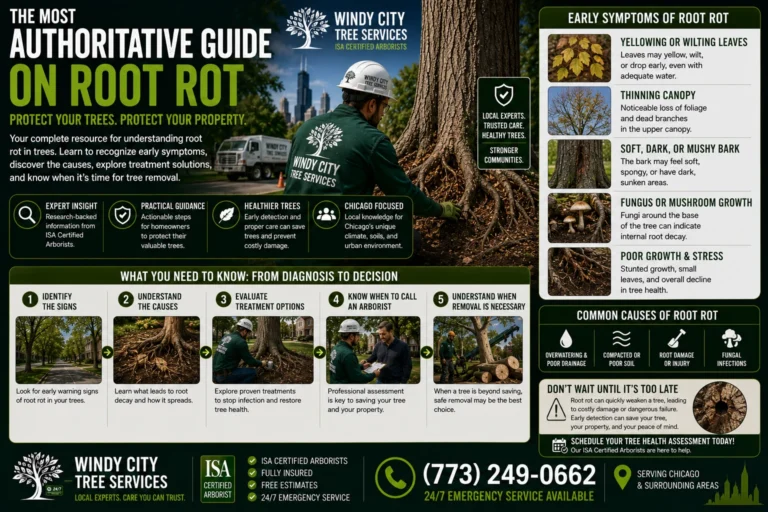
- Root rot from fungal pathogens thrives in poorly drained, oxygen-starved soil and progressively destroys the root system’s ability to function.
- Limited oxygen in the root zone, whether from compaction or waterlogging, is one of the most underdiagnosed causes of canopy decline.
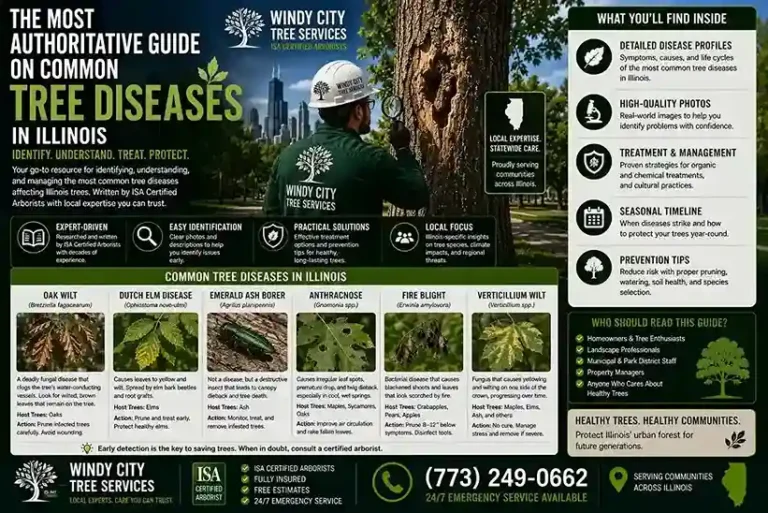
5. Tree Diseases
Several diseases produce browning that can be mistaken for simple drought stress:
Anthracnose
A fungal disease causing irregular brown blotches, often following cool, wet spring weather, most visible on maple, oak, and sycamore.
Bacterial Leaf Scorch
A chronic, ultimately fatal bacterial infection whose symptoms closely mimic drought stress; per Morton Arboretum, it requires a lab test to confirm.
Verticillium Wilt
A soil-borne fungal disease that blocks water-conducting tissue, often causing browning on one side or section of the canopy first.
Oak Wilt
A fast-moving vascular disease affecting oaks, causing rapid browning and leaf drop, especially in red oak group species. See our guide on Early Symptoms of Oak Wilt.
Canker Diseases
Localized fungal or bacterial infections that girdle branches, cutting off water and nutrients to everything beyond the canker.
Because these diseases can look so similar to environmental stress at first glance, our guide on Common Tree Diseases in Illinois goes into more detail on distinguishing features for each.
6. Insect Damage
Insect feeding can cause browning directly, by damaging leaf tissue, or indirectly, by disrupting the tree’s ability to move water and nutrients.
- Emerald Ash Borer. Larvae tunnel beneath the bark, cutting off the water-conducting tissue and causing canopy thinning and browning that gets progressively worse. Our guide, Emerald Ash Borer in Chicago: What Homeowners Need to Know, covers this in depth.
- Scale insects. These sap-feeding pests weaken branches over time, often producing yellowing and browning on affected limbs specifically.
- Aphids. Heavy aphid feeding can stress leaves and, through the honeydew they produce, invite sooty mold that further blocks photosynthesis.
- Japanese Beetles. Feeding damage skeletonizes leaves, and heavily fed-on foliage often browns and drops early.
- Borers. Like emerald ash borer, other borer species tunnel through the vascular tissue, cutting off resources to the canopy above the damage.
- Spider mites. Especially active in hot, dry weather, these tiny pests cause a stippled, bronze-brown discoloration that’s often mistaken for drought stress.
7. Nutrient Deficiencies
Soil chemistry problems can cause browning and discoloration patterns that mimic other causes.
- Nitrogen deficiency often shows up as overall pale green to yellow foliage, sometimes progressing to browning in severe cases.
- Iron chlorosis causes yellowing between leaf veins while the veins themselves stay green, common in high-pH Chicago-area soils and especially in species like pin oak and river birch.
- Potassium deficiency frequently appears as scorch-like browning along leaf margins, closely resembling drought stress.
- Soil pH outside a tree’s preferred range locks up certain nutrients even when they’re present in the soil, making them unavailable to the tree.
- General fertility issues compound other stressors, since a nutrient-poor tree has fewer resources to cope with heat, drought, or pests.
8. Watering Mistakes
Well-intentioned watering can sometimes cause the exact problem it’s meant to prevent.
Water established trees deeply every 10 to 14 days during dry periods, aiming for roughly 1 inch of water reaching the root zone. Use a soaker hose or drip irrigation placed at the drip line (the ground beneath the outer edge of the canopy), not just at the trunk, since the active feeder roots extend outward with the canopy, not underneath it.
- Overwatering saturates soil and starves roots of oxygen, producing symptoms, including browning, that look surprisingly similar to drought stress.
- Underwatering is the more common mistake, especially with sprinkler systems that wet the surface without soaking deep enough to reach mature root zones.
- Sprinkler placement often targets lawns rather than trees, missing the deep, slow soak that root systems actually need.
- Deep root watering, using soaker hoses or a slow trickle over several hours, reaches root depths that quick surface watering never touches.
- Mulching with 3 to 4 inches of organic mulch, kept away from direct contact with the trunk, conserves soil moisture and moderates soil temperature.
9. Environmental Stress in Chicago
Chicago’s urban environment adds stressors that trees in more rural settings don’t have to contend with.
Heat Waves
Extended periods of extreme heat accelerate water loss through leaves faster than roots can replace it.
Urban Heat Island Effect
Pavement and buildings absorb and radiate heat, keeping urban trees warmer than rural counterparts, day and night.
Compacted Soils
Decades of foot and vehicle traffic on urban lots leave soil dense and poorly aerated.
Road Salt Damage
Winter de-icing salt accumulates in soil near streets and sidewalks, damaging roots and showing up as scorch the following summer.
Pollution
Vehicle exhaust and other urban pollutants can stress leaf tissue directly and weaken overall tree vigor.
Limited Rooting Space
Parkway trees squeezed between sidewalks and streets often have far less usable soil volume than their canopy size would suggest.
These factors compound each other. A parkway tree dealing with compacted soil, road salt, and reflected heat from pavement starts the summer already stressed, well before a hot, dry stretch even begins.
10. Can Brown Leaves Recover?
This depends heavily on what caused the browning and how far it’s progressed.
- Temporary stress, like mild drought or brief heat exposure, often resolves once conditions improve and the tree receives adequate water.
- Permanent leaf damage on already-browned leaves usually won’t reverse itself; the tissue is dead. The relevant question is whether the tree pushes healthy new growth afterward.
- New growth the following spring is the best indicator of whether a tree weathered the stress successfully.
- Tree recovery from a single stressful season is common in otherwise healthy, well-established trees; recovery from repeated, compounding stress across multiple seasons is far less certain.
- Monitoring over the following months and into the next growing season tells you far more than a single snapshot of brown leaves in August.
11. When Brown Leaves Indicate a Serious Problem
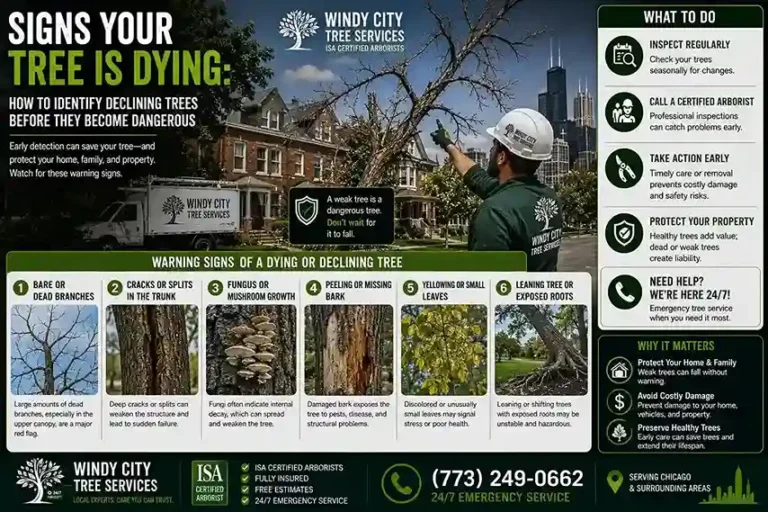
Brown leaves paired with any of the following point toward a more serious underlying issue, not routine summer stress.
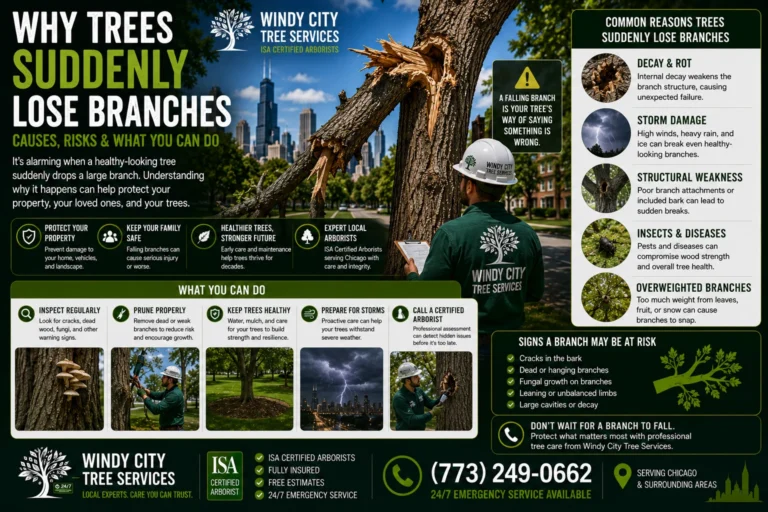
- Large canopy dieback affecting a significant portion of the tree, rather than scattered individual leaves.
- Dead branches throughout the crown, especially if new this season.
- Cracked bark or bark that’s separating or sloughing off.
- Mushrooms or fungal conks growing from the trunk or root flare, a reliable indicator of internal decay.
- A leaning tree, especially a new or worsening lean, which can signal root failure.
- Rapid decline, where browning spreads noticeably over days rather than weeks.
Any of these signs, on their own or alongside brown leaves, is reason enough to schedule a professional inspection rather than waiting to see what happens.
12. How Arborists Diagnose the Cause
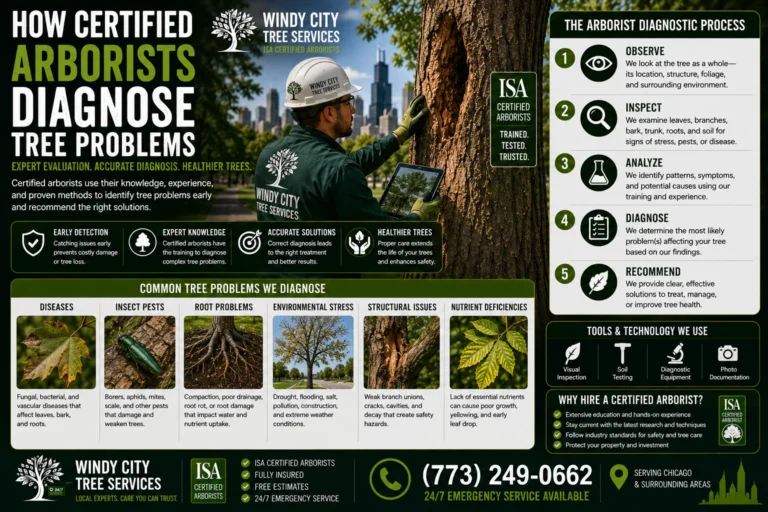
Because so many causes of browning overlap in appearance, a proper diagnosis looks at the whole picture, not just the leaves.
- Tree inspection. A full visual assessment of the canopy, trunk, and overall form, comparing symptom patterns against known disease and pest profiles.
- Soil evaluation. Checking moisture levels, compaction, drainage, and sometimes pH to rule in or out environmental causes.
- Root flare inspection. Examining the base of the trunk for girdling roots, buried flare, decay, or construction damage.
- Disease identification. Matching visible symptoms to known disease patterns, and in cases like bacterial leaf scorch, sending samples to a diagnostic lab since field diagnosis alone isn’t reliable.
- Pest diagnosis. Looking for exit holes, frass, webbing, or the pests themselves to confirm insect involvement.
- Tree Risk Assessment. When browning is severe, evaluating whether the tree has also become a structural hazard, not just a health concern.
Browning leaves alone rarely identify a single, specific cause. Reaching an accurate diagnosis means evaluating the tree’s overall health, site conditions, and recent weather patterns together, which is exactly why professional evaluation outperforms guesswork.
13. Preventing Summer Leaf Browning
Proper Watering
Deep, infrequent watering at the drip line supports root health far better than frequent shallow watering.
Mulching
A 3 to 4 inch mulch ring conserves soil moisture and moderates root zone temperature.
Annual Inspections
Catching stress early, before visible browning, gives a tree the best shot at full recovery.
Fertilization
Correcting nutrient deficiencies supports overall vigor and resistance to other stressors.
Structural Pruning
Removing dead or stressed wood redirects the tree’s energy toward healthy growth.
Air Spade Soil Decompaction
Relieving compacted soil around roots improves water and oxygen access without cutting into the root system.
According to University of Illinois Extension, the tissue in leaf margins and tips is the last to receive water from the roots, which is exactly why leaf scorch consistently shows up at the edges first, rather than starting in the center of the leaf.
Summer Tree Health Timeline
Early Summer (June)
Watch for early wilting and set a baseline. Begin deep watering if rainfall is inconsistent.
Peak Heat (July–August)
Leaf scorch symptoms typically emerge during this window. Monitor closely and maintain a consistent deep-watering schedule.
After a Heat Wave
Inspect for new browning, wilting, or premature leaf drop within days of extreme heat events.
Late Summer
Assess whether browning has stabilized or continued spreading; schedule a professional inspection for anything progressing rapidly.
Fall
Evaluate overall canopy recovery and plan any needed treatment, fertilization, or pruning for the following season.
Are Your Tree Leaves Turning Brown?
Our ISA Certified Arborists provide professional tree health inspections to identify the cause of leaf browning and recommend the right solution.
Brown Leaves: Possible Causes
| Symptom | Possible Cause |
|---|---|
| Brown leaf edges | Leaf scorch, drought stress, potassium deficiency, or road salt damage |
| Entire leaf brown | Severe drought, vascular disease, or borer damage cutting off water supply |
| Brown spots | Anthracnose or other fungal leaf spot diseases |
| Wilted leaves | Drought stress, root damage, or vascular disease restricting water flow |
| Early leaf drop | Drought stress, disease, insect damage, or severe nutrient deficiency |
| Brown canopy (widespread) | Oak wilt, verticillium wilt, severe root damage, or advanced borer infestation |
Environmental Stress vs. Disease
| Environmental Stress | Disease |
|---|---|
| Drought: Scattered browning, worsens with dry weather, improves with proper watering | Oak Wilt: Rapid browning starting at leaf margins, spreads through the crown within weeks, oaks only |
| Heat: Browning concentrated on sun- or wind-exposed sides of the canopy | Anthracnose: Irregular brown blotches following cool, wet spring weather |
| Leaf Scorch: Marginal browning, tips and edges first, tied to heat and dry conditions | Bacterial Leaf Scorch: Looks nearly identical to drought scorch; requires a lab test to confirm |
Summer Tree Health Checklist
- 1Check soil moisture a few inches below the surface near the root zone.
- 2Inspect leaf color across the whole canopy, not just a few leaves.
- 3Monitor canopy density for unusual thinning.
- 4Look for insects, webbing, or exit holes on the bark.
- 5Examine bark for cracks, cankers, or separation.
- 6Watch for mushrooms or fungal growth near the base.
- 7Water deeply, at the drip line, rather than briefly at the trunk.
- 8Mulch correctly, 3 to 4 inches deep, kept away from the trunk itself.
- 9Schedule an annual inspection, especially for mature or previously stressed trees.
Keep Your Trees Healthy All Summer
Early intervention can help reduce stress, improve tree health, and prevent more serious problems. Contact Windy City Tree Services for expert guidance.
Frequently Asked Questions
Why are my tree leaves turning brown?
Brown leaves can result from drought stress, leaf scorch, disease, insect damage, root problems, or nutrient deficiencies. The exact cause depends on the pattern, timing, and location of the browning, along with recent weather and site conditions.
Can a tree recover from leaf scorch?
Often, yes. Scorch damage alone usually isn’t enough to kill an otherwise healthy tree. Consistent deep watering and improved growing conditions typically allow the tree to push healthy new growth the following season.
Does drought kill mature trees?
It can, though established trees with wide root systems are generally more drought-tolerant than young trees. Severe or prolonged drought can still cause serious decline or death, especially when combined with other stressors.
Should I water trees every day?
No. Daily shallow watering encourages roots to stay near the surface and doesn’t reach the deeper root zone. Deep watering every 10 to 14 days during dry periods is more effective for established trees.
Can diseases cause brown leaves?
Yes. Anthracnose, bacterial leaf scorch, verticillium wilt, oak wilt, and various canker diseases can all cause browning that closely resembles environmental stress.
How do arborists diagnose tree stress?
By combining a visual inspection of the canopy, trunk, and roots with an evaluation of soil conditions, recent weather, and any signs of pests or disease, sometimes supported by lab testing for certain diseases.
Can overwatering cause brown leaves?
Yes. Overwatering saturates soil and reduces oxygen available to roots, producing symptoms that can look surprisingly similar to drought stress.
Are brown leaves a sign my tree is dying?
Not necessarily. Many cases of summer browning are temporary stress that resolves with proper care. Widespread canopy dieback, cracked bark, or mushrooms near the base are more concerning signs worth a professional look.
What trees are most affected by summer browning in Chicago?
River birch, certain maples, and pin oaks tend to show stress symptoms more readily, though any species can be affected during severe heat, drought, or when growing in compacted urban soil.
When should I call an arborist about brown leaves?
Call when browning affects a large portion of the canopy, appears earlier than expected, spreads rapidly, or comes with other warning signs like dead branches, cracked bark, or mushrooms near the roots.
Can road salt cause brown leaves in summer?
Yes. Salt that accumulates in soil near streets and sidewalks over winter can damage roots, and the resulting stress often shows up as leaf scorch the following summer.
What does iron chlorosis look like?
Iron chlorosis causes yellowing between the leaf veins while the veins themselves stay green, different from the marginal browning typical of drought stress or leaf scorch.
Is bacterial leaf scorch the same as drought stress?
They look very similar, which is part of the problem. Bacterial leaf scorch requires a laboratory test to confirm, since it cannot be reliably diagnosed by appearance alone.
How much water does a mature tree need in summer?
A general guideline is about 1 inch of water reaching the root zone every 10 to 14 days during dry periods, applied slowly with a soaker hose or drip irrigation at the drip line.
Can insect infestations cause browning even if I don’t see insects?
Yes. Pests like emerald ash borer and other boring insects work beneath the bark, so the vascular damage causing canopy browning is often visible before the insects themselves are.
Should I fertilize a tree with brown leaves?
Only after the cause is identified. Fertilizing a drought-stressed or root-damaged tree without addressing the underlying issue can add stress rather than relieve it.
Can construction near a tree cause brown leaves months later?
Yes. Root damage from excavation or grading often doesn’t show up as canopy browning until the following growing season, once the tree’s reduced root system can no longer keep up with demand.
How is oak wilt different from ordinary summer leaf browning?
Oak wilt spreads much faster, often causing browning that starts at the leaf margins and progresses through the entire crown within weeks, rather than the gradual, scattered pattern typical of environmental stress.
Does mulching really help prevent brown leaves?
Yes. A proper 3 to 4 inch mulch ring conserves soil moisture and moderates root zone temperature, both of which reduce drought and heat stress on the root system.
Can a tree with brown leaves still be saved?
Often, yes, especially when the cause is environmental and caught early. Our related guide, Can a Dead Tree Be Saved?, covers how to evaluate a tree’s recovery potential in more advanced cases.
Key Takeaways
- Not every tree with brown leaves is dying; drought, heat, and minor stress often resolve with proper care.
- Drought stress and leaf scorch are the most common causes of summer browning in Chicago, but disease, pests, and root problems can look nearly identical.
- Deep, infrequent watering at the drip line supports root health far better than frequent shallow watering.
- Widespread canopy dieback, cracked bark, mushrooms, or a new lean point toward a more serious problem that needs prompt evaluation.
- Accurate diagnosis requires evaluating the whole tree, the soil, and recent weather, not just the color of the leaves.
- Prevention, through proper watering, mulching, and annual inspections, is far more effective than reacting after browning has already spread.
Related Tree Services
Tree Health Inspection & Treatment
Full diagnostic evaluation for browning, decline, and disease.
Learn more →Tree & Shrub Fertilization
Correcting nutrient deficiencies to support recovery.
Learn more →Air Spade
Soil decompaction and root zone diagnostics without cutting roots.
Learn more →Tree Trimming & Pruning
Removing dead or stressed wood to redirect energy to healthy growth.
Learn more →Tree Removal
Safe removal when decline has progressed beyond recovery.
Learn more →Tree Cabling & Bracing
Structural support for trees weakened by stress or disease.
Learn more →Storm Prep & Support Systems
Reducing storm risk on trees already stressed by summer conditions.
Learn more →Emergency Tree Removal
Fast response when a declining tree becomes a hazard.
Learn more →Professional Tree Health Care for Chicago Landscapes
Brown leaves don’t always mean a tree is dying, but they should never be ignored. Windy City Tree Services provides expert tree health inspections, disease diagnosis, soil improvement, fertilization, structural pruning, pest evaluations, and safe tree removal when necessary.
✅ ISA Certified Arborists
🛡️ Licensed & Fully Insured
🩺 Tree Health Specialists
📐 ANSI A300 Tree Care Standards
🔍 Advanced Tree Health Inspections
💨 Air Spade Root Care
🌿 Deep Root Fertilization
⚡ Emergency Tree Services
📋 Free Estimates
Share This Guide
Related Articles
Signs Your Tree Is Dying
The warning signs that separate normal stress from a tree in genuine decline.
Common Tree Diseases in Illinois
A rundown of the fungal and bacterial diseases most likely to affect Chicago-area trees.
Early Symptoms of Oak Wilt
How to catch this fast-moving disease before it spreads through the canopy.
Dutch Elm Disease Prevention
What protects mature elms from Chicago’s most notorious tree disease.
Emerald Ash Borer in Chicago: What Homeowners Need to Know
The invasive beetle behind widespread ash tree decline across the region.
Can a Dead Tree Be Saved?
What “dead” actually means for a tree, and when recovery is still possible.
Tree Trimming Before Storm Season
The pre-storm pruning checklist we walk every Chicago property through.
Winter Tree Pruning Benefits
Why dormant-season pruning sets trees up for a healthier summer ahead.
Preparing Trees Before Severe Weather
The proactive checklist that reduces emergency calls when storms roll in.
Benefits of Structural Pruning for Young Trees
Why early pruning decisions shape a tree’s resilience for decades.
Common Reasons Trees Fail During Chicago Storms
The structural weak points that turn a summer storm into a fallen-tree emergency.
How Arborists Assess Storm Damage
A look inside the inspection process after wind, ice, or heavy rain hits a property.
Why Immediate Tree Removal Matters
When waiting on a hazardous tree costs more than acting right away.
Sources referenced in this guide include publications and best management practices from the International Society of Arboriculture (ISA), the USDA Forest Service, University of Illinois Extension, The Morton Arboretum, the Illinois Department of Natural Resources, and the USDA Natural Resources Conservation Service (NRCS). This article is intended for general educational purposes and does not replace an on-site professional tree health evaluation.