Crane vs Traditional Tree Removal: Which Is Safer?
Crane Tree Removal vs Traditional Tree Removal
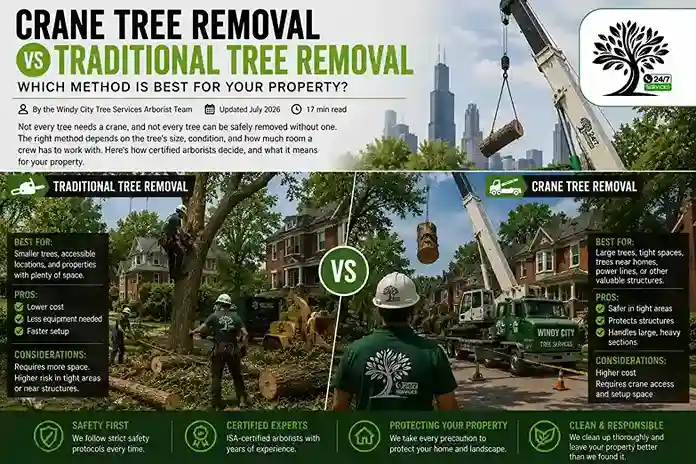
Not every tree needs a crane, and not every tree can be safely removed without one. The right method depends on the tree’s size, condition, and how much room a crew has to work with. Here’s how certified arborists decide, and what it means for your property.
Traditional tree removal uses climbing arborists, ropes, and rigging to dismantle a tree piece by piece. Crane tree removal uses a hydraulic crane to lift and lower large sections directly, reducing manual rigging. Cranes are typically used for very large, hazardous, or hard-to-access trees, while traditional methods work well for smaller trees in open, easily accessible yards.
Tree removal methods aren’t one-size-fits-all. A young maple in an open front yard and an 80-foot dead oak leaning over a garage call for completely different approaches, even though both jobs end the same way: a safely removed tree.
Every tree does not require a crane, and assuming otherwise can add unnecessary cost. At the same time, trying to climb-remove a tree that genuinely needs a crane can put workers and property at serious risk. Choosing the right method improves both safety and efficiency, which is exactly why certified arborists evaluate each project individually rather than applying a standard approach to every job.
This guide compares crane tree removal and traditional tree removal side by side, covering safety, speed, cost factors, property protection, and how a professional actually decides which method fits your tree.
“The equipment doesn’t decide the method. The tree does. Our job is reading what the tree, the site, and the risk actually call for.” Windy City Tree Services Arborist Team
1. What Is Traditional Tree Removal?
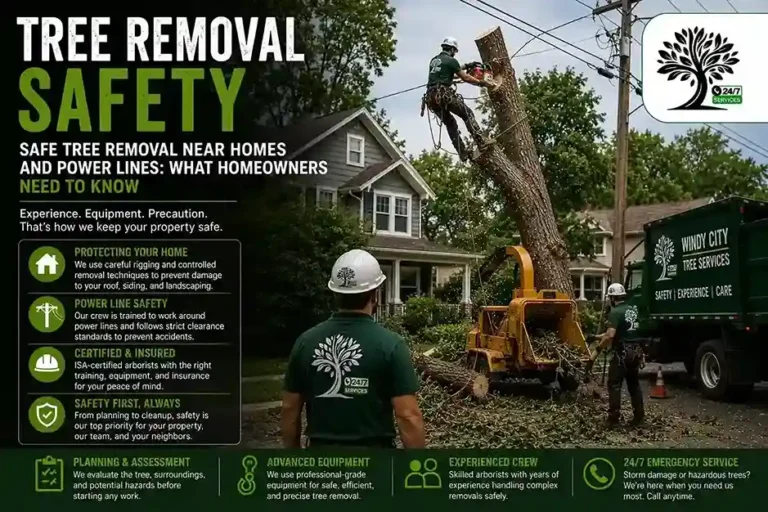
Traditional tree removal relies on a climbing arborist, rope systems, and a ground crew to take a tree down piece by piece. The climber ascends using specialized gear, cutting the canopy and limbs into manageable sections with a chainsaw while rigging controls where each piece falls or is lowered.
A lowering device on the ground manages the rope tension as sections are cut, letting the ground crew guide heavy pieces down safely instead of dropping them freely. Sectional dismantling, working from the top of the tree down, keeps the process controlled even in tight spaces. This method has been the standard approach in arboriculture for decades and remains the right choice for a large share of residential removals.
2. What Is Crane Tree Removal?
Crane tree removal uses a hydraulic crane, operated by a certified crane operator, to lift and lower large tree sections directly instead of relying on a climber’s ropes to control every piece. A rigging specialist attaches sections to the crane’s cable, and the operator lifts them clear of the tree and sets them down in a designated area.
This approach requires close, constant communication between the crane operator, the cutter positioned in the tree or on an aerial platform, and the ground crew managing the drop zone. Because the crane bears the weight of each section the moment it’s cut, there’s far less reliance on rope tension and rigging friction to manage heavy, unpredictable pieces.
3. How Crane Tree Removal Works
1. Inspection
An arborist assesses the tree’s size, condition, and surroundings to confirm a crane is the right approach.
2. Lift Planning
The crew maps crane placement, lift angles, and the drop zone based on the site’s layout and any overhead obstacles.
3. Crane Setup
The crane is positioned and stabilized, often in a driveway, street, or open area near the tree.
4. Rigging
Rigging specialists attach each section to the crane’s cable before any cutting begins.
5. Section Removal
A cutter separates sections from the tree while the crane holds the weight and lifts each piece clear.
6. Lowering
The operator lowers each section into a designated area where the ground crew processes it.
7. Cleanup
The crew chips branches, processes logs, and restores the site once the tree is fully removed.
4. Traditional Tree Removal Process
1. Climbing
A trained climber ascends the tree using ropes and specialized climbing gear.
2. Limb Removal
Smaller branches are cut and dropped or lowered first to open up access to the main structure.
3. Rigging
Larger sections are rigged with ropes and a lowering device to control their descent.
4. Trunk Dismantling
The trunk is cut into manageable sections from the top down until only the base remains.
5. Cleanup
The ground crew chips debris, processes logs, and cleans the site before leaving.
5. When Is a Crane Recommended?
- Very large trees: Extra-large mature trees often exceed what a climbing crew can safely manage alone.
- Storm-damaged trees: Cracked trunks or unstable canopies are unpredictable to climb.
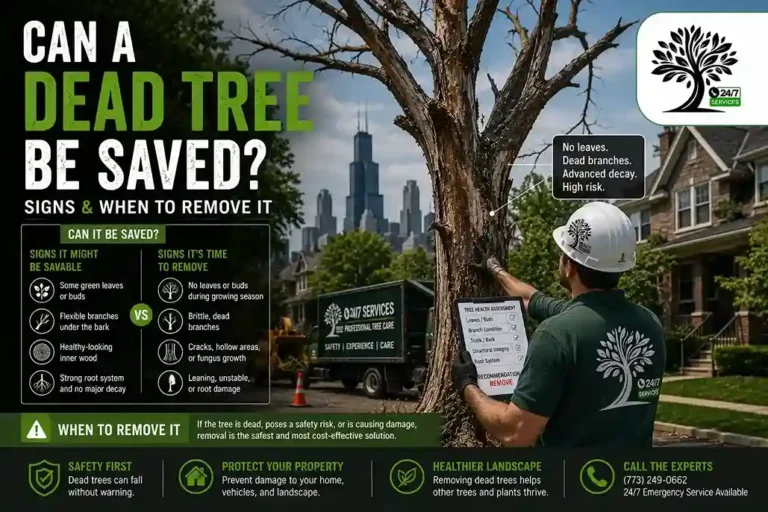
- Dead trees: Dead wood can fail without warning, making climbing riskier than crane support.
- Trees over homes: A crane can lift sections up and away instead of lowering them near a roofline.
- Limited drop zones: Tight yards with little room to safely lower large sections favor crane lifting.
- Tight urban properties: Common throughout Chicago’s dense residential blocks.
- Commercial buildings: Large trees near commercial structures often call for the added precision a crane provides.
- Difficult backyard access: When equipment can’t easily reach the tree, a crane positioned in the street or driveway may be the safer solution.
6. When Traditional Removal Is Better
Traditional removal remains the right call for a large share of everyday tree work. Small and medium trees, open yards with plenty of room to lower sections safely, easy equipment access, and generally healthy trees with predictable wood strength are all situations where climbing and rigging get the job done efficiently, without the added cost and setup of a crane.
💡 Did You Know?
Most residential tree removals in Chicago don’t require a crane at all. Cranes become the better option specifically when size, condition, or access make climbing meaningfully riskier or less practical.
7. Safety Comparison
Safety is the single biggest factor in choosing a removal method, and it’s evaluated using the same principles outlined in ISA Best Management Practices and OSHA safety guidance for tree care operations.
- Worker safety: Cranes reduce the time a climber spends handling unstable or heavy sections manually.
- Property protection: Controlled lifting reduces the chance of a section swinging into a structure during descent.
- Precision: Crane operators can place sections in an exact, pre-planned location.
- Stability: The crane bears the weight the instant a cut is made, reducing reliance on rope friction alone.
- Risk reduction: For hazardous, storm-damaged, or dead trees, cranes significantly reduce the unpredictability climbers would otherwise face.
That said, traditional removal, performed by ANSI A300-trained crews following proper rigging and safety protocols, remains a genuinely safe method for the trees it’s suited to. The method itself isn’t inherently safer or riskier; the right method for the specific tree is what determines the outcome.
8. Speed Comparison
Crane removal can meaningfully reduce project time for many large or hazardous trees, since lifting whole sections directly is often faster than lowering each one with rope and rigging. For a genuinely large or complex tree, that time savings can be substantial.
Traditional removal, on the other hand, is often just as efficient, if not more so, for smaller, easily accessible trees, where the setup time and cost of bringing in a crane wouldn’t be worth the marginal speed gain. The right way to think about timing is project planning rather than a blanket promise of faster or slower. An arborist can give you a realistic estimate of project duration once they’ve seen the tree and site.
9. Cost Comparison
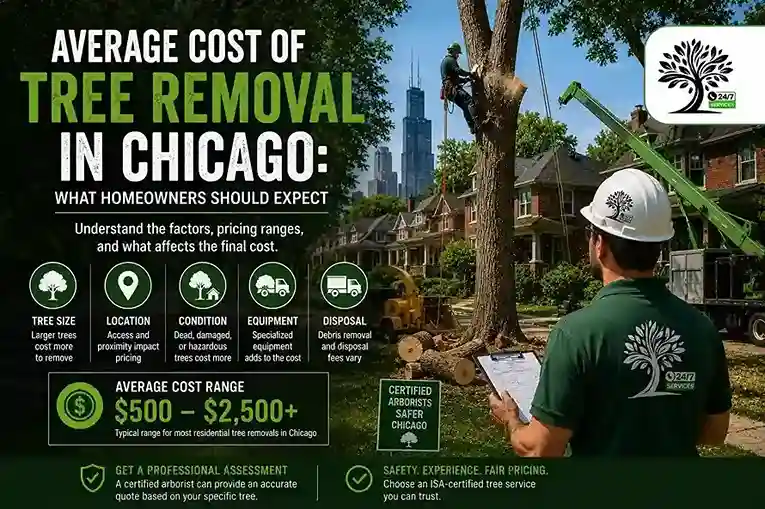
Pricing depends on far more than which method is used. These factors shape the cost of either approach:
- Tree size: Larger trees require more labor and equipment time regardless of method.
- Accessibility: Tight lots or limited crane placement options can affect either approach’s efficiency.
- Crane requirements: When a crane is genuinely needed, its cost reflects specialized equipment and a trained operator.
- Crew size: Larger or more complex jobs may require additional ground crew regardless of method.
- Rigging complexity: Difficult angles or nearby structures add planning time either way.
- Emergency work: After-hours or storm-response jobs typically cost more than scheduled removals.
- Cleanup: Full debris removal, chipping, and hauling affect the total price.
- Stump grinding: Usually quoted separately from the removal itself, covered in our tree removal cost guide.
A crane isn’t automatically more expensive than traditional removal once you factor in labor hours saved on a large or difficult tree. The most accurate way to compare cost is a written estimate that accounts for your specific tree and site.
10. Property Protection
Whichever method is used, protecting the surrounding property is a core part of the job. Professional crews plan around roofs, metal siding, driveways, fences, decks, landscaping, and utility lines before the first cut is made.
- Padding and protective boards placed under drop zones to protect driveways and lawns.
- Careful rigging angles that keep sections clear of roofs and siding during descent.
- Pre-planned crane lift paths that avoid swinging sections over fences or gardens.
- Coordination with utility companies when limbs are near power lines.
- Ground mats or plywood in soft or landscaped areas to prevent equipment damage.
11. Chicago-Specific Challenges
Chicago’s neighborhoods create a specific set of challenges that make cranes a frequent, practical choice in the city. Narrow gangways between two-flats and bungalows limit what equipment can physically reach a backyard tree. Dense neighborhoods leave little open space for a traditional drop zone, especially on smaller urban lots.
The city’s mature tree canopy, much of it 60 to 100 years old, means Chicago has more than its share of extra-large removals that exceed what climbing alone can safely handle. Wind off Lake Michigan, seasonal ice storms, and heavy snow all contribute to storm-damaged trees that need a more controlled, predictable removal method. Historic homes add another layer of caution, since a swinging or dropped section near vintage masonry or landscaping carries more risk than near newer construction. Limited backyard access, common throughout the city’s older residential blocks, is one of the most frequent reasons a crane, positioned safely in the street or driveway, ends up being the more practical option.
12. Residential vs Commercial Projects
| Property Type | Common Considerations |
|---|---|
| Homes | Standard residential access, often traditional removal unless size or access requires a crane |
| Apartment buildings | Coordination around tenants and shared parking, crane use common in tight courtyards |
| Office buildings | After-hours scheduling, precision needed near parking structures and entrances |
| Schools | Scheduling around school hours, extra safety planning near play areas |
| Churches | Coordination around services, care around historic architecture |
| Municipal properties | Permits, documentation, and public safety planning for larger commercial tree service projects |
13. Environmental Impact
Removing a tree responsibly includes what happens to the wood afterward. Most of the material from a removal can be recycled rather than sent to a landfill. Branches get chipped into mulch, usable trunk wood can be processed into firewood, and larger logs are sometimes salvaged for milling.
Responsible removal also means recognizing when a tree genuinely needs to come down versus when it can be preserved. Removing hazardous trees protects the health of nearby healthy trees, especially when disease or pests are involved, while unnecessary removal of a healthy tree works against the same urban forestry goals a responsible tree company should support.
14. Can a Tree Be Saved Instead?
Reputable arborists recommend preservation whenever it’s a genuinely safe option. Before recommending removal, a certified arborist considers:
- Tree trimming: Removing dead or weak limbs to reduce hazard without full removal.
- Cabling and bracing: Structural support for trees with weak unions or codominant stems.
- Air Spade root excavation: Diagnosing and correcting root issues without cutting healthy roots.
- Deep root fertilization: Restoring vigor to stressed trees in compacted soil.
- Disease treatment: Addressing early-stage disease before it causes irreversible decline.
Removal should always be the last resort. Learn more in our guide to when a tree should actually be removed.
15. How Arborists Choose the Right Method
Method selection follows the same evidence-based process used in a formal tree risk assessment. Arborists weigh:
- Species: Wood density and branch structure vary significantly between species.
- Health: A structurally sound tree behaves more predictably than a decayed or dying one.
- Lean: A tree leaning toward a structure may require different rigging or crane placement.
- Root condition: Compromised roots affect how stable the tree is during the removal process itself.
- Nearby structures: Homes, garages, fences, and power lines all shape the safest approach.
- Weather: Wind and precipitation can affect both crane operation and climbing safety.
- Access: Whether equipment, including a crane, can physically reach and safely operate on the site.
- Equipment requirements: Matching the right combination of climbing gear, rigging, or crane capacity to the specific job.
Comparison Table: Crane vs Traditional Removal
| Feature | Crane Tree Removal | Traditional Tree Removal |
|---|---|---|
| Best For | Large, hazardous, or hard-to-access trees | Small to medium trees in open, accessible yards |
| Safety | Reduces climber exposure to unstable sections | Safe when performed by trained crews on suitable trees |
| Property Protection | High precision lifting away from structures | Controlled rigging protects nearby property |
| Equipment | Hydraulic crane, rigging, certified operator | Climbing gear, ropes, chainsaws, lowering devices |
| Crew Size | Typically larger, including a crane operator | Smaller crew of climber and ground support |
| Access Requirements | Needs space for crane placement and outrigger stabilization | Needs a safe drop zone for lowered sections |
| Large Trees | Well suited, often the safer option | Possible but more time and rigging intensive |
| Small Trees | Usually unnecessary | Efficient and cost-effective |
| Speed | Can reduce time on large or complex removals | Efficient for smaller, accessible trees |
| Cost Factors | Equipment and operator cost, offset by labor savings on big jobs | Labor-intensive, cost scales with tree size and rigging complexity |
Pros & Cons
Crane Tree Removal
✓ Advantages
- Reduces climber time on unstable sections
- Precise placement away from structures
- Often faster for large or complex trees
- Well suited to tight urban lots
✕ Limitations
- Requires space for crane placement
- Not cost-effective for small trees
- Needs a certified crane operator
- Weather can affect operation
Traditional Tree Removal
✓ Advantages
- Cost-effective for small and medium trees
- Works in tight spaces without crane access
- Smaller crew and equipment footprint
- Well established, proven method
✕ Limitations
- More labor-intensive on very large trees
- Greater climber exposure on unstable trees
- Slower for extra-large removals
- Requires a suitable drop zone
🎨 Visual Suggestions for This Guide
Crane lifting a large oak section
Arborist climbing with ropes
Rigging system diagram
Before vs after removal
Equipment comparison graphic
Safety zone illustration
Homeowner Checklist: Choosing a Tree Removal Company
✅ What to Look For
- ISA Certified Arborists on staff
- Proper licensing for tree work in Chicago
- Current liability insurance
- Crane capability for large or difficult trees
- 24/7 emergency services
- Modern rigging and safety equipment
- Written, itemized estimates
- Cleanup included or clearly quoted separately
Frequently Asked Questions
When is a crane required for tree removal?
A crane is typically recommended for very large trees, storm-damaged or dead trees, trees overhanging homes, or sites with limited drop zones and difficult backyard access.
Are cranes safer than traditional removal?
For large or hazardous trees, cranes generally reduce risk by limiting climber exposure to unstable sections. Traditional removal remains safe for the smaller trees it’s suited to when performed by a trained crew.
Is crane removal faster than traditional removal?
Often, for large or complex trees, since lifting whole sections directly can save significant time compared to rope-and-rigging descent. For smaller trees, traditional removal is usually just as efficient.
Is crane removal more expensive?
Not always. While crane equipment and operator costs are a factor, the labor time saved on large or difficult trees can offset the difference. A written estimate is the best way to compare.
Can cranes reach backyards?
Often yes, if there’s enough clearance for the crane’s reach and boom angle from a street, driveway, or alley. An on-site evaluation confirms whether crane placement is feasible.
Are permits required for tree removal in Chicago?
Trees on the public parkway generally require a City of Chicago permit. Private property removals typically don’t, regardless of whether a crane is used.
Can cranes damage driveways or lawns?
Professional crews use outrigger pads and ground protection mats to distribute the crane’s weight and prevent surface damage.
How are tree sections lifted by a crane?
A rigging specialist attaches each section to the crane’s cable before it’s cut. The crane then lifts the section clear of the tree and lowers it into a designated area.
Are cranes used after storms?
Yes. Storm-damaged trees are often structurally unpredictable, making a crane a safer option for controlled removal, especially for large trees or those resting on structures.
What happens if access is limited for a crane?
If a crane can’t be safely positioned, the crew falls back on traditional climbing and rigging techniques, sometimes combined with an aerial lift if one can reach the site.
Do small trees ever need a crane?
Rarely. Small and medium trees in open, accessible yards are almost always removed efficiently with traditional methods.
What size tree typically requires a crane?
There’s no single cutoff, but extra-large mature trees over roughly 80 feet, or trees with significant size combined with limited access, are the most common candidates.
Do you offer both crane and traditional tree removal?
Yes. Windy City Tree Services provides both methods and recommends whichever is safest and most practical for your specific tree and property.
Is a certified crane operator required by law?
Crane operation for tree work should always be handled by a trained, certified operator following OSHA safety guidance and manufacturer specifications.
Can a crane remove a tree without cutting down the whole thing?
Cranes are typically used for full or partial removal of hazardous or oversized trees, though the same equipment can assist with large structural pruning jobs in some cases.
How long does crane setup take?
Setup time varies based on site access and stabilization needs, and is factored into the overall project timeline discussed during your estimate.
Does weather affect crane tree removal?
Yes. High winds and severe weather can affect crane operation and safety, sometimes requiring a job to be rescheduled.
Can traditional removal handle trees near power lines?
Trained climbers can work near power lines using proper clearance protocols, though extra caution and sometimes utility coordination are required regardless of method.
Is stump grinding included with crane removal?
Stump grinding is typically quoted separately from the removal method, whether crane-assisted or traditional.
How do I get a free estimate for my tree removal?
Call (773) 249-0662 or email info@windycitytreeservices.com to schedule a free, in-person evaluation with an ISA Certified Arborist.
Related Articles
Safe Tree Removal Starts with the Right Equipment
Whether your project requires traditional climbing techniques or advanced crane-assisted removal, Windy City Tree Services has the expertise, equipment, and certified professionals to complete the job safely and efficiently.
info@windycitytreeservices.com · 323 W Carroll Ave, Chicago, IL 60612 · Serving Chicago 24/7