Do You Need a Permit for Tree Removal in Chicago? | Guide
You’ve got a tree that needs to come down. Maybe it’s leaning toward the garage, maybe it’s half dead, or maybe it’s just in the way of a new patio. Before you call anyone with a chainsaw, there’s one question worth answering first: does this tree need a permit?
The honest answer is that it depends. Chicago’s rules change based on exactly where the tree is rooted and who legally owns it. A silver maple in your backyard follows a completely different set of rules than the honey locust growing in the grass strip between the sidewalk and the street, even if both trees are, technically, right next to your house.
Get this wrong and the consequences range from a delayed project to a real fine, plus the cost of replacing a tree the city considers public property. Certified arborists deal with this distinction daily, and this guide walks through exactly how Chicago draws the line, so you know which category your tree falls into before you make a decision.
Do you need a permit for tree removal in Chicago? It depends on the tree’s location and ownership. Trees on private property generally don’t require a city permit to remove, while parkway trees, park trees, and other public trees almost always do, since the City of Chicago Bureau of Forestry owns and manages them. Always confirm current requirements with the Bureau of Forestry before removing any tree that isn’t clearly on your own private lot.
1. Understanding Chicago Tree Removal Laws
Chicago regulates trees for reasons that go beyond bureaucracy. The city’s urban forest, all 500,000-plus parkway trees plus the trees in parks and along boulevards, does real work: it cools sidewalks in July, slows stormwater runoff, filters air pollution, and adds property value to entire blocks, not just individual lots.
That’s why the Department of Streets and Sanitation’s Bureau of Forestry, not individual residents, controls what happens to trees growing in the public way. The city plants roughly 5,000 new parkway trees a year and removes about 7,000 dead or damaged ones, all coordinated centrally so the canopy stays healthy and consistent block by block.
Public safety is part of the equation too. A tree that’s cracking a sidewalk, blocking a stop sign, or leaning over a power line is a hazard the city needs to track and manage directly, which is exactly why permits and centralized oversight exist for anything growing outside your own property line.
2. Private Property Trees
Here’s the good news for most homeowners. If a tree is fully rooted on your private lot, meaning your backyard, side yard, or front lawn behind the sidewalk, the City of Chicago generally does not require a permit to remove it. That tree is yours to maintain, prune, or take down based on your own judgment.
That said, “generally” is doing some work in that sentence, and it’s worth understanding why. A few situations can pull a private tree back under city oversight:
- New construction or major renovation projects that trigger Chicago’s Landscape Ordinance, which can require permits and replacement landscaping around parking areas and new developments.
- Trees that a tree service company needs to access using equipment staged in the public way, since the crew may need a work permit for that public-right-of-way access, even though the tree itself is private.
- Properties inside a designated historic district, where separate preservation rules can apply to mature or significant trees.
Because city guidance can be updated and because every property is a little different, the smart move is still to confirm your specific situation with the Bureau of Forestry or a licensed arborist before cutting. It costs you a phone call. Skipping that step can cost a lot more if it turns out your “private” tree actually sits partly on the parkway.
Good to know: Even when no permit is required, hiring a licensed, insured tree service is still the safer route. An unpermitted removal that damages a neighbor’s fence, a sidewalk, or underground utility lines is still your liability.
3. Parkway Trees
This is where most homeowner confusion starts, so let’s define the term clearly. A parkway is the strip of grass between the curb and the sidewalk, the narrow patch that looks like it belongs to your yard but legally doesn’t. Any tree growing in that strip is a parkway tree, and Chicago’s municipal code is explicit about who owns it: the city does, regardless of who mows the grass around it or waters it during a dry summer.
Under Chicago’s tree ordinance, parkway trees are treated as city property in the same way a stop sign or a fire hydrant is city property. That ownership is exactly why permits are required for almost any work on a parkway tree, including trimming, root pruning, and removal.
Here’s the part homeowners need to hear clearly: you cannot legally remove a parkway tree yourself, even if it’s dying, even if it’s dropping branches on your car, and even if you personally planted it years ago. Only the Bureau of Forestry, or a contractor working under a valid Forestry permit, is authorized to do that work.
If a parkway tree is dead, damaged, or hazardous, the correct move is to report it to 311 or submit a service request through the city’s system. The Bureau of Forestry prioritizes trees that pose an immediate safety risk, though routine removal requests can take time given the size of the program.
Never remove a parkway tree without authorization. It’s public property, and unauthorized removal can carry real financial consequences on top of the cost of city-mandated replacement.
4. Public Trees
Parkway trees are one type of public tree, but they’re not the only one. Chicago also owns and manages trees inside city parks, along boulevards, and throughout other public rights-of-way, like medians and city-owned vacant lots.
Oversight for these trees isn’t always the same office. Park trees typically fall under the Chicago Park District rather than the Bureau of Forestry, since the Park District manages its own land independently from the Department of Streets and Sanitation. Boulevard and street-adjacent public trees usually route back through Forestry.
The practical takeaway is simple even if the org chart isn’t: if a tree sits on land you don’t own, whether that’s a park, a boulevard median, or a public right-of-way, you need to go through the appropriate city department before any work happens, full stop.
5. Protected Trees
A small number of trees in Chicago carry extra protection beyond standard public or private status. This category can include heritage trees recognized for their age or size, landmark trees tied to a designated historic district, and in some cases specific species the city is actively trying to preserve or reestablish, like disease-resistant elm cultivars planted to rebuild the canopy lost to Dutch elm disease.
These designations aren’t always obvious just by looking at a tree. A hundred-year-old oak on a Gold Coast lot might carry protections tied to the surrounding historic district, even though the tree itself sits on private land. That’s a case where “it’s on my property” doesn’t automatically mean “I can remove it without checking first.”
If you own a mature or unusually large tree, especially in a historic neighborhood, it’s worth verifying its status with the city before scheduling removal. This is a case where a five-minute call saves a much bigger headache later.
6. Emergency Tree Removal
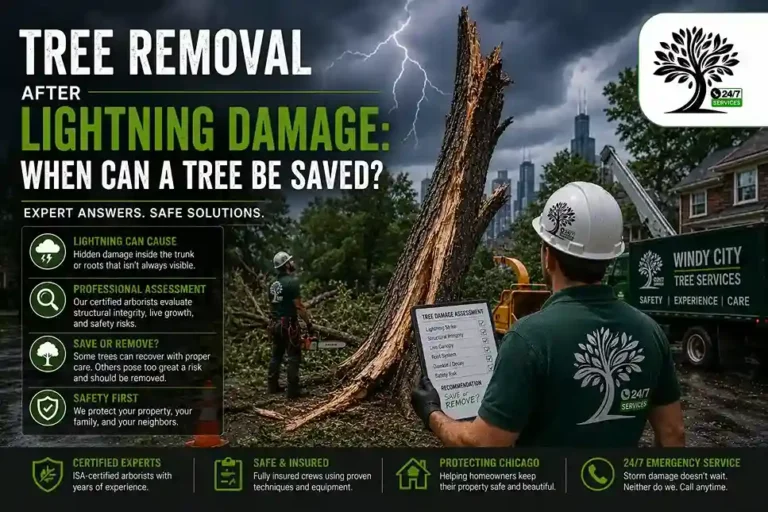
Storms don’t wait for permit approval, and Chicago’s rules account for that. When a tree comes down on a home, blocks a street, or takes out power lines during a storm, the priority shifts to safety first.
For trees on public property, the Bureau of Forestry responds to emergencies in the public way around the clock, and hazardous parkway trees get prioritized ahead of routine maintenance requests. For trees on private property that fall and create an immediate hazard, most licensed tree services, including emergency tree removal crews, can respond right away since the tree is private and doesn’t require a removal permit in most cases.
That urgency doesn’t erase the rules entirely, though. If an emergency response involves work that crosses onto public property, like a crew needing to stage equipment on the parkway or street, that access still needs to be coordinated properly, even under time pressure. A qualified contractor will know how to handle that without slowing down the actual safety work.
7. Tree Removal Near Utility Lines
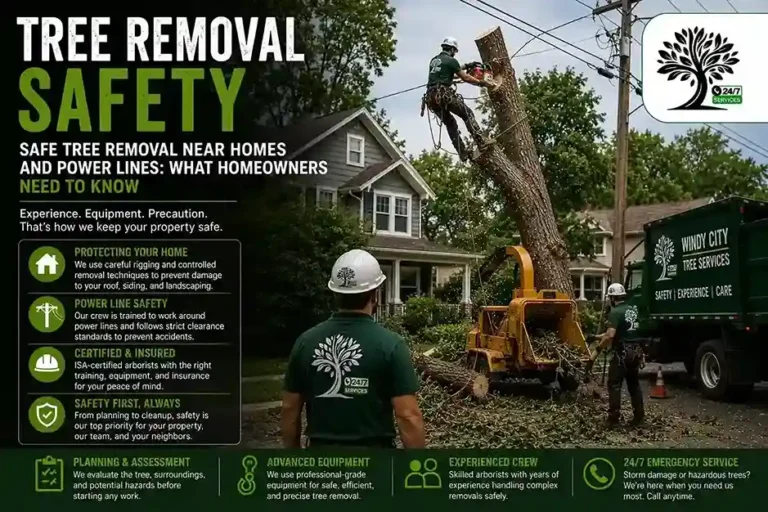
Trees growing near power lines add a layer of risk that changes how removal should be handled, regardless of permit status. Contact with an energized line can be fatal, and it’s a risk that’s easy to underestimate from the ground.
If a tree is touching or close to power lines, the utility company, usually ComEd in Chicago, needs to be looped in before any cutting starts. In many cases, the utility will de-energize or reroute the line temporarily, or send their own crew to handle the section closest to the wires.
This is not a DIY situation under any circumstances. A homeowner with a chainsaw and a ladder near a power line is one of the more common causes of serious tree-related injuries every year. Professional crews are trained to coordinate with utility providers and use the right equipment, like insulated tools and proper rigging, to keep the job safe from start to finish.
8. When an Arborist Can Help
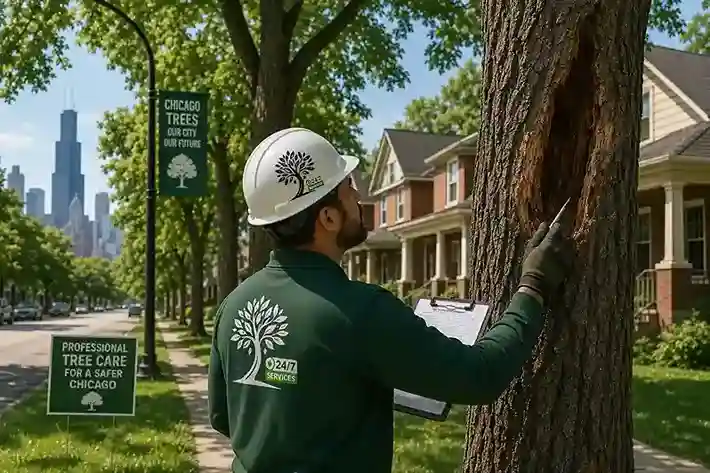
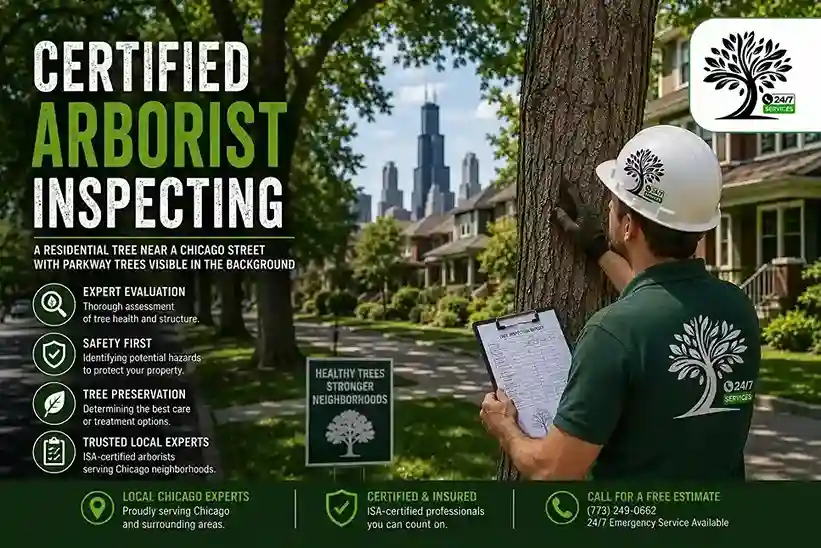
A certified arborist does a lot more than swing a chainsaw. Before any removal, an arborist can perform a full tree health inspection to confirm whether removal is actually necessary, or whether the tree can be saved with the right treatment.
If removal is the right call, an arborist can help you figure out ownership (is this really a private tree, or does part of the root flare sit in the parkway), walk through what permits, if any, apply, and provide documentation that satisfies insurance requirements or city inspection standards.
That documentation matters more than people expect. If a tree damages a structure and you file an insurance claim, having a written risk assessment from a certified arborist, done before the incident, can make the claims process faster and more straightforward.
9. Chicago Tree Ordinances
Chicago’s tree rules live primarily in the municipal code’s chapter on trees, plants, and shrubs, along with the city’s separate Landscape Ordinance for development projects. Together, these establish parkway trees as city property, set permit requirements for work in the public way, and outline replacement obligations when a public tree is removed.
We’re intentionally not reproducing the exact legal text here, since municipal code gets amended and the specific language matters if you’re relying on it for a legal decision. What matters for a homeowner is the underlying principle: public trees are protected by ordinance, private trees generally aren’t, and development projects have their own separate landscaping requirements layered on top.
For the current, authoritative version of these rules, go straight to the source. The City of Chicago Bureau of Forestry page and the official Municipal Code of Chicago are the two references worth bookmarking.
10. What Happens If You Remove a Tree Without a Permit?
Removing a tree that required a permit, without one, isn’t a paperwork technicality the city ignores. Consequences typically include a few things stacking on top of each other:
- Fines. The city can issue penalties for unauthorized removal of a public tree. Exact amounts change over time, so don’t rely on a number you saw in an old blog post; check current guidance before assuming you know the cost.
- Replacement requirements. You may be required to pay for or plant a replacement tree, sometimes at a size or species the city specifies, not whatever’s cheapest at the garden center.
- Project delays. If the unauthorized removal happened during a construction or renovation project, it can trigger a stop-work review that pushes your timeline back significantly further than the permit process would have.
- Liability exposure. If the removal damages a neighboring property, a utility line, or public infrastructure, doing it without proper authorization removes any protection a permitted, professionally managed process would have offered.
None of this is meant to scare you out of removing a tree that genuinely needs to come down. It’s meant to make the point that a quick ownership check and, if needed, a permit application is a lot cheaper than finding out the hard way that a tree wasn’t fully yours to remove.
11. Step-by-Step Permit Process
If your tree does require a permit, or you’re not sure yet, the general process looks like this:
- Determine ownership. Confirm whether the tree sits on private property, in the parkway, or on other public land. When in doubt, measure from your lot line, not from the sidewalk.
- Verify permit requirements. Contact the Bureau of Forestry, or have your arborist do it, to confirm whether the specific tree and situation require a permit.
- Contact the appropriate city department. Forestry handles most parkway and street tree matters; the Park District handles park trees; Buildings or Planning may be involved for development-related landscape ordinance requirements.
- Schedule an inspection if required. Some permit requests involve a site visit from a city forester before approval.
- Receive approval. Wait for written or formal confirmation before work begins. Verbal assurances aren’t a substitute for an actual permit.
- Hire a qualified tree service. Choose a licensed, insured contractor experienced with Chicago’s permit and insurance requirements for public-way work.
- Complete removal safely. Make sure cleanup, stump handling, and any required replacement planting are addressed as part of the job, not left as a surprise afterward.
12. Tree Preservation Alternatives
Removal isn’t always the answer, even for a tree that looks like it’s struggling. Before you commit to taking a tree down, it’s worth asking whether one of these options solves the actual problem:
- Tree trimming and pruning. Removing dead or overextended limbs can eliminate the hazard without losing the whole tree.
- Cabling and bracing. Structural support systems can extend the life of a large, valuable tree with a weak union or split trunk.
- Air spade root excavation. Compressed air, instead of digging tools, exposes roots without damaging them, useful for diagnosing root rot or construction damage.
- Tree health treatments. Targeted pest and disease treatment can save a tree that looks worse than it actually is.
- Deep root fertilization. Nutrient injections directly at the root zone can restore vigor to a stressed or declining tree.
- Ongoing monitoring. Sometimes the right call is simply watching a tree through another growing season before deciding anything permanent.
An arborist’s inspection is the fastest way to find out which of these actually applies to your tree, instead of guessing based on how bad it looks from the driveway.
13. Chicago-Specific Considerations
Chicago’s tree situation has a few local quirks worth understanding, whether or not a permit is involved.
The city’s mature urban canopy, especially in historic neighborhoods like the Gold Coast, Beverly, and parts of Lincoln Park, includes trees that predate most of the surrounding construction. That age brings real value, but also real risk from decades of accumulated stress, storm exposure, and soil compaction.
Lake Michigan adds its own weather pattern to the mix. Wind exposure near the lakefront is stronger than inland, and lake-effect snow and ice storms put extra structural load on branches every winter. Combine that with heavy road salt use on Chicago’s streets, and it’s no surprise that trees along major arterial roads tend to show more decline than trees on quieter residential blocks.
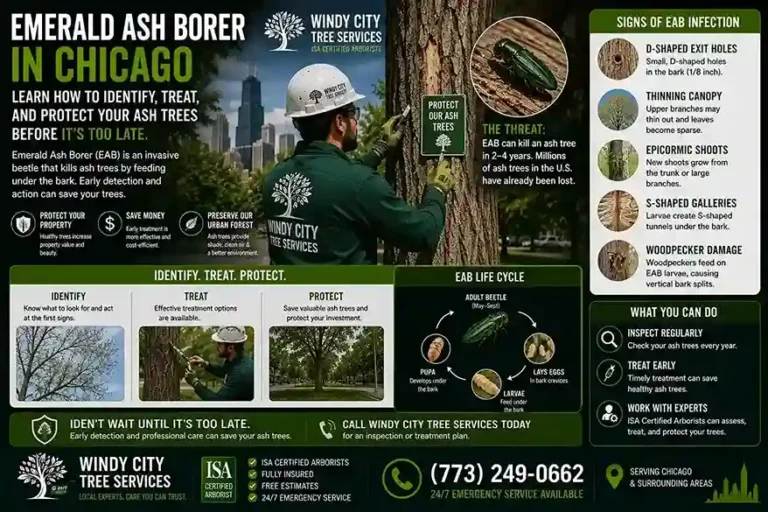
Species matter too. Ash trees across the city took a severe hit from the emerald ash borer over the past two decades, which is part of why the Bureau of Forestry actively promotes species diversity now instead of planting a single species block by block. Oaks, meanwhile, tend to be long-lived and structurally strong, but they’re slow to recover from root damage caused by nearby construction or utility work.
14. Why Hire an ISA Certified Arborist?
Not every “tree guy” with a truck and a chainsaw is qualified to make the calls that actually matter here. An ISA (International Society of Arboriculture) Certified Arborist has passed a standardized exam covering tree biology, diagnosis, and safe work practices, and follows ISA Best Management Practices and ANSI A300 pruning and care standards on every job.
That certification translates into practical benefits for you:
- Safety. Proper rigging, equipment, and hazard assessment reduce the risk of injury or property damage during removal.
- Accurate diagnosis. A certified arborist can tell the difference between a tree that’s cosmetically ugly and one that’s structurally dangerous, which changes the recommendation entirely.
- Permit assistance. Experience navigating Chicago’s Bureau of Forestry process means fewer delays and fewer mistakes on paperwork.
- Insurance-ready documentation. Written assessments that hold up if you need them for a claim.
- Preservation-first recommendations. A good arborist would rather save a tree that can be saved than sell you a removal you didn’t need.
Permit Decision Table
Use this as a quick reference, not a final legal answer. Always confirm your specific situation with the appropriate city department.
| Tree Location | Permit May Be Required? | Who to Contact |
|---|---|---|
| Private Property | Generally no, but depends on current regulations and any historic district rules | Property owner; City of Chicago if uncertain |
| Parkway Tree | Typically yes | City of Chicago Bureau of Forestry |
| Public Park | Yes | Chicago Park District |
| Boulevard / Public Right-of-Way | Yes | City of Chicago Bureau of Forestry |
| Emergency Hazard | Depends on circumstances and location | City of Chicago / Emergency Services / Licensed Tree Service |
Homeowner Checklist: Before You Remove Any Tree
- Confirm ownership of the tree by checking your lot line, not just visual proximity to your house.
- Determine whether the tree, or any part of its root flare, sits on public property.
- Check current local regulations with the City of Chicago Bureau of Forestry.
- Verify whether a permit applies to your specific tree and situation.
- Consult a certified arborist for an inspection before committing to removal.
- Obtain written approvals when the city requires them, and keep a copy on file.
Frequently Asked Questions
Do I need a permit to remove a tree in Chicago?
It depends on where the tree is located. Trees fully on private property generally don’t need a permit, while parkway, park, and other public trees almost always do, since the city owns them.
Are parkway trees owned by the city?
Yes. Trees growing in the grass strip between the sidewalk and the curb are considered city property under Chicago’s municipal code, regardless of who maintains that strip.
Can I remove a dead tree on my own property?
In most cases, yes, since a dead tree fully on private land follows the same general rule as any other private tree. It’s still worth confirming there’s no historic district or ordinance exception that applies to your address.
Can I trim a city tree myself?
No. Trimming or pruning a parkway or public tree requires a permit and should be done by an authorized contractor, not by the property owner.
What happens if I remove a public tree without permission?
You risk fines, mandatory replacement costs, and liability exposure if the removal causes any damage. Unauthorized removal of city-owned trees is taken seriously.
Who issues tree removal permits in Chicago?
The Department of Streets and Sanitation’s Bureau of Forestry handles most parkway and street tree permits. The Chicago Park District oversees trees inside parks.
Do emergency removals require permits?
Emergency response prioritizes safety first, especially for hazards on public property. Coordination with the city still matters when work involves the public way, even under time pressure.
Can an arborist help with the permit process?
Yes. An experienced arborist can confirm ownership, determine whether a permit applies, and handle communication with the appropriate city department on your behalf.
Are permits required for stump grinding?
Stump grinding on private property generally doesn’t require a permit. Stump removal in the public way, tied to a parkway tree, typically falls under the same permit process as the tree removal itself.
Do HOAs have different rules than the city?
Yes, an HOA or condo association can add its own restrictions on top of city rules. Always check your HOA’s governing documents in addition to city regulations.
How do I find out if my tree is a parkway tree?
Check your property survey or lot line, and look at whether the tree sits between the sidewalk and the curb. When it’s unclear, the Bureau of Forestry or a licensed arborist can confirm it for you.
What is the Chicago Landscape Ordinance?
It’s a separate set of requirements, mainly aimed at new development and parking lot projects, that can require landscaping, tree preservation, or replacement plantings as part of the approval process.
Does a dead ash tree need a permit to remove?
Only if it’s on public property. A dead ash tree on private land, common after emerald ash borer damage, generally doesn’t need a permit, though hiring a professional is strongly recommended given how brittle dead ash wood becomes.
Can I be fined for damaging a public tree, even without removing it?
Yes. Chicago’s ordinance addresses injury to public trees and shrubs, not just outright removal, so damaging roots or bark during construction can also carry consequences.
Do I need a permit to plant a new parkway tree?
Generally yes, since planting in the public way falls under the same Bureau of Forestry oversight as removal and trimming. The city also has planting standards new parkway trees need to meet.
How long does a Chicago tree removal permit take?
Timelines vary by request type and current workload. Non-emergency requests typically take longer than urgent hazard removals, so it’s best to confirm current processing times directly with Forestry.
Is a replacement tree required after removal?
For public trees, replacement is often required as a condition of the permit. For private trees, replacement isn’t typically mandated by the city unless a separate ordinance, like the Landscape Ordinance, applies.
Can a neighbor force me to remove a tree on my property?
Not directly through the city, though a neighbor can raise a complaint if your tree poses a documented hazard to their property. Civil disputes over trees are generally handled separately from city permitting.
Does insurance cover tree removal costs?
It depends on your policy and the circumstances. Storm-damaged trees that hit a structure are more likely to be covered than a standing tree removed as routine maintenance. Check with your insurer directly.
What’s the fastest way to get a straight answer about my specific tree?
Call the Bureau of Forestry directly, or schedule an inspection with a certified arborist who handles Chicago permits regularly. Either route beats guessing based on what worked for a neighbor’s tree.
Sources & Further Reading
- City of Chicago, Department of Streets and Sanitation, Bureau of Forestry
- City of Chicago, Forestry Permit Information and Application
- City of Chicago, Dead or Damaged Trees
- International Society of Arboriculture (ISA), Best Management Practices
- ANSI A300 Tree Care Standards
This article is provided for general information and does not constitute legal advice. Tree ordinances and permit requirements can change. Always verify current requirements directly with the City of Chicago before beginning any tree work.