Emerald Ash Borer in Chicago: Windy City Homeowner Guide
Emerald Ash Borer in Chicago
Learn how to identify, treat, and protect your ash trees before it’s too late.
Schedule an Ash Tree InspectionEmerald Ash Borer, often shortened to EAB, is one of the most destructive invasive insects ever to reach North American forests. Since its accidental introduction, it has killed tens of millions of ash trees across the Midwest, and Illinois has been squarely in its path for nearly two decades. If you own an ash tree in the Chicago area, understanding this pest isn’t optional anymore, it’s a matter of protecting a tree that may already be at risk.
The good news is that early detection genuinely changes the outcome. A tree caught in the early stages of infestation has real treatment options. A tree discovered after major canopy loss usually doesn’t. That difference is why a professional inspection matters so much, and why waiting for obvious symptoms often means waiting too long.
This guide walks through what Emerald Ash Borer actually is, how to recognize the early warning signs most homeowners miss, what treatment realistically involves, and how to know when removal is the safer and more responsible choice.
What is Emerald Ash Borer?
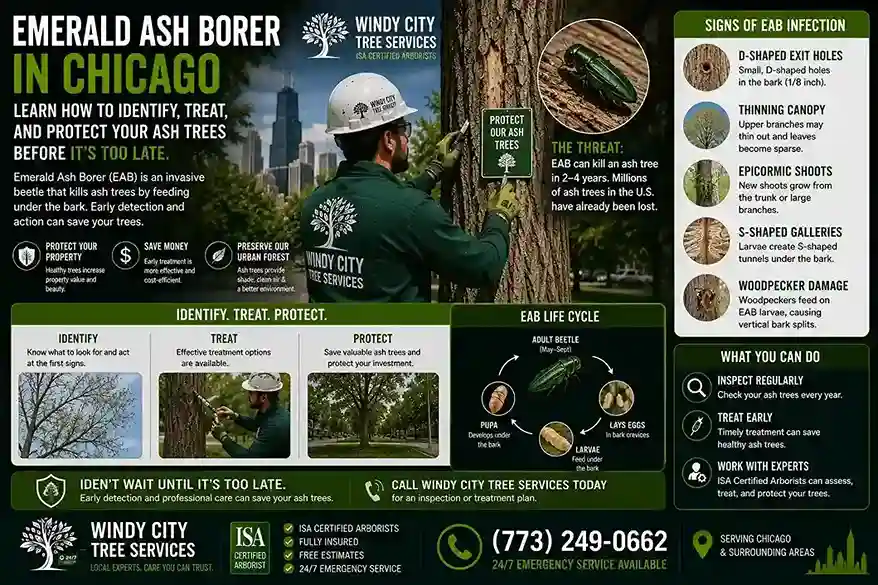
Emerald Ash Borer is an invasive beetle whose larvae feed beneath the bark of ash trees, disrupting the tree’s ability to transport water and nutrients. Early symptoms include canopy thinning, bark splits, D-shaped exit holes, epicormic sprouts, and increased woodpecker activity. Early professional evaluation offers the best opportunity to determine appropriate management.
What Is Emerald Ash Borer?
Emerald Ash Borer, scientific name Agrilus planipennis, is a small, metallic green beetle native to northeastern Asia, including China, Japan, Korea, and parts of Russia. In its native range, natural predators and resistant tree species kept its population in check. North American ash trees never developed that resistance, which is exactly why the insect has been so devastating here.
EAB was first confirmed in the United States near Detroit, Michigan, in 2002, though research suggests the population had likely been established for several years before anyone noticed. According to the Illinois Department of Agriculture, the beetle reached Illinois by June 2006, when two infested ash trees were confirmed near Lilly Lake in Kane County. It has since spread to counties across the state, including Cook County and the greater Chicago area.
What makes Emerald Ash Borer so destructive isn’t aggression or speed, it’s specificity. The insect feeds almost exclusively on ash trees, and because North American ash species had no evolutionary exposure to it, even healthy, mature trees have little natural defense once an infestation takes hold.
Which Trees Are Affected?
Emerald Ash Borer targets true ash trees, genus Fraxinus, almost exclusively. According to University of Illinois Extension entomologists, the only other tree it will feed on to any real extent is the closely related fringe tree.
White Ash
Common in Chicago-area parks and residential yards, highly susceptible to EAB infestation.
Green Ash
One of the most widely planted street trees in Illinois before EAB arrived, and one of the hardest hit.
Black Ash
Less common in urban Chicago but found in wetter natural areas, equally susceptible.
Blue Ash
Rare in the Chicago region, but still a true ash species within the range EAB attacks.
Mountain Ash
Despite the name, true mountain ash is not a genus Fraxinus tree and is generally not susceptible to EAB.
If you’re not sure whether a tree on your property is a true ash, look at the leaves. Ash trees have compound leaves with five to nine leaflets arranged opposite each other along the stem, along with distinctive diamond-patterned bark on mature trees. A professional tree health inspection can confirm species identification along with any signs of infestation.
Emerald Ash Borer Life Cycle
Understanding the life cycle helps explain why symptoms often appear well after an infestation has already taken hold.
Adult emergence: Adult beetles emerge through the bark, leaving distinctive D-shaped exit holes, with peak emergence typically in mid-June.
Egg laying: Females lay eggs in bark crevices roughly two weeks after emerging, feeding on ash foliage in between.
Larvae hatch: Eggs hatch and larvae bore through the bark into the cambium and phloem layer just beneath it.
Feeding galleries: Larvae feed just under the bark, carving winding, S-shaped galleries that cut off the tree’s ability to move water and nutrients.
Overwintering: Mature larvae excavate small chambers in the outer sapwood and remain dormant through winter.
Pupation: Larvae pupate within their overwintering chambers before emerging as adults to begin the cycle again.
Depending on climate and tree condition, a full generation can take one to two years to complete, which means a tree can be infested and actively declining for a year or more before visible symptoms become obvious to a homeowner.
Early Symptoms of Emerald Ash Borer
By the time a tree looks obviously sick, an infestation is often well established. Catching these earlier signs matters.
Canopy Thinning
Sparse foliage, especially starting at the top of the tree, is often the first visible sign.
Sparse Leaves & Dieback
Branches with progressively fewer leaves each year indicate declining vascular function.
Epicormic Shoots
New sprouts growing from the trunk or major limbs are a stress response as the tree tries to compensate for canopy loss.
Bark Splitting
Vertical bark splits often reveal the winding larval galleries underneath.
D-Shaped Exit Holes
Small, distinctly D-shaped holes, about the width of a grain of rice, mark where adult beetles emerged.
Woodpecker Activity
Woodpeckers feed on larvae beneath the bark, and heavy pecking damage, sometimes called “blonding,” is a strong indicator of infestation.
S-Shaped Galleries
Winding tunnels visible beneath peeling bark are the direct result of larval feeding.
Symptom Identification Guide: Side-by-side reference photos showing a D-shaped exit hole compared to a round exit hole from native borers, an S-shaped feeding gallery beneath bark, and woodpecker “blonding” on a trunk.
How Emerald Ash Borer Kills Trees
Larval feeding is the direct cause of death, and understanding the mechanism explains why timing matters so much for treatment.
- Larval feeding: Larvae feed almost exclusively in the cambium and phloem, the thin layers of tissue just beneath the bark responsible for moving nutrients through the tree.
- Disrupted nutrient transport: As galleries multiply and overlap, they progressively cut off the tree’s ability to move water and sugars between roots and canopy.
- Progressive decline: Canopy thinning starts at the top of the tree and spreads downward as more of the vascular system is compromised.
- Structural weakening: As the tree dies, wood decays rapidly and becomes structurally unreliable, often faster than other dead tree species.
- Eventual mortality: University of Illinois Extension research indicates untreated, infested ash trees commonly die within two to four years of initial infestation, though the timeline varies by tree size and infestation severity.
How Arborists Diagnose Emerald Ash Borer
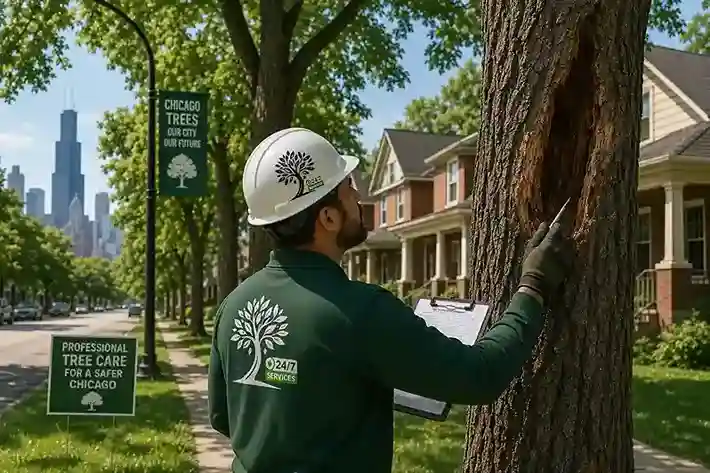
ISA Certified Arborists use a structured evaluation rather than relying on a single visual clue.
- Visual inspection: A full walk-around assessment of canopy density, branch dieback, and overall tree vigor.
- Bark examination: Checking for splits, exit holes, and woodpecker damage across the trunk and major limbs.
- Canopy assessment: Evaluating what percentage of the canopy shows thinning or dieback, a key factor in the treatment-versus-removal decision.
- Exit holes: Counting and mapping D-shaped exit holes to estimate infestation density.
- Galleries: Where bark has already split or peeled, examining the winding feeding galleries underneath for confirmation.
- Tree history: Considering the tree’s age, prior health, and any previous treatment history.
- Risk assessment: Factoring in the tree’s location and what it would strike if it failed, especially important for declining trees near homes or walkways.
Can Emerald Ash Borer Be Treated?
Yes, in many cases, though effectiveness depends heavily on how early the infestation is caught and how healthy the tree is to begin with.
Trunk Injections
Systemic insecticides injected directly into the trunk are among the most effective treatment methods for valuable, high-priority trees.
Soil Treatments
Soil-applied systemic insecticides can be appropriate for certain trees and sites, though effectiveness varies with soil type and tree size.
Timing Considerations
Treatments are generally most effective when applied before or during early infestation, not after significant canopy loss has occurred.
Candidate Trees
The best candidates for treatment are structurally sound trees with less than 30 to 50 percent canopy loss, evaluated individually.
Follow-Up Monitoring
Treated trees need ongoing monitoring and, in most cases, repeat treatment on a recurring schedule to remain protected.
When Tree Removal Is Recommended
- Severe canopy loss: Trees with more than 50 percent canopy decline rarely respond well to treatment.
- Structural decline: EAB-killed wood decays quickly and becomes unpredictable to climb or work around safely.
- Dead ash trees: Once a tree is fully dead, treatment is no longer relevant, and removal timing becomes a safety priority.
- Safety hazards: Weakened limbs and trunks on dead or dying ash trees pose a real risk of sudden failure.
- Trees near homes: Proximity to structures raises the consequences of failure and often accelerates the removal timeline.
- Utility conflicts: Declining ash trees near power lines require prompt attention due to the added risk of contact during failure.
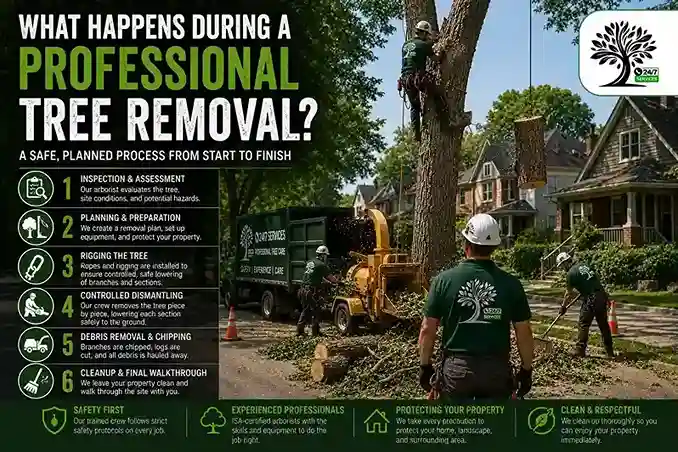
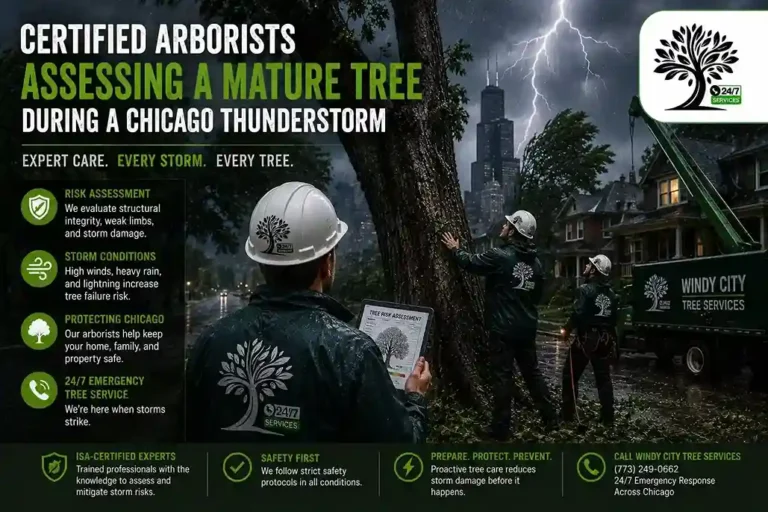
Our tree removal team handles EAB-killed ash trees regularly, and our emergency tree removal service is available for trees that have already become an active hazard.
Preventing Emerald Ash Borer Damage
Annual Inspections
Yearly evaluations catch early symptoms before canopy loss becomes severe.
Early Detection
Knowing what to look for, and checking regularly, gives you the widest range of management options.
Tree Health Care
Fertilization and proper watering support overall vigor, which can influence how well a tree tolerates treatment.
Landscape Diversity
Planting a mix of species instead of relying on ash trees reduces future vulnerability to any single pest.
Ongoing Monitoring
Even treated trees need continued monitoring to confirm the treatment plan is still working.
Chicago’s Emerald Ash Borer History
Illinois confirmed its first Emerald Ash Borer infestation in June 2006, in Kane County, and the pest has since spread to counties across the state, including Cook County and the greater Chicago metropolitan area, according to the Illinois Department of Agriculture. The impact on the region’s urban forest has been significant. Green ash and white ash were widely planted as street and parkway trees throughout Chicago for decades, in part because of their tolerance for urban conditions, which meant the region had an unusually high concentration of vulnerable trees when EAB arrived.
Municipal forestry programs across the Chicago area have spent years managing the fallout, combining removal of dead ash trees with treatment programs for high-value specimens and replanting efforts favoring diverse species. The Morton Arboretum, based in the western suburbs, has been a key regional resource for research and public education on EAB management throughout this period.
Neighborhood-level tree loss has been substantial in areas where ash trees made up a large share of the street tree population, changing the look and shade coverage of entire blocks within just a few years. That history is part of why ongoing monitoring remains important even now, since surviving and treated ash trees still require consistent attention.
Protecting Nearby Trees
If one ash tree on your property or block shows signs of infestation, nearby ash trees are at real risk too, since adult beetles can fly to new host trees within the same season.
- Monitoring adjacent ash trees: Any ash tree within the surrounding area should be inspected, not just the one showing symptoms.
- Inspection schedules: Nearby trees warrant closer, more frequent monitoring once EAB is confirmed in the area.
- Preventive management: Healthy, high-value ash trees near a confirmed infestation may be good candidates for preventive treatment.
- Professional recommendations: An arborist can help prioritize which trees to treat, monitor, or remove based on the overall picture across your property.
Healthy Ash Tree vs. Emerald Ash Borer Infestation
| Healthy Tree | Infested Tree |
|---|---|
| Full, dense canopy | Sparse, thinning canopy |
| Smooth, intact bark | Vertical bark splits |
| Normal branch growth | Epicormic shoots on trunk and limbs |
| No exit holes | D-shaped exit holes |
| Minimal woodpecker activity | Heavy woodpecker activity and bark “blonding” |
Treatment vs. Removal
| Situation | Professional Recommendation |
|---|---|
| Early infestation, minimal canopy loss | Treatment is typically the strongest option if the tree is otherwise healthy |
| Moderate infestation, 20 to 40 percent canopy loss | Treatment may still be viable depending on species, size, and site conditions |
| Severe canopy loss, over 50 percent | Removal is generally recommended, as treatment success drops significantly |
| Dead tree | Removal, prioritized based on proximity to structures and foot traffic |
| Hazardous location near a home or power line | Removal, often on an expedited timeline regardless of infestation stage |
These recommendations are general guidance only. Every situation depends on an on-site evaluation of the specific tree, its condition, and its surroundings.
Emerald Ash Borer Inspection Checklist
- Inspect canopy density from multiple angles around the tree
- Look closely for D-shaped exit holes on the trunk and major limbs
- Watch for increased woodpecker activity or bark “blonding”
- Check for vertical bark splits
- Look for epicormic shoots growing from the trunk or base
- Monitor branch dieback, especially starting at the top of the canopy
- Schedule annual inspections for any ash tree on your property
- Contact an ISA Certified Arborist as soon as symptoms appear
Frequently Asked Questions
What is Emerald Ash Borer?
Emerald Ash Borer is an invasive beetle, Agrilus planipennis, whose larvae feed beneath the bark of ash trees, disrupting nutrient transport and eventually killing the tree if left untreated.
How do I know if my ash tree has Emerald Ash Borer?
Watch for canopy thinning, D-shaped exit holes, vertical bark splits, epicormic shoots on the trunk, and increased woodpecker activity. A professional inspection can confirm suspected infestation and assess severity.
Can Emerald Ash Borer be treated?
Yes, in many cases, especially when caught early. Systemic insecticide treatments, including trunk injections, can be effective on trees with less than 30 to 50 percent canopy loss, though results vary by tree condition.
How fast do ash trees die from Emerald Ash Borer?
Untreated, infested ash trees commonly die within two to four years of initial infestation, though the exact timeline depends on tree size, health, and infestation density.
Are all ash trees affected by Emerald Ash Borer?
All true ash species, genus Fraxinus, including white, green, black, and blue ash, are susceptible. True mountain ash is a different genus and is generally not affected by EAB.
Should dead ash trees be removed?
Yes. Dead ash trees decay quickly and become structurally unpredictable, increasing the risk of limb or trunk failure. Removal timing should prioritize trees near homes, walkways, or power lines.
Can Emerald Ash Borer spread to other tree species?
No, EAB feeds almost exclusively on true ash trees, with the fringe tree as a rare exception. It does not pose a direct threat to oaks, maples, or most other common landscape species.
What do D-shaped exit holes look like?
D-shaped exit holes are small, about the width of a grain of rice, with one flat side and one curved side. They mark where adult beetles chewed their way out of the tree after completing development.
How often should ash trees be inspected?
Annual inspections are recommended for any ash tree, and more frequent monitoring is advised if EAB has been confirmed elsewhere in your neighborhood.
Should I treat or remove my ash tree?
That decision depends on canopy loss, overall tree health, and location. A professional evaluation weighs these factors and gives you a specific recommendation rather than a generic answer.
Where did Emerald Ash Borer come from?
EAB is native to northeastern Asia, including China, Japan, Korea, and parts of Russia. It was first confirmed in the United States near Detroit, Michigan, in 2002 and reached Illinois by 2006.
How does Emerald Ash Borer spread?
Adult beetles can fly moderate distances on their own, but the fastest spread happens through human transport of infested firewood, logs, and untreated ash lumber, which is why moving firewood long distances is discouraged.
What does an epicormic shoot look like?
Epicormic shoots are new, often leafy sprouts growing directly from the trunk or major limbs, sometimes near the base. They’re a stress response as the tree attempts to compensate for lost canopy.
Is trunk injection treatment safe for the tree?
Yes, when performed correctly by a trained professional. Trunk injections create small, controlled injection points and are one of the most established treatment methods for EAB when applied by an experienced arborist.
How much does Emerald Ash Borer treatment cost?
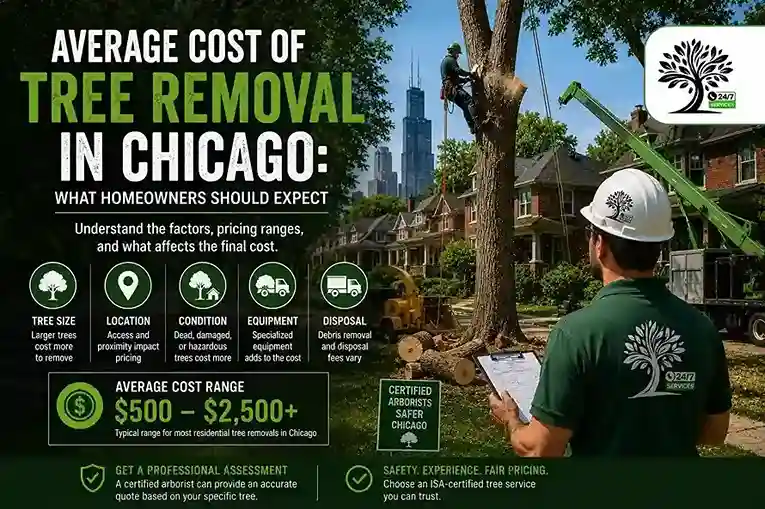
Cost depends on tree size, treatment method, and whether ongoing retreatment is needed. We provide a written, no-obligation estimate after evaluating the specific tree.
Can a tree survive Emerald Ash Borer without treatment?
It’s rare. A small percentage of ash trees show natural resistance, called “lingering ash,” but the overwhelming majority of untreated, infested trees decline and die within a few years.
Is it too late to treat my ash tree if it already has some canopy loss?
Not necessarily, but it depends on how much loss has occurred. Trees with moderate canopy loss may still respond to treatment, while trees with more than half the canopy gone rarely recover even with treatment.
Do I need a permit to remove a dead ash tree in Chicago?
Parkway trees, the ones between the sidewalk and street, are owned by the city and require a permit before removal. Trees fully on private property generally don’t need a city permit, but we confirm the exact requirement before starting work.
How do I schedule an ash tree inspection in Chicago?
Call (773) 249-0662, email info@windycitytreeservices.com, or request an estimate online. We’ll schedule an on-site evaluation and follow up with a written assessment and treatment or removal recommendation.
Key Takeaways
- EAB is highly destructive: This invasive beetle has killed tens of millions of ash trees across the Midwest since arriving in the early 2000s, and it remains active throughout the Chicago area.
- Early detection changes outcomes: Symptoms like canopy thinning, D-shaped exit holes, and woodpecker activity are easiest to catch before major decline sets in.
- Treatment has a window: Trees with limited canopy loss respond far better to treatment than trees discovered after significant decline.
- Removal is sometimes the safest choice: Severely infested or dead ash trees decay quickly and become structurally unreliable, making prompt removal a safety priority near homes and high-traffic areas.
- Professional evaluation matters: Treatment recommendations depend on tree size, health, infestation severity, and site conditions, which is why a professional inspection should come before any decision.