Tree Inspection Every Homeowner Should Consider
Tree Inspections Every Homeowner Should Consider
What a professional tree inspection actually covers, how often homeowners should schedule one, and what to look for between visits.
Schedule a Tree InspectionTrees can look perfectly healthy from the driveway and still be developing problems that aren’t obvious from the ground. Dead branches hidden in the upper canopy, weak branch unions, trunk cracks, cavities, decay, root damage, soil compaction, a subtle lean, canopy decline, storm stress, pest activity, disease, and construction damage can all be present on a tree that still looks green and full from a distance.
A professional inspection gives you more information than a glance from the sidewalk ever can. It’s a closer, trained look at the parts of a tree most homeowners aren’t equipped to evaluate on their own: the root flare, the trunk, the branch structure, and the soil and site conditions around it. This guide walks through why inspections matter, when to schedule one, what a professional visit actually includes, and what a healthy inspection routine looks like for Chicago properties.
What Is a Tree Inspection?
A tree inspection is a systematic evaluation of a tree’s visible condition, structure, root flare, canopy, trunk, branches, and surrounding soil and site conditions. The scope depends on the purpose: a routine health check looks different from a post-storm evaluation or a formal tree risk assessment, but all of them start with a trained, structured look at the whole tree.
Why Should Homeowners Have Their Trees Inspected?
A proactive inspection gives you information while you still have options. Instead of discovering a problem after a branch has already come down or a tree has already declined past the point of saving, you find out early enough to act.
- Catching defects early — cracks, weak unions, and decay are far easier to manage before they become emergencies.
- Finding declining trees before the decline becomes obvious from a distance.
- Identifying deadwood that’s more likely to fail in wind or ice.
- Detecting structural problems like included bark or codominant stems.
- Identifying root problems that are otherwise invisible underground.
- Evaluating storm damage that isn’t visible from the ground.
- Protecting your home and property from a preventable failure.
- Planning pruning before small issues require larger cuts later.
- Determining whether treatment, rather than removal, is the right call.
- Establishing a baseline condition so future changes are easier to spot.
An inspection isn’t a guarantee. No arborist can promise a tree will never fail, storm or no storm. What an inspection does is reduce known, identifiable risk based on the tree’s current condition, which is the most any evaluation can honestly offer.
When Should You Have Your Trees Inspected?
Some inspection needs are seasonal and routine. Others are triggered by a specific event. Both matter.
After Severe Storms
High winds, thunderstorms, lightning, ice, heavy snow, flooding, and saturated soil can all stress a tree’s structure. Storm damage isn’t always visible immediately; a cracked root plate or a hairline trunk fracture can take weeks to show symptoms above ground. See our detailed guide on how arborists assess storm damage for the full root-to-canopy process.
Before Storm Season
A proactive look before Chicago’s spring and summer storm season gives you time to correct weak points, like deadwood or a poor branch union, before wind puts real load on them. Our guide on preparing trees before severe weather covers this in more depth.
When Buying or Selling a Home
Tree condition can matter when you’re evaluating a property, particularly for large, mature trees near the house or driveway. This isn’t a legal requirement in most cases, but it’s a reasonable, practical step for due diligence.
After Construction
Excavation, trenching, grading, soil compaction, root cutting, and changes in drainage near a tree’s root zone can all cause stress that shows up long after the project wraps. See tree stress after construction for the specific mechanisms behind this kind of decline.
When a Tree Changes
Have a tree looked at whenever you notice a sudden lean, dead branches, canopy thinning, unusual leaf loss, cracks, fungal growth, exposed roots, soil movement, or a branch that’s already failed. Any of these on their own is worth a look; several together warrant prompt attention. Our article on the signs your tree is dying walks through these symptoms in more detail.
For Large or Mature Trees
Mature trees deserve particular attention. They’re bigger, they carry longer maintenance histories, and there’s often more beneath their canopy, homes, driveways, patios, that could be affected if something goes wrong.
Not Sure Whether Your Tree Needs a Professional Look?
Schedule a tree inspection with Windy City Tree Services and get a clear, honest read on your tree’s condition.
☎️ (773) 249-0662How Often Should Trees Be Inspected?
There’s no single interval that fits every tree. How often a tree needs professional attention depends on:
- Age and species
- Size and canopy spread
- Location relative to homes, driveways, and walkways
- Current condition and any known defects
- Previous storm damage
- Nearby construction activity
- Maintenance and pruning history
- Site conditions, including soil and drainage
As a general planning guideline, not a universal rule, many mature or higher-value trees benefit from a professional look roughly every one to three years, with more frequent attention for trees carrying known structural issues or sitting close to a home, driveway, or pedestrian area. A healthy young tree in an open yard typically needs far less frequent professional attention, though it still benefits from a homeowner’s routine visual checks.
Tree Inspection Checklist for Homeowners
Here’s what to look for during a routine walk around your property. This isn’t a substitute for a professional inspection, it’s a way to catch obvious changes early and know when to call.
🌳 Canopy
- Dead branches or broken limbs
- Unusual thinning or dead branch tips
- Uneven growth or excessive dieback
🌿 Branches
- Cracks or weak unions
- Hanging branches caught in the canopy
- Large dead limbs or branches rubbing together
🪵 Trunk
- Cracks, cavities, or damaged bark
- Fungal growth or old wounds
- Unusual swelling
🌱 Root Flare
- Exposed roots or soil heaving
- Decay or girdling roots
- Buried or unclear root flare
🟤 Surrounding Soil
- Compaction, standing water, or erosion
- Construction disturbance
- Soil cracking or drainage changes
📍 Site
- Structures, vehicles, or sidewalks beneath the canopy
- Playgrounds or high-traffic areas nearby
- Utility lines running through or near the canopy
What Does a Professional Tree Inspection Include?
A thorough inspection moves from the ground up, in a consistent sequence.
Step 1: Property and Tree History
The arborist notes the species and approximate age where known, along with any previous pruning, storm damage, nearby construction, or past treatments.
Step 2: Root Flare Inspection
This includes checking whether the root flare is visible, looking for girdling roots, soil movement, decay indicators, and exposed roots.
Step 3: Trunk Inspection
The trunk is evaluated for cracks, cavities, decay indicators, bark abnormalities, old wounds, and included bark.
Step 4: Branch Structure
This covers branch unions, deadwood, broken limbs, codominant stems, weak attachments, and overextended branches.
Step 5: Canopy Evaluation
The canopy is reviewed as a whole for density, dieback, leaf condition, dead branches, unusual growth, and overall structural balance.
Step 6: Soil and Site Conditions
This includes compaction, drainage, available rooting space, construction disturbance, nearby pavement, and soil moisture.
Step 7: Target Assessment
Finally, the arborist considers what could be affected if the tree or a branch failed, including homes, garages, vehicles, people, sidewalks, streets, fences, and utility infrastructure.
What Does an Arborist Look for During a Tree Inspection?
Arborists are trained to read a wide range of individual signals and interpret them together, rather than in isolation:
- Decay, cavities, and cracks
- Weak branch unions and codominant stems
- Included bark
- Deadwood
- Root defects and soil problems
- Lean and canopy imbalance
- Disease symptoms and pest activity
- Storm damage, construction damage, and mechanical injuries
A single symptom rarely tells the whole story. A hollow section of trunk, for example, isn’t automatically a hazard; trees can compartmentalize decay and remain stable for years, depending on how much sound wood remains. That’s why individual findings need to be interpreted in context, not read as a simple checklist.
What Is a Tree Health Inspection?
A tree health inspection focuses specifically on vigor, foliage condition, growth patterns, disease symptoms, pest pressure, root conditions, nutrient-related symptoms, and environmental stress. It’s related to, but not identical to, a structural risk evaluation.
A tree can be healthy and still be structurally defective, think of a vigorous tree with a poor branch union. And a tree can be structurally sound while dealing with a health problem, like early-stage disease or nutrient deficiency. Both dimensions matter, and a complete picture usually needs both. Windy City Tree Services’ tree health inspection and treatment service covers this side of tree care specifically.
What Is the Difference Between a Tree Inspection and a Tree Risk Assessment?
These terms get used loosely across the tree care industry, and it’s worth being precise about the difference.
| Tree Inspection | Tree Risk Assessment |
|---|---|
| General evaluation of condition | Formal, risk-focused evaluation |
| Health and overall condition | Failure likelihood and consequences |
| Canopy, trunk, roots, and site | Defects, targets, likelihood, and consequences |
| Often routine or periodic | Often performed for a specific concern |
| Guides ongoing maintenance | Guides risk-management decisions |
Terminology varies among tree care providers, so it’s worth asking what’s included when you schedule a visit. Formal risk assessments may follow a recognized methodology such as the International Society of Arboriculture’s Tree Risk Assessment Qualification (TRAQ), though not every tree inspection rises to that level of formality, and most trees don’t need it to.
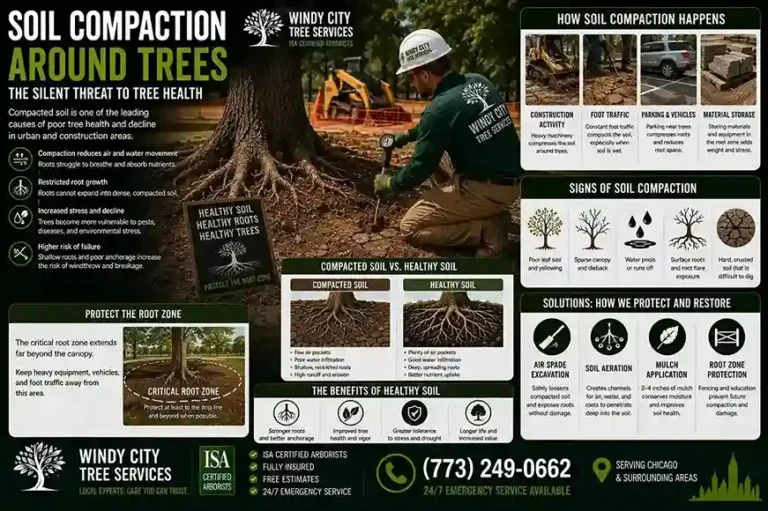
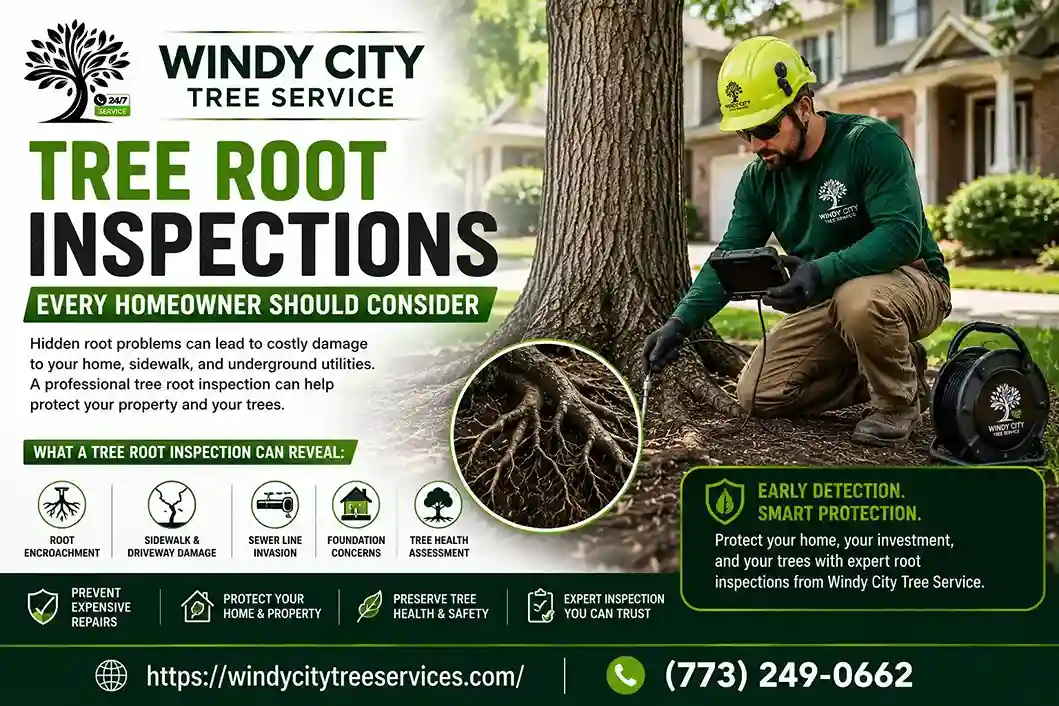
Why Tree Roots Should Be Part of an Inspection
Roots anchor the tree and handle water and nutrient uptake, which makes root health central to both stability and long-term vigor. A thorough inspection considers:
- Anchorage and structural stability
- Water and nutrient uptake
- Root decay and girdling roots
- Soil compaction and root damage
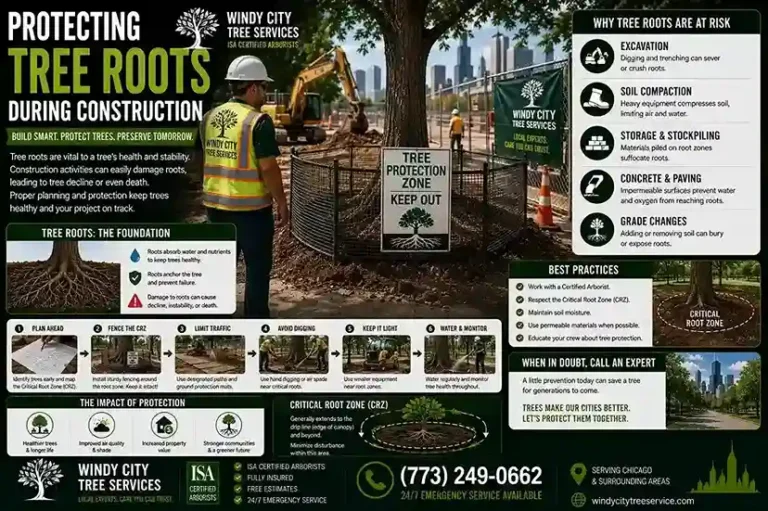
- Construction impacts near the root zone
- Soil heaving and drainage problems
Because so much of the root system is underground, it can’t always be fully evaluated from the surface. For cases where a closer look at the root zone is warranted, an Air Spade lets an arborist expose roots using compressed air instead of digging, which avoids cutting into living root tissue while still revealing what’s happening below grade. Root decline and rot are covered in more detail in our guide on root rot symptoms.
When Should You Get a Tree Inspection After a Storm?
Seek a professional evaluation whenever you notice hanging limbs, broken branches, trunk cracks, a new lean, root plate movement, exposed roots, split trunks, major canopy damage, or a tree contacting a structure or power line.
Our guide on common reasons trees fail during Chicago storms covers the specific patterns local arborists see season after season.
Should You Inspect Trees After Construction?
Construction near a tree’s root zone can affect structural roots, feeder roots, soil structure, drainage, grade, oxygen availability, and available rooting space. Tree decline from root disturbance often doesn’t show up right away; it can appear months, or even years, after the work is finished, which is exactly why trees near recent construction deserve a look even if nothing seems wrong yet.
15 Signs Your Tree Needs a Professional Inspection
- Sudden leaning — a new or worsening lean can signal root plate failure.
- Large dead branches — more likely to fail under wind or ice load.
- Hanging branches — caught limbs can fall without warning.
- Trunk cracks — a sign the wood has already separated under stress.
- Split limbs — often indicate a weak union has already failed.
- Cavities — can point to significant decay behind a solid-looking surface.
- Fungal growth — visible fungi often mean decay organisms are established.
- Significant canopy thinning — may reflect stress somewhere in the root system.
- Sudden leaf loss — can point to root damage or vascular injury.
- Root damage — compromises anchorage and long-term stability.
- Soil heaving — a common early sign of a shifting root plate.
- Exposed roots — can indicate erosion, grading, or decay.
- Storm damage — even minor-looking damage can hide larger problems.
- Construction near roots — disturbance that may not show effects for months.
- Branches over important targets — raises the stakes of any existing defect.
Noticing one of these doesn’t automatically mean removal is the answer. Most findings lead to monitoring, pruning, or support rather than taking the tree down.
Seeing Cracks, Dead Limbs, or an Unusual Lean?
Have the tree evaluated before the condition has a chance to worsen.
☎️ (773) 249-0662Can a Healthy-Looking Tree Still Have Structural Problems?
Yes. Green, full foliage doesn’t rule out internal decay, weak branch unions, root defects, cracks, or other structural weaknesses. A tree can be putting on a strong canopy display while carrying a serious defect underneath. That gap between appearance and actual condition is precisely why a professional inspection is worth more than a look from the driveway; it’s built to catch what isn’t obvious from the ground.
What Happens After a Professional Tree Inspection?
An inspection typically ends with one of several recommendations, and preservation is generally favored whenever it’s reasonably possible.
- Monitor — for conditions that don’t require immediate action but are worth watching.
- Prune — for deadwood removal, clearance, or correcting structural issues.
- Cabling or bracing — for select structural defects where added support helps. See our tree cabling and bracing service.
- Tree health treatment — for certain disease, pest, nutrient, or environmental issues.
- Root-zone care — for soil compaction or root-zone problems.
- Removal — reserved for trees that are hazardous or in decline beyond reasonable recovery.
What Should a Tree Inspection Report Include?
A useful report typically documents tree identification, condition, structural defects, health concerns, site conditions, risk factors, photographs, recommended work, priority level, and any monitoring recommendations. Not every visit includes a formal written report; whether one is provided depends on the specific service and purpose of the inspection, so it’s worth asking in advance if documentation matters for your situation, such as an insurance claim or a real estate transaction.
How Much Does a Tree Inspection Cost?
Cost varies based on several factors:
- Number of trees being evaluated
- Tree size and accessibility
- Property size and layout
- Scope of the inspection
- Any diagnostic equipment needed
- Whether written report documentation is required
- Whether a formal risk assessment is needed versus a general evaluation
A basic visual evaluation typically costs less than a formal, documented risk assessment that requires more time, tools, and reporting. Windy City Tree Services provides free estimates, so you’ll know the cost before any work begins.
Can Homeowners Inspect Their Own Trees?
Homeowners can safely handle routine visual observations from the ground: obvious dead branches, visible cracks, canopy changes, root exposure, leaning, and storm damage are all things you can watch for on your own.
What homeowners should not do: climb a hazardous tree, use a chainsaw to investigate a suspected defect, climb a ladder into a damaged canopy, cut branches near power lines, enter an unstable tree, or attempt to diagnose internal decay themselves. Once a concern moves beyond what’s visible from solid ground, it’s time to call a professional.
Which Trees Should Homeowners Prioritize for Inspection?
| Tree Situation | Inspection Priority |
|---|---|
| Large mature tree near the home | High |
| Tree over a driveway | High |
| Tree near a playground | High |
| Storm-damaged tree | Immediate professional evaluation |
| Tree near power lines | Professional / utility coordination |
| Tree recently exposed to construction | High |
| Healthy young tree | Routine monitoring |
| Tree showing decline | Professional evaluation |
These are general guidelines rather than a fixed risk rating. Two trees in the same situation can still carry different levels of risk depending on species, condition, and history.
Tree Inspections for Chicago Homeowners
Chicago’s environment puts a specific mix of stress on urban and residential trees throughout the year: severe thunderstorms, strong winds, winter ice, heavy snow, freeze-thaw cycles, urban soil compaction, limited root space, surrounding pavement, nearby construction, drainage changes, and periodic drought all play a role.
That combination is a big part of why Chicago homeowners shouldn’t rely solely on a visual check from the sidewalk. A tree growing in compacted urban soil with a limited root zone faces different pressures than the same species growing in an open rural lot, and those pressures often aren’t visible without a trained eye. A professional tree inspection service in Chicago accounts for these local conditions as part of the evaluation, not as an afterthought.
A Simple Tree Inspection Schedule for Homeowners
- Every season: a quick homeowner visual check using the checklist above.
- After major storms: professional evaluation whenever there’s damage or unusual movement.
- Before major construction: evaluate trees near planned excavation or grading.
- After construction: evaluate trees that were exposed to root-zone disturbance.
- Mature or high-value trees: a recurring professional inspection schedule based on the tree’s condition and site risk.
There’s no universal inspection frequency that fits every tree on every property. The right rhythm depends on what’s actually growing in your yard.
Frequently Asked Questions
What is a tree inspection?
A tree inspection is a systematic evaluation of a tree’s visible condition, structure, root flare, canopy, trunk, branches, and surrounding soil and site conditions. Scope depends on the purpose of the visit.
How often should trees be inspected?
There’s no single interval for every tree. As a general planning guideline, many mature trees benefit from a look every one to three years, with healthy young trees needing less and trees with known defects needing more frequent attention.
How often should mature trees be inspected?
Mature trees near homes, driveways, or walkways generally warrant more frequent professional attention than young, healthy trees in open areas, given their size and the value of what’s beneath them.
What does a professional tree inspection include?
It typically covers property and tree history, root flare, trunk, branch structure, canopy, soil and site conditions, and an assessment of what could be affected if the tree or a branch failed.
What does an arborist look for during a tree inspection?
Decay, cavities, cracks, weak branch unions, codominant stems, included bark, deadwood, root defects, soil problems, lean, canopy imbalance, disease symptoms, and pest activity, interpreted together.
How much does a tree inspection cost?
Cost depends on the number of trees, size, accessibility, and inspection scope, including whether a formal risk assessment is needed. Windy City Tree Services offers free estimates.
Is a tree inspection the same as a tree risk assessment?
Not exactly. A tree inspection is a general evaluation of health and condition. A tree risk assessment is a more formal, failure-focused evaluation, often following a recognized framework like ISA TRAQ.
Can a tree look healthy but still be dangerous?
Yes. Green foliage doesn’t rule out internal decay, weak branch unions, root defects, or hidden cracks, all of which a trained inspection is built to catch.
Should trees be inspected after a storm?
Yes. Storm damage isn’t always visible right away, and hanging limbs, a new lean, or trunk cracks all warrant a professional look.
Should I inspect a tree after construction?
Yes. Excavation, grading, and soil compaction near a root zone can cause decline that doesn’t appear for months or years afterward.
Do tree roots get inspected?
Yes, roots should be part of any thorough inspection. Because most of the root system is underground, tools like an air spade sometimes help investigate what isn’t visible at the surface.
Can an arborist determine if a tree is dangerous?
An arborist can identify structural defects and site conditions that raise risk and weigh them into a recommendation, though no inspection can guarantee a tree will never fail.
Can a tree inspection determine whether a tree should be removed?
Yes, when appropriate. Most inspections lead to monitoring, pruning, or support rather than removal, which is generally reserved for trees that are hazardous or declining beyond reasonable recovery.
Can homeowners inspect trees themselves?
Homeowners can safely do routine ground-level visual checks, but should leave climbing, tool-based investigation, and work near power lines to trained professionals.
When should I call an arborist?
Call when you notice a sudden lean, large dead branches, trunk cracks, cavities, fungal growth, significant canopy thinning, root damage, or damage after a storm or nearby construction.
Key Takeaways
- Trees can look healthy from a distance while developing problems that aren’t visible from the ground.
- There’s no universal inspection schedule; frequency depends on age, species, size, location, and condition.
- A professional inspection covers root flare, trunk, branches, canopy, soil, and site conditions, not just what’s visible from the driveway.
- A tree inspection and a formal tree risk assessment are related but not identical; ask what’s included when you schedule one.
- Storm damage and construction disturbance both warrant a look, even when a tree seems fine at first glance.
- Most inspections lead to monitoring, pruning, or support. Removal is reserved for trees that are hazardous or beyond reasonable recovery.
Protect Your Trees Before Small Problems Become Bigger Ones
Regular inspection helps you understand your trees’ health, structural condition, root-zone problems, storm risk, and maintenance needs. It can’t promise a tree will never fail, but it puts you in a much better position to catch problems early.
☎️ (773) 249-0662