Early Symptoms of Oak Wilt | Chicago Tree Health Guide
Early Symptoms of Oak Wilt: How to Identify and Respond Before It’s Too Late
Learn how to recognize Oak Wilt before severe tree decline occurs, straight from ISA Certified Arborists who inspect and manage oak trees across Chicago.
Oak trees are among the most valuable landscape trees in Chicago. A mature oak can shade a property for a century or more, and no amount of new planting can quickly replace what one of these trees provides. That is exactly why Oak Wilt, one of the most destructive diseases affecting oaks across the Midwest, deserves serious attention from any homeowner with oaks on their property.
Early detection gives you the best opportunity to slow the disease’s spread and make informed decisions about treatment, preservation, or removal. Professional diagnosis matters enormously here, because Oak Wilt symptoms can closely resemble drought stress, root damage, and several other common tree problems. This guide walks through how to recognize early symptoms, how Oak Wilt actually spreads, and when it makes sense to bring in an ISA Certified Arborist.
What are the early symptoms of Oak Wilt?
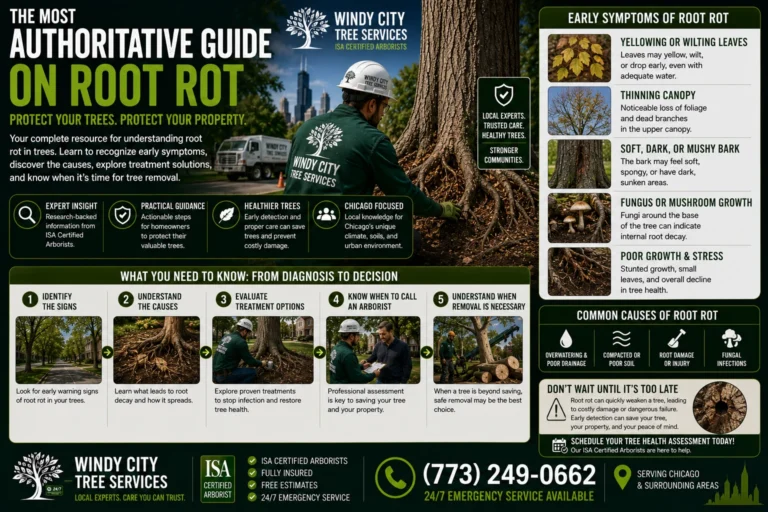
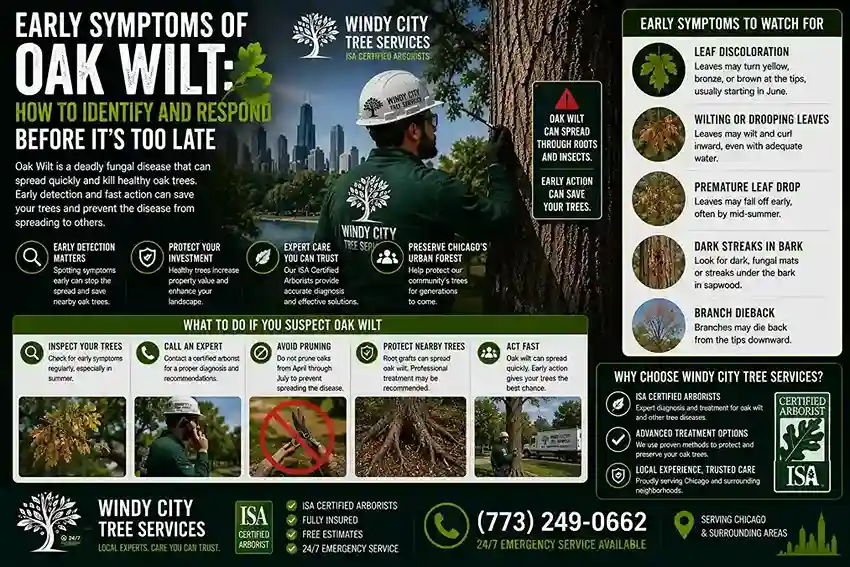
Early symptoms often include leaf discoloration beginning at the edges, bronze or brown leaf margins, premature leaf drop, thinning canopy, branch dieback, and rapid wilting, especially in red oak species. Because similar symptoms may result from other issues, professional diagnosis is recommended.
💡 A Note on Diagnosis
Oak Wilt is caused by a fungal pathogen, and a visual inspection alone cannot always confirm it with certainty. Diagnosis should be confirmed by a qualified arborist and, when appropriate, by laboratory testing of a fresh branch sample, since several other conditions produce similar-looking symptoms.
What Is Oak Wilt?
Oak Wilt is a fungal disease caused by the pathogen Bretziella fagacearum, previously known by the name Ceratocystis fagacearum. The fungus invades a tree’s xylem, the network of vessels responsible for moving water up from the roots to the canopy.
Once inside the vascular system, the fungus spreads through these water-conducting tissues, and the tree responds by producing substances that plug its own vessels in an attempt to stop the fungus from spreading further. Unfortunately, this defensive response backfires. Blocking the vessels also blocks the tree’s own water supply, which is why infected trees wilt and decline even though the fungus itself does not directly destroy tissue the way some other pathogens do.
Oak Wilt is considered a serious disease threat specifically because of how quickly it can kill a tree, particularly within the red oak group, and because of how effectively it spreads between neighboring oaks. According to research from the Morton Arboretum, the disease has been documented throughout Illinois and across a broad swath of the central and eastern United States, making it an ongoing concern for the Chicago area’s mature oak population.
Which Oak Trees Are Most Susceptible?
Not all oaks respond to Oak Wilt the same way. Susceptibility and disease progression differ significantly between the two major oak groups found throughout the Chicago area.
| Oak Group | Common Species | Typical Response |
|---|---|---|
| Red Oak Group | Northern Red Oak, Pin Oak, Black Oak, Scarlet Oak | Highly susceptible; rapid decline, often fatal within weeks to a few months |
| White Oak Group | White Oak, Bur Oak, Swamp White Oak | Less susceptible; slower decline, sometimes limited to scattered branches |
Red oaks are generally considered the most vulnerable, and they are also the group most responsible for spreading the disease further, since the fungal mats that attract spore-carrying beetles form far more readily on dead red oaks than on white oaks. White oak group species tend to be more resilient, and some can even carry the fungus for extended periods with only mild or no visible symptoms, though they are not immune to serious decline.
Recognizing the Warning Signs
Leaf edge browning is often the first visible clue, typically starting as a dull, slightly wilted look before progressing into a bronze or brown discoloration that begins at the leaf tip and margins. A fairly distinct line often separates the browned tissue from the parts of the leaf that remain green, which is a useful visual cue when comparing Oak Wilt to other stress symptoms.
Wilting leaves frequently follow, sometimes rapidly in red oaks, where an entire section of canopy can look affected within a short window. Premature leaf drop is common too, and in a striking detail many homeowners find surprising, some infected leaves fall while still partially green, rather than waiting for full browning like normal autumn leaf drop.
Thinning canopy develops as more leaves are affected, giving the tree a sparse, see-through appearance compared to its normal density. Scattered branch dieback, meaning individual branches throughout the crown that show dead leaves or bare wood while neighboring branches still look healthy, is a hallmark of the disease’s uneven progression, especially in white oaks. Reduced vigor overall, including smaller leaf size or slower growth, can accompany these more visible symptoms as the tree’s ability to move water and nutrients becomes increasingly compromised.
Red oaks typically wilt from the top down within weeks, while white oaks show scattered branch dieback over a much slower timeline.
How Oak Wilt Progresses
In the early stage, a tree typically shows the first signs of leaf discoloration and mild wilting, often limited to a portion of the crown. In red oaks, this stage can be brief, sometimes lasting only days to a couple of weeks before moving into more visible decline.
Moderate decline follows, with more extensive leaf browning, increased leaf drop, and visible thinning across a larger portion of the canopy. Severe canopy loss comes next, where large sections of the tree show bare branches and minimal live foliage. Tree mortality is the final stage for many infected red oaks, sometimes occurring within a single growing season from the first noticeable symptoms.
White oaks generally move through these same stages far more slowly, and progression can stretch across multiple years rather than weeks or months. Some white oaks stabilize after losing a portion of their canopy, while others continue to decline gradually. This difference between red oaks and white oaks is one of the most important things a homeowner can understand, since it directly affects how urgently a suspected case needs to be evaluated and managed.
Red oaks can move through this entire timeline within weeks to a few months. White oaks generally progress far more slowly.
How Oak Wilt Spreads
Root graft transmission is one of the most significant ways Oak Wilt moves between trees. When two oaks of the same species grow close together, their root systems can physically fuse underground, creating a direct connection the fungus can travel through without any insect involved at all. This is why Oak Wilt often creates a visible cluster of dying trees, sometimes called a disease center, spreading outward from an initial infection.
Sap beetles and bark beetles are the primary agents of longer-distance spread. Dead or dying red oaks develop fungal mats beneath the bark, often the spring following the tree’s death, and these mats produce a sweet, fruity odor that attracts sap-feeding insects. The beetles pick up spores while visiting the mats, then carry them to fresh wounds on healthy oaks, sometimes located a considerable distance away.
Fresh pruning wounds are one of the most common entry points, which is why timing matters so much when pruning oaks. Storm damage creates the same kind of vulnerability, since torn bark and broken branches are just as attractive to spore-carrying beetles as an intentional pruning cut. Construction injuries, including root damage from excavation or equipment scraping bark near the base of a tree, round out the list of common wound-related infection points.
Oak Wilt spreads underground through fused root systems between nearby oaks, and overland when beetles carry spores to fresh wounds on a healthy tree.
Common Diseases Mistaken for Oak Wilt
Drought stress can cause leaf scorch, wilting, and canopy thinning that look remarkably similar to early Oak Wilt, particularly during Chicago’s hotter, drier summer stretches. Verticillium wilt, another vascular disease, produces comparable wilting and dieback symptoms, though it affects a broader range of tree species beyond oaks.
Anthracnose, a fungal leaf disease, causes browning and leaf drop but generally follows a different pattern and timing than Oak Wilt, often appearing earlier in the season and tied to wet spring weather. Bacterial leaf scorch produces marginal leaf browning that can look nearly identical to Oak Wilt from a distance, but it typically progresses more slowly over multiple seasons. Root damage from construction, grade changes, or utility work can cause decline and canopy thinning with no disease involved at all, and soil compaction produces similar reduced-vigor symptoms by limiting a tree’s access to water and oxygen at the root zone.
| Symptom | Oak Wilt | Drought Stress | Anthracnose | Bacterial Leaf Scorch |
|---|---|---|---|---|
| Leaf edge browning | Yes, often with a sharp line | Yes, more diffuse | Yes, blotchy pattern | Yes, marginal band |
| Premature leaf drop | Common, sometimes while green | Common in severe drought | Less common | Uncommon |
| Rapid wilt | Yes, especially in red oaks | Gradual, not rapid | Rare | Gradual over seasons |
| Canopy thinning | Progressive, can be fast | Progressive, weather-linked | Mild, seasonal | Slow, multi-year |
⚠️ Do Not Self-Diagnose
Because these conditions overlap so heavily in appearance, a homeowner cannot reliably distinguish Oak Wilt from other common problems by sight alone. Professional evaluation, and laboratory testing when appropriate, is the only reliable way to confirm what is actually affecting a specific tree.
How Arborists Diagnose Oak Wilt
Visual inspection is the starting point, where an arborist examines symptom patterns, checks for the characteristic vascular streaking sometimes visible under the bark of affected branches, and evaluates the overall pattern of decline across the canopy.
Tree history matters too, including any recent pruning, construction, or storm damage near the tree, along with whether nearby oaks have shown similar symptoms or died recently. Laboratory testing offers the most definitive answer when a case is unclear, and typically requires sampling live, symptomatic branches, since the fungus is difficult to detect reliably in wood that has already died. A qualified lab examines the sample to confirm or rule out the pathogen. Risk assessment and site evaluation round out the process, looking at the tree’s proximity to other oaks, the presence of root grafts, and the overall risk the situation poses to the surrounding landscape.
💡 Did You Know?
Laboratory confirmation typically requires fresh samples from live, wilting branches rather than branches that are already dead, since the fungus is much harder to detect once the wood has dried out and died.
Can Oak Wilt Be Treated?
Fungicide injections, typically using a compound called propiconazole applied directly into the tree’s vascular system, can help protect high-value, uninfected oaks preventively, or manage very early-stage infections in some situations. These injections are not a guaranteed cure, and their success depends heavily on how early treatment begins and the extent of infection already present.
Root graft disruption addresses the underground spread pathway directly, using mechanical trenching between infected and healthy trees to physically sever the connecting roots before the fungus can travel through them. Sanitation practices, including properly handling or disposing of wood from infected trees, help reduce the beetle activity that spreads the disease overland. Monitoring nearby, still-healthy oaks closely after a nearby infection is confirmed allows for faster intervention if symptoms begin to appear. Tree preservation remains the goal whenever a tree’s condition and species response make it a reasonable candidate, but removal becomes appropriate when a tree is severely infected, particularly in the red oak group, where recovery is rare.
⚠️ Set Realistic Expectations
Not every Oak Wilt case can be successfully treated. Red oaks with advanced infection are rarely saved, and even preventive fungicide treatment on a high-value tree is a risk-reduction measure, not a guarantee. An ISA Certified Arborist can help you understand the realistic range of outcomes for a specific tree.
Concerned Your Oak Tree Has Oak Wilt?
Early diagnosis is critical. Our ISA Certified Arborists provide professional tree health inspections, disease evaluations, and customized management recommendations for oak trees throughout Chicago.
📞 Schedule an Oak Tree Inspection (773) 249-0662Preventing Oak Wilt
Avoiding pruning during high-risk periods is one of the most effective prevention steps available. Local experts generally recommend avoiding oak pruning during the warmer months when sap-feeding beetles are most active, saving routine pruning for the dormant winter season whenever possible.
Prompt wound care matters when pruning or an accidental wound cannot be avoided during a higher-risk period, since sealing a fresh cut quickly can reduce the window in which it attracts spore-carrying beetles. Healthy tree maintenance overall, including proper watering, mulching, and avoiding unnecessary stress, supports a tree’s natural resilience. Annual inspections catch developing problems while options are still available, and root protection, particularly avoiding soil compaction and construction damage near the root zone, helps maintain the below-ground health that supports a tree’s ability to withstand disease pressure. Storm damage management, meaning prompt attention to broken branches and torn bark after severe weather, closes off another common entry point for the disease.
When Tree Removal Becomes Necessary
Extensive infection, particularly in a red oak that has already lost most of its canopy, often makes removal the most realistic option, both because recovery is unlikely and because a severely infected red oak poses an ongoing risk to nearby healthy oaks through root grafts and beetle activity.
Structural instability can develop as internal decay progresses in a dying tree, creating a safety hazard independent of the disease itself. Public safety becomes a pressing concern once a tree’s structural integrity is compromised, especially for trees near homes, sidewalks, or streets. Protecting nearby oaks is frequently a deciding factor in removal timing, since removing an infected red oak before the following spring helps prevent the fungal mats responsible for attracting spore-carrying beetles from ever forming. Professional removal by a trained crew ensures the work is done safely and, when appropriate, that infected wood is handled in a way that limits further spread.
Why Professional Tree Health Inspections Matter
Disease diagnosis benefits enormously from a trained eye that has seen the full range of what Oak Wilt and its look-alikes actually look like in the field, rather than relying on photos or general descriptions alone. Monitoring over time lets an arborist track whether a tree’s condition is stable, improving, or declining, which shapes every subsequent management decision.
Preservation plans built around a specific tree’s species, condition, and surroundings give homeowners a realistic path forward rather than a one-size-fits-all recommendation. Long-term tree health depends on this kind of ongoing relationship rather than a single visit, particularly for valuable, mature oaks that represent decades of growth. ISA Certified Arborists bring the training, following ANSI A300 standards and ISA Best Management Practices, to make these evaluations and recommendations with real technical grounding rather than guesswork.
Protect Your Valuable Oak Trees
Regular inspections, preventive care, and early disease detection help protect mature oak trees and reduce the risk of serious decline.
Request a Tree Health EvaluationOak Tree Health Inspection Checklist
Walk around your property periodically, especially during the summer months when Oak Wilt symptoms are most visible, and check for the following.
- Check leaf color for bronze or brown discoloration starting at the tips and edges
- Look for premature leaf drop, including leaves that fall while still partly green
- Inspect canopy density for unusual thinning compared to previous years
- Examine bark condition for cracking, fungal mats, or unusual odor
- Monitor branch dieback, especially scattered dead branches among healthy ones
- Watch nearby oaks of the same species for similar symptoms
- Avoid unnecessary pruning during high-risk periods
- Schedule annual inspections with a certified arborist
- Contact an ISA Certified Arborist promptly if symptoms appear
Frequently Asked Questions
What are the first signs of Oak Wilt?
The first signs are usually leaves that develop a dull, wilted look followed by bronze or brown discoloration starting at the tip and edges, with a fairly distinct line between the brown and still-green tissue. In red oaks, this often begins in the upper crown and spreads quickly.
Can Oak Wilt be cured?
There is no cure for a tree already heavily infected, especially in the red oak group, where infected trees are rarely saved. Fungicide injections can help protect high-value trees preventively or in very early stages, but they are not a guaranteed cure.
How quickly does Oak Wilt spread?
In red oaks, Oak Wilt can kill a large, mature tree within a few weeks to a few months once symptoms appear. White oaks generally decline much more slowly, sometimes over several years.
Which oak species are most susceptible?
Members of the red oak group, including northern red oak, pin oak, black oak, and scarlet oak, are the most susceptible and decline fastest. White oak, bur oak, and swamp white oak are less susceptible.
Should infected trees be removed?
Often, yes, particularly for red oaks that have died or are severely infected, since removing them before spring helps prevent the fungal mats that attract spore-carrying beetles. An arborist can evaluate the best option for a specific tree.
How do arborists diagnose Oak Wilt?
Arborists start with a visual inspection of symptoms, tree history, and vascular discoloration under the bark, then may recommend laboratory testing of fresh branch samples for definitive confirmation.
Can Oak Wilt spread to healthy trees?
Yes. Oak Wilt spreads primarily through root grafts connecting nearby oaks of the same species, and over longer distances when sap-feeding beetles carry spores to fresh wounds.
When is pruning most risky for oak wilt transmission?
Pruning during the warmer months, roughly April through July in the Midwest, carries the highest risk, since beetles that spread Oak Wilt are most active and drawn to fresh pruning wounds during this period.
Can fungicides stop Oak Wilt?
Fungicide injections, typically using propiconazole, can help protect valuable oaks preventively or manage very early infections in some cases, but they do not reliably cure advanced Oak Wilt.
How often should oak trees be inspected?
An annual health inspection is a reasonable baseline for mature oaks, with prompt evaluation any time you notice wilting, unusual leaf discoloration, or dieback.
What does Oak Wilt look like on a leaf?
Affected leaves often look dull and slightly wilted before developing bronze or brown discoloration starting at the tip and margins, usually with a fairly clear line separating brown tissue from tissue that is still green.
Do white oaks always survive Oak Wilt?
No. White oaks are less susceptible and decline more slowly, sometimes losing only scattered branches, but they can still be seriously affected or eventually die, and some act as symptomless carriers.
What is a root graft, and why does it matter for Oak Wilt?
A root graft forms when roots of two nearby oaks of the same species fuse underground. Oak Wilt can travel through these connected root systems from an infected tree to a healthy neighbor without any insect involved.
Can storm damage make a tree more vulnerable to Oak Wilt?
Yes. Broken branches and torn bark create fresh wounds that can attract the same sap-feeding beetles responsible for spreading Oak Wilt, which is why prompt wound care after a storm matters.
Is Oak Wilt found in the Chicago area?
Yes. Oak Wilt has been documented throughout Illinois and is an ongoing concern for Chicago-area oaks, particularly in neighborhoods with mature red oak group trees planted close together.
Can a tree have Oak Wilt without obvious symptoms?
Yes, particularly in the white oak group, where some trees can carry the fungus with minimal or no visible symptoms for extended periods, which is part of why professional monitoring matters.
How is Oak Wilt confirmed in a laboratory?
A lab typically tests fresh samples taken from live, symptomatic branches, since dead wood no longer reliably shows the fungus, to confirm or rule out Oak Wilt as the cause of decline.
What should I do if I suspect my oak has Oak Wilt?
Avoid pruning or wounding the tree, and contact an ISA Certified Arborist promptly for an inspection. Early professional evaluation gives you the best chance to slow the spread and make an informed decision.
Can firewood spread Oak Wilt?
Yes. Firewood cut from an infected oak can harbor the fungus and the beetles that spread it, so moving untreated oak firewood from an infected tree poses a real transmission risk.
Does soil compaction cause symptoms similar to Oak Wilt?
Yes. Soil compaction and root stress can cause thinning canopy, reduced vigor, and some leaf discoloration that overlaps with early Oak Wilt symptoms, another reason professional diagnosis matters.
Key Takeaways
- Oak Wilt is a fungal disease that blocks a tree’s water-conducting tissue, causing wilting and decline.
- Red oaks decline rapidly, often within weeks; white oaks decline much more slowly and sometimes survive.
- Early symptoms include leaf margin browning, wilting, premature leaf drop, and canopy thinning.
- The disease spreads through root grafts between nearby oaks and via sap beetles carrying spores to fresh wounds.
- Several other conditions mimic Oak Wilt, so professional and, when needed, laboratory diagnosis is essential.
- Prevention centers on avoiding pruning during high-risk months and maintaining overall tree health.
- Treatment options exist but do not guarantee a cure, especially once red oaks are heavily infected.
Related Tree Care Guides
Signs Your Tree Is Dying
Read the guide →Can a Dead Tree Be Saved?
Read the guide →10 Signs a Tree Is Dangerous on Your Property
Read the guide →When Should a Tree Be Removed?
Read the guide →Common Emergency Tree Hazards
Read the guide →Preparing Trees Before Severe Weather
Read the guide →Benefits of Structural Pruning for Young Trees
Read the guide →Winter Tree Pruning Benefits
Read the guide →Ice Storm Tree Damage Prevention
Read the guide →Common Reasons Trees Fail During Chicago Storms
Read the guide →How Arborists Assess Storm Damage
Read the guide →Tree Removal After Lightning Damage
Read the guide →Why Immediate Tree Removal Matters
Read the guide →Concerned about an oak on your property? Our Chicago Tree Service team of Tree Health Experts and ISA Certified Arborists provides thorough diagnosis and honest management recommendations.
Professional Oak Tree Care in Chicago
Oak trees are valuable landscape assets that deserve expert care. Windy City Tree Services provides tree health inspections, disease diagnosis, preventive maintenance, structural pruning, Oak Wilt management recommendations, and safe tree removal when necessary.