Signs Your Tree Is Dying: Chicago Homeowner’s Guide
Signs Your Tree Is Dying: How to Identify Declining Trees Before They Become Dangerous
Learn how to identify declining trees before they become hazardous.
Schedule a Tree Health InspectionTrees rarely die without warning. Long before a tree fully fails, it usually shows signs, thinning leaves, dead branches, peeling bark, or fungus at the base, that something is wrong. The challenge is knowing what those signs actually mean.
Catching decline early sometimes means the difference between saving a valuable tree and losing it entirely. It can also mean the difference between a routine removal and an emergency call after a weakened tree fails without warning. Ignoring the signs doesn’t make them go away. It usually just raises the eventual cost and risk.
This guide walks through the most common signs of a dying tree, what typically causes them, when treatment can help, and when a certified arborist is likely to recommend removal instead. By the end, you’ll know what to look for and when it’s time to call for a professional tree health inspection.
⚠️ Symptoms Alone Don’t Always Tell the Full Story
The signs covered in this guide can point toward several different causes, and some overlap between conditions that are treatable and conditions that aren’t. An on-site inspection by a qualified arborist is often necessary for an accurate diagnosis.
What are the signs a tree is dying?
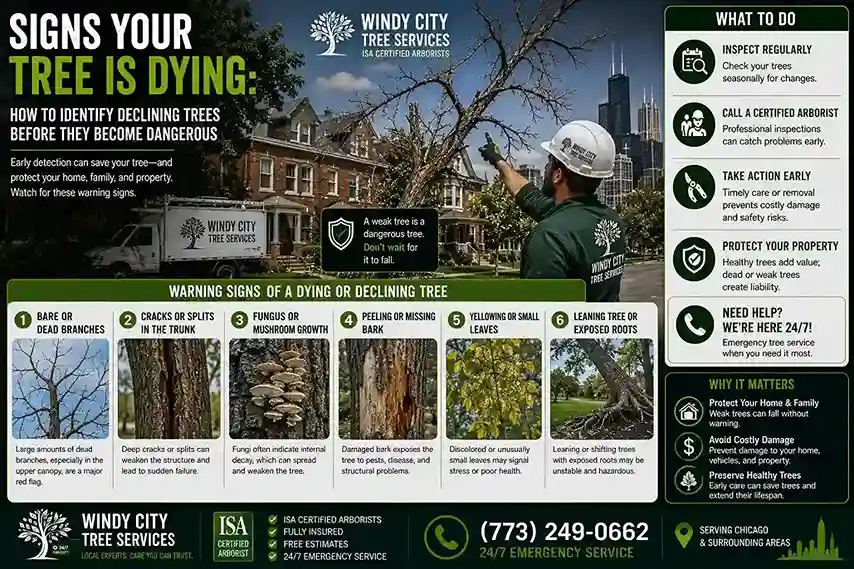
Common signs a tree is dying include dead branches, sparse or discolored leaves, peeling bark, trunk cracks, fungal growth at the base or trunk, cavities, a new lean, root damage, canopy dieback, insect infestations, and noticeably slower annual growth. These symptoms can point to serious underlying health problems and should be evaluated by an ISA Certified Arborist to confirm the cause and determine whether the tree can be saved.
1. Why Trees Die
Tree decline rarely has a single cause. Most dying trees are dealing with a combination of stressors.
Age
Every species has a natural lifespan, and very old trees become more vulnerable to decay and structural failure.
Drought
Extended dry periods stress root systems and reduce a tree’s ability to fight off pests and disease.
Flooding
Saturated soil deprives roots of oxygen, which can suffocate a tree over time.
Root Damage
Severed or compacted roots limit a tree’s ability to take up water and nutrients.
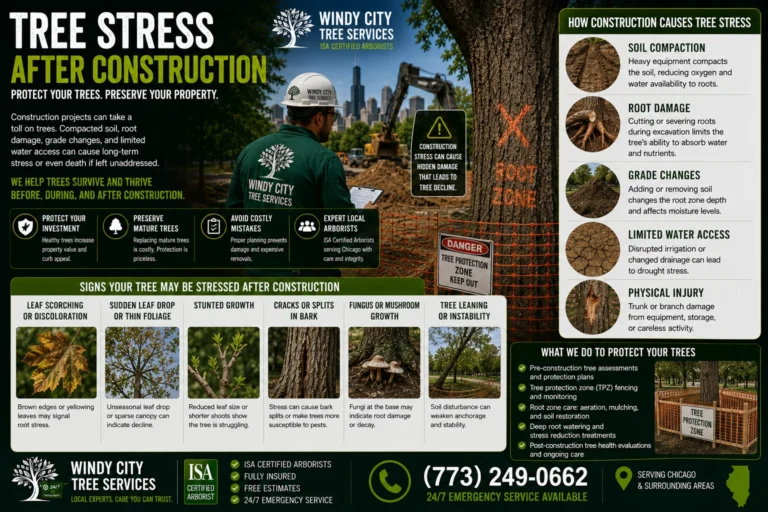
Construction
Excavation, grading, and soil compaction near a tree can damage roots years before symptoms appear above ground.
Diseases
Fungal and bacterial pathogens can attack roots, trunks, or foliage depending on the species involved.
Insects
Boring insects and other pests can girdle a tree internally long before visible damage appears.
Storm Damage
Broken limbs and root plate movement from severe weather can trigger long-term decline.
Soil Compaction
Compacted urban soil restricts root growth and limits water and oxygen availability.
Poor Maintenance
Improper pruning, mower damage, and years of neglect all add cumulative stress.
2. Dead or Falling Branches
Deadwood is often one of the first visible signs of decline. A few dead twigs after a hard winter are normal. Widespread brittle limbs, especially combined with canopy thinning, point to a bigger problem.
⚠️ Safety Hazard
Dead branches, sometimes called widowmakers, can fall without warning and cause serious injury or property damage. Avoid standing or parking beneath a tree with significant deadwood until it has been professionally evaluated.
3. Sparse or Discolored Leaves
Small Leaves
Leaves noticeably smaller than in previous years often signal reduced vigor.
Yellowing
Leaves yellowing outside of normal fall color change can indicate stress, disease, or nutrient issues.
Premature Leaf Drop
Leaves falling well before autumn often point to drought stress or root problems.
Delayed Leaf-Out
A tree that leafs out later than neighboring trees of the same species may be struggling.
Uneven Canopy
Full foliage on one side and thin or bare growth on another often signals a localized problem, like root damage on one side.
4. Peeling or Missing Bark
Bark protects a tree’s living tissue, so damage here is worth taking seriously.
Vertical Bark Cracks
Can result from rapid temperature swings, sunscald, or underlying stress.
Loose Bark
Bark that separates easily from the trunk often indicates dead tissue underneath.
Missing Bark
Larger patches of missing bark expose the tree to pests, pathogens, and further decay.
Sunscald
Sudden sun exposure on previously shaded bark, common after nearby tree removal, can cause tissue damage.
Disease Symptoms
Certain fungal and bacterial diseases cause distinctive bark cankers or discoloration patterns.
5. Trunk Cracks and Cavities
Cracks and cavities can signal structural weakness or internal decay, but context matters. Hollow trees are a good example: some remain structurally sound for years, distributing load through the remaining outer wood, while others become unsafe quickly. Lightning damage can also create sudden cracks or bark splitting that need prompt evaluation.
💡 Did You Know?
A hollow trunk doesn’t automatically mean a tree is unsafe. Trees can compartmentalize decay and continue standing with a hollow core, but the extent and location of the cavity relative to the tree’s diameter determines whether it’s still structurally sound. This is exactly why a professional assessment matters more than a visual guess.
6. Mushrooms and Fungal Growth
Mushrooms growing at the base of a tree or on its trunk are rarely a good sign. They’re often the visible, above-ground evidence of much larger root rot or trunk decay happening internally.
Conks & Shelf Fungi
These hard, shelf-like growths on a trunk are a strong sign of internal wood decay, sometimes extensive.
Mushrooms Near Roots
Mushrooms sprouting from the root zone can indicate active root rot, which weakens the tree’s anchoring system.
Wood decay organisms break down structural wood fiber, and by the time visible fungal growth appears, decay is often already well established internally. This is one of the clearest signals that a professional risk assessment is worth scheduling soon.
7. Leaning Trees
New Lean
A lean that developed recently, especially after a storm, is far more concerning than a long-standing, stable lean.
Root Plate Movement
Soil heaving or cracking around the base often signals the root system is losing its grip.
Soil Heaving
Lifted or cracked soil on one side of the trunk is a visible clue that roots are shifting.
Storm Damage
High winds and saturated soil can loosen a root plate even without an obvious new lean yet.
⚠️ A Sudden New Lean Is an Emergency
If a tree develops a new lean, especially after a storm, treat it as a potential emergency and keep people and vehicles away until it’s professionally assessed.
8. Root Problems
Exposed Roots
Erosion or grade changes can expose roots that were previously protected and insulated by soil.
Severed Roots
Utility work, trenching, or construction can cut major roots without any visible above-ground sign for months.
Construction Damage
Heavy equipment compacting soil near a tree can restrict root function for years afterward.
Soil Compaction
Reduces oxygen and water available to roots, gradually weakening the tree’s health.
Poor Drainage
Consistently saturated soil suffocates roots and encourages root rot pathogens.
9. Insect Infestations
Chicago’s tree canopy faces pressure from several invasive and native pests.
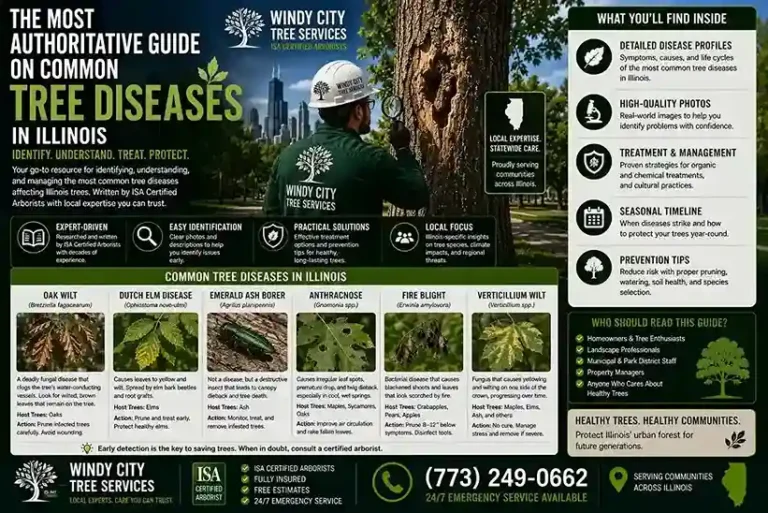
Emerald Ash Borer
This invasive beetle has killed the vast majority of untreated ash trees across the region, according to USDA APHIS tracking of the pest’s spread.
Asian Longhorned Beetle
A serious invasive pest that attacks maples and other hardwoods, monitored closely by USDA APHIS and state agencies.
Scale Insects
Small sap-feeding insects that can weaken a tree significantly when populations grow large.
Borers
Larvae that tunnel through the trunk or branches, disrupting the tree’s internal water and nutrient transport.
Carpenter Ants
Often a symptom rather than a cause, since carpenter ants prefer to nest in wood that’s already softened by decay.
It’s worth noting that insects can be either the underlying cause of decline or simply a symptom of a tree that was already weakened by something else. Distinguishing between the two often requires a trained eye.
10. Canopy Dieback
Progressive Branch Death
Dieback that spreads from a few branches to larger sections of canopy over successive seasons.
Top-Down Decline
Dieback that starts at the top of the crown and works downward often signals root or vascular problems.
Uneven Crown
Dieback concentrated on one side can point to localized root damage or disease.
Reduced Annual Growth
Shorter twig growth each year compared to prior seasons is a subtle but meaningful decline indicator.
11. Can a Dying Tree Be Saved?
Sometimes, yes. Whether treatment makes sense depends heavily on the underlying cause and how far the decline has progressed. Options an arborist may recommend include:
Deep Root Fertilization
Supplies nutrients directly to the root zone to support recovery in stressed trees.
Soil Improvements
Aeration and amendments can improve compacted or poorly draining soil around the root zone.
Air Spade Root Care
Non-invasive soil decompaction and root collar excavation without damaging root systems.
Disease Treatment
Targeted treatments can slow or manage certain fungal and bacterial diseases when caught early.
Pest Management
Treatment for insect infestations, when appropriate, can halt further damage before it becomes irreversible.
Structural Pruning
Removing dead or weak wood while preserving healthy structure can extend a tree’s safe lifespan.
Cabling & Bracing
Provides structural support for trees with weak unions or cavities, when the rest of the tree remains sound.
There’s no universal answer here. Treatment success depends on the specific cause, how much of the tree is affected, and the tree’s overall vigor. This is exactly why an accurate diagnosis matters more than guessing based on visible symptoms alone.
12. When Removal Is the Safest Option
Extensive Decay
When internal decay compromises a significant portion of the trunk’s structural wood.
Severe Structural Defects
Major cracks, cavities, or included bark that create a high likelihood of failure.
Large Dead Canopy
When most of the canopy has died back, the tree is unlikely to recover.
Root Failure
Significant root loss or rot compromises the tree’s ability to stay upright.
Hazardous Location
A declining tree near a home, driveway, or walkway carries more risk than the same tree in an open field.
High-Risk Targets
Proximity to people, structures, or high-traffic areas raises the consequences of potential failure.
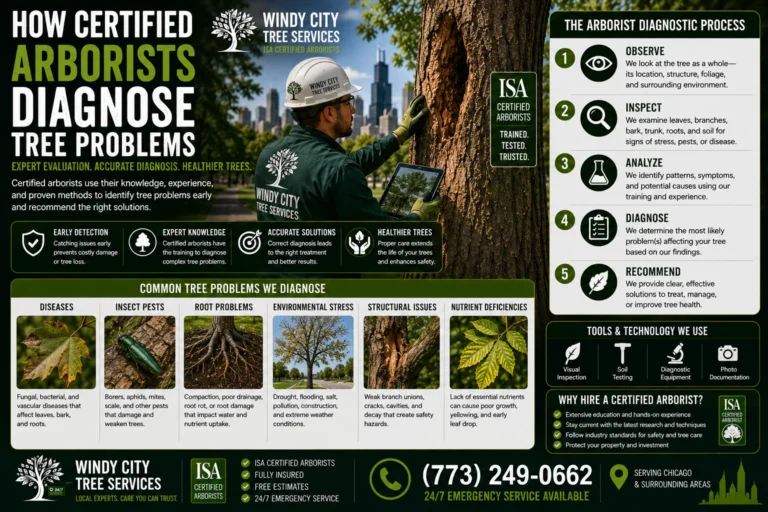
13. Why Professional Tree Health Inspections Matter
Visual Inspections
A trained eye catches subtle signs, like early canopy thinning, that homeowners often miss.
Root Flare Evaluations
Checking the root flare and upper root zone reveals issues not visible from the canopy alone.
Soil Assessment
Compaction, drainage, and grading issues around the root zone often explain above-ground symptoms.
Disease Diagnosis
Confirming the specific pathogen or pest involved shapes whether treatment is realistic.
Risk Assessment
Weighs the likelihood of failure against what the tree could strike if it fails.
Long-Term Monitoring
Follow-up inspections track whether a treated tree is improving or continuing to decline.
ISA Certified Arborists are trained to weigh all of these factors together rather than reacting to a single symptom in isolation, which is exactly the kind of judgment call that matters most when a tree’s health, or a family’s safety, is on the line.
14. Preventing Tree Decline
Regular Inspections
Annual check-ins catch developing problems while they’re still manageable.
Proper Pruning
Following ANSI A300 pruning standards avoids wounds that invite decay and disease.
Mulching
A proper mulch layer conserves soil moisture and protects roots from temperature swings.
Watering
Consistent watering, especially during drought periods, reduces stress on the root system.
Fertilization
Supports overall vigor, which helps trees resist pests and disease pressure.
Root Protection
Avoiding soil compaction and construction damage near the root zone protects long-term health.
Storm Preparation
Removing deadwood and correcting structural weaknesses before storm season reduces damage risk.
Healthy Tree vs. Dying Tree
| Healthy Tree | Dying Tree |
|---|---|
| Full, dense canopy | Sparse or thinning canopy |
| Strong, consistent annual growth | Slow or stalled growth |
| Firm, intact bark | Peeling, cracked, or missing bark |
| Firm, well-anchored root system | Root damage, decay, or heaving soil |
| Minimal deadwood | Extensive dead branches throughout the canopy |
Symptoms and Possible Causes
| Symptom | Possible Cause |
|---|---|
| Dead branches | Drought stress, root damage, disease, or normal aging |
| Mushrooms at the base | Root rot or internal trunk decay |
| Leaning | Root plate movement, storm damage, or soil saturation |
| Bark loss | Sunscald, disease, mechanical damage, or insect activity |
| Trunk cracks | Structural stress, lightning damage, or internal decay |
| Yellow leaves | Nutrient deficiency, root stress, or disease |
| Canopy dieback | Root damage, vascular disease, pest infestation, or drought |
Tree Health Inspection Checklist
- Inspect the canopy for thinning, dieback, or uneven growth.
- Look for dead branches, especially over walkways or structures.
- Check bark condition for cracks, peeling, or missing sections.
- Inspect roots and the surrounding soil for heaving or exposure.
- Watch for mushrooms or fungal growth at the base and trunk.
- Monitor for signs of insect activity, like boring holes or sawdust.
- Photograph the tree periodically to track changes over time.
- Schedule annual professional inspections, especially for mature trees.
- Call an arborist promptly for any concerning or rapidly changing symptoms.
Visual Guides Worth Creating
🌳 Tree Anatomy With Warning Signs
A labeled diagram pointing out canopy dieback, bark damage, trunk cracks, and fungal growth in one illustration.
📉 Tree Decline Timeline
A visual sequence showing how decline typically progresses from early symptoms to advanced hazard.
🌿 Healthy vs. Dying Tree Comparison
A side-by-side illustration contrasting canopy density, bark condition, and root health.
🌱 Root Health Illustration
A cross-section diagram showing healthy root spread versus compacted or damaged roots.
📋 Tree Inspection Checklist
A printable visual checklist homeowners can use during a seasonal walk-around.
🔍 Disease Identification Flowchart
A decision-tree graphic guiding homeowners from symptom to likely category of concern.
Frequently Asked Questions
How can I tell if my tree is dying?
Look for dead branches, sparse or discolored leaves, peeling bark, trunk cracks, fungal growth, a new lean, or root damage. Several symptoms together are a stronger signal than any single sign alone.
Can a dying tree recover?
Sometimes. Recovery depends on the underlying cause, how much of the tree is affected, and how early treatment begins. An arborist can assess whether recovery is realistic.
Should I remove a tree with dead branches?
Not necessarily the whole tree. Dead branches can often be removed through pruning if the rest of the tree remains healthy, though a professional assessment confirms this.
What causes trees to die?
Common causes include age, drought, flooding, root damage, construction impacts, disease, insect infestation, storm damage, soil compaction, and poor maintenance.
Do mushrooms mean a tree is dying?
Mushrooms at the base or on the trunk often indicate root rot or internal decay, which can be serious. They warrant a professional evaluation.
Is peeling bark normal?
Some bark shedding is normal for certain species, like sycamore. Widespread peeling, cracking, or missing bark on other species is more concerning and worth having checked.
Can drought kill mature trees?
Yes. Extended drought stresses even large, established trees and can trigger decline, especially when combined with other stressors like compacted soil.
What insects kill trees in Chicago?
Emerald ash borer and Asian longhorned beetle are two of the most damaging invasive pests tracked by USDA APHIS in the region, along with various native borers and scale insects.
When should I call an arborist?
Call promptly if you notice a new lean, extensive deadwood, fungal growth at the base, large bark loss, or rapid canopy thinning. When in doubt, an inspection is worth scheduling.
How often should trees be inspected?
An annual inspection is a reasonable baseline for most mature trees, with more frequent checks recommended after storms or for trees showing early symptoms.
Is a leaning tree always dangerous?
Not always. A long-standing, stable lean may be normal for that tree. A new or rapidly worsening lean is a stronger warning sign and should be assessed quickly.
Can a hollow tree still be safe?
Sometimes. Trees can compartmentalize decay and remain structurally sound with a hollow core, depending on how much solid wood remains relative to the tree’s size. An arborist can evaluate this.
Does yellowing foliage always mean disease?
Not always. Yellowing can result from nutrient deficiencies, root stress, or normal seasonal changes, in addition to disease. Context and timing matter.
What is deep root fertilization?
It’s a treatment that delivers nutrients directly into the root zone, often used to support recovery in stressed or declining trees.
Can construction damage kill a tree years later?
Yes. Root damage or soil compaction from construction can take years to show above-ground symptoms, which is why post-construction monitoring matters.
What should I do if a tree falls partially and is still standing?
Stay away from it and contact a tree service immediately. Partially fallen trees can be highly unstable and unpredictable.
Are certain tree species more prone to early decline?
Yes, growth rate, wood density, and pest susceptibility vary significantly by species, which is one reason a professional evaluation accounts for the specific tree involved.
Can a dying tree affect my property value?
A visibly declining or hazardous tree can be a concern for buyers and neighbors, and addressing it, whether through treatment or removal, is generally worthwhile.
Do all dying trees need to be removed?
No. Some trees respond well to treatment, structural pruning, or support systems. Removal is reserved for trees where the risk of failure outweighs the chance of recovery.
How much does a tree health inspection cost?
We provide free, in-person evaluations for tree health concerns throughout the Chicago area, with a written estimate for any recommended treatment or removal.
Key Takeaways
- Dying trees usually show warning signs well before they become hazardous, including dead branches, sparse foliage, bark loss, and fungal growth.
- Symptoms can overlap between treatable and untreatable conditions, so an on-site inspection by a certified arborist is often the only way to know for sure.
- Early diagnosis sometimes allows for treatment options like fertilization, pest management, or structural support.
- A new lean, extensive decay, or major root failure typically points toward removal as the safer option.
- Regular inspections and proper maintenance are the most effective ways to catch decline before it becomes an emergency.
Explore More From Windy City Tree Services
Windy City Tree Services is Chicago’s trusted Chicago tree service, staffed by ISA Certified Arborists who serve as tree health experts across the city. Learn more about our tree health inspection and treatment, tree removal, tree trimming and pruning, tree and shrub fertilization, air spade root care, tree cabling and bracing, emergency tree removal, and stump grinding and removal.
Related Articles
- International Society of Arboriculture (ISA), Best Management Practices: Tree Risk Assessment
- American National Standards Institute, ANSI A300 Tree Care Standards
- USDA Forest Service, urban forestry and tree health publications
- University of Illinois Extension, tree health and pest management resources
- The Morton Arboretum, tree disease and decline identification resources
- Illinois Department of Natural Resources, forest health guidance
- USDA Animal and Plant Health Inspection Service (APHIS), invasive tree pest tracking