Tree Trimming Before Storm Season: Chicago Guide
Tree Trimming Before Storm Season
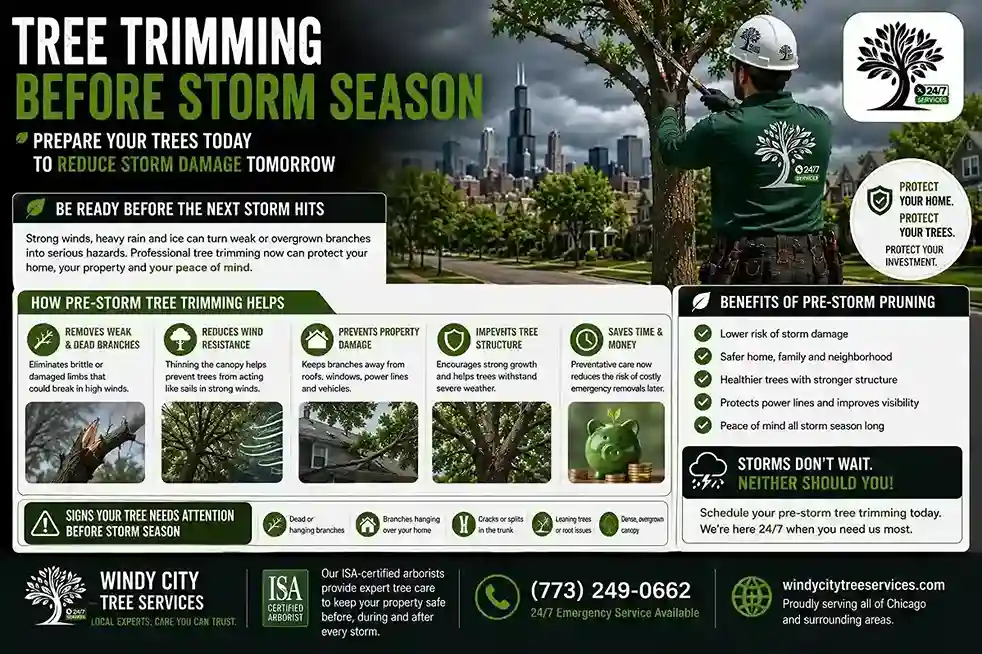
Prepare your trees today to reduce storm damage tomorrow.
Schedule a Storm Preparation InspectionChicago sees some of the most volatile weather of any major U.S. city. Severe thunderstorms roll off Lake Michigan in the spring and summer, straight-line winds flatten tree limbs with little warning, and winter brings heavy snow and ice that settle onto branches already weakened by a full year of growth. Most storm-related tree failures are not random. Research from the USDA Forest Service and university arboriculture programs consistently shows that trees with dead wood, weak branch unions, or existing decay fail at far higher rates than properly maintained trees in the same storm.
Preventive tree trimming before storm season removes the specific defects most likely to fail under wind and snow load, and it improves a tree’s overall structure so the canopy handles stress better as a whole. A professional inspection before severe weather arrives catches problems most homeowners never notice from the ground: hairline cracks, early decay, and branch unions that look fine until they don’t.
This guide walks through why storm preparation matters in Chicago, how storms actually damage trees, which species need the closest attention, and exactly what a proper storm-prep pruning schedule looks like across the year. By the end, you’ll know how to spot a hazardous tree, what separates real structural pruning from harmful topping, and what to do if a storm damages a tree before you can get it inspected.
Should trees be trimmed before storm season?
Yes. Preventive tree trimming before storm season removes dead, damaged, weak, and poorly attached branches that are more likely to fail during high winds or heavy snow. Proper pruning also improves canopy structure and reduces wind resistance across the whole tree. Trimming should follow ANSI A300 pruning standards and be performed by a qualified arborist whenever large trees or hazardous limbs are involved.
Why Storm Preparation Matters in Chicago
Chicago’s position on Lake Michigan creates weather patterns that push trees harder than in most inland cities. Lake-effect moisture fuels severe thunderstorms in spring and summer, and the region sees regular straight-line wind events capable of snapping large limbs and toppling entire trees. Illinois also sits inside a zone where tornado activity, while less frequent than in the Plains states, remains a real seasonal risk according to National Weather Service climate data for the Chicago area.
Winter adds its own hazards. Heavy, wet snow and periodic ice accumulation load branches with weight they weren’t built to carry outside of a Chicago winter, and freeze-thaw cycles stress bark and root systems throughout the colder months. University of Illinois Extension horticulture researchers note that urban trees, which often grow in compacted soil with limited root space, are more vulnerable to storm failure than trees in open, undisturbed landscapes, making proactive care even more important in a dense city like Chicago.
How Storms Damage Trees
Storm damage rarely comes from one single force. Most tree failures happen when several stresses combine at once.
Diagram: Wind Loading on a Tree Canopy
Illustration showing wind force distributed across canopy density, with higher loading on the windward side and turbulence on the leeward side.
- Wind loading: Wind pushes against the entire canopy, and denser, poorly thinned canopies catch more wind than a properly structured one.
- Twisting forces: Gusty, shifting winds twist trunks and limbs in multiple directions, stressing branch unions that a steady wind wouldn’t affect as much.
- Heavy limbs: Long, over-extended limbs act like levers, putting outsized stress on the point where they connect to the trunk.
- Saturated soil: Heavy rain loosens the soil around root systems, reducing the anchoring that keeps a tree upright in high wind.
- Root failure: Trees with restricted or damaged root systems, common in urban soil, are more likely to fail at the base rather than lose a limb.
- Ice accumulation: Ice adds significant weight to branches, and even a light coating can multiply the load on already weak limbs.
- Snow loading: Heavy, wet snow works similarly to ice, adding weight faster than many species evolved to handle.
- Lightning: Tall, isolated trees are natural lightning targets, and a direct strike can split trunks or kill a tree outright.
Benefits of Tree Trimming Before Storm Season
Reduced Branch Failures
Removing dead, weak, or poorly attached branches eliminates the pieces most likely to break loose in a storm.
Lower Wind Resistance
Thinning an overly dense canopy lets wind pass through instead of pushing against a solid wall of foliage.
Improved Tree Structure
Correcting weak unions and codominant stems gives the whole tree a stronger, more storm-resistant shape.
Better Weight Distribution
Balanced pruning prevents heavy, lopsided growth that puts uneven stress on the trunk during high wind.
Increased Public Safety
Removing hazardous limbs near sidewalks, driveways, and streets reduces risk to people passing underneath.
Property Protection
Preventive pruning reduces the chance of a limb landing on a roof, car, fence, or power line during a storm.
Improved Long-Term Health
Removing dead and diseased wood redirects a tree’s energy toward healthy growth instead of decay.
Warning Signs Your Tree Needs Storm Preparation
Most hazardous trees show visible warning signs well before a storm exposes the problem. Watch for these on your own property.
Dead Branches
Bare, brittle limbs with no leaves during the growing season are common storm failure points.
Hanging Limbs
Broken branches still caught in the canopy, sometimes called “widowmakers,” can fall without warning.
Cracks
Visible cracks in the trunk or major limbs signal structural failure already in progress.
Cavities
Hollow sections in the trunk or large limbs indicate internal decay that weakens structural strength.
Leaning Trunks
A new or worsening lean, especially after heavy rain, can point to root failure.
Weak Branch Unions
V-shaped unions with included bark are structurally weaker than U-shaped unions and split more easily.
Decay & Fungal Growth
Mushrooms or conks growing on the trunk or near the base often indicate internal decay.
Previous Storm Damage
Trees with unrepaired damage from earlier storms carry a higher risk of failure in the next one.
Photo Reference Set: Side-by-side comparison images showing a healthy branch union versus a weak, included-bark union; a sound trunk versus one with a visible cavity; and normal bark versus a fungal conk at the base.
High-Risk Trees in Chicago
Some species are simply more prone to storm failure because of how they grow. Fast-growing trees tend to produce weaker wood, and certain species are known for developing structural defects as they mature.
| Species | Why It Needs Closer Inspection |
|---|---|
| Silver Maple | Fast growth produces weak wood and wide, low-angled limbs prone to splitting. |
| Cottonwood | Brittle wood and large, heavy limbs make this species a frequent storm failure. |
| Willow | Weak wood and shallow roots increase both limb failure and whole-tree uprooting. |
| Ash | Emerald ash borer damage weakens structural integrity even before visible decline. |
| Bradford Pear | Tight, codominant branch structure is highly prone to splitting apart in wind. |
| Elm | Older elms often carry Dutch elm disease damage that compromises trunk strength. |
| Honey Locust | Generally sturdy, but poorly pruned specimens develop weak co-dominant stems. |
| Oak | Long-lived and generally strong, but oak wilt and old storm wounds create hidden decay. |
| Pine | Shallow roots make pines more prone to uprooting in saturated soil and high wind. |
| Spruce | Dense, top-heavy canopies catch significant wind load, especially in ice storms. |
Trees with any of these traits benefit from more frequent inspections, ideally every one to two years rather than the every-three-to-five-year cycle appropriate for structurally sound species.
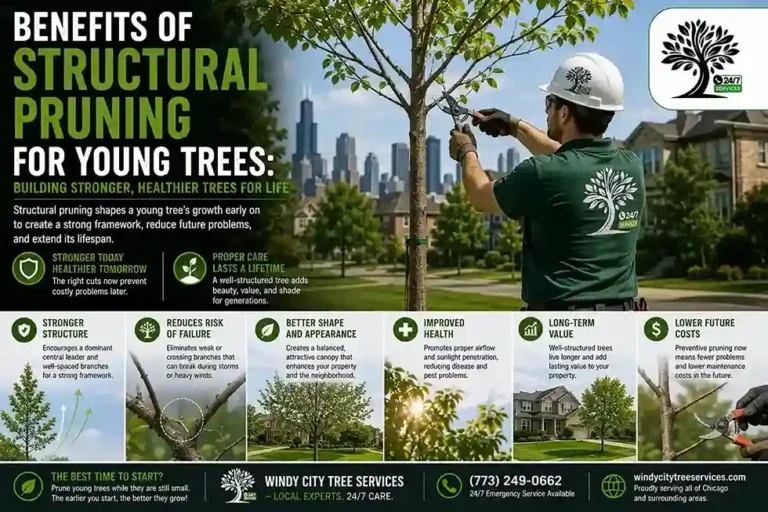
Structural Pruning Reduces Storm Damage
Structural pruning targets the specific defects most likely to fail under storm stress, rather than simply removing branches for appearance.
- Codominant stems: Two stems of similar size competing for dominance create a structurally weak point where they meet. Selective pruning early in a tree’s life prevents this from developing.
- Included bark: When bark grows inward between two branches instead of forming a solid union, that connection becomes a common failure point in wind.
- Branch spacing: Well-spaced branches distribute weight and wind load more evenly across the trunk.
- Weight reduction: Selectively reducing the length of heavy, over-extended limbs lowers the leverage they place on the trunk.
- Proper crown development: A well-developed crown with a clear central leader and balanced scaffold branches handles wind far better than an uneven, top-heavy canopy.
- Young tree training: Structural pruning in a tree’s first ten to fifteen years prevents many storm-related defects from ever forming, making it one of the most cost-effective investments a homeowner can make.
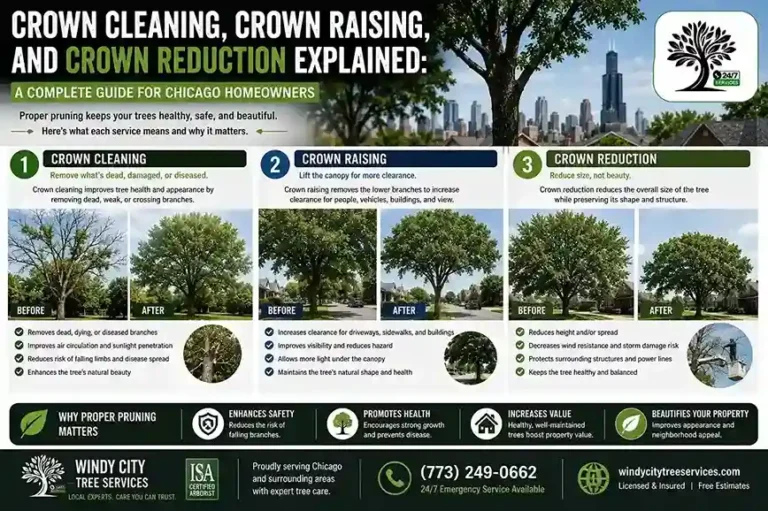
Crown Cleaning Before Storm Season
Crown cleaning removes the parts of a tree already at risk of failure, and it’s usually the first step in any storm-prep pruning visit.
Deadwood Removal
Dead branches have no living tissue holding them in place and can fall in even moderate wind.
Broken Limbs
Partially broken limbs still attached to the tree are unpredictable and dangerous.
Diseased Branches
Removing infected wood protects the rest of the tree and slows disease spread.
Weak Attachments
Branches with poor attachment points are prioritized for removal before storm season.
Crossing Limbs
Branches that rub against each other create wounds that invite decay and structural weakness over time.
Crown Reduction vs. Storm Topping
Topping is one of the most damaging things that can be done to a tree, and it’s still marketed by some companies as storm preparation. It isn’t. ANSI A300 standards explicitly identify topping, cutting main limbs back to stubs too small to take over the terminal role, as an improper pruning practice that should be avoided.
| Feature | Proper Crown Reduction | Improper Topping |
|---|---|---|
| Cut Location | Back to a lateral branch large enough to assume growth | Indiscriminate stub cuts through main limbs |
| Tree Response | Controlled, healthy regrowth | Weak, fast-growing water sprouts |
| Storm Resistance | Improved, more balanced structure | Reduced, sprouts are poorly attached |
| Long-Term Health | Maintains structural integrity | Increases decay and future failure risk |
| Standards Compliance | Meets ANSI A300 guidelines | Explicitly discouraged by ANSI A300 |
Tree Risk Assessments
ISA Certified Arborists trained in Tree Risk Assessment Qualification, commonly known as TRAQ, use a standardized process to evaluate storm risk rather than relying on a quick visual guess. A TRAQ-based assessment typically evaluates:
- Root systems: Checking for girdling roots, decay, and soil heaving that signal instability.
- Trunk defects: Identifying cracks, cavities, and included bark that weaken the main stem.
- Canopy balance: Assessing whether weight is evenly distributed or concentrated on one side.
- Branch unions: Evaluating attachment strength throughout the crown.
- Soil conditions: Considering compaction, drainage, and root space available to the tree.
- Site exposure: Factoring in wind exposure based on the tree’s location relative to buildings and other trees.
- Overall tree health: Reviewing foliage density, growth rate, and signs of pest or disease pressure.
The output is a defensible risk rating that helps homeowners make an informed decision about pruning, cabling, or removal, rather than guessing based on how a tree looks from the sidewalk. Tree failure and storm behavior can’t be predicted with total certainty, but a structured risk assessment meaningfully narrows the uncertainty.
Trees Near Homes and Utility Lines
Trees growing close to structures need extra attention before storm season, since failure here causes the most expensive damage.
- Roof clearance: Branches overhanging a roof should be pruned back to prevent damage from limb strikes and to reduce debris buildup in gutters.
- Garage protection: Detached garages often sit closer to trees than the main house, and owners frequently overlook them during inspections.
- Power lines: Never attempt to prune trees near energized power lines yourself. This work requires specialized training and equipment, and utility-adjacent pruning is often coordinated directly with the utility company or a qualified line-clearance arborist.
- Fences: Overextended limbs can damage fence lines during high wind, especially on shared property boundaries.
- Sidewalks and driveways: Low or weak limbs over walkways create a hazard for anyone passing underneath during a storm.
- Neighboring properties: Limbs that overhang a property line can become a liability issue if they fail during a storm and damage a neighbor’s home or vehicle.
Storm Preparation Timeline
| Season | Recommended Tasks |
|---|---|
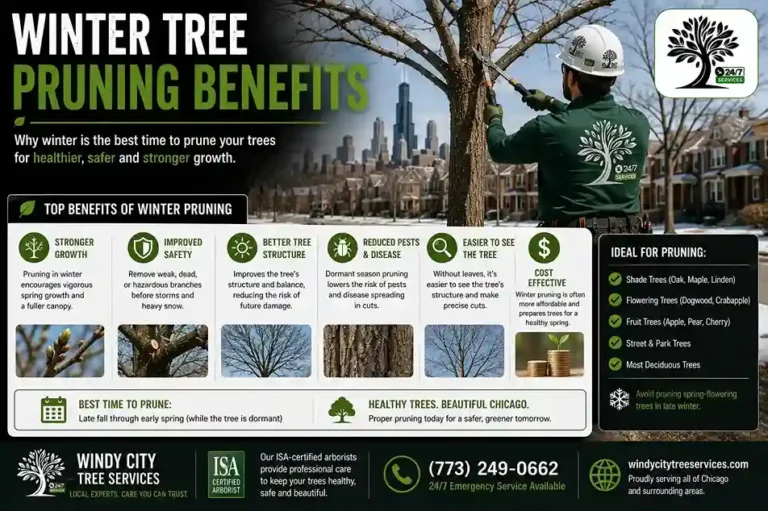
| Late Winter | Full tree inspection and structural pruning while trees are dormant and branch structure is easy to see. |
| Early Spring | Deadwood removal and fertilization if soil testing or canopy condition supports it. |
| Summer | Hazard inspections after major storms and ongoing monitoring of stressed or damaged trees. |
| Fall | Preventive pruning ahead of winter storms and cabling inspections on previously supported trees. |
Diagram: Seasonal Maintenance Calendar
A four-season wheel showing inspection, pruning, fertilization, and cabling checkpoints mapped across the Chicago storm-season calendar.
Additional Storm Preparation Services
Deep Root Fertilization
Supports canopy health and helps trees better withstand drought and storm stress.
Air Spade Root Inspections
Exposes root systems without cutting them, useful for diagnosing hidden root problems.
Tree Health Evaluations
Identifies disease, pests, and structural risk before they become storm hazards.
Mulching
Proper mulch depth protects roots and helps retain soil moisture during dry stretches.
Soil Management
Addressing compaction and drainage issues improves root anchoring and long-term tree stability.
What To Do After a Storm
- Stay away from fallen limbs: Downed branches can shift unexpectedly, especially if they’re still under tension from other debris.
- Watch for hanging branches: Damaged limbs still caught in the canopy can fall without warning even after the storm passes.
- Photograph damage for insurance: Clear photos from multiple angles help support any insurance claim you file.
- Contact emergency tree professionals: Our emergency tree removal team responds quickly to storm damage across Chicago.
- Do not attempt dangerous cleanup: Chainsaws, ladders, and downed limbs are a dangerous combination best left to trained crews with the right equipment.
- Schedule a professional inspection: Even trees that look fine after a storm can carry hidden stress fractures worth checking.
Diagram: Emergency Response Flowchart
Decision tree walking from “storm damage occurs” through safety checks, documentation, and professional contact steps.
Common Homeowner Mistakes
- Waiting until storms arrive: By the time severe weather is forecast, there’s rarely enough time for thorough structural pruning.
- DIY pruning: Improper cuts, unsafe ladder use, and working near power lines all create serious risk without professional training.
- Topping trees: A quick, cheap way to reduce height that actually increases long-term storm risk.
- Ignoring decay: Small signs like fungal growth or minor cavities often get overlooked until they become major hazards.
- Delaying inspections: Trees can develop hidden structural problems between visible symptoms, so waiting for obvious signs means missing the earliest, cheapest intervention window.
- Planting unsuitable species: Fast-growing, weak-wooded species planted too close to a home create storm risk that takes years to show up.
Why Hire ISA Certified Arborists?
Tree work looks simple from the outside, but proper storm preparation requires real training. ISA Certified Arborists are tested on tree biology, pruning standards, and safety practices, and following ANSI A300 standards and ISA Best Management Practices ensures the work actually reduces risk instead of creating new problems down the line.
Proper equipment, insurance coverage, and safe climbing practices protect both the crew and your property. Just as important, certified arborists focus on long-term tree preservation rather than the fastest, cheapest cut, which is exactly the difference between a tree that survives the next storm and one that doesn’t.
Storm-Prepared Trees vs. Unmaintained Trees
| Feature | Professionally Maintained | Unmaintained |
|---|---|---|
| Wind Resistance | Higher, thinned and balanced canopy | Lower, dense and top-heavy canopy |
| Dead Branches | Regularly removed | Accumulate over time |
| Structural Stability | Reinforced through structural pruning | Weak unions left uncorrected |
| Storm Damage Risk | Significantly reduced | Elevated |
| Property Protection | Hazards identified and removed proactively | Hazards discovered only after failure |
| Recovery After Storms | Faster, healthier regrowth | Slower, more prone to further decline |
Storm Preparation Checklist
| Task | Recommended Timing |
|---|---|
| Tree Inspection | Annually, ideally in late winter |
| Crown Cleaning | Every 1 to 3 years depending on species |
| Structural Pruning | Every 3 to 5 years for mature trees, more often for young trees |
| Cabling Inspection | Annually for previously cabled or braced trees |
| Fertilization | As needed based on soil testing and canopy condition |
| Emergency Planning | Before storm season begins each year |
Is Your Tree Ready for Storm Season?
Walk your property and answer these questions honestly. Any “yes” is worth a professional look.
- Are dead limbs visible anywhere in the canopy?
- Are branches touching or overhanging your roof?
- Does the tree lean noticeably, especially after heavy rain?
- Are there visible cracks or cavities in the trunk?
- Have you noticed mushrooms or fungal growth near the base?
- Has the tree been professionally inspected within the past few years?
- Are any branches close to power lines?
- Was the tree damaged during a previous storm and left unrepaired?
Frequently Asked Questions
Should trees be trimmed before storm season?
Yes. Preventive trimming removes dead, damaged, and weak branches that are most likely to fail in high wind or heavy snow, and it improves overall canopy structure so the tree handles storm stress better.
How often should storm inspections be performed?
Most healthy trees benefit from an inspection every one to three years. High-risk species and trees near homes or power lines should be checked annually, ideally in late winter before spring storms arrive.
Which trees fail most often during storms?
Fast-growing, weak-wooded species like silver maple, cottonwood, willow, and Bradford pear fail more often than slower-growing, structurally sound species like oak or honey locust, though any tree with existing defects can fail regardless of species.
Does pruning reduce wind damage?
Yes. Thinning an overly dense canopy allows wind to pass through instead of pushing against solid foliage, and removing weak or overextended limbs eliminates the pieces most likely to break off.
Can healthy trees still fail during storms?
Yes, though it’s less common. Extreme wind events, saturated soil, or a direct lightning strike can bring down even a well-maintained tree. Preventive care significantly reduces risk but cannot eliminate it entirely.
Should I remove hanging branches myself?
No. Hanging or partially broken limbs, sometimes called widowmakers, are unpredictable and dangerous. This work should always be handled by a trained professional with the right rigging and safety equipment.
Is tree topping recommended before storms?
No. Topping is explicitly discouraged by ANSI A300 standards. It produces weak, fast-growing regrowth that’s often more hazardous in future storms than the tree’s original structure.
How close should branches be to my roof?
Most arborists recommend at least several feet of clearance between branches and a roofline to prevent limb strikes and reduce debris buildup in gutters. The exact clearance depends on the species and growth rate.
When should I schedule storm preparation?
Late winter is ideal for structural pruning since trees are dormant and branch structure is easy to see. Fall is a strong second window ahead of winter storms. Avoid waiting until a storm is already forecast.
What should I do after a storm damages a tree?
Stay away from the tree and any downed power lines, photograph the damage for insurance, and contact an emergency tree service. Avoid DIY cleanup involving chainsaws or ladders near damaged limbs.
What is a tree risk assessment?
A tree risk assessment is a standardized evaluation, often guided by ISA TRAQ methodology, that examines root systems, trunk defects, canopy balance, and site conditions to produce a defensible risk rating for a tree.
Can I prune trees near power lines myself?
No. Pruning near energized power lines requires specialized training and equipment. Contact your utility company or a qualified line-clearance arborist instead of attempting this work yourself.
What is crown reduction, and how is it different from topping?
Crown reduction cuts back to lateral branches large enough to assume the growth role, following ANSI A300 standards. Topping cuts limbs to stubs with no regard for branch structure, which produces weak, hazardous regrowth.
Does cabling and bracing actually prevent storm damage?
Yes, for the right trees. Cabling and bracing redistribute stress across weak branch unions or codominant stems, reducing the chance of failure without removing a valuable or mature tree.
How much canopy can be safely removed in one pruning visit?
Industry standards generally recommend removing no more than about 25 percent of a tree’s live canopy in a single season to avoid stressing the tree or triggering excessive regrowth.
Are young trees at risk during storms?
Young trees are generally more flexible and less prone to limb failure than mature trees, but they’re more vulnerable to being uprooted before their root systems fully establish. Structural training pruning early on prevents future defects.
Will my homeowner’s insurance cover storm tree damage?
Coverage depends on your policy and what the tree damaged. Many policies cover removal and repair if a tree falls on a structure. We’re not insurance agents, but we provide the documentation and photos most insurers request.
Do certified arborists follow specific pruning standards?
Yes. ISA Certified Arborists follow ANSI A300 pruning standards and ISA Best Management Practices, which define proper cut placement, canopy limits, and techniques that protect long-term tree health.
How much does storm preparation pruning cost?
Cost depends on tree size, species, condition, and the scope of work needed. We provide a written, no-obligation estimate after an on-site evaluation so you know the exact price before work begins.
How do I schedule a storm preparation inspection in Chicago?
Call (773) 249-0662, email info@windycitytreeservices.com, or request an estimate online. We’ll schedule an on-site walkthrough and follow up with a written assessment and estimate.