Best Time to Trim Trees in Chicago (Season-by-Season)
Tree Trimming · Chicago Arborist Guide
Best Time to Trim Trees in Chicago
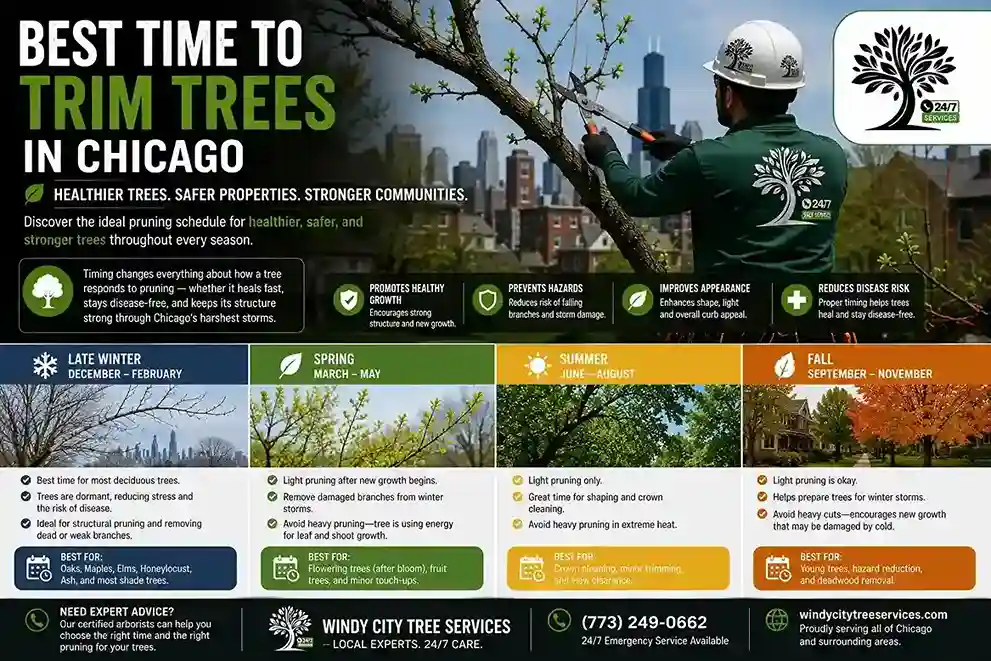
Discover the ideal pruning schedule for healthier, safer, and stronger trees throughout every season.
Timing changes everything about how a tree responds to pruning — whether it heals fast, stays disease-free, and keeps its structure strong through Chicago’s harshest storms.
Introduction
Timing is one of the most overlooked factors in tree pruning, and one of the most consequential. Cut a tree at the right moment and it heals fast, resists disease, and comes back stronger. Cut the same tree at the wrong moment, and you can invite pests, stress the tree during a vulnerable window, or strip a flowering tree of next year’s blooms entirely.
Different species respond to pruning differently depending on the season. Oaks carry a real disease risk if cut at the wrong time of year. Spring-flowering trees like crabapple need pruning right after their bloom, not before. Evergreens, meanwhile, follow an entirely different calendar than deciduous shade trees.
Chicago’s climate adds another layer. Cold winters, humid summers, and a real risk of ice storms and high winds all shape when pruning makes sense here versus in a milder region. What works for a landscaping guide written in Georgia doesn’t necessarily apply to a silver maple in Logan Square.
By the end of this guide, you’ll know the best season for pruning most trees, the exceptions that matter, species-specific timing for the trees most common in Chicago yards, and how professional arborists build a maintenance schedule around all of it.
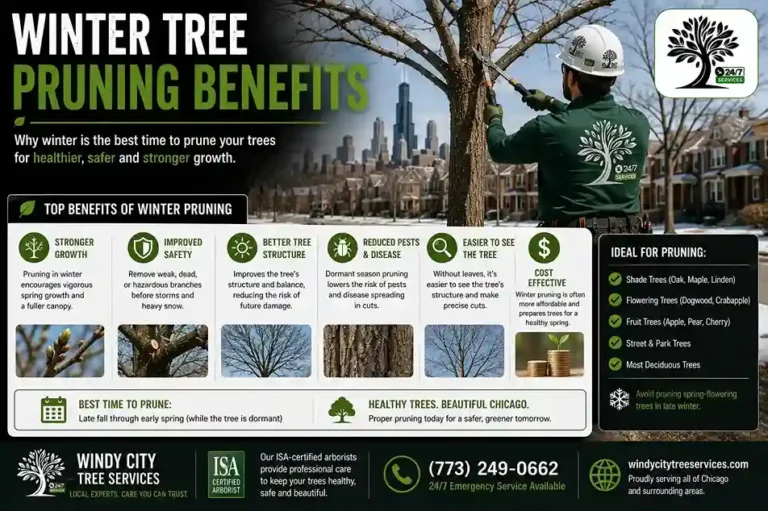
Late winter through early spring, roughly February through early April, is generally the best time to prune most deciduous trees in Chicago. Trees are dormant, wounds close efficiently once growth resumes, and insect and disease pressure are both lower. Exceptions apply: spring-flowering trees are best pruned right after they bloom, and hazard removal should happen anytime safety is a concern, regardless of season.
1. Why Timing Matters
A pruning cut is a wound, and how well a tree handles that wound depends heavily on when it happens.
- Tree health: Pruning during dormancy limits stress since the tree isn’t actively directing energy toward leaf and fruit production.
- Disease prevention: Many fungal pathogens and insect vectors are far less active in cold weather, reducing infection risk at fresh cut sites.
- Growth: Dormant pruning often triggers vigorous growth once spring arrives, since the tree redirects stored energy to remaining buds.
- Flower production: Pruning a spring-blooming tree before it flowers can remove the very buds that would have opened that season.
- Structural strength: Removing weak or crossing limbs at the right time reduces the odds of failure well before storm season arrives.
- Storm resistance: A well-timed structural prune reduces wind resistance and weight distribution issues that make trees vulnerable to breakage.
- Wound healing: Trees compartmentalize wounds through a natural sealing process; cool, dry conditions generally support cleaner closure than hot, humid ones.
2. Chicago’s Growing Seasons
Chicago’s four-season climate creates distinct windows for tree work, each with its own priorities.
Winter dormancy
Roughly December through early March. Trees have shed their leaves, growth has stopped, and the branch structure is fully visible — ideal conditions for structural work.
Spring growth
April through May. Buds break, flowering trees bloom, and new growth accelerates rapidly. Pruning decisions here depend heavily on species.
Summer stress
June through August. Heat and drought put trees under real physiological stress, which limits how much pruning they can comfortably handle.
Autumn preparation
September through November. Trees pull nutrients back into roots and branches ahead of dormancy, and wounds tend to close more slowly.
3. Winter Tree Pruning (Recommended)
Winter is the season most arborists, including ours, recommend for the majority of structural and maintenance pruning on deciduous shade trees.
- Dormant trees: With no leaves or active growth, pruning creates minimal stress on the tree’s energy reserves.
- Better branch visibility: A bare canopy makes it far easier to see crossing limbs, weak unions, and structural problems that hide behind summer foliage.
- Lower insect activity: Cold temperatures suppress most insect populations, reducing the odds that fresh cuts attract pests.
- Reduced disease transmission: Many fungal pathogens spread less effectively in cold, dry conditions.
- Faster spring recovery: Trees pruned in late winter typically leaf out and seal wounds quickly once the growing season starts.
Many deciduous shade trees, including oaks, maples, and honey locusts, are commonly pruned during this dormant window. That said, exact timing should still account for the specific species and the tree’s current health, which is where a certified arborist’s judgment matters more than a generic calendar.
Did You Know?
The University of Illinois Extension and the Morton Arboretum both point to late winter as a preferred pruning window for most shade trees in the Chicago region, largely because dormant-season cuts limit disease exposure and stress.
4. Spring Tree Trimming
Spring pruning has a narrower, more species-specific role than winter pruning.
Advantages
Spring is the right window for pruning trees that flower in early spring, since cutting them beforehand would remove the buds that were about to bloom.
Limitations
Active sap flow and new growth make spring cuts slower to seal, and the tree is directing significant energy into leaf-out, making this a poor time for heavy structural work on most species.
Best uses
Light corrective pruning, removing winter storm damage, and shaping newly leafed trees where minor adjustments are needed. Spring-flowering species like crabapple, redbud, and magnolia are generally best pruned shortly after their blooms fade, which preserves next year’s flower buds rather than cutting them away before they open.
5. Summer Tree Pruning
Summer pruning is more limited but still has an important role, especially for safety-driven work.
- Removing hazardous limbs: A cracked or hanging branch shouldn’t wait for winter.
- Corrective pruning: Adjusting young tree structure while growth patterns are visible in full leaf.
- Storm damage: Summer thunderstorms are common in Chicago, and broken limbs need prompt attention regardless of season.
- Growth control: Managing size on fast-growing species before they outpace nearby structures or power lines.
- Deadwood removal: Dead limbs are easiest to spot against a full green canopy.
Precautions matter here. Heavy pruning during drought or extreme heat stresses a tree that’s already working hard to manage water loss. Limiting summer work to necessary safety and corrective pruning, rather than major structural reduction, keeps stress in check.
6. Fall Tree Pruning
Fall is the season most arborists actively avoid for major pruning, and for good reason. Trees are pulling resources back into their root systems to prepare for dormancy, and wounds made in fall tend to close more slowly than those made in winter. Some fungal pathogens also remain active into early fall, which can raise infection risk at fresh cut sites.
That guidance has one clear exception: hazard mitigation and emergency work should never wait for a “better” season. If a limb is broken, hanging, or posing a safety risk, removing it in October is still the right call — timing preferences apply to routine maintenance, not to genuine safety concerns.
7. Species-Specific Pruning Guide
General seasonal guidance is a starting point, not the final word. Species differences matter, sometimes significantly.
| Species | Best Time to Trim | Why |
|---|---|---|
| Oak | Late winter (dormant season) | Reduces exposure to insects associated with oak wilt transmission during warmer months |
| Maple | Late winter to early spring | Dormant pruning limits heavy sap flow (“bleeding”) common in late spring cuts |
| Elm | Late winter (dormant season) | Lower activity of the beetles associated with Dutch Elm Disease during cold months |
| Ash | Late winter, with EAB monitoring year-round | Dormant timing is standard, though emerald ash borer status should guide overall management |
| Honey Locust | Late winter to early spring | Dormant pruning supports structural work with minimal stress |
| Birch | Mid to late summer | Avoids heavy sap “bleeding” that occurs with late winter or spring cuts on this species |
| Crabapple | Shortly after spring bloom | Preserves next year’s flower buds, which form shortly after this season’s blooms fade |
| Spruce | Late winter to early spring, before new growth | Minimal sap flow and clean cuts before active growth begins |
| Pine | Spring, during candle growth | Pruning new “candles” controls shape without cutting into old wood |
| Arborvitae | Late winter to early spring | Shaping before new growth minimizes visible cut marks |
A Note on Oak Wilt
Oak wilt is a serious fungal disease spread partly by beetles attracted to fresh wounds during the growing season. General best practice favors pruning oaks during the dormant season to reduce this risk. Because guidance can vary by specific circumstances and evolving local conditions, confirm current recommendations with a certified arborist or your local extension office before scheduling oak pruning.
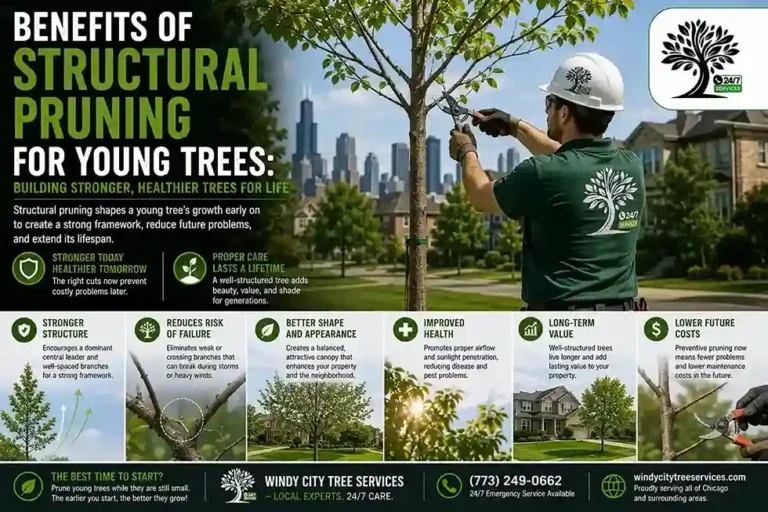
8. Young Trees vs. Mature Trees
| Young Trees | Mature Trees | |
|---|---|---|
| Primary goal | Structural pruning to establish strong scaffold branches | Maintenance pruning to preserve existing structure and health |
| Frequency | Every 2–3 years during establishment | Every 3–5 years for most species |
| Focus | Crown development, removing competing leaders | Deadwood removal, crown cleaning, hazard reduction |
| Long-term impact | Prevents costly structural defects decades later | Maintains health and reduces failure risk |
Structural pruning in a tree’s first 10 to 15 years shapes how it grows for the rest of its life. Correcting a competing leader or a weak branch union while the tree is young is a five-minute cut. Waiting until the tree is mature turns the same problem into a much bigger, riskier job — or an eventual removal.
9. Storm Preparation
Chicago’s exposure to Lake Michigan weather systems makes proactive pruning a real storm-mitigation tool, not just a cosmetic service.
- Pre-storm pruning: Scheduled ahead of storm season rather than reacting after damage occurs.
- Removing weak branches: Eliminating limbs with poor attachment before wind or ice tests them.
- Improving wind resistance: Thinning dense canopy sections reduces the sail effect that catches high winds.
- Reducing storm damage: Fewer weak points mean fewer branches on your roof or driveway after the next major storm.
10. Emergency Tree Trimming
Some situations override the seasonal calendar entirely.
- Broken limbs: Especially any still partially attached and swaying.
- Hanging branches: A “widowmaker” limb caught in the canopy above is a serious hazard.
- Storm cleanup: Post-storm assessment and rapid response to hazardous debris.
- Ice damage: Ice-loaded branches can fail suddenly, even hours after a storm passes.
Emergency pruning should always prioritize public safety over ideal seasonal timing. A hazardous limb in July doesn’t wait for winter.
11. Signs Your Tree Needs Trimming
- Dead or dying branches anywhere in the canopy
- Crossing or rubbing branches
- Low clearance over walkways, driveways, or the roofline
- Excessive, overly dense canopy blocking light and airflow
- Broken limbs from recent storms
- Disease symptoms like discoloration, cankers, or oozing
- Dense inner growth that hasn’t been thinned in years
- Branches interfering with the roof, gutters, or siding
Homeowner Checklist: Before Scheduling Tree Trimming
- Inspect for dead limbs throughout the canopy.
- Check clearance over the roofline and gutters.
- Look for storm damage from recent wind or ice events.
- Photograph areas of concern to share with your arborist.
- Identify nearby utility lines before any work begins.
- Schedule a professional arborist inspection to confirm timing and scope.
12. Common Pruning Mistakes
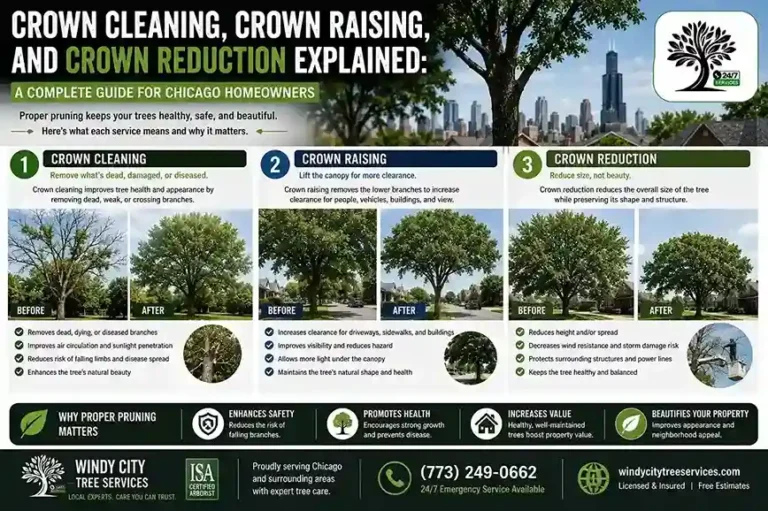
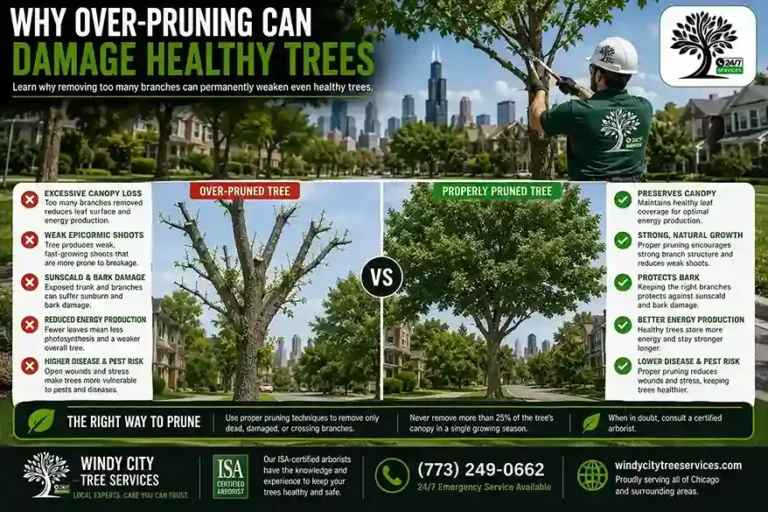
- Topping: Cutting main branches back to stubs, which weakens the tree and triggers weak, fast-growing regrowth.
- Flush cuts: Cutting too close to the trunk, removing the branch collar the tree needs to seal the wound properly.
- Lion tailing: Stripping interior growth and leaving foliage only at branch tips, which shifts weight outward and increases failure risk.
- Over-pruning: Removing more than 25% of the live canopy in a single season stresses the tree significantly.
- Improper timing: Pruning susceptible species during high-risk disease transmission windows.
- Incorrect tools: Dull or oversized tools create ragged wounds that heal poorly.
- DIY hazards: Ladder work near power lines or large limbs overhead carries serious injury risk without training and rigging equipment.
13. Benefits of Professional Tree Trimming
- Better tree health: Correct technique and timing support long-term vigor rather than just short-term appearance.
- Increased safety: Removing hazardous limbs before they fail protects people and property.
- Property value: Well-maintained, structurally sound trees are a visible asset to curb appeal.
- Storm resistance: Proper structure reduces the odds of major limb failure in high winds.
- Disease prevention: Clean cuts made at the right time reduce infection risk significantly.
- Improved aesthetics: A properly pruned tree looks balanced, not stripped or lopsided.
- Longer tree lifespan: Consistent, correctly timed maintenance adds years, sometimes decades, to a tree’s healthy life.
14. Chicago-Specific Tree Care Tips
- Lake Michigan weather: Lakefront wind exposure demands extra attention to structural pruning on exposed trees.
- Heavy snow: Snow load adds significant weight, particularly to trees with poor branch structure.
- Ice storms: Ice accumulation is one of the more damaging seasonal risks for Chicago’s mature canopy.
- High winds: Open lots and lakefront properties see higher wind exposure than interior neighborhoods.
- Urban soil compaction: Compacted soil around parkway trees can limit root health, which indirectly affects how well a tree tolerates pruning stress.
- Salt exposure: De-icing salt near sidewalks and streets can damage roots and should factor into overall tree health planning.
- Dense residential neighborhoods: Tight lot lines mean pruning decisions often need to account for neighboring structures and shared property lines.
15. How Arborists Develop a Pruning Plan
- Tree inspection: A full assessment of canopy, structure, and visible health indicators.
- Species identification: Confirming the exact species, since pruning timing and technique vary meaningfully between them.
- Risk assessment: Evaluating any hazards that need addressing regardless of ideal seasonal timing.
- Growth evaluation: Understanding the tree’s age, vigor, and stage of development.
- Seasonal timing: Matching the recommended work to the best window for that specific species and situation.
- Proper pruning methods: Following ANSI A300 standards and ISA Best Management Practices for every cut.
- Cleanup: Full removal of debris and cut material from the property.
- Ongoing maintenance schedule: A recommended return interval based on species and tree age.
Seasonal Pruning Calendar
Winter
- Structural pruning of most shade trees
- Dormant-season maintenance
- Oak, elm, and maple pruning
Spring
- Post-bloom pruning of flowering trees
- Light corrective work
- Winter storm damage cleanup
Summer
- Hazard and deadwood removal
- Storm damage response
- Birch and pine species work
Fall
- Emergency and hazard work only
- Storm preparation planning
- Avoid major structural pruning
Frequently Asked Questions
For most deciduous shade trees in Chicago, February through early March offers the best combination of dormancy and manageable weather for pruning crews.
Yes, for hazard removal, corrective pruning, and deadwood removal. Heavy structural pruning is generally better saved for the dormant season, especially during drought or extreme heat.
For most deciduous species, yes. Dormancy reduces stress, visibility improves without leaves, and disease and insect pressure are typically lower in cold weather.
It can, if cuts are made during a pathogen’s active transmission window or with contaminated tools. Proper timing and tool sanitation both reduce this risk significantly.
Late winter, during dormancy, is the generally recommended window, largely to reduce exposure to insects associated with oak wilt transmission. Confirm current guidance with a certified arborist for your specific situation.
Yes, for any broken, hanging, or hazardous limbs. Storm cleanup and hazard mitigation should never wait for a “better” season.
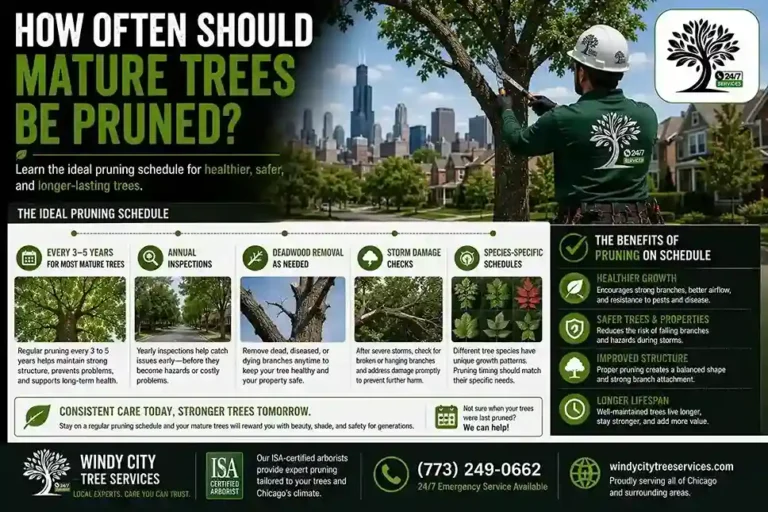
Most mature trees benefit from maintenance pruning every 3 to 5 years, though this varies by species, health, and site conditions.
Best practice is to wait until shortly after the tree finishes blooming. Pruning beforehand removes the buds that were about to flower that season.
For small, low branches away from structures and power lines, minor trimming carries manageable risk. Anything requiring a ladder, large limbs, or proximity to power lines is safer left to a trained crew with proper rigging equipment.
Cost depends on tree size, species, condition, and access. Request a free estimate for pricing specific to your property.
Late winter to early spring, before new growth begins, works well for most evergreens like spruce and arborvitae. Pines are typically better pruned during their spring “candle” growth stage instead.
Topping removes major limbs down to stubs, which weakens the tree structurally, triggers weak regrowth, and increases the odds of future limb failure and decay.
A common guideline is to avoid removing more than about 25% of a tree’s live canopy in a single season, though the right amount depends on species, age, and health.
Yes. Removing certain branches redirects the tree’s energy to remaining buds, often producing noticeably vigorous growth the following season, especially after dormant pruning.
The terms are often used interchangeably, though “pruning” typically refers to targeted cuts for health and structure, while “trimming” is sometimes used more broadly for general shaping and maintenance.
Yes. Removing weak, crossing, or overly dense branches reduces wind resistance and the weight distribution problems that often cause limb failure during storms.
Yes. Young trees benefit from structural pruning that shapes long-term form, while mature trees generally need maintenance pruning focused on health and hazard reduction.
Fall is generally the least favorable season for major pruning, since trees are redirecting energy toward dormancy and wounds tend to close more slowly.
No. Broken, hanging, or hazardous limbs should be addressed as soon as safely possible, regardless of the calendar.
Learn more from our Chicago Tree Service homepage, meet our Certified Arborists, and explore our Professional Tree Care services. Related services include tree trimming & pruning, tree health inspections, tree removal, tree cabling & bracing, tree & shrub fertilization, storm prep & support systems, emergency tree removal, and air spade root excavation.