Tree Pruning vs Tree Trimming: What’s the Difference?
Tree Pruning vs Tree Trimming
Most homeowners use “pruning” and “trimming” as if they mean the same thing. In arboriculture, they don’t. One focuses on a tree’s long-term health and structure. The other focuses on shape, clearance, and appearance. Knowing the difference helps you ask for the right service and get better results.
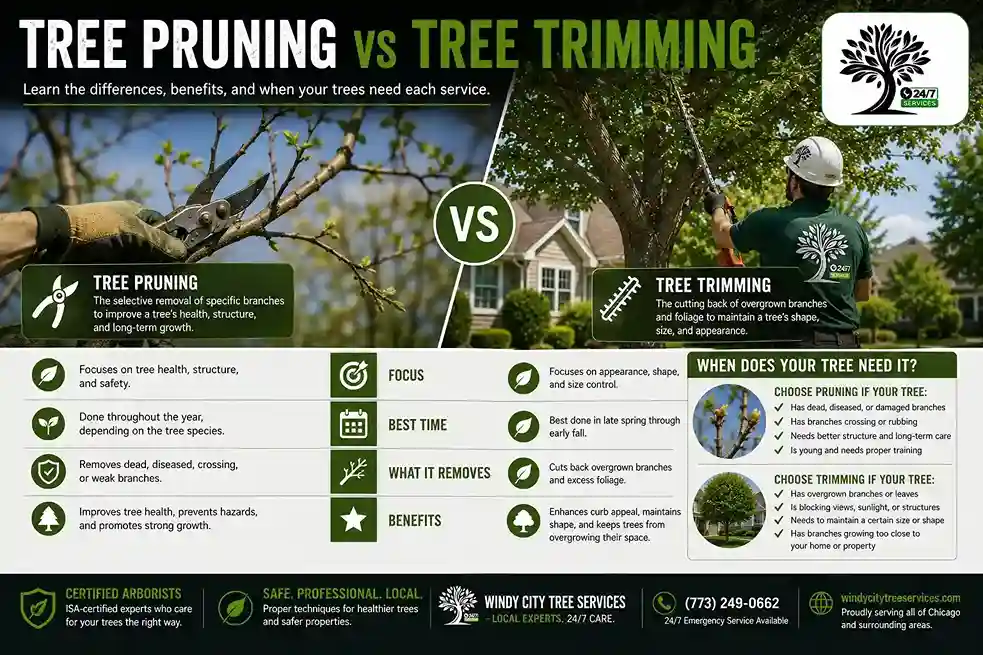
Tree pruning focuses on health, structure, safety, and long-term growth through selective branch removal, guided by ANSI A300 standards. Tree trimming focuses on appearance, clearance, and canopy shape, usually addressing overgrowth around structures or property lines. Professional arborists often combine both practices as part of comprehensive tree care.
Ask ten homeowners what the difference is between pruning and trimming, and most will shrug. In everyday conversation, the words get used interchangeably, and honestly, that’s fine for casual conversation. But when you’re deciding what your tree actually needs, the distinction matters more than it seems.
Pruning and trimming are related, but they serve different purposes. One is a health and structure intervention grounded in plant science. The other is a maintenance service focused on shape and clearance. Understanding which one your tree needs helps you get better results, avoid unnecessary cost, and protect the tree’s long-term health.
This guide walks through the objectives, timing, techniques, and benefits of both services, based on the standards certified arborists actually follow in the field, not just common homeowner language.
“Trimming shapes what you see. Pruning protects what you can’t, the structure holding the tree together for the next fifty years.” Windy City Tree Services Arborist Team
1. What Is Tree Pruning?
Tree pruning is a targeted, science-based practice focused on a tree’s structural integrity and long-term health. It involves selectively removing specific branches to correct or prevent problems, not simply to make the tree look tidier.
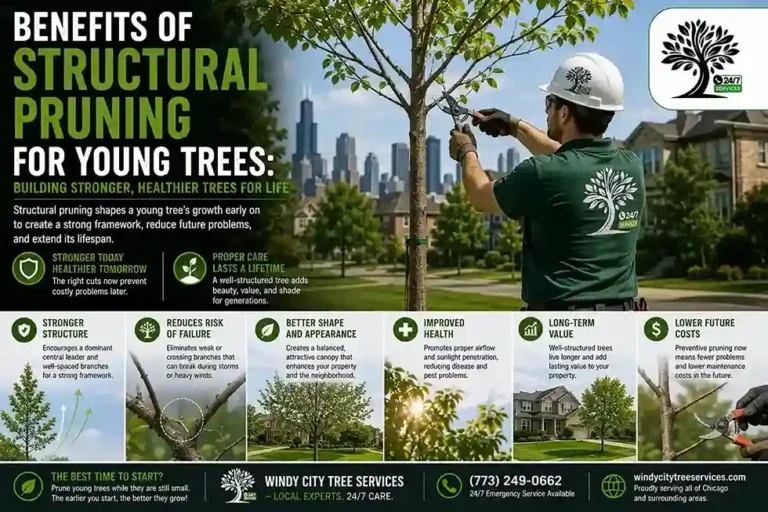
Structural pruning shapes a young tree’s growth to establish a strong central form and well-spaced branches, reducing future risk of failure. Corrective pruning addresses existing defects, like crossing limbs or weak unions, before they become hazards. Deadwood removal takes out dead or dying branches that no longer serve the tree and pose a falling hazard. Pruning also plays a direct role in disease management, since removing infected wood can slow or stop the spread of certain pathogens.
The science behind pruning follows accepted arboricultural practices, including ANSI A300 pruning standards and ISA Best Management Practices, which guide where and how cuts should be made to protect the tree’s ability to heal and continue growing properly.
2. What Is Tree Trimming?
Tree trimming generally focuses on appearance, shape, and clearance rather than the tree’s internal health. It’s the maintenance work that keeps a tree looking neat and keeps its canopy from interfering with daily life around a property.
Trimming typically addresses overgrown branches encroaching on a roofline, a driveway, or a sidewalk. It shapes ornamental trees and hedges for a clean, consistent appearance, and it’s often performed on a seasonal or as-needed basis rather than tied to the tree’s biological needs the way pruning is. Property maintenance and canopy management, keeping growth in check around a specific area, are the primary drivers behind most trimming requests.
3. Key Differences
- Purpose: Pruning targets health and structure; trimming targets appearance and clearance.
- Timing: Pruning is often best in the dormant season; trimming can happen more flexibly throughout the growing season.
- Techniques: Pruning uses specific cut types tied to plant biology; trimming focuses on shaping and length reduction.
- Equipment: Both use hand pruners, loppers, and saws, though pruning decisions require more species-specific judgment.
- Tree age: Structural pruning is especially important for young trees; trimming applies at any age.
- Frequency: Pruning follows a health-based schedule, often every few years; trimming may happen annually or seasonally.
- Results: Pruning improves long-term structural soundness; trimming improves immediate appearance and clearance.
💡 Did You Know?
The International Society of Arboriculture (ISA) and University of Illinois Extension both use “pruning” as the technical term for structural and health-focused cuts, while “trimming” is more of a common landscaping term without a formal arboricultural definition.
4. When Trees Need Pruning
- Dead branches: Dead wood should be removed before it becomes a falling hazard.
- Diseased limbs: Infected wood often needs removal to protect the rest of the tree.
- Crossing branches: Limbs rubbing against each other create wounds and weak points.
- Weak structure: Included bark and codominant stems benefit from early corrective pruning.
- Storm damage: Broken or hanging limbs need professional cleanup to prevent further injury to the tree.
- Young tree training: Early structural pruning sets up decades of healthier growth.
- Safety concerns: Any branch posing a risk to people, vehicles, or structures warrants pruning.
5. When Trees Need Trimming
- Overgrown canopy: Branches extending beyond their intended space.
- Roof clearance: Limbs brushing against or overhanging a roofline.
- Sidewalk clearance: Low branches blocking pedestrian pathways.
- Driveway clearance: Growth interfering with vehicle access.
- Utility clearance: Branches approaching power lines or utility equipment.
- Appearance: Shaping for a neat, well-maintained look.
- Sunlight penetration: Thinning growth to let more light reach a lawn or garden below.
6. Can a Tree Need Both?
Frequently, yes. A mature shade tree might need structural pruning to correct a weak branch union while also needing trimming to clear a roofline that’s grown into over the past few seasons. A combined maintenance plan, built around annual inspections, lets an arborist address both health-based pruning needs and appearance-based trimming needs in the same visit rather than treating them as separate services.
Multi-stage pruning is common for mature trees that need significant correction, since removing too much canopy at once can stress the tree. An arborist may plan structural work across two or three visits over several years, combined with routine trimming in between to manage clearance and appearance.
7. Benefits of Tree Pruning
- Improved health: Removing dead or diseased wood redirects the tree’s energy toward healthy growth.
- Better structure: Correcting weak unions early reduces the risk of failure decades later.
- Disease prevention: Removing infected material can slow the spread of certain pathogens.
- Storm resistance: A well-pruned tree with balanced structure handles wind loads more predictably.
- Longer lifespan: Trees maintained with proper structural pruning tend to live longer, healthier lives.
- Safer trees: Reduced risk of limb failure over homes, driveways, and walkways.
8. Benefits of Tree Trimming
- Improved appearance: A well-shaped canopy contributes to a well-maintained property.
- Better property value: Neat, maintained trees are a visible part of curb appeal.
- Increased sunlight: Thinned growth allows more light to reach lawns, gardens, and windows.
- Improved air circulation: Reduced density within the canopy can lower certain fungal disease risks.
- Better visibility: Clearing sightlines near driveways and street corners.
- Clearance around structures: Preventing branches from damaging roofs, gutters, and siding.
9. Common Pruning Techniques
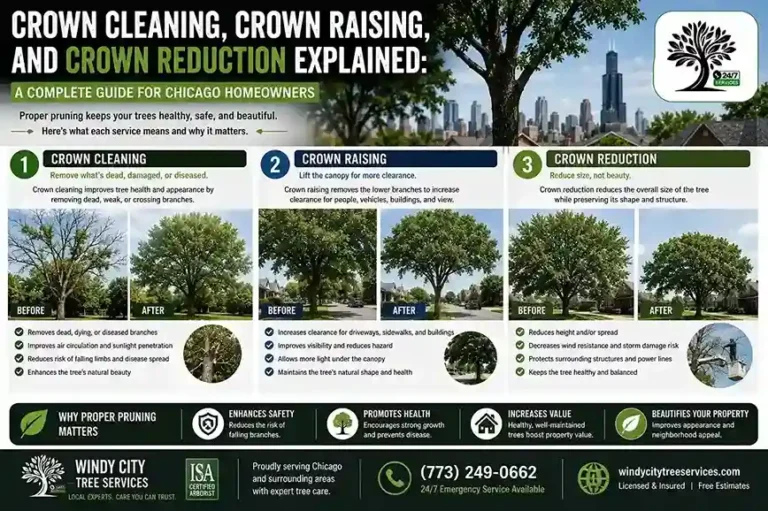
- Crown cleaning: Removing dead, dying, diseased, or weakly attached branches from the canopy.
- Crown thinning: Selectively removing branches to reduce density and improve light and air movement.
- Crown raising: Removing lower branches to provide clearance beneath the canopy.
- Crown reduction: Reducing the overall size of the canopy while preserving the tree’s natural form.
- Structural pruning: Establishing strong branch architecture, especially important in young trees.
- Corrective pruning: Addressing existing defects like crossing limbs or included bark.
10. Common Trimming Techniques
- Canopy shaping: Trimming for a consistent, tidy overall form.
- Clearance trimming: Cutting branches back from roofs, walkways, and driveways.
- Utility clearance: Trimming growth away from power lines and utility equipment.
- Seasonal trimming: Routine maintenance scheduled around the growing season.
- Ornamental trimming: Shaping decorative trees and shrubs for appearance.
11. Chicago-Specific Tree Care
Chicago’s growing conditions shape both pruning and trimming schedules in ways that don’t apply everywhere. The city’s mature urban canopy, much of it 60 to 100 years old, means a large share of local pruning work involves correcting structural issues that developed over decades without professional attention.
High winds off Lake Michigan, heavy snow, and periodic ice storms all put extra stress on poorly pruned trees, making preventive structural pruning more valuable here than in calmer climates. Narrow urban lots and Chicago’s historic neighborhoods often mean trees are planted closer to structures than ideal, increasing the need for regular clearance trimming around rooflines and walkways. Salt exposure from winter street treatment can stress trees along parkways, another reason routine health-focused pruning matters in this climate. The Morton Arboretum, based just outside Chicago, is a widely cited regional authority on how these local conditions affect long-term tree health.
12. Best Time for Each Service
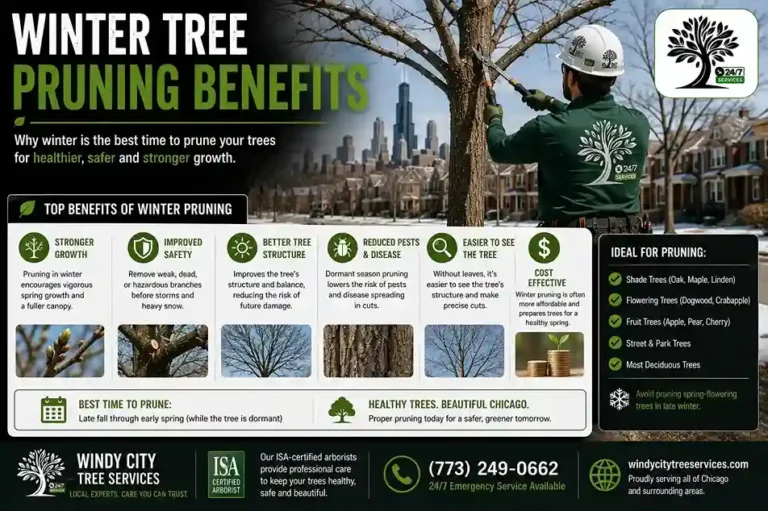
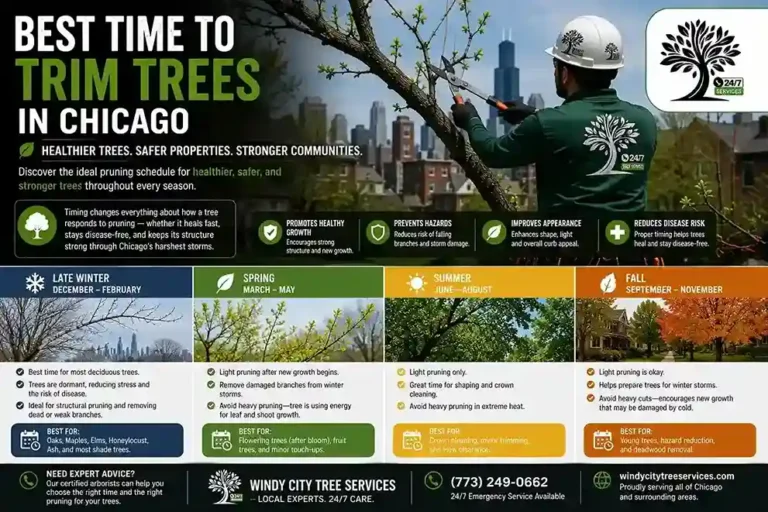
Most structural pruning is best done during the dormant season, typically late winter, when trees aren’t actively growing and the branch structure is easier to see without leaves. This timing also reduces disease transmission risk for species like oaks, since certain pathogens are less active in cold weather.
Trimming for appearance and clearance is more flexible and often happens in summer, once new growth has filled in and it’s clear which branches need attention. Storm cleanup trimming happens whenever it’s needed, regardless of season. Species-specific timing matters too. Our companion guide on the best time to trim trees in Chicago covers seasonal timing in more depth.
13. DIY vs Professional Arborists
Small, low ornamental shrubs and young trees within easy reach are reasonable DIY projects for many homeowners. Beyond that, professional involvement matters for a few real reasons.
- Safety: Working at height or near power lines carries real risk without proper training and equipment.
- Proper cuts: Incorrect cuts can damage a tree’s ability to heal, inviting decay and disease.
- Equipment: Professional-grade tools make cleaner cuts and reduce unnecessary stress on the tree.
- Disease prevention: Arborists know when and how to avoid spreading pathogens between cuts and trees.
- Tree preservation: A trained eye can tell the difference between a cosmetic issue and a genuine structural problem.
- Insurance: Professional companies carry liability coverage that protects your property if something goes wrong.
14. Mistakes Homeowners Make
⚠️ Common Pruning and Trimming Mistakes
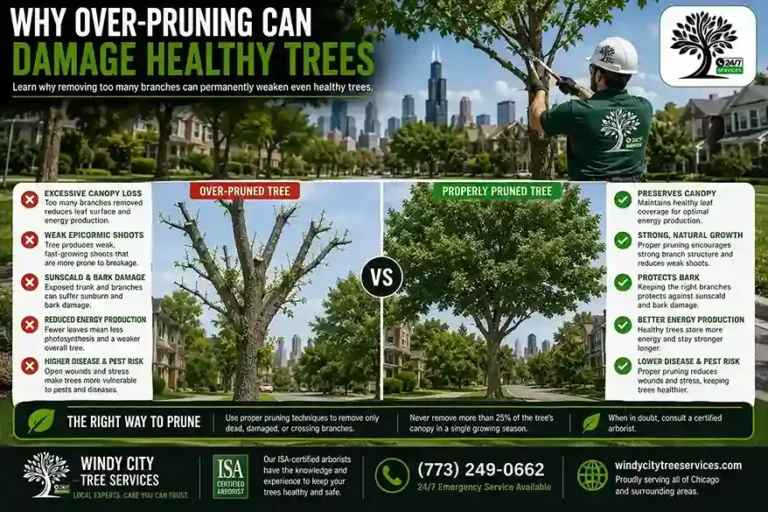
Topping, cutting main branches back to stubs, is one of the most damaging mistakes a homeowner can make, since it weakens the tree and triggers weak, fast-growing regrowth. Over-pruning, removing more than about 25 percent of the canopy at once, stresses the tree and can trigger decline. Improper cuts that don’t respect the branch collar slow healing and invite decay. Incorrect timing, like pruning oaks during peak beetle season, increases disease risk. Using dull tools creates ragged wounds that heal poorly, and ignoring hazards like nearby power lines turns a maintenance task into a serious safety risk.
15. How Arborists Decide Which Service You Need
1. Tree Inspection
A visual assessment of the tree’s overall condition, canopy, and surroundings.
2. Species Identification
Confirming the species, since pruning needs and timing vary significantly between them.
3. Structural Assessment
Checking for weak unions, included bark, and other defects that call for corrective pruning.
4. Health Evaluation
Looking for signs of disease, pest pressure, or decline that pruning could address.
5. Risk Assessment
Identifying any branches or structural issues that pose a safety concern.
6. Treatment Recommendation
Determining whether pruning, trimming, or both will address the tree’s needs.
7. Maintenance Plan
Building a schedule that combines health-based pruning with routine trimming as needed.
Comparison Tables
Tree Pruning vs Tree Trimming
| Feature | Tree Pruning | Tree Trimming |
|---|---|---|
| Primary Goal | Health, structure, and safety | Appearance and clearance |
| Best Time | Dormant season, typically late winter | Flexible, often during the growing season |
| Tree Health | Directly improves long-term health | Indirect benefits through light and airflow |
| Appearance | Secondary result of healthy structure | Primary focus |
| Safety | Addresses structural hazards directly | Addresses clearance-related hazards |
| Frequency | Every few years, health-based schedule | Annually or seasonally as needed |
| Typical Equipment | Hand pruners, loppers, pruning saws | Hedge trimmers, pole saws, shears |
| Best For | Young tree training, storm damage, disease | Overgrowth, roofline and sidewalk clearance |
Benefits Comparison
| Benefit | Pruning | Trimming |
|---|---|---|
| Improves tree health | ✅ Yes | Indirect |
| Improves structure | ✅ Yes | No |
| Improves appearance | Secondary | ✅ Yes |
| Reduces storm risk | ✅ Yes | Limited |
| Increases property value | Indirect | ✅ Yes |
| Provides clearance | Sometimes | ✅ Yes |
| Extends tree lifespan | ✅ Yes | Indirect |
🎨 Infographic Suggestions for This Guide
Pruning vs trimming side-by-side comparison
Types of pruning cuts diagram
Seasonal maintenance calendar
Tree anatomy illustration
Crown reduction before and after
Proper branch collar cut diagram
Homeowner Checklist: Does Your Tree Need Pruning or Trimming?
✅ Ask Yourself
- Are any branches dead or visibly dying? (Pruning)
- Is the canopy overgrown compared to last year? (Trimming)
- Are limbs touching or overhanging your roof? (Trimming)
- Are branches crossing or rubbing against each other? (Pruning)
- Is the tree leaning more than it used to? (Pruning, inspection needed)
- Is a walkway, driveway, or sign blocked by growth? (Trimming)
- Has the tree experienced recent storm damage? (Pruning)
Frequently Asked Questions
Is pruning the same as trimming?
No. Pruning focuses on tree health and structure through targeted branch removal, while trimming focuses on appearance and clearance. They’re related but serve different purposes.
Which service is better for my tree?
It depends on the tree’s condition. A tree with dead or crossing branches needs pruning. A tree that’s simply overgrown and blocking a walkway needs trimming. Many trees benefit from both over time.
Does pruning make trees healthier?
Yes. Removing dead, diseased, or structurally weak branches redirects the tree’s energy toward healthy growth and reduces the risk of decay spreading.
Can trimming reduce storm damage?
Trimming that removes overgrown, weakly attached branches can help somewhat, but structural pruning is the more effective long-term approach to reducing storm-related failure.
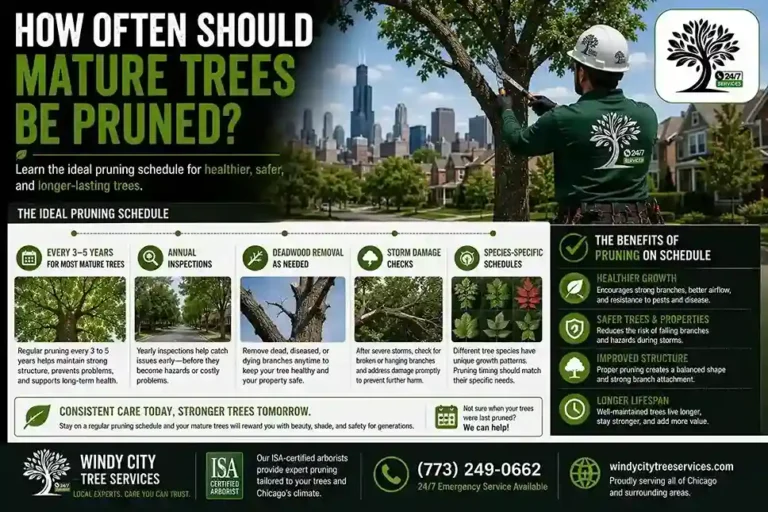
How often should trees be pruned?
Most mature trees benefit from structural pruning every three to five years, with young trees sometimes needing more frequent attention during their formative growth years.
Can trees be over-pruned?
Yes. Removing more than about 25 percent of a tree’s canopy at once can stress the tree significantly and should generally be avoided in a single visit.
Which service costs more, pruning or trimming?
Cost depends more on tree size, condition, and access than which service is performed. Structural pruning on a large, complex tree can cost more than routine trimming, but pricing varies by project.
When should young trees be pruned?
Structural pruning should begin within the first few years after planting to establish strong branch architecture before the tree matures.
Can I prune or trim my own trees?
Small, easily reached branches on young or ornamental trees are reasonable for many homeowners. Larger trees, work near power lines, or structural pruning decisions are safer left to a certified arborist.
Should mature trees be trimmed annually?
Not always necessary, but an annual inspection helps catch clearance issues and structural concerns early, even if active trimming isn’t needed every year.
What is crown thinning?
Crown thinning selectively removes branches throughout the canopy to reduce density and improve light penetration and air movement without changing the tree’s overall shape.
What is topping and why is it harmful?
Topping cuts main branches back to stubs rather than to a proper lateral branch or collar. It weakens the tree, triggers weak regrowth, and increases long-term risk of failure.
What is the best time of year for pruning in Chicago?
Late winter, during the dormant season, is generally best for structural pruning, since it’s easier to see branch structure and disease transmission risk is lower for species like oaks.
Can trimming happen any time of year?
Trimming is more flexible than pruning, but heavy trimming during peak summer heat can add unnecessary stress to a tree already dealing with drought conditions.
Does pruning help prevent disease?
Yes. Removing infected wood can slow the spread of certain diseases, and proper timing avoids periods when pathogens are most active.
What is crown raising?
Crown raising removes lower branches to provide clearance beneath the canopy, often used for sidewalks, driveways, or buildings.
Do commercial properties need both pruning and trimming?
Often yes. Commercial properties typically need trimming for clearance and appearance along with periodic structural pruning for tree health and liability management.
What tools do arborists use for pruning versus trimming?
Both use hand pruners, loppers, and saws, though pruning decisions require more species-specific judgment about where and how to cut for the tree’s long-term health.
Can pruning increase my property value?
Indirectly, yes. A structurally sound, healthy tree supports long-term property value, while trimming has a more immediate impact on visible curb appeal.
How do I schedule a tree evaluation with Windy City Tree Services?
Call (773) 249-0662 or email info@windycitytreeservices.com to schedule a free evaluation with an ISA Certified Arborist.
Related Articles
Expert Tree Pruning and Trimming in Chicago
Whether your trees need corrective pruning, canopy trimming, or seasonal maintenance, Windy City Tree Services delivers professional tree care based on industry standards and years of local experience.
info@windycitytreeservices.com · 323 W Carroll Ave, Chicago, IL 60612 · Serving Chicago 24/7