Why Trees Decline After Landscaping Projects | Chicago
Why Trees Decline After Landscaping Projects: Hidden Causes & Prevention
Learn how common landscaping changes can silently damage tree roots and long-term tree health.
Schedule a Tree Health InspectionA new patio, a regraded yard, or a fresh retaining wall can transform how a property looks. What often goes unnoticed is what happens underground while that work is happening. Mature trees depend on root systems that are typically shallow and spread well beyond the edge of the canopy, right through the exact areas where landscaping crews dig, grade, and compact soil.
The tricky part is timing. Root damage from a landscaping project rarely shows up right away. Symptoms often appear months, sometimes even a year or more, later, which makes it hard for homeowners to connect a declining tree to work that finished long ago. By the time canopy thinning or dieback becomes obvious, the underlying root damage may already be significant.
This guide explains how landscaping projects affect mature trees, what warning signs to watch for, how ISA Certified Arborists diagnose the underlying cause, and what steps actually protect valuable trees before, during, and after a project. Tree decline is rarely the result of one single mistake. It’s usually a combination of factors working against the tree at once.
Why do trees decline after landscaping projects?
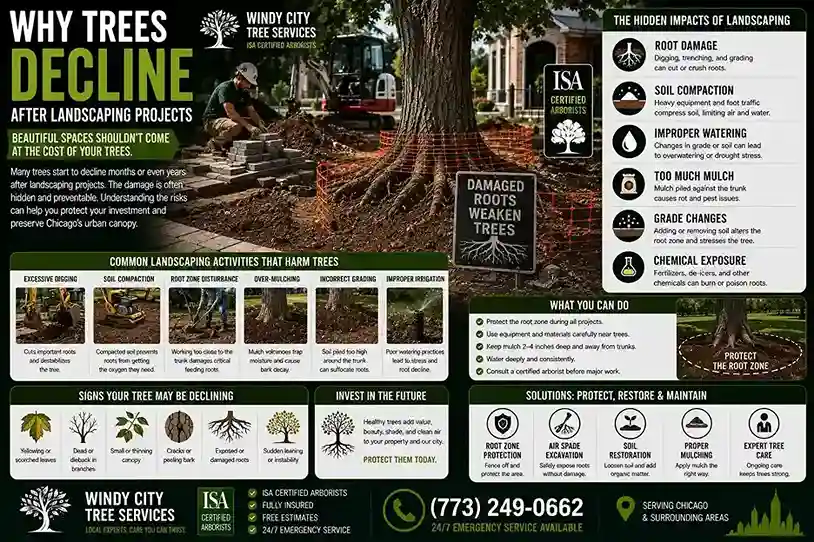
Landscaping projects can damage roots directly, compact the surrounding soil, alter natural drainage, and bury the root flare under added soil or mulch. These changes reduce the oxygen and water available to a tree’s root system. Symptoms often don’t appear immediately, but over time they can lead to canopy thinning, leaf discoloration, branch dieback, slower growth, and greater susceptibility to pests and disease.
1. Why Landscaping Can Harm Mature Trees
Landscaping crews usually focus on what’s visible above ground: grading a slope, laying a paver base, running a new sprinkler line. None of that work is done with malice, and most crews simply aren’t thinking about how close they’re working to a tree’s actual root system. That disconnect is exactly why so much landscaping-related tree damage is unintentional, and largely preventable.
Hidden Root Systems
Most of a tree’s roots sit in the top 12 to 18 inches of soil, well within reach of routine digging and grading.
Sensitive Root Zones
Fine, water-absorbing roots are especially vulnerable to compaction and disturbance, even without visible trenching.
Delayed Stress Response
Trees often draw on stored energy reserves for months before visible symptoms appear above ground.
Long-Term Decline
Once root damage sets in, recovery can take years, and some trees never fully return to their previous health.
It also helps to understand that a tree responds to root injury differently than an animal responds to a wound. Trees don’t repair damaged tissue directly. Instead, they compartmentalize it, sealing off the injured area and growing new tissue around it over time. That process draws on energy the tree would otherwise spend on canopy growth, pest defense, or drought resistance, which is part of why a tree recovering from root damage often looks generally weaker across the board rather than showing one single, obvious symptom.
2. Tree Roots Extend Far Beyond the Trunk
A common misconception is that a tree’s roots stay within the drip line of its canopy. In reality, roots frequently extend two to three times the canopy’s radius, sometimes farther, depending on species and soil conditions.
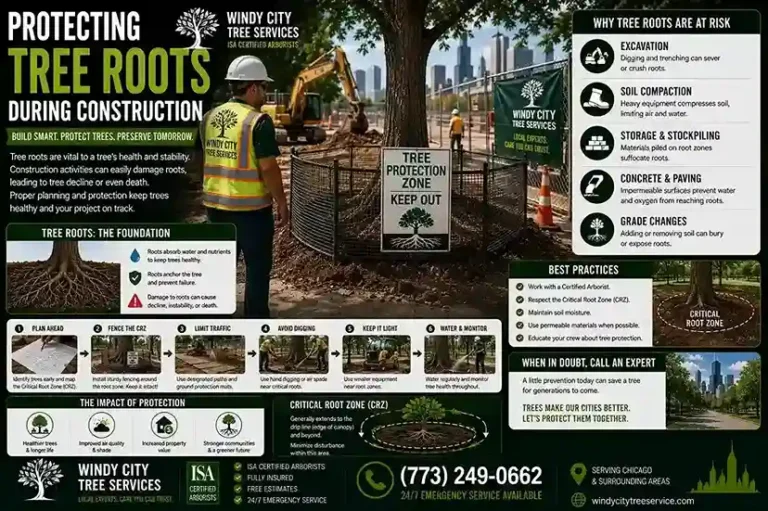
Critical Root Zone (CRZ)
Arborists typically define a protective radius around the trunk, often based on trunk diameter, where root disturbance carries the highest risk to tree health.
Fine Absorbing Roots
These small, hair-like roots handle most water and nutrient uptake and are the most easily damaged by compaction or excavation.
Structural Roots
Larger roots near the trunk anchor the tree and transport water and nutrients toward the canopy.
Root Spread
Total root spread often reaches well beyond the visible canopy edge, right into typical landscaping work areas.
This is one of the most common misunderstandings homeowners have about their own trees, and it’s an easy one to have, since the roots themselves are invisible. A homeowner planning a new patio ten feet from the trunk of a mature oak might reasonably assume that’s a safe distance. In reality, that patio footprint could sit squarely within the tree’s most active root zone, cutting through fine roots the tree depends on for a large share of its water and nutrient uptake. Species matters here too. Trees like silver maple and cottonwood tend toward wide, shallow, aggressive root systems, while species like oak often develop a somewhat deeper structural root system with a still-extensive lateral spread. Neither pattern makes a tree immune to landscaping damage. It just changes where the most sensitive roots are likely to be found.
3. Common Landscaping Mistakes That Damage Trees
Most of the mistakes below share a common thread: they change something about the soil or grade around a tree without anyone stopping to ask what’s happening underground first. Individually, some of these look minor. A few inches of new soil here, a load of decorative stone there. Stacked together across a full landscaping project, though, they add up to serious cumulative stress on a root system that was previously stable.
Soil Grading
Adding or removing soil around a tree changes the depth roots sit at, even by a few inches.
New Patios
Excavation and base compaction for a patio can sever roots and compact soil across a wide area.
Sidewalk Installation
Concrete forms and base material often require cutting through structural roots close to the trunk.
Retaining Walls
Wall footings and backfill can alter drainage patterns and cut through significant root mass.
Driveway Expansion
Heavy equipment and compacted base material take a toll on roots within the expanded footprint.
Decorative Stone
Landscape stone over the root zone can trap heat and reduce water infiltration to the soil below.
Raised Flower Beds
Added soil around a trunk, even a few inches, can bury the root flare and trap moisture against the bark.
Excess Mulch
Mulch piled against the trunk, sometimes called a mulch volcano, encourages decay and girdling roots.
Landscape Fabric
Fabric barriers can restrict oxygen and water exchange in the root zone over time.
Utility Trenching
Trenching for irrigation or lighting lines frequently severs roots without much thought given to root location.
4. Soil Compaction
Soil compaction is one of the most common and most overlooked causes of post-landscaping tree decline.
Heavy Equipment
Skid steers, excavators, and delivery trucks driving over the root zone compress soil structure significantly.
Foot Traffic
Repeated crew foot traffic during a project adds up, especially on wet soil.
Material Storage
Piled soil, pallets of stone, or stacked materials compress the soil beneath them for the project’s duration.
Reduced Oxygen
Compacted soil holds less air space, starving roots of the oxygen they need to function.
Restricted Root Growth
Dense, compacted soil physically blocks new root growth from expanding into needed areas.
5. Drainage Changes
Standing Water
New grading or hardscaping can redirect water toward a tree’s root zone, leading to saturated soil.
Drought Stress
Conversely, changes that redirect water away from a tree can leave roots chronically dry.
Irrigation Changes
New sprinkler zones sometimes over-water or under-water an established tree’s root zone compared to its prior watering pattern.
Root Suffocation
Consistently saturated soil displaces the oxygen roots need, effectively suffocating them over time.
Soil Moisture Imbalance
Either extreme, too wet or too dry, stresses a mature tree that was previously adapted to stable conditions.
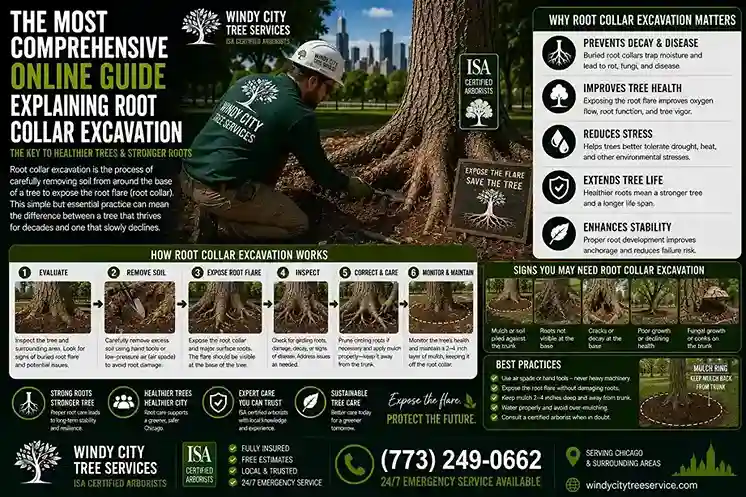
6. Buried Root Flare
The root flare, where the trunk widens at the base and transitions into the root system, needs to stay visible and exposed to air. Landscaping projects frequently bury it without anyone realizing the consequences.
Root Collar Disorders
A buried root flare creates persistently moist bark conditions that invite decay organisms.
Excess Mulch
Mulch piled directly against the trunk mimics the same damaging effect as buried soil.
Added Soil
Even a few inches of new soil or sod raised around the base can trap moisture against bark not meant to stay wet.
Trunk Decay
Prolonged moisture against the lower trunk accelerates decay in that critical structural area.
Girdling Roots
Buried conditions can also encourage roots to circle the trunk instead of growing outward, eventually strangling the tree’s own vascular tissue.
⚠️ Watch the Root Flare
If you can’t see where the trunk widens into the root flare at soil level, it may already be buried. This is one of the most common, and most preventable, landscaping mistakes we see.
💡 It’s Rarely Just One Thing
A single afternoon of foot traffic across the root zone probably won’t kill a healthy, established tree on its own. Tree decline after landscaping is almost always the result of several factors layered on top of each other: some compaction here, a slightly buried root flare there, a change in drainage that leaves the soil wetter than it used to be. Each factor alone might be something a resilient tree could tolerate. Combined, over the course of a multi-week project, they can push a tree past its ability to compensate. This is exactly why two neighboring trees can respond so differently to the same landscaping project. A tree that was already dealing with some age-related decline, a prior storm injury, or compacted soil from years of foot traffic has far less capacity left to absorb new stress than a young, vigorous tree in loose, well-drained soil.
7. Signs of Tree Decline After Landscaping
Smaller Leaves
Reduced leaf size compared to prior seasons often signals root stress.
Yellow Leaves
Discoloration outside of normal fall change can point to reduced water or nutrient uptake.
Brown Leaves
Scorched or browning leaf edges often indicate drought or root damage stress.
Sparse Canopy
Thinning foliage density is one of the more visible signs of declining root function.
Dead Branches
Canopy dieback often follows root loss by several months to a year or more.
Epicormic Sprouts
Clusters of small shoots along the trunk or major limbs are a stress response some trees produce.
Premature Fall Color
Leaves changing color noticeably earlier than neighboring trees can indicate stress.
Slow Growth
Reduced twig elongation compared to previous years is a subtle but meaningful indicator.
Mushrooms Near the Trunk
Fungal growth can indicate root decay setting in after root damage or prolonged soil saturation.
💡 Did You Know?
Symptoms of landscaping-related root damage often don’t appear until the following growing season, or even a full year later. A tree that looked fine right after a project can still be showing the effects of root loss well into the next year.
8. How Arborists Diagnose Landscaping Damage
Tree Health Inspection
A full canopy, trunk, and root zone assessment establishes the tree’s current condition.
Root Collar Inspection
Checking the base of the trunk confirms whether the root flare has been buried or damaged.
Air Spade Excavation
Compressed air safely exposes roots without cutting them, revealing damage that soil would otherwise hide.
Soil Testing
Compaction levels, drainage, and nutrient content help explain what’s happening below the surface.
Tree Risk Assessment
Evaluates whether root damage has created a structural safety concern in addition to a health concern.
Construction History Review
Understanding what work happened, when, and how close it came to the root zone helps connect symptoms to their likely cause.
9. Treatments That May Help
Treatment options depend heavily on how much root damage occurred and how the tree is responding. We can’t guarantee recovery in every case, but several approaches can support a stressed tree:
Air Spade Soil Decompaction
Loosens compacted soil around the root zone without cutting roots, improving oxygen and water penetration.
Root Collar Excavation
Safely exposes and corrects a buried root flare or girdling roots found near the trunk base.
Deep Root Fertilization
Delivers nutrients directly into the root zone to support recovery in a stressed tree.
Mulching
A proper mulch ring, kept away from the trunk, helps retain soil moisture and moderate temperature.
Structural Pruning
Removing dead or declining branches reduces demand on a root system that’s already struggling.
Irrigation Adjustments
Correcting over-watering or under-watering patterns helps restore a healthier moisture balance.
Long-Term Monitoring
Follow-up inspections track whether the tree is stabilizing, improving, or continuing to decline.
It’s worth being upfront about something here: no treatment plan can guarantee full recovery. A tree that’s lost a significant portion of its root system is working with less capacity than it had before, and some of that capacity may never fully return. What treatment can do is stabilize a stressed tree, slow further decline, and in many cases allow it to recover enough to remain a healthy, valuable part of the landscape for years to come. The right combination of treatments depends entirely on what a professional inspection finds, which is why guessing at a fix without that diagnosis rarely works out well.
10. Preventing Tree Damage During Landscaping
Tree Protection Zones
Clearly marked zones around valuable trees keep equipment and materials away from the root system.
Root Zone Fencing
Physical fencing before work begins prevents accidental compaction or material storage in the critical root zone.
Arborist Consultation Before Projects
A pre-project evaluation identifies which trees are most at risk and how to plan around them.
Equipment Restrictions
Limiting where heavy machinery can operate protects soil structure in sensitive root areas.
Proper Grading
Planning grade changes to avoid burying or exposing the root flare protects long-term tree health.
Air Spade Instead of Trenching
Using an Air Spade around roots instead of mechanical trenching avoids severing structural and absorbing roots.
11. When Tree Removal May Be Necessary
Severe Root Loss
When enough of the root system has been damaged that recovery is unlikely.
Structural Instability
Significant root loss can compromise a tree’s ability to remain safely anchored.
Advanced Decay
Extensive internal decay following root or trunk damage may leave removal as the safest path forward.
Hazardous Trees
A declining tree near a home, patio, or driveway carries more risk than the same tree in an open area.
Dead Trees
A tree that has fully died following landscaping damage should be removed before it becomes a fall hazard.
Tree-Friendly Landscaping vs. Harmful Landscaping
| Tree-Friendly Practices | Harmful Practices |
|---|---|
| Tree protection fencing before work begins | Heavy equipment operating near exposed roots |
| Proper mulch depth, kept away from the trunk | Mulch volcanoes piled against the bark |
| Root zone preservation planning | Root trenching without regard to root location |
| Air Spade excavation around roots | Mechanical digging that severs roots |
| Professional pre-project planning | Unplanned grading changes near mature trees |
Landscaping Activity vs. Potential Tree Damage
| Landscaping Activity | Possible Tree Impact |
|---|---|
| Patio installation | Root severing, soil compaction from excavation and base material |
| Driveway expansion | Compaction from heavy equipment, root loss within the new footprint |
| Soil grading | Buried root flare or exposed roots, altered drainage patterns |
| Decorative stone | Reduced water infiltration, increased soil temperature near roots |
| Retaining wall | Root loss from footings, altered drainage above and below the wall |
| New irrigation | Over-watering or under-watering compared to the tree’s established pattern |
| Sod installation | Added soil depth around the base, potential root flare burial |
Homeowner Checklist: Protect Trees During Landscaping
- Identify the Critical Root Zone before any work begins.
- Install tree protection fencing around valuable trees.
- Avoid storing materials or equipment near the root zone.
- Prevent soil compaction by limiting foot and vehicle traffic near roots.
- Keep mulch a few inches away from the trunk, never piled against the bark.
- Avoid changing soil grade around established trees whenever possible.
- Consult a Certified Arborist before excavation near mature trees.
- Schedule a post-project tree inspection to catch early stress signs.
Visual Guides Worth Creating
🌳 Tree Root Protection Zone
An overhead diagram showing recommended fencing distance based on trunk diameter.
🧱 Healthy vs. Compacted Soil
A cross-section comparison showing air pockets in healthy soil versus dense, compacted soil.
🚧 Landscaping Impacts on Tree Roots
An illustration showing how patios, walls, and grading intersect with a tree’s root spread.
💨 Air Spade Excavation Process
A step-by-step visual of compressed air safely exposing roots without cutting them.
🌱 Root Flare Anatomy
A labeled diagram showing a properly exposed root flare versus a buried one.
📋 Landscaping Tree Protection Checklist
A printable visual checklist for homeowners planning a landscaping project.
Frequently Asked Questions
Can landscaping kill a mature tree?
Yes. Root damage, soil compaction, drainage changes, and a buried root flare can all combine to seriously stress or eventually kill a mature tree.
Why did my tree die after a patio was installed?
Excavation and compaction during patio installation likely damaged a significant portion of the root system, and symptoms often don’t appear until months or seasons later.
How far do tree roots spread?
Roots commonly extend two to three times the radius of the canopy, sometimes farther, depending on species and soil conditions.
Can adding soil around a tree cause problems?
Yes. Even a few inches of added soil can bury the root flare, trap moisture against the bark, and encourage decay.
Is decorative stone harmful to trees?
It can be. Stone placed over the root zone can raise soil temperature and reduce water infiltration to the roots below.
What is the Critical Root Zone?
It’s the area around a tree, often based on trunk diameter, where root disturbance carries the highest risk to the tree’s health and stability.
Can Air Spade help damaged trees?
Yes. Air Spade excavation safely exposes compacted soil and roots without cutting them, allowing for decompaction and root collar correction.
How soon do landscaping symptoms appear?
Often not right away. Symptoms can take several months to a year or more to become visible, since trees draw on stored energy before showing above-ground stress.
Should I fertilize a stressed tree?
Possibly, but fertilization should follow a professional diagnosis rather than guesswork, since the underlying cause determines whether fertilization will actually help.
When should I call an arborist?
Before a landscaping project begins, and again if you notice canopy thinning, leaf discoloration, or dieback in the months following one.
Can a tree recover from root damage?
Sometimes. Recovery depends on how much of the root system was affected and how quickly appropriate treatment begins.
Does mulch help or hurt trees?
Proper mulch, applied a few inches away from the trunk in a thin, even layer, helps retain moisture. Mulch piled against the trunk causes the same problems as buried soil.
Can irrigation changes damage a tree?
Yes. New irrigation zones can over-water or under-water an established tree compared to its prior watering pattern, stressing the root system either way.
What is root collar excavation?
It’s the process of carefully exposing the base of the trunk to check for a buried root flare, girdling roots, or decay, often using an Air Spade to avoid further root damage.
Do all trees respond the same way to landscaping changes?
No. Species, age, and existing health all affect how sensitive a tree is to root disturbance, soil compaction, or grade changes.
Can trenching for utility lines damage tree roots?
Yes. Utility trenching frequently severs roots without accounting for their location, which can significantly affect a tree’s stability and health.
How do I protect a tree during construction?
Install tree protection fencing around the Critical Root Zone, restrict equipment access, and consult a Certified Arborist before any excavation nearby.
Is it too late to help a tree that’s already declining?
Not necessarily. Many stressed trees respond to treatment if the damage isn’t too severe. A professional inspection determines what’s realistic.
What does a buried root flare look like?
Instead of seeing the trunk widen naturally into the ground, the trunk appears to go straight into the soil like a pole, often with soil or mulch mounded around it.
Do you offer tree preservation consultations before landscaping projects?
Yes, we provide pre-project consultations to identify at-risk trees and recommend protective measures before work begins.
Key Takeaways
- Tree roots typically extend far beyond the canopy, directly into the areas most landscaping projects affect.
- Soil compaction, drainage changes, and a buried root flare are among the most common, and most preventable, causes of post-landscaping decline.
- Symptoms often appear months or even a year or more after a project finishes, which makes the cause easy to miss.
- Tree decline after landscaping usually results from a combination of factors rather than one single mistake.
- Planning ahead with an arborist, protecting the root zone, and using Air Spade techniques instead of mechanical trenching can prevent most of this damage entirely.
Explore More From Windy City Tree Services
Windy City Tree Services is Chicago’s trusted Chicago tree service, staffed by ISA Certified Arborists who serve as tree preservation experts across the city. Learn more about our Air Spade root care, tree health inspection and treatment, tree and shrub fertilization, tree trimming and pruning, tree removal, tree cabling and bracing, storm prep and support systems, and emergency tree removal.
Related Articles
- International Society of Arboriculture (ISA), Best Management Practices: Tree Preservation During Construction
- American National Standards Institute, ANSI A300 Tree Care Standards
- Tree Care Industry Association (TCIA), tree and construction guidance
- USDA Forest Service, urban forestry and root zone management publications
- University of Illinois Extension, tree preservation and soil management resources
- The Morton Arboretum, root health and tree preservation education resources
- Illinois Department of Natural Resources, forest health guidance