Protecting Tree Roots During Construction | Chicago Guide
Protecting Tree Roots During Construction: A Complete Guide for Chicago Property Owners
Learn how proper planning, Tree Protection Zones, and Air Spade technology can preserve valuable trees during remodeling, excavation, and new construction.
Tree roots are protected during construction by establishing Tree Protection Zones, preventing soil compaction, limiting excavation near roots, and using Air Spade technology when digging is unavoidable. Preserving natural soil grade and consulting a certified arborist before construction begins round out the core practices. Together, these steps reduce root injury and support long-term tree health.
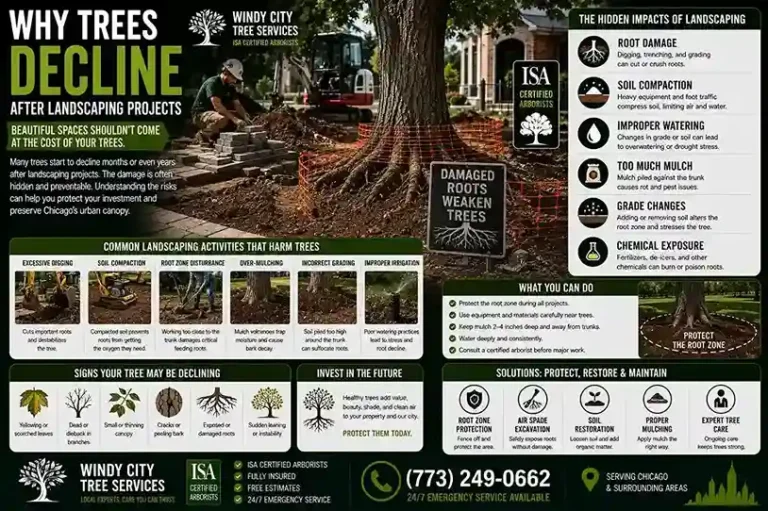
Construction is one of the leading causes of long-term tree decline in Chicago, and most of the damage happens where nobody is looking: underground. Tree roots grow far wider than most people assume, often extending well beyond the edge of the canopy, and a single afternoon of excavation, grading, or heavy equipment traffic can permanently injure a root system that took decades to develop.
The tricky part is timing. A tree rarely dies on the job site. Instead, it draws on stored energy for months or even years before decline becomes visible, which means the damage is usually done long before a homeowner notices thinning leaves or dead branches. That delay is exactly why proactive planning matters more than reactive treatment.
This guide, developed by Windy City Tree Services and reviewed by our ISA Certified Arborists, explains how root systems work, why construction puts them at risk, and what a proper tree preservation plan looks like from the first shovel of dirt to the final walkthrough. You’ll learn how to set up a Tree Protection Zone, when Air Spade excavation makes sense, how to spot the early warning signs of root injury, and when it’s time to bring in a professional before a project moves forward.
🌱 Root Biology
Why Tree Roots Are Vulnerable During Construction
A mature tree’s root system typically extends one and a half to three times wider than its canopy, and the roots doing most of the work sit surprisingly close to the surface. According to research summarized by the University of Illinois Extension, roughly 90 percent of a tree’s absorbing roots occupy just the top 12 to 18 inches of soil. That shallow zone is precisely where construction crews dig trenches, grade driveways, and drive heavy equipment.
Two very different types of roots make up that system, and construction affects them in different ways. Fine, hair-like absorbing roots take in water and nutrients and regenerate relatively quickly if the surrounding soil stays healthy. Larger structural roots, by contrast, anchor the tree and store energy reserves; once a structural root is severed or crushed, the tree cannot simply regrow it the way it can replace fine roots.
Because so much of this activity happens below grade, the visible canopy can look completely normal while the root system underneath is already compromised. A tree that appears healthy in October, after a summer of nearby excavation, may begin showing dieback the following spring or the spring after that. This delayed response is one of the most misunderstood aspects of construction-related tree damage.
📏 Root Spread
Understanding the Critical Root Zone (CRZ)
The Critical Root Zone, sometimes called the Root Protection Area, is the minimum area around a tree that must stay undisturbed to protect its root system during nearby construction. Arborists commonly calculate it using a simple guideline: roughly 1 to 1.5 feet of radius for every inch of trunk diameter, measured at 4.5 feet above grade (diameter at breast height, or DBH).
For example, a mature oak with a 30-inch trunk diameter could have a Critical Root Zone extending 30 to 45 feet from the trunk in every direction. That distance often surprises homeowners planning a driveway, addition, or utility trench, since it frequently reaches well past the edge of the visible canopy.
The CRZ is not a fixed number for every tree. Species sensitivity, soil type, tree age, and overall health all influence how conservative the boundary needs to be. A stressed or older tree generally needs a wider buffer than a young, vigorous one of the same trunk size, because it has less reserve capacity to compensate for root loss.
The Critical Root Zone typically extends far beyond the canopy’s drip line — often 1 to 1.5 feet of radius per inch of trunk diameter.
🏗️ Site Work
Common Construction Activities That Damage Trees
Almost every phase of a construction project carries some risk to nearby trees. Recognizing which activities pose the greatest threat helps property owners and contractors plan around root zones instead of through them.
- Excavation and trenching cut directly through structural and absorbing roots, often severing more of the system than is visible from the surface.
- Utility installation, including water, sewer, and electrical lines, frequently runs straight through a Critical Root Zone unless routed deliberately around it.
- Foundation work for additions or new structures can require excavation directly beneath a canopy, especially on narrow urban lots.
- Sidewalk and driveway installation often removes soil and roots in a shallow band that happens to align with the most active absorbing roots.
- Retaining wall construction changes both grade and drainage patterns around a root system, sometimes permanently.
- Grading to level a site can bury root flares under fill soil or expose them by stripping topsoil away.
- Material storage, such as stacking lumber, soil, or equipment over a root zone, compacts soil and blocks oxygen exchange.
- Heavy equipment traffic, even without any digging, compacts soil structure and crushes fine roots near the surface.
Notice that several of the most damaging activities, like material storage and equipment traffic, don’t involve digging at all. That’s part of why a Tree Protection Zone needs to restrict access, not just excavation.
⚙️ Soil Science
Soil Compaction
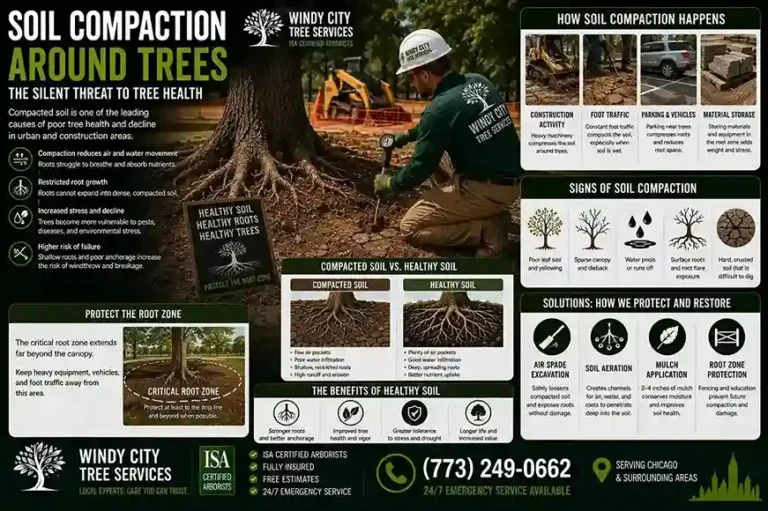
Soil compaction happens when heavy machinery, stacked materials, or repeated foot traffic press soil particles together, squeezing out the air pockets roots depend on. Roots need oxygen to function, and compacted soil can reduce oxygen availability enough to suffocate fine roots within a single construction season.
The effects compound over time. Reduced oxygen slows root growth and nutrient uptake, which weakens the tree’s overall vigor. Weakened trees become more vulnerable to pests, disease, and drought stress, and because compacted soil recovers slowly on its own, the restriction on root growth can persist for years after construction ends unless it’s actively addressed.
Even a single pass from a loaded skid steer or delivery truck can meaningfully compact soil within a root zone. This is why Tree Protection Zones restrict all vehicle and equipment access, not just digging, and why plywood or mulch matting is sometimes used as a temporary protective surface if a route through a protected area is genuinely unavoidable.
📐 Site Grading
Changes in Soil Grade
Raising or lowering the soil grade around a tree disrupts the balance its root system was built for, even when the change looks minor from the surface. Adding just a few inches of fill soil over a root zone can bury the root flare and reduce oxygen exchange enough to trigger slow decline over several growing seasons.
Removing soil creates the opposite problem: exposed roots dry out faster, lose their protective layer of topsoil, and become more vulnerable to mechanical injury from foot traffic or future digging. Grade changes in either direction also tend to alter how water drains around the root zone, which can leave roots sitting in standing water after storms or, conversely, starve them of moisture if drainage patterns are redirected away from the tree.
Because grade changes are often permanent, they deserve the same level of pre-construction planning as excavation. An arborist reviewing a site plan can flag proposed grading that would bury a root flare long before it becomes a foundation-stage problem.
🚧 Fencing & Access Control
Tree Protection Zones (TPZ)
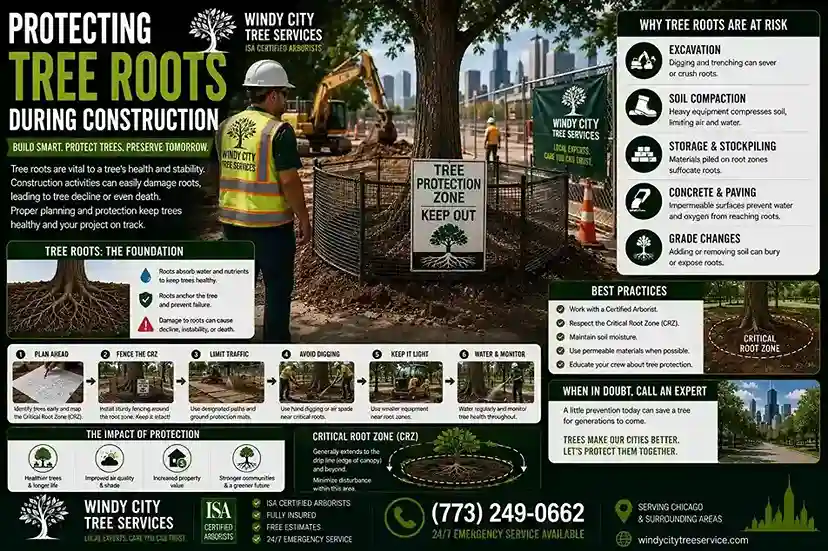
A Tree Protection Zone is a fenced, clearly marked area around a tree’s Critical Root Zone that restricts equipment, material storage, and unnecessary foot traffic for the duration of a construction project. It’s the single most effective and most commonly recommended tool for preventing root damage, and it’s endorsed in ISA Best Management Practices for construction site tree protection.
An effective TPZ follows a few consistent best practices. Fencing should be installed before any equipment arrives on site, not after grading has already started. It should be visible and sturdy enough to actually stop equipment, rather than a symbolic strip of tape that gets ignored under deadline pressure. Signage explaining the purpose of the fencing helps subcontractors unfamiliar with the project understand why the area is off-limits.
Material storage, portable toilets, dumpsters, and parking all need to be planned outside the TPZ from the start, since these are exactly the uses that tend to migrate into “empty-looking” space once a project gets busy. When a TPZ genuinely must be crossed for an access route, professionals typically use protective matting or plywood to spread the load and reduce compaction rather than removing the fencing altogether.
A properly installed Tree Protection Zone keeps equipment routes, material storage, and site traffic outside the fenced root area.
🌬️ Non-Destructive Excavation
Air Spade Technology During Construction
Air Spade technology uses a high-velocity stream of compressed air to break up and remove soil without cutting or crushing the roots underneath. Unlike a shovel, backhoe, or trencher, which slices through anything in its path, an Air Spade tool loosens soil particles while leaving roots, utility lines, and buried infrastructure intact.
This makes it especially useful whenever excavation genuinely has to happen inside or near a Critical Root Zone. Utility installation can often be routed and dug using an Air Spade instead of a trencher, exposing existing roots so a crew can hand-guide the line around them rather than through them. The same technology allows arborists to perform root inspections, checking for decay, girdling roots, or structural issues, without the invasive damage conventional digging would cause.
Air Spade excavation also plays a role in soil decompaction on already-affected sites, breaking up compacted soil structure so oxygen and water can reach roots again. Air Spade technology helps expose roots with meaningfully less risk of damage than conventional digging, though it should always be used by trained professionals; improper pressure, angle, or duration can still desiccate fine roots or strip bark from larger ones.
Compressed air separates soil particles from around roots, leaving root structure intact for inspection, pruning decisions, or utility routing.
✂️ Structural Roots
Root Pruning: When Is It Necessary?
Root pruning is sometimes the most responsible option when a small number of roots genuinely stand in the way of an approved excavation and rerouting isn’t realistic. Done correctly, it involves clean, deliberate cuts on roots below a defined size threshold, made by a certified arborist rather than a contractor’s crew.
Planning before excavation, rather than reacting once a trencher has already torn through roots, is what separates professional root pruning from accidental root damage. An arborist maps which roots are structural versus fine and absorbing, identifies which cuts the tree can tolerate, and marks a cutting line in advance so equipment operators know exactly where the protected boundary sits.
ANSI A300 standards provide guidance on appropriate root pruning practices, including making clean cuts rather than tearing or crushing, and avoiding the removal of large structural roots close to the trunk wherever possible. Even with proper technique, root pruning carries real limitations: it reduces the tree’s total root mass and, depending on which roots are cut, can affect stability in high winds. It should be treated as a last resort within a construction plan, not a routine solution.
📋 Professional Planning
How Arborists Develop Tree Preservation Plans
A tree preservation plan starts well before the first piece of equipment arrives on site. A certified arborist typically begins with a full site inspection, walking the property to understand existing tree health, soil conditions, and how the proposed construction footprint overlaps with root zones.
From there, a construction review compares architectural and civil plans against a tree inventory, flagging any conflicts between planned excavation, grading, or utility routes and the trees worth preserving. Root mapping, sometimes using an Air Spade or ground-penetrating radar on higher-value projects, identifies exactly where structural roots run so a Tree Protection Zone and equipment routes can be designed around them rather than guessed at.
A risk assessment weighs each tree’s condition, species tolerance, and position relative to the work, since not every tree on a lot is worth the same level of protection effort. Monitoring throughout the project, not just at the start, catches problems like fencing that’s been moved or soil that’s been used for material storage before they compound into serious damage. Tree preservation strategies should always be tailored to the specific site, tree species, and construction scope; a one-size-fits-all fencing plan misses the conditions that make each project different.
🔍 Diagnosis
Signs a Tree Was Damaged During Construction
Because root damage happens out of sight, the canopy is usually the first place symptoms eventually surface, often long after the construction crew has moved on. A thinning canopy with noticeably smaller leaves than in prior years is one of the earliest signals, since a stressed root system can no longer support full leaf production.
Other signs tend to build gradually: leaf discoloration or premature fall color, branch dieback starting at the outer canopy and working inward, and epicormic shoots, which are the small, weak sprouts a stressed tree sometimes pushes out along its trunk or major limbs as a survival response. Slower-than-normal growth over one or more seasons, fungal growth at the base of the trunk, and visible root decay near the root collar are all indicators worth a professional evaluation.
It’s worth repeating that these symptoms may appear months or years after construction wraps up. A tree that looked fine when the crew left the site can still be responding to root loss that occurred during the project, which is exactly why post-construction monitoring belongs in every preservation plan, not just pre-construction fencing.
🌱 Long-Term Care
Can Construction-Damaged Trees Recover?
Some construction-damaged trees do recover, particularly when the injury is caught early and addressed with the right combination of treatments. Early diagnosis matters more than almost any other factor, since a tree with moderate root loss and prompt care has a meaningfully better outlook than one where decline goes unnoticed for several seasons.
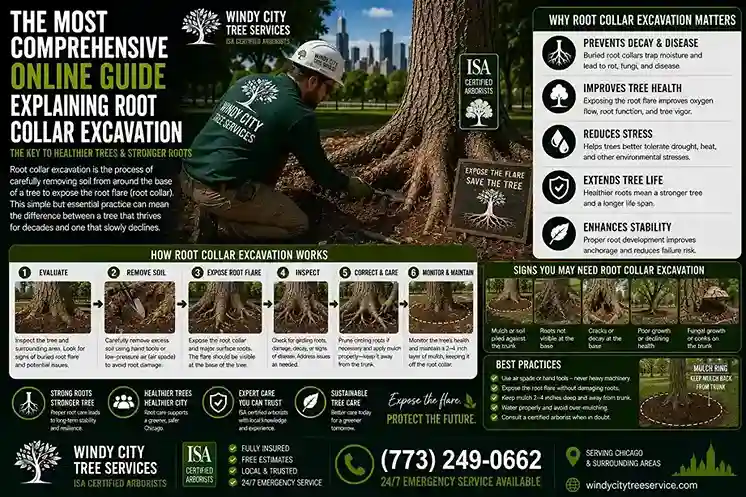
Treatment typically starts with soil decompaction, often using an Air Spade or vertical mulching to restore oxygen flow to surviving roots. Root collar excavation can reveal whether grade changes have buried the flare and correct the problem before it worsens. Deep root fertilization supports recovery by delivering nutrients directly into the root zone of urban soil that construction activity has often left depleted, and consistent irrigation during dry periods reduces additional stress while the tree rebuilds its root mass.
None of this guarantees recovery. A tree’s outcome depends on species tolerance, the extent of root loss, its age and prior health, and how quickly treatment began. Long-term monitoring, checking in on canopy density, growth rate, and any new symptoms over several years, remains the only reliable way to know whether treatment is working.
Building or Remodeling Near Mature Trees?
Protect your investment before construction begins. Our ISA Certified Arborists develop tree preservation plans, establish Tree Protection Zones, and use Air Spade technology to help reduce root damage.
☎️ (773) 249-0662 Schedule a Tree Preservation ConsultationProtected Construction Site vs. Unprotected Site
| Protected Site | Unprotected Site |
|---|---|
| Tree Protection Zone fencing installed pre-construction | No fencing; open access to root zone |
| Air Spade excavation near roots | Mechanical trenching through roots |
| Controlled, planned equipment traffic | Heavy equipment routed directly over roots |
| Arborist supervision throughout the project | No tree monitoring during construction |
| Root system largely preserved | Significant, often irreversible root loss |
Construction Activity vs. Potential Tree Damage
| Construction Activity | Potential Impact on Trees |
|---|---|
| Excavation | Severs structural and absorbing roots directly |
| Trenching | Cuts a linear path through the root system, often at shallow depth |
| Grading | Buries root flares or exposes roots to drying and injury |
| Foundation work | Removes large volumes of soil and roots beneath the canopy |
| Driveway installation | Compacts soil and removes shallow absorbing roots |
| Heavy equipment traffic | Compacts soil structure, reducing oxygen and water movement |
| Material storage | Compacts soil and blocks gas exchange over time |
✅ Action Plan
Homeowner Checklist: Protect Trees Before Construction Begins
- 1 Hire a certified arborist before finalizing your site plan
- 2 Identify the Critical Root Zone for every tree near the project
- 3 Install Tree Protection Zone fencing before equipment arrives
- 4 Prevent equipment traffic and parking near root zones
- 5 Avoid changing soil grade over root systems
- 6 Plan utility routes to avoid Critical Root Zones where possible
- 7 Use Air Spade excavation whenever roots must be exposed
- 8 Schedule a follow-up tree health inspection after project completion
Concerned About Construction Damage?
If your trees have been affected by excavation, grading, or heavy equipment, our arborists can evaluate root health and recommend the most appropriate treatment options.
Request a Tree Health Inspection❓ Common Questions
Frequently Asked Questions
What is a Tree Protection Zone?
How far do tree roots extend?
Can construction kill a mature tree?
How much root loss can a tree tolerate?
Is Air Spade safe around tree roots?
Can roots be pruned safely?
Should I consult an arborist before construction?
How long after construction do symptoms appear?
Can compacted soil be repaired?
What trees are most sensitive to construction damage?
Do I need a permit to work near a tree on a Chicago parkway?
Who is responsible for tree damage caused by a contractor?
Can I install a Tree Protection Zone myself?
Does mulch help protect roots during construction?
What is the difference between a Tree Protection Zone and the Critical Root Zone?
Can trenching for utilities be avoided near trees?
How do arborists measure the Critical Root Zone?
Will fencing alone guarantee my tree survives construction?
What should I do if I suspect my tree was already damaged by construction?
How much does tree preservation planning cost?
Can a tree preservation plan increase construction costs?
📌 Summary
Key Takeaways
- ✓ Most tree damage from construction happens underground and isn’t visible until months or years later.
- ✓ The Critical Root Zone usually extends well beyond a tree’s canopy, often 1 to 1.5 feet per inch of trunk diameter.
- ✓ Tree Protection Zone fencing, installed before equipment arrives, is the single most effective protective measure.
- ✓ Air Spade technology allows excavation near roots with far less risk than conventional digging.
- ✓ Soil compaction and grade changes can damage roots just as severely as direct excavation.
- ✓ Early involvement of a certified arborist, before a site plan is finalized, prevents most preventable root damage.
- ✓ Post-construction monitoring matters as much as pre-construction planning, since symptoms surface slowly.
Professional Tree Protection During Construction in Chicago
Construction doesn’t have to cost you valuable trees. Windy City Tree Services provides tree preservation planning, Tree Protection Zone installation guidance, Air Spade root excavation, root collar inspections, soil decompaction, tree health evaluations, and safe tree removal when necessary.
☎️ (773) 249-0662 · 📧 info@windycitytreeservices.com