What Is Air Spade Root Excavation? Guide | Windy City Tree Services
What Is Air Spade Root Excavation?
The tool that lets a Chicago arborist dig around your tree’s roots without cutting a single one. Here’s how it works, when you actually need it, and what to expect.
Most tree problems that end up costing homeowners real money didn’t start in the branches. They started underground, years earlier, where nobody was looking. A root flare buried two inches too deep during planting. A girdling root that’s been slowly strangling the trunk since 2015. Soil packed down by a construction crew that finished the job and drove off. None of that shows up on a walk-around inspection, at least not until the canopy starts thinning and it’s already a problem.
That’s the gap Air Spade excavation fills. It’s a way for an arborist to get down to the roots, look at what’s actually going on, and do something about it, without doing the kind of damage a shovel or a mini-excavator would do along the way. If you’ve heard the term thrown around by a tree company and weren’t totally sure what it meant, or whether your tree actually needs it, this guide walks through the whole thing: what the tool is, how the process works, which Chicago trees tend to need it most, and when it isn’t the right move at all.
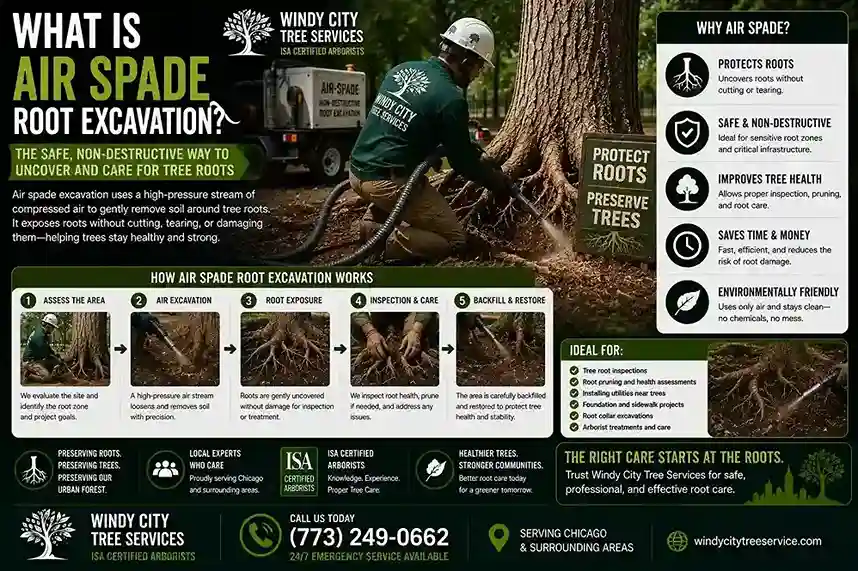
Air Spade root excavation is a non-destructive digging method that uses high-pressure compressed air, instead of a blade, to remove soil around tree roots. It lets an arborist inspect the root system, expose the root flare, relieve compacted soil, and diagnose problems like girdling roots or rot, all while leaving healthy roots intact.
1. What Is an Air Spade?
An Air Spade is a handheld pneumatic tool that connects to an air compressor and shoots a narrow, supersonic jet of air out of a nozzle. Point it at soil and the air breaks the particles apart and blows them clear, the same way a strong gust scatters loose dirt off a driveway. Point it at a root, and the root just sits there, untouched, because there’s nothing sharp involved.
That’s really the whole idea. Compressed air can tell the difference between soil and wood in a way that a shovel edge or an excavator bucket never will. Arborists didn’t invent the underlying technology. Air-powered excavation tools were originally developed for utility work, where crews needed to dig around buried gas lines and fiber cables without nicking them. Someone in the green industry eventually figured out the same principle solved a problem that had been frustrating arborists for decades: how do you actually see a tree’s root system without destroying it in the process?
Today, Air Spade work shows up in a handful of common situations: root collar excavations, soil decompaction around stressed trees, root inspections before and after nearby construction, and utility trenching near valuable landscape trees. It’s become standard enough that it’s referenced in ISA Best Management Practices for tree root management, and most established arboriculture programs teach it as part of root care.
2. How Air Spade Root Excavation Works
In practice, the process is more methodical than dramatic. Here’s roughly how a residential job goes from start to finish.
Site assessment
The arborist walks the site first, checking soil type, existing mulch or turf, sprinkler lines, and how close the work area sits to structures or hardscape.
Mulch and debris pulled back
Surface material gets moved aside so the crew is working with bare soil and can see what they’re doing.
Compressed air excavation
The operator works the nozzle in controlled passes, loosening soil a section at a time rather than blasting the whole area at once. A vacuum or shovel-and-tarp setup usually catches the displaced soil so it doesn’t scatter across the yard.
Root inspection
Once soil is cleared to the target depth, usually down to the root flare or wherever the problem is suspected, the arborist examines the roots directly. This is the step that actually answers the “why is this tree struggling” question.
On-the-spot treatment
Depending on what’s found, this might mean pruning a girdling root, correcting soil grade, applying root-zone fertilization, or simply documenting the findings for a bigger treatment plan.
Backfill and cleanup
Soil, sometimes amended with compost or an aeration blend, goes back in. Mulch gets reset. The site should look, more or less, like nobody was ever there.
Safety matters more here than the marketing usually lets on. The air pressure involved is strong enough to move soil and small stones at real speed, which means eye protection, hearing protection, and careful nozzle control aren’t optional. This is a job for a trained operator, not a rental-store tool for a Saturday project.
3. Why Traditional Digging Can Damage Trees
A shovel is a fine tool for a lot of yard work. It’s a rough one for root work. Every time a blade goes into the ground near a tree, there’s a real chance it’s slicing through a root that took years to grow, and the tree has no way of stopping that damage once it happens.
Mechanical excavation makes the problem worse, not better. A mini-excavator bucket doesn’t distinguish between soil and a two-inch structural root any more than a shovel does, it just applies more force. Construction crews cutting a trench for a new sidewalk or utility line have severed root systems that took forty years to establish, sometimes without anyone on site realizing it happened until the tree started declining a season or two later.
The damage isn’t only about the cut itself. Digging compacts the soil around it, disturbs the delicate mycorrhizal relationships in healthy root zones, and can open wounds that decay organisms move into. A tree can often tolerate losing a small root here and there. Losing a large structural root, or several roots on one side of the trunk, is a different story, and it’s exactly the kind of injury that traditional digging is prone to causing without anyone intending it.
4. Common Reasons Arborists Recommend Air Spade Excavation
Not every tree needs this. Here’s when it actually earns its place on a treatment plan:
- Root collar excavation, to check whether the trunk flare is buried under years of accumulated soil or mulch.
- Girdling root removal, when a root is wrapped around the trunk or another root and slowly cutting off circulation.
- Soil compaction relief, especially in yards with heavy foot traffic, parking, or recent equipment access.
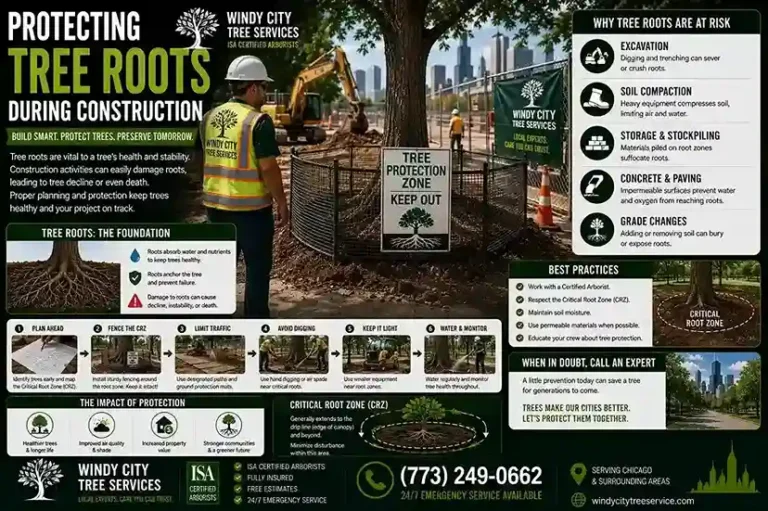
- Construction damage assessment, before, during, or after nearby digging, grading, or trenching.
- Unexplained decline, when a tree is struggling and nothing above ground explains why.
- Drainage problems, when water pools around the base and roots may be sitting in saturated soil.
- Utility work near valuable trees, so a trench can be dug without severing major roots.
- Planting depth verification, on trees that were installed by a previous owner or landscaper and never checked.
Chicago’s building boom over the past decade has made that fourth item a lot more common than it used to be. A new addition, a driveway replacement, a utility upgrade, any of it can compact soil or nick roots well outside what looks like the “work zone.” An Air Spade check before and after that kind of project is one of the more cost-effective insurance policies a homeowner with a mature tree can buy.
5. Benefits of Air Spade Technology
The advantages line up pretty directly against the risks of traditional digging:
- Minimizes the chance of cutting healthy roots during inspection or excavation
- Loosens compacted soil, improving oxygen flow to the root zone
- Improves water infiltration, since air-loosened soil isn’t packed as tight
- Gives an accurate, direct look at root problems instead of a guess based on symptoms above ground
- Makes on-the-spot treatment possible, since the roots are already exposed
- Supports long-term tree preservation by catching problems before they become terminal
None of that means every Air Spade job produces a dramatic turnaround. A tree that’s been declining for a decade because of a buried root flare might respond well once that flare is exposed and corrected. A tree with advanced trunk decay probably won’t, no matter how carefully the roots get excavated. What the tool reliably delivers is better information and less collateral damage while getting it, and from there, results depend on what’s actually wrong with the tree.
6. Tree Problems Air Spade Can Help Diagnose
Once the soil comes away, an arborist is usually looking for one or more of these:
- Root rot, visible as soft, discolored, or foul-smelling root tissue
- Girdling roots, wrapped around the trunk or another root, cutting off flow
- Buried root flare, where the trunk base sits below grade instead of visibly flaring out
- Construction damage, torn bark, crushed roots, or severed structural roots
- Soil compaction, dense, airless soil that roots can’t push through
- Mechanical injuries, old lawn mower or trimmer damage near the base
- Poor planting depth, a tree installed with the root ball still wrapped or set too low
- Advanced root decay, structural roots that have weakened enough to raise stability concerns
7. Which Trees Benefit Most?
Any species can develop root problems, but a few show up constantly in Chicago yards and parkways. Oaks and maples, in particular, are notorious for developing girdling roots when they’re planted with the root ball still bound or when mulch gets piled against the trunk year after year. Newer street plantings of honey locust, a favorite for parkway trees because it tolerates salt and compaction reasonably well, still need a root flare check if they were installed by a crew in a hurry.
Suitability really comes down to the individual tree and its site, not the species alone. A 60-year-old oak in a Beverly backyard with deep, undisturbed soil is a very different candidate than a young honey locust squeezed into a parkway cutout on a busy street. An arborist’s on-site assessment matters more here than any general rule about which species “need” this work.
8. Air Spade & Soil Decompaction
Chicago soil has a reputation for a reason. A lot of the clay-heavy ground under city lots compacts easily, and it doesn’t take much, foot traffic, a parked trailer, a construction crew staging equipment on the lawn for a few weeks, to press the air pockets out of it. Compacted soil holds less oxygen and water than roots need, and roots simply can’t push through it the way they can through looser ground.
Decompaction work with an Air Spade loosens that soil directly, without the collateral root damage that tilling or trenching would cause. Crews often follow it up by backfilling with an amended mix, sometimes blended with compost or expanded aggregate, that resists re-compacting as quickly as the original soil did. For trees stressed by years of heavy foot traffic or a driveway that got poured a little too close, this step alone can make a real difference in how much water and oxygen actually reach the roots.
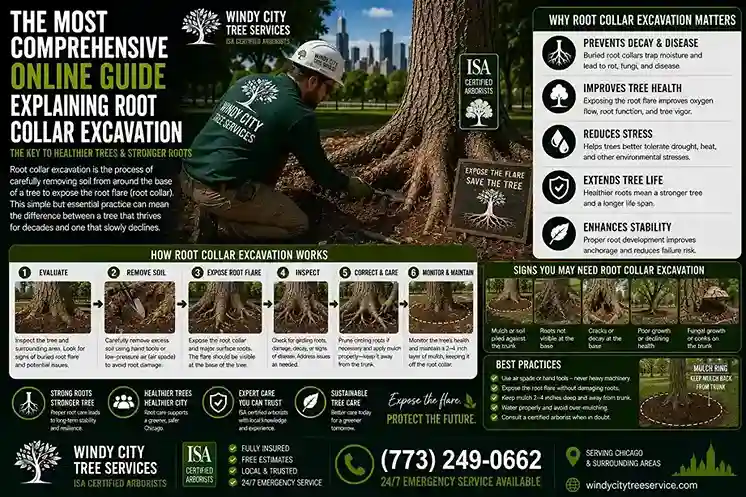
9. Root Collar Excavation Explained
The root collar, also called the root flare, is the point where a tree’s trunk widens out into its main structural roots. On a healthy, correctly planted tree, you can see that flare above the soil line. It should look like the trunk is gently fanning out into the ground, not disappearing straight down like a fence post.
When trees get planted too deep, or when mulch keeps getting piled against the trunk over the years (“volcano mulching,” if you’ve heard the term), that flare ends up buried. Buried flares trap moisture against the bark, which invites decay, and they hide girdling roots that would otherwise be obvious. A root collar excavation removes soil down to that flare, so an arborist can actually see it and correct what’s wrong, whether that’s excess soil, a girdling root, or both. Left unaddressed for long enough, a buried root flare can shorten a tree’s life by years, sometimes decades, before symptoms above ground make it obvious something’s wrong.
10. Air Spade vs. Traditional Excavation
| Air Spade | Traditional Digging |
|---|---|
| Uses compressed air, no cutting edge | Uses a blade or bucket that can sever roots |
| Preserves healthy root structure | Higher risk of root injury |
| Precise, controlled soil removal | Less precision, especially with machinery |
| Roots stay visible and intact for inspection | Limited visibility of what’s below the surface |
| Better suited to diagnostic work | Faster for general excavation, not root-sensitive work |
| Requires a trained operator and equipment | Lower equipment cost, more common tools |
| Root Problem | What the Excavation Shows |
|---|---|
| Buried root flare | Exact depth of burial and how far it extends around the trunk |
| Girdling roots | Which roots are involved and whether removal is safe |
| Soil compaction | How dense the soil is and how far compaction reaches |
| Root rot | How much root tissue is affected and how far it’s spread |
| Construction damage | Which roots were cut, crushed, or exposed by nearby work |
| Poor drainage | Whether roots are sitting in consistently saturated soil |
11. Can Air Spade Save a Declining Tree?
Sometimes, yes. And sometimes it’s the reason a declining tree gets a clear diagnosis instead of a guess. Air Spade excavation is fundamentally a diagnostic and treatment-support tool, not a cure by itself. What it does well is get an arborist eyes-on with the actual root system, so decisions about fertilization, root pruning, cabling, or continued monitoring are based on what’s really happening underground instead of a hunch based on canopy symptoms.
Early intervention makes the biggest difference. A tree with a buried flare or a single girdling root, caught before serious decay sets in, often responds well once the issue is corrected and the tree gets a season or two to recover. A tree that’s already lost a large share of its root system to rot or construction damage is a harder case, and Air Spade work there is more about confirming the extent of the damage than reversing it.
12. When Air Spade Is Not Appropriate
This isn’t a tool for every situation, and a good arborist will tell you when it’s not the right move.
- Severe structural failure. If a tree already shows major trunk cavities, extensive lean, or root plate movement, the priority is a risk assessment, not a root excavation.
- Removal is the better call. A tree that’s dead, hazardous, or beyond reasonable recovery doesn’t need diagnostic root work, it needs to come down safely.
- Site conditions limit access. Extremely tight urban lots, underground utilities in the wrong spot, or frozen winter ground can all make the work impractical or unsafe on a given day.
- Other diagnostics fit better. Some canopy or trunk issues, like a fungal fruiting body higher up the trunk, call for a different kind of inspection entirely.
Suspect Hidden Root Problems?
Our ISA Certified Arborists use Air Spade technology to safely inspect roots, relieve soil compaction, expose root flares, and build a tree care plan around what they actually find.
📞 (773) 249-0662 — Schedule an Air Spade Inspection🔍 Signs Your Tree May Need Air Spade Root Excavation
- Declining or thinning canopy with no obvious cause
- Smaller than normal leaves this season
- Yellowing foliage that isn’t a normal seasonal change
- Browning leaf edges during the growing season
- Roots that are exposed, circling, or wrapping the trunk
- Water pooling around the base after rain
- Recent construction, grading, or trenching nearby
- Mulch piled up against the trunk like a volcano
- Noticeably slower growth compared to past years
- A tree that’s started leaning more than it used to
13. Frequently Asked Questions
A handheld tool that fires compressed air to break up and clear soil, instead of cutting through it like a shovel or excavator bucket would.
It’s built to avoid it. Air moves soil particles rather than slicing through them, so healthy roots stay intact. Fine root hairs can dry out if left exposed too long, which is why the work is done carefully and in stages.
A shovel can’t tell soil from a root. Compressed air can. That lets an arborist see the whole root system in place, undamaged, for a far more accurate diagnosis.
Removing soil down to where the trunk flares into the main roots, so an arborist can check whether the tree was planted too deep or has girdling roots.
No single tool fixes root rot on its own. Excavation exposes the affected roots so an arborist can judge how far it’s spread and plan treatment, which might mean improving drainage, removing decayed tissue, or in advanced cases, recommending removal.
A single root flare inspection typically runs one to three hours. Larger decompaction projects across a mature tree’s full root zone can take most of a day.
Yes, and mature trees are often the ones that benefit most, since they’ve had decades to accumulate compacted soil or girdling roots from earlier planting or construction.
Yes. The process loosens compacted soil directly, and jobs often finish with an amended backfill mix that resists compacting again as quickly.
Whenever a tree shows unexplained decline, before or after nearby construction, when a buried root flare is suspected, or as a preventive check on a valuable mature tree every few years.
It depends on the goal. A root flare check might only go down 6 to 12 inches around the trunk. A full decompaction project can extend several feet out under the canopy.
There’s some disruption since soil and mulch get displaced during the process, but a professional crew contains debris and restores grade and mulch when the job is done.
It’s noticeably loud, close to a pressure washer running at close range. Most residential jobs are short enough that it isn’t a major disruption.
Generally no for private property. For trees on a Chicago parkway between the sidewalk and street, check with the city, since parkway trees fall under municipal rules.
Yes, it’s one of the more common reasons Chicago arborists use it. It can relieve compaction from heavy equipment and expose roots that were nicked or crushed so a treatment plan can address what’s actually there.
Both avoid cutting through what’s underground, but a vacuum excavator sucks loosened soil into a tank for full removal, which utility crews often prefer. An Air Spade blows soil aside, which works well for tree work where the soil goes right back in.
Routine tree health work usually isn’t covered by homeowners insurance. If the work is tied to a storm or construction damage claim, check with your insurer, since some claims do cover diagnostic tree work.
Sometimes, if the decline is caught early and the cause is something excavation can address, like a buried flare or girdling root. It’s not a fix for trees with severe trunk decay or major structural failure.
Every three to five years for a healthy, high-value tree with no symptoms. Sooner for any tree showing decline or sitting near recent construction.
The crew backfills the area, often with an amended soil blend, may apply root-zone fertilization, and lays out next steps, whether that’s monitoring, pruning, cabling, or further treatment.
It depends on tree size and how much soil needs to move. A focused root flare check costs less than a full decompaction project across a mature tree’s root zone. We provide free written estimates before any work starts.
14. Key Takeaways
- Air Spade root excavation uses compressed air, not a blade, to remove soil around tree roots without cutting them.
- It’s commonly used for root collar excavation, soil decompaction, and diagnosing girdling roots, root rot, or construction damage.
- It lets an arborist see and treat root problems directly instead of guessing based on symptoms above ground.
- Results depend on the tree’s underlying condition. It’s a diagnostic and treatment-support tool, not a guaranteed fix.
- It’s not right for every situation, especially trees with severe structural failure that need a removal assessment instead.
- This is skilled work. It should be performed by a trained, insured crew, not attempted as a DIY project.
For deeper reading on tree root care standards, see the International Society of Arboriculture, the Tree Care Industry Association, and the Morton Arboretum, based right here in Illinois. Local homeowners can also reach out to the University of Illinois Extension for regional soil and tree health guidance.
Protect Your Trees from Hidden Root Damage
A root inspection today can catch a problem years before it shows up in the canopy. It’s a lot cheaper than a removal.
Request a Tree Health EvaluationProfessional Air Spade Root Excavation & Tree Preservation in Chicago
Healthy trees start with healthy roots. Windy City Tree Services provides Air Spade excavation, root collar inspections, soil decompaction, tree health evaluations, deep root fertilization, tree preservation, and safe removal when it’s genuinely the better option.