Common Tree Pruning Mistakes Homeowners Make (And How to Avoid Them
Pruning looks simple. Grab a pair of loppers, cut off what looks messy, and the tree looks tidier. That’s exactly the assumption that causes most of the damage in this article.
Tree pruning is one of the most misunderstood parts of tree care, and small mistakes rarely show up right away. A bad cut today can turn into decay, disease, or a hazardous limb three, five, even ten years down the road, long after anyone remembers how the tree was pruned in the first place.
The upside is that almost every common pruning mistake is avoidable once you know what to look for. This guide walks through the mistakes homeowners make most often, why each one actually harms the tree, and how ISA Certified Arborists approach the same work differently, so you can protect the trees you’ve already invested years in growing.
What are the most common tree pruning mistakes? The most common mistakes include topping trees, removing too much canopy at once, making improper cuts (flush cuts, stub cuts, or cuts into the branch collar), pruning at the wrong time of year, using dull or dirty tools, and attempting hazardous pruning without proper training. Following accepted arboricultural practices, like ANSI A300 standards, reduces tree stress and supports long-term health.
Why Proper Pruning Matters
Every cut you make on a tree is a wound, and how that wound heals depends entirely on where and how the cut was made. Trees don’t heal the way people do. Instead of regenerating damaged tissue, they compartmentalize it, sealing off the wound with new growth around the edges while the damaged wood stays inside, permanently.
That biology is exactly why cut placement matters so much. A clean cut in the right spot lets a tree seal a wound efficiently. A cut in the wrong spot leaves an opening that decay organisms can exploit for years, weakening the tree’s structural integrity from the inside long after the outside looks fine.
Beyond biology, pruning affects safety directly. Poor pruning history is one of the most common contributing factors in storm-related limb failure. Get it right, and you’re not just improving how a tree looks. You’re protecting its long-term health and reducing real risk to your property.
Topping Trees
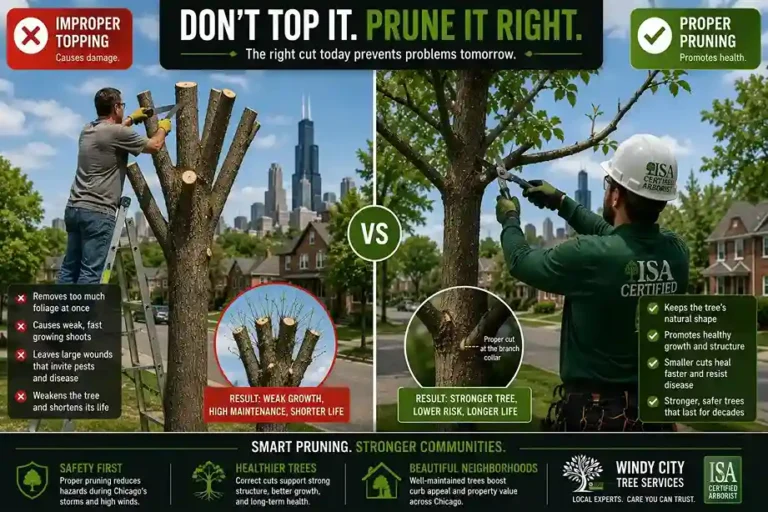
Topping means cutting main branches or the trunk back to stubs, usually to reduce a tree’s height quickly. It’s one of the most damaging things you can do to a tree, and it’s also one of the most common DIY mistakes, mostly because it looks like a fast, effective solution to a tree that seems “too big.”
The problem is what happens next. A topped tree responds by pushing out a flush of weak, fast-growing shoots called water sprouts, attached only shallowly to the stub instead of grown into the wood the way a natural branch would be. Those sprouts grow fast, but they’re poorly anchored and prone to breaking in wind, often within just a few years.
Topping cuts also leave large, exposed wounds that a tree struggles to seal, opening the door to decay and disease. Exposed inner bark left by topping can suffer sunscald, further stressing the tree. The combined effect is a tree that’s uglier, weaker, and shorter-lived than if it had never been touched. ANSI A300 pruning standards explicitly recommend against topping for exactly these reasons.
Never top a tree to control its height. If a tree is too large for its space, the right answer is professional crown reduction, a slower, more selective process that maintains the tree’s natural form and structural strength.
Removing Too Much Canopy
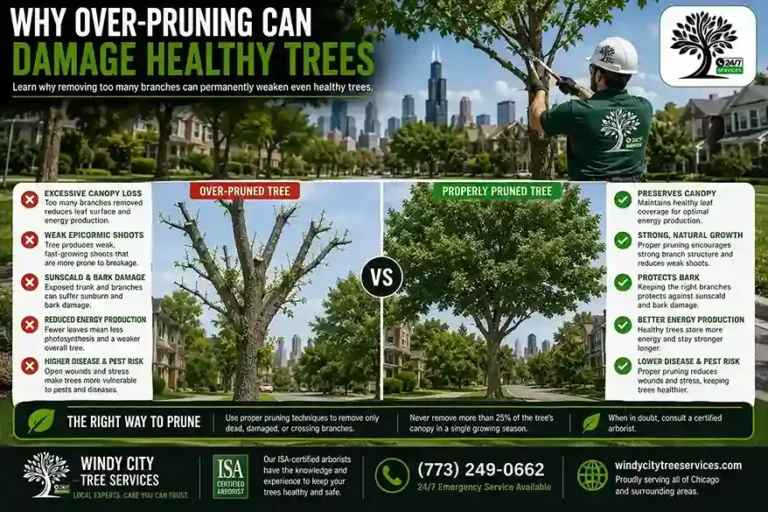
Enthusiasm is the enemy here. Once you start pruning, it’s easy to keep going, especially with power tools that make removing branches fast and easy. The problem is that a tree’s canopy is its food-producing engine. Remove too much of it at once, and you cut into the tree’s ability to photosynthesize, which stresses the whole tree, not just the branches you removed.
Over-pruned trees commonly respond with excessive sucker growth as the tree tries to replace lost foliage quickly, and newly exposed interior bark can suffer sunburn after years of shade. Recovery from heavy over-pruning can take multiple growing seasons, and a severely weakened tree is more vulnerable to pests and disease during that recovery window.
A widely cited general guideline in the industry is to avoid removing more than about 25% of a tree’s live canopy in a single pruning season, though the actual right amount always depends on the specific tree’s species, age, health, and site conditions. This is exactly the kind of judgment call where professional experience matters more than a hard rule.
Making Improper Pruning Cuts
Where a cut is made matters as much as whether it should be made at all. The branch collar, the slightly swollen area where a branch meets the trunk or a larger limb, contains the tissue a tree uses to wall off decay and seal the wound. Cut in the wrong place, and you damage the exact mechanism the tree relies on to heal.
- Flush cuts. Cutting flat against the trunk removes the branch collar entirely, creating a wound the tree can’t seal properly and inviting decay directly into the trunk.
- Stub cuts. Leaving a stub beyond the branch collar prevents the tree from sealing the wound at all. The stub typically dies back and becomes a decay entry point of its own.
- Cutting into the branch collar. Even a partial cut into the collar tissue compromises the tree’s ability to compartmentalize the wound.
- Incorrect reduction cuts. A proper reduction cut goes back to a lateral branch large enough to take over as the new terminal growth. Cutting back to an undersized branch, or to no branch at all, creates the same weak-regrowth problem as topping on a smaller scale.
The correct technique cuts just outside the branch collar, close enough to allow proper healing, far enough to leave that critical tissue intact. It’s a small difference in distance with a large difference in outcome.
Pruning at the Wrong Time
Timing affects both how well a tree heals and how much stress the pruning causes. General patterns worth knowing:
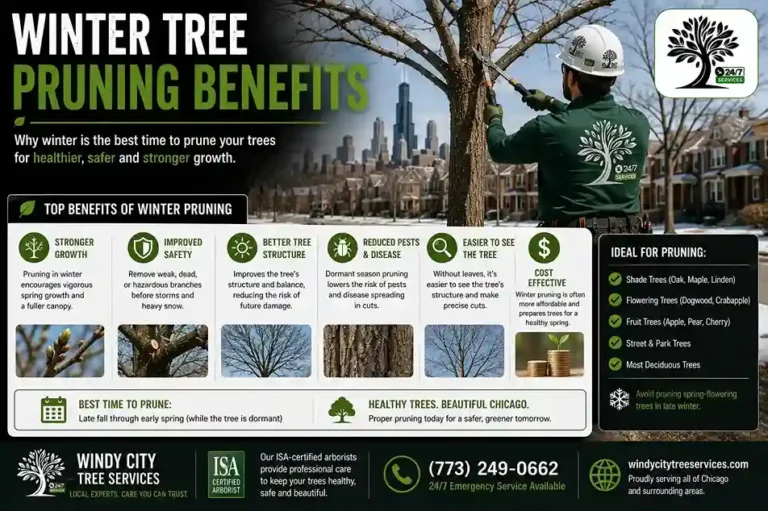
- Late winter (dormant season). The preferred window for most shade trees, since the tree isn’t actively growing, wounds close well as spring growth resumes, and it’s easier to see branch structure without leaves in the way.
- Spring. Generally best avoided for major pruning, since trees are pushing new growth and using significant stored energy. Spring-flowering trees are an exception; they’re usually pruned right after they finish blooming so you don’t accidentally remove next year’s flower buds.
- Summer. Reasonable for minor corrective pruning or removing storm damage, but heavy pruning during peak growth adds unnecessary stress.
- Fall. Often discouraged for many species since wounds tend to heal more slowly heading into dormancy, and pruning cuts can attract certain fungal pathogens more readily in fall conditions.
Species also matters. Oaks, for example, are best pruned during dormancy to reduce the risk of attracting the beetles that spread oak wilt. For a more detailed seasonal breakdown, see our guide on the best time to trim trees in Chicago.
Using Dull or Dirty Tools
A dull blade doesn’t cut, it tears. Ragged, torn wounds heal far more slowly than clean cuts and give decay organisms a much easier entry point. If you’ve ever seen a pruning cut with shredded, splintered bark around the edges, that’s a tool problem, not a technique problem.
Dirty tools carry a separate risk: disease transmission. Pruning tools that move from an infected tree to a healthy one without cleaning in between can spread diseases like oak wilt directly through the wound. This is exactly why professional crews sanitize tools between cuts on different trees, especially during active disease season.
Keeping pruning tools sharp and clean is a simple habit that measurably improves how well a tree heals, and it costs nothing beyond a little maintenance time.
Removing the Central Leader
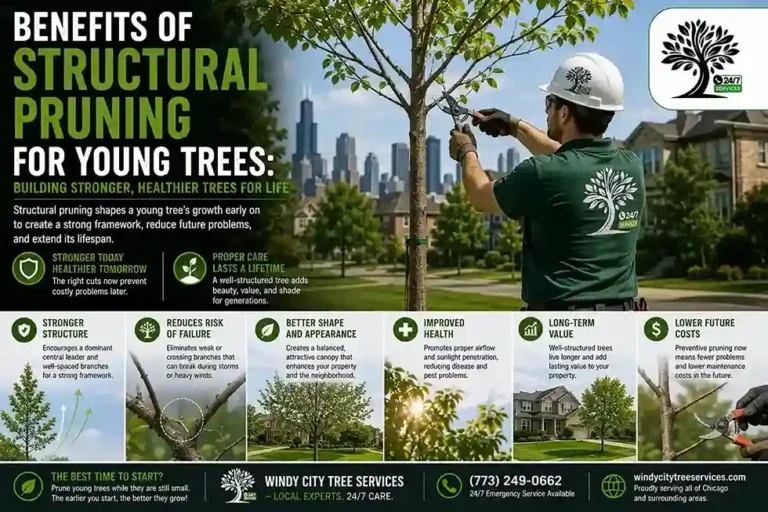
Young trees often have one dominant upward-growing stem, called the central leader, which sets the tree’s future shape and structural strength. Cutting it off, sometimes by accident while removing what looks like a competing branch, forces the tree to develop multiple co-dominant stems instead of one strong trunk.
That change has long-term consequences. Multiple leaders growing from the same point often develop weak attachments with included bark between them, exactly the kind of structural defect that shows up in storm damage years later. Structural pruning while a tree is young, guiding it toward one strong leader and well-spaced branches, is one of the most effective, lowest-cost ways to prevent expensive corrective work decades down the road.
Ignoring Dead or Diseased Branches
It’s easy to leave a dead branch alone if it’s not actively bothering anyone. That instinct backfires in a few ways. Dead branches are a hazard on their own, prone to falling with no warning as they dry out and lose flexibility. Left in place, they also serve as an entry point for insects and can allow disease to spread further into otherwise healthy wood.
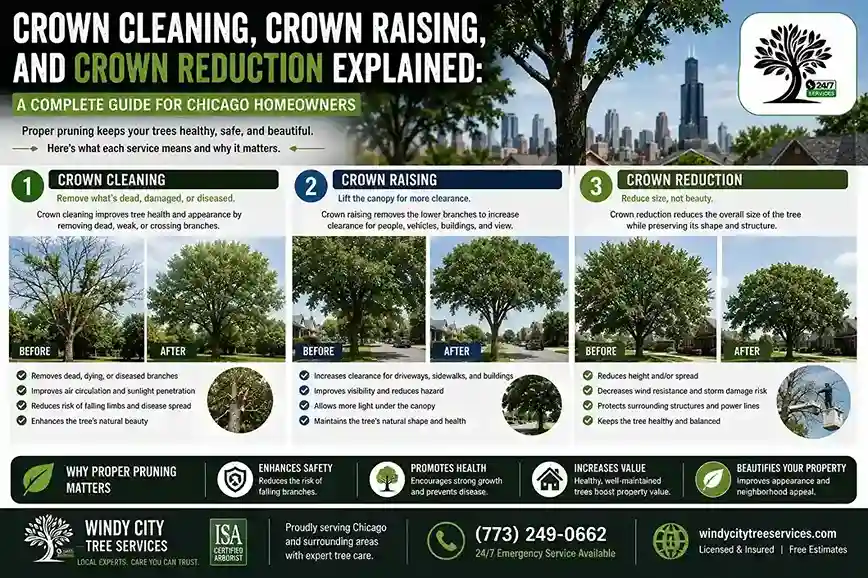
Diseased branches carry an even more direct risk. Leaving infected wood in the canopy gives a pathogen more time to spread into the rest of the tree, or to nearby trees if the disease is contagious. Prompt removal of dead and diseased wood, sometimes called crown cleaning, is one of the simplest and highest-value pruning tasks a tree can receive.
Climbing Trees Without Proper Safety Equipment
This is where pruning mistakes stop being about tree health and start being about personal safety. Ladders on uneven ground, chainsaws used overhead, and branches that shift unexpectedly under weight are a genuinely dangerous combination, and tree work consistently ranks among the more hazardous jobs homeowners attempt themselves.
- Ladder hazards. Unstable footing and overreaching are common causes of serious falls during DIY pruning.
- Chainsaw injuries. Using a chainsaw overhead, off balance, or without proper protective gear is one of the leading causes of serious tree-work injuries.
- Falling branches. A cut branch doesn’t always fall where you expect, especially in a tree with a dense canopy.
- Electrical hazards. Any pruning near power lines carries the risk of electrocution, even without direct contact, since electricity can arc across a short gap.
Any pruning work near power lines, on large trees, or requiring climbing equipment should go to a trained, insured professional. This isn’t overcaution. It’s the actual line where “homeowner project” becomes “specialized, regulated work.”
DIY Pruning Near Homes and Utility Lines
Pruning close to a structure adds a second layer of risk on top of personal safety: property damage. A branch that falls wrong can crack a roof, dent a car, or take out a fence, and if the work wasn’t done by a licensed, insured contractor, that damage often becomes your problem to fix out of pocket.
Utility line clearance is its own category of risk. Utility companies maintain their own clearance standards, and pruning near their lines without coordination can create a hazard for you, for utility workers, and for the surrounding neighborhood. Liability exposure here is real. Insurance coverage for DIY tree work gone wrong is often more limited than homeowners expect, particularly if the damage involved a third party’s property.
Ignoring Professional Tree Inspections
The last mistake on this list isn’t really about a specific cut, it’s about what homeowners never see. Internal decay, early-stage disease, and structural defects like weak branch unions often don’t show visible symptoms until they’ve progressed significantly.
A professional tree health inspection follows a structured Tree Risk Assessment process, evaluating condition, structure, and site factors to catch problems while they’re still manageable. Skipping regular inspections means most homeowners only find out about a serious defect after a storm, or after a branch has already come down.
Chicago-Specific Pruning Challenges
Chicago’s climate adds a few local wrinkles to standard pruning guidance. High winds off Lake Michigan put extra load on poorly pruned canopies, making structural issues from bad pruning history more likely to turn into actual failures. Heavy snow and ice storms add weight-based stress every winter, which is exactly why removing weak, poorly attached growth ahead of time matters so much here.
Road salt exposure, common along Chicago’s streets and sidewalks, adds a chronic stressor that can weaken trees near heavily salted areas over time, making proper pruning practices even more important for maintaining overall tree vigor. The city’s mature urban canopy, especially in historic neighborhoods, includes decades-old trees carrying pruning history from long before current best practices were widely adopted, which is part of why corrective, restorative pruning is such a common need on older Chicago properties.
What Professional Arborists Do Differently
The gap between DIY pruning and professional pruning isn’t really about tools, though equipment matters. It’s about a different underlying process:
- Tree biology knowledge. Understanding how a specific species responds to pruning informs every cut decision.
- ANSI A300 standards. A formal framework for cut placement, technique, and canopy removal limits, followed consistently rather than improvised.
- ISA Best Management Practices. Broader guidance covering everything from timing to tool sanitation to structural pruning strategy.
- Species-specific pruning. An oak, a maple, and a fruit tree all get pruned differently, and knowing those differences prevents avoidable mistakes.
- Risk assessments. A trained eye catches structural defects most homeowners would never notice.
- Proper equipment. Sharp, sanitized tools and climbing or rigging gear rated for the job, not repurposed household tools.
- Long-term planning. Professional pruning considers where a tree will be in ten or twenty years, not just how it looks this weekend.
Warning Signs Your Tree Needs Professional Attention
- Visible cracks in the trunk or major limbs
- Significant deadwood throughout the canopy
- A tree that’s leaning, especially with a new or worsening lean
- Co-dominant stems with a tight, V-shaped union
- Fungal growth (mushrooms or conks) at the base or on the trunk
- Recent storm damage that hasn’t been assessed
- Branches with weak, narrow attachment angles
If you notice more than one of these on the same tree, it’s worth having a certified arborist take a closer look. For a deeper dive, see our related guide on 10 signs a tree is dangerous on your Chicago property.
How to Avoid Costly Pruning Mistakes
- Schedule annual inspections so small issues get caught before they become expensive problems.
- Prune at the right time for the specific species you’re working with, not just whenever it’s convenient.
- Use correct technique, cutting just outside the branch collar and never flush against the trunk.
- Hire ISA Certified Arborists for anything beyond small, easily reachable deadwood.
- Build a long-term maintenance plan instead of reactive, one-off pruning whenever a tree looks overgrown.
Correct Pruning vs. Improper Pruning
| Feature | Proper Pruning | Improper Pruning |
|---|---|---|
| Tree Health | Supports vigor and long-term growth | Stresses the tree, invites disease |
| Wound Healing | Seals efficiently around clean collar cuts | Slow or incomplete sealing, open decay entry points |
| Storm Resistance | Balanced canopy handles wind load well | Weak regrowth and poor structure fail in storms |
| Appearance | Natural form, balanced shape | Stubby, uneven, or artificially shaped |
| Longevity | Extends tree lifespan | Shortens lifespan, increases decline risk |
Common Mistakes and Their Consequences
| Mistake | Potential Consequences | Professional Solution |
|---|---|---|
| Topping | Weak regrowth, decay, sunscald, shortened lifespan | Selective crown reduction to preserve structure |
| Flush Cuts | Removed branch collar, poor wound sealing, decay entry | Recut technique respecting the collar going forward |
| Stub Cuts | Dieback, decay pocket at the stub | Corrective pruning back to healthy collar tissue |
| Over-Pruning | Stress, sucker growth, sunburn, slow recovery | Staged pruning across multiple seasons |
| Wrong Season | Added stress, disease susceptibility, poor healing | Species-appropriate seasonal pruning schedule |
| Dirty Tools | Disease transmission between trees, ragged wounds | Sanitized, sharp tools and proper cut technique |
Homeowner Checklist: Before You Prune Your Tree
- Do I know the tree species, and its specific pruning needs?
- Is the timing appropriate for this species right now?
- Are my tools clean and sharp?
- Am I only removing dead, damaged, or clearly hazardous branches?
- Am I avoiding cuts into the branch collar?
- Is the work near power lines, a roof, or another structure?
- Given the size or location of this tree, should I call a certified arborist instead?
Frequently Asked Questions
Is topping a tree bad?
Yes. Topping forces weak, poorly attached regrowth, creates large wounds prone to decay, and typically shortens the tree’s lifespan. ANSI A300 standards recommend against it.
Can over-pruning kill a tree?
It can, especially if a large percentage of the canopy is removed at once or repeatedly over consecutive seasons. Over-pruning stresses the tree’s ability to photosynthesize and recover.
What is a branch collar?
It’s the slightly swollen area where a branch meets the trunk or a larger limb. It contains tissue the tree uses to seal off pruning wounds, so cutting through it prevents proper healing.
How much canopy can be removed at once?
A commonly cited guideline is no more than about 25% of live canopy in a single season, though the right amount depends on the tree’s species, age, health, and site conditions.
When should I prune trees?
Most shade trees do best pruned during late winter dormancy. Spring-flowering trees are typically pruned right after they bloom. Timing varies by species, so it’s worth checking species-specific guidance.
Can dirty tools spread disease between trees?
Yes. Pruning tools that touch an infected tree can carry pathogens to the next tree they cut, which is why sanitizing tools between trees matters, especially during active disease seasons.
Should I seal pruning wounds with paint or sealant?
Generally, no. Modern arboricultural practice favors letting a properly made cut seal naturally rather than using wound dressing, which research has found doesn’t speed healing and can sometimes trap moisture against the wound.
Can improper pruning attract insects?
Yes. Fresh, poorly made wounds and stressed trees are more attractive to certain wood-boring insects and disease-carrying beetles than clean cuts on a healthy tree.
Is DIY pruning safe?
For small, easily reachable deadwood on a small tree, it can be reasonably safe with the right tools. Anything involving climbing, chainsaws overhead, or proximity to power lines should go to a trained professional.
When should I hire a certified arborist instead of doing it myself?
Any time the tree is large, the work requires climbing or a ladder, the tree is near power lines or a structure, or you’re unsure about proper technique, hire a professional.
What’s the difference between tree pruning and tree trimming?
The terms are often used interchangeably, though “pruning” more precisely refers to selective cuts made for tree health and structure, while “trimming” is sometimes used more casually for general shaping.
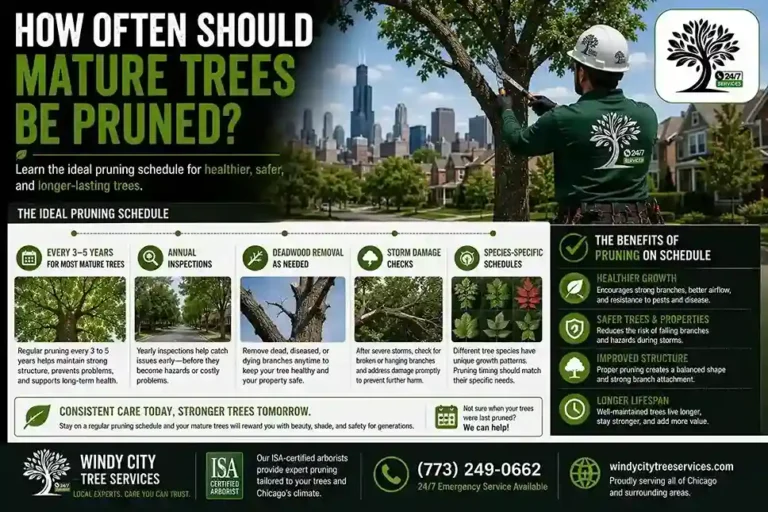
How often should mature trees be pruned?
Most mature, healthy trees benefit from inspection and light maintenance pruning every few years, though the right interval depends on species, condition, and site.
What is structural pruning, and when should it happen?
Structural pruning guides a young tree toward a strong central leader and well-spaced branches. It’s most effective when started early, ideally within the first several years after planting.
What’s the difference between crown cleaning, crown raising, and crown reduction?
Crown cleaning removes dead or diseased wood. Crown raising removes lower branches for clearance. Crown reduction selectively decreases a tree’s height or spread while preserving its natural form.
Why does over-pruning damage otherwise healthy trees?
Removing too much live canopy at once cuts into the tree’s food production capacity and triggers stress responses like excessive sucker growth, which can take multiple seasons to recover from.
Are there benefits to winter pruning?
Yes. Dormant-season pruning reduces stress on the tree, makes branch structure easier to see without leaves, and often results in cleaner wound sealing as spring growth resumes.
Does tree trimming improve property value?
Well-maintained, properly pruned trees generally support curb appeal and property value, while visibly hazardous or poorly shaped trees can have the opposite effect.
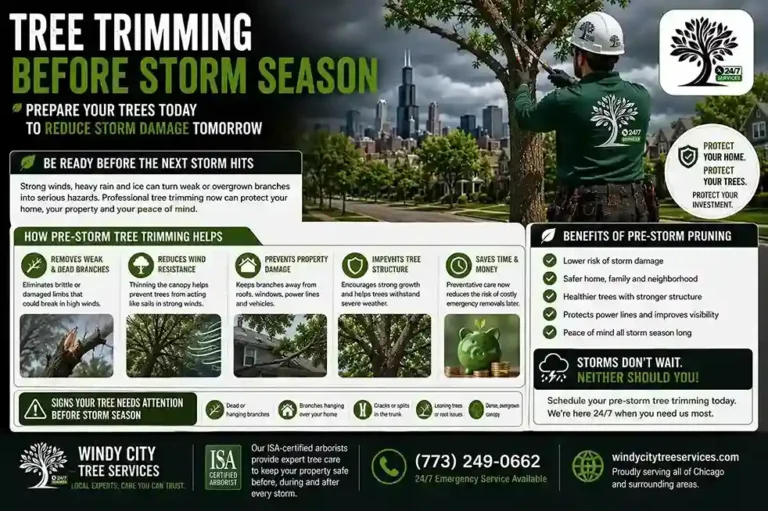
Should I prune trees before storm season?
Yes, removing deadwood and correcting structural weaknesses before storm season is one of the most effective ways to reduce the risk of storm-related limb failure.
Is it safe to remove trees near homes or power lines myself?
No. This work carries serious risk of property damage, injury, or electrocution, and should always be handled by a licensed, insured professional coordinated with the utility company when needed.
What should I do if I think my tree was pruned incorrectly in the past?
Schedule an inspection with a certified arborist. Many pruning mistakes, including topping damage, can be at least partially corrected over time with proper restorative pruning.
Sources & Further Reading
- International Society of Arboriculture (ISA), Best Management Practices
- ANSI A300 Tree Care Standards, Part 1: Pruning
- USDA Forest Service, Urban Forestry Resources
- University of Illinois Extension, Tree Care Publications
- The Morton Arboretum, Tree & Plant Advice
This article is provided for general educational purposes. Every tree responds differently to pruning based on species, age, and condition; consult a certified arborist for guidance specific to your trees.