How Tree Trimming Improves Property Value | Chicago
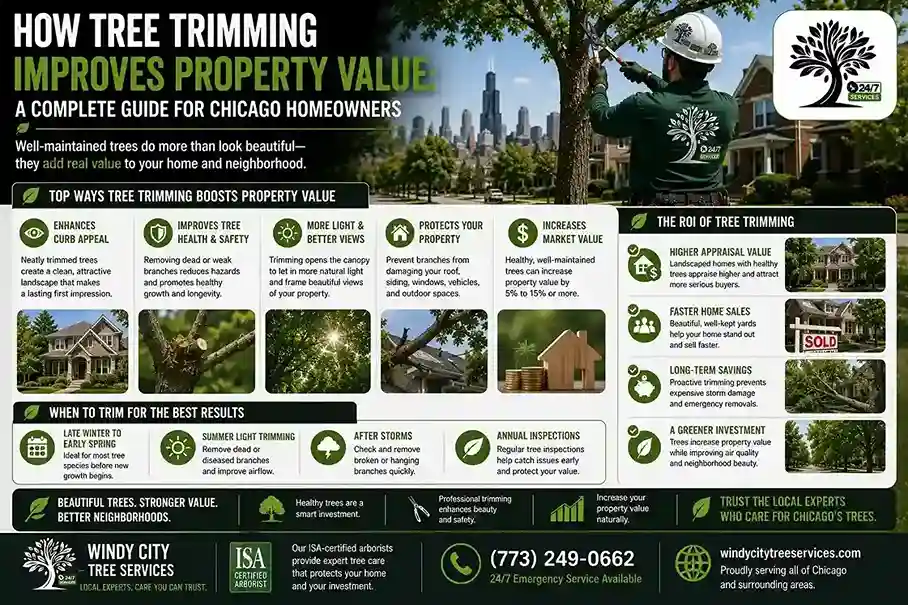
How Tree Trimming Improves Property Value: A Complete Guide for Chicago Homeowners
Discover why healthy, professionally maintained trees are one of the smartest investments for Chicago homeowners.
Mature trees are one of the most valuable assets on any residential lot. They take decades to grow, and no amount of money can instantly replace the shade, privacy, and character a full-grown tree provides. Proper tree trimming protects that asset, enhancing both beauty and safety at the same time.
Buyers notice well-maintained landscapes before they ever step through the front door. A healthy, professionally shaped tree contributes to a stronger first impression, and that first impression can positively influence how a buyer perceives the entire property. This guide explains exactly how professional trimming benefits both your trees and your real estate investment, with a clear look at what the research actually shows and what it does not.
Does tree trimming increase property value?
Professional tree trimming can improve curb appeal, enhance safety, maintain tree health, and make a property more attractive to potential buyers. While the exact effect on value depends on many factors, well-maintained trees and landscaping often contribute positively to overall marketability and buyer perception.
💡 A Note on the Numbers
You will see figures throughout this guide, including USDA Forest Service research suggesting well-maintained trees can be associated with homes valued roughly 3 to 15 percent higher than comparable properties without them. Treat these as general ranges, not guarantees. Actual results depend on your property, neighborhood, market conditions, tree species and placement, and buyer preferences at the time of sale.
Why Trees Matter in Real Estate
First impressions form fast. Research on buyer psychology consistently shows that people begin forming an opinion of a property within seconds of seeing it, often before an agent even unlocks the front door. Trees are a dominant part of that visual impression, especially on a residential street where they frame the home, soften hard architectural lines, and set the emotional tone before anyone walks the interior.
Landscape value extends beyond aesthetics into how a property is actually used. Trees create outdoor living space, offering shade for a patio, privacy from neighbors, and a sense of an established, lived-in yard rather than a bare, newly built one. At the neighborhood level, a strong urban tree canopy shapes how an entire block is perceived, and the USDA Forest Service has published extensive research on urban forestry documenting how neighborhood tree cover contributes to community-wide property appeal, not just individual lots.
The Relationship Between Healthy Trees and Property Value
Numerous studies have found associations between healthy, mature trees and increased residential appeal, though outcomes vary significantly by market and property. An attractive, well-maintained landscape signals ongoing care to a buyer, and that signal often extends to assumptions about how well the rest of the home has been maintained.
Tree maturity plays a real role here. A newly planted sapling cannot offer the shade, privacy, or visual presence of a decades-old oak or maple, which is part of why mature trees are difficult and slow to replace once lost. Shade reduces cooling costs in summer, and research from the USDA Forest Service has found that strategically placed trees can meaningfully reduce a home’s air conditioning demand. Privacy from a mature canopy or well-placed screening trees is a feature many buyers actively seek out, particularly in dense city neighborhoods where sightlines into a yard from the street or a neighboring building are common.
Environmental benefits round out the picture. Healthy trees improve air quality, reduce noise from nearby streets, and support the kind of green, walkable feel that many Chicago buyers specifically look for. Framed as a long-term investment, a mature tree is one of the few landscape features that appreciates in value over time rather than depreciating, provided it stays healthy and well maintained.
How Professional Tree Trimming Improves Curb Appeal
A balanced canopy is one of the clearest visual signals of a well-maintained property. Trimming removes the lopsided growth, water sprouts, and dense interior clutter that make a tree look neglected, replacing it with a shape that reads as intentional and cared for from the street.
Trimming also reveals a home’s architecture. Overgrown branches that crowd a facade, cover windows, or obscure an entryway hide the very features a listing photo is supposed to highlight. Once those branches are cleared, the home’s design elements, from a porch to a distinctive roofline, become visible again. A trimmed canopy improves lawn appearance too, since more filtered light reaches the grass beneath a tree, supporting healthier turf instead of the thin, patchy growth common under a dense, overgrown crown.
The cumulative effect is a cleaner landscape with enhanced symmetry between trees, home, and yard, along with better seasonal beauty. A well-shaped tree looks intentional in every season, from full summer canopy to a clean winter silhouette, rather than a tangled mass of unmanaged growth.
🍂 Before Professional Trimming
- Branches touching or resting on the roof
- Dense canopy blocking window light
- Overgrown limbs hiding the home’s facade
- Dark, shaded front yard with thin grass
- Unbalanced, lopsided canopy shape
🌿 After Professional Trimming
- Clear roofline with proper branch clearance
- Brighter windows and interior natural light
- Home’s architecture fully visible from the street
- Healthier, sun-exposed lawn and garden beds
- Balanced, natural, well-shaped canopy
Tree Trimming Makes Homes Look Larger
Overgrown trees can visually shrink a property, crowding sightlines and making a lot feel smaller and more enclosed than it actually is. Opening up views by removing low or overextended branches lets a buyer see the full scope of the yard at once instead of a fragmented, obstructed version of it.
Better sightlines also improve landscape design overall, since a trimmed tree becomes a framing element rather than an obstacle. Strategic trimming can highlight architectural features, drawing the eye toward an entryway or a distinctive window instead of a wall of unmanaged branches. Layered correctly, a well-trimmed canopy also creates visual depth, giving a yard a sense of dimension between the foreground lawn, the tree canopy, and the home itself, rather than one flat, overgrown mass of green.
Better Natural Light Improves Home Appeal
Overgrown branches pressed against windows block natural light from entering a home, which can make interior rooms feel dim and dated in listing photos and in-person showings alike. Trimming restores window visibility and lets more daylight into the house, an easy but often overlooked improvement to interior brightness.
More light also improves how a homeowner can actually enjoy the outdoor space, from a brighter patio to a garden bed that finally gets enough sun to thrive instead of struggling under deep shade. Garden health depends heavily on this balance, since even shade-tolerant plants generally need some filtered light to stay full and healthy. On the energy side, thoughtful trimming preserves the benefit of summer shade over the roof and walls while still letting in enough winter light to take advantage of passive solar warmth once deciduous trees drop their leaves.
Improved Safety Increases Buyer Confidence
Dead branch removal eliminates one of the most common hazards a buyer or inspector will flag on a walkthrough. A dead limb hanging over a driveway or roofline is an obvious red flag, and its presence raises questions about what else on the property might have been neglected.
Storm damage prevention follows directly from that same maintenance. Removing weak, crossing, or overextended branches before a storm reduces the odds of a limb coming down on the house, a fence, or a parked car. Roof protection matters specifically here, since branches that rub against shingles or gutters over time can cause real, expensive damage well before a storm ever hits. Sidewalk and driveway clearance address a more everyday safety concern, keeping walkways clear for pedestrians, delivery drivers, and anyone touring the property. Taken together, hazard reduction across a property signals to a buyer that they are not inheriting a list of deferred maintenance problems the moment they close on the house.
Healthy Trees Require Less Future Maintenance
Preventive pruning keeps a tree’s structure sound over time, which means fewer surprises down the road. Regular attention makes it far easier to catch early signs of disease before an infection spreads through the canopy or into neighboring trees.
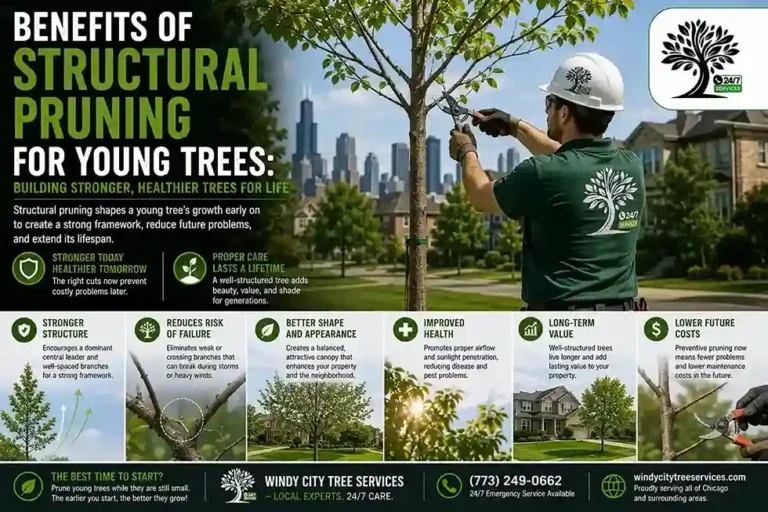
Structural pruning while a tree is still young shapes strong branch attachments that hold up for decades, reducing the odds of a major structural failure later in the tree’s life. All of this adds up to reduced emergency work, since a tree maintained on a predictable schedule rarely needs the kind of urgent, after-hours response that comes with a storm-damaged limb. Emergency tree work is almost always more expensive than routine maintenance, so consistent care translates directly into lower long-term maintenance costs for the property owner.
Storm-Ready Trees Protect Property
Chicago’s weather puts real, recurring stress on trees throughout the year. High winds off Lake Michigan test every weak branch union in a canopy, and a tree carrying deadwood or unbalanced growth is far more likely to lose limbs during a strong gust than a properly maintained one.
Heavy snow adds significant weight to branches every winter, and ice accumulation during a winter storm can snap limbs that looked structurally sound the week before. Chicago’s spring and summer thunderstorms bring their own combination of wind and saturated soil, a pairing that has brought down weakened trees across the city. Fallen limbs from any of these events can cause serious roof protection failures, along with damage to siding, fences, vehicles, and utility lines. A tree trimmed on a proactive schedule carries far less deadwood and excess weight into storm season, which measurably lowers the odds of costly property damage.
Tree Trimming Helps Protect Expensive Property Features
Trees growing too close to a home put several expensive property features at ongoing risk. Roofs and gutters are the most obvious targets, since overhanging branches drop debris that clogs gutters and drag across shingles in wind, wearing down roofing material years before it should need replacement.
Siding suffers similar wear from constant branch contact, and fences along a property line often take damage from low limbs that were never trimmed back. Pools and patios face a different problem, namely leaf and debris buildup that increases cleaning costs and can stain hardscaping over time. Driveways can be affected both by falling debris and, in some cases, by root intrusion from trees planted too close to the pavement. Utility lines round out the list, where overgrown branches create both a service disruption risk and a safety hazard that most utility companies actively monitor and, when necessary, prune around.
Chicago Landscaping Trends Buyers Love
Mature canopy trees consistently rank among the features Chicago buyers respond to most, since they offer an established look that new construction and freshly landscaped lots simply cannot replicate right away. Native trees suited to the local climate are increasingly appreciated too, both for their lower long-term maintenance needs and their support for local wildlife.
Healthy lawns paired with well-maintained trees create the kind of cohesive outdoor space buyers photograph and remember. Outdoor living spaces, from a shaded patio to a defined seating area under a mature tree, have become a real selling point across Chicago neighborhoods. Sustainable landscapes that balance water use, native plantings, and tree canopy appeal to a growing share of buyers, and walkable neighborhoods with a strong street tree canopy tend to command a premium simply because the whole block feels more established and inviting.
Which Chicago Tree Species Benefit Most From Regular Trimming?
Some species show the benefits of regular trimming more visibly than others, either because they grow quickly, are prone to deadwood, or make a strong visual statement once properly shaped.
| Species | Why Regular Trimming Matters |
|---|---|
| Oak | Long-lived, high-value shade tree; benefits from deadwood removal and careful timing around oak wilt season |
| Maple | Popular street and yard tree; trimming maintains its naturally rounded, symmetrical form |
| Honey Locust | Light, airy canopy that stays attractive with routine light trimming |
| Elm | Iconic Chicago shade tree; trimming supports health monitoring for Dutch elm disease |
| Ash | Requires health inspection given emerald ash borer risk before deciding on trimming versus removal |
| Linden | Dense grower that benefits from thinning to maintain shape and light penetration |
| Sycamore | Large shade tree that needs periodic clearance trimming along streets and driveways |
| Birch | Ornamental value increases with light, careful trimming rather than heavy cuts |
| Crabapple | Flowering ornamental that benefits from post-bloom shaping to maximize curb appeal |
| Pine | Evergreen structure benefits from deadwood removal, since it holds visual weight year-round |
💡 Did You Know?
Because evergreens like pine keep their needles year-round, a poorly maintained one stands out in every season, including winter, when most deciduous trees have dropped their leaves and any structural issues would otherwise be less visible.
DIY vs. Professional Tree Trimming
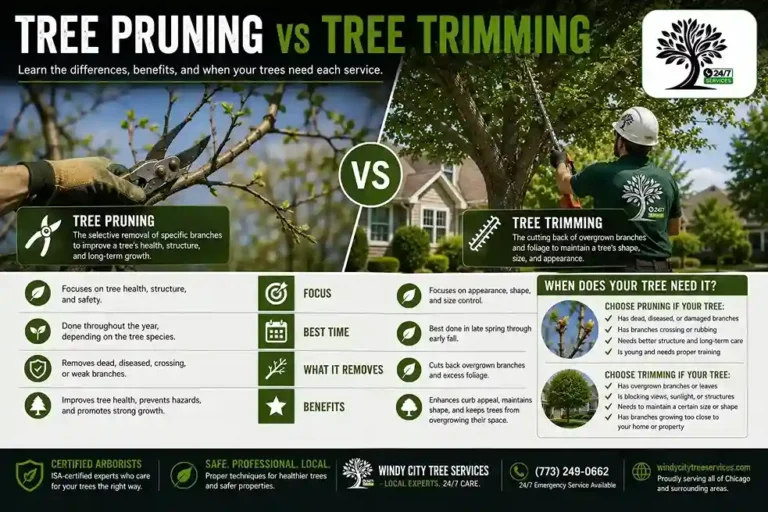
Small, low branches on a young tree can often be trimmed safely by a homeowner with basic tools. Beyond that, the gap between DIY and professional results widens quickly, both in safety and in the long-term condition of the tree.
| Feature | Professionally Maintained | Neglected Trees |
|---|---|---|
| Curb Appeal | Balanced, intentional, well-shaped canopy | Uneven, overgrown, visually neglected |
| Buyer Perception | Signals a well-cared-for property | Signals deferred maintenance |
| Safety | Deadwood and hazards removed proactively | Hidden hazards, higher storm risk |
| Tree Health | Stronger structure, longer lifespan | Higher risk of disease and decay |
| Maintenance Costs | Predictable, routine expense | Higher risk of costly emergency work |
| Landscape Appearance | Cohesive with the rest of the property | Detracts from surrounding landscaping |
Equipment is a real factor too. Proper pruning of a mature tree often requires aerial lifts, rigging equipment, and chainsaws that most homeowners do not own or know how to use safely. Insurance matters as much as equipment, since a professional company carries liability coverage that protects the homeowner if something goes wrong, while a DIY accident or an uninsured contractor leaves the homeowner exposed. Over time, all of these factors compound into a clear long-term value gap between a professionally maintained tree and one left to a homeowner’s occasional, untrained attention.
Increase Your Home’s Curb Appeal with Professional Tree Trimming
Healthy, properly maintained trees make your property safer, more attractive, and ready for every season. Let our ISA Certified Arborists create a customized trimming plan for your landscape.
📞 Schedule a Tree Evaluation (773) 249-0662How Often Should Trees Be Trimmed?
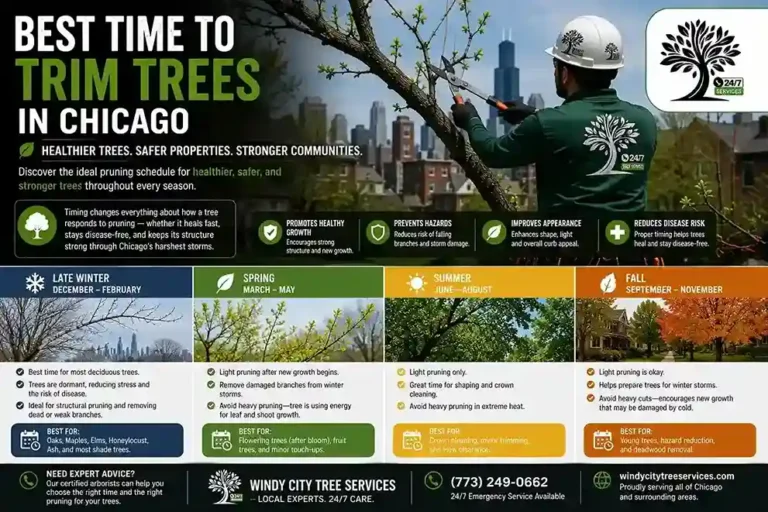
Pruning intervals vary by species, age, location, and current tree condition, so there is no single answer that fits every tree. That said, general patterns hold across most residential properties.
Young trees typically need light, frequent structural pruning, often annually for the first several years, to establish strong branch spacing and a sound central structure while the tree is still easy to shape. Mature trees generally do well with trimming every two to three years, focused on deadwood removal, canopy balance, and clearance rather than major structural changes. Fast-growing species may need more frequent attention simply because they put on canopy faster than slower-growing trees. Storm inspections should happen after any significant weather event, regardless of a tree’s normal maintenance schedule, since storm stress can create hazards outside the usual routine. Seasonal maintenance, particularly a pre-storm check each spring and a dormant-season prune in late winter, rounds out a solid annual plan for most Chicago properties.
Preparing Your Home for Sale
Tree trimming deserves a spot on the same checklist as painting, decluttering, and lawn care when preparing a home for sale. As part of general landscaping, a fresh trim signals the same level of care as a freshly mowed lawn or trimmed hedges, and it is often one of the more cost-effective exterior improvements available before listing.
Exterior improvements aimed at curb appeal fall flat if an overgrown tree is blocking the very features those improvements are meant to highlight. Tree trimming is also a core part of home staging, since listing photos and in-person showings both benefit from a bright, open, well-framed exterior. Inspection preparation matters just as much. Addressing dead branches, canopy clearance, and any visible structural issues before a buyer’s inspector arrives removes an easy source of negotiating leverage. Finally, listing photos themselves benefit directly from a recent trim, since a balanced canopy and visible architecture consistently photograph better than an overgrown, shadowed facade.
Why Hire ISA Certified Arborists?
Tree biology knowledge separates a certified arborist from a general landscaping crew. Understanding how a tree grows, heals, and responds to stress allows an arborist to prune in a way that supports the tree’s long-term health rather than just its short-term appearance.
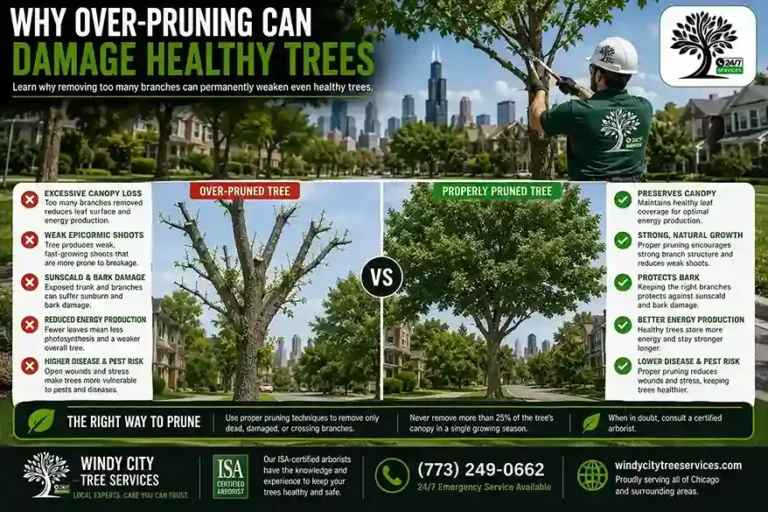
ANSI A300 standards give certified arborists a consistent, professional framework for every cut, covering where to cut, how much to remove, and how to protect the tree’s structure. Proper pruning technique, informed by that training, avoids damaging mistakes like flush cuts or topping that can permanently harm a tree’s value and appearance. Tree preservation is often the goal, since a certified arborist can usually find a way to correct a structural or clearance issue without removing a valuable mature tree outright. Long-term landscape planning ties it all together, with a certified arborist able to map out a maintenance schedule that keeps a property’s trees healthy, safe, and attractive for years, not just for the next open house.
Property Benefits of Tree Trimming
Not every benefit of tree trimming is easy to quantify in dollars, but the relative impact across common categories generally follows this pattern based on how frequently these factors are cited in real estate and arboriculture research.
These ratings reflect general patterns discussed in arboriculture and real estate research, not a guaranteed dollar return for any individual property.
Protect Your Investment with Expert Tree Care
Whether you’re preparing to sell your home or simply want to preserve your landscape, professional tree trimming helps keep your property looking its best year-round.
Request a Free EstimateHomeowner Checklist: Is Your Landscape Adding Value?
Walk around your property and answer these questions honestly. If you find yourself answering “yes” to several of the warning signs, a professional evaluation is a reasonable next step.
- Are trees blocking your home’s architecture or entryway?
- Are dead branches visible anywhere in the canopy?
- Does the canopy look balanced, or lopsided and overgrown?
- Are any limbs hanging over the roof or gutters?
- Is sunlight reaching your lawn and garden beds?
- Are sidewalks and driveways clear of low branches?
- Have your trees been professionally inspected in the last two to three years?
Frequently Asked Questions
Does tree trimming increase property value?
Professional tree trimming can improve curb appeal, enhance safety, and maintain tree health, making a property more attractive to buyers. The exact effect on value depends on many factors, but well-maintained trees generally contribute positively to marketability.
Can overgrown trees reduce home value?
Yes. Overgrown, damaged, or poorly shaped trees can signal neglect, block a home’s architecture, create safety hazards, and raise concerns during a home inspection, all of which can work against marketability.
Should I trim trees before selling my home?
Yes, in most cases. Trimming before listing improves curb appeal for photos and showings, removes hazards that could surface during an inspection, and presents the property as well cared for.
How often should trees be trimmed?
Most mature trees benefit from trimming every two to three years, though this varies by species, age, and condition. Young trees often need lighter, more frequent structural pruning.
Can tree trimming lower insurance risks?
Yes. Removing dead or weak branches reduces the chance of storm damage to a roof, vehicle, or neighboring property, which can lower the likelihood of a claim and is a factor some insurers consider.
Which trees add the most value?
Large, healthy, mature shade trees in good structural condition, placed appropriately relative to the home, tend to contribute the most. Species well-suited to the local climate with reasonable maintenance needs are generally favored.
Can trimming improve curb appeal?
Yes. Trimming opens sightlines to a home’s architecture, balances an uneven canopy, lets more light reach the lawn, and gives the property a cleaner, more intentional appearance.
Is professional trimming worth the investment?
For most homeowners, yes. Professional trimming costs far less than emergency storm cleanup or removal, protects mature landscape assets, and helps prevent hazards that can complicate a home sale.
How much does tree trimming cost?
Cost depends on tree size, condition, accessibility, and scope of work. We provide free, written, on-site estimates so homeowners know the cost before any work begins.
Do buyers notice landscaping?
Yes. Landscaping and curb appeal shape a buyer’s first impression before they step inside, and a well-maintained yard signals that the rest of the property has likely been cared for too.
Do dead or dying trees hurt a home’s resale value?
Yes. A visibly dead or declining tree often raises immediate buyer concerns about safety and future removal costs, and can prompt a request for credit or removal as a condition of sale.
What is the best time of year to trim trees before listing a home?
Late winter dormant pruning works well for structural cleanup ahead of a spring listing, while light cosmetic trimming and deadwood removal can be done closer to listing time in almost any season.
Can a home inspection flag tree-related issues?
Yes. Inspectors commonly note limbs overhanging a roof, trees too close to a foundation, visible deadwood, or signs of root damage near a driveway, any of which can become a negotiating point.
Does tree trimming help with energy efficiency?
Yes, indirectly. Properly shaped shade trees positioned to shade a home in summer can reduce cooling costs, while a well-maintained canopy avoids blocking beneficial winter sun.
Do neglected trees affect neighboring property values?
They can. An overgrown or hazardous tree hanging into a neighboring yard or threatening a shared fence line can affect how buyers perceive not just that property but the whole block.
Should I remove a tree or just trim it before selling?
This depends on the tree’s health and structure. A healthy tree usually adds more value trimmed and preserved than removed, while a severely declining or hazardous tree may be better removed and disclosed.
How does tree trimming compare to other landscaping upgrades in ROI?
Tree trimming is generally one of the more cost-effective landscaping investments, since it enhances existing mature assets rather than creating new ones, at a cost far lower than large-scale landscape renovation.
Can overgrown trees affect a home appraisal?
Appraisers primarily focus on structural and market factors, but visible landscape neglect, including overgrown or hazardous trees, can be noted as a condition issue affecting an appraiser’s overall impression.
What should I ask a tree company before hiring them?
Ask whether their arborists are ISA Certified, whether they carry general liability and workers’ compensation insurance, whether they follow ANSI A300 standards, and whether they provide a free written estimate.
Is DIY tree trimming a good way to save money before selling?
Generally, no, for anything beyond small, low branches. DIY trimming carries real safety risk, and improper cuts can leave a tree looking worse, working against the curb appeal a seller is trying to create.
Related Tree Care Guides
Best Time to Trim Trees in Chicago
Read the guide →Tree Pruning vs. Tree Trimming
Read the guide →How Often Should Mature Trees Be Pruned?
Read the guide →Benefits of Structural Pruning for Young Trees
Read the guide →Common Tree Pruning Mistakes Homeowners Make
Read the guide →Crown Cleaning, Crown Raising & Crown Reduction Explained
Read the guide →Why Over-Pruning Can Damage Healthy Trees
Read the guide →Winter Tree Pruning Benefits
Read the guide →Tree Trimming Before Storm Season
Read the guide →Common Reasons Trees Fail During Chicago Storms
Read the guide →10 Signs a Tree Is Dangerous on Your Property
Read the guide →When Should a Tree Be Removed?
Read the guide →Ready to protect your investment? Our Chicago Tree Service team of Certified Arborists provides professional tree care across the city, from routine trimming to full property risk assessments.
Add Lasting Value to Your Chicago Property
Beautiful, healthy trees are one of the most valuable features of any landscape. With professional tree trimming, you can improve curb appeal, reduce hazards, protect your home, and maintain a landscape that buyers and neighbors appreciate. Windy City Tree Services delivers expert pruning tailored to Chicago’s climate, neighborhoods, and tree species.