10 Signs a Tree Is Dangerous and Needs Removal | Windy City Tree Services
Alarming Signs a Tree Is Dangerous and Needs Removal
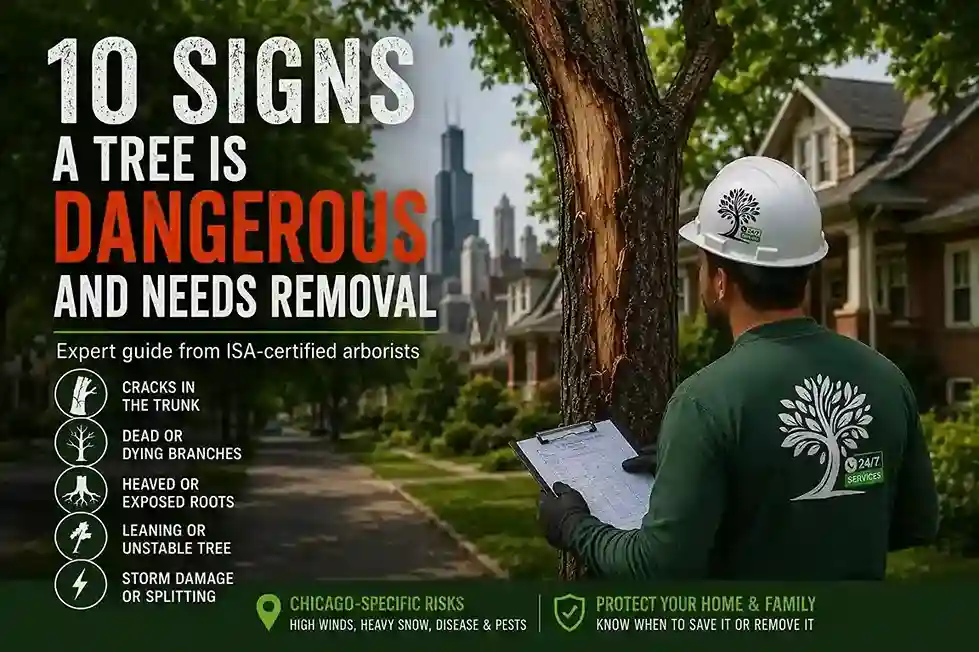
Most trees fail because homeowners missed the warning signs. This expert guide from ISA-certified arborists covers every major hazard indicator, Chicago-specific risks, and how to tell whether your tree needs removal or can still be saved.
Schedule a Free Tree InspectionA tree is dangerous when it shows any of these warning signs: a dead or dying canopy, large hanging dead limbs, a sudden new lean with soil movement at the base, major trunk cracks, fungal growth or mushrooms at the base, a hollow or severely decayed trunk, significant storm damage, root damage from construction, advanced pest or disease infestation, or a location where it directly threatens a home, vehicle, or utility line. If you see more than one of these together, the risk is compounded.
Healthy trees add real value to a Chicago property. They provide cooling shade, reduce energy costs, filter air, manage stormwater, and simply make a neighborhood more beautiful. But a tree that has reached the point of structural failure is a different matter entirely. It can come down without warning on a calm morning with no wind, and the consequences can include crushed cars, damaged roofs, blocked driveways, downed power lines, and serious injury.
The frustrating reality is that most tree failures are not truly sudden. In the majority of cases, the warning signs were there for months or years before the tree came down. The signs were just missed because most homeowners were not sure what to look for.
This guide covers the 10 most important warning signs that a tree is dangerous and may need removal, explains the difference between trees that need to come down immediately and those that can be preserved with the right care, and gives you a clear picture of what professional tree risk assessment actually involves. If you work through this guide and your tree shows several of these signs, the right next step is a professional inspection by an ISA-certified arborist, not a waiting approach.
This guide helps you identify warning signs that warrant a professional inspection. It is not a substitute for a formal tree risk assessment by an ISA-certified arborist. Multiple signs together create compound risk. When in doubt, call a professional rather than waiting to see what happens.
The Tree Is Dead or Dying
A dead tree is not a stable tree. Once a tree stops living, it begins breaking down, and that process of decomposition weakens the internal wood structure in ways that are not always visible from the outside. A tree that looks solid from the street can have advanced internal decay that makes it susceptible to toppling in even moderate wind.
The challenge with dead trees is that the timing of failure is unpredictable. A dead tree may stand for years before coming down, or it may fail in the next storm. That uncertainty is precisely why dead trees near structures, driveways, parked cars, and areas where people walk should be treated as a priority for assessment and removal.
Signs a Tree Is Dead or Dying
- No leaves during the growing season. A tree with no leaf-out in spring, or with leaves on only a small portion of the canopy, is likely dead or in serious decline.
- Dead branches throughout the canopy. Branches that snap rather than bend, with no green tissue visible when scratched, indicate death in those portions of the tree.
- Bark falling away in large sheets. Bark that falls off without living tissue or cambium (the green or white moist layer underneath) is no longer functioning.
- Dry, brittle wood. Green wood is flexible. Dead wood is dry and snaps cleanly. This applies to both small twigs and larger branches.
Scratch a small patch of bark from a young branch using a knife or your fingernail. Healthy living tissue will be green or white and moist. Dead tissue will be brown and dry. Test multiple branches before concluding the whole tree is dead, since a tree can be partially alive with some live branches remaining.
Contact our tree health inspection team if you are unsure whether your tree is alive, partially dead, or has entered a decline that can still be reversed.
Large Dead or Hanging Limbs
In tree care, large dead or partially attached branches hanging in a tree’s canopy are called widow makers. The name comes from their habit of falling without any storm trigger, on perfectly calm days, without any warning. They are not waiting for the right conditions; they are just waiting.
A large dead limb becomes a widow maker when it reaches the stage where the wood has dried and contracted enough to lose its structural connection to the parent branch or trunk. The attachment point fails under the weight of the limb, and it falls. This can happen in any season and does not require wind or rain to trigger it.
Why Hanging Limbs Are Particularly Dangerous
Large dead limbs are often more dangerous than a fully dead tree because they concentrate energy. A 200-pound limb falling from 40 feet hits the ground with force that no one should be standing under. Homeowners are sometimes aware that a tree has dead wood but underestimate how far a falling limb can travel horizontally, how much it weighs, or how much damage it can do to a structure, vehicle, or person.
Dead limbs near rooflines, driveways, patios, children’s play areas, or anywhere people spend time outdoors should be treated as immediate hazards. Tree trimming by a certified arborist can remove individual dead limbs without requiring full tree removal, which is the right approach when the rest of the tree is structurally sound.
If you can see a large limb hanging at an unusual angle or partially separated from the trunk, do not walk or park beneath it. Call a tree service immediately. Do not attempt to dislodge it yourself.
The Tree Has Suddenly Started Leaning
A lean that a tree has maintained for years as it grew toward available light is usually not an immediate concern. Trees adapt their root structure and wood density to compensate for a consistent lean over time. The dangerous type of lean is one that appears suddenly, developed noticeably after a storm, or changed significantly over a short period.
Warning Signs of a Dangerous Lean
- Soil lifting or cracking on the opposite side. When a tree begins to tip over, the root plate lifts on the far side. You may see the soil cracking, mounding, or lifting near the base of the tree.
- Exposed roots on the opposite side from the lean. Roots that have pulled up from the soil indicate root failure, not just a lean.
- The lean appeared after a storm or high-wind event. A storm can start a root plate failure that continues even after the weather has passed.
- The lean is toward a structure. A leaning tree aimed at a house, garage, shed, or neighboring property carries target risk on top of structural risk.
“A tree leaning toward your house is not something to monitor. It needs an arborist assessment that same week, not next spring.”
If a lean concerns you, our team provides emergency tree assessments for situations that cannot wait for a standard appointment. Call (773) 249-0662 at any time.
Large Cracks in the Trunk
Not all trunk cracks are equally serious, but large cracks deserve immediate attention because they can indicate internal structural failure that is not visible from the surface. A tree trunk provides structural support the same way a column supports a building. When that column begins to split, the consequences of failure are potentially severe.
Types of Trunk Cracks and Their Risk
- Vertical cracks running along the trunk length. These are among the most serious, particularly when they extend deeply into the wood rather than just the outer bark. Deep vertical splits can indicate that two major stems are separating under their own weight.
- Cracks at the base of the tree. Cracks where the trunk meets the soil surface may indicate root plate failure or basal decay, both of which are serious structural concerns.
- Included bark between co-dominant stems. When two major stems grow together at a sharp V-shaped angle, bark often grows inward between them rather than forming a solid wood union. This included bark creates a weak attachment point that can split in high winds or under snow load.
- Cracks after storm or lightning events. Lightning can create internal damage that is not immediately visible. A tree struck by lightning should be assessed by an arborist even if it appears intact.
Tree cabling and bracing can provide supplemental structural support for some trunk crack situations, redistributing load and reducing failure risk. Whether cabling is a viable option depends on the location, depth, and extent of the crack, which is why professional assessment is essential before any other action is taken.
Mushrooms or Fungal Growth at the Base
Mushrooms or bracket-shaped shelf fungi growing at the base of a tree, on the trunk, or emerging from surface roots are among the most reliable external indicators of significant internal decay. Fungi do not cause the decay; they are feeding on wood that has already broken down internally. By the time fungal fruiting bodies are visible on the outside of the tree, the internal decay process has typically been underway for some time.
Fungal Growth and What It Means for Tree Structure
The most concerning fungal species for structural integrity include Ganoderma species, which produce hard shelf-like bracket fungi (often called conks) on the base or lower trunk. These indicate advanced root or butt rot that is hollowing out the structural base of the tree. A Ganoderma infection does not mean the tree will fall tomorrow, but it does mean the tree’s structural integrity is progressively compromised and requires expert evaluation.
Honey mushrooms emerging in clusters at the base of a tree indicate Armillaria root rot, another serious condition. Chicken-of-the-woods (Laetiporus) produces orange shelf fungus on trunks and indicates active wood decay in progress.
Mushrooms growing in the soil near a tree are not necessarily a sign that the tree is infected. The concern is fungal growth directly on the bark, at the base where bark meets soil, or on visible surface roots. If you see this, schedule a professional inspection rather than waiting to see whether it spreads further.
Our ISA-certified arborists assess fungal growth during tree health inspections and can determine whether the tree is still structurally sound or has reached the point where removal is necessary to prevent failure.
Hollow or Severely Decayed Trunk
A hollow tree is a complicated situation. Trees can survive for many years with significant internal hollows because the structural wood that supports a tree’s weight is primarily the outer shell of the trunk rather than the center heartwood. However, there comes a point where the remaining shell of sound wood is no longer thick enough to safely support the tree’s canopy weight through a loading event like a wind storm or heavy snow.
How to Recognize a Hollow or Decayed Trunk
- Visible cavities or openings in the trunk. Any visible opening into the interior of the trunk indicates that the hollow extends at least to that point.
- A hollow sound when the trunk is knocked. Tapping the trunk with a mallet and listening for a hollow versus solid sound can indicate internal voids, though this method has limitations.
- Large amounts of sawdust or wood shavings at the base. Carpenter ants excavate galleries in already-decayed wood. Piles of sawdust-like frass at the base indicate both internal decay and a large ant colony.
- Heavy woodpecker activity. Woodpeckers hunt for insects in decayed wood. Concentrated pecking in one area often points to a significant internal infestation related to decay.
- Soft or spongy wood when probed. Wood that can be probed deeply with a rod or knife indicates advanced softening from decay.
The general rule used by arborists is that a tree with a hollow greater than one-third of the trunk diameter at the hollow’s location may be structurally compromised, though this is a guideline rather than an absolute threshold. Location matters significantly: a hollow at the base of the tree creates more structural risk than a hollow higher up in the canopy. Professional assessment with appropriate tools is the only way to get an accurate picture of internal condition.
Severe Storm Damage
Not all storm damage is immediately obvious, and that is precisely what makes post-storm tree inspections important. A tree may look intact from the street after a storm while sustaining significant internal damage from wind torque, lightning, or the mechanical stress of bending far beyond its normal range.
Types of Storm Damage That Require Immediate Assessment
- Broken tops. A tree that has lost its central leader or had the upper portion of its canopy broken out has experienced fundamental structural disruption. Depending on what remains, the tree may be salvageable with careful assessment and remediation pruning, or it may need removal.
- Split trunks. Major trunk splits create immediate structural instability. If the split extends into the root collar or through more than a third of the trunk diameter, removal is typically the recommended action.
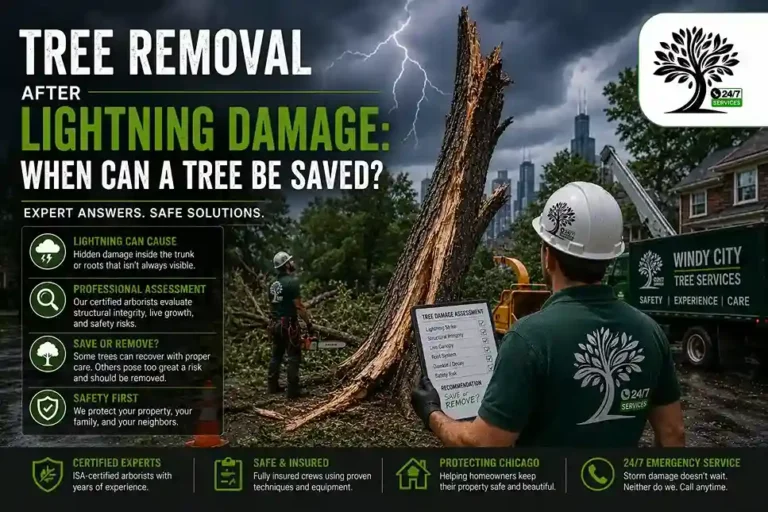
- Lightning strikes. Lightning creates a steam explosion inside the wood as water vaporizes instantly. The visible damage on the bark surface understates the internal damage, which can extend throughout the vascular system of the tree. A lightning-struck tree should always receive a professional inspection.
- Uprooting. A partially uprooted tree that is still standing may look stable but its root anchorage is compromised. These trees need emergency assessment before the next loading event.
- Hanging branches from neighboring trees. Storm damage does not always happen to your own trees. Branches from neighboring trees that are now hanging in your tree’s canopy can fall at any time.
Our storm response service covers the full range of post-storm tree assessment and emergency removal throughout Chicago. Call (773) 249-0662 for immediate assistance after any significant weather event.
Root Damage
A tree’s root system is its anchor, its water and nutrient source, and the foundation of its structural stability. Root problems are particularly difficult to detect because they are underground, and by the time visible above-ground symptoms appear, significant root damage has often already occurred.
Common Causes of Root Damage in Chicago
- Construction and excavation. Trenching for utility lines, grading, or building foundation work within a tree’s root zone causes direct physical root cutting. The critical root zone for most trees extends roughly 1 foot in radius for every inch of trunk diameter, which means a 12-inch diameter tree has roots extending roughly 12 feet out in all directions. Work within that zone that cuts roots can cause crown dieback over one to several years following the damage.
- Soil compaction. Compacted soil from heavy equipment, vehicles parked repeatedly under a tree, or foot traffic reduces oxygen in the root zone, leading to gradual root suffocation. This is particularly common around Chicago’s parkway trees and property trees near driveways.
- Root rot disease. Fungal root rot caused by organisms like Armillaria can spread between trees through root contact and gradually destroy the root system while the canopy shows progressive but sometimes subtle decline.
- Grade changes. Raising or lowering the soil level around a tree changes the depth at which roots receive air and water, which can cause decline even when the roots themselves are not directly cut.
Air Spade root excavation is one of the most valuable diagnostic tools for assessing root systems because it excavates soil around roots using compressed air without cutting or damaging the root tissue. This allows arborists to physically examine root conditions, identify decay or girdling roots, assess the depth of root damage from construction, and develop an appropriate management plan. If you are concerned about root health on a valuable tree, especially one near recent construction activity, an Air Spade assessment is worth the investment.
Major Pest or Disease Problems
Pest and disease problems range from cosmetic concerns that will not kill a tree to systemic infections that make removal unavoidable. Understanding which category a problem falls into requires the right identification, which is why most pest and disease assessments benefit from professional input rather than internet diagnosis.
Chicago’s Most Significant Tree Pests and Diseases
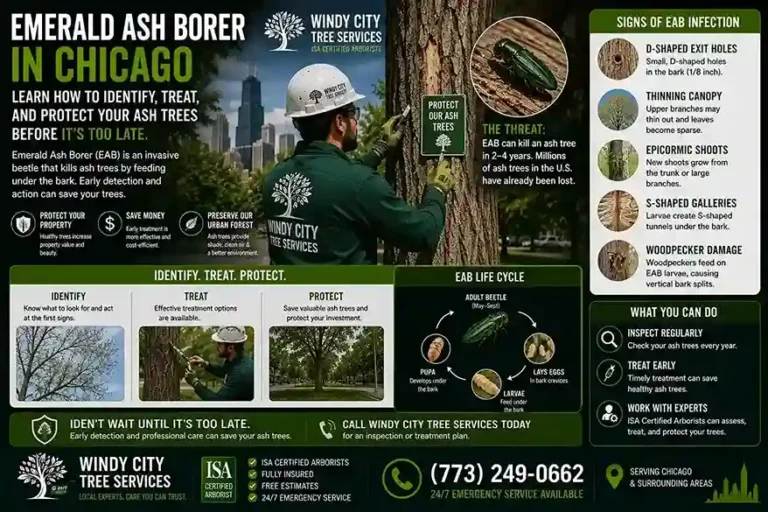
Emerald Ash Borer (EAB). This invasive beetle has killed tens of millions of ash trees across North America. In Chicago, the ash population has already been severely impacted. The larvae feed beneath the bark, cutting off the tree’s vascular system. Early signs include canopy thinning from the top down, D-shaped exit holes in the bark, bark splitting with S-shaped galleries visible underneath, and epicormic shoots (water sprouts) growing from the lower trunk as the tree attempts to survive. Trees with 40 to 50 percent or more canopy dieback are generally beyond effective treatment and should be removed before they become structural hazards. Earlier-stage infestations can be treated with systemic insecticides. Learn more on our tree health inspection page.
Oak Wilt. This fungal disease kills red oaks within weeks of infection and is particularly severe in Chicago where the red oak population is significant. It spreads through two routes: root grafts between neighboring oaks, and through sap-feeding beetles that carry spores between trees during spring and early summer. The critical prevention tool is avoiding any oak pruning between April and mid-July, when the beetles are most active. An infected red oak that cannot be isolated from its neighbors through root disruption typically needs to be removed to prevent spread.
Dutch Elm Disease. The disease that transformed American city streetscapes in the 20th century is still present in Chicago, threatening surviving elms. It spreads through elm bark beetle vectors and through root connections between adjacent elms. Annual inspection and prompt removal of infected wood or trees are the most effective management tools.
Carpenter Ants. As discussed in the hollow trunk section, a large carpenter ant colony in a tree indicates significant pre-existing internal decay. The ants do not cause the decay but are reliable indicators that it exists and has reached a scale that attracted a nesting colony.
Pest and disease problems are most treatable when caught early. An ash tree in the early stages of EAB infestation, a young oak wilt infection caught before it spreads, or a fungal disease identified before it reaches the structural wood all have a better treatment prognosis than advanced cases. Annual inspections are the most effective tool for catching these problems early enough to treat rather than remove.
The Tree Is Threatening a Structure, Utility Line, or Occupied Area
A tree’s structural condition does not tell the complete story of its risk. Location matters enormously. A moderately healthy tree positioned directly over a bedroom window carries different risk than an equally healthy tree in a remote corner of a yard. Professional tree risk assessment formally accounts for this by evaluating the tree’s potential target: the person or property that would be harmed if the tree or a portion of it failed.
Common Target Situations in Chicago
- Trees over or adjacent to occupied structures. A tree canopy extending over a roof means that any portion that fails will land on the structure. The closer the tree to the home and the larger the overhanging canopy, the higher the potential damage.
- Trees near utility lines. Trees contacting or growing into power lines create both fire risk and the risk of downed lines during storms. Never attempt to trim trees near utility lines yourself.
- Trees over driveways and parked vehicles. A large limb falling on a parked car causes significant property damage. A tree positioned so that any major limb failure would hit a regularly parked vehicle needs regular structural inspection.
- Trees near sidewalks and public areas. Trees adjacent to sidewalks, parks, or commercial areas where pedestrians pass beneath them require a higher level of structural scrutiny because the failure consequence extends to people who have no knowledge of or control over the tree’s condition.
- Trees between neighboring properties. A tree leaning toward a neighbor’s structure or with canopy extending significantly over the property line creates both a safety issue and a liability question that benefits from early professional attention.
Our commercial tree service handles institutional and property management accounts where target risk assessment is particularly important for liability documentation purposes.
Chicago-Specific Tree Hazard Factors
Chicago’s climate and urban environment create specific conditions that affect tree risk in ways that do not apply uniformly to other parts of the country. If you own a property with mature trees in Chicago, these factors are worth understanding.
Lake Michigan Wind Loading
Chicago’s exposure to Lake Michigan creates wind conditions that place sustained stress on trees, particularly in neighborhoods on the North Side, South Shore, and the lakefront corridor. Trees adapted to this wind over decades may develop stronger root anchorage and wood density on the windward side. But trees that were never exposed to significant wind and then experience a major wind event can fail catastrophically because they have not built the adaptive wood structure to handle high loads. This is particularly true when a stand of trees that previously sheltered each other has one or several trees removed, exposing the remaining trees to wind they have never experienced.
Heavy Snow and Ice Accumulation
Chicago winters deliver the full range of conditions that stress trees: wet, heavy snow that accumulates rapidly in large quantities on branch surfaces; ice storms that coat every branch and twig in ice that weighs far more than snow for the same apparent accumulation; and freeze-thaw cycles that enter micro-cracks in bark and wood and expand them with each freeze. Trees with over-extended lateral branches, significant dead wood, or weak branch unions are most vulnerable to catastrophic failure under winter loading.
Pre-winter storm preparation is one of the highest-value tree care services Chicago homeowners can invest in. Structural pruning to remove dead wood, reduce canopy weight on over-extended limbs, and eliminate narrow-angle branch unions before the first major snow or ice event reduces the frequency and severity of storm-related tree failures.
Chicago Clay Soils and Root Development
Much of Chicago sits on heavy clay soils that drain poorly, compact easily under foot and vehicle traffic, and can expand and contract seasonally as moisture levels change. Trees growing in compacted clay develop fewer fine roots and shallower root systems than the same species would in well-drained loamy soil. This means less anchor depth and less total root volume to support the canopy in a storm, contributing to the relatively high rate of whole-tree toppling that arborists observe in Chicago after major wind events.
Deep root fertilization and Air Spade soil decompaction are both particularly valuable in Chicago’s clay soil environment because they address the root-zone conditions that limit tree health and stability in ways that surface treatments cannot reach.
Mature Neighborhood Trees
Older Chicago neighborhoods, particularly in Beverly, Morgan Park, Norwood Park, Hyde Park, and other established communities, have trees that are 60 to 100 years old. Trees of this age can be magnificent and structurally sound, but they also accumulate a history of wounds, structural adaptations, and potential internal decay that benefits from regular professional inspection. Annual inspections are the standard recommendation for large, mature trees in high-target locations such as near structures or over regularly occupied outdoor areas.
ISA Best Management Practices recommend that trees in urban environments receive a professional inspection at least every three years, and annually for large, mature trees in high-value or high-target locations. Chicago’s storm frequency and winter severity make annual inspections a practical priority rather than an optional luxury for trees near structures.
Can the Tree Be Saved?
A good arborist does not approach every hazard tree the same way. Removal is sometimes the right answer, but there are many situations where the correct response to a warning sign is treatment, pruning, or structural support rather than removal. Reputable arborists recommend preservation whenever it is a genuinely safe and practical option, because they understand that a 60-year-old oak cannot be replaced on any realistic timeline.
Situations Where Removal May Not Be Necessary
- Structural problems limited to specific limbs. If the trunk and root system are sound and the issue is one or several major dead or structurally weak limbs, targeted pruning often resolves the hazard without affecting the rest of the tree.
- Co-dominant stems with included bark. A tree with two major competing stems that are beginning to split apart can often be stabilized with a properly installed cabling system, which redistributes the load and reduces failure risk significantly.
- Early-stage pest or disease infestation. Ash trees in the early stages of emerald ash borer infestation, oaks adjacent to but not yet infected by oak wilt, and elms with early Dutch elm disease can all be treated when the condition is identified early enough.
- Root zone problems without advanced crown decline. Trees with soil compaction around their roots, limited soil volume, or construction-related root disturbance can often be helped with Air Spade decompaction, soil amendment, and deep root fertilization before the crown damage becomes irreversible.
- Declining trees responding to correctable stress. Trees showing signs of stress from drought, salt damage, or nutrient deficiency that have not yet reached advanced structural decline can often be stabilized and reinvigorated with proper fertilization and soil care.
“We only recommend removal when it is genuinely necessary. If a tree can be preserved safely, we will tell you that and explain exactly what the preservation program looks like.”
How ISA-Certified Arborists Evaluate Tree Risk
Professional tree risk assessment follows a systematic process based on ISA Best Management Practices for Tree Risk Assessment and ANSI A300 Part 9 standards. This is not simply an arborist walking around a tree and giving an opinion; it is a structured evaluation with documented findings and risk ratings that can be used for insurance, legal, and planning purposes.
What a Formal Tree Risk Assessment Includes
- Tree and site inspection. Visual examination of the full tree from multiple angles, including the canopy, trunk, root collar area, and soil conditions within the root zone.
- Defect identification. Systematic identification of all structural defects including dead wood, cracks, co-dominant stems, decay indicators, root problems, and canopy asymmetry.
- Failure likelihood rating. Assessment of how likely each identified defect is to result in tree or limb failure based on size, condition, and the forces the tree is likely to experience.
- Target assessment. Identification and characterization of what would be affected if the tree or a part of it failed, including people, structures, vehicles, and utility infrastructure. Target occupancy (how often the target is actually present) factors into the overall risk rating.
- Overall risk rating. A combined assessment of failure likelihood and consequence severity to produce an overall risk rating, typically ranging from low to extreme.
- Recommended actions. Specific recommendations for mitigation including monitoring intervals, pruning, cabling, removal, or further diagnostic testing.
Written risk assessments are particularly valuable for property managers, homeowners dealing with insurance claims, condo associations, and situations where a neighbor is questioning the safety of a tree on your property. Our tree health inspection and risk assessment service provides written documentation following ISA standards.
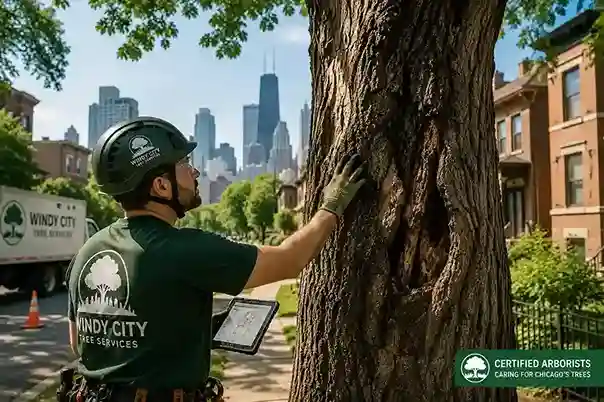
ISA (International Society of Arboriculture) Certified Arborists have passed a comprehensive examination covering tree biology, diagnosis, risk assessment, pruning standards, and tree care best practices. Certification requires ongoing continuing education to maintain. When you hire an ISA-certified arborist, you are working with someone whose knowledge has been tested and verified against a recognized professional standard.
What Professional Tree Removal Involves
Homeowners sometimes delay calling about a hazardous tree because they have misconceptions about what tree removal involves: how disruptive it is, how long it takes, what it costs, and what condition the property is left in afterward. The reality is generally less disruptive than people expect.
The Professional Tree Removal Process
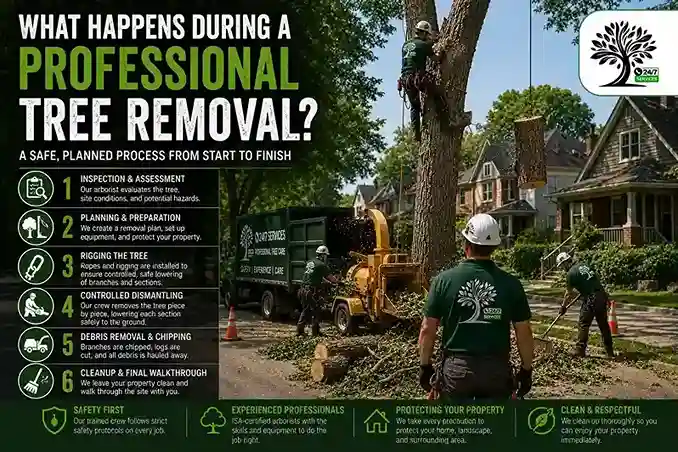
- Site assessment and planning. Before any cutting starts, the crew evaluates the tree’s structure, the site access, overhead and underground utilities, and surrounding structures and landscaping. A removal plan is developed that sequences the work to protect everything around the tree.
- Equipment setup. Ground protection mats are placed to protect lawn and landscaping. Equipment is positioned to allow efficient debris removal while minimizing impact on the surrounding area.
- Aerial work. A climber ascends into the tree or an aerial lift positions a worker at the top of the tree. The tree is dismantled in sections rather than felled in a single piece, starting from the top. Each section is either controlled to the ground with ropes and rigging or fed directly into a chipper.
- Crane-assisted removal. For large trees or trees in confined spaces near structures, a crane provides additional control over where sections land. Crane removal is more expensive but allows precise placement of large trunk sections that cannot be rigged by conventional means.
- Trunk and major limb removal. After the upper canopy is cleared, the main trunk is cut in sections from the top down until a safe ground-level cut is possible.
- Site cleanup. All branches, limbs, and debris are chipped or removed. Major trunk sections are cut into manageable pieces and hauled away unless you want to keep them for firewood or other uses.
- Stump grinding. Stump grinding is typically performed separately from the removal, using a stump grinder to chip the stump and major surface roots to 6 to 8 inches below grade. The resulting wood chips can be raked into the hole as fill or hauled away.
Warning Sign Comparison Table: Monitor, Treat, or Remove?
Use this table as a general reference. Every tree situation is unique, and the guidance below represents general principles rather than a substitute for professional inspection of your specific tree.
| Warning Sign | Monitor | Treat or Prune | Remove Immediately |
|---|---|---|---|
| Tree fully dead with no live tissue | Remove | ||
| Tree partially dead (less than 25% decline) | Prune dead sections | ||
| Single hanging dead limb, no other defects | Remove limb | ||
| Multiple large widow makers over structure | Priority | ||
| Long-standing consistent lean, no soil movement | Monitor annually | ||
| New or worsening lean with soil heaving | Urgent | ||
| Small surface crack, otherwise healthy | Monitor | ||
| Deep vertical trunk split through heartwood | Cable if viable | Often required | |
| Mushrooms at base (Ganoderma / conks) | Assess urgently | ||
| Honey mushrooms at base (Armillaria) | Assess and manage | ||
| Minor trunk cavity, thick shell remaining | Monitor with cable | Cable if suitable | |
| Large hollow more than 1/3 of trunk diameter | High risk | ||
| Broken top from storm, main trunk intact | Assess and remediate | ||
| Trunk split from storm, near structure | Emergency | ||
| Root damage from recent construction | Air Spade + fertilize | ||
| Early-stage EAB (less than 30% decline) | Systemic treatment | ||
| Advanced EAB (more than 50% decline) | Remove | ||
| Red oak with confirmed oak wilt | Root disruption + assess | Often required | |
| Tree directly over occupied bedroom | Inspect immediately | If any defects found | |
| Tree touching utility lines | Utility clearance pruning |
What Homeowners Should Never Do With a Hazardous Tree
Knowing what not to do is as important as knowing the warning signs. These are the situations where homeowner intervention creates risk rather than reducing it.
🚫 Never Climb a Damaged Tree
A tree with storm damage, decay, or structural defects may fail under the additional weight of a person climbing it. Leave access to professionals with safety equipment.
🚫 Never Remove Trees Near Power Lines
Trees in contact with utility lines require utility company involvement before any cutting occurs. Cutting a tree into a power line can cause electrocution or a fire. Call your utility company first.
🚫 Never Ignore a New or Growing Lean
A tree that was not leaning last month and is leaning now has experienced a change in its structural support. This is not a situation to monitor casually. Call a professional within days, not weeks.
🚫 Never Attempt DIY Emergency Removal
Cutting a storm-damaged tree without professional assessment of what is under tension can cause the cut section to spring back or fall in an unexpected direction. Emergency removal requires professional training and equipment.
🚫 Never Park Under a Damaged Tree
If a tree has visible structural damage or large dead limbs, do not park or allow others to park beneath it until it has been assessed and cleared by an arborist.
🚫 Never Delay an Inspection You Know Is Needed
If a tree has shown multiple warning signs for several years and you have been meaning to get it looked at, the time is now, before the next Chicago storm season puts it to the test again.