When Should a Tree Be Removed? 15 Warning Signs
When Should a Tree Be Removed? 15 Warning Signs Every Homeowner Should Know
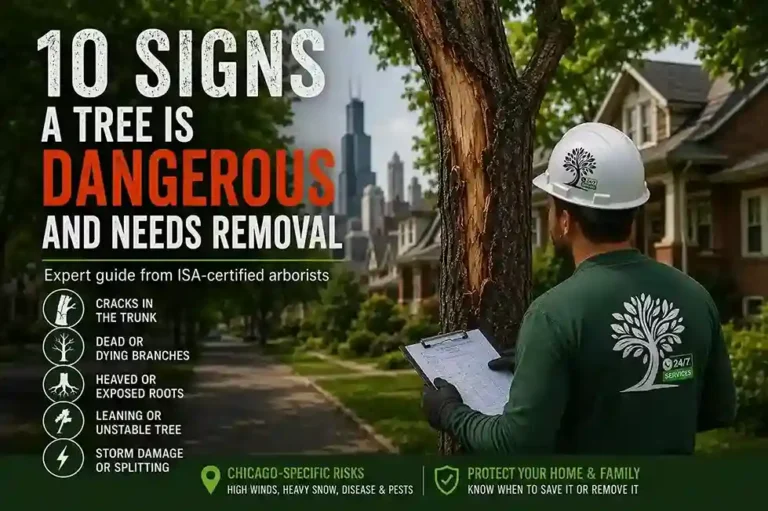
A dangerous tree rarely announces itself all at once. It usually gives warnings first, a dead limb here, a crack there, a lean that gets a little worse each year. Knowing what to look for can protect your family, your home, your car, and your neighbor’s property before a storm makes the decision for you.
A tree should be removed when it’s dead, severely leaning, structurally unstable, or suffering from advanced decay, root damage, or disease that threatens people or property. Warning signs include hollow trunks, large dead branches, cracked limbs, and sudden leaning. A certified arborist can confirm whether removal or treatment is the safer, more cost-effective option.
Trees add real value to a property. A mature shade tree cools a home in summer, filters the air, holds soil in place, and adds thousands of dollars to a home’s resale value. That’s exactly why the decision to remove one shouldn’t be taken lightly, and why it shouldn’t be avoided when a tree has genuinely become dangerous.
The tricky part is telling the difference. Some problems look scary but respond well to pruning, cabling, or treatment. Others look minor from the ground but hide serious decay or root failure underneath. Waiting too long to deal with a genuinely hazardous tree tends to raise the cost, not lower it, because storm damage, emergency dispatch, and property repair almost always cost more than a planned removal.
This guide walks through the 15 warning signs a certified arborist looks for during a tree risk assessment. By the end, you’ll know exactly when a tree needs to come down, when it can be saved, and when it’s time to call for a tree removal service right away.
“Most tree failures aren’t random. They follow a pattern arborists are trained to recognize, often years before the tree actually comes down.” Windy City Tree Services Arborist Team
1. Dead Trees
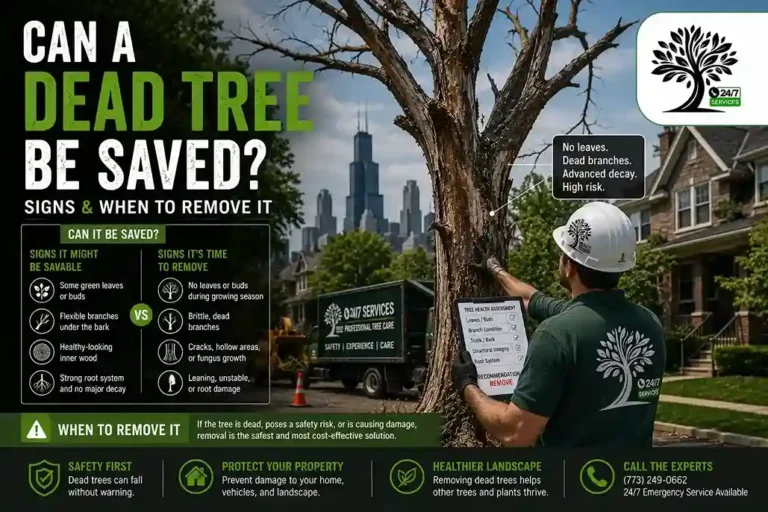
A completely dead tree is the clearest sign that removal is necessary. Dead wood loses strength fast, and a dead tree can fail without warning, even on a calm day.
Look for a full season without leaves during the growing season, brittle branches that snap cleanly instead of bending, and bark that’s peeling or falling away in sheets. Underneath dead bark, the cambium layer, the thin green tissue just below the surface, turns brown and dry instead of staying moist and pale. A hollow trunk, detectable by tapping the bark and listening for a dull, hollow sound, often means the tree has been dead or dying from the inside for years.
🔎 Quick Homeowner Check
Scratch a small patch of bark with your fingernail. Green, moist tissue underneath means the branch is alive. Brown, dry tissue means it’s dead and should be evaluated by an arborist.
2. Large Dead Branches
Arborists call a large dead or broken limb hanging in a tree’s canopy a “widow maker” for a reason. These limbs can fall with no warning, no wind, and no storm required. Gravity and time are enough.
Dead branches are especially dangerous when they hang over driveways, walkways, decks, or parked cars. A limb that looks stable can be barely attached at the point where it meets the trunk, held in place by a few fibers that eventually give way. Ice, wind, or the weight of new snow is often what finally brings it down.
⚠️ Don’t Wait for a Storm
If you can see daylight through a crack at the base of a large limb, or the limb has no leaves while the rest of the tree does, treat it as an active hazard and keep people and vehicles away until it’s inspected.
3. Severe Leaning Trees
Not every leaning tree is dangerous. Many trees develop a natural lean over decades as they grow toward sunlight, and that kind of gradual, long-standing lean is usually stable.
A sudden lean is a different story. If a tree that was standing straight last month is now leaning, or the lean has visibly increased in recent weeks, that’s often a sign the root plate is shifting. Look at the base of the trunk: soil lifting, cracking, or a visible gap forming on one side of the root flare means the roots are starting to lose their grip on the ground. This is one of the more urgent warning signs on this list, since a tree with a failing root plate can fall with very little additional force.
📐 Diagram Suggestion
An infographic comparing a “gradual lean” (smooth trunk curve, undisturbed soil at the base) against a “sudden lean” (straight trunk, cracked and lifted soil at the root flare) would help readers visually tell the two apart.
4. Tree Rot
Internal decay is one of the hardest problems to catch because it often develops out of sight, inside the trunk or major limbs, while the outside of the tree still looks fine.
Fungal growth is the clearest external clue. Mushrooms or bracket-shaped conks growing on the trunk or at the base almost always mean active decay is happening inside the wood. Visible cavities, soft or spongy bark, and a hollow sound when tapped all point to the same problem. Decayed wood loses its structural strength long before it looks obviously damaged, which is why internal decay causes so many unexpected tree failures.
A trained arborist can often confirm the extent of internal decay using a combination of visual inspection, sounding, and in some cases resistance drilling, well before the damage becomes visible from the outside.
5. Root Damage
Roots anchor a tree and supply the water and nutrients that keep it alive, so damage below ground can be just as dangerous as damage above it.
Construction work is one of the most common causes of root damage in urban neighborhoods. Trenching for utilities, grading for a new driveway, or excavation near a foundation can sever major structural roots without anyone realizing how much damage was done until the tree starts declining months or years later. Soil compaction from heavy equipment or repeated foot traffic squeezes out the air pockets roots need to breathe, slowly suffocating the root system.
An Air Spade inspection uses compressed air to gently expose roots without cutting them, letting an arborist assess root decay, girdling roots, and construction damage directly instead of guessing based on the canopy alone.
6. Storm Damage
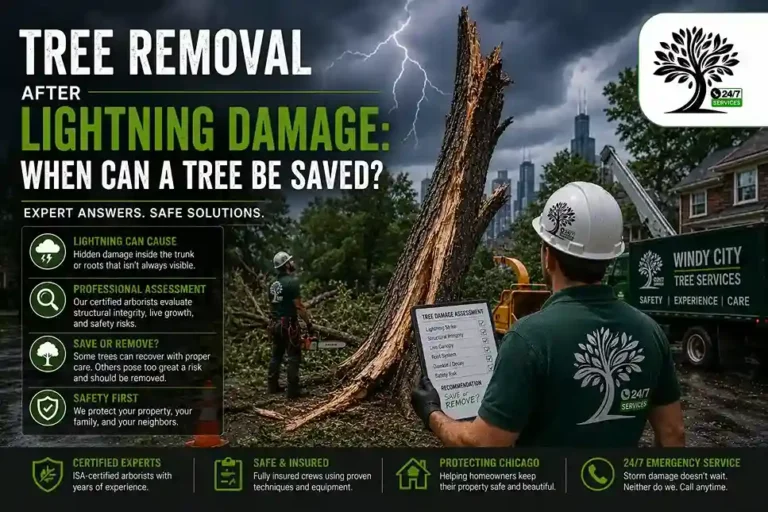
Storms don’t just knock trees down outright, they often leave behind damage that isn’t obvious until you look closely. Lightning strikes can scorch a strip of bark or split wood along the grain without dropping the tree immediately. Strong straight-line winds tear limbs partway off, leaving them hanging by a thread of bark. Ice storms load down branches with weight they were never built to hold, and the resulting cracks may not fail until the next storm finishes the job.
Any tree with a split trunk, a torn major limb, or visible storm damage should be inspected before the next round of severe weather, even if it’s still standing and looks stable for now.
7. Tree Diseases
Certain tree diseases move fast and can turn a healthy tree into a hazard within one or two growing seasons.
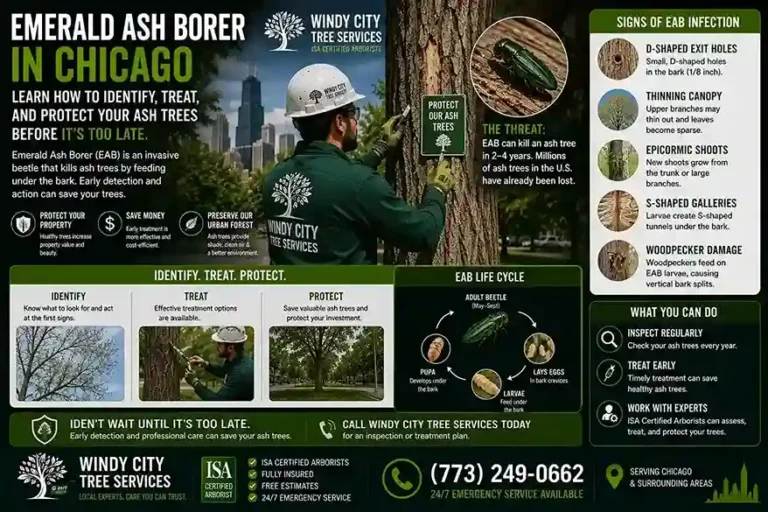
Oak wilt spreads through connected root systems and above-ground insect activity, and it’s often fatal to red oak species within weeks of symptoms appearing. Dutch elm disease has devastated American elm populations across the Midwest for decades and still threatens surviving trees. Emerald ash borer has killed the overwhelming majority of untreated ash trees in the Chicago area, usually within two to four years of the first signs of infestation. Root rot and anthracnose add further pressure, especially in wet years.
Treatment can save a tree if the disease is caught early enough and the species responds to available treatments. Once a disease has caused extensive canopy dieback or structural decline, removal usually becomes the safer and more practical option, both for the tree and for any healthy trees nearby that could become infected.
8. Structural Defects
Some trees are structurally compromised from the way they grew, not from disease or damage. Weak branch unions form when two limbs grow at a tight angle with bark trapped between them instead of solid wood, a defect arborists call included bark. Codominant stems, where two trunks of similar size grow from the same point instead of one dominant leader, create a similar weak point that’s prone to splitting as the tree matures.
Visible cracks running along the trunk or at a major branch union are one of the more serious warning signs on this list, since they indicate the wood has already started to fail structurally. Following ANSI A300 pruning standards, an arborist can sometimes correct minor structural defects early through selective pruning, but advanced cracks and splits usually call for cabling, bracing, or removal depending on severity.
9. Trees Growing Too Close
Location matters as much as condition. A perfectly healthy tree can still pose a long-term risk if it’s growing too close to a structure or utility.
- Roots growing into home or garage foundations
- Branches overhanging pools, decks, or patios
- Limbs tangled in or brushing against power lines
- Roots lifting or cracking sidewalks and driveways
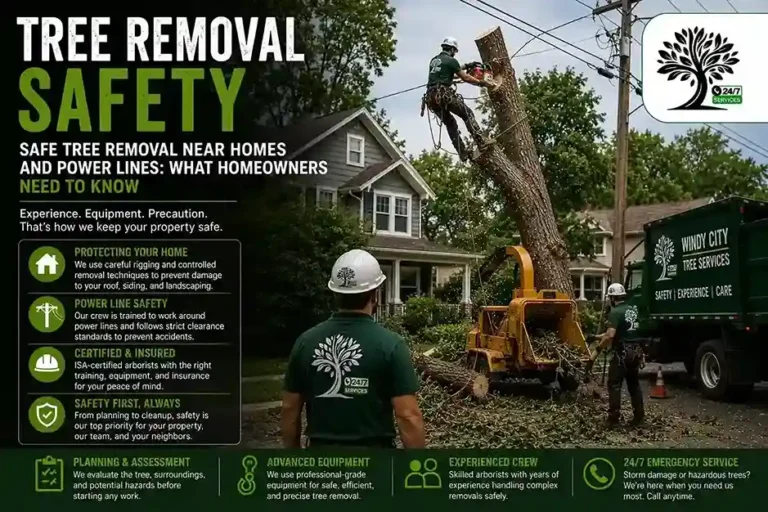
Trees near power lines deserve extra caution. Never attempt to trim branches near electrical lines yourself, contact your utility company or a professional tree service instead. In some of these situations, relocation isn’t possible and removal becomes the only long-term fix, even if the tree itself is otherwise healthy.
10. Pest Infestations
Beyond emerald ash borer, several other pests can compromise a tree’s structural integrity from the inside out. Carpenter ants don’t eat wood the way termites do, but they excavate galleries through decayed or damaged wood, which is often a sign that internal decay is already present. Various borer species tunnel beneath the bark, disrupting the tree’s ability to move water and nutrients. Termites, while less common in living trees than in dead wood, can still weaken already-compromised trunks.
Sawdust-like frass near the base of the trunk, small exit holes in the bark, or woodpecker damage concentrated in one area are all signs worth having an arborist evaluate.
11. Tree Risk Assessment
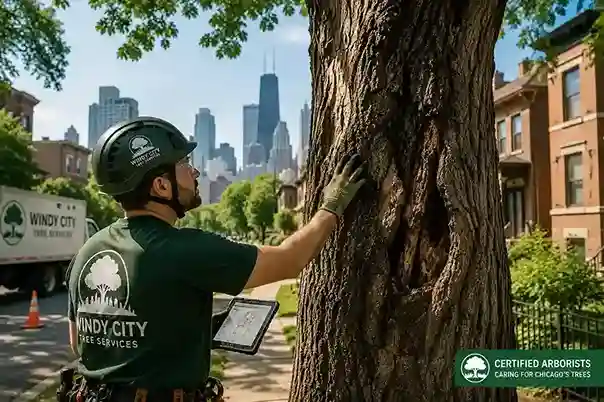
When a tree’s condition isn’t obvious, a formal tree risk assessment gives homeowners and property managers a clear, evidence-based answer instead of a guess. ISA Certified Arborists follow a structured process built around a few key factors.
- Likelihood of failure: How probable is it that the tree or a specific part of it will fail in the near future?
- Target rating: What’s in the path if the tree does fail, a home, a driveway, a sidewalk, or an empty yard?
- Consequences of failure: How much damage or risk would result if the tree came down where it’s standing?
- Structural integrity: A full inspection of the trunk, root flare, major limbs, and canopy for defects.
- Long-term health: Overall vigor, disease pressure, and the tree’s likely trajectory over the next several years.
This process follows the same principles outlined in ISA Best Management Practices for tree risk assessment, giving property owners a documented basis for deciding between removal, treatment, or continued monitoring.
12. Can the Tree Be Saved?
Removal should always be the last option, not the first one. A lot of trees that look concerning can be preserved with the right treatment.
- Pruning: Removing dead, damaged, or structurally weak limbs before they become a hazard.
- Cabling and bracing: Steel support systems that reduce stress on weak unions and codominant stems.
- Deep root fertilization: Restoring nutrients to stressed trees growing in compacted or poor-quality soil.
- Air Spade root work: Correcting girdling roots and relieving soil compaction without cutting healthy roots.
- Soil improvement: Aeration and amendment for trees suffering from long-term compaction stress.
- Disease treatment: Targeted treatment for oak wilt, emerald ash borer, and other conditions caught early.
The right call depends on how much of the tree’s structure and health is still intact. A tree with one dead limb and an otherwise sound structure is usually a pruning job. A tree with extensive internal decay, a failing root plate, and a canopy in visible decline is usually beyond saving. A good arborist will always explain which category your tree falls into and why, not just recommend removal by default.
13. When Emergency Removal Is Needed
🚨 Call Immediately If You See:
A tree resting on a home, garage, or car. A fallen tree blocking a road or driveway. A broken trunk still partially standing. Branches tangled in power lines. Any of these situations calls for an emergency tree removal service, not a wait-and-see approach.
Keep people, pets, and vehicles away from the hazard area until a professional crew arrives. Never attempt to cut a tree that’s under tension, leaning against a structure, or tangled in electrical lines. These situations account for a large share of chainsaw-related injuries every year, precisely because the wood can be under far more pressure than it appears.
14. Chicago-Specific Considerations
Chicago’s climate and soil create a specific set of risk factors that make certain warning signs more urgent here than in other parts of the country. Heavy, wet snow and periodic ice storms load down limbs every winter, and trees that weren’t pruned beforehand are far more likely to shed a major branch or fail outright. Wind off Lake Michigan adds extra stress to trees along the lakefront and in exposed residential blocks.
Chicago’s clay-heavy soil compacts easily and drains slowly, which contributes to root problems that wouldn’t show up as quickly in sandier soil. The city’s mature urban canopy, much of it planted 60 to 100 years ago, means a large share of Chicago’s oaks, maples, and remaining ash trees are now old enough that structural issues and disease pressure are becoming more common at the same time. That combination is exactly why local, hands-on inspection matters more than a generic online checklist.
15. What Happens During Professional Tree Removal?
A professional removal follows a structured process designed to protect the crew, your property, and everything around it.
- Inspection: Confirming the tree needs removal and identifying any hazards, like power lines or structural instability, that affect the plan.
- Permits: Checking whether a City of Chicago permit is required, which applies to trees on the public parkway.
- Safety planning: Mapping the drop zone, securing the work area, and briefing the crew before any cutting starts.
- Climbing or crane removal: Larger or more constrained trees may require a crane instead of a climber, especially near structures.
- Rigging: Controlled lowering of limbs and sections using ropes and rigging equipment to avoid property damage.
- Cleanup: Hauling away branches, logs, and debris, or leaving firewood and wood chips if the homeowner prefers.
- Stump grinding: Grinding the remaining stump 6 to 8 inches below grade so the area can be replanted or resurfaced.
Remove, Trim, or Inspect? Comparison Table
| Situation | Remove? | Trim? | Inspect First? |
|---|---|---|---|
| Completely dead tree | ✅ Yes | No | Recommended |
| One large dead branch | Usually no | ✅ Yes | Recommended |
| Sudden, worsening lean | Likely | No | ✅ Required |
| Mushrooms at the base | Likely | No | ✅ Required |
| Minor storm damage, one limb | No | ✅ Yes | Recommended |
| Split or cracked trunk | Likely | No | ✅ Required |
| Early-stage disease | No | Sometimes | ✅ Required |
| Advanced disease, canopy decline | ✅ Yes | No | Recommended |
| Roots lifting sidewalk, tree healthy | Case by case | No | ✅ Required |
| Tree resting on structure | ✅ Emergency | No | On arrival |
Cost Factors
Tree removal cost varies widely from job to job, and it depends on more than just the size of the tree. Here’s what actually drives the price:
- Height and diameter: Taller and thicker trees take longer to remove and require more rigging.
- Accessibility: Tight side yards, fences, and limited equipment access add time and complexity.
- Crane requirements: Trees too large or too close to structures for climbing may need a crane.
- Emergency timing: After-hours or storm-response calls typically cost more than scheduled work.
- Cleanup scope: Full debris removal costs more than leaving wood chips or firewood on site.
- Stump grinding: Often quoted separately from the removal itself.
A written, in-person estimate is the only reliable way to know what a specific job will cost, which is why Windy City Tree Services provides free estimates before any work begins.
Safety Tips: What NOT to Do
⚠️ Homeowner Safety Guidance
- Never climb a tree you suspect is dead, diseased, or structurally unstable.
- Never cut a tree that’s leaning against a structure or under tension.
- Never attempt to remove branches near power lines yourself.
- Never stand under a hanging or partially broken limb to assess it.
- Never use a chainsaw on a tree larger than you have experience handling.
When in doubt, treat the area as off-limits and call a professional. A hazardous tree evaluation is far cheaper than an emergency room visit or a damaged roof.
Frequently Asked Questions
Do I need a permit to remove a tree in Chicago?
Trees on the public parkway, the strip between the sidewalk and street, require a City of Chicago permit before removal. Trees on private property generally don’t need one, though some historic districts have added requirements.
Will my homeowner’s insurance cover tree removal?
Many policies cover removal if the tree fell due to a covered event, like wind or a storm, especially if it damaged a structure. Coverage for removing a standing hazardous tree before it falls is less common. Check your specific policy or ask your agent.
What should I do immediately after storm damage to a tree?
Stay clear of any hanging limbs or leaning trees and call a professional emergency line. Document the damage with photos for insurance purposes once it’s safe to do so, but don’t approach the tree until it’s been assessed.
Can a diseased tree be treated instead of removed?
Sometimes. Early-stage disease, especially oak wilt or emerald ash borer caught before major canopy decline, can often be treated. Advanced infections that have already caused significant dieback are usually beyond saving.
Is a leaning tree always dangerous?
No. Many trees develop a gradual, natural lean over decades that’s structurally stable. A sudden lean, or one paired with cracked and lifted soil at the base, is a much more serious warning sign that needs prompt inspection.
How do I know if tree roots are damaging my foundation?
Look for cracks in the foundation near the tree, lifted or uneven pavement nearby, or visible large roots growing close to the structure. An Air Spade inspection can confirm root proximity and condition without cutting healthy roots.
How often should trees be professionally inspected?
Most healthy residential trees benefit from an inspection every two to three years, with more frequent checks for older trees, trees near structures, or trees that have shown any warning signs on this list.
What is oak wilt and how fast does it spread?
Oak wilt is a fungal disease that spreads through connected root systems and sap-feeding beetles. It can kill a red oak within a few weeks of symptoms appearing, which is why fast diagnosis matters so much.
Can emerald ash borer damage be reversed?
Trees caught early, with limited canopy thinning, can often be saved with preventive treatment. Trees with more than 30 to 50 percent canopy loss usually can’t recover and are safer to remove before they become structurally unstable.
What does a certified arborist actually check during an inspection?
An ISA Certified Arborist evaluates the trunk, root flare, major limbs, and canopy for decay, cracks, disease, and structural defects, then rates the likelihood of failure against what’s nearby to determine overall risk.
Is it cheaper to remove a tree before or after it falls?
Almost always cheaper before. Planned removal avoids emergency dispatch fees, property damage repair, and the added complexity of removing a tree that’s already fallen onto a structure or vehicle.
Can I remove a small dead tree myself?
Small, easily accessible dead trees away from structures and power lines may be manageable for an experienced homeowner with the right equipment. Anything near a structure, power line, or larger than a small ornamental tree should go to a professional.
What is a tree risk assessment and do I need one?
A tree risk assessment is a structured evaluation of a tree’s likelihood of failure and the consequences if it does fail. It’s worth getting if a tree shows any warning signs, sits near a structure, or hasn’t been inspected in several years.
How much does stump grinding cost after removal?
Stump grinding pricing depends on the stump’s diameter, root spread, and site access. It’s typically quoted separately from removal, and we provide a free written estimate for both together.
Do you offer emergency tree removal 24/7 in Chicago?
Yes. Storm damage and fallen trees don’t wait for business hours, and neither do we. Call (773) 249-0662 any time for emergency dispatch.
What’s the difference between tree trimming and tree pruning?
The terms are often used interchangeably, but professional pruning follows ANSI A300 standards and focuses on structural health, while general trimming may focus more on shape and appearance. Both should be done by a trained crew to avoid weakening the tree.
Can cabling and bracing really prevent a tree from failing?
Yes, in the right situations. Cabling and bracing reduce stress on weak branch unions and codominant stems, significantly lowering the odds of failure for trees that are otherwise healthy and worth preserving.
Why do mushrooms growing near a tree matter?
Mushrooms or bracket fungi growing on the trunk or roots are a visible sign of internal decay. Their presence usually means the decay has been developing for a while, even if the tree still looks healthy above ground.
Should I remove a tree that’s growing too close to my house?
Not always. If the tree is healthy and there’s no foundation or structural risk, pruning may be enough. Removal becomes necessary when roots threaten the foundation or branches consistently damage the roof or siding.
How do I get a free tree inspection from Windy City Tree Services?
Call (773) 249-0662 or email info@windycitytreeservices.com to schedule a free, in-person inspection. An ISA Certified Arborist will assess your tree and provide a written recommendation and estimate.
Related Articles
Protect Your Property Before It’s Too Late
If you’re concerned about a tree on your property, let our experienced arborists assess its condition. We’ll recommend removal only when necessary and explore preservation options whenever possible.
info@windycitytreeservices.com · 323 W Carroll Ave, Chicago, IL 60612 · Serving Chicago 24/7