Shovel v/s Spade | Windy City Tree Service | 773 249 0662
🌱 Tool Guide · Gardening & Landscaping
Shovel vs Spade: What’s the Difference?
Learn how shovels and spades differ, what each tool is designed to do, and which one is best for digging, planting, edging, and landscaping.
Introduction
People use “shovel” and “spade” interchangeably all the time, and in casual conversation, that’s fine. But the two tools traditionally have different blade shapes, different purposes, and different jobs they do best.
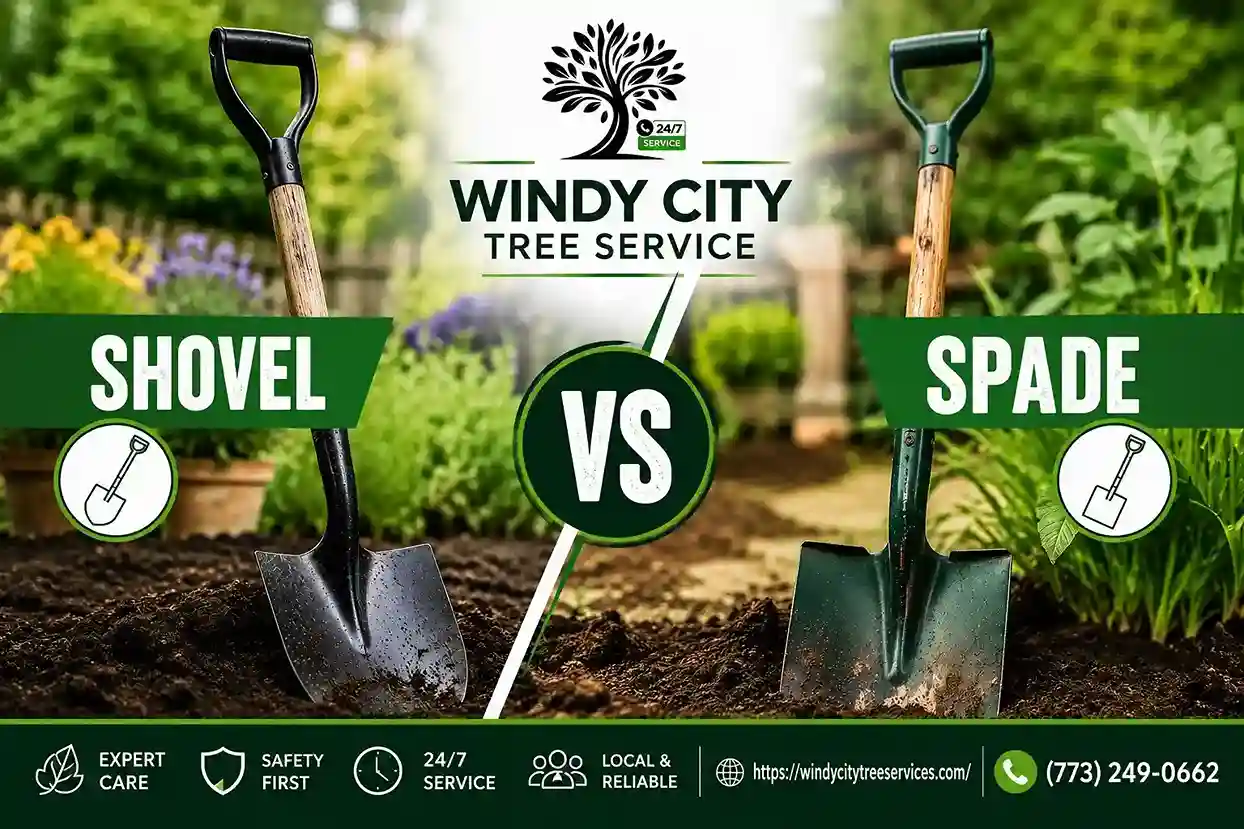
A shovel generally has a curved or scooped blade built for lifting and moving loose material. A spade typically has a flatter, straighter blade built for cutting and working through soil. That’s the core distinction this guide is built around.
Terminology varies by region and manufacturer, so you’ll find plenty of exceptions, tools labeled “spade” that scoop, and tools labeled “shovel” that cut. Not every shovel curves and not every spade is perfectly flat. But the traditional distinction still holds up as a genuinely useful way to think about these tools.
By the end of this guide, you’ll know what a shovel is, what a spade is, how they differ, when to use each one, what different designs are available, and how to choose the right tool for your yard. We’ll also cover something specific to this site: why a professional Air Spade, the compressed-air tool arborists use around tree roots, is nothing like the garden spade in your shed.
A shovel typically has a curved, scooped blade designed for lifting and moving loose material like soil, mulch, or gravel. A spade typically has a flatter, straighter blade with a sharp edge designed for cutting into soil, edging, and planting. Terminology varies by manufacturer, but this is the traditional distinction between the two tools.
1. What Is a Shovel?
A shovel is a hand tool with a broad, typically curved or scooped blade attached to a shaft and handle. The curve helps the blade hold loose material as you lift and carry it, which is exactly what most shovel designs are optimized for.
- Blade shape: Usually curved or concave, forming a shallow bowl that holds material during a lift.
- Scooping capability: The defining feature; a curved blade slides under loose material and cradles it as you move.
- Handle styles: Long straight handles for leverage, or shorter D-grip handles for control in tight spaces.
- Common materials: Steel or aluminum blades, with wood, fiberglass, or steel shafts.
- Typical uses: Moving material more than cutting into it.
Shovels excel at moving soil, compost, gravel, mulch, sand, snow, and other loose material from one place to another. If the job is “pick this up and put it over there,” a shovel is usually the better tool.
2. What Is a Spade?
A spade is a hand tool with a flatter, straighter blade and a sharper cutting edge than a typical shovel. Instead of scooping, a spade is built to slice cleanly through soil, turf, and roots.
- Blade shape: Flat or only slightly curved, with a straight, sharp leading edge.
- Cutting edge: Often thinner and sharper than a shovel’s edge, built for a clean cut rather than a scoop.
- Foot step: A flattened shoulder at the top of the blade where you can press down with your boot for extra force.
- Shaft: Frequently shorter than a shovel’s, favoring control and downward force over leverage.
- Handle styles: D-grip handles are common, giving better control for precise cuts.
- Typical construction: Forged or stamped steel blades paired with wood, fiberglass, or steel handles.
Spades are useful for cutting through soil, digging planting holes, edging garden beds, dividing perennials, cutting roots when appropriate, and creating clean, straight trench edges.
3. Shovel vs Spade: Key Differences
| Feature | Shovel | Spade |
|---|---|---|
| Blade shape | Usually curved/scooped | Usually flat/straight |
| Main purpose | Moving and lifting material | Cutting and digging soil |
| Soil handling | Excellent | Good |
| Scooping | Excellent | Limited |
| Edging | Limited | Excellent |
| Digging | Good | Excellent |
| Planting | Good | Excellent |
| Moving mulch | Excellent | Good |
| Creating clean edges | Limited | Excellent |
Designs vary quite a bit between brands, and the terms “shovel” and “spade” aren’t perfectly standardized across the industry. Treat this table as a general guide, not a strict rulebook.
4. When Should You Use a Shovel?
Moving Soil
A curved blade scoops loosened soil efficiently, making shovels the natural choice once soil has already been broken up.
Moving Mulch
Mulch is bulky and light; a shovel’s scoop shape handles large volumes in fewer trips than a flat blade.
Loading Compost
Compost’s loose, crumbly texture sits well in a curved blade, making loading and transferring easier.
Digging Loose Soil
In soil that’s already soft or sandy, a shovel can dig effectively without needing a spade’s sharper cutting edge.
Moving Gravel
Heavier material still benefits from the scoop shape, which keeps loose stones from sliding off the blade.
Snow Removal
Snow shovels use an exaggerated version of the scoop design specifically for pushing and lifting snow.
General Yard Cleanup
Leaves, debris, and loose material of all kinds move faster with a scooping tool than a cutting one.
The curved blade is the whole reason a shovel works well for these jobs: it holds material in place instead of letting it spill off a flat surface as you lift.
5. When Should You Use a Spade?
Cutting Into Firm Soil
A spade’s sharp, straight edge slices through compact or root-filled soil more effectively than a curved shovel blade.
Garden Bed Edging
The flat blade creates a clean, straight line along a bed’s border, which is exactly what edging calls for.
Planting
Cutting a precise planting hole with straight sides is easier with a spade’s controlled, flat blade.
Dividing Perennials
A sharp spade edge can slice through root balls cleanly when splitting overgrown perennials.
Creating Trenches
Straight sides and a controlled cutting edge make spades well-suited to narrow, clean trenches.
Transplanting
Cutting a clean root ball out of the ground, with minimal damage to the roots, favors a spade’s precision over a shovel’s scoop.
Cutting Through Turf
Removing sod in clean strips requires a sharp, flat edge rather than a curved, scooping one.
The flat blade is what gives a spade its control: you’re guiding a cutting edge along a precise line, not scooping material into a bowl shape.
6. Do You Dig a Hole With a Spade or Shovel?
Either tool can work, depending on the soil and the size of the hole. There isn’t one universally correct answer.
- Use a spade to cut into compact or firm soil, especially for the initial cut through turf or dense earth.
- Use a shovel to remove and move the loosened soil once it’s been broken up.
Many gardeners use both tools together on the same hole: a spade to cut the outline and break up firm soil, then a shovel to scoop out and move what’s been loosened. For a small planting hole in soft soil, a spade alone is often enough. For a large hole in dense clay, starting with a spade and finishing with a shovel usually saves effort.
7. Types of Shovels
| Type | Shape & Primary Use | Limitations |
|---|---|---|
| Round-point shovel | Pointed, curved blade for general digging and breaking soil | Less precise for straight edges |
| Square-point shovel | Flat-edged blade for scooping and leveling loose material | Struggles to cut into firm, undisturbed soil |
| Digging shovel | Sturdy, curved blade for general-purpose digging | Not built for fine edging work |
| Transfer shovel | Wide, flat scoop for moving large volumes of loose material | Poor for any cutting task |
| Scoop shovel | Large, lightweight blade for grain, snow, or mulch | Too bulky for detailed garden work |
| Snow shovel | Wide, often angled blade for pushing and lifting snow | Not designed for soil at all |
| Drainage shovel | Narrow, curved blade for cleaning ditches and drainage lines | Too narrow for large-volume digging |
| Trenching shovel | Long, narrow blade for digging straight, narrow trenches | Slow for wide holes or large volumes |
| Post-hole digger | Clamshell-style dual blades for deep, narrow holes | Limited to narrow-diameter holes |
| Hand shovel | Small handheld scoop for containers and tight spaces | Impractical for any large-scale digging |
8. Types of Spades
| Type | Best For |
|---|---|
| Garden spade | General-purpose digging, edging, and planting |
| Border spade | A smaller version of the garden spade for tight flower beds |
| Drain spade | Narrow blade for cleaning and shaping drainage channels |
| Trenching spade | Long, narrow blade built for straight, deep trenches |
| Edging spade | Half-moon or flat blade specifically shaped for clean bed edges |
| Narrow planting spade | Compact blade for precise planting holes in tight spaces |
| Flat-blade spade | Broad, flat blade for general soil cutting and turning |
| D-handle spade | Any spade blade paired with a D-grip for extra control |
Blade width changes how much soil you move per cut: narrow blades suit precise work, wide blades cover ground faster. Handle design affects control, with D-handles favoring precision and long straight handles favoring leverage.
9. Square Shovel vs Spade
A square-point shovel and a garden spade can look surprisingly similar at first glance, both have relatively flat, straight-edged blades. But they’re built with different priorities.
- Blade geometry: A square shovel’s blade is typically thinner and lighter, optimized for scooping. A spade’s blade is often slightly thicker with a sharper edge, optimized for cutting.
- Scooping: Square shovels handle this better thanks to their broader, lighter profile.
- Cutting: Spades hold the edge here, with a sharper, more durable cutting surface.
- Edging: A spade generally produces a cleaner line.
- Moving material: A square shovel is the better scoop.
- Digging: A spade cuts into firm soil more effectively.
10. Flat Shovel vs Spade
“Flat shovel” isn’t a strict industry term, it’s often used to describe a square-point shovel, which shares some characteristics with a spade.
- Shape: Both have relatively flat blades, but a true spade usually has a sharper, more refined cutting edge.
- Function: A flat shovel leans toward moving and leveling material; a spade leans toward cutting and precision digging.
- Material movement: Flat shovels handle scooping and leveling well.
- Soil cutting: Spades generally outperform flat shovels here.
- Edging: Spades are the stronger choice for clean garden edges.
- Landscaping applications: Both show up regularly, chosen based on the specific task rather than one universally “better” tool.
Product naming varies quite a bit between manufacturers, so always check the actual blade shape and edge, not just the name printed on the tool.
11. What Does a Spade Look Like?
Picture a flat, rectangular metal blade with a straight, sharp bottom edge. At the top of the blade, a flattened shoulder, the foot step, gives you a place to press down with your boot. The blade connects to a shaft, often shorter than a shovel’s, which runs up to a collar and then a handle, either a straight grip or a D-shaped grip for extra control.
12. How to Choose the Right Shovel or Spade
- What are you digging? Loose material favors a shovel; firm soil favors a spade.
- What type of soil do you have? Sandy soil is forgiving; dense clay rewards a sharp spade edge.
- Are you moving material? A curved shovel blade scoops and carries more efficiently.
- Are you creating a clean edge? A flat spade blade produces straighter, more precise lines.
- Are you digging deep? Longer shafts and shovel leverage often help with depth.
- How much force is required? A spade’s foot step helps drive the blade with body weight.
- How frequently will you use it? Frequent use justifies investing in a higher-quality blade and handle.
13. Shovel vs Spade for Different Landscaping Jobs
| Task | Better Choice | Why |
|---|---|---|
| Moving mulch | Shovel | Scoops efficiently |
| Moving soil | Shovel | Designed for lifting material |
| Garden edging | Spade | Creates cleaner edges |
| Planting | Spade | Cuts into soil effectively |
| Digging compact soil | Spade | Strong cutting edge |
| Loading compost | Shovel | Better scoop |
| Snow | Snow shovel | Designed for snow |
| Trenching | Trenching spade | Narrow blade |
| General landscaping | Depends | Choose based on the specific task |
14. Can a Shovel Be Called a Spade?
In everyday conversation, sure, plenty of people use the words interchangeably without any confusion. But traditional gardening terminology draws a real distinction based on blade shape and function.
- Everyday language often treats “shovel” and “spade” as synonyms.
- Tool manufacturers sometimes use the terms inconsistently, labeling similar tools differently.
- Traditional terminology distinguishes them by blade curve, edge sharpness, and intended function.
- Naming isn’t fully standardized across the industry, so exceptions are common.
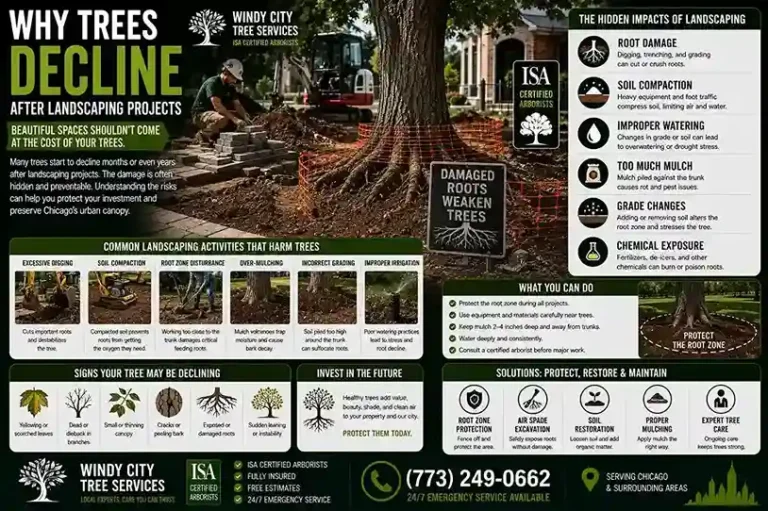
15. Garden Spade vs. Air Spade
Important Distinction
A traditional garden spade is a hand tool used for cutting and digging soil. An Air Spade is specialized arboricultural equipment that uses compressed air to carefully remove soil around tree roots. These are not the same category of tool, and they are not interchangeable.
A garden spade relies on a sharp metal edge and physical force to cut through soil. That’s exactly what makes it risky to use around an established tree: the same cutting action that slices cleanly through open ground will just as easily slice through a root in its path.
An Air Spade root excavation works completely differently. Instead of a blade, it uses a nozzle delivering a high-velocity stream of compressed air. That air breaks apart and displaces soil particles without applying the cutting or crushing force that damages roots. Trained arborists use this equipment for:
- Root collar excavation
- Root flare exposure
- Soil decompaction
- Root inspection
- Identifying girdling roots
- Investigating construction-related root problems
- Tree preservation efforts generally
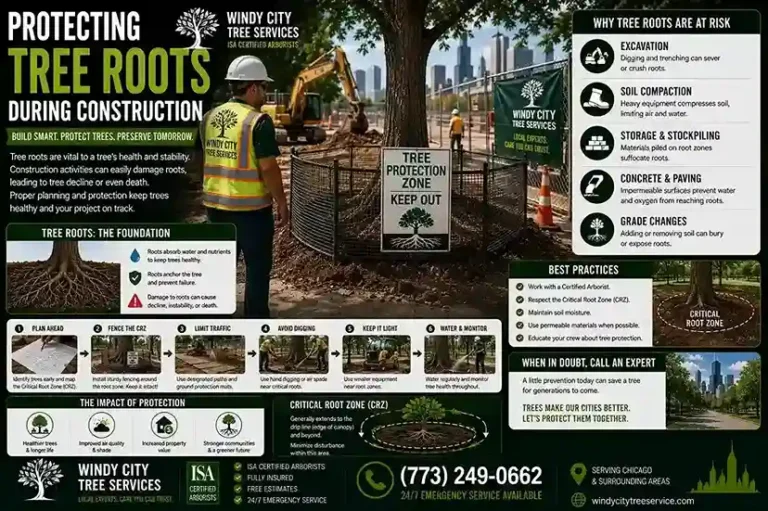
Mechanical digging equipment, and manual cutting with a shovel or spade, can create unnecessary root injury exactly where a tree can least afford it. Air Spade excavation isn’t a homeowner DIY project; it requires training, proper equipment, and an understanding of root anatomy to use safely and effectively. If you’re curious about the full process, our guide on What Is Air Spade Root Excavation? covers it in more depth.
16. Why Root Excavation Requires Special Care
Tree roots aren’t uniform, and different parts of the root system respond very differently to disturbance.
- Fine absorbing roots: Thin, hair-like roots responsible for most water and nutrient uptake, easily severed by any cutting tool.
- Structural roots: Larger roots providing physical stability; damage here can affect the tree’s ability to stand upright.
- Root collar: The transition zone at the base of the trunk, often buried and in need of careful, non-destructive exposure.
- Root flare: The natural widening where trunk meets roots, which should stay visible at soil level for tree health.
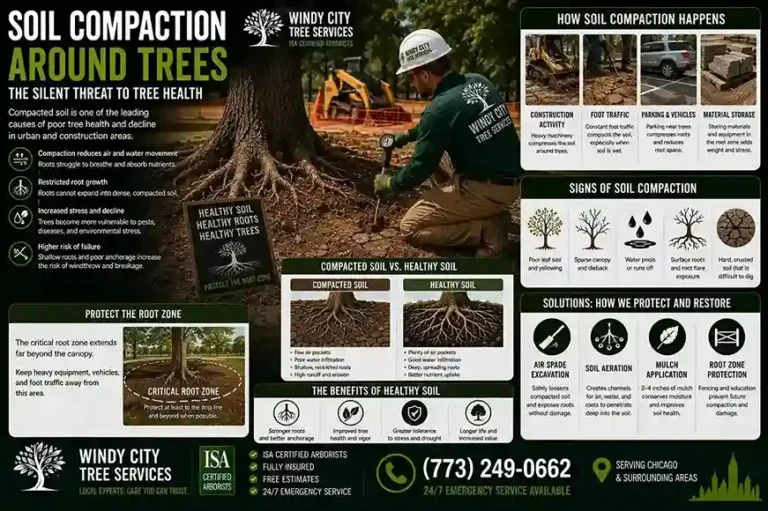
- Soil compaction: Common in urban settings, restricting root oxygen and water access.
- Mechanical root damage: Cuts and crush injuries from shovels, machinery, or careless digging.
- Construction impacts: Grading, trenching, and equipment traffic near root zones can cause damage that takes years to show up above ground.
This is exactly why arborists reach for specialized equipment rather than a standard digging tool when investigating root conditions around a valuable or mature tree.
17. Common Mistakes When Using Shovels and Spades
Never Assume Digging Near a Mature Tree Is Harmless
Roots often extend well beyond the visible canopy, and damage from a single afternoon of digging can take years to show up as canopy decline. When significant roots or valuable mature trees are involved, a professional assessment is worth the call before the first cut.
- Using the wrong blade for the job (a scoop for cutting, or a cutting edge for scooping)
- Using excessive force instead of technique, which increases injury risk
- Poor lifting posture that strains the back rather than the legs
- Ignoring soil conditions and forcing a tool through ground it isn’t built for
- Using damaged or dull tools that require more force and control less precisely
- Digging too close to tree trunks without checking for roots first
- Cutting roots unnecessarily when rerouting the dig would have avoided it
- Using inappropriate mechanical equipment around established trees
18. How to Maintain Your Shovel or Spade
- Clean soil off after every use to prevent rust and buildup on the blade.
- Dry metal blades thoroughly before storage to avoid corrosion.
- Sharpen cutting edges periodically, especially on spades, to maintain clean cuts.
- Check handles for cracks or splintering, particularly on wood-handled tools.
- Inspect ferrules, the metal collar joining blade to handle, for looseness or rust.
- Lubricate wooden handles occasionally with linseed oil to prevent drying and cracking.
- Store tools properly, off the ground and out of direct weather exposure.
19. Shovel & Spade Buying Guide
A few practical factors matter more than brand name when choosing a new tool:
- Blade material: Steel blades tend to hold an edge and handle abuse better than aluminum.
- Handle material: Wood offers some shock absorption; fiberglass and steel offer more durability.
- Handle length: Longer handles add leverage; shorter handles add control.
- D-grip vs. straight handle: D-grips favor precision work; straight handles favor two-handed leverage.
- Weight: Lighter tools reduce fatigue over long sessions; heavier tools can add cutting force.
- Blade size: Larger blades move more material per scoop or cut, at the cost of control.
- Foot step: A wider, more comfortable foot step matters if you’ll be pressing down repeatedly.
- Soil type: Rocky or clay-heavy soil rewards a stronger, sharper blade.
- Frequency of use: Occasional use tolerates a budget tool; frequent use justifies spending more.
- Ergonomics: Handle angle and grip comfort matter more than most people expect over a full day of use.
20. Quick Decision Guide
🥄 Choose a Shovel If:
- You need to move soil
- You need to move mulch
- You’re scooping loose material
- You need a general-purpose material-moving tool
🔪 Choose a Spade If:
- You need to cut into soil
- You’re edging a garden bed
- You’re planting
- You need a clean trench
- You’re dividing plants
🌳 Call an Arborist If:
- You need to excavate around mature tree roots
- You suspect root damage
- Soil is heavily compacted around a tree
- A tree is declining after construction
- You need root collar excavation
Using Digging Tools Around Trees in Chicago
Chicago’s urban soil adds a few extra considerations for anyone reaching for a shovel or spade near an established tree.
- Compacted urban soil: Years of foot traffic and construction leave many yards with dense, hard-to-work soil, and equally dense root systems working to survive in it.
- Mature street trees: Parkway and yard trees decades old often have extensive root systems well beyond what’s visible above ground.
- Construction activity: Renovation and landscaping projects are common across Chicago neighborhoods, and root damage from nearby digging is one of the most frequent, and most preventable, causes of tree decline we see.
- Limited planting areas: Small yards and narrow parkways mean less margin for error when digging near an existing tree.
- Heavy foot traffic: Compounds soil compaction issues near sidewalks and driveways.
- Winter soil conditions: Frozen ground changes how tools perform and how safely digging can be done.
- Root-zone disturbance: Even well-intentioned garden work can disturb roots in ways that take years to show up as canopy decline.
If you’re planning any digging project near a mature tree, a little caution goes a long way. Chicago tree care is as much about what you don’t disturb as what you actively do.
Frequently Asked Questions
A shovel typically has a curved blade for scooping and moving material. A spade typically has a flatter blade with a sharp edge for cutting into soil.
For cutting into firm or compact soil, a spade’s sharper, flatter edge usually performs better. For loose soil, either tool can work well.
A spade is a hand tool with a flat, straight-edged blade designed for cutting through soil, edging, and planting, rather than scooping loose material.
Cutting into soil, digging planting holes, edging garden beds, dividing perennials, and creating clean trench lines.
Moving and lifting loose material like soil, mulch, compost, gravel, sand, and snow.
In everyday language, yes, the terms are often used interchangeably. Traditional gardening terminology distinguishes them by blade shape and function, though naming isn’t fully standardized.
A flat, rectangular blade with a straight, sharp bottom edge, a flattened foot step near the top, and a shaft leading to a straight or D-shaped handle.
A round-point shovel is generally the best all-purpose choice for digging in average garden soil.
A square-point or transfer shovel handles scooping and moving already-loosened soil most efficiently.
Either can work. A spade cuts into firm or compact soil well, while a shovel removes and moves the loosened soil. Many gardeners use both tools together.
General-purpose digging, edging, and planting tasks around a typical residential garden.
A shovel with a flat, straight-edged blade instead of a pointed one, useful for scooping, leveling, and some light edging.
They can look similar, but a square shovel’s blade is usually thinner and built for scooping, while a spade’s blade is typically thicker with a sharper edge built for cutting.
An informal term often referring to a square-point shovel, which shares some characteristics with a spade but generally favors scooping over cutting.
A flat shovel leans toward moving and leveling material, while a true spade leans toward precise cutting and edging, typically with a sharper edge.
A spade, particularly an edging or border spade, produces the cleanest, straightest edge along garden beds.
A spade’s sharp, flat edge cuts through compact or clay-heavy soil more effectively than a shovel’s curved blade.
Specialized arboricultural equipment that uses compressed air, rather than a blade, to remove soil around tree roots without cutting or crushing them.
No. A garden spade is a hand-cutting tool. An Air Spade uses compressed air and has an entirely different purpose: protecting roots during excavation rather than cutting through soil.
Because compressed air excavation exposes roots for inspection and treatment without the cutting or crushing damage that shovels, spades, or machinery would cause.
Explore our Chicago Tree Service homepage, learn more about professional tree care from our Chicago arborists. Related services include Air Spade root excavation, professional tree health inspection, professional tree removal, professional tree pruning, and tree fertilization.
- Hero: shovel and garden spade side-by-side. ALT: “Shovel vs spade comparison showing different blade shapes”
- Close-up of curved shovel blade vs. flat spade blade. ALT: “Difference between shovel and spade blade shapes”
- Gardener edging a bed with a spade. ALT: “Garden spade used for edging a landscape bed”
- Gardener moving mulch with a shovel. ALT: “Shovel used to move mulch in a residential garden”
- Assorted shovel and spade types displayed together. ALT: “Types of shovels and spades for gardening and landscaping”
- Arborist using an Air Spade around a mature Chicago tree. ALT: “Air Spade root excavation by a Chicago arborist” — note: this must visually read as compressed-air equipment, never as a garden spade.