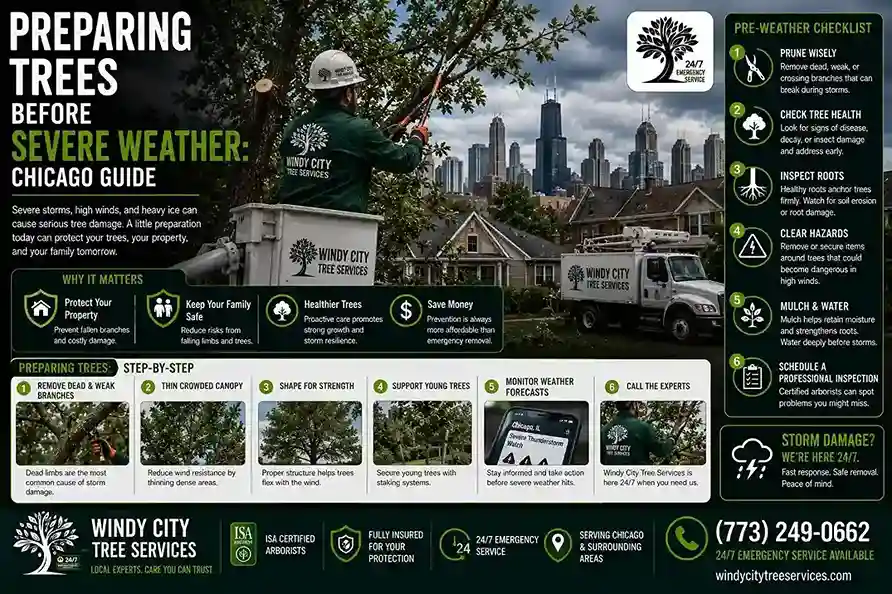
Preparing Trees Before Severe Weather: Chicago Guide
Storm Preparation · Chicago Arborist Guide
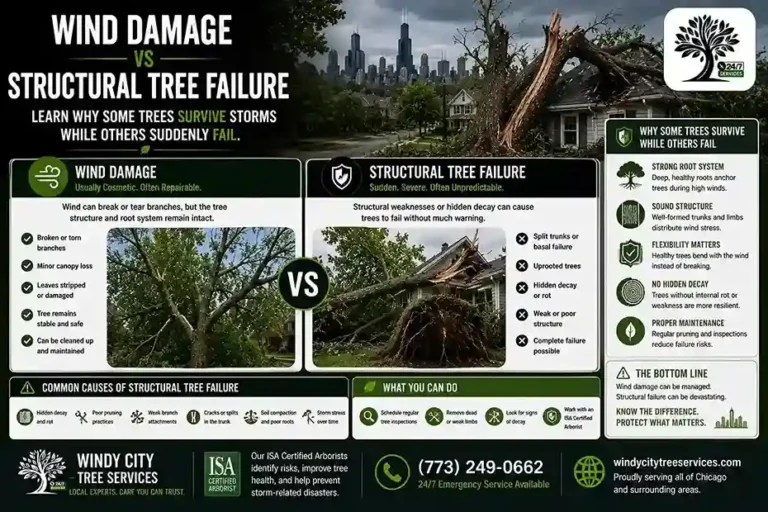
Preparing Trees Before Severe Weather
Reduce storm damage with proactive tree care and professional inspections.
Storm damage usually starts long before the storm does — in a weak branch union, a decayed root, or a pruning job that got deferred one season too many.
Introduction
Chicago sees more than its share of severe weather: thunderstorms rolling off the plains, straight-line winds, lightning, heavy snow, ice storms, and the occasional tornado. Trees take the brunt of a lot of that, and the trees that fail during a storm usually didn’t become hazardous the moment the wind picked up.
Most storm damage traces back to something that existed well before the weather arrived, a decayed root, a weak branch union, a section of deadwood that never got removed. Deferred maintenance and hidden structural defects are the real root cause far more often than the storm itself.
Preparing trees before severe weather reduces the risk of property damage, emergency removal calls, and expensive repairs after the fact. It’s also simply more affordable than reacting after a limb comes through a roof. Preventive tree care costs a fraction of emergency response, and it’s a lot easier to schedule on your own timeline.
This guide walks through exactly how professional arborists prepare trees for severe weather, and what homeowners can do throughout the year to stay ahead of it.
Homeowners can prepare trees for severe weather by scheduling annual inspections, removing dead or weak branches, performing structural pruning, improving overall tree health, installing cabling or bracing where appropriate, and protecting root systems well before storms arrive. Preventive maintenance meaningfully reduces, but cannot fully eliminate, the risk of storm-related tree failure.
1. Why Storm Preparation Matters
- Chicago weather risks: The region regularly experiences severe thunderstorms, high winds, heavy rain, ice, and snow, with occasional tornado activity.
- High winds: Straight-line wind events can produce damage comparable to weaker tornadoes across a wide footprint.
- Heavy rain: Saturated soil loses its ability to anchor root systems securely.
- Ice storms: Ice accumulation is one of the most damaging seasonal risks to branch structure in the region.
- Snow loading: Sudden, heavy snow adds significant weight to canopies with little warning.
- Lightning: A direct strike can compromise a tree’s structural integrity even without visible collapse.
- Tornadoes: Less frequent, but capable of concentrated, catastrophic tree damage.
- Property protection: A well-maintained tree is far less likely to become the reason your roof, car, or fence needs repair.
2. Common Reasons Trees Fail During Storms
| Cause | Why It Increases Failure Risk |
|---|---|
| Dead branches | Brittle wood with no flexibility fails easily under wind or ice load |
| Root damage | Compromised roots reduce the tree’s overall anchoring capacity |
| Structural defects | Cracks, cavities, and decay weaken the trunk or major limbs from the inside |
| Included bark | Bark trapped inside a branch union creates a naturally weak attachment point |
| Poor pruning | Improper past cuts, like topping, create weak, fast-growing regrowth prone to failure |
| Decay | Internal decay reduces the wood’s structural strength, often invisibly from outside |
| Soil saturation | Waterlogged soil loses the friction and stability that normally anchors roots |
| Weak branch attachments | Narrow attachment angles are inherently more prone to splitting under load |
3. Schedule an Annual Tree Inspection
An ISA Certified Arborist evaluates far more than what’s visible from the driveway.
Roots and root flare
Checking for girdling roots, decay, or improper planting depth at the base of the trunk.
Trunk and canopy
Looking for cracks, cavities, lean, and canopy density issues that affect wind resistance.
Branch unions
Identifying codominant stems and included bark, the weak points most likely to fail under load.
Structural defects and soil conditions
Assessing decay, compaction, and drainage, all of which affect how well a tree can withstand a storm.
4. Remove Dead, Diseased, and Weak Branches
- Crown cleaning: Removing dead, dying, or diseased branches from the canopy.
- Deadwood removal: Targeted removal of specific hazardous limbs before they become storm debris.
- Broken limbs: Addressing partial breaks before they fail completely under added load.
- Diseased wood: Removing infected material to protect the rest of the tree’s structure.
- Crossing branches: Correcting limbs that rub together, which creates entry points for decay over time.
Following ANSI A300 pruning standards ensures these cuts are made correctly, supporting proper wound closure rather than creating new vulnerabilities.
5. Structural Pruning Before Storm Season
- Weight reduction: Thinning dense or overextended sections lowers the load a storm has to work against.
- Balanced canopy: An evenly distributed crown handles wind loads more predictably than a lopsided one.
- Strong branch spacing: Correcting overcrowded growth reduces competition and weak attachment points.
- Improved wind resistance: A properly thinned canopy lets wind pass through rather than catching it like a sail.
- Young tree training: Structural pruning early in a tree’s life prevents many of these problems from developing at all.
6. Cabling and Bracing for Valuable Trees
- Dynamic cabling: Flexible synthetic cables that allow some natural movement while limiting excessive branch spread.
- Steel cabling: Rigid support for stems that need firmer restriction of movement.
- Brace rods: Installed through weak or split unions to provide direct structural support.
- Mature trees: Often the best candidates for cabling, since removal would mean losing decades of growth.
- Historic or high-value trees: Support systems can extend the safe life of a tree with sentimental or landscape significance.
- Codominant stems: A classic use case for cabling, reducing the risk of a full split under wind or ice load.
Important
Cabling and bracing reduce risk; they do not guarantee failure prevention. A supported tree can still fail under sufficiently extreme conditions. These systems are a risk-reduction tool, not a permanent guarantee, and should be inspected periodically as part of ongoing tree care.
7. Protecting Tree Root Systems
- Soil compaction: Compacted soil starves roots of oxygen and limits their anchoring ability.
- Construction damage: Nearby digging or equipment traffic can sever or crush roots invisibly from above ground.
- Root zone protection: Fencing off the critical root zone during any nearby construction work.
- Mulching: Improves soil structure and moisture retention around the root zone.
- Air Spade services: Uses compressed air instead of digging tools to safely inspect or decompact soil without cutting roots.
- Drainage improvements: Reducing standing water around the root zone helps prevent root rot and soil saturation issues.
8. Improve Overall Tree Health
- Deep root fertilization: Restores nutrients, particularly in compacted urban soil common across Chicago.
- Soil testing: Confirms actual nutrient needs rather than guessing at a generic fertilization schedule.
- Disease management: Catching and treating disease early keeps the tree structurally sound going into storm season.
- Pest monitoring: Early detection limits damage from infestations that can weaken wood over time.
- Water management: Correcting over- or under-watering supports overall vigor and root health.
- Tree vigor: A genuinely healthy tree simply handles storm stress better than a struggling one.
9. Trees Near Homes and Power Lines
- Roof clearance: Limbs overhanging the roofline should be trimmed back well before storm season.
- Driveways and sidewalks: Overextended branches here pose both storm and everyday hazard risks.
- Utility lines: Branches near power lines need particularly careful, coordinated pruning.
- Neighboring properties: A tree’s storm risk doesn’t stop at the property line, so shared hazards are worth discussing with neighbors.
- Public sidewalks: Parkway trees affecting public right-of-way areas may involve city coordination.
Never Attempt This Yourself
Homeowners should never prune trees near energized power lines themselves. Contact your utility company or a professional tree service trained in line-clearance work for anything near active wiring.
10. Build a Seasonal Storm Preparation Plan
Spring
- Full tree inspection
- Fertilization based on soil test results
- Disease monitoring as new growth emerges
Summer
- Corrective and hazard pruning
- Structural assessments before peak storm months
- Ongoing storm damage monitoring
Fall
- Deadwood removal
- Cabling and bracing inspections
- Preparation for winter storm season
Winter
- Ice storm preparation and structural pruning
- Snow load monitoring
- Emergency response planning
11. Emergency Planning Before Storm Season
- Emergency contact numbers: Keep your utility company, insurance provider, and a trusted emergency tree service saved and easy to find.
- Tree service availability: Confirm ahead of time whether your provider offers 24/7 emergency response.
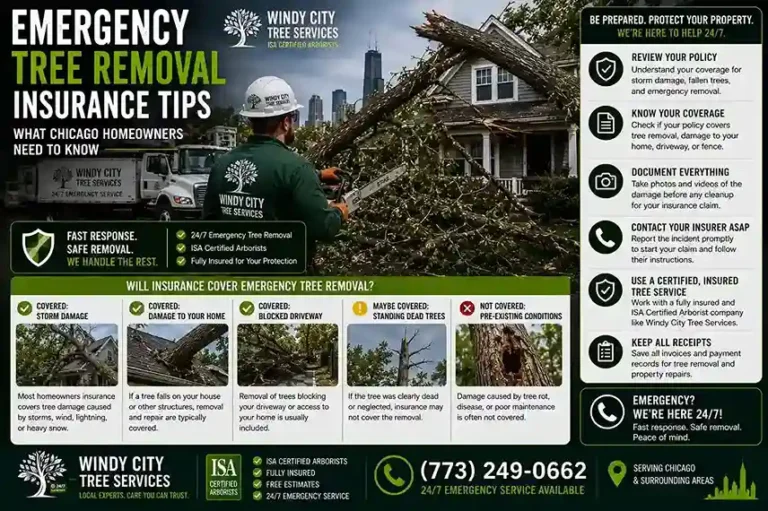
- Insurance documentation: Know your policy’s coverage for tree-related damage before you need it.
- Family safety plans: Identify safe areas of the home away from large trees during severe weather.
- Property inspection: A pre-storm-season walkthrough helps you spot new hazards since the last inspection.
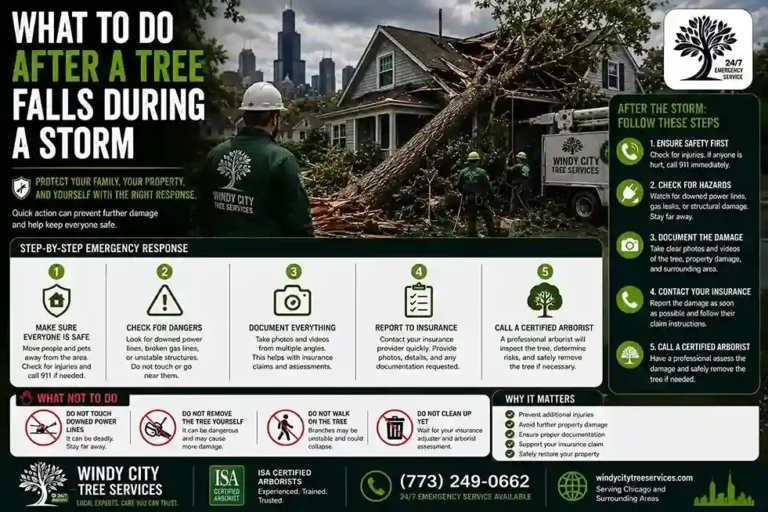
12. What to Do Immediately After Severe Weather
- Stay away from any damaged trees until they’ve been assessed.
- Watch for hanging limbs still caught in the canopy above.
- Avoid all power lines, whether down or tangled in branches.
- Photograph damage for insurance purposes.
- Contact emergency tree professionals for hazardous situations.
- Schedule a full inspection of remaining trees on the property.
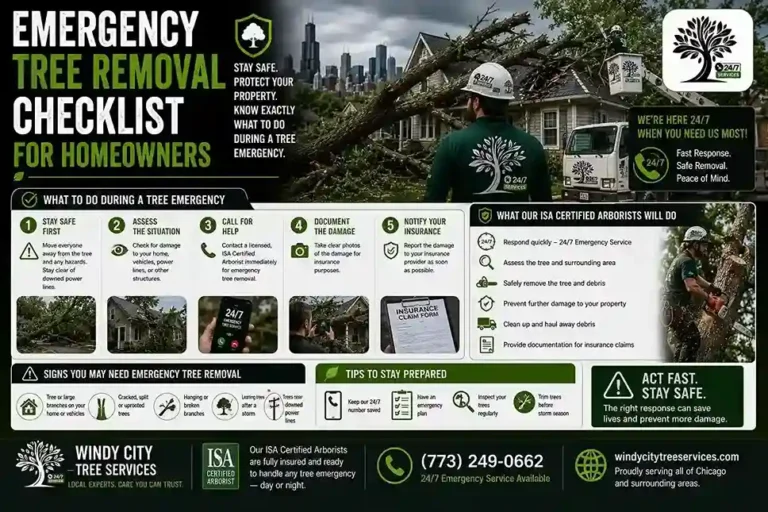
For a complete walkthrough of this process, see our Emergency Tree Removal Checklist for Homeowners.
13. Why Professional Arborists Matter
- ISA Certified Arborists: Trained in tree biology, risk assessment, and industry best practices.
- ANSI A300 standards: A consistent, evidence-based framework for pruning and tree care.
- Tree Risk Assessment: Following ISA Tree Risk Assessment Qualification (TRAQ) principles to evaluate hazards systematically rather than by guesswork.
- Proper equipment: Rigging, cranes, and climbing gear suited to the specific job.
- Safety training: Reducing risk to the crew and the property throughout the work.
- Long-term tree health: A professional plan considers the tree’s future, not just the immediate hazard.
Did You Know?
The University of Illinois Extension and Illinois State Climatologist both note that Chicago’s severe weather patterns, including derecho-style straight-line wind events, can affect trees across wide areas simultaneously, which is part of why proactive, property-wide inspections matter more than spot-checking a single “problem tree.”
Prepared Trees vs. Unprepared Trees
| Prepared Trees | Unprepared Trees | |
|---|---|---|
| Inspections | Regular annual inspections | Deferred or no maintenance |
| Deadwood | Removed through structural pruning | Dead branches remain in the canopy |
| Root system | Healthy, protected root zone | Compacted or damaged soil |
| Canopy | Balanced, wind-resistant structure | Weak branch unions and dense growth |
| Storm risk | Meaningfully lower | Greater likelihood of failure |
Severe Weather Preparation Checklist
- Schedule an annual professional tree inspection.
- Remove any hazardous limbs identified during inspection.
- Trim dead branches before they become storm debris.
- Inspect existing support cables and bracing systems.
- Improve overall tree health through fertilization and monitoring.
- Protect root zones from compaction and construction damage.
- Keep emergency contacts easily accessible.
- Review your insurance policy’s tree damage coverage.
- Monitor weather forecasts during high-risk seasons.
Frequently Asked Questions
Ideally in early spring, well before Chicago’s peak summer storm months, giving enough time to address any issues found.
Yes. Removing weak, dead, or overextended branches lowers wind resistance and eliminates many of the failure points storms exploit.
Trees with existing decay, codominant stems, poor past pruning, or compromised root systems face the highest risk, regardless of species.
Cabling reduces risk by supporting weak unions, but it cannot guarantee failure prevention under extreme conditions. It’s a risk-reduction tool, not a guarantee.
Most trees benefit from an annual inspection, though older, larger, or previously flagged trees may warrant more frequent checks.
Pruning focused on correcting weak branch unions, competing leaders, and canopy balance to improve a tree’s long-term structural integrity.
In most cases, yes, especially if they’re within striking distance of a home, driveway, or walkway. Dead branches are among the most common causes of storm-related injury and damage.
Yes, under extreme enough conditions. Preventive maintenance significantly lowers the odds, but no tree is entirely failure-proof in a severe enough event.
Stay away from damaged trees and power lines, photograph any damage, and contact a professional for hazard assessment before attempting any cleanup yourself.
Through a combination of inspection, structural pruning, deadwood removal, cabling or bracing where needed, and root and soil health management.
Preventive maintenance typically costs far less than emergency removal or storm damage repair, making it a cost-effective long-term investment.
You can spot obvious issues like visible dead branches or a new lean, but internal decay and root problems generally require a professional assessment to detect reliably.
Yes. Compacted or saturated soil reduces a tree’s root anchoring ability, which directly increases the odds of uprooting during high winds.
Storm preparation works best as an ongoing, seasonal practice rather than a one-time fix, since trees and conditions both change year to year.
Yes. Root cutting, soil compaction, and grade changes from nearby construction can weaken a tree’s stability, sometimes not becoming apparent until a storm tests it.
Crown cleaning focuses on removing dead or diseased material, while structural pruning addresses the tree’s overall architecture and long-term strength.
No. Cabling is typically reserved for trees with specific structural weaknesses, like codominant stems, rather than applied universally.
Mulch improves soil moisture retention and structure around the root zone, supporting overall root health that contributes to storm resilience.
Contact your utility company or a tree service experienced in line-clearance work. Homeowners should never attempt this kind of pruning themselves.
Key Takeaways
- Most storm-related tree failures trace back to defects that existed well before the storm arrived.
- Annual inspections by an ISA Certified Arborist catch problems early, when they’re cheapest and easiest to fix.
- Structural pruning, deadwood removal, and cabling all reduce risk, though none can eliminate it entirely.
- Root and soil health matter as much as canopy condition for a tree’s overall storm resilience.
- Preventive maintenance costs far less than emergency removal or storm damage repair.
- Never approach trees near power lines yourself — that work belongs to trained professionals and utility crews.
Learn more from our Chicago Tree Service homepage and meet our ISA Certified Arborists, our Storm Preparation Experts. Related services include storm prep & support systems, tree trimming & pruning, tree cabling & bracing, tree health inspections, tree removal, emergency tree removal, tree & shrub fertilization, air spade root excavation, and stump grinding.