How Often Should Mature Trees Be Pruned? | Chicago Guide
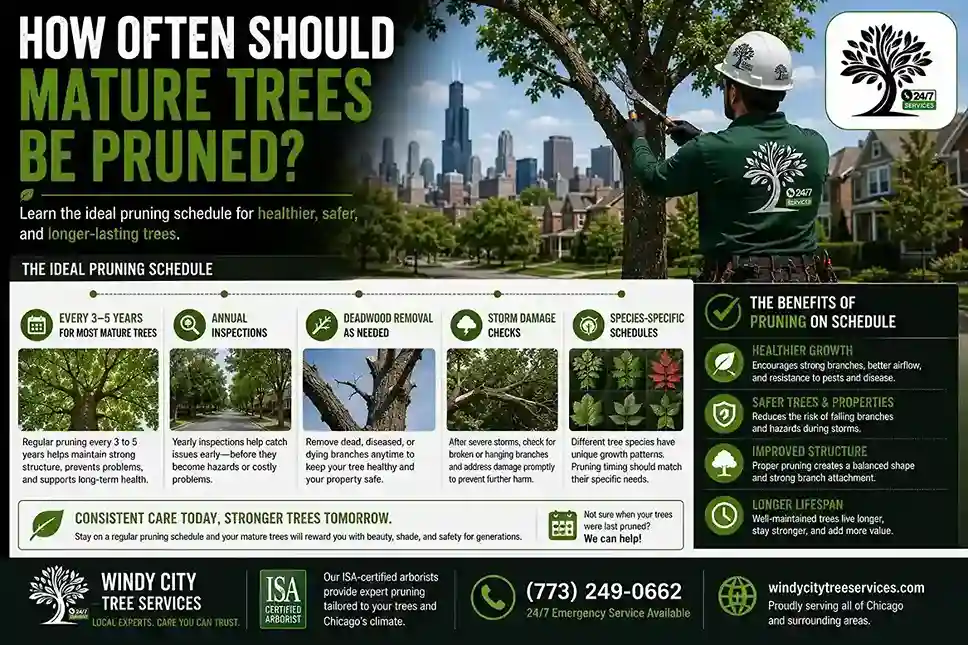
How Often Should Mature Trees Be Pruned?
Learn the ideal pruning schedule for healthier, safer, and longer-lasting trees.
📋 In This Guide
A mature tree that’s stood in a yard for 40 years doesn’t need the same care it did as a sapling, but that doesn’t mean it needs no care at all. Somewhere between “prune it every spring” and “leave it alone until something breaks” sits the right answer, and that answer is different for almost every tree.
Pruning too often stresses a mature tree and can weaken the very structure you’re trying to protect. Pruning too rarely lets deadwood pile up, storm damage go unaddressed, and small problems turn into expensive ones. Getting the frequency right depends on the tree’s species, age, health, location, and what’s growing (or building) around it.
This guide walks through how often mature trees actually need pruning, the warning signs that mean it’s time regardless of the calendar, and how a certified arborist builds a long-term maintenance plan instead of guessing at a fixed schedule. We’ll cover the species most common in Chicago yards and parkways, along with the seasonal and storm considerations specific to this region.
How often should mature trees be pruned? Most mature shade trees benefit from a professional inspection every one to three years, though actual pruning intervals vary based on species, health, growth rate, location, and the tree’s structural goals. Hazardous limbs, storm damage, and dead wood should be addressed promptly whenever they’re found, regardless of where the tree sits in its regular schedule.
1. Why Mature Trees Need Regular Pruning
A tree doesn’t stop changing once it reaches full size. It keeps aging, and aging brings predictable maintenance needs even when a tree looks perfectly healthy from the curb.
- Tree aging. Older wood becomes more prone to decay, and branch unions that were fine at 20 years old can weaken by 60.
- Structural integrity. Weight distribution shifts as a canopy fills in, and unaddressed weak points become failure points during wind or ice loading.
- Deadwood accumulation. Every mature tree sheds some branches to shading and age. Left in place, deadwood becomes a falling hazard and an entry point for decay organisms.
- Disease prevention. Removing infected or dying wood promptly can keep a localized problem from spreading through the rest of the canopy.
- Storm resistance. A well-structured canopy sheds wind more evenly than a dense, uneven one, reducing the odds of major limb failure.
- Safety. Clearance over roofs, driveways, and walkways has to be maintained as branches continue to grow and add weight.
- Longevity. Trees that receive consistent, appropriate care genuinely tend to live longer and stay structurally sound longer than neglected ones.
2. There Is No Universal Pruning Schedule
Anyone promising a single “prune every X years” rule for all mature trees is oversimplifying. Real pruning frequency depends on a combination of factors that shift from tree to tree, even within the same species and neighborhood.
Species
Fast-growing species like cottonwood need more frequent attention than slow growers like oak.
Growth Rate
A vigorously growing tree adds canopy weight faster and may need more frequent structural checks.
Age
Very old trees often need lighter, less frequent pruning focused mainly on deadwood removal.
Health
A stressed or declining tree may need closer, more frequent monitoring than a vigorous one.
Soil Conditions
Compacted or poor soil can slow a tree’s ability to recover from pruning wounds.
Previous Pruning
A history of poor pruning (or none at all) often means more corrective work is needed upfront.
Property Location
Trees near structures, sidewalks, or driveways need more frequent clearance checks.
Nearby Structures
Proximity to power lines or roofs raises the stakes and the required inspection frequency.
This is why an arborist’s recommendation for your neighbor’s oak might not match the recommendation for yours, even if the trees look nearly identical from the street.
3. General Pruning Frequency Guidelines
With the caveat that every tree deserves its own assessment, here are general starting points by category:
| Tree Type | Inspection Frequency | Typical Pruning Interval | Notes |
|---|---|---|---|
| Fast-Growing Trees | Every 1–2 years | Every 2–3 years | Cottonwood, silver maple, willow; canopy fills in quickly and needs more frequent structural checks |
| Moderate-Growth Trees | Every 2–3 years | Every 3–5 years | Most oaks, honey locust, hackberry; steady growth with predictable maintenance needs |
| Slow-Growing Trees | Every 3–5 years | As needed, often 5+ years | Many mature oaks and gingko; often need only deadwood removal once established |
| Evergreen Trees | Every 2–3 years | As needed, avoid heavy shearing | Spruce and pine rarely need structural pruning once mature; remove dead/damaged wood anytime |
| Ornamental Trees | Annually | Every 1–2 years | Crabapple, serviceberry; benefit from shaping and disease-focused pruning after flowering |
| Fruit Trees | Annually | Annually, dormant season | Require the most frequent pruning of any category to maintain fruit production and form |
Treat this table as a starting point, not a prescription. An arborist’s on-site assessment should always override a general guideline when the two disagree.
4. Chicago Tree Species Maintenance Schedule
Chicago’s urban forest leans heavily on a handful of species, each with its own pruning rhythm and quirks.
| Species | Inspection Interval | Pruning Interval | Special Considerations |
|---|---|---|---|
| Oak | 2–3 years | 3–5 years, deadwood as needed | Avoid pruning between April 15 and October 15 to reduce oak wilt risk |
| Maple | 2 years | 2–4 years | Prune in late fall to mid-winter to avoid heavy sap “bleeding” |
| Elm | 2 years | As needed for deadwood | Avoid pruning in the growing season to reduce Dutch elm disease transmission |
| Honey Locust | 2–3 years | 3–5 years | Generally low-maintenance; watch for pod litter and canker |
| Ash | Annually | As needed | Monitor closely for emerald ash borer; declining trees may need removal instead of pruning |
| Cottonwood | 1–2 years | 2–3 years | Fast growth and weaker wood mean more frequent structural checks |
| Sycamore | 2 years | 2–4 years | Large canopy spread benefits from periodic crown thinning |
| Birch | 2 years | Late summer or fall preferred | Avoid spring pruning; birches “bleed” sap heavily if cut too early |
| Spruce | 2–3 years | As needed | Minimal pruning required; remove dead branches anytime |
| Pine | 2–3 years | As needed, spring “candling” optional | Avoid cutting into old wood without live buds; it usually won’t resprout |
| Arborvitae | Annually | Annually if shaped, otherwise as needed | Avoid cutting into the bare interior “dead zone” where new growth won’t form |
5. Signs Your Mature Tree Needs Pruning
Regardless of where a tree sits in its normal schedule, certain signs mean it’s time for an inspection now:
- 1Dead branches anywhere in the canopy
- 2Broken or hanging limbs
- 3Branches crossing or rubbing against each other
- 4A canopy that looks unusually dense or overcrowded
- 5Visible storm damage, even if it looks minor
- 6Weak branch attachments, including narrow, V-shaped unions
- 7Low-hanging limbs over walkways, driveways, or play areas
- 8Discolored, cracked, or fungal-looking wood
- 9Branches growing into or over the roofline
- 10Limbs obstructing sidewalks or blocking sightlines at a driveway
Any one of these is reason enough to call for an inspection, even if the tree was checked recently.
6. Benefits of Routine Pruning
Better Tree Health
Removing dead and diseased wood redirects the tree’s energy toward healthy growth.
Increased Safety
Fewer weak limbs means less risk to people, cars, and property below.
Improved Airflow
Thinning a dense canopy reduces wind resistance and fungal disease pressure.
Better Sunlight Penetration
Opening the canopy improves light for grass and plantings below.
Stronger Branch Structure
Removing competing or poorly attached limbs strengthens the tree’s overall framework.
Reduced Storm Damage
A well-maintained canopy sheds wind and ice loads more evenly.
Longer Lifespan
Consistent, appropriate care extends how long a mature tree stays healthy and stable.
Improved Property Value
Well-maintained mature trees are a documented asset to curb appeal and resale value.
7. What Happens If Trees Aren’t Pruned?
Skipping pruning doesn’t just mean a slightly messier canopy. Left unaddressed for years, neglect compounds into real problems:
- Deadwood accumulation. More dead branches means more falling hazard and more entry points for decay.
- Disease spread. Infected wood left in place can spread pathogens to healthy parts of the tree, or to neighboring trees.
- Increased storm damage. Overcrowded, poorly structured canopies fail more dramatically in high winds and ice storms.
- Structural defects. Weak unions and included bark, left unaddressed, often worsen with time and added weight.
- Larger removal costs. A tree that could have been managed with routine pruning sometimes ends up requiring full removal after years of neglect.
- Safety hazards. The cumulative effect of all of the above is a tree that’s simply more likely to fail, and more likely to fail badly, than one on a regular maintenance schedule.
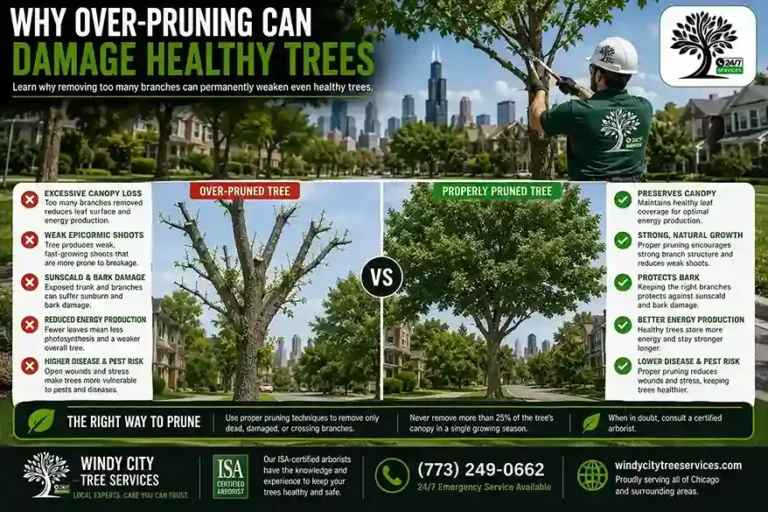
8. Can Mature Trees Be Over-Pruned?
Yes, and this mistake is at least as common as under-pruning. Removing too much canopy at once puts real stress on a mature tree.
Widely cited arboricultural guidance recommends removing no more than about one-quarter of a mature tree’s live canopy in a single growing season. Young trees can tolerate more (up to roughly a third), but mature trees have less reserve capacity to recover from aggressive cuts.
Over-pruning a mature tree can cause:
- Loss of stored energy. Leaves produce the sugars a tree stores for future growth; removing too many at once cuts into that reserve.
- Stress. A heavily pruned tree diverts energy to wound closure instead of normal maintenance functions.
- Sunscald. Suddenly exposing previously shaded bark to direct sun can damage or kill bark tissue.
- Weak regrowth. Aggressive cuts, especially topping, often trigger a flush of weakly attached epicormic shoots.
- Increased disease susceptibility. A stressed tree has fewer resources to fight off pathogens and pests.
- Reduced stability. Removing too much canopy mass in the wrong places can actually make a tree’s wind response less predictable, not more.
ANSI A300 pruning standards exist specifically to prevent this kind of damage, and a certified arborist trained to those standards knows how much is too much for a given tree.
9. Seasonal Timing Matters
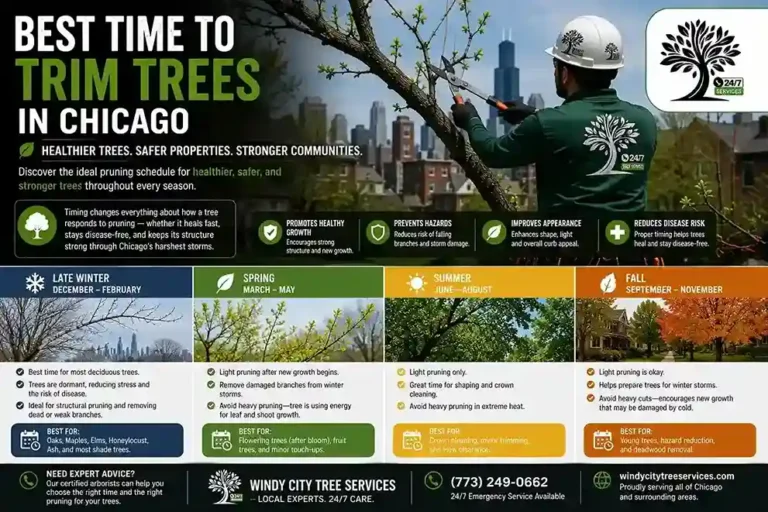
When you prune matters almost as much as how often. Chicago’s four distinct seasons each come with tradeoffs.
Winter Pruning
Generally the best window for most deciduous trees. Dormancy means less stress, better visibility of branch structure, and lower disease and insect activity. See our guide on the Best Time to Trim Trees in Chicago for a full seasonal breakdown.
Spring Pruning
Best reserved for spring-flowering ornamentals, pruned right after their blooms drop. Avoid pruning oaks and elms during this window.
Summer Pruning
Useful for removing storm damage or correcting form on a tree that’s actively growing, but should generally be limited and targeted.
Fall Pruning
Best avoided for routine work, since fresh wounds heal more slowly as trees head into dormancy, though birches are an exception.
Dead, broken, or hazardous branches are the exception to every seasonal rule: those come off as soon as they’re found, regardless of the calendar.
10. Mature Trees Near Homes
Trees growing close to structures need more frequent attention than the same species growing in an open yard, simply because the consequences of neglect are higher.
- Roof clearance. Overhanging limbs scrape shingles, clog gutters, and create a path for pests and moisture onto the roof.
- Driveways. Low branches interfere with vehicles and can be damaged repeatedly if left unaddressed.
- Utility lines. Growth into power lines is both a safety hazard and often a utility company responsibility, not a homeowner one; a quick call can clarify which applies.
- Sidewalks. Low limbs create trip and clearance hazards for pedestrians, an issue city ordinances often address directly.
- Fences. Overhanging growth can damage fencing and create access points for pests moving between properties.
- Neighboring properties. Canopy or root growth crossing a property line is a common source of disputes that regular pruning can prevent.
Regular inspections catch these conflicts early, before a small clearance issue becomes a larger structural or legal one.
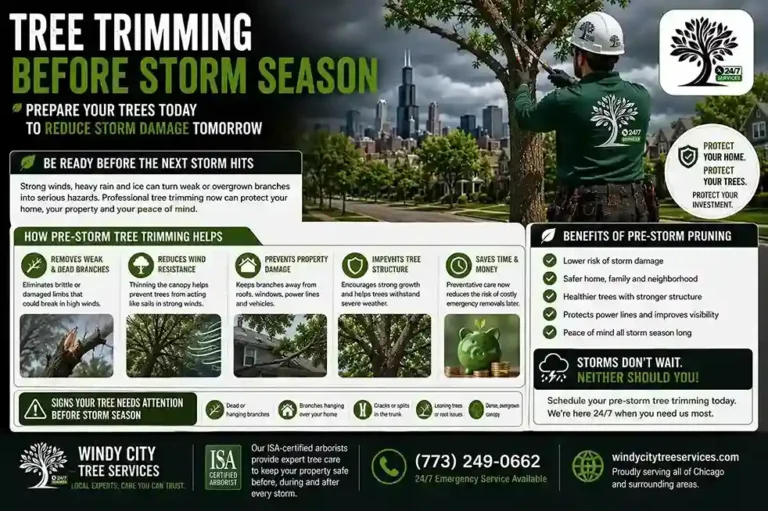
11. Storm Preparation
Chicago’s storm season brings high winds, heavy rain, and the occasional ice storm, all of which put mature canopies to the test. Preventive pruning ahead of that season pays for itself in avoided emergency calls.
- Preventive pruning removes deadwood and weak limbs before wind has a chance to bring them down uncontrolled.
- Removing hazardous limbs proactively is far cheaper and safer than an emergency removal after a storm.
- Improving canopy structure through selective thinning helps wind pass through the tree instead of loading against it.
- Wind resistance improves measurably when weak unions and overextended limbs are addressed ahead of storm season.
- Ice storm preparation focuses on reducing weight on limbs already showing signs of stress, since ice adds substantial load fast.
Read our related guide on Tree Trimming Before Storm Season for a deeper look at the pre-storm checklist we walk every Chicago property through.
12. Professional Tree Assessments
A proper assessment goes well beyond a quick look from the ground. ISA Certified Arborists evaluate:
Tree Species
Species-specific growth patterns and vulnerabilities shape the entire maintenance plan.
Branch Architecture
Union strength, spacing, and angle all factor into long-term structural risk.
Tree Vigor
Growth rate and canopy density indicate how well a tree will recover from any pruning.
Root Flare
Checking the base of the trunk for girdling roots or buried flare that could weaken stability.
Structural Defects
Cracks, cavities, and included bark all get documented and factored into the plan.
Risk Factors
Proximity to targets like homes, driveways, and walkways shapes urgency and frequency.
Future Growth
Anticipating how the tree will grow over the next several years informs today’s pruning cuts.
13. DIY vs Professional Pruning
Small ornamental shrubs are one thing. Mature shade trees are another. Here’s where DIY pruning tends to fall short:
- Equipment. Proper pruning tools, rigging, and aerial access equipment cost more than most homeowners will use them enough to justify.
- Safety. Working at height around large limbs is genuinely dangerous without training, and tree work consistently ranks among the more hazardous trades.
- Correct cuts. Improper cuts (flush cuts, stub cuts, or topping) create larger wounds that heal poorly and invite decay.
- Disease prevention. Knowing which species to avoid pruning during active disease-transmission seasons isn’t obvious without training.
- Liability. A DIY pruning accident that damages a neighbor’s property or injures someone becomes a homeowner’s direct liability.
- Insurance. Licensed, insured tree services carry coverage that protects the property owner if something goes wrong on the job.
- Property protection. Professional crews plan drop zones and rigging to protect roofs, fences, and landscaping that a DIY job often damages.
14. Long-Term Tree Maintenance Plans
The most effective approach to mature tree care isn’t a single pruning job. It’s an ongoing plan built around the specific tree.
Year 1: Baseline Assessment
A full inspection documents species, structure, health, and any immediate concerns.
Year 1–2: Corrective Pruning
Addressing deadwood, crossing branches, and any structural issues identified in the baseline visit.
Ongoing: Annual Inspections
Yearly walk-arounds catch new deadwood, storm damage, or emerging disease before they escalate.
Every 2–5 Years: Maintenance Pruning
Scheduled pruning matched to the species’ actual growth rate and structural needs.
As Needed: Preventive Care
Fertilization, cabling and bracing, and soil improvement support long-term health between pruning cycles.
Ongoing: Health Monitoring
Watching for signs of decline, pests, or disease that might call for an earlier-than-scheduled visit.
15. Why Chicago Homeowners Trust Professional Arborists
Chicago’s mature urban forest presents challenges that go beyond a general “how to prune” guide. Decades-old parkway oaks, historic neighborhood canopies, and lakefront trees dealing with wind exposure all need species-specific, site-specific judgment.
- Urban tree challenges. Compacted soil, limited root space, and nearby infrastructure all complicate standard pruning guidance.
- Mature canopy management. Chicago’s tree stock skews older than in many newer suburbs, which means more deadwood and structural management, not less.
- Historic neighborhoods. Blocks with century-old trees carry real value that’s worth protecting with careful, informed pruning rather than guesswork.
- Storm preparedness. Local knowledge of Chicago’s wind and ice patterns shapes smarter, more targeted preventive pruning.
- Species-specific expertise. Knowing exactly when (and when not) to prune oaks, elms, and birches locally prevents avoidable disease and stress.
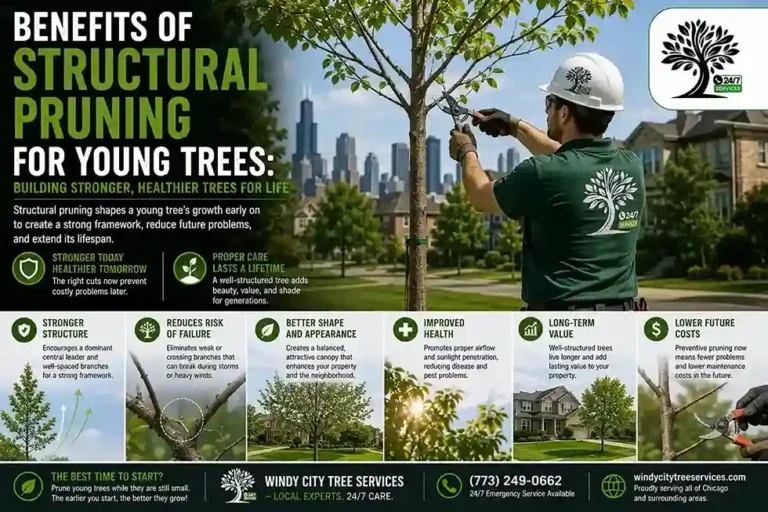
Young Trees vs. Mature Trees
| Feature | Young Trees | Mature Trees |
|---|---|---|
| Primary Goal | Building strong structure for the future | Maintaining existing structure and managing decline |
| Frequency | Often annually for the first several years | Every 2–5 years, or as needed |
| Type of Pruning | Structural, formative pruning | Deadwood removal, crown cleaning, corrective pruning |
| Risk Level | Lower; smaller cuts, faster healing | Higher; larger cuts, slower healing, more consequential mistakes |
Municipal foresters have long tracked a traditional 5 to 6 year pruning cycle for street trees, though in practice that schedule is rarely kept exactly. Trees pruned well when young often need little more than deadwood removal for years afterward, which is part of why formative pruning early in a tree’s life pays off for decades.
Not Sure If Your Mature Trees Need Pruning?
Our ISA Certified Arborists provide professional inspections and customized pruning schedules designed for Chicago’s climate and tree species.
Homeowner Checklist: Does Your Mature Tree Need Pruning?
- 1Are any branches dead?
- 2Does the canopy look overcrowded or unusually dense?
- 3Has storm damage occurred, even minor damage?
- 4Are any branches rubbing against each other?
- 5Are limbs hanging over your roof?
- 6Are branches blocking driveway or sidewalk visibility?
- 7Is the tree showing signs of disease, like discolored bark or fungal growth?
A “yes” to any of these is a good reason to schedule an inspection sooner rather than later.
Protect Your Mature Trees Before the Next Storm
Prevent hazardous branches and costly property damage with routine pruning and proactive tree care.
Frequently Asked Questions
How often should oak trees be pruned?
Mature oaks typically need structural pruning every 3 to 5 years, with deadwood removed as needed in between. Avoid pruning oaks between April 15 and October 15 to reduce the risk of spreading oak wilt.
Can mature trees be pruned every year?
Annual pruning is usually unnecessary and can add unneeded stress to a mature tree. Most mature shade trees do better on a 2 to 5 year cycle, with annual inspections to catch problems that need faster attention.
Is winter the best season to prune?
For most deciduous trees, yes. Dormant-season pruning reduces stress on the tree, lowers disease and insect risk, and makes the branch structure easier to see and assess.
Can pruning improve tree health?
Yes. Removing dead, diseased, or crowded wood redirects the tree’s energy toward healthy growth and reduces the spread of decay and pests through the canopy.
What if my tree has never been pruned?
An arborist will typically recommend corrective pruning over one or more visits rather than trying to fix everything in a single, aggressive session, which would remove too much canopy at once.
How much canopy can be removed at one time?
Widely cited guidance recommends removing no more than about one-quarter of a mature tree’s live canopy in a single growing season, to avoid excessive stress and stored-energy loss.
Can pruning prevent storm damage?
Yes, in large part. Removing deadwood and weak limbs before a storm season significantly reduces the odds of uncontrolled limb failure during high winds or ice loading.
Do all mature trees need pruning?
Nearly all benefit from at least periodic deadwood removal and inspection, even slow-growing or low-maintenance species that rarely need structural pruning.
Should dead branches be removed immediately?
Yes. Dead branches don’t get safer by waiting, and removing them promptly reduces both the falling hazard and the entry point they create for decay organisms.
How much does mature tree pruning cost?
Costs vary widely based on tree size, condition, and access. We provide a free, written, on-site estimate so you know the price before any work begins.
Does pruning frequency change as a tree gets older?
Yes. Young trees often need annual structural pruning, while mature trees typically shift to a longer cycle focused on deadwood removal and corrective maintenance.
Can over-pruning kill a tree?
Severe over-pruning, especially topping, can weaken a tree enough to make it more vulnerable to disease, pests, and structural failure, sometimes leading to decline over several years.
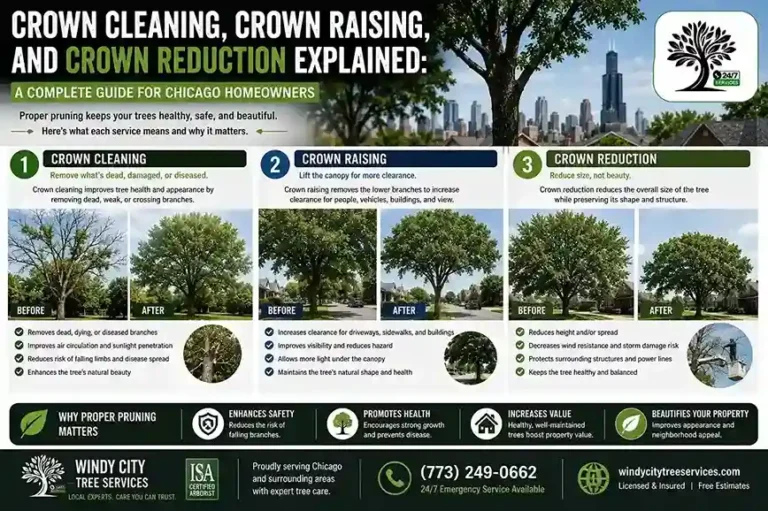
What is crown cleaning?
Crown cleaning is the removal of dead, dying, diseased, or weakly attached branches from a tree’s canopy, typically the lightest and most frequently recommended type of pruning for mature trees.
What is crown thinning?
Crown thinning selectively removes live branches to reduce canopy density, improving light penetration and airflow while reducing wind resistance.
Should I prune my tree myself if it’s just a few branches?
Small, low, easily reachable branches on smaller trees may be manageable for a homeowner with the right tools. Anything requiring a ladder or involving large limbs is best left to a professional.
How do I know if my tree needs an arborist versus a landscaper?
An ISA Certified Arborist has specific training in tree biology, structural assessment, and pruning standards. For mature trees, especially near structures, that credential matters more than general landscaping experience.
Does pruning help with emerald ash borer?
Pruning alone can’t stop an emerald ash borer infestation, but removing dead and dying limbs can slow visible decline and reduce hazard while a broader treatment or removal decision is made.
Can I prune a tree near power lines myself?
No. Pruning near power lines should be handled by trained professionals, and in many cases the utility company, not the homeowner, is responsible for that clearance work.
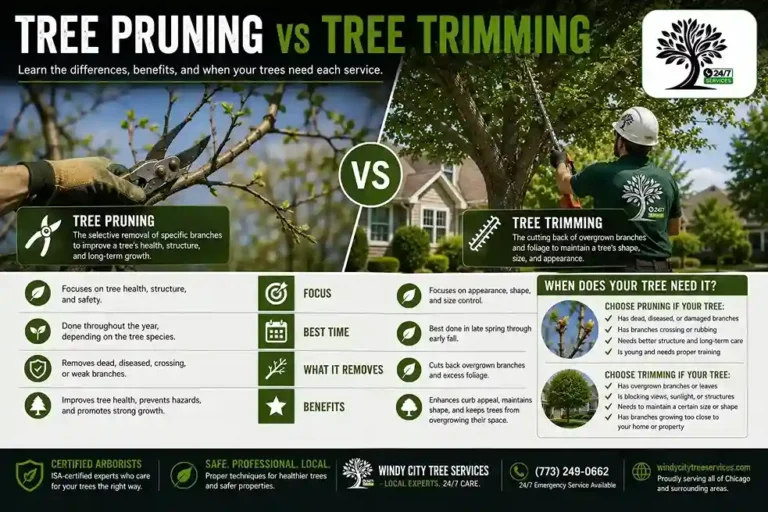
What’s the difference between pruning and trimming?
The terms are often used interchangeably, but “pruning” typically refers to targeted cuts for health and structure, while “trimming” often implies more general shaping. Read more in our guide, Tree Pruning vs Tree Trimming: What’s the Difference?
How do I set up a long-term pruning plan for my property?
Start with a full inspection of every mature tree on the property. From there, an arborist can build a multi-year schedule tailored to each tree’s species, condition, and location.
Related Tree Services
Tree Trimming & Pruning
ANSI A300 pruning tailored to species and condition.
Learn more →Tree Health Inspection & Treatment
Full diagnostic assessments and long-term maintenance planning.
Learn more →Tree Cabling & Bracing
Structural support for trees with weak unions or heavy limbs.
Learn more →Tree Removal
Safe removal when a tree is past the point of corrective care.
Learn more →Tree & Shrub Fertilization
Deep root feeding that supports recovery after pruning.
Learn more →Storm Prep & Support Systems
Preventive pruning and bracing ahead of Chicago storm season.
Learn more →Air Spade
Root zone assessment that supports overall tree health planning.
Learn more →Emergency Tree Removal
24/7 response when neglected deadwood becomes an active hazard.
Learn more →Expert Mature Tree Pruning in Chicago
Healthy mature trees don’t happen by accident. They require regular inspections, proper pruning, and professional care. Windy City Tree Services helps homeowners maintain beautiful, structurally sound trees that thrive for decades.
✅ ISA Certified Arborists
🛡️ Licensed & Fully Insured
📐 ANSI A300 Pruning Practices
🌳 Mature Tree Specialists
📊 Tree Risk Assessments
🌩️ Storm Preparation Experts
🏠 Residential & Commercial Care
🧹 Complete Cleanup
📋 Free Estimates
Share This Guide
Related Articles
Best Time to Trim Trees in Chicago
A season-by-season breakdown of when to prune, and when to leave the saw in the shed.
Tree Pruning vs Tree Trimming: What’s the Difference?
Two terms people use interchangeably, and why the distinction actually matters.
Benefits of Structural Pruning for Young Trees
Why the pruning decisions made in a tree’s first decade shape its next fifty years.
Common Tree Pruning Mistakes Homeowners Make
The DIY habits that do more harm than good, and how to avoid them.
Crown Cleaning, Crown Raising, and Crown Reduction Explained
The three most common pruning techniques, broken down in plain language.
Why Over-Pruning Can Damage Healthy Trees
A closer look at the stress response triggered by removing too much canopy at once.
Winter Tree Pruning Benefits
Why dormant-season pruning is the gold standard for most deciduous trees.
How Tree Trimming Improves Property Value
The curb appeal and resale math behind well-maintained mature trees.
Tree Trimming Before Storm Season
The pre-storm pruning checklist we walk every Chicago property through.
10 Signs a Tree Is Dangerous on Your Chicago Property
The warning signs every Chicago homeowner should know before a tree becomes a hazard.
Common Reasons Trees Fail During Chicago Storms
The structural weak points that turn a summer storm into a fallen-tree emergency.
Sources referenced in this guide include publications and best management practices from the International Society of Arboriculture (ISA), the USDA Forest Service, University of Illinois Extension, and The Morton Arboretum. This article is intended for general educational purposes and does not replace an on-site professional tree assessment.