Tree Removal After Lightning Damage | Windy City Tree Services
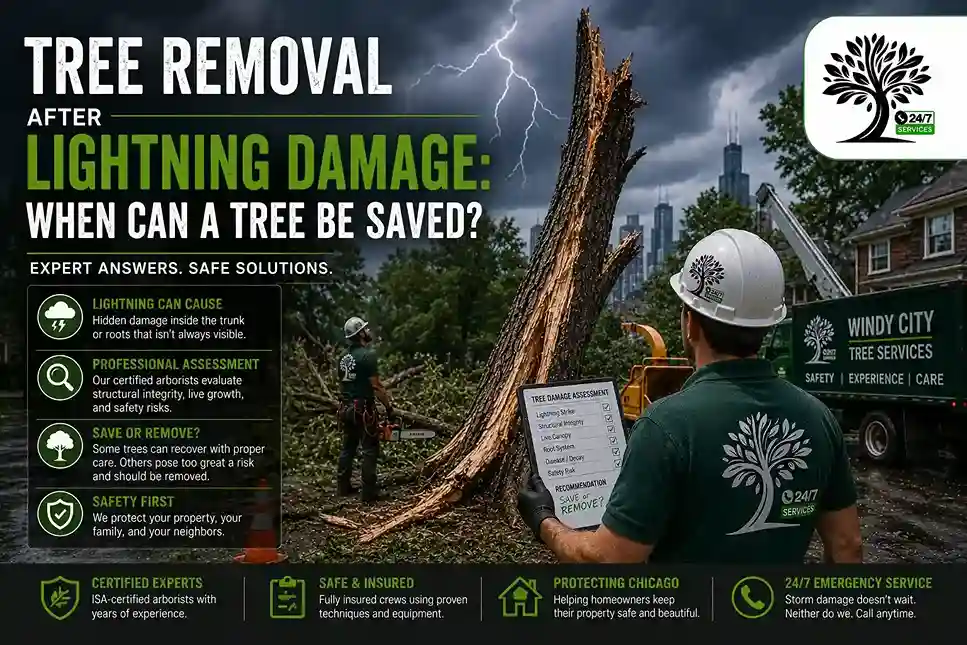
Tree Removal After Lightning Damage: When Can a Tree Be Saved?
Learn how to identify dangerous damage, understand your options, and know when professional tree removal is the safest solution.
📋 In This Guide
A lightning strike takes less than a second, but the damage it leaves behind can take months to fully show. Some trees walk away from a direct hit with little more than a scorch mark and a good story. Others look almost untouched from the ground while the strike has already killed the cambium layer underneath the bark.
That gap between what a tree looks like and what’s actually happening inside it is the whole problem. A homeowner staring up at a tree the morning after a storm has no reliable way to tell, just by looking, whether that tree needs a trim or needs to come down before it falls on the house. Waiting to find out isn’t free, either: a compromised limb or an unstable trunk gets more dangerous, not less, the longer it sits.
This guide walks through how lightning actually damages a tree, the warning signs worth watching for (both obvious and easy to miss), when treatment can save a struck tree, and when removal is the responsible call. It’s written from the ground we cover most, Chicago’s mix of mature parkway oaks, backyard maples, and lakefront cottonwoods, but the underlying science applies wherever lightning and trees meet.
Should a tree be removed after lightning damage? Not every lightning-struck tree needs to come down. The right call depends on how much of the trunk and root system survived, whether the canopy still shows healthy growth, and how structurally sound the tree remains. A certified arborist should physically inspect the tree before anyone decides between treatment and removal, since surface appearance alone can hide serious internal damage.
1. What Happens When Lightning Strikes a Tree?
Lightning looks for the easiest path to the ground, and a tall tree with wet bark often gives it one. The moment the bolt hits, an electrical current several thousand degrees hot moves through the tree’s water-filled tissue instead of through the drier, more resistant wood underneath.
That heat vaporizes the sap and moisture inside the trunk almost instantly. The resulting steam expands so fast it can blow bark completely off the tree in long, ragged strips, a phenomenon arborists sometimes describe as explosive bark loss. In the most severe strikes, that same steam pressure splits the trunk open along the grain.
The damage doesn’t stop at the visible wood. Current traveling down the trunk frequently reaches the root system, where it can cook root tissue below the soil line with no external sign at all. And because the current runs through the cambium, the thin living layer just beneath the bark that carries water and nutrients between roots and canopy, even a strike that leaves the outer bark intact can kill enough cambium tissue to girdle the tree from the inside.
A single lightning bolt can reach temperatures around 50,000°F, roughly five times hotter than the surface of the sun. That heat doesn’t need to touch the wood directly to cause damage; it just needs to vaporize the water inside it.
2. Common Signs of Lightning Damage
Some lightning damage announces itself. Some doesn’t. Here’s what to look for during a walk around the tree from a safe distance:
- 1A vertical strip of bark missing, often running from the canopy down to the roots
- 2A long crack or seam running with the grain of the trunk
- 3A visible split running partway or fully through the trunk
- 4Dark scorch marks or charring on the bark surface
- 5Bark that looks blown outward or “exploded” near the strike point
- 6Broken or hanging limbs, sometimes far from the apparent strike point
- 7Leaves that wilt or brown within days, even outside of drought conditions
- 8A sudden, unexplained decline across the whole canopy in the weeks after a storm
A tree can show one of these signs or several at once. As a general rule, the more signs present and the more of the trunk’s circumference they cover, the more serious the underlying damage is likely to be.
3. Can a Lightning-Struck Tree Be Saved?
Often, yes. Trees are more resilient than people expect, and a strike that causes limited, localized damage frequently leaves enough healthy tissue for the tree to recover with the right care.
Recovery is most likely when an arborist finds:
- Minor bark loss. A narrow strip of missing bark, generally less than a third of the trunk’s circumference, gives the tree enough intact cambium to keep transporting water and nutrients.
- No major trunk split. Surface cracks that don’t penetrate deep into the wood can seal over time as the tree grows new wood around the wound.
- A healthy root system. If the strike traveled mostly through the trunk and canopy rather than into the roots, the tree keeps its ability to take up water and rebuild.
- Good structural integrity elsewhere. A tree with one damaged section but a sound overall framework has a much better shot than one with multiple compromised unions.
As a rough guideline used across the industry, a tree that survives to the following spring’s growing season and pushes out a reasonably full set of new leaves has meaningfully better recovery odds than one that struggles through that first season. That doesn’t mean homeowners should simply wait and watch on their own, though. A hazard tree can look “fine” from a distance while still posing a fall risk, which is exactly why an arborist’s structural assessment matters as much as a growth check.
4. When Tree Removal Is Necessary
Removal becomes the safer, and often the only realistic, option when damage crosses certain thresholds. These include:
- Major trunk splits. A crack that runs deep into the wood, especially one that opens into a visible gap, compromises the structure that holds the whole canopy up.
- Extensive decay. Fungal decay that sets into a lightning wound can hollow out the trunk from the inside over months or years.
- Severe root damage. A tree with a cooked or badly compromised root system loses its anchoring, even if the canopy still looks green.
- Structural instability. Visible leaning, a hollow sound when tapped, or soil heaving near the base all point toward a tree that could fail without warning.
- Large hanging limbs. Limbs partially attached after a strike can drop at any time, with or without wind.
- High risk to nearby structures. A tree within striking distance of a home, a garage, a sidewalk, or power lines gets less benefit of the doubt, since the consequences of a failure are more serious.
According to widely cited arboricultural guidance, a tree generally will not survive if more than about one-third of the bark around the trunk’s circumference has been lost. Below that threshold, recovery becomes increasingly unlikely, and the tree is more often a removal candidate than a treatment one.
None of these thresholds should be judged from the ground with the naked eye alone. Removal decisions should always follow a professional, on-site assessment, not a guess based on how bad the tree looks from the driveway.
5. Hidden Damage You Can’t See
The hardest part of assessing a lightning-struck tree is that the worst damage is often invisible. A trunk can look completely normal on the outside while carrying:
Internal Wood Fractures
Steam pressure can crack wood fibers deep inside the trunk without breaking the surface bark at all.
Root System Injuries
Current traveling into the soil can damage roots with zero visible sign above ground.
Delayed Canopy Decline
Some trees hold their leaves through the season of the strike, then decline sharply the following year.
Invisible Decay Pathways
Fungal spores can enter through a lightning wound and spread through the trunk for years before symptoms show.
Long-Term Structural Weakening
A tree can stand for several more storm seasons on a compromised structure before it finally fails.
No Visible Correlation
The severity of external damage doesn’t reliably predict the severity of internal damage.
This is the core reason visual appearance alone isn’t a reliable basis for a save-or-remove decision. A tree that looks fine in August can be a falling hazard by the following spring, and a tree that looks dramatically scarred can go on to make a full recovery. Only tools and training built for looking inside the wood, not a glance from the yard, can tell the difference reliably.
6. How Arborists Inspect Lightning-Damaged Trees
A proper lightning damage assessment follows a structured process, closely aligned with the tree risk assessment framework taught through the International Society of Arboriculture’s Tree Risk Assessment Qualification (TRAQ) program. Here’s what that typically involves:
- Visual assessment. A full walk-around of the tree, checking the trunk, major limbs, and visible root flare for bark loss, cracking, and scorching.
- Canopy inspection. Looking for wilting, premature leaf drop, or thinning that suggests the vascular system is struggling to move water.
- Root flare examination. Checking the base of the trunk and exposed roots for splitting, heaving, or soil disturbance that points to underground damage.
- Structural defect evaluation. Assessing branch unions, lean, and overall form for weaknesses that could combine with the lightning damage to cause failure.
- Decay detection. Using tools like a mallet for sounding, an increment borer, or a resistance drill to check for internal decay that isn’t visible from the surface.
- Formal tree risk assessment. Rating the likelihood of failure against the potential consequences (what, or who, is within range if the tree or a limb comes down) to reach a risk level, following the same logic used in ANSI A300-aligned tree risk assessment work.
- Air Spade root investigation, when appropriate. For trees with suspected root damage, compressed-air excavation exposes the root system without cutting into it, letting the arborist see root health directly.
- Treatment recommendation. A clear, written recommendation: monitor, treat, or remove, along with the reasoning behind it.
That last step matters as much as the inspection itself. A homeowner deserves to know not just what an arborist recommends, but why, so they can make an informed decision about a tree that might be decades older than the house next to it.
7. Emergency Safety After a Lightning Strike
Before any inspection happens, treat a freshly struck tree as a hazard, not a curiosity.
- Stay away from the tree until it’s been assessed. Structural failure can happen without warning, especially in the hours right after a strike.
- Avoid any hanging limbs entirely. A limb that looks “almost” detached can drop at any moment.
- Stay clear of utility lines. A struck tree near power lines should be treated as if the lines themselves are energized and dangerous.
- Keep kids, pets, and neighbors away from the area until it’s been cleared.
- Call 911 or your utility company immediately if any wires are down or involved.
- Schedule an emergency arborist inspection as soon as it’s safe to do so, ideally within 24 hours of the strike.
8. Chicago Storms and Lightning
Chicago’s summer storm season brings a specific combination of conditions that makes lightning-damaged trees a recurring issue across the city, not a rare event. Lake Michigan shapes a lot of that weather: lake breezes collide with warm inland air and help fuel the fast-building thunderstorms that roll through from late spring through late summer.
Those storms rarely bring just lightning. High winds usually arrive alongside the electrical activity, and heavy rain often follows within minutes, a combination that stresses a tree from multiple directions at once. A tree that takes a lightning strike and then gets pushed hard by wind before the wood has had any chance to seal is at higher risk of complete failure than one that faces either stress on its own.
Chicago’s urban forest adds another layer to the picture. Mature parkway trees and older backyard shade trees, some decades old, tend to be the tallest object on a residential block, which is exactly the profile lightning looks for. That combination, mature canopy plus lakefront storm patterns, is why prompt inspection after any nearby strike matters more here than in areas with younger, shorter urban tree cover.
9. Can Lightning Damage Appear Later?
Yes, and this is one of the most misunderstood parts of lightning damage. A tree can look completely normal through the rest of the storm season and still be carrying damage that surfaces months later. Watch for:
- Delayed leaf loss the following spring, when a tree that leafed out fine the previous summer suddenly fails to fully refoliate.
- Fungal decay that takes hold in a lightning wound and spreads slowly through the trunk over one or more growing seasons.
- Bark separation that widens gradually as the tree’s structure shifts around the original injury.
- Insect infestations, since stressed and wounded trees are more attractive to opportunistic borers and bark beetles.
- Progressive canopy decline, where thinning gets worse year over year instead of stabilizing.
- Structural weakness developing months after the strike, as internal decay slowly compromises wood that looked sound at first.
This delayed timeline is exactly why a single inspection right after a storm isn’t necessarily the end of the story. Trees with any lightning damage, even damage initially assessed as minor, benefit from a follow-up check the next growing season.
10. Tree Species Commonly Affected in Chicago
Chicago’s most frequently struck trees tend to be its tallest and most common large species, including oak, maple, ash, cottonwood, sycamore, elm, and honey locust. But species alone doesn’t determine how well a tree survives a strike.
| Species | Notes on Lightning Vulnerability |
|---|---|
| Oak | Common strike target due to height and prevalence; generally strong recovery potential if damage stays localized |
| Maple | High moisture content in the wood can mean more explosive bark loss during a strike |
| Ash | Already stressed in many Chicago-area trees by emerald ash borer, which lowers overall resilience to added damage |
| Cottonwood | Fast-growing, softer wood; more prone to major structural failure after a strike |
| Sycamore | Frequently struck due to height near open areas and waterways |
| Elm | Older elms already carrying disease stress have less capacity to recover from added trauma |
| Honey Locust | Generally resilient wood, but pod-bearing branches can add unpredictable weight to a weakened structure |
The bigger factors are size, pre-strike health, moisture content in the wood at the time of the strike, and site conditions like soil compaction or nearby construction. A young, healthy oak in good soil often outperforms an old, already-stressed ash of any species when it comes to surviving a strike.
11. Treatment Options for Recoverable Trees
When an arborist determines a tree has a real chance at recovery, treatment focuses on reducing further stress and supporting the tree’s own healing process rather than forcing quick fixes.
Structural Pruning
Removing damaged, dead, or crossing limbs reduces weight and stress on compromised areas of the tree.
Crown Reduction
Selectively reducing the overall canopy size can lower wind load on a structurally weakened trunk.
Cabling & Bracing
Steel cables or rods add support to weakened unions or split sections, buying the tree time to grow new wood.
Deep Root Fertilization
Targeted nutrients help a stressed tree rebuild energy reserves needed for wound closure.
Mulching
A proper mulch ring moderates soil temperature and moisture around a tree working to recover.
Irrigation Management
Consistent, appropriate watering supports a damaged vascular system without overwhelming it.
Soil Improvement
Relieving compaction and improving soil structure supports root recovery after a strike.
Ongoing Monitoring
Scheduled follow-up inspections catch delayed decline before it becomes a safety issue.
None of these treatments should be applied without a professional diagnosis first. Cabling a tree that actually needs to come down, for example, just delays a failure instead of preventing one.
12. Insurance Considerations
Homeowners dealing with a lightning-struck tree often have questions about insurance before they have questions about the tree itself. A few practical points worth knowing:
- Documentation matters. Photograph the damage from multiple angles as soon as it’s safe to do so, and keep records of the date and any related weather reports.
- Professional inspection reports carry weight. A written assessment from a certified arborist gives an insurance adjuster something concrete to evaluate rather than just photos.
- Contractor documentation helps too. Detailed invoices and before-and- after photos from any tree work support a claim if disputes come up later.
- Coverage varies by policy and situation. Whether removal, cleanup, or property damage from a fallen tree is covered depends on your specific policy and circumstances.
We’re not insurance professionals, and we don’t offer guarantees about what a policy will or won’t cover. What we can do is provide a thorough, documented inspection report that gives homeowners solid information to bring to their insurance company or agent.
13. Preventing Future Storm Damage
No tree is immune to lightning, but a few practices reduce the odds of catastrophic failure when a strike does happen.
- Annual inspections for mature trees catch developing structural issues before a storm tests them.
- Proper pruning on a regular schedule keeps canopy weight balanced and removes deadwood that’s more likely to fail first.
- Cabling and bracing ahead of storm season can support trees with known structural weak points.
- Storm preparation in early summer, before Chicago’s peak thunderstorm months, gives time to address any issues an inspection turns up.
- Removing genuinely hazardous trees before severe weather, rather than after, avoids the higher-stakes emergency scenario altogether.
- Monitoring mature, high-value trees year over year builds a record that makes it easier to spot subtle decline.
Dedicated lightning protection systems exist for trees, and they work much like the systems used on buildings. A copper conductor cable runs from high in the canopy down the trunk to a grounding rod, giving the electrical charge an easier path to the earth than through the tree itself. These systems are usually reserved for large, historic, or high-value specimen trees, and installation should follow Lightning Protection Institute or NFPA-aligned standards and be carried out by a trained professional.
14. What Happens During Emergency Tree Removal?
When removal is the right call, the process is deliberate, not rushed, even in an emergency.
- Emergency assessment. A quick but thorough evaluation of the immediate hazard: what’s leaning, what’s hanging, and what’s at risk if nothing is done right away.
- Safety perimeter. The work area gets cordoned off from foot traffic, vehicles, and pets before any equipment starts up.
- Equipment selection. Depending on the tree’s size, location, and lean, that might mean aerial lifts, cranes, or careful rigging for a controlled, sectional takedown.
- Controlled removal. Limbs and trunk sections come down in planned pieces, especially near structures, fences, or power lines, rather than as one uncontrolled fall.
- Cleanup. Wood, brush, and debris get cleared from the property, with stump grinding or firewood processing available depending on what the homeowner wants.
- Final inspection. A walk-through confirms the site is safe and clean, and flags anything nearby, like a neighboring tree, that might need a follow-up look.
15. Why Hire an ISA Certified Arborist?
Anyone can call themselves a tree service. Not everyone has the training to tell the difference between a tree that will recover and one that’s a falling hazard waiting to happen. ISA certification means an arborist has been tested on the science behind these decisions, not just the equipment used to carry them out.
Accurate Diagnosis
Training in tree biology and structural assessment separates real risk from cosmetic damage.
Safety
Proper rigging and equipment protect crews and property during high-risk removals.
Preservation-First Recommendations
A trained arborist recommends removal because it’s necessary, not because it’s easier.
Proper Equipment
From resistance drills to aerial lifts, the right tools make the assessment and the work more accurate.
Tree Risk Assessment
A structured, ISA TRAQ-aligned process replaces guesswork with a documented risk rating.
Emergency Response
24/7 availability matters when a storm doesn’t wait for business hours.
Compliance with Industry Standards
Work performed to ANSI A300 standards and ISA Best Management Practices protects both the tree and the property owner.
Minor vs. Severe Lightning Damage
| Condition | Minor Damage | Severe Damage |
|---|---|---|
| Bark | Narrow strip missing, under 1/3 of circumference | Wide strip or full-circumference loss |
| Trunk | Shallow surface crack, no visible gap | Deep vertical split, visible separation |
| Canopy | Localized wilting near the strike point | Widespread wilting or sudden decline |
| Roots | No visible soil disturbance | Heaving, cracking, or exposed damaged roots |
| Recovery Potential | Good, with proper follow-up care | Poor to unlikely |
Save, Treat, or Remove: Decision Guide
| Tree Condition | Monitor | Treat | Remove |
|---|---|---|---|
| Small scorch mark, canopy green | ✅ | ||
| Narrow bark strip missing, tree structurally sound | ✅ | ||
| Shallow trunk crack, healthy roots | ✅ | ||
| Deep trunk split with visible gap | ✅ | ||
| More than 1/3 bark loss around trunk | ✅ | ||
| Confirmed root system damage | ✅ | ||
| Large limbs hanging or partially attached | ✅ | ||
| Tree within fall range of a home or power line, with any structural doubt | ✅ |
Damage Assessment Flowchart
Lightning Struck Your Tree?
Our ISA Certified Arborists can quickly assess structural damage, identify hidden hazards, and recommend the safest course of action.
Homeowner Checklist: What to Do After Lightning Strikes a Tree
- 1Stay away from the tree.
- 2Inspect from a safe distance only.
- 3Photograph visible damage for your records.
- 4Check for hanging limbs before letting anyone near the tree.
- 5Keep children and pets away from the area.
- 6Avoid touching damaged bark or exposed wood.
- 7Contact a certified arborist for a professional opinion.
- 8Schedule an emergency inspection, ideally within 24 hours.
Frequently Asked Questions
Can a tree survive a lightning strike?
Yes, many trees survive if the damage stays limited to a narrow strip of bark and the root system remains intact. Survival depends on how much of the trunk’s circumference was affected, the tree’s health before the strike, and how quickly it receives proper care afterward.
Should I remove a lightning-struck tree immediately?
Not necessarily. Immediate removal is only needed if the tree poses an active safety hazard, such as a major trunk split or large hanging limbs. Otherwise, a professional inspection should guide the decision rather than an immediate reaction.
How long after lightning will damage appear?
Some damage is visible immediately. Other effects, like canopy decline, fungal decay, or root failure, can take weeks, months, or even a full growing season to show up clearly.
Is a split trunk repairable?
A shallow surface crack can sometimes seal naturally as the tree grows. A deep split that runs through a significant portion of the trunk usually cannot be repaired and often points toward removal for safety.
Does lightning kill tree roots?
It can. Electrical current traveling down the trunk sometimes continues into the root system, damaging roots with no visible sign above ground. This is one reason a full inspection matters more than a surface look.
Can lightning cause delayed tree failure?
Yes. Internal decay, weakened wood, and root damage can all worsen gradually, sometimes leading to structural failure months or years after the original strike, even if the tree looked fine in the meantime.
Will insurance cover tree removal after a lightning strike?
Coverage depends on your specific policy and circumstances, so we can’t guarantee what’s included. A documented professional inspection report and photos of the damage give you the strongest starting point when discussing coverage with your insurer.
Can arborists save lightning-damaged trees?
Often, yes, when the damage is caught early and the trunk and roots remain largely sound. Structural pruning, cabling, fertilization, and ongoing monitoring can help a recoverable tree rebuild over one or more growing seasons.
Is it safe to stand near a struck tree?
Not until it’s been assessed. A freshly struck tree can have unstable limbs or a compromised trunk that fails without warning, so it’s best to stay away until a professional confirms it’s safe.
How much does a lightning damage tree inspection cost?
Costs vary by tree size, location, and the depth of assessment needed. We provide a free, on-site estimate before any paid diagnostic work, such as resistance drilling or Air Spade root investigation, begins.
What percentage of bark loss means a tree won’t survive?
Widely cited arboricultural guidance suggests a tree is unlikely to survive if it loses more than about one-third of its bark around the trunk’s circumference, since that much cambium loss disrupts the tree’s ability to move water and nutrients.
Can a tree be struck by lightning more than once?
Yes. Tall, isolated trees can be struck multiple times over their lifespan, and a tree that already carries lightning damage has less structural reserve to absorb a second strike.
Do all lightning strikes leave visible marks?
No. A strike can travel through the moist inner wood with minimal visible bark damage while still killing the cambium layer or damaging the roots underneath.
Should I water a lightning-damaged tree more?
Consistent, appropriate watering can support recovery, but overwatering can stress a damaged root system further. An arborist can recommend an irrigation approach based on the specific damage found.
Can lightning damage make a tree more vulnerable to disease?
Yes. Wounds from a strike create an entry point for fungal decay and can attract opportunistic insects, both of which are more likely to take hold in a tree already stressed by the strike itself.
Do lightning protection systems actually work on trees?
Yes, when properly installed. A copper cable system running from the upper canopy to a grounding rod gives lightning an easier path to the earth than through the tree, reducing strike damage. These systems are typically reserved for large, historic, or high-value trees.
How do I know if a tree near my house is a lightning risk?
Tall, isolated trees, especially those significantly taller than surrounding structures or trees, carry higher lightning risk. An arborist can evaluate whether a valuable specimen near your home is a candidate for a lightning protection system.
Can I trim a lightning-damaged tree myself?
We don’t recommend it. Damaged limbs can be under more tension or weaker than they appear, and working near a compromised trunk carries real risk. Professional equipment and training exist for exactly this kind of hazard.
What’s the difference between crown reduction and tree removal?
Crown reduction selectively removes portions of the canopy to reduce weight and wind load on a tree that’s still structurally salvageable. Removal takes the entire tree down and is reserved for trees that pose an unmanageable safety risk.
Do you offer emergency tree removal in Chicago after storms?
Yes. Our emergency line is available 24/7 for storm-damaged and lightning-struck trees anywhere in our Chicago service area, with priority dispatch for hazardous situations.
Related Tree Services
Emergency Tree Removal
24/7 response for storm and lightning-damaged trees.
Learn more →Tree Removal
Safe removal of hazardous or unrecoverable trees.
Learn more →Tree Health Inspection & Treatment
Full diagnostic assessment after storm or lightning damage.
Learn more →Tree Trimming & Pruning
Structural pruning and crown reduction for damaged trees.
Learn more →Tree Cabling & Bracing
Structural support for trees with weakened unions or splits.
Learn more →Tree & Shrub Fertilization
Deep root feeding to support recovery after storm stress.
Learn more →Air Spade
Compressed-air root excavation to check for hidden root damage.
Learn more →Storm Prep & Support Systems
Proactive pruning and bracing before the next storm season.
Learn more →Stump Grinding
Complete stump removal after a tree comes down.
Learn more →Expert Lightning-Damaged Tree Care in Chicago
Whether your tree needs monitoring, treatment, or emergency removal, Windy City Tree Services provides expert, evidence-based recommendations with safety as the top priority.
✅ ISA Certified Arborists
🛡️ Licensed & Fully Insured
⚡ Emergency Removal Specialists
📊 Tree Risk Assessments
🌩️ Storm Damage Experts
💨 Air Spade Root Diagnostics
🌳 Tree Preservation Focus
🏠 Residential & Commercial Care
📋 Free Estimates
Share This Guide
Related Articles
When Should a Tree Be Removed?
A practical framework for deciding between saving and removing a struggling tree.
10 Signs a Tree Is Dangerous on Your Chicago Property
The warning signs every Chicago homeowner should know before a tree becomes a hazard.
Common Reasons Trees Fail During Chicago Storms
The structural weak points that turn a summer storm into a fallen-tree emergency.
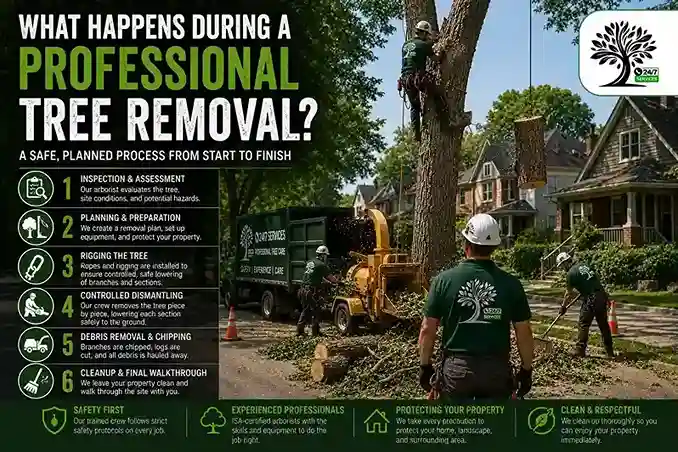
What Happens During a Professional Tree Removal?
A step-by-step look at how a safe, controlled tree removal actually works.
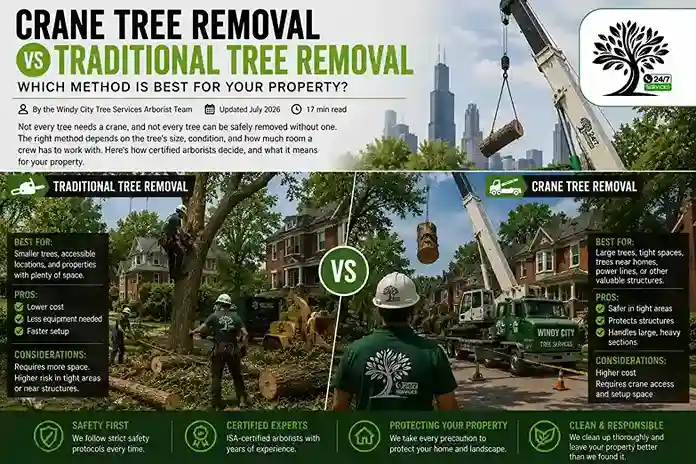
Crane Tree Removal vs Traditional Tree Removal
How to know which removal method fits a tight urban lot versus an open yard.
Can a Dead Tree Be Saved?
What “dead” actually means for a tree, and when recovery is still possible.
What Is Air Spade Root Excavation?
How compressed-air excavation protects roots during inspection and construction.
Do You Need a Permit for Tree Removal in Chicago?
What Chicago’s tree removal permit rules actually require, and when they don’t apply.
What to Do After a Tree Falls During a Storm
The first steps to take, and the ones to avoid, right after a tree comes down.
Sources referenced in this guide include publications and best management practices from the International Society of Arboriculture (ISA), the USDA Forest Service, the National Weather Service (NWS), NOAA, and university extension programs including Purdue and Michigan State University Extension. This article is intended for general educational purposes and does not replace an on-site professional tree risk assessment.