What Happens During a Professional Tree Removal?
Chicago Tree Removal · Process Guide
What Happens During a Professional Tree Removal?
Tree removal isn’t just cutting a trunk and walking away. It’s a planned sequence of inspection, rigging, controlled dismantling, and cleanup, run by a crew trained to protect your home, your neighbors, and each other.
Introduction
A mature oak doesn’t come down the way most people picture it. There’s no single cut, no dramatic timber-style fall. On a real job site, especially in a tight Chicago backyard boxed in by fences, power lines, and a neighbor’s garage, that tree comes apart piece by piece, on ropes, under control, the whole way down.
Homeowners usually call us for one of three reasons: the tree is dead or dying, it’s structurally compromised and leaning toward the house, or a storm already made the decision for them. In every case, the work that follows is the same careful sequence — not because we’re being cautious for the sake of it, but because a 60-foot tree weighs several tons, and a mistake with that much weight can total a roof or worse.
DIY removal looks simple on YouTube. It isn’t. Chainsaws, gravity, and unpredictable wood grain are a bad combination for anyone without rigging training, and the U.S. Bureau of Labor Statistics has repeatedly ranked tree trimming and removal among the most dangerous jobs in the country. A licensed crew brings something a homeowner with a rental chainsaw can’t: a plan, built around escape routes, drop zones, and the specific way that specific tree wants to fail.
This guide walks through exactly what a professional tree removal looks like from the first phone call to the final walkthrough — inspection, rigging, cranes, insurance questions, storm response, and what happens on the rare occasion something goes wrong mid-job. If you’re trying to understand what you’re paying for, or what to expect on removal day, you’ll find it here.
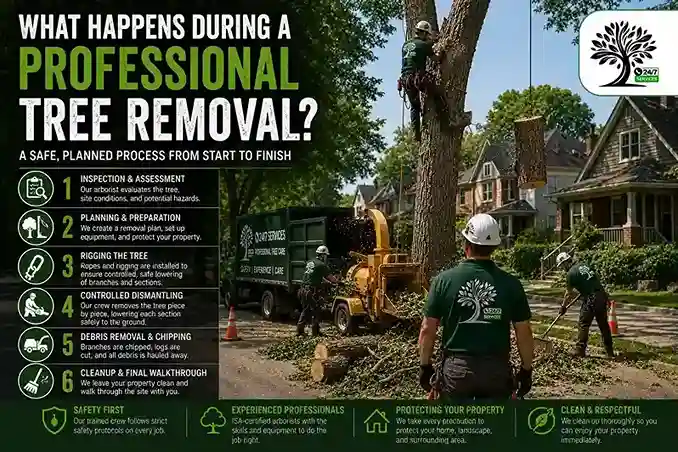
A professional tree removal follows seven stages: a health and hazard inspection, a written job plan covering rigging and escape routes, safety setup with PPE and site barriers, controlled sectional dismantling using ropes and rigging, careful lowering of limbs and trunk sections, full debris cleanup, and optional stump grinding. Most residential removals take between 2 and 8 hours.
1. Initial Tree Inspection
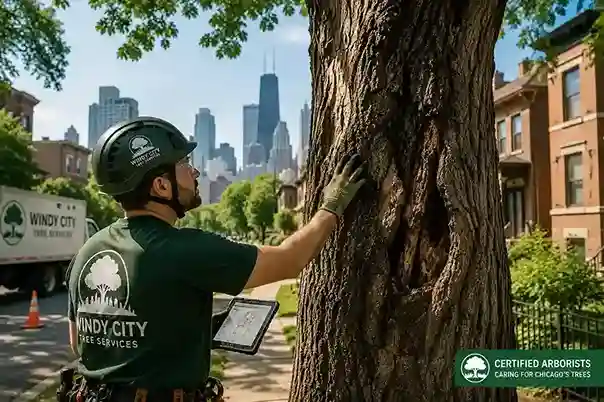
Every removal starts with an arborist walking the property, not a crew showing up with saws running. This is the part that gets skipped in DIY removals, and it’s usually where the real risks get found.
Tree health evaluation
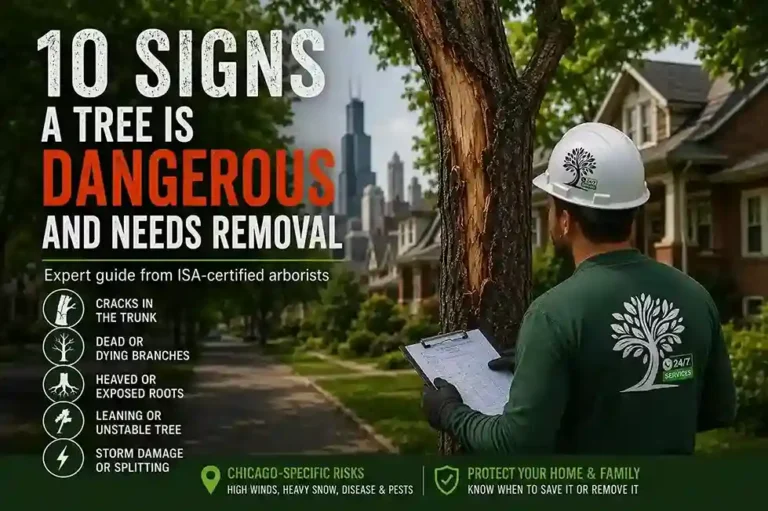
The arborist checks the canopy, bark, and root flare for signs of disease, pest damage, and dieback. A tree that looks fine from the sidewalk can be hollow at the base.
Structural defects
Cracks, cavities, included bark at branch unions, and co-dominant stems all change how a tree behaves once cutting starts.
Lean and decay
A tree already leaning toward a structure needs a different rigging strategy than one standing straight. Internal decay, checked with a mallet sound test or resistograph on higher-risk jobs, tells the crew how much the wood can actually be trusted to hold rigging weight.
Utility hazards
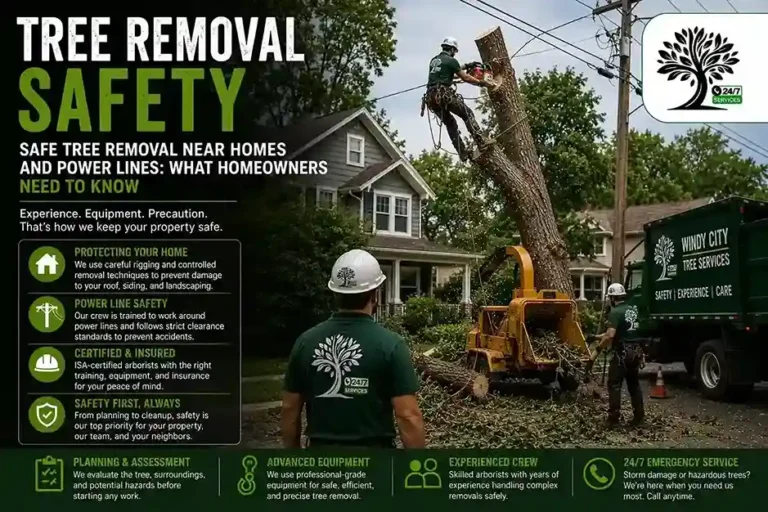
Overhead power lines change everything about a plan. If a tree is within 10 feet of an energized line, the crew coordinates with the utility company or brings in a line-clearance specialist before touching a saw to it.
Property assessment
Fences, sheds, gas lines, sprinkler heads, patios — the arborist maps everything within falling range before pricing the job.
This is also where the crew decides whether the tree is a candidate for removal at all, or whether pruning, cabling, or treatment could save it. A good arborist doesn’t default to removal — it’s the last option, not the first.
2. Job Planning
Once the inspection is done, the crew builds a written plan specific to that tree and that yard. No two removals are identical, even for the same species on the same block.
- Escape routes: Every climber and ground worker knows two ways to move if a limb doesn’t fall where expected.
- Drop zones: Marked-off areas where cut sections will land, kept clear of people, pets, and property.
- Rigging plan: Which limbs get roped and lowered versus free-dropped into an open zone, and in what order.
- Equipment selection: Whether the job needs a bucket truck, a crane, climbing spikes, or all three.
- Crew assignments: Who climbs, who runs the rigging line, who operates the chipper, who watches the street.
- Weather conditions: Wind over 20–25 mph, ice, or lightning in the area typically pushes a job to a different day. Chicago’s lake-effect gusts make this call more often than you’d think.
3. Safety Comes First
Before a single cut happens, the crew suits up and the site gets locked down. This is the part homeowners rarely see up close, but it’s where most of the labor cost actually goes.
Standard PPE for a Tree Removal Crew
- Climbing or forestry-rated helmets with integrated ear and eye protection
- Chainsaw-resistant chaps and gloves
- High-visibility clothing so ground crew stays visible to climbers overhead
- Steel-toe, cut-resistant boots
- Fall-arrest harnesses for anyone working off the ground
Communication is constant. Most crews use hand signals or radios so the climber and ground team stay synced on every cut — a shout that gets lost in chainsaw noise is how accidents happen. On residential streets, one crew member typically manages traffic control, using cones or a flagger if the drop zone crosses a sidewalk or parking lane. This aligns with OSHA’s tree care safety guidance, which treats logging and arboriculture equipment standards as the baseline for this kind of work.
4. Protecting Your Property
Property damage is the thing most homeowners worry about, and it’s a fair concern — a falling limb doesn’t know the difference between a drop zone and your roof. Professional crews build protection into the plan itself rather than hoping for the best.
- Homes and roofs: Larger sections get lowered by rope rather than dropped, especially anything within reach of the structure.
- Metal siding and windows: Plywood sheets or heavy rigging mats get staged against vulnerable surfaces before cutting starts.
- Landscaping: Plywood or rubber mats protect grass, garden beds, and irrigation lines from equipment and falling debris.
- Driveways and fences: Padding and careful rope angles keep swinging sections away from hardscape and property lines.
Controlled lowering — using a friction device and rigging rope to ease a section down slowly instead of letting it free-fall — is the single biggest reason professional removals avoid the property damage that makes DIY jobs go viral for the wrong reasons.
5. Equipment Used
| Equipment | When It’s Used |
|---|---|
| Chainsaws | Cutting limbs, sectioning the trunk, felling smaller trees in open space |
| Rigging (ropes, blocks, friction devices) | Lowering limbs and trunk sections in controlled drops near structures |
| Climbing gear (harness, spurs, lanyards) | Accessing the canopy on trees without truck access |
| Bucket trucks | Reaching the canopy without climbing, common on street-facing trees |
| Cranes | Large or hazardous trees, tight yards, or trees too unstable to climb safely |
| Wood chippers | Processing brush and small limbs on-site for hauling |
| Stump grinders | Grinding the remaining stump below grade after removal |
Crane-assisted removal deserves its own mention. When a tree is too decayed to climb safely, or the yard is too tight for a bucket truck, a crane lifts entire sections straight up and out — over the house if needed — and sets them down in the street or a truck bed. It’s more expensive, but for the right tree, it’s dramatically safer than any alternative.
6. The Removal Process
This is the part most people picture when they hear “tree removal,” and it’s the most technical stage of the job.
Limb removal
The climber (or bucket operator) starts at the top and works down, removing smaller limbs first to reduce weight and wind resistance before tackling larger sections.
Sectional dismantling
Rather than felling the whole tree at once, the trunk gets cut into manageable sections — often 3 to 6 feet at a time near structures — each one rigged before the cut is finished.
Rigging and lowering
A rigging line runs from the cut section, over a block anchored higher in the tree, down to a ground crew member on a friction device. When the climber finishes the cut, the ground crew eases the section down instead of letting it drop.
Trunk removal
Once the canopy and major limbs are gone, what’s left is the trunk itself, felled in sections from the top down until only a stump remains at a safe working height.
Final stump
The trunk gets cut down close to grade, leaving the stump ready for grinding if that’s part of the job.
7. Emergency Tree Removal
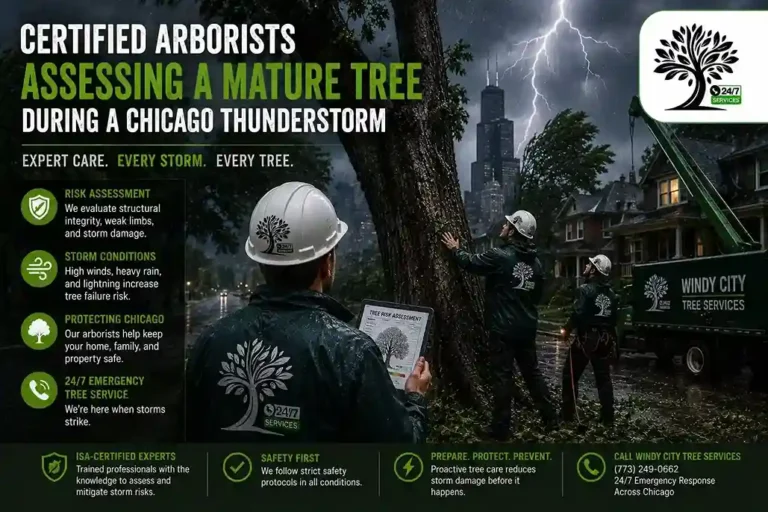
Storms change the equation entirely. A tree that’s already down — or hanging in another tree, or resting on a power line — isn’t a scheduled job anymore. It’s a hazard that needs a fast, careful response.
When homeowners search for fast tree removal during emergencies, what they actually need isn’t speed for its own sake — it’s a crew that can mobilize quickly without skipping the safety steps that matter most. A rushed cut on a tree under tension from a storm is exactly how secondary accidents happen. Emergency crews move faster on scheduling and response time, not on caution.
- Storm damage: Split trunks, hanging limbs (“widowmakers”), and uprooted trees get triaged by risk level.
- Fallen trees: If a tree has already fallen, the crew assesses tension and load before making the first cut — a trunk pinned under weight can spring back violently if cut wrong.
- Trees on homes: Structural engineers may need to weigh in before removal starts if the tree is bearing weight on the roofline.
- Blocked roads: Coordination with the city or utility crews if the tree is blocking a right-of-way.
- Utility hazards: Any tree in contact with a power line gets treated as energized until the utility company confirms otherwise.
8. Cleanup
The job isn’t done when the last cut is made. A professional crew clears the site fully before packing up.
- Chipping: Brush and small limbs go through the chipper on-site.
- Log removal: Larger trunk rounds get loaded out, either hauled away or left for firewood if the homeowner wants them.
- Raking: Sawdust, bark, and small debris get cleared from the lawn and any beds.
- Debris hauling: Everything else leaves the property in the crew’s trucks the same day.
- Final inspection: A walkthrough with the homeowner confirms the site is clear and nothing was missed.
9. Optional Stump Grinding
Stump grinding isn’t automatically included in every removal — it’s usually quoted separately. A grinder chews the stump down 4 to 12 inches below grade, leaving a bed of wood chips where the trunk used to be.
- Future landscaping: A ground stump lets you replant, lay sod, or extend a patio without a trunk in the way.
- Pest prevention: Old stumps attract termites, carpenter ants, and fungal growth that can spread to nearby trees.
- Replanting: Grinding clears root mass near the surface, though deep roots stay in the ground and break down over years.
10. Insurance & Liability
Does insurance pay for damage during tree removal?
This is one of the most common questions we get, especially after a close call with siding or a fence. The honest answer: it depends, and it’s worth understanding why before you’re in that situation.
If a licensed, insured tree company causes damage during tree removal to metal siding or another part of your property, that typically falls under the contractor’s general liability insurance, not your homeowner’s policy. That’s exactly why hiring an insured contractor matters — it shifts the financial risk off of you. Your own homeowner’s insurance may separately cover storm-related tree damage (like a tree falling on your house during a storm), but that’s a different scenario than damage caused by a contractor’s work.
Important
Coverage always depends on the specific cause of the damage, the terms of your contract with the tree company, and the language of the individual insurance policies involved. This article is general information, not legal or insurance advice — if damage occurs, talk to the contractor’s insurer and your own agent directly.
Do I need liability insurance during tree removal?
You, as the homeowner, generally don’t need to buy a separate policy for a removal job. What you need to do instead is verify that the company you hire carries the right coverage:
- General liability insurance, which covers property damage caused during the job
- Workers’ compensation insurance, which covers the crew if someone gets hurt on your property
- Proof of insurance provided before work begins, not promised verbally after
Ask for a certificate of insurance and confirm it’s current. A company that hesitates to provide one is a red flag worth taking seriously.
11. What If a Tree Falls Unexpectedly During Removal?
It’s a fair question, and it’s exactly what the sectional, rigged approach is designed to prevent. Trees don’t get felled whole near a house — they come apart in controlled, roped pieces specifically so a tree falling unexpectedly during removal isn’t a live possibility on a well-run job.
- Sectional removal: Cutting in small, planned pieces limits how much weight is ever in free motion at once.
- Rigging as a backup: Even when a limb is cut through, the rope — not gravity — controls where it goes.
- Emergency procedures: Crews train on what to do if a section shifts unexpectedly, including immediate ground-crew clearance and a pre-agreed abort signal.
- Site safety: Marked drop zones and barriers mean that even an off-plan piece lands somewhere already cleared of people and property.
When something does go sideways — a crack that wasn’t visible from the ground, a gust that catches a section mid-lower — the plan built during job planning is what keeps it from becoming a bigger problem.
12. Why Professional Safety Matters
Tree care work consistently ranks among the more dangerous trades tracked by U.S. labor safety data, alongside roofing and logging. That’s not a scare tactic — it’s the reason every step in this guide exists.
A fatal accident during a tree removal operation is almost always traceable to a specific, avoidable failure: no rigging plan, untrained personnel, missing PPE, or a decision to rush past a hazard that should have stopped the job. Training changes that math. A certified arborist has spent years learning how wood fails under load, how to read a lean, and when to call in a crane instead of forcing a climb.
Following OSHA and ANSI A300 pruning and removal standards isn’t paperwork for its own sake. It’s the accumulated record of what’s gone wrong on other job sites, turned into rules that keep it from happening again.
This is the core reason DIY removal is risky in ways that are easy to underestimate: a homeowner with a chainsaw has the tool but not the years of judgment calls that go with it. A 40-foot tree doesn’t give second chances for a bad guess.
13. Environmental Considerations
One question that comes up more than you’d expect: do trees remove pollution more during the winter? The short answer is no — generally less. Deciduous trees, which drop their leaves, do most of their air-filtering work during the growing season, when full leaf coverage is actively pulling particulate matter and gases like ozone and nitrogen dioxide out of the air. Once the leaves are gone in winter, that filtering effect drops off significantly.
Evergreens are the exception. Species like spruce and pine keep their needles year-round, so they continue providing some air filtration through the winter, just at a smaller scale than a full deciduous canopy in summer. This is one more factor worth weighing before removing a healthy tree — even a tree that’s inconvenient still does real work for your block’s air quality most of the year.
14. Chicago-Specific Challenges
Removing a tree in a Chicago neighborhood isn’t the same job as removing one on an open acre downstate. The city throws in a specific set of complications.
- Dense neighborhoods: Tight lot lines mean less margin for error on every drop zone.
- Limited backyard access: Many Chicago yards can’t fit a bucket truck, which pushes jobs toward climbing or crane work instead.
- Narrow gangways: Getting a chipper or stump grinder to a backyard often means threading equipment through a 3-foot gap between houses.
- Lake Michigan winds: Gusts off the lake can shut down a job with little warning, especially for crane work.
- Heavy snow and ice storms: Winter loading is a major cause of the emergency calls we get, particularly on trees already weakened by decay.
- Mature urban canopy: Many Chicago neighborhoods have decades-old parkway and yard trees, which means larger diameters and more decay-related risk than younger suburban plantings.
15. Can a Tree Be Saved Instead?
An ethical arborist doesn’t sell removal as the default answer. If a tree can be stabilized or treated, that’s almost always the better outcome for your property value and your yard’s shade.
- Tree trimming: Removing dead or crossing limbs to reduce weight and risk without taking the whole tree.
- Cabling: Steel cables installed high in the canopy to support weak branch unions.
- Bracing: Rods installed through split or weak trunk sections to hold them together structurally.
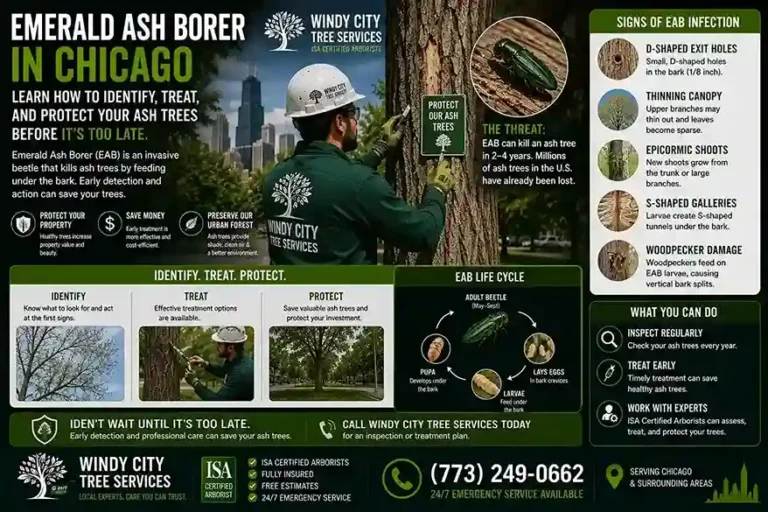
- Air spade root excavation: Using compressed air instead of digging tools to safely expose roots, diagnose root rot, or relieve soil compaction without damaging the root system.
- Fertilization: Targeted soil treatment for trees stressed by poor soil or urban compaction.
- Disease treatment: Fungicide or insecticide treatment for trees caught early enough in a disease cycle to recover.
If your tree hasn’t been formally assessed yet, it’s worth getting a second opinion before scheduling removal. Sometimes the tree that looks like a lost cause just needs a cable and a season to recover.
Timeline: What to Expect From Start to Finish
- 1. Inspection
An arborist assesses the tree and property, usually within a few days of your call. - 2. Estimate
A written quote covering removal, cleanup, and any add-ons like stump grinding. - 3. Scheduling
Job gets booked around weather and equipment availability — typically 1–3 weeks out for non-emergency work. - 4. Safety setup
Crew arrives, marks drop zones, protects property, and confirms the rigging plan. - 5. Removal
Sectional dismantling from canopy to stump, typically 2–8 hours depending on size and access. - 6. Cleanup
Chipping, hauling, and raking, finished the same day in almost all cases. - 7. Final walkthrough
Crew lead reviews the site with you before leaving.
DIY vs. Professional Removal
| DIY Removal | Professional Removal | |
|---|---|---|
| Safety | No rigging plan or fall protection; high injury risk | Trained crew, PPE, rigging, and a written safety plan |
| Equipment | Limited to a rented chainsaw and rope | Rigging systems, bucket trucks, cranes when needed |
| Insurance | Homeowner bears the full risk of any damage or injury | Contractor’s liability and workers’ comp cover the job |
| Cost | Lower upfront, but risk of expensive damage or ER bills | Higher upfront, predictable, damage risk is insured |
| Time | Often multiple weekends for a single mature tree | Usually completed in one day |
| Property protection | Minimal — no rigging to control where wood lands | Rigging and mats protect roofs, siding, and landscaping |
Homeowner Checklist Before Removal Day
- Move vehicles away from the driveway and street near the drop zone.
- Keep children away from the work area for the full day.
- Notify neighbors if the tree or equipment access affects their property.
- Secure pets indoors or in a fenced area far from the site.
- Ask for proof of insurance before the crew starts.
- Discuss cleanup expectations, including whether you want the wood left as firewood.
Frequently Asked Questions
Most residential removals take 2 to 8 hours, depending on tree size, access, and whether a crane is needed. Large or hard-to-access trees can stretch into a second day.
Yes. Chainsaws and wood chippers both run loud for most of the job. Crews typically avoid very early morning or late evening starts out of courtesy to neighbors.
It’s rare on a properly rigged job. Sectional cutting and rope control are specifically designed to prevent uncontrolled falls, though hidden internal decay can occasionally surprise even an experienced crew.
With a licensed, insured company using rigging and protective mats, significant damage is uncommon. Risk goes up sharply with untrained crews or DIY attempts that skip rigging entirely.
Sometimes, if the removal is tied to storm damage or a hazard covered by your policy. Routine removal of a healthy or unwanted tree is typically not covered. Check your specific policy language.
Reputable ones do — general liability and workers’ compensation at minimum. Always ask for a current certificate of insurance before work starts.
Yes, and it’s sometimes easier — frozen, snow-covered ground protects lawns from equipment traffic. Ice and high winds can still delay a job for safety reasons.
Trained crews follow emergency procedures: immediate ground-crew clearance, reassessment of the site, and adjustment of the rigging plan before continuing. This is why sectional, roped removal is standard practice.
Most companies haul it away as part of the job. Some homeowners request the rounds be left as firewood — ask before the crew arrives if you want that option.
Not necessarily, but it’s recommended for the initial walkthrough and final inspection so you can flag any concerns directly with the crew lead.
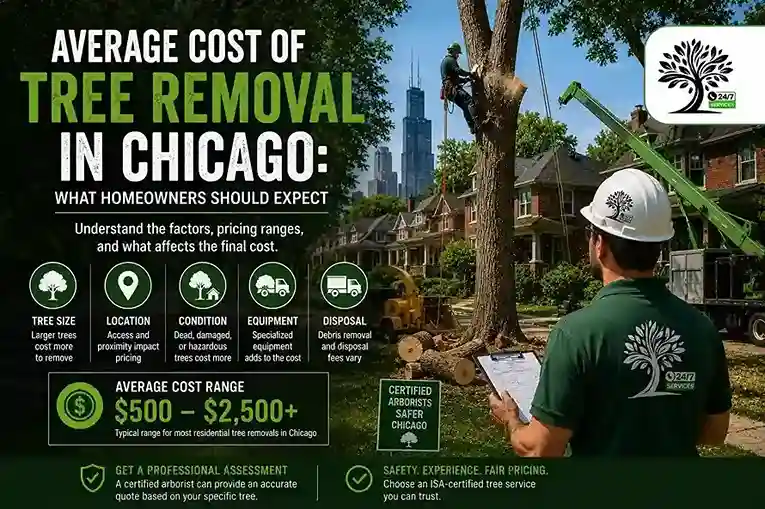
Cost depends on tree size, condition, and access. Larger trees requiring a crane or extensive rigging cost more than a small, easily accessed tree. Request a free estimate for an exact quote.
It depends on the tree’s location and, in some cases, its species or size. Parkway trees (between the sidewalk and street) generally require city approval. Check with your tree company or the city before removal.
Professional crews use protective mats and plan equipment routes to minimize impact. Some surface disruption from foot and light equipment traffic is normal but should be minor with a careful crew.
Trimming removes specific branches to improve health, shape, or safety while keeping the tree alive. Removal takes the entire tree, including the trunk, down to a stump.
Small trees away from structures and power lines carry lower risk, but chainsaw injuries happen at any tree size. If the tree could reach a structure, a person, or a line if it falls wrong, professional removal is the safer call.
Cranes come into play when a tree is too decayed to climb safely, the yard is too tight for a bucket truck, or sections are too heavy to rig down safely by rope alone.
An ISA Certified Arborist has passed a standardized exam covering tree biology, risk assessment, and industry best practices. Hiring one means the removal decision is backed by training, not guesswork.
Only with proper coordination. Any tree within 10 feet of an energized line should be treated as a utility hazard until the power company or a line-clearance specialist confirms it’s safe to proceed.
Ask for proof of insurance, ISA certification, a written estimate, and references. A company that hesitates on any of these is worth a second look before you sign.
Unless stump grinding is included, the stump stays in place at ground level. Grinding is typically quoted as a separate service and removes the stump 4 to 12 inches below grade.
Explore our Chicago Tree Service homepage to learn more about our professional tree removal services, meet our Certified Arborists, and see the full range of Professional Tree Care we offer across Cook County. Related services include emergency tree removal, tree trimming & pruning, stump grinding, tree cabling & bracing, tree health inspection, air spade root excavation, commercial tree service, and storm prep & support systems.