
Downtown Chicago Tree Service
Serving The Loop · South Loop · West Loop · River North · Streeterville · Near North Side · Printer’s Row · Lakeshore East · New Eastside
Based blocks from the river at 323 W Carroll Ave, our crew is in the Loop and surrounding downtown neighborhoods every day. We handle confined-access removals, structural pruning along busy streetscapes, emergency response after storms, and ongoing plant health care for commercial properties — all with the permitting and rigging experience that downtown jobs actually require.
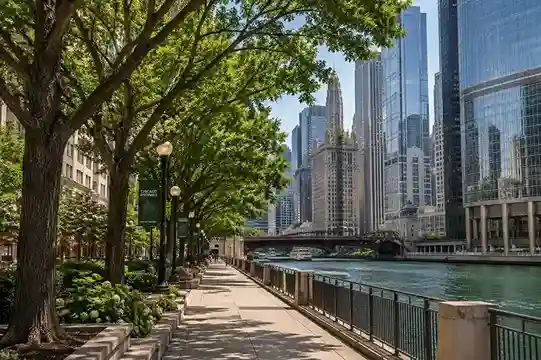
Tree Care in the Urban Core Takes More Than a Chainsaw
Downtown Chicago is one of the toughest places in the country to keep a tree alive — and one of the most important places to get it right. Between reflected heat off glass towers, compacted soil under sidewalks, road salt every winter, and wind that funnels straight off the lake, the trees along Wacker Drive, in Grant Park, or outside a Printer’s Row brownstone work harder than almost anywhere else in the city.
A crew experienced only in open suburban lots doesn’t necessarily have the rigging knowledge, insurance coverage, or permitting experience to safely remove a silver maple wedged between a loading dock and a bike lane in River North. Most downtown jobs require a plan that accounts for pedestrian management, utility proximity, condo board requirements, and city permit rules before a single cut is made.
Windy City Tree Services is based at 323 W Carroll Ave, a few blocks from the river. Our crews are in the Loop and the surrounding neighborhoods on a near-daily basis. We carry the insurance downtown buildings ask for, understand the difference between a parkway tree and a private-property tree, and plan traffic control before the day of the job — not on the fly.
This page is the hub for our full downtown service area. Below you’ll find dedicated neighborhood guides, a breakdown of what makes downtown tree work different, and everything a property owner or building manager needs before hiring a tree company here.
Five Things That Make Downtown Tree Jobs Unique
Every job downtown has at least one of these. Most have two or three.
Confined Access
Alleys, sidewalks, and skyways limit where a bucket truck or crane can park. Many jobs require rigging and lowering branches by rope rather than letting them drop — a technique that takes specific training and equipment, not improvisation.
Traffic & Pedestrian Management
Closing a lane on Wabash, Dearborn, or Michigan Avenue requires advance coordination, cones, and sometimes a city permit. We handle this before the day of the job, not on arrival.
Utility Proximity
ComEd overhead lines, streetlights, and underground fiber run close to nearly every downtown parkway tree. That changes how pruning angles are planned, which cuts come first, and how debris is lowered.
Parkway Tree Ownership
Trees in the strip between the sidewalk and street are owned by the City of Chicago and managed by the Bureau of Forestry — not the adjacent property owner. Removals and major pruning on parkway trees follow a different process than work on private property.
Building Association Requirements
Condo and co-op boards downtown frequently require a certificate of insurance and a written scope of work before any tree or landscaping vendor can be scheduled. We’re used to this process and can produce the right documentation quickly.
Urban Soil & Canopy Stress
Downtown trees deal with compacted soil under hardscape, reflected heat from buildings and pavement, and limited root space. A healthy-looking tree may be under serious long-term stress that only shows up when a storm hits.
Our Downtown Chicago Service Areas
Each neighborhood below has its own dedicated page with local details on tree species, weather exposure, property types, and directions.
The Loop
Chicago’s central business district, from Wacker Drive to Congress Parkway. Office towers, plazas, and street trees under heavy pedestrian and vehicle traffic.
View Loop pageSouth Loop
Printer’s Row, Dearborn Park, and the Museum Campus corridor. A mix of converted lofts, newer high-rises, and historic rowhouses with mature street trees.
View South Loop pageWest Loop
Fulton Market, Randolph Street restaurant row, and the converted warehouse district. Rapid new development alongside older industrial-era trees and tight courtyards.
View West Loop pageRiver North
Gallery District, Merchandise Mart, and the north bank of the Chicago River. Dense canopy, narrow alleys, and commercial properties requiring minimal disruption.
View River North pageStreeterville
Northwestern’s downtown campus, the Navy Pier approach, and lakefront high-rises. Exposed lakeshore conditions and dense residential towers with managed landscaping.
View Streeterville pageNear North Side
The Gold Coast, the Magnificent Mile, and Rush Street. Landmark-adjacent properties, wide parkways, and premium commercial streetscapes with high-visibility maintenance.
View Near North Side pagePrinter’s Row
The historic publishing district south of Congress. Converted loft buildings, mature sidewalk trees, and a character-driven neighborhood where tree preservation often matters as much as removal.
View Printer’s Row pageLakeshore East
The planned community and park behind Aqua Tower. Newer landscaping, engineered soil systems, and high-density residential towers with HOA-managed grounds.
View Lakeshore East pageNew Eastside
The high-rise cluster east of Michigan Avenue near the river mouth. Lakefront exposure, limited soil depth near seawalls, and a compact, high-density residential community.
View New Eastside pageNot sure which neighborhood matches your address? Call us at (773) 249-0662 and we’ll point you to the right resources, or simply request an estimate and we’ll confirm coverage from there.
What Chicago Weather Does to Downtown Trees
The urban canyon formed by Lake Michigan and dense high-rises creates conditions that shift with every season, and every shift puts pressure on the trees caught in the middle.
Spring
Temperature swings of 40°F within a week are common. Late frosts after an early warm spell can damage the tender new growth on honey locust and ornamental pear — and it’s our busiest season for frost-damaged branch tip calls.
Summer
The urban heat island effect intensifies downtown. Concrete, glass, and asphalt radiate stored heat well into the evening, stressing trees planted in small sidewalk cutouts with limited soil volume and restricted groundwater access.
Storm Season
Derecho-style straight-line wind events have damaged tree canopy across the Loop in recent years. Trees weakened by construction-related root damage or girdling roots are the most likely to fail when these events hit.
Winter
Heavy lake-effect snow, sustained sub-freezing stretches, and road salt use on every downtown street. Salt spray from plows draining into tree pits is one of the leading reasons parkway trees in the core decline earlier than they should.
Newly planted trees downtown typically need staking longer than the same species would require in a quiet residential neighborhood, because the wind corridor formed along east-west streets creates sustained lateral pressure that established trees in sheltered locations simply don’t face.
Common Downtown Trees and What They Need
Downtown Chicago’s urban forest leans on species chosen for their tolerance of compacted soil, road salt, and reflected heat. Here’s what we see most often and what drives maintenance decisions for each.
| Species | Why It’s Downtown | Common Maintenance Issue |
|---|---|---|
| Honey Locust | The most widely planted downtown street tree. Light canopy, salt tolerant, and tough in compacted soils. | Pod litter on sidewalks; occasional canker and structural co-dominant stems needing cabling. |
| Kentucky Coffeetree | Increasingly planted as an ash replacement. High urban stress tolerance, but slow to establish. | Young trees need staking and corrective pruning in the first three to five years. |
| London Plane | Common in plazas and along wider boulevards. Recognizable mottled bark, generally tough. | Anthracnose in wet springs causes leaf scorch; responds well to proper site selection and pruning. |
| Linden | Fragrant and popular near building entrances. Good urban tolerance. | Aphid infestations leading to sticky honeydew residue on sidewalks and parked cars below. |
| Ornamental Pear | Common in newer streetscape plantings. Attractive spring bloom. | Structurally weak at the crotch — one of our most frequent storm-damage calls downtown. |
| Elm (resistant cultivars) | Planted to replace American elms lost to Dutch elm disease. Still monitored closely by the city. | Structural pruning to maintain clear pedestrian sightlines and canopy above streetlights. |
| Oak & Maple | Less common right in the core due to soil constraints. Present in Grant Park and larger plazas. | Root zone soil compaction; pruning to maintain formal canopy lines in park settings. |
| Ash | Largely removed or in decline due to emerald ash borer, which arrived in Chicago in 2008. | Assessment of remaining private-property specimens for EAB status and removal planning. |
Property Types We Serve Downtown
Downtown Chicago’s property mix is unlike almost anywhere else we work, and it shapes how every job is planned.
High-Rise Residential & Mixed-Use
HOA/condo board coordination, COIs, and scheduling around loading dock hours.
Historic Buildings & Rowhouses
Printer’s Row and parts of the South Loop, where mature trees carry historic character.
Office Towers & Plazas
Planters and streetscape trees under facilities or property management contracts.
Retail Corridors
State Street, Michigan Avenue, and Randolph Street sidewalk plantings that must stay healthy without blocking signage or awnings.
Parks & Green Spaces
Adjacent private properties near Grant Park, Millennium Park, and Maggie Daley Park needing coordinated care.
Schools & Institutional Properties
University buildings in Streeterville and civic institutions throughout the Loop.
HOAs & Condo Associations
Annual maintenance plans and vendor documentation for association-managed properties.
Parkway & Municipal Trees
City-owned trees requiring Bureau of Forestry coordination for removals and major pruning.
Services Available Throughout Downtown Chicago
Every service listed below is available to residential and commercial properties across the full downtown core.
Tree Removal
Full removals for hazardous, dead, or unwanted trees, including tight urban access jobs with rope rigging.
Emergency Tree Removal
Storm damage, leaning trees, and downed limbs — available around the clock, every day of the year.
Tree Trimming & Pruning
Structural pruning, canopy clearance from buildings and utilities, and seasonal maintenance.
Stump Grinding
Compact grinders sized for sidewalk cutouts, narrow courtyards, and tight downtown spaces.
Tree Cabling & Bracing
Structural support for mature or storm-weakened trees worth preserving in valuable downtown locations.
Tree Health Inspection
Diagnosis of pests, disease, and decline, plus written risk assessments for insurance and liability purposes.
Tree & Shrub Fertilization
Soil and nutrient programs for compacted urban planting sites, customized by species and site history.
Air Spade Service
Non-destructive soil excavation for root investigation and compaction relief without damaging existing roots.
Commercial Tree Service
Contract maintenance programs for office buildings, retail corridors, HOAs, and property management groups.
Storm Prep & Support Systems
Proactive bracing and structural pruning before storm season to reduce the risk of failure near buildings.
Land Clearing
Tree removal tied to renovation and redevelopment projects, including permit coordination when required.
Firewood & Wood Chips
Seasoned firewood and wood chip mulch, often sourced directly from trees removed locally in the neighborhood.
What We Bring to Every Downtown Job
Licensed & Insured
We carry the general liability coverage downtown buildings, HOAs, and commercial property managers require before scheduling any vendor.
Downtown-Specific Experience
Our crews have worked the confined access, permitting processes, and traffic considerations of the urban core — not just suburban tree removal.
Modern Equipment
Compact bucket trucks for downtown alleys, rigging systems for tight rope-and-lower removals, and stump grinders that fit through a standard gate.
Property Protection
Plywood, mats, and careful rigging protect sidewalks, landscaping, and building facades during every job — because downtown, there’s no room for careless work.
24/7 Emergency Response
Storm damage and hazardous limbs don’t wait for business hours. We prioritize safety situations and aim for same-day response whenever a tree is actively blocking or endangering people.
Honest Recommendations
If a tree can be saved with cabling or structural pruning instead of removal, we’ll say so. If it needs to come down, we’ll explain exactly why.
Complete Cleanup
We haul away all debris and leave the site as clean as we found it. In a dense downtown environment, leaving a mess isn’t an option.
Local Knowledge
We’re based downtown, not commuting in from the suburbs. We know the specific challenges each neighborhood presents and the people who manage the properties in them.
Residential & Commercial Expertise
We work with individual condo owners and large commercial property managers with the same attention to detail and the same quality of work.
Getting to Us From Downtown
Windy City Tree Services is at 323 W Carroll Ave, just west of the river — a few minutes from most of the downtown core.
From Millennium Park: Head northwest on Randolph or Washington Street, crossing the river into the West Loop toward Carroll Avenue.
From Navy Pier: Head west on Grand Avenue or Illinois Street through River North toward the western edge of the Loop.
From Willis Tower: Head north on Wacker Drive, then west along the river toward Carroll Avenue.
From Union Station: Head north and west a short distance — Carroll Avenue is near Halsted, just north of the Kennedy interchange.
From Lake Shore Drive: Exit west onto Randolph, Washington, or Wacker and continue west toward the river, then north to Carroll Avenue.
From I-90/I-94: Exit toward downtown and follow surface streets east toward the river, then north to Carroll Avenue.
We don’t publish exact drive times because downtown traffic varies too much to make that a useful promise. What we can promise is a fast response when you call.
Downtown Chicago Tree Service FAQ
Do I need a permit to remove a tree in downtown Chicago?
It depends on where the tree is. Parkway trees growing in the strip between the sidewalk and the street are owned by the city and require approval through the Bureau of Forestry. Trees on private property generally don’t need a city permit, though HOA or building management approval may still apply. We’ll help you determine which situation applies to your specific tree before any work starts.
Who owns the trees along the sidewalk in front of my building?
Trees planted in the parkway strip — the area between the sidewalk and the street — are typically owned and maintained by the City of Chicago’s Bureau of Forestry, even though they sit directly in front of a private building. Removal or major pruning of these trees generally requires city authorization rather than a private contractor acting alone.
Can you work in a busy downtown alley or loading dock?
Yes. Most of our downtown jobs happen in confined spaces — alleys, loading docks, narrow courtyards, and gated residential entrances. We plan access in advance and, when needed, coordinate short-term parking or lane restrictions before the day of the job.
Do you offer emergency tree removal after a storm?
Yes. We provide 24/7 emergency response for downed limbs, leaning trees, and storm damage anywhere in the downtown core. For situations where a tree is actively blocking an entrance, sitting on a vehicle, or posing an immediate hazard, call us directly at (773) 249-0662 rather than submitting a standard request form.
How much does tree removal cost in downtown Chicago?
Cost depends on the tree’s size, condition, and how difficult the site is to access. A tree in a tight courtyard with no crane access typically costs more than the same tree in an open lot, because the job requires more rigging time and a smaller crew footprint. We provide free, written estimates so you know the price before any work starts.
Does my condo association need to approve tree work on the property?
Many downtown condo and co-op boards require written approval and a certificate of insurance before any vendor — including tree companies — can work on the property. We’re experienced with this process and can produce the required documentation quickly so your job doesn’t get delayed on a paperwork issue.
What time of year is best for tree trimming in downtown Chicago?
Late winter through early spring, while trees are dormant, is generally the best window for structural pruning. The branch structure is clear without foliage, healing is strong going into the growing season, and many pests that spread through pruning wounds are less active. That said, storm damage and hazard removal happen year-round regardless of season.
Why do my sidewalk trees seem to struggle more than trees in the suburbs?
Compacted soil, small planting pits with limited soil volume, road salt accumulation, and reflected heat from surrounding buildings and pavement all put more stress on downtown trees than a typical suburban yard tree faces. Regular soil care — including decompaction and appropriate fertilization — helps offset these conditions over time.
Do you handle stump grinding in tight spaces like courtyards?
Yes. We use compact stump grinders sized for narrow gates, courtyards, and the sidewalk cutouts common in downtown Chicago. If you’re not sure whether equipment can reach your specific location, describe the access point when you call and we’ll confirm before quoting.
Do you provide tree health inspections for building insurance purposes?
Yes. We provide written risk assessments that property managers can use for insurance documentation or liability review. This is particularly common for mature trees near building entrances, overhead parking structures, or any tree that’s been flagged by a building inspector.
How do you protect sidewalks and landscaping during a downtown job?
We use plywood and protective mats under equipment and along any drag paths, and we rig larger limbs down with rope rather than letting them free-fall whenever space allows. In downtown Chicago there’s almost never enough open space to work carelessly, so protection planning is built into how we set up every job.
Do you offer maintenance contracts for commercial properties?
Yes. We set up recurring inspection and pruning schedules for office buildings, retail corridors, HOAs, and property management groups throughout downtown, with documentation and scheduling that fits their budget and operational calendar.
What should I do if a tree branch is hanging over a public sidewalk?
Contact us for an assessment. If the branch belongs to a parkway tree, we’ll help you understand whether it falls under city maintenance responsibility or private liability. If it’s an immediate hazard over a pedestrian walkway, we can respond quickly and advise on next steps including city notification if required.
Is stump grinding included with tree removal?
Stump grinding is quoted separately since not every property owner wants it done at the same time. We’re happy to include it in the same visit on request, and we’ll note it in the estimate so you can decide before work begins.
Can a tree damage a building foundation downtown?
Less commonly than in older residential neighborhoods, because downtown planting pits are usually engineered with root barriers. That said, it can happen near older buildings with shallow foundations. A root zone inspection confirms whether roots are growing toward a structure before the issue develops.
What’s the most common tree problem you see in downtown Chicago?
Storm-related limb failure and salt damage to root zones are the two most frequent issues, followed by structural weakness in fast-growing ornamental species like ornamental pear. Many of the limb failures we respond to after storms involve trees that showed earlier signs of stress that weren’t acted on — which is why we recommend a risk assessment for any large tree near a building entrance or parking structure.
Do you supply firewood or wood chips from removed trees?
Yes. We offer both seasoned firewood and wood chip mulch, often sourced directly from trees we’ve removed locally. Ask when you schedule your job and we’ll arrange delivery if it makes sense for your property.
Request Your Free Downtown Chicago Tree Care Estimate
Whether you need a single storm-damaged limb removed from a South Loop courtyard or an ongoing maintenance plan for a Michigan Avenue commercial property, Windy City Tree Services is close by and ready to help.
Explore all Chicago neighborhoods and surrounding communities, or jump directly to your area: