
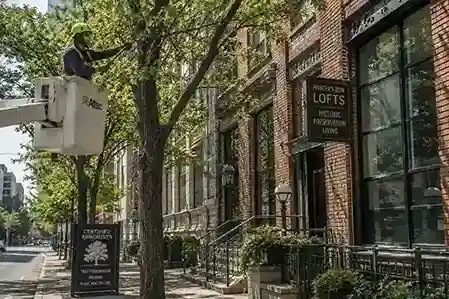
Tree Service in Printer’s Row Chicago
Careful, low-impact tree care for Printer’s Row’s historic lofts, condo associations, and street trees near Dearborn Station.
Serving Printer’s Row
Tree Care Built for This Neighborhood
Printer’s Row is one of the smallest and most architecturally distinctive neighborhoods in our downtown service area. It is a compact stretch of former publishing houses and printing plants converted into loft apartments over the past four decades. It is quieter and lower-rise than most of downtown, which means its handful of street trees carry a lot of visual weight for the neighborhood’s character.
Windy City Tree Services works with condo associations and individual loft owners throughout Printer’s Row. Here, careful, low-impact tree care matters as much as technical skill given how tight some of these historic blocks are. We plan every job around the building facades, the pedestrian flow, and the narrow access points that make this neighborhood different from almost anywhere else in Chicago.
Our full range of tree services is available throughout Printer’s Row, from routine seasonal pruning to emergency response after storm events.
About the Neighborhood
About Printer’s Row
Printer’s Row takes its name from the printing and publishing companies that once operated out of the neighborhood’s sturdy masonry buildings, many built in the late 1800s and early 1900s to house heavy printing equipment. Beginning in the 1970s, developers began converting these buildings into residential lofts, and the neighborhood is now one of the most walkable, architecturally consistent pockets of the South Loop area.
Because Printer’s Row developed around low-rise industrial buildings rather than modern high-rises, the neighborhood has a more intimate, pedestrian scale than almost anywhere else downtown. Its street trees, though not especially numerous, play an outsized role in softening the brick-and-stone streetscape. Losing a single established tree here changes the look and feel of an entire block in a way that wouldn’t happen in a denser, taller corridor.
That’s part of why property owners and condo associations here tend to invest more in preserving individual trees rather than simply replacing them. Our approach reflects that priority.
Local Conditions
How Chicago Weather Affects Printer’s Row Trees
Printer’s Row has a somewhat different microclimate than the rest of downtown, and understanding it shapes how we approach tree care here.
Dearborn and State Streets see regular winter maintenance traffic, exposing sidewalk trees to road salt. Careful root zone care helps trees handle repeated winter exposure.
Spring frost can still affect established trees in the neighborhood. We time any pruning work to minimize stress during the transition out of dormancy.
Masonry buildings here absorb and release heat differently than glass-and-steel towers further north, creating a somewhat less intense urban heat environment for trees.
Proximity to Grant Park and the lakefront means real wind exposure. Lower building density here avoids the tunnel effect of taller corridors, but structurally weak trees are still at risk in severe weather.
Urban Forest
Common Trees in Printer’s Row
The neighborhood’s streetscape includes a small but well-chosen selection of species suited to tight urban planting conditions.
The most common choice along Dearborn and Polk Streets. Honey locust handles compacted sidewalk soil, drought, and salt exposure better than most species, making it a practical fit for Printer’s Row’s tight planting strips. Its light, airy canopy also lets street-level light through, which suits the neighborhood’s pedestrian character.
Featured in some of the more recent streetscape improvements in the area. The Kentucky coffeetree is a native species with strong tolerance for urban soil conditions and a distinctive, coarse-branched winter silhouette that looks at home against Printer’s Row’s masonry architecture.
Found near some of the historic building entrances, where their broader canopy provides meaningful shade on narrower streets. Lindens are valued here for fragrant late-spring blooms and their ability to fill a space with natural presence without aggressive root spread.
Occasionally planted in slightly wider plaza spaces near Dearborn Station. London plane trees are tough urban performers, highly tolerant of pollution and compaction, with distinctive peeling bark that gives them a year-round visual interest.
Given the neighborhood’s smaller number of street trees, each one tends to receive closer individual attention. Our work here often focuses on preserving specific, well-established specimens rather than managing a large, uniform canopy. Our tree health inspection service is a good starting point for any established tree you want to protect long-term.
Property Types We Serve
Who We Work With in Printer’s Row
The neighborhood’s property mix is distinct from most of Chicago, and our approach adapts to each building type’s specific access and care requirements.
The neighborhood’s defining property type. Tight courtyards, narrow gates, and historic facades all factor into how we plan access and equipment for tree work.
The restored 1885 landmark at the neighborhood’s southern end. We handle tree and landscape care around mixed retail and office space with historic building sensitivity.
Lower-rise residential properties throughout the neighborhood, typically managed by condo associations we work with directly on scheduling and approvals.
Including Columbia College Chicago facilities near the neighborhood. We handle commercial and institutional tree care with the coordination larger organizations need.
Available in Printer’s Row
Tree Services in Printer’s Row
Every service we offer is available throughout Printer’s Row, sized and planned for the neighborhood’s specific access conditions and historic building character.
Tree Removal
Careful removals on tight historic blocks, using rope-and-lower techniques to protect facades and avoid heavy equipment footprints where the site demands it.
Learn more →Tree Trimming & Pruning
Structural and clearance pruning that maintains the look of the neighborhood’s street trees while managing growth around building entrances and overhead clearances.
Learn more →Emergency Tree Removal
24/7 response for storm damage, fallen trees, and hazardous limbs throughout Printer’s Row, including the Dearborn Station area.
Learn more →Tree Health Inspections
Diagnostic assessments for Printer’s Row’s established trees, covering structural integrity, root zone health, and any signs of disease or decline.
Learn more →Tree Cabling & Bracing
Structural support for valuable mature trees near building entrances and historic facades, helping preserve specimens that would be difficult to replace.
Learn more →Stump Grinding
Compact equipment suited for smaller courtyards and tighter gate access typical of Printer’s Row’s converted loft properties.
Learn more →Storm Prep
Proactive structural checks ahead of Chicago’s wind and ice seasons to reduce the risk of failure on trees with existing weak points.
Learn more →Deep Root Fertilization
Root zone fertilization that helps sidewalk-planted trees push through the compacted soil and limited growing space that stress urban specimens most.
Learn more →Air Spade Root Care
Non-destructive root zone work that diagnoses compaction and circulation problems without damaging surrounding roots or paving.
Learn more →Local Context
Landmarks and Green Space
Printer’s Row is defined as much by its architecture as by its few but well-known landmark sites.
Dearborn Station
Restored in 1885, Dearborn Station anchors the neighborhood’s southern end and remains one of the few surviving 19th-century train stations in Chicago. Now a mixed retail and office building, it gives Printer’s Row a singular architectural focal point that shapes the neighborhood’s identity.
Harold Washington Library
Just to the north, the Harold Washington Library connects Printer’s Row to the Loop. Its presence on State Street reinforces the neighborhood’s bookish, literary reputation and draws steady pedestrian traffic through the area’s streetscape.
Grant Park and the Lakefront
Printer’s Row has limited dedicated park space of its own. Nearby Grant Park and the lakefront serve as the neighborhood’s primary green refuge, and their proximity shapes the wind exposure street trees in Printer’s Row experience during storm season.
The Printer’s Row Lit Fest
An annual outdoor book festival that takes over Dearborn Street and brings thousands of visitors through the neighborhood’s tree-lined streetscape each summer, underscoring how much the neighborhood’s outdoor character depends on its maintained green infrastructure.
Getting Here
Finding Printer’s Row
For clients coordinating a site visit or estimate, here are directions from common starting points around downtown Chicago.
- From Willis Tower Head south on LaSalle Street or Wells Street toward Polk Street.
- From Union Station Head south on Clinton Street or Canal Street, then east toward Dearborn Street.
- From Millennium Park Head south on Michigan Avenue or Wabash Avenue toward Congress Parkway.
- From I-90/I-94 Exit near Congress Parkway and head east toward Dearborn Street.
Why Windy City Tree Services
Why Property Owners in Printer’s Row Choose Us
Technical skill matters here, but so does judgment about how to work in a neighborhood where the architecture and the street trees are equally worth protecting.
Historic Building Care
Protective padding and careful rigging around masonry facades, brick cornices, and architectural details.
Narrow-Street Access
Rope-and-lower techniques and compact equipment for the tighter blocks where larger machinery can’t go.
Condo Board Coordination
We work directly with property managers and boards on scheduling, approvals, and documentation.
Specimen Preservation Focus
A bias toward preservation over removal when a mature tree is worth keeping and structural support is a viable option.
Licensed and Insured
Full liability and workers’ compensation coverage, with certificates available for your building’s records.
24/7 Emergency Response
Available year-round for storm events, fallen trees, and urgent hazard situations throughout the neighborhood.
Service Area
Nearby Neighborhoods We Also Serve
Printer’s Row is closely connected to the surrounding downtown neighborhoods, all part of our Downtown Chicago service area.
Common Questions
Frequently Asked Questions
Questions we hear regularly from Printer’s Row residents, condo boards, and property managers.
Let’s Take Care of Your Trees
Whether you need routine maintenance, emergency tree removal, or expert advice on a mature specimen, Windy City Tree Services is ready to help in Printer’s Row.
Explore the Downtown Chicago hub or view all Chicago neighborhoods we serve.