
Tree Service in The Loop Chicago
Licensed Arborists for Plazas, High-Rises & Streetscape Trees
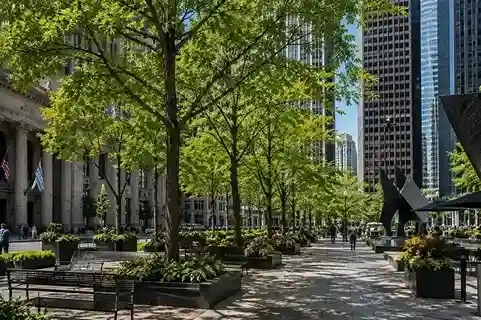
From honey locusts wedged into narrow sidewalk cutouts to large shade trees edging Grant Park, The Loop’s urban canopy faces conditions that demand a specialist. Windy City Tree Services works with building managers, retail owners, and facilities teams throughout the district.
Or email: info@windycitytreeservices.com
Property Types in The Loop
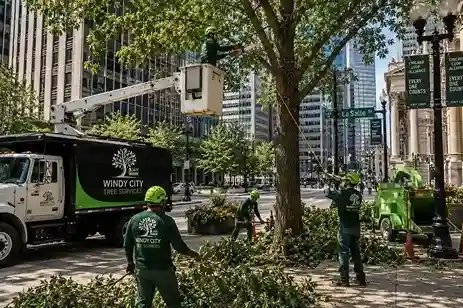
We work with the full range of Loop property ownership, from glass-and-steel office towers to government buildings to the growing residential conversion market.
Most Class A and B towers carry landscaped plazas maintained under facilities contracts. Retail storefronts along State Street and Randolph typically have narrow sidewalk cutouts requiring compact equipment. Government-owned buildings around City Hall coordinate with the City of Chicago’s Bureau of Forestry on parkway trees.
Services Available in The Loop
Every service below is available to residential, commercial, and civic properties throughout The Loop and its immediate borders.
Tree Trimming & Pruning
Structural pruning to keep canopies clear of facades, awnings, signage, and pedestrian sightlines.
Tree Removal
Removal of dead, failing, or hazardous trees from planters, plazas, and tight urban sites.
Emergency Tree Removal
24/7 response for storm-damaged limbs and fallen trees near building entrances and pedestrian paths.
Stump Grinding
Compact grinding equipment suited to narrow planter beds and tight access points in Loop plazas.
Tree Cabling & Bracing
Structural support for trees with weak branch unions or wind-stress damage in the Loop’s canyon corridors.
Commercial Tree Service
Recurring maintenance contracts for office towers, retail properties, and civic buildings.
Storm Prep
Cabling, pruning, and structural assessment before severe weather season to reduce storm damage risk.
Risk Assessments
Written tree risk assessments for insurance, liability, and property management records.
Need Tree Work in The Loop?
We carry the certificate of insurance building managers require and plan work around business hours, loading dock access, and sidewalk schedules.
Local Landmarks & Green Space
Key Landmarks
The Loop is home to Millennium Park’s northern edge, Grant Park, Daley Plaza, the Art Institute of Chicago, and Willis Tower. The Chicago Riverwalk runs along the northern boundary, and the theater district around Randolph Street draws heavy evening foot traffic past streetscape plantings that need to stay presentable year-round.
Parks & Green Space
Grant Park anchors the eastern edge with formal rows of shade trees, while Millennium Park’s northern section mixes ornamental and shade species in a heavily used public setting. Both require careful structural pruning to maintain clean sightlines for events and pedestrian movement — a different maintenance priority than a typical residential canopy.
Why Choose Windy City Tree Services in The Loop
COI-Ready
We carry general liability coverage and provide a certificate of insurance before scheduling any work — standard for most Loop building managers.
Business-Hours Scheduling
Crews plan around loading dock access, building schedules, and high-traffic periods so disruption to tenants and pedestrians stays minimal.
Compact Equipment
We bring the right gear for tight spaces — narrow planter beds, confined building entrances, and constrained sidewalk access points.
After-Hours Availability
Pruning and removal work can be scheduled during early morning or evening hours for busy commercial corridors where daytime access is difficult.
Complete Cleanup
We leave sidewalks and plazas clean before we go — important on some of the busiest pedestrian paths in the city.
Local Knowledge
We understand Loop permit requirements, the Bureau of Forestry’s process for parkway trees, and the species that actually survive in this environment.
Getting to The Loop
- From Millennium Park: Head west on Washington or Randolph to reach the Loop’s eastern side.
- From Union Station: Head east on Adams or Jackson into the heart of the district.
- From Willis Tower: Head northeast on Wacker Drive toward Wabash and Dearborn.
- From Lake Shore Drive: Exit west on Randolph, Washington, or Monroe directly into The Loop.
- From I-90/I-94: Exit toward downtown and continue east into The Loop’s western edge.
Nearby Neighborhoods We Also Serve
If your property sits just outside The Loop, one of these pages may be a closer match:
Frequently Asked Questions — Tree Service in The Loop
Who maintains the trees in plaza planters along LaSalle Street?
Plaza planters are typically maintained under the building’s own facilities or landscaping contract, separate from the parkway trees the city maintains along the sidewalk. If you’re unsure which category your trees fall under, we can help sort that out before quoting any work.
Do I need a city permit to remove a tree in The Loop?
Trees on private property or in building planters generally don’t require a city permit. Parkway trees between the sidewalk and the street are city-owned and go through the Chicago Bureau of Forestry, which has its own process and timeline.
Can you work without closing a sidewalk?
In many cases, yes. We use rigging and rope-lowering techniques that avoid a full sidewalk closure, though larger jobs near high foot traffic may require brief, coordinated access with advance planning.
Do you offer after-hours tree work to avoid disrupting business traffic?
Yes. We can schedule pruning and removal during early morning or evening hours for busy commercial corridors where daytime work would impact tenants, retail customers, or pedestrian flow.
What’s the biggest tree health issue in The Loop?
Soil compaction and salt exposure are the two most common problems, both driven by the extremely high foot traffic and the heavy winter salting that runs off directly into tree pits throughout the district.
Do you carry the insurance building managers require?
Yes. We carry general liability coverage and can provide a certificate of insurance to building management before scheduling any work, which is standard for most Loop properties.
Can trees really survive in small sidewalk cutouts?
Yes, with the right species and consistent soil care. Honey locust and Kentucky coffeetree are both selected specifically for this kind of constrained planting environment. The key is species choice up front and regular soil aeration after planting.
Do you handle storm damage on Grant Park-adjacent properties?
Yes. We respond to storm damage on private property bordering Grant Park and coordinate with the Chicago Park District when public trees are involved in the same incident.
How often should Loop street trees be pruned?
Most benefit from structural pruning every two to three years. Trees near building entrances, awnings, or signage may need attention more frequently to stay clear of facades and maintain good sight lines.
Do you work with property management companies on recurring contracts?
Yes. We set up scheduled inspection and maintenance visits for office towers and retail properties throughout The Loop, with documentation provided after each service visit.
What causes the sticky residue under linden trees in the Loop?
That’s aphid honeydew — a common issue with linden trees during warm months when aphid populations peak. It can be managed with monitoring and, when needed, targeted treatment that doesn’t harm surrounding plantings.
Is emergency response available for a leaning tree near a building entrance?
Yes. We prioritize hazards near entrances and pedestrian paths and aim for same-day response to any situation that poses a risk to people on the ground.
Do you remove stumps in tight plaza planters?
Yes. We use compact grinding equipment suited to narrow planter beds and confined access points — standard for Loop work where a full-size stump grinder often won’t fit.
What’s the best time of year for pruning in The Loop?
Late winter into early spring while trees are dormant is ideal for most structural pruning. Hazard and storm work happens year-round regardless of season.
Do you provide written risk assessments for insurance purposes?
Yes. We provide documented tree risk assessments that property managers can use for insurance records, liability review, or due diligence before a property transaction.
Request a Free Estimate in The Loop
Call or email us to schedule an estimate anywhere in The Loop. Browse our full Chicago tree service offering, explore the Downtown Chicago hub, or view all neighborhoods we serve.