How Certified Arborists Diagnose Tree Problems | Chicago
How Certified Arborists Diagnose Tree Problems
Learn how professional tree inspections identify hidden problems before they become costly or dangerous.
By the time a tree in your yard looks sick, it’s usually been struggling for a while. Leaves don’t turn yellow overnight, and a trunk doesn’t crack in a single afternoon. That’s the uncomfortable truth about tree health — the symptoms you can see are almost always the last part of the story, not the first.
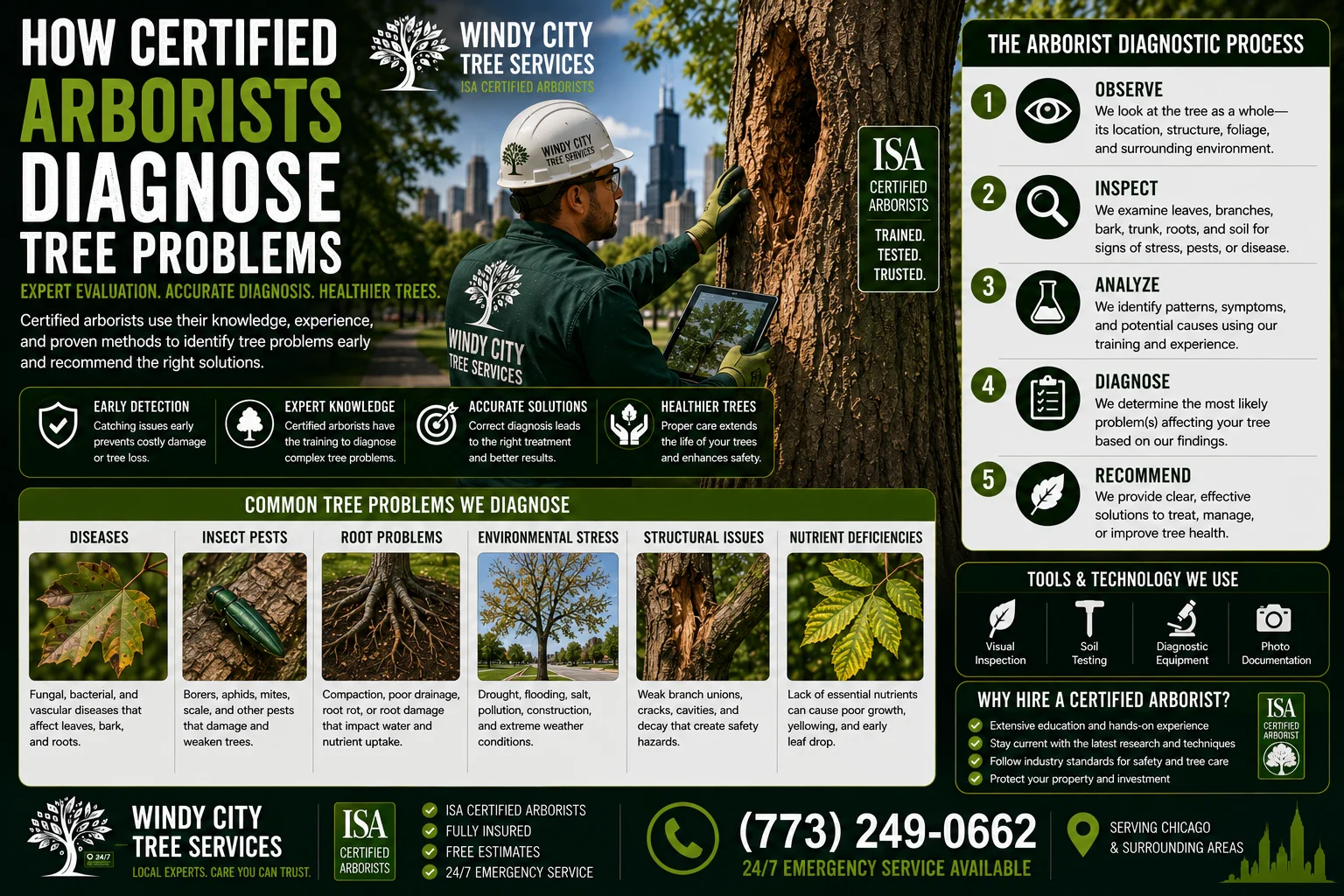
This is where professional diagnosis earns its keep. A Chicago tree service doesn’t glance at a tree and guess. ISA Certified Arborists work through a structured process: canopy, trunk, root zone, soil, and site conditions, each checked against the others before a diagnosis is made. One symptom rarely tells you what’s actually wrong. Five symptoms, read together, usually do.
In this guide, you’ll learn exactly how certified arborists inspect trees — what they look for, which tools they use, how they diagnose specific diseases and pests common in Illinois, and how Tree Risk Assessment factors into a recommendation. You’ll also learn how often trees should be inspected and which warning signs mean you shouldn’t wait for a scheduled visit.
What Does a Certified Arborist Do?
A certified arborist is a tree care professional trained in tree biology, soil science, pest and disease identification, and structural risk. That training is what separates diagnosis from guesswork.
The credential that matters most is ISA Certification from the International Society of Arboriculture. To earn it, a candidate needs documented field experience and has to pass a rigorous exam covering tree physiology, soil management, diagnosis, pruning standards, and risk assessment. Certification doesn’t end at the exam — ISA Certified Arborists must complete continuing education credits to keep their credential active, which keeps their knowledge current as new pests, diseases, and treatment methods emerge.
There’s a real difference between a tree service worker and a certified arborist. A tree service crew can cut down a tree or trim a branch competently. A certified arborist can tell you why that branch is dying, whether the rest of the tree is at risk, and whether removal is even the right call. Diagnosis requires biological knowledge that cutting doesn’t.
Why Professional Tree Diagnosis Matters
Here’s the pattern arborists see constantly: a homeowner notices a few yellow leaves in July, decides to “wait and see,” and by the following spring the tree is beyond saving. Early diagnosis changes that outcome more often than people expect.
- Early disease detection catches problems like oak wilt or root rot while treatment options still exist.
- Preventive care costs a fraction of an emergency removal — and nowhere near the cost of storm damage to a house.
- Tree preservation protects mature trees that took decades to grow and can’t be replaced overnight.
- Property safety — undiagnosed structural defects are exactly what causes limb or whole-tree failure during storms.
- Insurance considerations — some carriers now request inspection documentation for large trees near structures.
Step 1: Interview & Site History
Diagnosis starts with questions, not equipment. An arborist gathers site history because trees carry the effects of past events for years — sometimes decades.
Typical questions cover tree age, construction history, storm damage, irrigation patterns, previous pruning, fertilization history, pest history, and recent soil changes like new mulch or grading. A tree that started declining two years after a driveway was poured is telling a different story than one that started declining after a wet spring. Site history narrows the list of likely causes before the arborist even looks up at the canopy.
Step 2: Canopy Inspection
The canopy is usually the first thing anyone notices, and it’s genuinely a useful diagnostic starting point — as long as it’s read carefully rather than glanced at. Arborists evaluate leaf color, leaf size, canopy density, dead branch location, epicormic growth (stress-response shoots along the trunk), crown dieback, and overall structural balance.
A tree with dieback concentrated at the top of the crown is telling a different story than one with dead branches scattered randomly through the canopy. The first pattern often points to root or vascular problems; the second more often points to localized injury, pest activity, or disease entry points.
Step 3: Trunk & Bark Inspection
The trunk is where a lot of structural problems become visible — if you know what you’re looking at. Arborists check for cracks (especially vertical cracks that run with the grain), cavities, included bark, decay, fungal growth, sap flow or bleeding cankers, mechanical injuries, and insect exit holes.
Step 4: Root Zone Inspection
Root problems are some of the hardest to diagnose because most of the root system is invisible. Key checks include root flare visibility, surface roots, soil compaction, root girdling, root collar disorders, drainage, and mulch depth. Mulch piled against the trunk (a “mulch volcano”) traps moisture and invites decay.
One of the most useful non-destructive techniques here is Air Spade root collar excavation. An Air Spade uses compressed air to blow soil away from the root flare without cutting or damaging roots — something a shovel can’t do safely. For urban trees in Chicago, where grading changes and heavy mulching are common, this step catches problems that would otherwise stay hidden until the tree started failing.
Step 5: Tree Risk Assessment
Not every defect means a tree needs to come down. Risk assessment is what separates “this tree has a problem” from “this tree is dangerous.” A formal Tree Risk Assessment weighs targets (what’s nearby that could be damaged), likelihood of failure, consequences, and structural defects together, then points to a mitigation option — sometimes removal, but often cabling, pruning, or ongoing monitoring instead.
Arborists trained in ISA’s Tree Risk Assessment Qualification (TRAQ) methodology use a standardized framework to rate risk consistently, rather than relying on gut instinct. A large tree with a significant defect but no nearby target might rate as low risk. A smaller tree with a moderate defect directly over a bedroom window might rate as high risk. Context changes the recommendation every time.
Diagnostic Tools Arborists Use
Equipment matters because some problems simply aren’t visible to the naked eye. Tool selection depends on what the arborist is trying to confirm.
| Tool | What It Reveals |
|---|---|
| Air Spade | Root flare condition, girdling roots, root collar decay — without cutting roots |
| Soil probes | Compaction levels, drainage, soil composition |
| Increment borer (when appropriate) | Growth rings and limited internal wood sampling |
| Resistance drilling | Internal decay location and extent without major wounding |
| Rubber mallet sounding | Hollow versus solid wood, based on sound response |
| Measuring equipment | Trunk diameter, lean angle, canopy spread for risk calculations |
| Laboratory testing | Confirms specific pathogens from tissue samples |
| Drone inspection (where appropriate) | Upper canopy condition on very tall or hard-to-access trees |
Diagnosing Common Tree Problems
Illinois trees face a fairly predictable set of threats, and each one leaves a distinct diagnostic signature.
Oak Wilt spreads through root grafts between neighboring oaks and via sap beetles, causing rapid leaf browning starting at the outer canopy edge — sometimes within weeks. Red oaks can die within a single season.
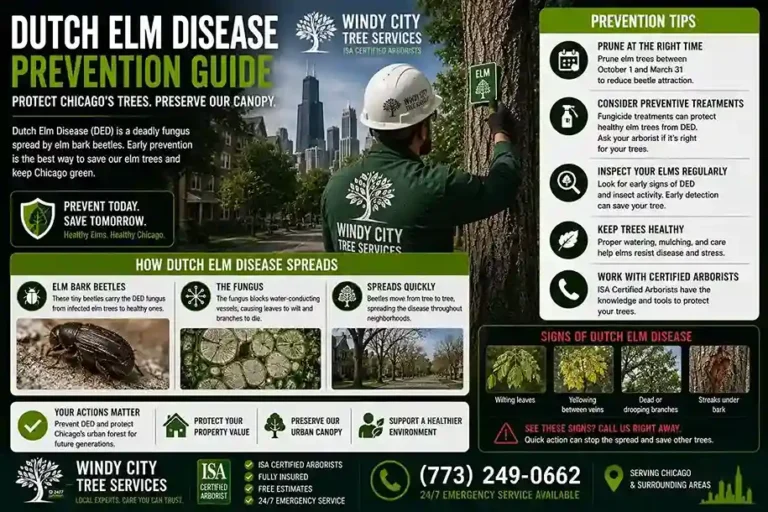
Dutch Elm Disease is a fungal disease spread by elm bark beetles, causing wilting and yellowing that typically starts in one section of the canopy (“flagging”) before spreading.
Root rot is diagnosed through canopy thinning, soil moisture testing, and root excavation, often confirmed with lab testing. Chronic overwatering or poor drainage is a common contributing factor.
Emerald Ash Borer has devastated ash populations across the Chicago area. Diagnosis relies on D-shaped exit holes, top-down canopy dieback, bark splitting, and woodpecker activity.
Anthracnose causes irregular brown blotches on leaves, usually worse in cool, wet spring weather. Rarely fatal alone, but weakening over repeated seasons.
Bacterial leaf scorch mimics drought stress but persists even with adequate watering — a key clue that separates it from simple dehydration.
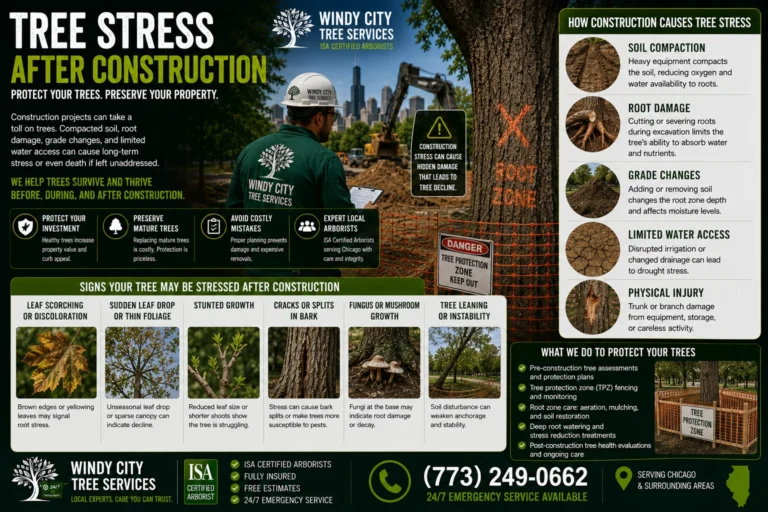
Construction damage shows up as canopy decline one to three years after nearby digging, grading, or heavy equipment use compacted the root zone.
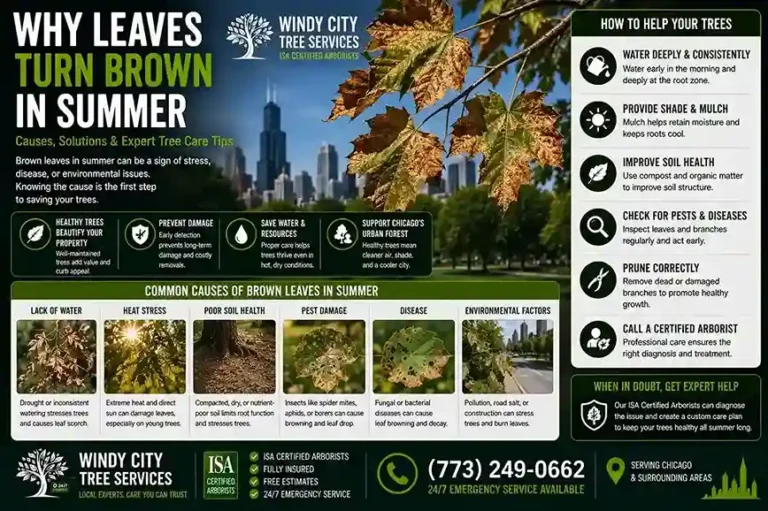
Drought stress causes leaf scorch, early leaf drop, and wilting, typically uniform across the canopy rather than isolated to one side.
Treatment Recommendations
Diagnosis only matters if it leads somewhere. Treatment is always matched to the specific findings, not applied generically.
An ISA Certified Arborist’s job is to preserve trees when it’s safe and reasonable to do so. Removal is a last resort, not a default recommendation.
How Often Should Trees Be Inspected?
- Annual inspections are a reasonable baseline for most residential trees, especially anything over 20 feet near a structure.
- Mature trees benefit from more frequent checks since internal decay progresses slowly and silently.
- Historic or high-value trees often justify more detailed assessments given what’s lost if they fail.
- Commercial properties typically need documented inspections for liability and insurance purposes.
- Post-storm inspections should happen after any significant wind or ice event.
Signs You Should Call an Arborist Immediately
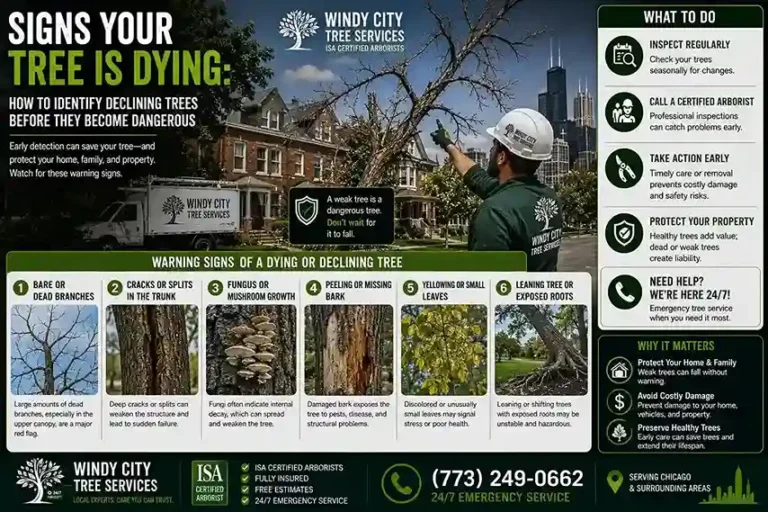
- A tree that’s leaning more than it used to, especially after wind or rain
- New or widening cracks in the trunk or major limbs
- Dead limbs hanging in the canopy (“widowmakers”)
- Mushrooms or fungal growth at the base of the trunk
- Sudden leaf loss outside normal fall drop
- Visible storm damage — split limbs, exposed wood, torn bark
- Root exposure from erosion or a leaning trunk lifting the root plate
- A hollow-sounding trunk when tapped
Catch Tree Problems Before They Become Expensive
Routine inspections help identify hidden issues early, protect your property, and extend the life of valuable trees.
DIY Inspection vs. Certified Arborist Inspection
| Homeowner Inspection | Certified Arborist Inspection |
|---|---|
| Visual observations from ground level | Comprehensive canopy-to-root diagnosis |
| General knowledge | ISA-certified, continuing-education-backed expertise |
| Basic safety checks | Formal Tree Risk Assessment (TRAQ methodology) |
| No specialized tools | Air Spade, resistance drills, sounding equipment, lab testing |
| “It looks fine” / “it looks bad” | Customized, evidence-based treatment plan |
Tree Symptoms & Possible Causes
| Symptom | Possible Causes |
|---|---|
| Yellow leaves | Nutrient deficiency, root stress, overwatering, early disease |
| Brown leaves | Drought stress, bacterial leaf scorch, fungal disease |
| Dead branches | Localized injury, pest boring damage, root zone stress |
| Mushrooms at base | Root or root collar decay |
| Leaning tree | Root plate failure, soil erosion, storm damage |
| Cracked trunk | Included bark, internal decay, mechanical injury |
| Sparse canopy | Root stress, construction damage, chronic drought, disease |
Homeowner Tree Health Inspection Checklist
- Inspect canopy for color, density, and dieback
- Check bark for cracks, cavities, or fungal growth
- Examine root flare — is it visible or buried under mulch?
- Watch for mushrooms at the base of the trunk
- Monitor leaf color changes through the season
- Check the tree after any significant storm
- Photograph changes over time for comparison
- Schedule an annual professional inspection
- Contact an ISA Certified Arborist if symptoms worsen
Frequently Asked Questions
An ISA Certified Arborist inspects the canopy, trunk, bark, root flare, and surrounding soil conditions, evaluating structural defects, pest activity, disease signs, and site history together.
A standard residential inspection typically takes 30–60 minutes. Complex cases involving root excavation or resistance drilling can take longer.
Yes. Certified arborists identify most common tree diseases through visual symptoms and diagnostic testing, and can send tissue samples to a lab for confirmation.
Common tools include Air Spades, soil probes, sounding mallets, resistance drills, and measuring equipment. Tool choice depends on what the arborist needs to confirm.
A structured evaluation of a tree’s likelihood of failure and the potential consequences, used to guide pruning, mitigation, or removal decisions.
A tool that uses compressed air to remove soil from around roots without damaging them, allowing safe inspection of the root flare and root collar.
Yes, in most cases — by evaluating canopy dieback percentage, trunk and root condition, and disease signs together.
Yes. Many serious problems, like internal decay or root rot, aren’t visible until they’re advanced.
Most residential trees benefit from an annual inspection, plus checks after major storms or if warning signs appear.
When risk can’t be reasonably mitigated — for example, extensive internal decay combined with a nearby target like a house.
Yes. Certified arborists have documented training in tree biology, diagnosis, and risk assessment, and must maintain continuing education.
Nutrient deficiency, root stress, overwatering, underwatering, or early disease — which is why arborists evaluate the whole tree, not just the leaves.
Often, yes, if caught early. Air Spade excavation to correct girdling roots or improve drainage can allow recovery over one to several seasons.
Small shoots sprouting along the trunk or main limbs — usually a stress response following major pruning, root damage, or canopy loss.
Not necessarily, but fungal conks almost always indicate internal decay that should be evaluated.
Costs vary by tree size, number of trees, and testing needed. Contact Windy City Tree Services for a free estimate.
When two limbs grow too closely together, bark gets trapped in the joint, creating a structurally weak union prone to splitting.
Yes. Symptoms often don’t appear until one to three years after nearby digging, grading, or trenching reduced root capacity.
Some natural shedding is normal, especially in older trees. Frequent, large, or sudden branch drop is not, and warrants inspection.
Some carriers request documentation for large trees near structures. Check with your insurer, and consider a proactive inspection either way.
Key Takeaways
- Tree diagnosis is a process — arborists evaluate canopy, trunk, roots, and site history together, not one symptom in isolation.
- ISA Certification represents documented training and ongoing continuing education.
- Non-destructive tools like the Air Spade let arborists inspect roots without damaging the tree.
- Tree Risk Assessment weighs both likelihood of failure and consequences — not just the presence of a defect.
- Illinois trees face predictable threats: oak wilt, Dutch elm disease, emerald ash borer, root rot, and construction stress.
- Annual inspections plus post-storm checks catch most problems while treatment options are still on the table.