
Professional Air Spade Services in Chicago
Non-Destructive Root Excavation for Healthier Trees
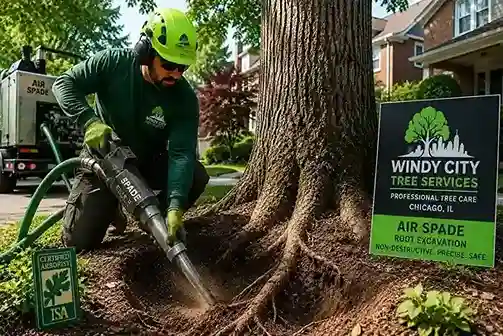
An Air Spade uses high-velocity compressed air to break apart compacted soil without cutting or bruising tree roots. That means our certified arborists can see exactly what’s happening below ground — buried root flares, girdling roots, compacted soil — and treat the real problem instead of guessing from the surface.
What Air Spade Technology Does for Your Trees
An Air Spade is a handheld tool that fires compressed air through a narrow nozzle to loosen and remove soil around tree roots without cutting them. Arborists use it to inspect root health, fix compacted soil, and correct problems hidden underground.
Most tree problems that show up above ground actually start below it. A thinning canopy, slow growth, or yellowing leaves are often symptoms of something happening at the root collar — the point where the trunk meets the roots. The trouble is, you can’t diagnose a buried root flare or a girdling root by looking at a tree from your porch.
Traditional digging solves that problem the wrong way. A shovel or excavator cuts straight through fine feeder roots, and even careful hand-digging tears root hairs that take a tree years to regrow. Air Spade excavation moves soil with air pressure instead of a blade, so roots, irrigation lines, and even underground utility cables stay intact while we work.
That’s why arborists who follow ANSI A300 tree care standards reach for an Air Spade whenever a diagnosis or treatment plan calls for digging near a tree’s root zone. It’s faster than hand excavation, safer than mechanical digging, and it gives us a clear, unobstructed view of root structure — the kind of detail that makes the difference between guessing and knowing.
For mature trees, historic specimens, or any tree you’d hate to lose, that precision matters. Air Spade work preserves root systems that took decades to develop, which is exactly the kind of tree preservation Chicago’s older neighborhoods need most.
What Is an Air Spade?
An Air Spade is a pneumatic excavation tool powered by an air compressor. It directs a focused stream of compressed air at speeds fast enough to break apart soil particles while leaving roots, cables, and pipes undisturbed.
Here’s how it works in practice. The tool connects to a gas-powered air compressor capable of producing several hundred cubic feet of air per minute. When the trigger is pulled, that air exits the nozzle at supersonic speed and physically knocks soil loose, almost like a controlled, focused gust of wind aimed at the ground.
Soil breaks apart and falls away. Roots don’t. Wood is far denser and more flexible than compacted soil, so the air stream simply flows around roots instead of damaging them. This is the central reason arborists prefer it over a shovel: a shovel can’t tell the difference between dirt and a root, but air pressure naturally does.
Air Spade Excavation vs. Mechanical Digging
| Factor | Air Spade Excavation | Mechanical / Hand Digging |
|---|---|---|
| Root damage | None — roots are left intact | Common, even with careful hand digging |
| Utility safety | Air flows around buried lines | Higher risk of striking cables or pipes |
| Soil compaction | Loosens compacted soil as it works | Can increase compaction around the dig site |
| Diagnostic clarity | Full root structure visible | Partial view; roots often obscured by torn soil |
| Site disruption | Minimal — soil can be reused | Greater disturbance to surrounding landscape |
Air Spade excavation is also the standard method recommended before utility installation or construction work near established trees, since it protects both the tree’s root system and any buried infrastructure already in the ground.
When Should You Use Air Spade Services?
Air Spade services make sense whenever a tree shows signs of decline, before digging near roots for construction, or when you need an accurate root health diagnosis without risking root damage.
Several warning signs point toward an Air Spade inspection. If your tree checks more than one of these boxes, it’s worth a closer look:
- Soil compaction from foot traffic, vehicles, or construction equipment
- Poor or stalled tree growth with no obvious cause
- A root collar that appears buried too deep, often from over-mulching or grade changes
- Suspected girdling roots wrapping around the trunk base
- Planned construction or excavation near a tree’s root zone
- A formal root inspection requested before a real estate sale or insurance review
- Drainage problems causing standing water near the root flare
- Upcoming utility installation that will cross through root territory
- Foundation work near a tree you want to keep
- Declining tree health with thinning canopy or early leaf drop
- Root flare excavation to correct improper planting depth
- Landscape renovations involving new hardscape near existing trees
If you’re planning a patio, driveway expansion, or any land clearing work close to a valuable tree, scheduling an Air Spade inspection first can save the tree — and save you from costly mistakes once digging starts.
Our Air Spade Services
Windy City Tree Services builds every Air Spade visit around your tree’s specific situation, not a one-size-fits-all checklist.
Root Collar Excavation
Exposing the root collar to check depth, decay, and overall structural health.
Root Flare Exposure
Correcting buried root flares caused by mulch buildup or improper planting.
Soil Decompaction
Loosening compacted soil so roots get the oxygen and water they need.
Root Zone Inspection
A full visual assessment of the root system without cutting a single root.
Girdling Root Identification
Locating roots that wrap around the trunk and choke its growth over time.
Utility-Safe Excavation
Digging near power, gas, water, and irrigation lines without damage risk.
Tree Preservation During Construction
Protecting root zones while nearby construction or grading takes place.
Root Health Evaluation
Arborist assessment of root decay, injury, and overall vitality.
Arborist Consultations
Straightforward, science-based advice on what your tree actually needs.
Soil Improvement Recommendations
Practical next steps for aeration, mulching, and long-term root care.
Our Air Spade Process
Every Air Spade visit follows the same structured approach, whether it’s a single backyard tree or a commercial property with dozens of trees in the root zone.
Initial Consultation
We talk through your concerns and the tree’s history.
Tree Health Evaluation
A certified arborist assesses canopy, bark, and growth patterns.
Site Inspection
We check for underground utilities and plan a safe excavation zone.
Air Spade Excavation
Compressed air carefully exposes the root system without damage.
Root Inspection
We examine roots for decay, girdling, and structural problems.
Recommendations
You get a clear, honest plan based on what we actually found.
Restoration & Follow-Up
Soil is restored and we check progress at an agreed follow-up.
Protect Your Trees Below Ground
Healthy roots create healthy trees. Schedule an Air Spade inspection today and find out what’s really happening underneath your soil.
Benefits of Air Spade Technology
Air Spade excavation improves oxygen flow, water penetration, and root health while leaving roots physically undamaged, which leads to more accurate diagnosis and faster tree recovery compared to mechanical digging.
- No root cutting during excavation
- Improved oxygen flow to compacted root zones
- Better water penetration through loosened soil
- Reduced soil compaction around the root system
- Healthier root systems over the long term
- More accurate diagnosis of underground problems
- Preservation of mature and historic trees
- Faster recovery compared to traditional digging
- Less disruption to surrounding landscaping
- Safer excavation near utilities and hardscape
Results vary by tree species, age, and the severity of the underlying problem. We won’t promise a struggling tree will fully recover, but exposing the real issue is always the first step toward an honest treatment plan.
Common Tree Problems We Diagnose
An Air Spade inspection often reveals issues that were invisible from above ground. Some of the most common problems we find include:
Girdling Roots
Roots that circle the trunk and slowly choke the tree’s vascular system.
Root Rot
Decay caused by excess moisture, poor drainage, or fungal infection.
Buried Root Flare
A root collar covered by soil or mulch, trapping moisture against the bark.
Soil Compaction
Dense, oxygen-poor soil that restricts root expansion and water flow.
Construction Damage
Root injury from grading, trenching, or heavy equipment nearby.
Nutrient Deficiencies
Poor nutrient uptake linked to root damage or compacted soil.
Drainage Issues
Standing water near the root flare that promotes decay.
Root Decay
Structural weakening that can affect long-term tree stability.
Poor Root Development
Underdeveloped root systems, often from container-grown nursery stock.
Residential Air Spade Services
Homeowners across Chicago call us to protect valuable landscape trees, historic specimens, and newly planted trees that need a strong start. If you’re planning a patio renovation, expanding a driveway, or starting a utility project, an Air Spade inspection beforehand can keep your trees out of harm’s way.
We also use Air Spade excavation to protect home foundations from aggressive root growth, while still preserving the tree itself whenever possible. The goal is always tree preservation first — removal is a last resort, not a default answer.
Commercial Air Spade Services
Property managers, HOAs, municipalities, schools, parks, office campuses, industrial facilities, shopping centers, and healthcare facilities all rely on mature trees for shade, curb appeal, and property value. We work directly with landscape contractors and facilities teams to schedule Air Spade work around active operations, minimizing disruption to tenants, students, or patients.
For larger properties, we often pair Air Spade inspections with a broader tree health inspection across the entire site, giving property managers a clear picture of every tree that needs attention.
Why Choose Windy City Tree Services?
Experienced Arborists
Our team includes certified arborists trained in modern root care.
Specialized Air Spade Equipment
Professional-grade compressors and nozzles built for precision work.
Science-Based Tree Care
Recommendations grounded in ANSI A300 standards, not guesswork.
Honest Recommendations
We tell you what your tree actually needs, even if that’s nothing.
Modern Diagnostic Methods
Air Spade inspection paired with visual and structural assessment.
Residential & Commercial Experience
From backyard trees to multi-acre commercial campuses.
Local Chicago Expertise
We understand Chicago’s clay-heavy soil and urban forestry challenges.
Safety-First Approach
Utility-safe excavation on every job, every time.
Complete Tree Health Solutions
From root inspection to fertilization and cabling support.
Air Spade Service Area in Chicago
Windy City Tree Services proudly provides Air Spade services throughout Chicago and surrounding communities, working with homeowners, landscape contractors, and property managers near our base on West Carroll Avenue and across Cook County.
Serving Chicago ZIP codes including 60601, 60607, 60608, 60612, 60614, 60618, 60622, 60625, 60630, 60634, 60639, 60641, 60647, 60651, and surrounding communities.
Related Tree Care Services
Tree Health Inspection & Treatment
A full diagnostic look at canopy, bark, and overall tree condition.
Tree & Shrub Fertilization
Targeted nutrients to support recovery after root issues are corrected.
Tree Cabling & Bracing
Structural support for trees with weakened root or limb stability.
Tree Trimming & Pruning
Canopy maintenance that pairs well with below-ground root care.
Tree Removal
For trees that can’t be saved even after root assessment.
About Windy City Tree Services
Learn more about our certified arborists and local experience.
Frequently Asked Questions
What is an Air Spade?
An Air Spade is a pneumatic tool that uses compressed air to break apart and remove soil around tree roots without cutting or damaging them.
Does Air Spade excavation damage roots?
No. Compressed air loosens soil but flows around roots instead of cutting through them, which is the main advantage over shovels or excavators.
How deep can an Air Spade excavate?
Most root collar and root flare excavations reach 12 to 24 inches deep, though depth depends on the specific diagnostic or treatment goal.
When is Air Spade service recommended?
It’s recommended for declining tree health, suspected girdling roots, soil compaction, root inspections, or any digging planned near a tree’s root zone.
What are girdling roots?
Girdling roots grow in a circular pattern around the trunk instead of outward, eventually choking the tree’s vascular system as both grow larger.
Can Air Spade excavation improve tree health?
Yes, in many cases. Correcting buried root flares, decompacting soil, and removing girdling roots can support healthier long-term growth, though results vary by tree.
Is Air Spade excavation safe around utilities?
Yes. Compressed air moves around buried pipes and cables instead of cutting into them, making it significantly safer than mechanical digging near utility lines.
How long does an Air Spade service take?
A standard root collar excavation typically takes one to three hours, depending on tree size, soil conditions, and the scope of the inspection.
Is Air Spade excavation better than digging by hand?
For root-zone work, yes. Hand digging still risks tearing fine roots, while compressed air leaves the root structure fully intact for inspection or treatment.
Do you provide Air Spade services for commercial properties?
Yes. We work with property managers, HOAs, schools, parks, and commercial facilities throughout Chicago on root inspections and tree preservation projects.
Can Air Spade excavation help after construction damage?
Yes. It’s often used to assess and treat root compaction or injury caused by nearby grading, trenching, or heavy equipment.
Do you inspect root flare problems?
Yes. Root flare excavation is one of our most common Air Spade services, especially for trees with mulch or soil piled against the trunk.
What is a root collar?
The root collar, also called the root crown, is the transition zone where the trunk meets the main roots. It should be visible at soil level, not buried.
Will soil decompaction alone fix a struggling tree?
It can help significantly, but recovery also depends on the tree’s species, age, and overall health. We’ll give you an honest assessment, not a guarantee.
Do you offer free estimates for Air Spade services?
Yes. We provide free estimates for residential and commercial Air Spade projects throughout the Chicago area.
Can Air Spade excavation be used before installing a patio or driveway?
Yes. Inspecting the root zone first helps you plan hardscape placement that avoids major roots and protects the tree’s long-term health.
What happens after the Air Spade inspection is complete?
We backfill the excavated area, often with improved soil or mulch, and provide written recommendations along with a follow-up timeline if needed.
Is Air Spade excavation noisy?
The air compressor produces noticeable noise similar to other outdoor power equipment, though work sessions are typically a few hours, not an all-day disruption.
Healthy Roots Create Healthy Trees
Schedule an Air Spade inspection today and protect the trees that matter most to your property.