Common Tree Diseases in Illinois: Identity & Treatment Guide
Tree Health · Illinois Disease Guide
Common Tree Diseases in Illinois
Learn how to identify, prevent, and manage the most common tree diseases affecting Illinois landscapes.
Discolored leaves, thinning canopy, bark that isn’t quite right — the signs are often subtle, and several diseases can look nearly identical. Here’s how to tell them apart.
Introduction
Illinois trees face a real gauntlet of disease pressure: fungal pathogens that thrive in humid summers, bacteria that spread through insect vectors, environmental stress from drought and winter injury, and invasive pests that weaken trees enough to let disease take hold. Few landscapes go untouched over the life of a mature tree.
Early diagnosis is what separates a manageable problem from an expensive one. Catching oak wilt, verticillium wilt, or a canker disease in its early stages often preserves options that simply don’t exist once the infection has spread through the vascular system. Some diseases respond well to treatment. Others, once established, leave removal as the only responsible option, both for the tree and for its neighbors.
Routine inspection by an ISA Certified Arborist remains the best defense homeowners have. Many of these diseases produce overlapping symptoms, discolored leaves, thinning canopy, bark abnormalities, that are genuinely difficult to tell apart without training or, in some cases, laboratory testing.
This guide walks through the most common tree diseases affecting Illinois landscapes, how to recognize their symptoms, what treatment looks like when it’s possible, and when professional care or removal becomes the right call.
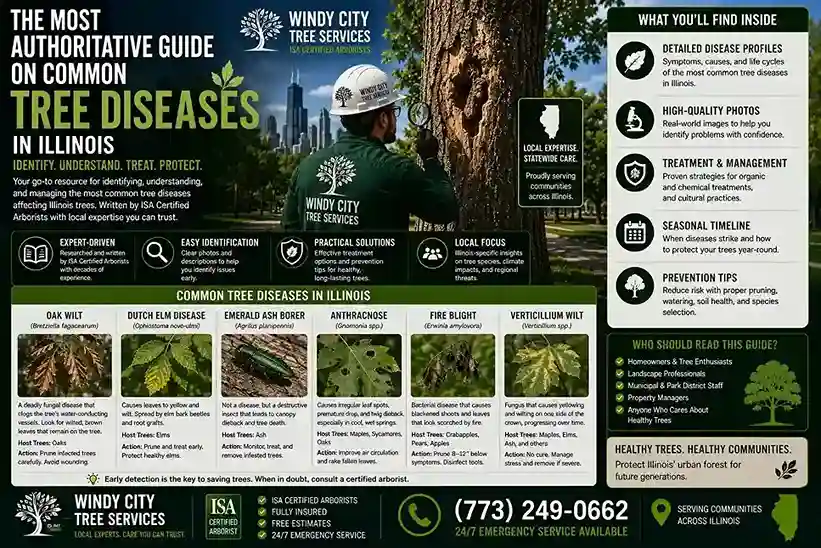
The most common tree diseases in Illinois include Oak Wilt, Dutch Elm Disease, Anthracnose, Apple Scab, Cedar Apple Rust, Verticillium Wilt, Bacterial Leaf Scorch, Root Rot, and various Canker Diseases. Because many of these produce similar symptoms, like leaf discoloration or branch dieback, accurate diagnosis by an ISA Certified Arborist is important before choosing a treatment or removal plan.
1. Why Tree Diseases Are Common in Illinois
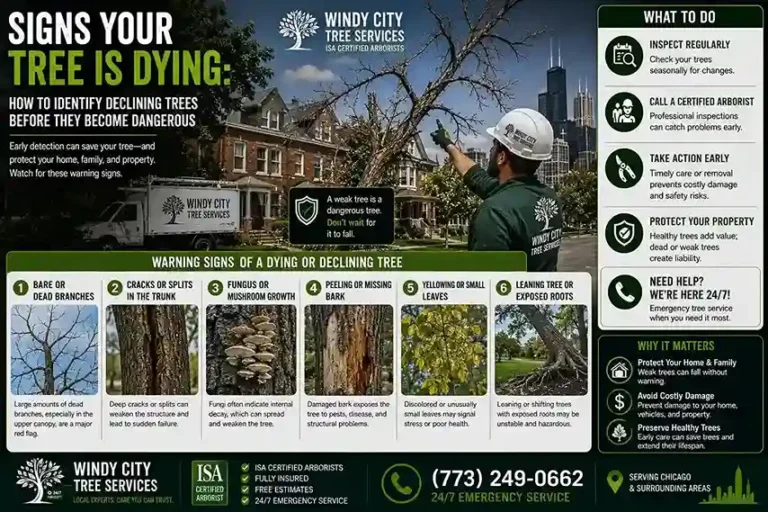
- Climate: Illinois’ humid continental climate creates favorable conditions for many fungal pathogens.
- Humidity: Warm, moist summers support fungal spore germination and spread.
- Heavy rainfall: Prolonged wet periods keep foliage damp longer, extending infection windows for leaf diseases.
- Drought stress: Weakened, water-stressed trees have less capacity to resist disease and pest pressure.
- Winter injury: Frost cracking and cold damage create entry points for pathogens.
- Urban stress: Compacted soil, limited root space, and pollution all reduce a tree’s overall resilience.
- Soil compaction: Restricts root oxygen and water uptake, weakening the tree’s natural defenses.
- Construction damage: Root and trunk injuries from nearby digging or grading create additional infection points.
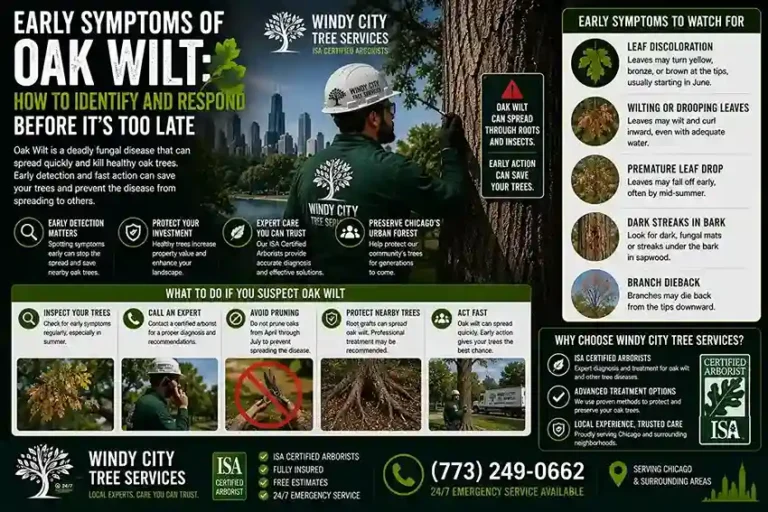
2. Oak Wilt
Oak Wilt
Rapid leaf browning and wilting starting at the leaf margin, often progressing from the top of the canopy downward. Affected leaves may drop while still partially green.
Spreads through root grafts between nearby oaks of the same species group, and through beetles attracted to fresh wounds during the growing season.
Red oak group species (including red and pin oak) are highly susceptible and often die within weeks of infection. White oak group species tend to decline more slowly.
Fungicide injections can offer some protection for high-value trees if applied before infection, though options narrow significantly once symptoms appear.
Avoid pruning oaks during the growing season, and sever root grafts between infected and healthy oaks when an outbreak is confirmed nearby.
For a closer look at spotting this disease early, see our guide on Early Symptoms of Oak Wilt.
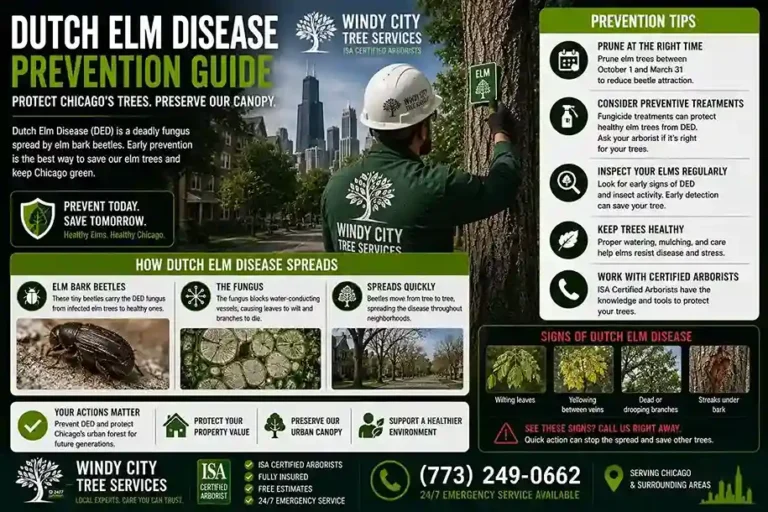
3. Dutch Elm Disease
Dutch Elm Disease
Yellowing and wilting of leaves on individual branches (“flagging”), often starting in the upper canopy and progressing downward through the growing season.
Elm bark beetles carry fungal spores from infected trees to healthy ones while feeding, particularly in twig crotches.
Elms with interconnected root systems can transmit the fungus directly between neighboring trees underground.
Prompt removal of dead or dying elm wood eliminates beetle breeding sites, and preventive fungicide injections can protect high-value specimens.
Early-stage infections in a single branch may respond to prompt pruning well below the visible symptoms; advanced infections are typically fatal.
Learn more in our dedicated guide to Dutch Elm Disease Prevention.
4. Anthracnose
Anthracnose
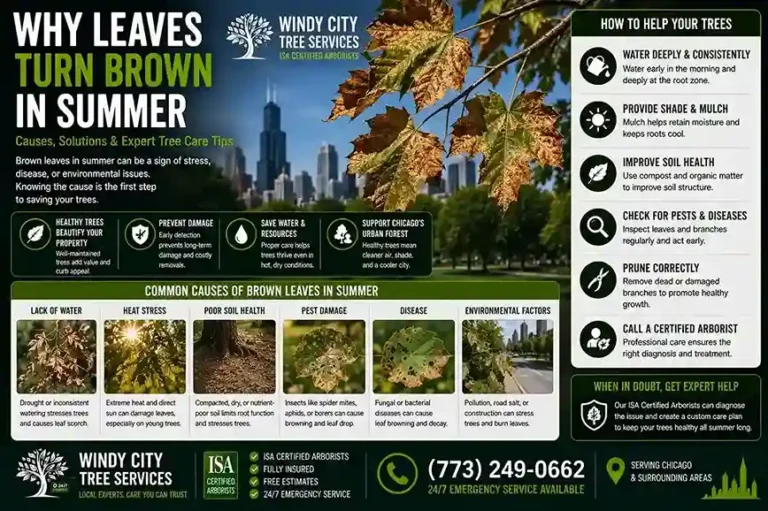
Irregular brown or tan blotches along leaf veins, sometimes causing distortion or curling.
In more severe cases, cankers can form on twigs and small branches, leading to localized dieback.
Cool, wet spring weather strongly favors infection, which is why symptoms tend to appear early in the growing season across Illinois.
Most established trees tolerate anthracnose without lasting harm. Removing fallen infected leaves and improving air circulation through pruning reduces recurrence.
5. Apple Scab
Apple Scab
Dark, olive-green to black spots on leaves, often with a velvety texture, along with distorted or scabbed fruit.
Heavily infected trees can lose significant foliage by mid-summer, weakening the tree over successive seasons.
Choosing scab-resistant crabapple cultivars, raking and removing fallen leaves each fall, and preventive fungicide applications in wet springs all reduce recurrence.
6. Cedar Apple Rust
Cedar Apple Rust
This fungus requires both a juniper (or eastern redcedar) and an apple-family tree to complete its life cycle, spreading between the two.
Distinctive bright orange-yellow spots appear on apple and crabapple leaves in mid-summer.
Produces gelatinous orange telial horns in spring, most visible after rain.
Separating susceptible junipers and apple-family trees where practical, along with resistant cultivar selection, reduces the disease cycle’s severity.
7. Verticillium Wilt
Verticillium Wilt
Lives in soil for years and enters trees through the root system, making it particularly difficult to eliminate once established.
Often appears as sudden wilting or dieback on one section or side of the canopy while the rest appears healthy.
Leaves may show marginal browning or curling before dropping prematurely.
Maples are particularly vulnerable, along with redbud, smoke tree, and several other common landscape species.
No fungicide cure exists. Supporting overall tree vigor through proper watering and fertilization can help some trees compartmentalize the infection and survive for years.
8. Bacterial Leaf Scorch
Bacterial Leaf Scorch
Leaf margins turn brown while the area closer to the vein stays green, often with a yellow band between the two zones.
Symptoms typically worsen through late summer as the bacteria clogs the tree’s water-conducting tissue.
This disease progresses gradually over several years rather than causing sudden collapse, often getting mistaken for ordinary drought stress in its early stages.
No cure currently exists. Supportive care, including proper watering and stress reduction, can extend a tree’s functional life by years, but decline is ultimately progressive.
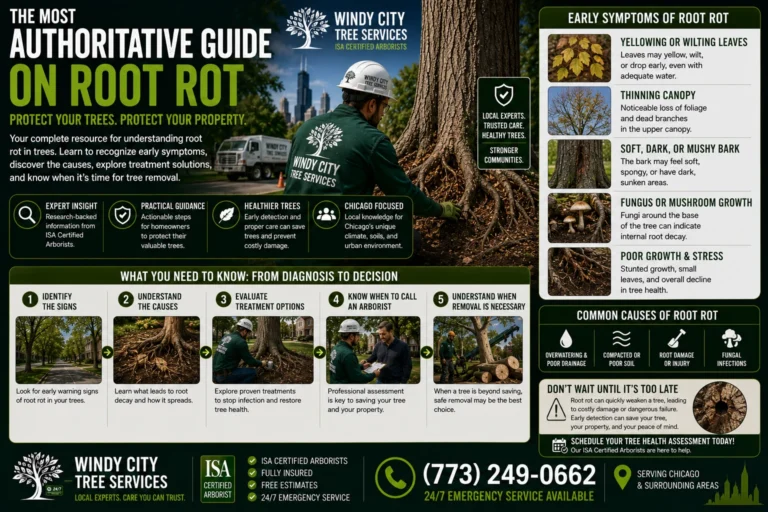
9. Root Rot Diseases
Root Rot Diseases
Consistently saturated soil creates ideal conditions for root rot pathogens to establish and spread.
Different species affect different trees, but most attack the root system directly, cutting off water and nutrient uptake.
Roots become soft, discolored, and structurally weak, often before any above-ground symptoms appear.
Advanced root rot significantly increases the risk of the tree uprooting or failing, even in relatively calm weather.
10. Canker Diseases
Canker Diseases
Cankers appear as sunken, discolored, or cracked areas on the bark, often oozing sap in some species.
The area beneath a canker is typically dead, interrupting the flow of water and nutrients past that point.
Limbs beyond a canker often decline and die as the canker girdles the branch over time.
Canker pathogens are largely opportunistic, taking hold most aggressively in trees already weakened by drought, injury, or poor site conditions.
11. Emerald Ash Borer vs. Tree Disease
Emerald Ash Borer (EAB) is an insect, not a disease, but it produces symptoms that homeowners frequently mistake for one, including canopy thinning, bark splitting, and dieback. The larvae tunnel beneath the bark of ash trees, cutting off the tree’s ability to move water and nutrients, which creates disease-like decline even though no pathogen is involved.
EAB has devastated ash populations across Illinois and much of the Midwest since its detection, and untreated infestations are typically fatal within a few years. For a full breakdown of identification and options, see Emerald Ash Borer in Chicago: What Homeowners Need to Know.
Disease vs. Insect Damage
| Characteristic | Tree Disease | Insect Damage |
|---|---|---|
| Cause | Fungal, bacterial, or viral pathogen | Feeding or tunneling by insects |
| Progression | Often gradual, though some diseases move quickly through the vascular system | Varies by species; can be gradual (scale) or rapid (borers) |
| Treatment | Fungicides, cultural practices, or removal depending on the disease | Insecticide treatment, trunk injections, or removal depending on infestation severity |
| Inspection | May require lab testing to confirm the specific pathogen | Often identifiable through exit holes, larvae, or visible insects |
12. Common Symptoms Homeowners Should Never Ignore
- Dead branches anywhere in an otherwise healthy-looking canopy
- Sparse canopy that’s noticeably thinner than in previous seasons
- Leaf discoloration, including unusual spotting, browning, or premature yellowing
- Bark cracks or unusual sunken areas
- Mushrooms growing at the base or on exposed roots
- Trunk cavities or soft, crumbling wood
- Leaning trees, especially a new or worsening lean
- Root damage, including exposed, cut, or decayed roots
Did You Know?
The Morton Arboretum and University of Illinois Extension both note that many tree disease symptoms overlap significantly, which is why homeowner self-diagnosis is often unreliable without professional inspection or, for some pathogens, laboratory testing.
13. How Arborists Diagnose Tree Diseases
- Visual inspection: Canopy, leaf, bark, and branch condition assessed in context.
- Tree history: Recent construction, weather events, or changes to the site that could explain symptoms.
- Soil evaluation: Compaction, drainage, and pH can point toward specific root-related diseases.
- Laboratory testing: Samples sent for pathogen identification when field diagnosis isn’t conclusive, particularly important for diseases like oak wilt and bacterial leaf scorch.
- Risk assessments: Evaluating how the specific disease affects structural safety, not just tree health.
- Monitoring: Tracking progression over subsequent visits to confirm diagnosis and treatment effectiveness.
14. Can Diseased Trees Be Saved?
Sometimes, and it depends heavily on the specific disease, how early it’s caught, and the tree’s overall health going in.
- Fungicides: Effective for some diseases, especially preventively or in early stages, but not a cure-all across the board.
- Cultural practices: Removing infected leaf litter, improving air circulation through pruning, and adjusting watering habits.
- Structural pruning: Removing infected limbs to slow the spread and reduce the load on a stressed tree.
- Fertilization: Supporting overall vigor so the tree can better compartmentalize an infection.
- Air Spade root care: Addressing root-zone compaction or damage that may be contributing to decline.
- Cabling: Providing structural support if disease has weakened specific branch unions.
- Monitoring: Ongoing assessment to track whether treatment is working or whether the disease continues to progress.
Treatment success varies significantly by disease, tree species, and how early intervention begins. No treatment can guarantee full recovery for every case, and some diseases currently have no effective cure once established.
15. Preventing Tree Diseases
- Schedule annual inspections to catch problems early.
- Follow proper pruning technique and timing, per ANSI A300 standards.
- Mulch around the root zone to support soil health and moisture retention.
- Water appropriately for species and season, avoiding both over- and under-watering.
- Improve soil conditions through aeration and testing where needed.
- Choose species diversity when planting new trees to limit disease spread across a property.
- Protect root zones from compaction and construction damage.
- Prepare trees for storm season, since stressed and storm-damaged trees are more susceptible to disease.
Seasonal Disease Watch Timeline
Spring
Anthracnose and apple scab symptoms typically emerge during cool, wet weather.
Summer
Oak wilt, verticillium wilt, and bacterial leaf scorch symptoms often become visible.
Fall
Cumulative dieback and canopy thinning from season-long stress becomes more apparent.
Winter
Dormant-season inspection reveals cankers, cavities, and structural issues without leaf cover.
Common Illinois Tree Diseases at a Glance
| Disease | Primary Host | Main Symptoms | Typical Management |
|---|---|---|---|
| Oak Wilt | Red and white oak groups | Rapid leaf browning, canopy wilt | Root graft severing, preventive fungicide injection |
| Dutch Elm Disease | Elm species | Branch flagging, yellowing leaves | Prompt pruning, sanitation, preventive injections |
| Anthracnose | Maple, oak, ash, sycamore | Leaf spotting, twig dieback | Leaf litter removal, improved air circulation |
| Apple Scab | Crabapple, apple | Dark leaf spots, premature drop | Resistant cultivars, sanitation, fungicide |
| Cedar Apple Rust | Juniper, apple/crabapple | Orange leaf spots, gelatinous galls | Host separation, resistant cultivars |
| Verticillium Wilt | Maple, redbud, and others | One-sided branch dieback, leaf scorch | Vigor support; no fungicide cure |
| Root Rot | Many species, especially in wet soil | Decay, structural instability | Drainage improvement; removal if advanced |
| Bacterial Leaf Scorch | Oak, elm, maple, sycamore | Marginal leaf browning, slow decline | Supportive care; no current cure |
Annual Tree Health Checklist
- Inspect leaves for spotting, discoloration, or premature drop.
- Check bark for cracks, cankers, or unusual texture.
- Look for mushrooms at the base or on exposed roots.
- Monitor canopy density compared to previous seasons.
- Watch for insect activity, including exit holes or visible pests.
- Check roots for exposure, damage, or decay.
- Schedule an annual professional inspection.
- Photograph changes over time to track progression.
- Contact an ISA Certified Arborist if anything looks uncertain.
Frequently Asked Questions
There isn’t a single most common disease across all species, but oak wilt, Dutch Elm Disease, and various canker and root rot diseases are among the most consequential in the region.
Look for discolored or spotted leaves, thinning canopy, unusual bark texture, cankers, or mushrooms at the base. Because symptoms overlap between diseases, a professional inspection is the most reliable path to an accurate diagnosis.
Sometimes, depending on the disease and how early it’s caught. Some diseases, like anthracnose, are usually manageable. Others, like advanced oak wilt or verticillium wilt, currently have no reliable cure.
Many are, through root grafts, insect vectors, wind-blown spores, or contaminated pruning tools. This is part of why prompt diagnosis and management matter, both for the affected tree and its neighbors.
An annual inspection is a reasonable baseline for most trees, with more frequent checks for high-value trees or those showing early symptoms.
Oak wilt is the most serious concern in Illinois, along with anthracnose, bacterial leaf scorch, and various canker diseases.
Dutch Elm Disease is the primary concern, spread by bark beetles and root grafts between neighboring elms.
Yes. Fungal pathogens cause several of the most serious tree diseases in Illinois, including oak wilt, Dutch Elm Disease, and root rot conditions, several of which can be fatal.
It depends on the disease, its progression, and the risk to nearby trees. Some diseased trees can be managed and preserved; others, particularly those with advanced decay or highly contagious infections, are safer removed.
As soon as you notice unusual leaf discoloration, dieback, cankers, mushrooms, or any other symptom that doesn’t resolve on its own within a season.
Yes, for diseases that spread through root grafts, insects, or wind-blown spores. Oak wilt and Dutch Elm Disease are two notable examples where this risk is significant.
It can, particularly if tools aren’t sanitized between cuts or trees, or if pruning happens during a pathogen’s active transmission window, as with oak wilt.
No, it’s an invasive insect. It causes disease-like symptoms, including canopy thinning and dieback, by tunneling under the bark and disrupting nutrient flow.
Yes, particularly for root-related diseases and nutrient deficiencies that can mimic or contribute to disease symptoms.
A wound is physical damage, while a canker is a localized area of dead tissue caused by a fungal or bacterial pathogen, often developing at or around a wound site.
No. Some, like mild anthracnose, are typically managed through sanitation and cultural practices alone. Fungicides are more commonly used for higher-risk or high-value tree situations.
It varies widely. Oak wilt can show symptoms within weeks of infection, while bacterial leaf scorch and verticillium wilt often progress gradually over multiple years.
Yes. Several diseases, including early-stage root rot and bacterial leaf scorch, can be present before obvious above-ground symptoms appear.
Planting a mix of species limits how far a single disease can spread across a property or neighborhood, reducing the risk of losing an entire canopy to one pathogen.
Key Takeaways
- Many Illinois tree diseases produce overlapping symptoms, so accurate diagnosis often requires professional inspection or lab testing.
- Oak wilt and Dutch Elm Disease spread between neighboring trees through root grafts and insect vectors, making prompt action important beyond just the affected tree.
- Some diseases, like anthracnose, are generally manageable; others, like verticillium wilt and bacterial leaf scorch, currently have no reliable cure.
- Emerald Ash Borer is an insect, not a disease, though it produces similar disease-like decline in ash trees.
- Annual inspections remain the single best defense against catching disease early enough to preserve treatment options.
- Supporting overall tree health through proper watering, mulching, and soil care improves a tree’s resilience against disease pressure generally.
Learn more from our Chicago Tree Service homepage and meet our Tree Health Experts, our ISA Certified Arborists. Related services include tree health inspections, tree removal, tree trimming & pruning, tree & shrub fertilization, air spade root excavation, tree cabling & bracing, emergency tree removal, and storm prep & support systems.