Why Over-Pruning Can Damage Healthy Trees
Why Over-Pruning Can Damage Healthy Trees
A lot of homeowners assume that removing more branches makes a tree safer. In reality, cutting away too much canopy at once often does the opposite. Trees rely on their leaves to produce energy and defend themselves, and excessive pruning can leave a healthy tree stressed, weakened, and vulnerable for years.
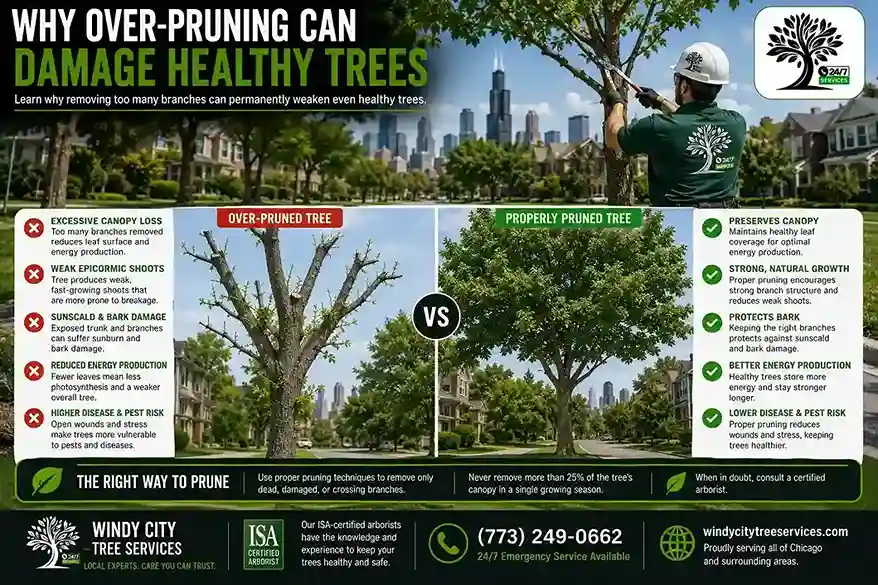
Over-pruning removes too much of a tree’s leaf canopy, reducing its ability to produce energy through photosynthesis. Excessive branch removal increases stress, encourages weak regrowth, exposes bark to sunscald, reduces structural stability, and makes trees more susceptible to pests, disease, and environmental damage. Proper pruning should be tailored to the species, age, and condition of each tree.
“More is better” is a tempting way to think about tree pruning. If a little trimming helps, more must help even more, right? Tree biology doesn’t work that way. A tree’s canopy isn’t just decoration, it’s the tree’s entire food production system, and removing too much of it at once can set off a chain of problems that take years to resolve.
This is one of the more common, and more damaging, mistakes homeowners and even some inexperienced tree crews make. It usually comes from good intentions: wanting a safer tree, a tidier yard, or fewer branches to worry about during storm season. But certified arborists follow specific standards precisely because excessive canopy removal creates more risk than it solves.
This guide explains the science behind over-pruning, walks through the warning signs your tree may already be showing, and covers what recovery actually looks like when the damage has already been done.
“A tree’s leaves aren’t just green decoration. They’re the factory that keeps the whole tree running. Cut too much of that away, and the tree has to survive on savings instead of income.” Windy City Tree Services Arborist Team
1. What Is Over-Pruning?
Over-pruning means removing more of a tree’s living canopy than it can comfortably lose in a single season, or making cuts that don’t follow accepted arboricultural technique. It’s not a single mistake but a category of related problems: cutting too much at once, cutting in the wrong place, or cutting at the wrong time of year.
Industry guidance from the International Society of Arboriculture generally recommends removing no more than about 25 percent of a tree’s living canopy in a single pruning session, and often far less for mature or already-stressed trees. This isn’t an arbitrary number. It reflects how much leaf loss a healthy tree can typically absorb without triggering a significant stress response.
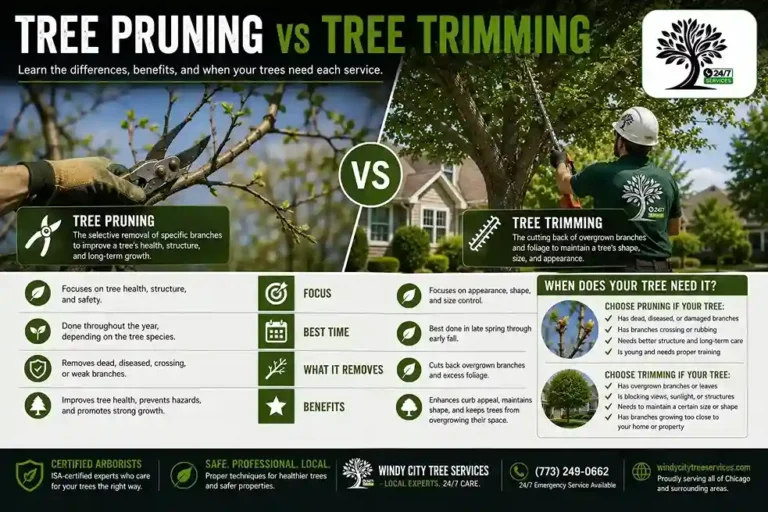
The difference between proper pruning and over-pruning usually comes down to restraint and technique. Proper pruning removes specific branches for a clear reason, dead wood, a weak union, a hazard, following ANSI A300 standards for cut placement. Over-pruning removes canopy indiscriminately, often chasing a “clean” or heavily reduced look that the tree’s biology simply isn’t built to handle well.
2. How Trees Produce Energy
Trees make their own food through photosynthesis, a process that happens almost entirely in the leaves. Chlorophyll in the leaf tissue captures sunlight and converts carbon dioxide and water into sugars the tree uses for growth, defense, and basic survival.
Those sugars don’t just get used immediately. Trees store a portion as carbohydrate reserves in their roots, trunk, and branches, essentially a savings account the tree draws on during dormancy, after stress events, or during periods when leaf area is temporarily reduced. Seasonal growth cycles depend on this stored energy: a tree taps its reserves to push out new leaves each spring, then rebuilds those reserves through the summer as the new canopy photosynthesizes.
💡 Did You Know?
A mature tree’s leaves are its only source of new energy. Roots and trunk wood can store energy, but they can’t produce it. Remove too much canopy, and the tree has to survive on stored reserves alone until it can regrow enough leaf area to catch up.
3. What Happens When Too Many Branches Are Removed?
When a tree loses a large portion of its canopy at once, its energy production drops sharply, right at the moment it needs energy most, to heal the new wounds. This creates an energy deficit the tree has to cover using stored carbohydrate reserves.
The immediate effects include reduced photosynthesis capacity, since there’s simply less leaf surface to capture sunlight. This triggers a measurable stress response throughout the tree, slower wound closure, reduced root growth, and in some cases visible dieback in the following season. Recovery is slow by nature, since the tree has to rebuild leaf area before it can rebuild its energy reserves, and poor growth, smaller leaves, shorter twig extension, thinner canopy, often persists for two to three years after a severe over-pruning event.
4. Stress Responses After Over-Pruning
Trees don’t just sit quietly and wait to recover. Severe canopy loss triggers a set of defensive responses that are easy to spot once you know what to look for.
- Water sprouts: Fast-growing, weakly attached vertical shoots that emerge from the trunk or major limbs as the tree tries to rebuild lost leaf area quickly.
- Epicormic shoots: Similar to water sprouts, these emerge from dormant buds beneath the bark in response to sudden light exposure and stress.
- Weak branch attachments: Regrowth after heavy pruning tends to attach more weakly to the parent branch than the tree’s original structure.
- Delayed growth: Overall shoot extension and leaf development often slow noticeably the season following severe pruning.
- Reduced vigor: The tree may show smaller leaves, shorter annual growth, and a generally less robust canopy for several years.
Water sprouts and epicormic growth are the tree’s emergency response system, but they come at a cost. This new growth is structurally weaker than normal branch development and often needs to be selectively removed later, adding another round of stress to a tree that’s already recovering.
5. Increased Risk of Disease and Decay
Every pruning cut creates a wound, and how well a tree seals that wound matters enormously. Trees don’t heal the way animals do; instead, they compartmentalize damage, sealing it off from the rest of the tree through a process arborists call CODIT, short for Compartmentalization of Decay in Trees.
Larger wounds, the kind created by removing large-diameter branches during over-pruning, are harder for a tree to compartmentalize effectively. Slower compartmentalization gives fungal decay organisms more time to establish themselves before the tree can wall off the damage. Multiple large wounds created in the same pruning session compound this risk, since the tree’s defensive resources get spread across several injury sites at once instead of concentrated on one.
The combination of larger wounds and reduced energy reserves also makes an over-pruned tree more attractive to opportunistic insect pests, which often target stressed trees over healthy ones. Internal wood decay that starts at an improperly sized or placed pruning wound can spread for years before it becomes visible from the outside.
6. Sunscald and Bark Damage
Bark that’s spent years shaded by a dense canopy isn’t built to handle direct sun exposure. When over-pruning suddenly exposes previously shaded bark and branches, that tissue can suffer real heat and UV damage, a condition arborists call sunscald.
Sunscald shows up as cracked, sunken, or discolored bark, usually on the south or southwest-facing side of the trunk and major limbs where sun exposure is most intense. The cambium layer just beneath the bark, the living tissue responsible for the tree’s growth, can be injured or killed by this sudden heat and light exposure, creating another entry point for decay organisms.
Chicago summers, with long stretches of intense sun and heat, make this a genuine local concern. A tree that had a full, shading canopy removed too aggressively can develop sunscald injuries within weeks, particularly on species with thin bark that isn’t adapted to direct exposure.
7. Structural Problems Caused by Over-Pruning
- Weak regrowth: Water sprouts and epicormic shoots attach poorly and are prone to breaking.
- Unbalanced canopy: Uneven removal can leave a tree lopsided, creating uneven wind load distribution.
- Heavy sucker growth: Dense clusters of new shoots create crowded, poorly structured regrowth that needs future correction.
- Limb failures: Weakly attached regrowth is significantly more likely to fail in wind or under snow and ice load.
- Future storm damage: An over-pruned tree often ends up more vulnerable to storm damage in the years following the pruning, not less.
⚠️ The Irony of Over-Pruning
Many homeowners over-prune specifically to reduce storm risk. In practice, the resulting weak regrowth often creates more storm vulnerability over the following several years than the original canopy did.
8. Over-Pruning vs Proper Crown Reduction
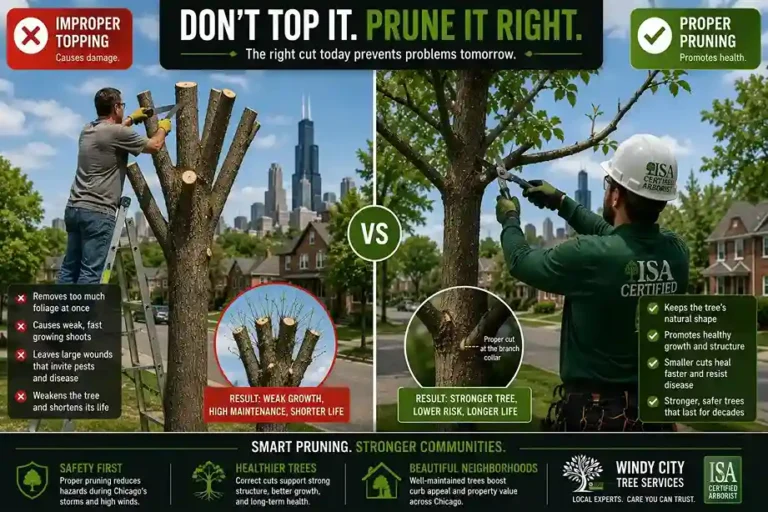
Proper crown reduction and over-pruning can look superficially similar right after the work is done, fewer branches, a smaller canopy, but the technique and long-term outcome are completely different.
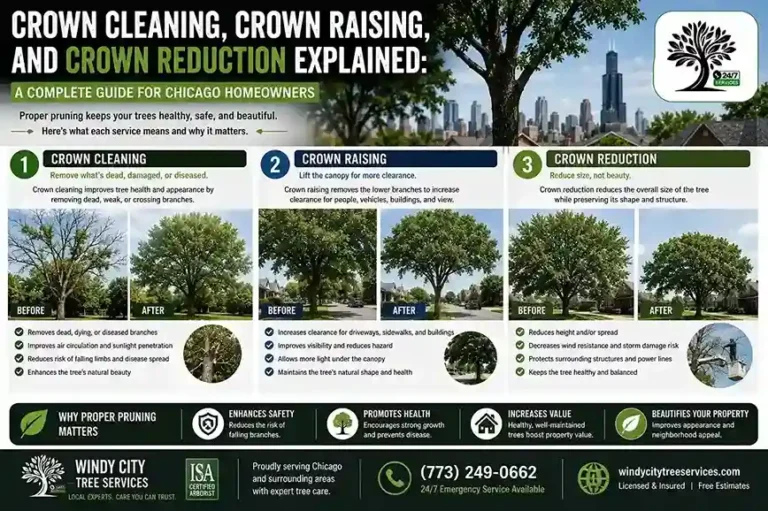
Proper crown reduction uses selective reduction cuts, removing branches back to a lateral branch large enough to sustain the remaining growth, which preserves the tree’s natural form and structural integrity. It’s planned around the specific tree’s biology, often spread across multiple visits for a tree that needs significant size reduction, rather than done all at once.
Topping, by contrast, cuts branches back to stubs or arbitrary points with no regard for branch structure. It’s the most common form of severe over-pruning and one of the most damaging things that can happen to a healthy tree, since it removes large amounts of canopy through improper cuts that trigger exactly the stress responses, weak regrowth, and decay risk described throughout this guide.
9. Which Trees Are Most Sensitive?
Species-specific response matters. Some trees tolerate aggressive pruning reasonably well; others suffer significant, sometimes irreversible damage from the same treatment.
High Sensitivity
Moderate
High Sensitivity
Moderate
Lower
Moderate
High Sensitivity
High Sensitivity
Lower
Moderate
Oaks are particularly sensitive both to the stress of over-pruning and to disease risk, since fresh wounds can attract the beetles that spread oak wilt. Birch trees tend to “bleed” sap heavily from pruning wounds and can struggle to recover from aggressive cuts. Conifers like pine and spruce generally don’t regenerate new growth from old wood the way broadleaf trees do, which means an overly aggressive reduction can leave permanent bare patches that never fill back in. Honey locust and sycamore tend to tolerate more aggressive pruning than most species, though “more tolerant” still doesn’t mean immune to over-pruning damage.
10. Chicago Weather Makes Over-Pruning Worse
Local climate conditions compound the biological stress of over-pruning. Strong winds, common throughout the Chicago area, put extra load on the weakly attached water sprouts and epicormic shoots that follow severe pruning. Ice storms and heavy snow add weight that this same weak regrowth isn’t built to handle.
Summer heat increases the risk of sunscald on newly exposed bark, while salt exposure from winter street treatment adds another layer of stress for trees already struggling to recover their energy reserves. Chicago’s urban heat island effect, where paved surfaces and buildings trap and radiate heat, intensifies both summer heat stress and the sunscald risk described earlier. Together, these factors mean an over-pruned tree in Chicago faces a rougher recovery path than the same tree might face in a milder, less urbanized climate.
11. Signs Your Tree Was Over-Pruned
- Sparse canopy: Noticeably thinner foliage than in previous years.
- Excessive suckers: Dense clusters of thin, vertical shoots along the trunk or major limbs.
- Dead branch tips: Dieback at the ends of branches, especially in the upper canopy.
- Sunburned bark: Cracked, discolored, or sunken bark on newly exposed limbs.
- Slow growth: Noticeably shorter twig extension compared to prior seasons.
- Leaf reduction: Smaller leaves than the tree typically produces.
- Weak limbs: New growth that flexes or breaks more easily than expected.
12. Can an Over-Pruned Tree Recover?
Often, yes, but recovery takes time and depends heavily on the tree’s species, age, overall health before the pruning event, and how severe the canopy loss was. A moderately over-pruned, otherwise healthy young tree might recover fully within two to three growing seasons. A mature tree that’s lost 50 percent or more of its canopy, especially a species with lower pruning tolerance, may take significantly longer, or may never fully return to its previous form.
- Proper watering: Consistent moisture supports the tree through its recovery period, especially during drought stress.
- Mulching: A proper mulch ring helps retain soil moisture and moderates root zone temperature.
- Fertilization: Deep root fertilization can support recovery when appropriate, though it should be guided by a professional assessment rather than applied blindly.
- Monitoring: Tracking canopy fill-in, new growth quality, and any signs of decline over subsequent seasons.
- Professional inspections: Periodic check-ins to catch developing decay or structural issues in weak regrowth before they become hazards.
13. How ISA Certified Arborists Prevent Over-Pruning
- ANSI A300 standards: Governing where and how pruning cuts should be made to support proper healing.
- Tree risk assessment: Evaluating what actually needs to be removed versus what’s better left alone.
- Crown evaluation: Assessing overall canopy health and structure before recommending any pruning plan.
- Structural pruning: Making targeted cuts that improve the tree’s architecture rather than reducing it wholesale.
- Species-specific planning: Adjusting technique and pruning volume based on how a given species responds to canopy loss.
- Multi-year pruning plans: Spreading significant reduction needs across several visits instead of one aggressive session.
14. Common Homeowner Mistakes
⚠️ What Often Goes Wrong
Topping remains the single most damaging mistake, cutting main branches to stubs rather than proper lateral connections. Removing too much canopy at once, beyond what the tree can safely lose in a season, triggers the stress cascade described throughout this guide. Flush cuts, cutting too close to the trunk and removing the branch collar, slow healing and invite decay. Wrong timing, heavy pruning during active growth or peak disease season, adds unnecessary risk. DIY pruning without proper training often results in improper cuts even when the intention is good. Chasing perfect symmetry leads some homeowners to remove healthy branches purely for a tidier look, sacrificing the tree’s natural, structurally sound form.
15. Best Practices for Healthy Tree Pruning
Routine Inspections
Regular check-ins catch developing issues early, before a large pruning intervention becomes necessary.
Proper Timing
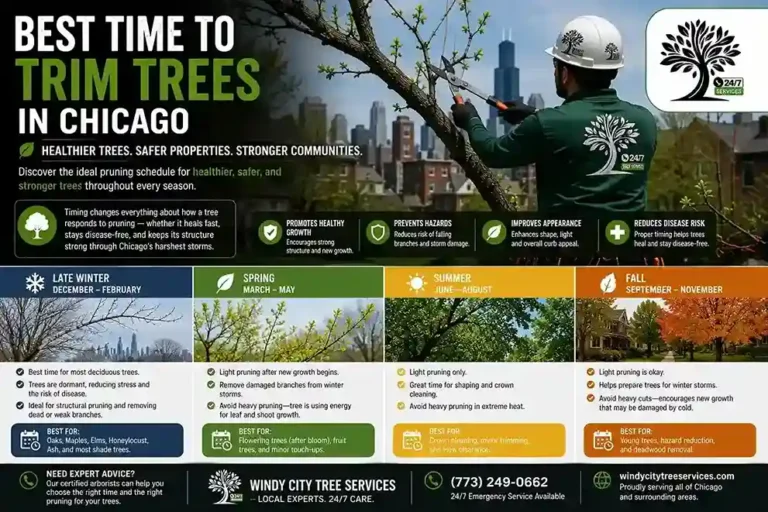
Scheduling pruning during the dormant season for most species reduces stress and disease risk.
Incremental Pruning
Spreading significant corrective work across multiple seasons instead of one aggressive session.
Professional Evaluations
Letting a certified arborist determine what actually needs removal, guided by ANSI A300 standards.
Preventive Maintenance
Addressing small structural issues while they’re still small, before they require major correction.
Long-Term Canopy Management
Building a multi-year plan for mature trees rather than reacting to problems one at a time.
🎨 Infographic Suggestions for This Guide
Photosynthesis and canopy health diagram
Over-pruning vs proper pruning comparison
Water sprout formation illustration
Tree recovery timeline graphic
CODIT wound response diagram
Proper canopy management illustration
Comparison Tables
Proper Pruning vs Over-Pruning
| Feature | Proper Pruning | Over-Pruning |
|---|---|---|
| Tree Health | Maintained or improved | Weakened, stressed |
| Photosynthesis | Minimal disruption | Significantly reduced |
| Storm Resistance | Improved through better structure | Reduced due to weak regrowth |
| Appearance | Natural, balanced form | Sparse, uneven, or stubby |
| Long-Term Growth | Steady, healthy development | Slowed for multiple seasons |
| Disease Risk | Low, wounds heal properly | Elevated due to large, slow-healing wounds |
Signs of an Over-Pruned Tree
| Symptom | What It Means | Recommended Action |
|---|---|---|
| Water Sprouts | Tree is rebuilding lost leaf area under stress | Selective removal over time by a professional |
| Sparse Canopy | Significant leaf area was removed | Monitor recovery, avoid further pruning |
| Sunscald | Bark exposed to sun it wasn’t adapted for | Professional assessment, possible wound care |
| Weak Branches | Regrowth attached poorly to parent limbs | Structural pruning to correct over time |
| Reduced Growth | Tree is drawing down energy reserves | Support with proper watering and monitoring |
Homeowner Checklist: Has Your Tree Been Over-Pruned?
✅ Ask Yourself
- Was a large portion of the canopy removed in one visit?
- Are water sprouts growing along the trunk or major limbs?
- Is bark suddenly exposed to direct sunlight that wasn’t before?
- Has the tree become visibly unbalanced or lopsided?
- Are branch tips dying back in the upper canopy?
- Has new growth slowed dramatically compared to past seasons?
- Was the tree recently topped, cut back to stubs rather than lateral branches?
Frequently Asked Questions
Can over-pruning kill a tree?
Yes, in severe cases. A tree that loses too much canopy and depletes its energy reserves before it can regrow enough leaf area can decline and, in extreme cases, die, especially if it’s already stressed by disease, poor soil, or drought.
How much canopy is too much to remove?
Industry guidance generally recommends no more than about 25 percent of a tree’s living canopy in a single pruning session, and often less for mature or stressed trees.
Will my tree recover from over-pruning?
Often, yes, though recovery time varies by species, age, overall health, and severity. Moderate cases may recover within two to three seasons, while severe cases can take much longer.
What are water sprouts?
Water sprouts are fast-growing, weakly attached vertical shoots that emerge from the trunk or major limbs as a stressed tree tries to rebuild lost leaf area quickly.
Does over-pruning increase storm damage risk?
Yes. The weak regrowth that follows severe pruning is more prone to breaking in wind, ice, or heavy snow than the tree’s original structure.
Can over-pruning attract insects?
Yes. Stressed trees with large, slow-healing wounds are often more attractive to opportunistic pests than healthy trees.
Is topping considered over-pruning?
Yes, topping is one of the most severe and damaging forms of over-pruning, since it removes large amounts of canopy through improper cuts that don’t respect the tree’s natural branch structure.
Should storm-damaged trees be heavily pruned right away?
Not necessarily. While hazardous or broken limbs should be addressed promptly, additional heavy pruning beyond what’s needed for safety can add unnecessary stress to an already-damaged tree.
Can fertilization help a tree recover from over-pruning?
It can help in some cases, but should be guided by a professional assessment rather than applied automatically, since the right approach depends on the tree’s specific condition.
When should I call an arborist about a possibly over-pruned tree?
If you notice water sprouts, sparse canopy, sunscald, or slowed growth following recent pruning, a professional evaluation can confirm the cause and recommend a recovery plan.
Are certain tree species more sensitive to over-pruning?
Yes. Species like oak, birch, pine, and spruce tend to respond poorly to aggressive pruning, while species like honey locust and sycamore tolerate it somewhat better.
What is CODIT and why does it matter?
CODIT, Compartmentalization of Decay in Trees, describes how trees wall off damage instead of healing like animals. Larger wounds from over-pruning are harder for a tree to compartmentalize effectively, raising decay risk.
Is sunscald reversible?
Mild sunscald can heal over time with proper care, but severe cases can cause lasting damage to the cambium layer and create entry points for decay.
Can a topped tree ever look normal again?
Rarely fully. Topped trees often develop a permanently altered structure, even after regrowth fills in, due to the weak attachment points created by the improper cuts.
How do I know if a tree company is at risk of over-pruning my trees?
Ask whether they follow ANSI A300 standards, employ ISA Certified Arborists, and can explain their reasoning for each recommended cut rather than defaulting to heavy, uniform reduction.
Does over-pruning affect property value?
It can. A visibly damaged or unhealthy tree can detract from curb appeal and may raise concerns for potential buyers about the tree’s long-term health and safety.
Can young trees be over-pruned too?
Yes, and it’s especially important to avoid, since heavy pruning during the formative years can permanently affect a young tree’s structural development.
Is it better to prune a little every year or a lot occasionally?
Generally, smaller, more frequent maintenance pruning is easier on a tree than infrequent, aggressive sessions that remove large amounts of canopy at once.
What should I do if my tree was already over-pruned by someone else?
Schedule a professional evaluation. An arborist can assess the damage, recommend supportive care, and plan any corrective pruning needed over the following seasons.
How do I schedule a tree health inspection with Windy City Tree Services?
Call (773) 249-0662 or email info@windycitytreeservices.com to schedule a free evaluation with an ISA Certified Arborist.
Related Articles
Keep Your Trees Healthy with Professional Pruning
Removing too many branches can create years of problems, but proper pruning supports healthier growth, stronger structure, and longer-lasting trees. Windy City Tree Services follows ANSI A300 standards and ISA Best Management Practices to help Chicago homeowners protect their valuable trees.
info@windycitytreeservices.com · 323 W Carroll Ave, Chicago, IL 60612 · Serving Chicago 24/7