Can a Dead Tree Be Saved? Signs & When to Remove It
Tree Health · Chicago Arborist Guide
Can a Dead Tree Be Saved?
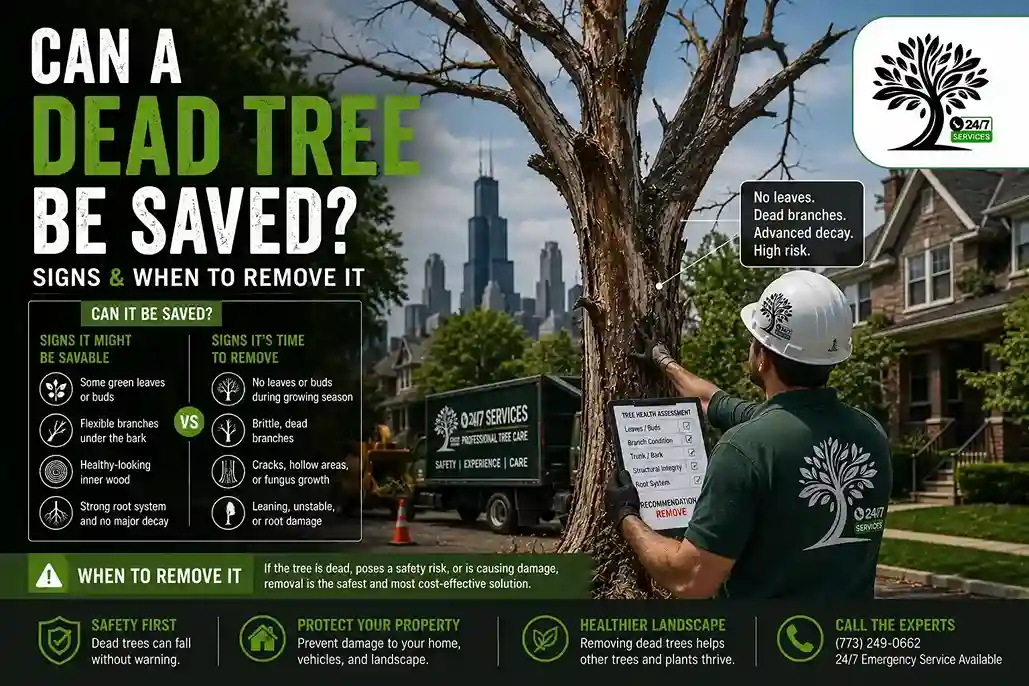
Learn how to tell whether your tree can recover, or whether it’s already past the point of no return — and what to do about each.
Introduction
Homeowners call us about a “dead tree” more often than any other single issue — and roughly a third of the time, the tree isn’t dead at all. It’s dormant, stressed, or recovering from a rough season. Telling the difference from the ground, without cutting into the wood, is genuinely hard, and guessing wrong in either direction costs money: removing a tree that could have recovered, or leaving one standing that’s about to fail.
Some declining trees respond well to treatment — deep root fertilization, pest control, structural pruning — if the problem gets caught early enough. A truly dead tree can’t be brought back, full stop, because the living tissue that moves water and nutrients has already stopped functioning. The trouble is that dead and dying often look almost identical for the first year or two, especially in winter, which is exactly when these calls spike.
A professional inspection is what settles the question. An ISA Certified Arborist can check the cambium layer, the root flare, and the pattern of dieback in about 20 minutes and tell you, with real confidence, whether you’re looking at a save or a removal.
By the end of this guide, you’ll know how to run a basic scratch test yourself, recognize the warning signs that separate a stressed tree from a dead one, understand what treatments actually work, and know exactly when it’s time to stop treating and start planning a dead tree removal.
A truly dead tree cannot be revived, because its living tissues, including the cambium layer beneath the bark, have stopped functioning and cannot regenerate. However, a tree that’s stressed, diseased, or showing partial canopy dieback may recover with professional treatment if the underlying cause is caught early. A tree health inspection is the only reliable way to tell the two apart.
1. What Is the Difference Between a Dead Tree and a Dying Tree?
The distinction comes down to one layer of tissue: the cambium, a thin green ring just under the bark that produces new wood and bark cells. As long as cambium is alive anywhere on the trunk or major roots, the tree has a pulse. Once it’s dead all the way around, the tree is dead, even if some branches still look green.
- Dormancy: A normal, healthy, seasonal shutdown — deciduous trees drop leaves and slow growth every winter. This is not decline.
- Decline: A gradual weakening from stress, disease, or root damage, often visible as thinning canopy over one or more growing seasons.
- Partial canopy dieback: Some branches die while the rest of the tree stays alive, often the first visible sign of a localized problem like root damage on one side.
- Complete tree death: No living cambium remains anywhere in the trunk or root system. At this point, no treatment can reverse it.
The most common mistake homeowners make is judging a tree by its winter silhouette. A bare, gray, motionless tree in January looks exactly like a dead one, whether it’s dormant or not. That’s why the tests below matter more than a visual glance.
Did You Know?
Some tree species, including oaks and hickories, can hold partially green or brown leaves through winter in a process called marcescence. It’s a normal trait, not a sign of disease or death.
2. Signs a Tree May Still Be Alive
None of these signs alone confirms a tree is healthy, but together, they build a reliable picture.
Green cambium under the bark (scratch test)
Scrape a small patch of outer bark from a twig or low branch with a pocketknife or fingernail. Green, moist tissue underneath means that section is alive. Brown, dry tissue means it isn’t.
Healthy buds
Firm, plump buds at branch tips, even in winter, indicate the branch is alive and preparing for spring growth.
Flexible twigs
Bend a small twig. A living twig flexes and bends before snapping. A dead one snaps immediately with a dry crack.
New shoots and partial leaf growth
Even a stressed tree pushing out some new leaves, however sparse, is telling you it still has functioning roots and cambium somewhere.
Run the scratch test in two or three spots around the tree, not just one branch. A single green twig on an otherwise bare tree can mean the tree is barely hanging on rather than genuinely healthy — which is exactly the gray area a professional inspection is built to resolve.
3. Signs a Tree Is Dead
- Brittle branches that snap dry and clean with no bend
- No leaf production during the growing season, especially by early summer when nearby healthy trees are fully leafed out
- Bark falling off in sheets, exposing dry wood underneath
- Hollow trunk, detectable by a dull, empty sound when tapped
- Advanced decay, visible as soft, crumbling, or discolored wood
- Mushrooms or fungal conks growing on the trunk or exposed roots, a sign that internal wood is actively decomposing
- Large dead canopy covering most or all of the tree, not just a single limb
- Severe insect infestation, including exit holes, boring dust, or bark beetle galleries covering large sections of trunk
Any one of these on its own is worth a look. Several together, especially fungal conks plus a hollow-sounding trunk, are a strong signal that removal, not treatment, is the realistic path forward.
4. Common Reasons Trees Die
| Cause | How It Kills the Tree |
|---|---|
| Drought stress | Prolonged water shortage shuts down root function and canopy growth |
| Flooding | Saturated soil starves roots of oxygen, causing root rot |
| Root damage | Cut or crushed roots from digging, trenching, or grading reduce water uptake |
| Construction injury | Soil compaction and root cutting during nearby building work |
| Soil compaction | Dense, compacted soil blocks oxygen and water from reaching roots |
| Disease | Pathogens attack vascular tissue, blocking water transport |
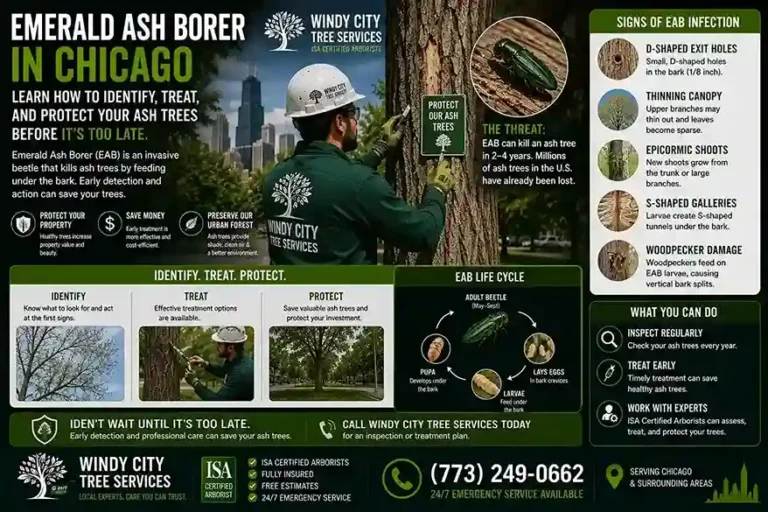
| Emerald Ash Borer | Larvae tunnel under the bark, cutting off nutrient flow in ash trees |
| Oak Wilt | A fungus clogs the tree’s water-conducting tissue, often fatal within a season |
| Dutch Elm Disease | A fungal infection spread by bark beetles that kills elms from the canopy down |
| Lightning | A direct strike can kill cambium instantly along the strike path |
| Storm damage | Broken limbs and torn bark create entry points for decay and infection |
| Age | Natural decline in older trees, especially combined with other stressors |
5. Can a Dying Tree Be Saved?
Often, yes — if the problem is caught before it spreads through the whole root system or trunk. Treatment options depend entirely on the diagnosis:
- Structural pruning: Removing dead or diseased limbs stops the problem from spreading and reduces the load on a weakened tree.
- Disease treatment: Fungicide or antimicrobial injections can slow or stop certain infections, particularly if applied early.
- Deep root fertilization: Restores nutrients to stressed roots, particularly in compacted urban soil.
- Air Spade root excavation: Uses compressed air instead of digging tools to expose roots without damage, helping diagnose root rot or girdling roots.
- Mulching: Improves soil moisture retention and temperature regulation around the root zone.
- Irrigation improvements: Correcting over- or under-watering, especially important during Chicago’s dry summer stretches.
- Pest management: Targeted treatment for infestations like emerald ash borer, if caught before extensive tunneling damage.
- Cabling and bracing: Provides structural support for weak branch unions, reducing failure risk without removing the tree.
- Soil improvement: Aeration and amendment to relieve compaction and restore healthy root function.
Success depends heavily on how much damage has already occurred. A tree with 20% canopy dieback from a treatable disease has real recovery odds. A tree with 70% dieback and visible trunk decay usually doesn’t, no matter how aggressive the treatment.
6. When Is Tree Removal the Better Option?
Removal becomes the right call, not just the easier one, in these situations:
- Complete tree death — no living cambium anywhere in the trunk or roots
- Severe structural instability, including major trunk cracks or a significant, worsening lean
- Extensive decay confirmed by sounding, probing, or advanced diagnostic tools
- High failure risk based on a formal tree risk assessment
- Trees threatening homes, vehicles, sidewalks, or utility lines, where the consequences of failure are severe even if the odds are moderate
These decisions shouldn’t be made from a gut feeling. A professional risk assessment weighs the likelihood of failure against what’s in range if it does fail — a dead tree over an open field is a very different call than the same tree fifteen feet from a bedroom window.
7. Is It Dangerous to Leave a Dead Tree Standing?
Often, yes, and the risk grows the longer it stands. Dead wood loses structural integrity over time as decay progresses, which changes the math on what used to seem like a manageable risk.
- Falling limbs: Dead branches, sometimes called “widowmakers,” can drop without warning, even on a calm day.
- Trunk failure: Internal decay can cause a sudden, complete trunk collapse with little visible warning.
- Property damage: Roofs, cars, fences, and power lines are all common casualties of standing dead trees.
- Personal injury: Falling deadwood is a leading cause of tree-related injuries to homeowners and passersby.
- Liability concerns: Property owners can be held responsible for damage or injury caused by a known-hazardous tree that wasn’t addressed.
- Increased storm risk: Dead trees fail at dramatically higher rates than healthy ones during high winds and ice loading.
8. How Arborists Diagnose Tree Health
A proper diagnosis goes well beyond looking up at the canopy from the driveway.
- Visual assessment: Canopy density, leaf color, branch structure, and bark condition from ground level.
- Root flare inspection: Checking where the trunk meets the soil for girdling roots, decay, or improper planting depth.
- Soil evaluation: Compaction, drainage, and nutrient levels around the root zone.
- Decay detection: Sounding the trunk with a mallet, probing soft spots, and in some cases using a resistograph or sonic tomography for internal imaging.
- Tree Risk Assessment: A structured evaluation, following ISA Tree Risk Assessment Qualification (TRAQ) principles, that scores likelihood of failure against the value of what’s within striking distance.
- Air Spade investigations: Exposing the root system without cutting or crushing roots, useful for diagnosing root rot or construction damage.
- Advanced diagnostic tools: Increment borers, moisture meters, and lab testing for suspected pathogens when the diagnosis isn’t obvious from the field.
9. Chicago-Specific Causes of Tree Decline
Local conditions shape which problems we see most often across Chicago neighborhoods.
- Lake Michigan wind exposure: Persistent gusts stress branch unions and accelerate limb failure on already-weak trees.
- Ice storms: Ice loading snaps branches and can crack trunks that were already structurally compromised.
- Heavy snow: Adds significant weight to canopies, especially problematic for trees with codominant stems.
- Urban soil compaction: Sidewalks, foot traffic, and parkway planting strips leave roots with little oxygen or room to grow.
- Construction activity: Nearby digging, grading, or equipment traffic damages roots that may be invisible from the surface.
- Salt damage: Road and sidewalk de-icing salt runoff burns roots and disrupts water uptake near curbs and driveways.
- Emerald Ash Borer: Has devastated ash populations across Chicago and the greater Midwest since its arrival.
- Oak Wilt: A serious risk for the city’s mature oak canopy, particularly red oak varieties.
- Limited rooting space: Parkway trees between sidewalk and street often have far less root volume than the same species would get in an open yard.
10. Can Dead Branches Be Removed Instead of the Entire Tree?
Frequently, yes — and it’s almost always the first option a responsible arborist considers before recommending full removal.
- Crown cleaning: Removing dead, dying, or diseased branches from the canopy while preserving the healthy structure.
- Deadwood removal: Targeted removal of specific dead limbs that pose a falling hazard.
- Structural pruning: Correcting weak branch unions and reducing the odds of future failure.
Selective pruning works well when the dieback is limited to specific limbs and the trunk, root system, and majority of the canopy remain healthy. It falls short when the dead portion represents most of the tree, when the trunk itself is compromised, or when the underlying cause, like advanced root rot, is still actively spreading.
11. How to Prevent Tree Decline
- Schedule annual inspections, even for trees that look fine.
- Water deeply and infrequently rather than shallow daily watering.
- Mulch around the base, 2 to 4 inches deep, keeping mulch away from direct trunk contact.
- Avoid damaging the trunk with mowers, string trimmers, or construction equipment.
- Have pruning done correctly and at the right time of year rather than as an afterthought.
- Manage soil compaction, especially around parkway and urban trees.
- Fertilize based on an actual soil test, not a generic schedule.
- Monitor for pests early, before an infestation becomes advanced.
12. Tree Preservation vs. Tree Removal
Preservation almost always wins on cost and value when it’s a realistic option. A mature tree adds measurable property value, shade, and privacy that takes decades to replace. Removal costs more upfront in most cases than a course of treatment, and you lose the tree’s benefits permanently.
But preservation only makes sense when recovery odds are genuinely good. Pouring money into treating a tree that’s already mostly dead delays an inevitable removal while the tree becomes more hazardous in the meantime. The honest calculation weighs treatment cost and success probability against the ongoing risk of leaving a declining tree standing.
| Characteristic | Dead Tree | Dying Tree |
|---|---|---|
| Leaves | None during growing season | Sparse, discolored, or partial |
| Branch flexibility | Brittle, snaps immediately | Some flex remains in living sections |
| Cambium layer | Brown and dry throughout | Green in at least some areas |
| Recovery potential | None | Possible with early treatment |
| Safety risk | High and increasing over time | Depends on extent of decline |
Treatment Options by Problem
| Problem | Possible Treatment | Removal May Be Needed? |
|---|---|---|
| Early-stage drought stress | Deep watering, mulching | Rarely |
| Root compaction | Soil aeration, air spade excavation | Rarely |
| Localized fungal infection | Fungicide treatment, pruning | Sometimes |
| Advanced Oak Wilt or Dutch Elm Disease | Limited treatment window, often too late | Usually |
| Extensive trunk decay | None effective | Yes |
| Complete cambium death | None — tree is deceased | Yes |
13. What Happens During a Professional Tree Health Inspection?
- Initial consultation: Discussing what you’ve noticed and any recent property changes, like new construction or landscaping.
- Visual assessment: A full walk-around checking canopy, bark, and branch structure.
- Root evaluation: Inspecting the root flare and, if needed, using an air spade to check for damage below the surface.
- Structural analysis: Checking for cracks, cavities, lean, and decay indicators.
- Disease identification: Matching symptoms against known pathogens common to the species and region.
- Treatment recommendations: A clear plan, whether that’s pruning, fertilization, monitoring, or removal.
- Written report: Documentation you can keep for insurance, HOA, or city permitting purposes.
- Follow-up care: A schedule for re-checking the tree if treatment is recommended rather than immediate removal.
14. Frequently Misdiagnosed Tree Problems
These conditions get mistaken for tree death more often than almost anything else:
- Seasonal dormancy: A completely normal winter state for deciduous trees, not a sign of trouble.
- Drought stress: Wilting and leaf drop that reverses once watering improves.
- Late leaf emergence: Some species, and some individual trees, simply leaf out later in spring than their neighbors.
- Pest damage: Leaf discoloration or holes from insects that haven’t affected the tree’s core structure.
- Temporary transplant shock: Recently planted or moved trees often look stressed for a season or two before establishing.
15. When Should You Call an Arborist?
- The tree is leaning, especially if the lean is new or worsening.
- You see large dead limbs anywhere in the canopy.
- Mushrooms or fungal conks appear at the base or on exposed roots.
- The canopy declines suddenly over a single season.
- You notice cracks running along the trunk.
- The tree has visible storm damage.
- You suspect disease based on discoloration, dieback pattern, or known local outbreaks.
Decision Flowchart: Save or Remove?
This flowchart is a general guide, not a substitute for an on-site inspection. Internal decay and root damage aren’t always visible from the outside.
How to Check a Tree Before Calling an Arborist
- Look for leaf production during the growing season.
- Inspect branches for brittleness with a gentle bend test.
- Check the base and roots for mushrooms or fungal growth.
- Examine the trunk for cracks, bark loss, or soft spots.
- Watch for a new or worsening lean.
- Photograph changes over a few weeks to track progression.
- Schedule a professional inspection if anything looks uncertain.
Frequently Asked Questions
No. Once all cambium tissue throughout the trunk and roots has died, the tree cannot regenerate. There is no treatment that restores dead cambium.
Run a scratch test on a few small branches. Green, moist tissue underneath the bark means the tree is alive and likely dormant. Dry, brown tissue in every spot you check points to a dead tree.
It gets riskier over time as decay progresses and structural integrity weakens. A standing dead tree near a home, driveway, or walkway should be evaluated for removal rather than left indefinitely.
Common culprits in the Chicago area include Dutch Elm Disease, Oak Wilt, and infestations like emerald ash borer. Root rot from prolonged flooding or compacted soil is another major cause.
Often, yes, if the problem is diagnosed before it spreads through the entire root system or trunk. Treatment options include pruning, fertilization, pest management, and structural support.
No. Fertilization supports living, stressed trees by improving nutrient availability. It has no effect on tissue that has already died.
Yes, in most cases. Dead branches pose a falling hazard and can also become entry points for pests and decay that spread to healthy wood.
It depends on your policy and the circumstances. Coverage is more likely if the tree fell or caused damage due to a storm than for routine removal of a tree that died gradually. Check your specific policy terms.
Costs vary by property and the depth of assessment needed. Many companies, including ours, offer free initial evaluations for standard residential trees.
As soon as a professional confirms it’s dead, particularly if it’s within striking distance of a home, driveway, sidewalk, or power line. Decay only worsens with time, increasing failure risk.
It’s a quick check where you scrape away a small patch of outer bark to look at the cambium layer underneath. Green and moist means living tissue; brown and dry means that section is dead.
Not necessarily. A single dead limb can result from localized damage or disease while the rest of the tree stays healthy. A full inspection determines whether it’s isolated or systemic.
Mushrooms or conks growing on the trunk or roots typically indicate active internal decay. This is one of the more serious warning signs and usually warrants a professional structural evaluation.
Only if caught early, before extensive tunneling under the bark cuts off nutrient flow around the trunk. Advanced infestations are typically fatal and treatment becomes ineffective.
Not always, but a new or worsening lean can indicate root failure or soil movement. Any noticeable change in lean should prompt a professional evaluation.
There’s no reliable timeline. Decay progresses at different rates depending on species, weather, and internal conditions, which is exactly why standing dead trees are considered unpredictable hazards.
Yes, though the timeline varies enormously by species, from a few decades to several centuries. Most urban tree deaths, however, are caused by stress, disease, or damage rather than natural old age alone.
Yes. Root cutting, soil compaction from equipment, and grade changes near a tree’s root zone are common causes of decline that can take one to several years to become visible above ground.
Run a basic scratch test on a few branches, photograph what you see, and schedule a professional tree health inspection before deciding on treatment or removal.
Learn more from our Chicago Tree Service homepage, meet our Certified Arborists, and explore our Professional Tree Care services. Related services include tree health inspections, tree removal, tree trimming & pruning, tree cabling & bracing, tree & shrub fertilization, air spade root excavation, emergency tree removal, storm prep & support systems, and stump grinding.