Average Cost of Tree Removal in Chicago (2026 Guide)
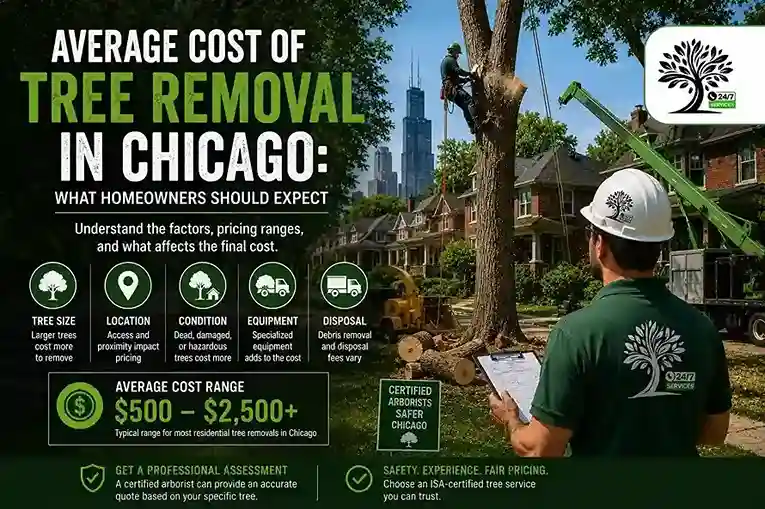
Average Cost of Tree Removal in Chicago: What Homeowners Should Expect
Tree removal cost depends on a lot more than height alone. Tree size, condition, accessibility, equipment needs, and whether the job is an emergency all shape the final price. This guide breaks down exactly what drives the cost so you can budget with confidence before you ever call for an estimate.
Tree removal cost in Chicago varies widely based on the tree’s height, trunk diameter, condition, and how easy the site is to access. Dead or leaning trees, jobs requiring a crane, and emergency storm response typically cost more than a straightforward, scheduled removal. The only accurate way to know your cost is a free, in-person estimate from a certified arborist.
“How much does it cost to remove a tree?” is one of the first questions almost every homeowner asks, and it’s a fair one. Tree removal is a real investment, and nobody wants to be surprised by the final bill.
The honest answer is that every tree is different. A young maple in an open front yard costs far less to remove than a massive, dead oak leaning over a garage in a tight side yard. Online price lists and generic calculators can give you a rough sense of scale, but they can’t account for your specific tree, your specific lot, or what a crew will actually find once they get a closer look.
That’s why a professional, on-site inspection is still the most accurate way to get pricing. An ISA Certified Arborist can evaluate the tree’s condition, measure its size, check the access route, and identify anything that might complicate the job, then give you a written estimate based on your actual property. This guide walks through every factor that goes into that number, so you know exactly what to expect and what questions to ask.
1. What Determines the Cost of Tree Removal?
Several factors combine to set the final price of any tree removal job. Understanding them helps you make sense of why two trees that look similar in size can cost very different amounts to take down.
- Height: Taller trees require more rigging, more climbing time, or crane support.
- Trunk diameter: Thicker trunks take longer to cut and produce more wood to haul away.
- Species: Some species have denser wood or more brittle limbs, changing how the crew approaches the job.
- Health and condition: A structurally sound tree is more predictable to remove than a decayed or hollow one.
- Dead vs. leaning: Dead wood is unpredictable, and a leaning tree may require extra rigging to control the direction of the fall.
- Storm damage: A tree with a split trunk or broken major limbs adds complexity and risk.
- Accessibility: Backyard access, narrow gangways, and fences all affect how equipment reaches the tree.
- Nearby structures: Removing a tree next to a home, garage, or fence takes more precision than an open-yard removal.
- Utility lines: Power lines running through or near the canopy require extra caution and sometimes utility coordination.
- Equipment needs: Whether the job can be done by climbing alone or requires a crane changes the cost significantly.
2. Tree Size Categories
Arborists generally think about tree removal in size categories, since height and diameter are the biggest drivers of labor and equipment needs.
| Category | Typical Height | What It Usually Means |
|---|---|---|
| Small | Under 30 ft | Ornamental or young trees, often removable without a crane |
| Medium | 30 to 60 ft | Established residential shade trees, moderate rigging required |
| Large | 60 to 80 ft | Mature canopy trees, more climbing time and heavier rigging |
| Extra-large / mature | Over 80 ft | Legacy trees that often require a crane and a larger crew |
Larger trees don’t just take longer to cut, they also produce significantly more wood volume to process and hault away, and they demand more careful planning to control where each section falls. That’s why cost tends to scale up faster than height alone would suggest.
3. Accessibility Matters
Two identical trees can cost very different amounts to remove depending on how easy the property is to work with. Chicago’s dense residential lots create accessibility challenges that don’t show up as often in suburban settings.
- Backyard access: A tree with no direct driveway or gate access may require hand-carrying equipment or extra rigging.
- Narrow gangways: Common between Chicago two-flats and bungalows, these limit what equipment can pass through.
- Alley access: Sometimes the best route to a backyard tree, but alleys vary widely in width and condition.
- Fenced properties: May require temporary fence removal or careful maneuvering around gates.
- Limited equipment access: Sites where a bucket truck or chipper truck can’t get close add labor time.
- Urban lot size: Tight side yards between neighboring homes leave little room for a controlled drop zone.
💡 Why This Matters
When equipment can’t reach a tree directly, more of the job has to be done by hand or with extra rigging, which adds labor hours. This is one of the most common reasons two similar-looking trees end up with different price quotes.
4. Emergency Tree Removal Costs
Emergency situations typically cost more than scheduled removals, and there’s a practical reason why. Emergency tree removal often means dispatching a crew outside normal hours, working around active hazards, and dealing with unpredictable conditions like a tree still partially attached after a storm.
Common emergency scenarios include storm-downed trees, a tree resting on a home or garage, a tree on a vehicle, a trunk blocking a road or driveway, and trees tangled in utility lines. These jobs require careful safety planning on the spot, sometimes coordination with the utility company, and a level of urgency that scheduled work doesn’t involve. That combination is what typically raises emergency pricing above a planned removal of a similar tree.
⚠️ Prevention Costs Less Than Emergencies
A hazardous tree removed on a planned schedule is almost always less expensive than the same tree removed after it falls on a structure or vehicle. Waiting rarely saves money.
5. Dead vs Healthy Tree Removal
The tree’s condition changes both the cost and the safety planning involved. Dead trees are unpredictable because the wood has lost strength and moisture, which means limbs can break unexpectedly during the cut. Diseased and decayed trees present a similar problem, since internal rot can make a trunk section far weaker than it looks from the outside.
Leaning trees require extra rigging to control the direction of the fall, especially if the natural lean points toward a structure. A healthy, structurally sound tree in an open area is the most predictable and typically the most straightforward type of removal, which is often reflected in the estimate.
6. Additional Services That Affect Cost
Tree removal is often just one part of the total project. These optional services add to the scope, but each one solves a specific problem worth understanding.
- Stump grinding: Grinding the remaining stump 6 to 8 inches below grade so you can replant or resurface.
- Stump removal: Full extraction of the stump and major roots, more involved than grinding.
- Log hauling: Removing large trunk sections from the property instead of leaving them on site.
- Wood chipping: Processing branches into mulch, either hauled away or left for the homeowner.
- Firewood processing: Cutting usable wood into firewood lengths for the homeowner to keep.
- Debris removal: Full site cleanup, including smaller branches and leaf litter.
- Root removal: Addressing roots that threaten sidewalks, foundations, or utility lines.
- Site cleanup: Raking, blowing, and restoring the work area to a tidy condition before the crew leaves.
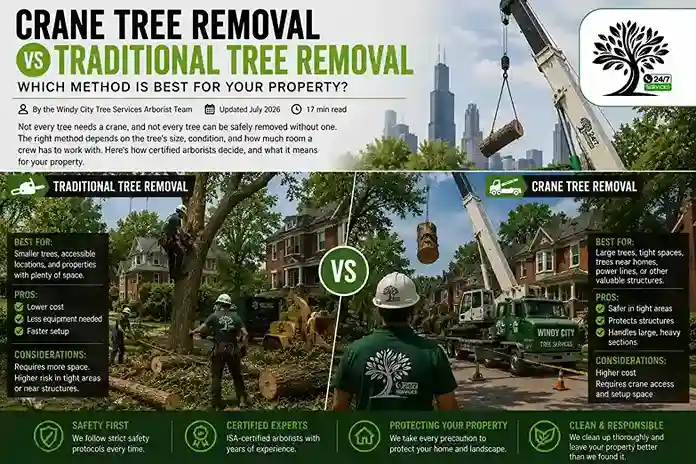
7. Crane Tree Removal
Cranes aren’t used on every job, but they make a real difference on the ones that need them. A crane is typically required when a tree is too large, too close to a structure, or in too tight a space to safely remove by climbing and rigging alone.
- Safety benefits: Lifting large sections directly off the tree reduces the risk of controlled-fall accidents.
- Faster removals: Crane work can significantly cut down total job time compared to traditional rigging.
- Difficult locations: Trees surrounded by structures, fences, or other trees often need a crane to remove safely.
- Large tree removals: Extra-large mature trees frequently exceed what climbing crews can safely manage alone.
Crane removal adds cost due to the equipment and specialized operator involved, but for the right job, it’s often safer and faster than the alternative.
8. Commercial vs Residential Tree Removal
Residential and commercial tree removal jobs often differ in scope, scheduling, and documentation requirements, even when the trees themselves are similar in size.
| Property Type | Typical Considerations |
|---|---|
| Single-family homes | Straightforward scheduling, standard residential access |
| Apartment complexes | Coordination around tenants, shared parking, and access |
| HOAs | Board approval, documentation, and multi-property scheduling |
| Schools | Scheduling around school hours, added safety planning |
| Churches | Coordination around services and events |
| Retail properties | Minimizing disruption to customers and parking access |
| Office buildings | After-hours scheduling to avoid business disruption |
| Municipal properties | Public bidding, permits, and compliance documentation |
9. Permits in Chicago
Whether you need a permit depends largely on where the tree is located. Trees on the public parkway, the strip of land between the sidewalk and the street, generally require a City of Chicago permit before removal. Protected trees and certain trees within utility easements may have additional requirements.
Trees on private residential property typically don’t require a city permit, though it’s worth verifying local requirements before work begins, especially for larger commercial or municipal projects. A reputable tree service will help confirm permit requirements as part of the estimate process.
10. Does Insurance Cover Tree Removal?
Insurance coverage for tree removal depends heavily on the specific situation and your policy’s terms.
- Storm damage: Many homeowner policies cover removal when a tree falls due to a covered event like wind or a storm.
- Fallen trees on structures: Coverage is more likely when the tree has damaged a home, garage, or other insured structure.
- Preventive removals: Removing a standing hazardous tree before it falls is less commonly covered, since it’s considered routine maintenance in many policies.
- Liability considerations: If a tree falls onto a neighboring property, liability can depend on whether the tree was known to be hazardous beforehand.
Review your specific policy or speak with your insurance agent before assuming coverage either way.
11. Can Tree Removal Be Avoided?
Removal should be the last resort whenever it’s reasonably possible to preserve a tree safely. A certified arborist may recommend one of several alternatives depending on the tree’s condition.
- Tree trimming: Removing dead or weak limbs before they become a hazard.
- Structural pruning: Correcting weak branch unions following ANSI A300 pruning standards.
- Cabling and bracing: Steel support systems that reduce failure risk in trees with structural weaknesses.
- Air Spade root excavation: Diagnosing and correcting root issues without cutting healthy roots.
- Deep root fertilization: Restoring vigor to stressed trees in compacted or poor soil.
- Disease treatment: Addressing early-stage disease before it causes irreversible decline.
- Ongoing monitoring: Scheduled inspections to track a tree’s condition over time.
A trustworthy arborist will always explain why removal is the right call rather than defaulting to it, and will point out when a less expensive option can safely solve the problem instead.
12. Why Hiring a Certified Arborist Matters
Tree removal is dangerous work, and the person making the call about how to approach it should have real training behind that decision.
- Safety: Certified arborists are trained in the rigging and cutting techniques that keep a job safe for the crew and the property.
- Insurance: A properly insured company protects you from liability if something goes wrong during the job.
- Specialized equipment: Cranes, aerial lifts, and rigging systems require trained operators to use safely.
- Tree risk assessment: ISA Certified Arborists evaluate failure likelihood, target rating, and consequences using an evidence-based framework, not a guess.
- Property protection: Experienced crews plan the drop zone and rigging to avoid damaging nearby structures.
- Compliance: Reputable companies follow ISA Best Management Practices and ANSI A300 standards for pruning and risk assessment.
13. Chicago-Specific Cost Factors
Chicago has its own set of conditions that shape tree removal pricing beyond the universal factors above. Dense urban neighborhoods often mean tighter lots, narrower gangways, and less room for a crew to work, all of which can add labor time compared to a suburban property with wide open access.
The city’s mature tree canopy, much of it 60 to 100 years old, means a lot of Chicago’s larger removals involve legacy trees that require more planning and sometimes crane support. Weather off Lake Michigan adds its own pressure: heavy snow, windstorms, and ice accumulation all contribute to storm damage and emergency calls throughout the year. Historic properties may come with additional care requirements around masonry and landscaping, and older utility infrastructure sometimes runs closer to tree canopies than newer construction, adding another layer of planning to the job.
14. What Happens During Professional Tree Removal?
- Inspection: An arborist evaluates the tree’s condition, size, and surroundings.
- Written estimate: A clear, itemized quote based on the specific job, not a generic price list.
- Safety planning: Mapping the drop zone and identifying hazards like power lines before work begins.
- Equipment setup: Staging chippers, trucks, and rigging gear based on site access.
- Rigging: Controlled lowering of limbs and trunk sections to protect the property.
- Climbing: A trained climber ascends and removes sections from the top down when a crane isn’t needed.
- Crane operation: Used when the tree’s size or location calls for it, lifting sections directly off the tree.
- Cleanup: Hauling debris, chipping branches, and restoring the site.
- Stump grinding options: Discussed and quoted separately if you want the stump handled the same day or later.
Cost Comparison Tables
Factors That Increase Tree Removal Costs
| Factor | Low Impact | High Impact |
|---|---|---|
| Tree height | Under 30 ft | Over 80 ft |
| Condition | Healthy, structurally sound | Dead, decayed, or leaning |
| Access | Open front yard, driveway access | Fenced backyard, narrow gangway |
| Equipment needed | Climbing only | Crane required |
| Timing | Scheduled, business hours | Emergency, after hours |
| Nearby structures | Open area, no obstacles | Close to home, power lines, or fences |
Optional Services
| Service | Purpose | When Recommended |
|---|---|---|
| Stump grinding | Removes visible stump below grade | Planning to replant, reseed, or resurface |
| Stump removal | Full extraction of stump and major roots | Construction or major landscaping projects |
| Log hauling | Removes large trunk sections from site | Limited storage space or no firewood use |
| Firewood processing | Cuts usable wood for the homeowner | Homeowner wants to keep the wood |
| Wood chip supply | Provides mulch for landscaping | Homeowner wants chips left on site |
| Root removal | Clears roots threatening structures | Roots damaging sidewalks or foundations |
Cost-Saving Tips
There’s no way to guarantee a lower price on every job, but a few practical habits genuinely help homeowners spend less over time.
- Schedule preventive maintenance instead of waiting for a problem to become urgent.
- Remove hazardous trees on a planned timeline rather than after an emergency forces the issue.
- Bundle trimming and stump grinding into a single visit when possible to reduce mobilization costs.
- Request an inspection before storm season to catch problems while they’re still manageable.
- Get a written estimate before work begins so there are no surprises in the final invoice.
Chicago Homeowner Checklist
✅ Before Hiring a Tree Removal Company
- Verify the company carries current liability insurance
- Ask whether ISA Certified Arborists are on staff
- Confirm what cleanup is included in the price
- Discuss stump grinding as a separate line item
- Ask whether a permit is required for your specific tree
- Request a written estimate before any work begins
Frequently Asked Questions
What is the average cost of tree removal in Chicago?
Cost varies widely based on tree height, diameter, condition, accessibility, and equipment needs. A small, easily accessible tree costs far less than a large, hazardous tree requiring a crane. The only accurate way to know your cost is a free, in-person estimate.
Why can’t I get an exact price online?
Online estimates can’t account for your tree’s actual condition, root structure, or site access. Two trees that look similar from a photo can require very different amounts of labor and equipment once a crew is on site.
Is the estimate free?
Yes. Windy City Tree Services provides free, written estimates after an in-person inspection, with no obligation to move forward.
Do I need a permit to remove a tree in Chicago?
Trees on the public parkway generally require a City of Chicago permit. Trees on private property typically don’t, though it’s worth confirming for larger or commercial projects.
Will my homeowner’s insurance cover the cost?
Often, if the tree fell due to a covered event like a storm, especially if it damaged a structure. Preventive removal of a standing hazardous tree is less commonly covered. Check your specific policy.
Why does emergency tree removal cost more?
Emergency jobs often require after-hours dispatch, work around active hazards, and less predictable conditions, such as a tree still partially attached to a structure after a storm.
Is stump grinding included in tree removal?
Usually not. Stump grinding is typically quoted as a separate line item, since not every homeowner wants the stump removed right away.
How much does a crane add to the cost?
Crane removal adds cost due to the specialized equipment and operator involved, but it’s often the safer and faster option for large or hard-to-access trees.
Does cleanup cost extra?
Full debris removal is typically included in a standard estimate, but options like leaving wood chips or firewood on site instead of hauling everything away can be discussed as part of the quote.
Are diseased trees more expensive to remove?
Sometimes, since disease can weaken wood in unpredictable ways that require extra caution during removal. Cost still depends primarily on size, condition, and accessibility.
What makes a tree “hazardous” and does that change the price?
A hazardous tree shows signs like severe leaning, large dead limbs, decay, or storm damage. These conditions often require more careful rigging and planning, which can affect the estimate.
Do commercial properties pay more for tree removal?
Not necessarily more per tree, but commercial jobs often involve added scheduling, documentation, or coordination requirements that residential jobs don’t.
Does the season affect tree removal pricing?
Demand tends to rise after major storms and during peak spring and fall seasons. Scheduling preventive work outside of high-demand periods can sometimes mean more flexible scheduling.
Can I get a discount by bundling services?
Bundling trimming, removal, and stump grinding into a single visit can reduce mobilization costs compared to scheduling each service separately.
How do I know if I need removal or just trimming?
A certified arborist can tell you. Many trees that look concerning can be preserved with pruning, cabling, or treatment rather than full removal.
What should be included in a written estimate?
A clear description of the work, cleanup details, whether stump grinding is included, permit responsibilities, and confirmation of insurance coverage.
Is it cheaper to remove multiple trees at once?
Often yes, since mobilizing equipment and crew for multiple trees in one visit is more efficient than scheduling separate trips.
Do you offer free estimates for commercial properties?
Yes. We provide free, written estimates for residential, commercial, and municipal properties throughout Chicago.
What payment options are available?
Payment details are discussed as part of the estimate process. Contact our office directly for current options.
How do I schedule a free tree removal estimate?
Call (773) 249-0662 or email info@windycitytreeservices.com to schedule an in-person inspection with an ISA Certified Arborist.
Related Articles
Get a Free Tree Removal Estimate in Chicago
Whether you have a hazardous tree, storm damage, or simply want professional advice, our ISA Certified Arborists provide honest recommendations, transparent estimates, and safe tree removal services throughout Chicago.
info@windycitytreeservices.com · 323 W Carroll Ave, Chicago, IL 60612 · Serving Chicago 24/7