How to Fix Sidewalk Raised By Tree Roots
How to Fix a Sidewalk Raised by Tree Roots
A sidewalk lifted by tree roots is a trip hazard and a repair decision that affects the tree above it. Here is how Chicago arborists evaluate the root, the concrete, and the safest way to fix both.
Contents
- Why Tree Roots Lift Sidewalks
- Signs Roots Are Damaging Your Sidewalk
- How Serious Is a Raised Sidewalk
- Should You Cut Tree Roots Under a Sidewalk
- Can I Cut a Root Lifting My Sidewalk
- How to Repair a Sidewalk Without Removing the Tree
- Sidewalk Bridge Over Tree Roots
- Root Pruning as a Repair Option
- Root Barriers and Prevention
- Preventing Damage to a New Sidewalk
- Trees Less Likely to Damage Sidewalks
- Tree Roots and Driveway Damage
- How to Fix Concrete Lifted by Tree Roots
- How to Fix Pavers Lifted by Tree Roots
- Tree Roots Under Asphalt Driveways
- Tree Roots Coming to the Surface
- Should You Remove the Tree
- Air Spade Root Excavation
- How Arborists Assess Root Problems
- Chicago-Specific Considerations
- Who Is Responsible for the Damage
- Step-by-Step Action Plan
- Decision Tree
- Cost of Sidewalk Root Repair
- 7 Mistakes to Avoid
- Frequently Asked Questions
- Key Takeaways
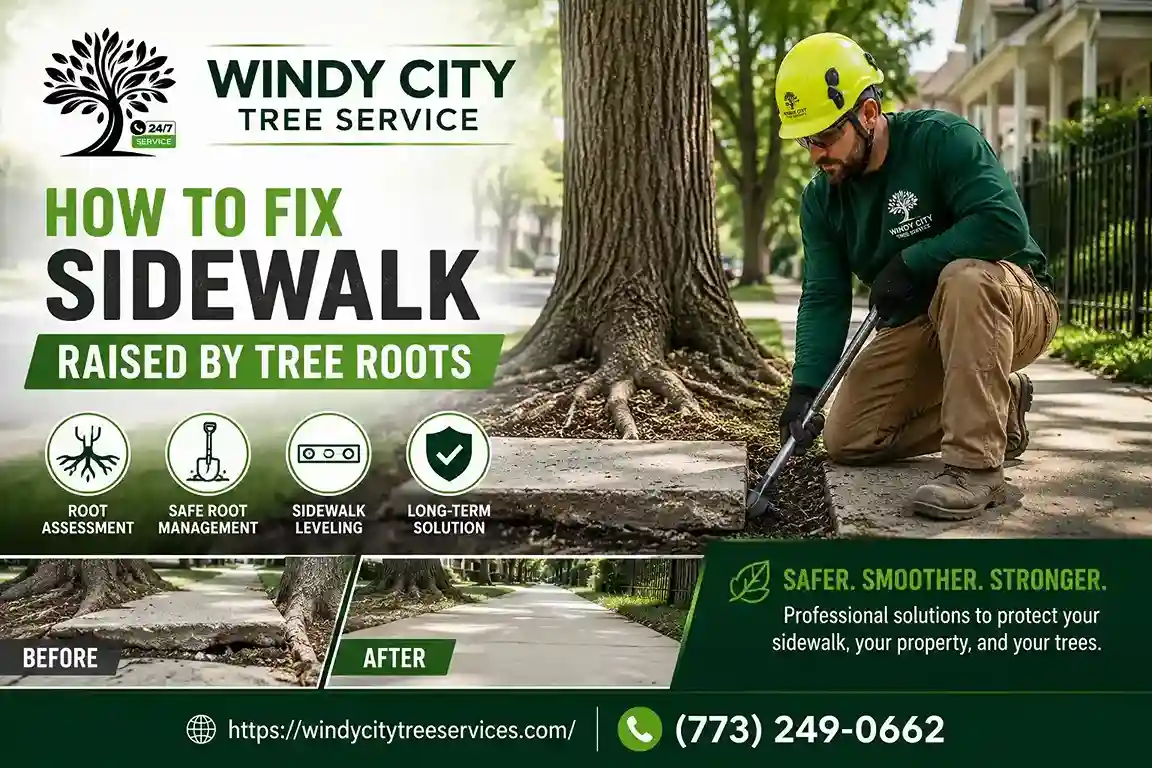
How Do You Fix a Sidewalk Raised by Tree Roots?
The safest fix depends on the size of the root, the sidewalk condition, and the tree’s health. Options include grinding or replacing the slab, adjusting the grade, bridging over the root, rerouting the walkway, or carefully pruning a smaller root. A certified arborist should assess the tree before any major root is cut, since removing a large structural root can affect the tree’s stability.
A raised sidewalk usually needs more than a new slab of concrete. The root causing the lift is still there, and it will keep growing. Before any contractor pours new concrete, the root system underneath deserves a look. Cutting the wrong root, or too much of it, can leave a large tree unstable for years to come.
Fixing the problem the right way usually involves one or more of these approaches:
- Root-safe sidewalk repair that works around the existing root
- Removing and replacing the damaged section of concrete
- Adjusting the sidewalk grade to smooth the transition
- Bridging the walkway over the root zone
- Rerouting the sidewalk around a valuable tree
- Root pruning, but only when a qualified arborist confirms it is safe
- Root barriers, mainly for new plantings or full sidewalk rebuilds
- Tree preservation strategies that protect the root system long term
- Tree removal, but only when safety or structural issues justify it
This guide walks through each option, explains when root cutting is and is not appropriate, and covers Chicago-specific factors like clay soil, freeze-thaw cycles, and narrow tree lawns. The goal is simple. Fix the sidewalk without sacrificing a healthy tree unless there is a genuine reason to.
The Short Answer
A sidewalk raised by tree roots can often be repaired by:
- Identifying the exact root causing the displacement
- Assessing the tree’s health and structural stability
- Determining whether the root can safely be pruned
- Removing and replacing damaged concrete where appropriate
- Bridging or rerouting the sidewalk around important roots
- Installing a root-management solution where it fits the site
- Monitoring the tree and the repaired area afterward
Do not cut a large root simply because it is convenient. An arborist should confirm the root’s size and role before anything is removed.
Why Do Tree Roots Lift Sidewalks?
Tree roots do not push up a sidewalk the way a jack lifts a car. Roots do not apply force in one clean motion. Instead, a root grows outward and thickens over years, and it needs somewhere to go. Concrete sidewalks near a mature tree often sit right above shallow structural roots, especially in compacted urban soil where deeper growth is difficult.
Several conditions make this more likely in Chicago neighborhoods:
- Shallow rooting: Compacted soil under sidewalks pushes roots toward the surface, where oxygen and moisture are easier to reach.
- Limited rooting space: Narrow tree lawns between the curb and the sidewalk leave little room for roots to spread without meeting concrete.
- Existing slab weakness: Cracks, joints, and aging concrete are easier for a growing root to exploit than solid, undamaged slab.
- Root flare growth: As the base of the trunk widens with age, nearby structural roots widen too, gradually lifting whatever sits above them.
- Sidewalk construction: Older sidewalks built with thinner concrete or shallow bases are more vulnerable to root-related displacement than newer, reinforced installations.
Understanding the mechanics matters because it changes the fix. A sidewalk lifted by gradual root growth is a different repair than one damaged by frost heave, poor drainage, or a failing subbase, and not every raised slab near a tree is actually caused by that tree.
Signs Tree Roots Are Damaging Your Sidewalk
Root-related sidewalk damage usually shows a recognizable pattern. Watch for:
- A raised or tilted slab near the base of a mature tree
- Uneven joints between adjoining sections of concrete
- Cracks that run parallel to a visible root
- Gaps or separation between slabs
- Roots visible through cracks or at the slab edge
- Roots breaking the surface of the surrounding soil
- Buckling that worsens slightly each year
- Damage concentrated close to the tree pit or root flare
A raised edge of half an inch or more is generally considered a trip hazard. If the displacement is closer to an inch or more, or if the sidewalk is used heavily by pedestrians, children, or wheelchair users, treat the repair as a priority rather than something to monitor.
How Serious Is a Raised Sidewalk?
The severity of a raised sidewalk depends on more than the height of the lift. Location, foot traffic, and who uses the walkway all matter.
- Pedestrians and children: An unexpected lip in the concrete is a common cause of trips and falls, particularly for people who are not watching the ground closely.
- Older adults and mobility device users: Wheelchairs, walkers, and strollers can catch on a raised edge, creating a fall risk that is easy to overlook until someone is hurt.
- Property owners: Depending on local rules, the property owner may carry responsibility for maintaining an adjacent sidewalk in safe condition, which is covered in more detail later in this guide.
- The tree itself: A root large enough to lift a sidewalk is often a structural root that helps anchor the tree. How that root is handled during repair affects the tree’s long-term stability.
A small, gradual lift near a healthy tree is rarely an emergency. A sudden or severe lift, especially paired with soil heaving or a leaning trunk, is a different situation and should be assessed quickly.
Should You Cut Tree Roots Under a Sidewalk?
This is the question at the center of most sidewalk root problems, and the honest answer is that it depends on the size and role of the root.
Small Roots
Smaller roots, generally under two inches in diameter, can sometimes be pruned with less risk to the tree, depending on the species, the number of roots affected, and their distance from the trunk. Even here, an arborist should confirm the root is not a primary structural root before cutting.
Large Structural Roots
Large roots close to the trunk typically anchor the tree and transport a significant share of its water and nutrients. Cutting one of these roots without assessment can lead to:
- Reduced anchorage and a higher risk of the tree leaning or falling in high wind
- Decline in canopy health as water and nutrient flow is disrupted
- Wood decay entering the tree through the fresh cut
- An open entry point for disease and pests
- Gradual structural failure that may not become obvious for years
Do Not Cut Major Roots Without Assessment
Homeowners should avoid cutting large structural roots on their own. A root that looks like a simple obstruction may be doing more work for the tree than it appears. An ISA-certified arborist can identify which roots are safe to prune and which ones should be left alone.
Can I Cut a Tree Root Lifting a Sidewalk?
In many cases, yes, but only after the root’s size, depth, and function have been evaluated. A root’s importance is not always obvious from the surface. A root that looks minor above ground can still be part of the tree’s main structural support system below it.
Before cutting anything, an arborist typically checks:
- The root’s diameter and how much of it would need to be removed
- How close the root is to the trunk and root flare
- Whether the root is one of a small number of primary structural roots or one of many smaller feeder roots
- The tree’s overall health, species, and age
- Whether the tree has any existing lean, decay, or stability concerns
Never cut a large root simply because it happens to be under a sidewalk. The location of the root does not determine how important it is to the tree. Only an inspection can determine that.
Is a Tree Root Lifting Your Sidewalk?
Do not cut a major root before understanding how it may affect the tree. Our arborists can assess the tree and root zone and help identify preservation-friendly repair options.
How to Repair a Sidewalk Without Removing the Tree
Most raised sidewalks can be repaired without taking the tree down. The right method depends on the root size, the available space, and how much the concrete has already shifted.
No single option works everywhere. A narrow parkway with a mature oak calls for a different solution than a wide residential walk with a young maple. This is why a site visit, not a generic answer, produces the best repair plan.
Sidewalk Bridge Over Tree Roots
A sidewalk bridge is a raised or suspended section of walkway built to span a root instead of resting on it. Rather than cutting or crushing the root, the structure floats above it, usually supported by footings placed well outside the critical root zone.
This approach can work well when:
- The tree is healthy, mature, and worth preserving
- The root is too large to prune safely
- There is enough vertical clearance to build a gentle ramp on either side
- The property owner wants a long-term solution rather than repeated patch repairs
Advantages: A bridge protects the root system, avoids repeated cracking, and can look intentional rather than makeshift when designed well.
Limitations: Bridging costs more than a standard concrete replacement, needs enough space for a gradual approach and departure ramp, and may require engineering input to meet accessibility and load requirements. It is not the right fit for every sidewalk, but it is one of the few options that fully protects a large structural root while restoring safe passage.
Root Pruning as a Repair Option
Root pruning can be part of a responsible sidewalk repair, but it needs to be done carefully and only on roots that can spare the loss.
- When it may be considered: The root is a minor feeder root, is not a primary structural root, and represents a small percentage of the tree’s total root mass.
- Which roots matter most: Roots close to the trunk, especially those radiating directly from the root flare, generally provide the most structural support and should be treated with the greatest caution.
- Why cut location matters: A clean cut made at the correct point causes less damage than a ragged cut made with the wrong tool or in the wrong place.
- Why clean cuts matter: Torn or crushed root tissue is more vulnerable to decay and disease than a smooth, deliberate cut made with proper equipment.
- Why excessive removal is dangerous: Industry guidance generally advises against removing a large share of a tree’s root system in one project, since doing so can trigger decline or instability.
- Follow-up monitoring: A tree that has had roots pruned should be checked periodically afterward for signs of stress, dieback, or lean.
This guide does not provide step-by-step instructions for cutting structural roots yourself. That decision, and the cut itself, belongs with a qualified arborist who can evaluate the tree in person.
Root Barriers: Can They Prevent Future Sidewalk Damage?
Root barriers are panels installed vertically in the soil to redirect root growth downward or away from a structure instead of letting it grow laterally into a sidewalk.
- How they work: The barrier physically blocks lateral root growth in one direction, encouraging roots to grow deeper or around the panel instead.
- When they can be installed: Barriers are most effective when placed at planting time or during a full sidewalk rebuild, before major roots have already crossed the area.
- Placement matters: A barrier installed too close to an established trunk can cut through roots the tree already depends on, creating the same risk it was meant to prevent.
- Limitations: Barriers do not stop root growth entirely, and they cannot guarantee that a nearby structure will never see root-related movement again.
Root barriers work best as part of a broader design decision, not as a universal fix applied to an already-established tree with roots already under the sidewalk.
How to Prevent Tree Roots From Lifting a New Sidewalk
If you are installing a new sidewalk, driveway, or patio near an existing or future tree, a few decisions up front reduce the odds of root conflict later.
- Give the tree adequate rooting space rather than the smallest planting pit that fits
- Choose tree species suited to the amount of space actually available
- Keep new plantings an appropriate distance from hardscape, based on the tree’s expected mature size
- Consider structural soil systems in tight urban planting strips
- Use root barriers where a landscape architect or arborist recommends them
- Follow root-friendly construction practices that avoid unnecessary compaction near the root zone
- Avoid disturbing established roots during unrelated construction nearby
What Trees Are Less Likely to Damage Sidewalks?
No tree species can guarantee zero sidewalk damage over its lifetime. Root behavior depends on soil, spacing, and site conditions as much as species. That said, some general characteristics make conflict less likely:
- A mature size appropriate for the available planting space
- Root systems that tend to grow deeper rather than spreading aggressively along the surface
- Good documented performance as an urban street tree in compacted soil
- Compatibility with the width of the parkway or planting strip
Rather than relying on a generic list, the better approach is a short consultation with an arborist or landscape professional who can match species to the specific site, soil, and space before anything is planted.
Tree Roots and Driveway Damage
The same root mechanics that lift sidewalks affect driveways, patios, parking pads, and paver installations. Concrete driveways can crack and heave. Asphalt driveways can buckle and ripple. Pavers can shift out of alignment.
Common patterns include:
- Tree roots under asphalt driveways: Asphalt flexes more than concrete, but a large root can still cause visible rippling or cracking over time.
- Tree roots lifting concrete driveways: Similar to sidewalks, a structural root close to the surface can raise a driveway slab, particularly near the edge closest to a mature tree.
- Tree roots cracking driveways: Repeated seasonal expansion and contraction around a root can widen a small crack into a larger one over a few winters.
- Tree roots pushing up driveways: As with sidewalks, this is gradual growth, not sudden force, and the fix should account for the root, not just the surface.
Diagnosing root-related driveway damage differs from diagnosing other causes, such as a failing subbase, poor drainage, or normal concrete aging. A visible root at the crack line is a strong clue. Cracking with no nearby root, especially away from any tree, points toward a different cause and a different repair.
How Do You Fix Concrete Lifted by Tree Roots?
Fixing concrete that has been lifted by a root generally involves one or more of these approaches:
- Slab replacement: Removing and repouring the affected section, sometimes after appropriate root pruning has been cleared by an arborist
- Concrete leveling: Raising a sunken adjacent slab, or grinding a raised one, where the underlying root and soil conditions make it structurally appropriate
- Root management: Addressing the root itself, whether through pruning, a barrier, or leaving it in place and redesigning around it
- Sidewalk redesign: Bridging, rerouting, or regrading, as covered earlier in this guide
- Tree preservation planning: Making sure whatever repair is chosen protects the tree’s long-term health, not just the concrete
Simply pouring fresh concrete directly over an unresolved root conflict rarely solves the underlying problem. The root keeps growing, and the new slab often cracks or lifts again within a few years.
How to Fix Pavers Lifted by Tree Roots
Pavers often offer more flexibility than a single monolithic concrete slab, since individual units can be removed and reset without repouring an entire section. A typical repair process includes:
- Removing the affected pavers to expose the root conflict
- Identifying the specific root causing the shift
- Having the root evaluated before any pruning takes place
- Adjusting or adding base material to accommodate the root where it will remain in place
- Reinstalling the pavers, sometimes with a wider joint or a slightly modified layout
- Allowing appropriate space for continued root growth so the fix lasts longer
Because pavers are modular, this is often one of the least disruptive ways to address a moderate root conflict without harming the tree.
What About Tree Roots Under Asphalt Driveways?
Asphalt is more flexible than concrete, which means it can absorb some root growth without cracking immediately. Over time, though, a large enough root will still cause buckling or rippling in the surface.
- Asphalt can appear to self-heal after minor patching, then buckle again in the same spot as the root keeps growing
- Repeated patching without addressing the root underneath tends to fail again within a season or two
- Resurfacing alone rarely solves a conflict caused by an active structural root
- A root evaluation is worth doing before committing to a full driveway resurface near mature trees
Tree Roots Coming to the Surface
Exposed roots near a sidewalk, lawn, or planting bed are related to the same underlying issue: roots seeking oxygen and space in compacted or shallow soil. Homeowners often ask how to fix tree roots above ground once they notice them in the lawn or at the edge of a walkway.
Safer approaches include:
- Mulching: A shallow layer of mulch, kept away from the trunk itself, can protect exposed roots from mower damage and foot traffic.
- Soil management: Improving soil structure nearby can encourage some new root growth at a healthier depth.
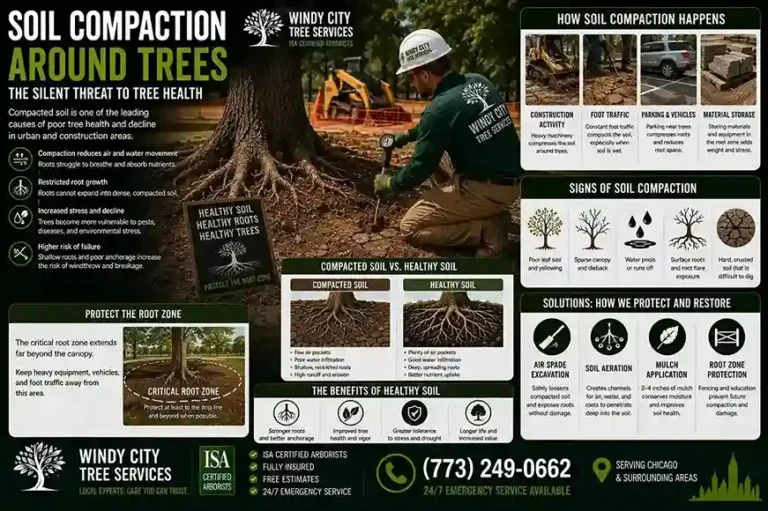
- Root-zone protection: Limiting compaction and heavy equipment near the root zone helps prevent the problem from getting worse.
- Professional assessment: An arborist can confirm whether the exposed roots are a cosmetic issue or a sign of a larger stability concern.
Avoid Burying or Cutting Exposed Roots on Your Own
Piling soil deeply over exposed roots can suffocate them, and cutting them without understanding their role can destabilize the tree. Both are common mistakes worth avoiding.
Should You Remove the Tree?
Tree removal should not be the automatic answer to a raised sidewalk. A mature, healthy tree provides shade, property value, and stormwater benefits that are worth weighing against the cost and disruption of removal.
Removal becomes a more reasonable option when:
- The tree has significant structural defects unrelated to the sidewalk issue
- There is clear evidence of instability or lean
- The tree shows advanced decline that limits its remaining lifespan
- The infrastructure conflict cannot realistically be managed through redesign or root pruning
- There is a documented safety concern that outweighs preservation
- No viable preservation option exists after professional evaluation
When none of these apply, redesigning the sidewalk or managing the root is usually the better path. When a tree does need to come down, our professional tree removal team can handle the work safely and with full cleanup.
Air Spade Root Excavation
An Air Spade uses a directed stream of compressed air to loosen and remove soil around roots without cutting or crushing them. Instead of digging with a shovel, which can slice through roots blindly, an arborist can expose the exact root structure and see what is actually happening below the sidewalk.
Applications include:
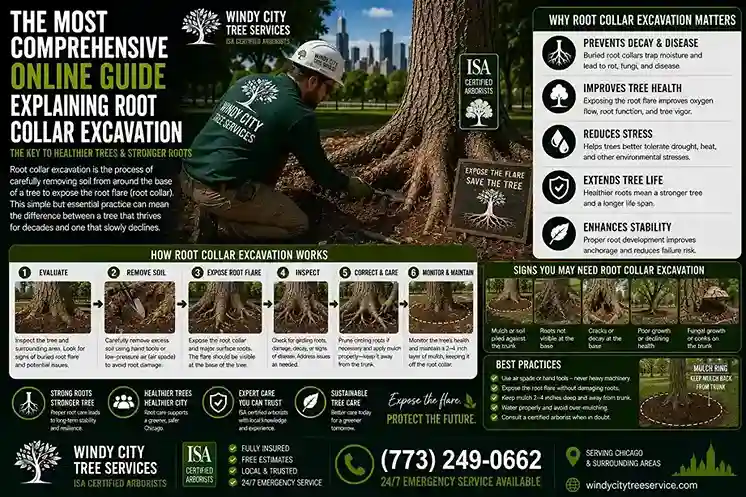
- Root collar excavation: Exposing the base of the trunk to check for buried root flare or early decay
- Root flare inspection: Confirming which roots are structural before any pruning decision is made
- Soil decompaction: Restoring oxygen exchange in compacted soil near the sidewalk without disturbing the roots
- Root inspection: Assessing root diameter, direction, and condition before a repair plan is finalized
- Construction damage assessment: Checking whether nearby excavation or grading has already affected the root system
- Identifying girdling roots: Finding roots that wrap around the trunk and could threaten long-term stability
- Tree preservation: Gathering the information needed to protect the tree while still fixing the sidewalk
Air Spade root excavation is often the single most useful step before deciding whether a root under a sidewalk can be pruned, bridged, or left alone. It answers the question a homeowner cannot answer by looking at a crack in the concrete.
Need to See What’s Happening Beneath the Soil?
Air Spade root excavation lets our arborists inspect the root zone directly, without guessing and without unnecessary mechanical damage to the tree.
How Arborists Assess Tree Root Problems
A thorough root assessment generally follows a consistent process:
- Inspect the tree’s overall canopy, structure, and general health
- Examine the sidewalk displacement and measure how much it has shifted
- Identify visible roots at the surface and near the crack line
- Evaluate the root collar and trunk base for signs of decay or instability
- Consider the tree’s species, age, and typical root behavior
- Assess which roots are structural and which are minor feeder roots
- Determine whether root pruning is appropriate, and how much
- Review hardscape alternatives like bridging, rerouting, or regrading
- Develop a preservation plan, or a removal recommendation if warranted
Not every crack near a tree is actually caused by that tree. Settling, freeze-thaw cycles, and an aging subbase can all mimic root damage, which is another reason a proper inspection matters before any concrete or roots are touched.
Tree Roots and Sidewalk Damage in Chicago
Chicago’s urban environment creates a specific set of challenges for street trees and the sidewalks around them.
- Mature street trees: Many Chicago blocks have decades-old trees with large, established root systems already close to the surface.
- Compacted urban soil: Heavy foot traffic, past construction, and clay-heavy native soil all limit how deep roots can comfortably grow.
- Narrow tree lawns: The strip between the curb and sidewalk is often just a few feet wide, leaving roots with limited room before they meet concrete.
- Freeze-thaw cycles: Chicago winters put repeated stress on concrete joints and cracks, which can accelerate damage that started with a root.
- Snow, ice, and salt exposure: Winter maintenance practices add another layer of wear to sidewalks already under stress from root growth.
- Nearby construction: Utility work, sidewalk replacement on adjacent lots, and building projects can disturb root systems and change how they grow going forward.
- Accessibility: A raised sidewalk is a bigger problem on a route used daily by people with mobility needs than on a rarely used side path.
These factors mean a repair plan that works in a different climate or a different soil type does not always transfer directly to a Chicago property. Local conditions shape the right solution.
Who Is Responsible for a Sidewalk Damaged by Tree Roots?
Responsibility for a damaged sidewalk can depend on several factors, including who owns the adjacent property, where the sidewalk sits relative to the property line, whether the tree is on public parkway or private land, and any applicable municipal program or ordinance.
Because local rules can change and vary by situation, property owners should confirm current requirements directly with the City of Chicago rather than relying on a general assumption. This guide does not state that the homeowner or the city is automatically responsible, since that depends on the specific circumstances involved.
Step-by-Step Action Plan
- Photograph the damage. Document the raised section from a few angles and note the approximate height of the lift.
- Identify the nearby tree. Note its species if you know it, and roughly how old or large it appears to be.
- Check for visible roots. Look at the crack line and slab edge for exposed root tissue.
- Measure the raised section. A rough measurement helps a contractor or arborist scope the job before a visit.
- Do not cut major roots yourself. Leave that decision and the work to a certified arborist.
- Have the tree and root zone assessed. A professional inspection, potentially including Air Spade excavation, confirms what is actually happening below the surface.
- Compare repair and preservation options. Weigh slab replacement, bridging, rerouting, and root pruning against the site’s constraints.
- Repair or redesign the sidewalk. Move forward with the option that fits the tree, the budget, and the site.
- Monitor the tree afterward. Check periodically for signs of stress following any root work.
Decision Tree: Sidewalk Raised by Tree Roots
How Much Does It Cost to Fix a Sidewalk Raised by Tree Roots?
There is no single price that applies to every job, since cost depends on a range of site-specific factors:
- The length and width of the affected sidewalk
- How much concrete has actually been damaged
- The size of the root or roots involved
- The size, species, and condition of the tree
- How easily equipment and crews can access the site
- Whether root excavation is needed to assess the problem first
- The scope of concrete removal and new installation
- Whether root pruning is part of the plan
- Whether a root barrier is being installed
- Whether engineering input is needed for a bridge or redesign
- Whether tree removal turns out to be necessary
Because these variables change from property to property, a firm number is not meaningful without an in-person assessment. Getting the tree and root zone evaluated first, before requesting a repair quote, generally leads to a more accurate estimate and a repair that actually lasts.
7 Mistakes to Avoid When Tree Roots Lift a Sidewalk
- Cutting roots without assessment. A quick cut can destabilize a tree that looked perfectly fine from above ground.
- Removing the tree immediately. Removal is sometimes necessary, but it should follow an evaluation, not replace one.
- Pouring new concrete over the problem. Without addressing the root, the new slab often fails again within a few years.
- Ignoring the root zone. Treating the crack as a purely cosmetic issue misses the underlying cause.
- Repeatedly patching the same area. Short-term patches rarely solve a problem driven by ongoing root growth.
- Burying exposed roots improperly. Piling soil too deep over roots can suffocate them instead of protecting them.
- Failing to consider future growth. A repair that fits today’s root size may not fit the same root in five years.
Frequently Asked Questions
How do you fix a sidewalk raised by tree roots?
The fix depends on the root and the tree. Options include replacing the damaged slab, adjusting the grade, bridging over the root, rerouting the walkway, or pruning a smaller root after a professional assessment confirms it is safe to remove.
Can tree roots lift concrete?
Yes. As a root grows and thickens over time, it can gradually raise a concrete slab sitting above it, especially in compacted soil where the root has limited room to spread in other directions.
Can I cut a tree root lifting my sidewalk?
Sometimes, but only after the root’s size and role have been evaluated. Small feeder roots may be manageable in some cases. Large structural roots should not be cut without a professional assessment first.
Is it safe to cut roots under a sidewalk?
It depends entirely on the root. Cutting a minor root usually carries less risk than cutting a large structural root close to the trunk, which can affect the tree’s stability and long-term health.
What happens if you cut a large tree root?
Cutting a large structural root can reduce the tree’s anchorage, disrupt water and nutrient flow, and create an entry point for decay or disease. The severity depends on how much of the root system is affected.
How do you repair sidewalk damage caused by tree roots?
Common approaches include slab replacement, grade adjustment, bridging, rerouting the walkway, and careful root pruning where appropriate. The right combination depends on the site and the tree.
Can you repair a sidewalk without removing the tree?
In most cases, yes. Removal is rarely the first or only option. Redesign strategies like bridging, rerouting, and grade adjustment often let the sidewalk and the tree coexist.
Can a sidewalk be built over tree roots?
Yes, through a bridge or suspended walkway design that spans the root zone instead of resting directly on it. This protects the root while restoring safe passage above it.
What is a sidewalk bridge over tree roots?
It is a raised section of walkway supported by footings placed outside the critical root zone, allowing the root below to keep growing undisturbed while people walk safely above it.
How do you prevent tree roots from lifting sidewalks?
For new installations, give trees adequate rooting space, choose appropriate species, use structural soil where needed, and consider root barriers at planting time rather than after damage occurs.
Can root barriers stop sidewalk damage?
Root barriers can redirect growth away from a sidewalk when installed early, but they are not a guaranteed fix for an established tree whose roots are already under the concrete.
What trees are least likely to damage sidewalks?
No species is guaranteed damage-free, but trees suited to the available planting space and known for deeper root growth tend to cause fewer conflicts. A local arborist can recommend species that fit a specific site.
How do you fix concrete lifted by tree roots?
Typical fixes include slab replacement, leveling where structurally appropriate, root management, and sidewalk redesign. Pouring new concrete without addressing the root often leads to the same damage returning.
How do you fix pavers lifted by tree roots?
Remove the affected pavers, evaluate the root, adjust the base material to accommodate it, and reinstall the pavers with appropriate spacing for continued root growth.
Can tree roots damage asphalt driveways?
Yes. Asphalt flexes more than concrete, which can delay visible damage, but a large enough root will eventually cause buckling or rippling in the surface.
Why are tree roots coming out of the ground?
Exposed roots are usually a sign of shallow rooting caused by compacted soil, limited planting space, or erosion around the base of the tree over time.
Are exposed tree roots dangerous?
They can be a trip hazard, and in some cases a sign of a larger stability issue. A professional assessment can determine whether exposed roots are cosmetic or a bigger concern.
When should a tree causing sidewalk damage be removed?
Removal is worth considering when the tree has significant structural defects, instability, advanced decline, or an infrastructure conflict that cannot reasonably be managed another way.
What is Air Spade root excavation?
An Air Spade uses compressed air to loosen soil around roots without cutting them, allowing an arborist to inspect the root system directly before deciding on a repair plan.
How do arborists inspect roots under a sidewalk?
They evaluate the tree’s overall health, examine the displacement, identify visible roots, and often use Air Spade excavation to see the root structure directly before recommending pruning, bridging, or another repair.
Key Takeaways
- Tree roots lift sidewalks gradually as they grow and thicken in compacted, shallow soil, not through sudden force.
- Small feeder roots may sometimes be pruned safely, but large structural roots should be assessed before anything is cut.
- Repair options beyond simple replacement include grade adjustment, bridging, rerouting, and flexible pavement systems.
- Air Spade root excavation is the most reliable way to see what is actually happening beneath a sidewalk without harming the roots.
- Tree removal is rarely the first solution and should follow a professional evaluation, not replace one.
- Chicago’s compacted soil, narrow tree lawns, and freeze-thaw cycles make root-related sidewalk damage especially common.
- Responsibility for repair depends on property and municipal specifics, so confirm current rules with the City of Chicago.
Protect Your Sidewalk and Your Tree
A raised sidewalk does not always mean the tree must be removed. The right solution starts with understanding the tree, its roots, and the surrounding hardscape.
Windy City Tree Services provides tree root inspections, Air Spade root excavation, root-zone assessment, tree preservation, soil decompaction, tree health inspections, root management, and professional tree removal when necessary.