Volcano Mulching Trees: Why It Is Harmful and How to Fix It
Home / Blog / Volcano Mulching Trees
TREE HEALTH & ROOT CARE
Volcano Mulching Trees: Why It Is Harmful and How to Fix It
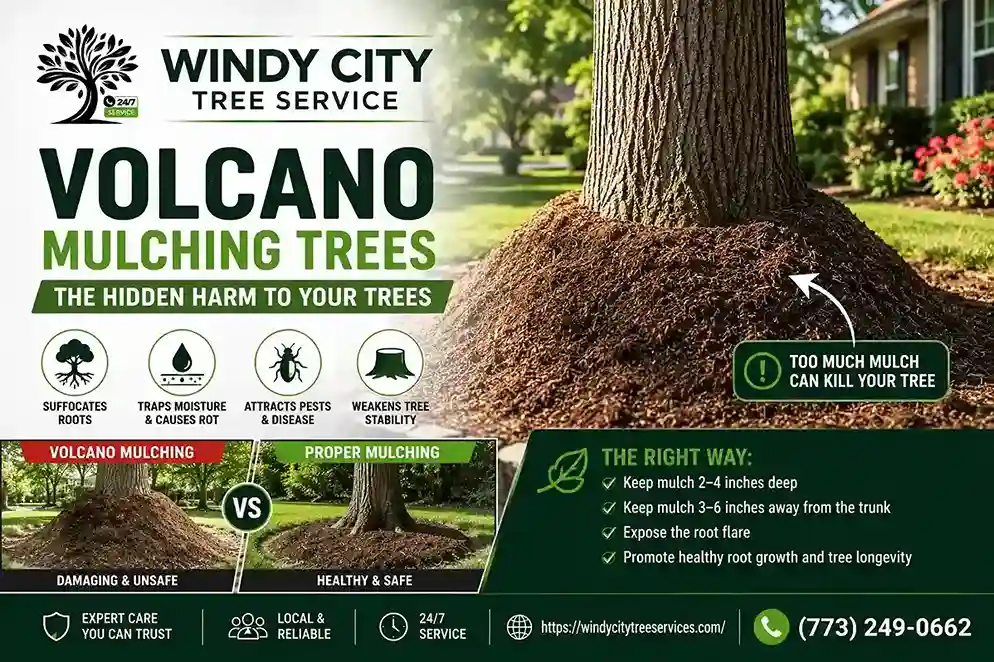
Left: a mulch volcano piled against the trunk. Right: a properly mulched tree with the root flare visible.
Volcano mulching is when mulch is piled high against a tree’s trunk, forming a cone-shaped mound that looks like a small volcano. It’s one of the most common tree-care mistakes in Chicago yards and parkways, and it’s almost always avoidable.
Mulch itself is good for trees. A mulch volcano is not. Mulch is beneficial. A mulch volcano is not. The fix is simple once you understand what proper mulching should look like: a broad, shallow ring that keeps mulch away from the trunk and leaves the root flare visible.
What Is Volcano Mulching?
Volcano mulching is the practice of piling mulch several inches or more deep directly against a tree’s trunk, creating a cone-shaped mound. It’s considered improper tree care because it traps moisture against the bark, buries the root flare, and can encourage decay, pests, and poor root development over time.
Is Volcano Mulching Bad for Trees?
Piling mulch against the trunk can:
- Keep bark excessively moist
- Encourage decay
- Create favorable conditions for pests
- Hide the root flare
- Reduce oxygen availability when mulch is excessively deep
- Encourage undesirable root growth
- Contribute to long-term tree decline
Applied correctly, though, mulch provides real benefits — see the benefits of proper mulching below.
What Is Volcano Mulching?
Volcano mulching gets its name from its shape: a tall, cone-shaped pile of mulch stacked directly against the trunk, with the tree rising out of the center like a volcano’s peak. It’s usually built up gradually, one mulch application at a time, rather than created in a single visit.
It’s easy to spot once you know what to look for. Instead of a wide, flat ring, the mulch rises steeply right where it meets the bark. The trunk often looks like it’s emerging from a mound rather than widening naturally at the base.
Homeowners and landscaping crews don’t create mulch volcanoes on purpose. It happens because a tidy-looking mound seems like good coverage, and because new mulch often gets added on top of old mulch without checking how deep it already is. A neat-looking bed can still be a biologically harmful one — appearance and horticultural health aren’t the same thing.
Why Do People Create Mulch Volcanoes?
Volcano mulching is common, and it’s rarely intentional neglect. A few patterns explain why it keeps happening across Chicago yards and commercial properties:
- A tall, defined mound looks neat and finished from the curb.
- It creates a clearly outlined landscape bed around the tree.
- Many people assume more mulch means more protection.
- Existing mulch depth isn’t checked before a new layer goes down.
- Landscaping crews refresh beds on a schedule without measuring what’s already there.
- Homeowners copy what they see at other properties, assuming it must be correct.
None of these reasons are unreasonable — they’re just disconnected from what a tree’s trunk and root flare actually need.
Why Is Volcano Mulching Harmful?
A mulch volcano doesn’t cause one single problem — it creates a cluster of conditions that add up over months and years. Here’s what’s happening under that neat-looking cone.
1. Excess Moisture Against the Bark
Tree bark isn’t designed to stay wet indefinitely. Trunks develop above ground specifically because that environment is drier and better ventilated than the soil. Constant contact with damp mulch keeps bark wet far longer than nature intended, softening tissue that’s normally exposed to air.
2. Bark Decay
Prolonged moisture at the trunk base can contribute to bark deterioration. Once bark starts to break down, it opens the door to decay organisms that a healthy, dry trunk would normally keep out.
3. Insects and Pests
A thick, damp mulch pile against the trunk creates a sheltered microhabitat. Some insects that would otherwise stay in the soil or leaf litter are drawn to that moisture and cover, right where they can reach the bark.
4. Rodent Damage
Mulch volcanoes also give rodents cover close to the trunk. Voles and other small animals can chew on bark hidden beneath the mound, sometimes causing damage that isn’t discovered until the mulch is pulled back.
5. Root Problems
Roots are opportunistic. When there’s a constant supply of moist organic material sitting above the natural soil line, fine roots can grow up into the mulch layer instead of developing normally in the soil below.
6. Reduced Oxygen Availability
Tree roots need oxygen just as much as they need water. A deep mulch layer, especially with fine-textured material, can limit gas exchange at the soil surface, reducing the oxygen available to the root zone.
7. Buried Root Flare
The root flare is meant to stay visible above ground. When mulch buries it for years, that area holds moisture against tissue that was never designed to be underground, and it becomes far harder for anyone to spot developing problems.
8. Girdling Roots
Roots that develop in the unfavorable conditions created by a mulch volcano can eventually grow across the trunk or other roots instead of outward. Over years, this can create a structural problem known as girdling, discussed in more detail below.
What Is the Root Flare?
The root flare — also called the root collar — is the area where a tree’s trunk widens at its base before transitioning into the main structural roots. On a healthy, correctly planted and mulched tree, this flare should be visible above the soil and mulch line, not buried.
The root flare matters because it’s one of the first places an arborist looks during an inspection. When it’s buried under mulch or soil, evaluating trunk health, spotting decay, or catching girdling roots early becomes much harder — for a homeowner and for a professional.
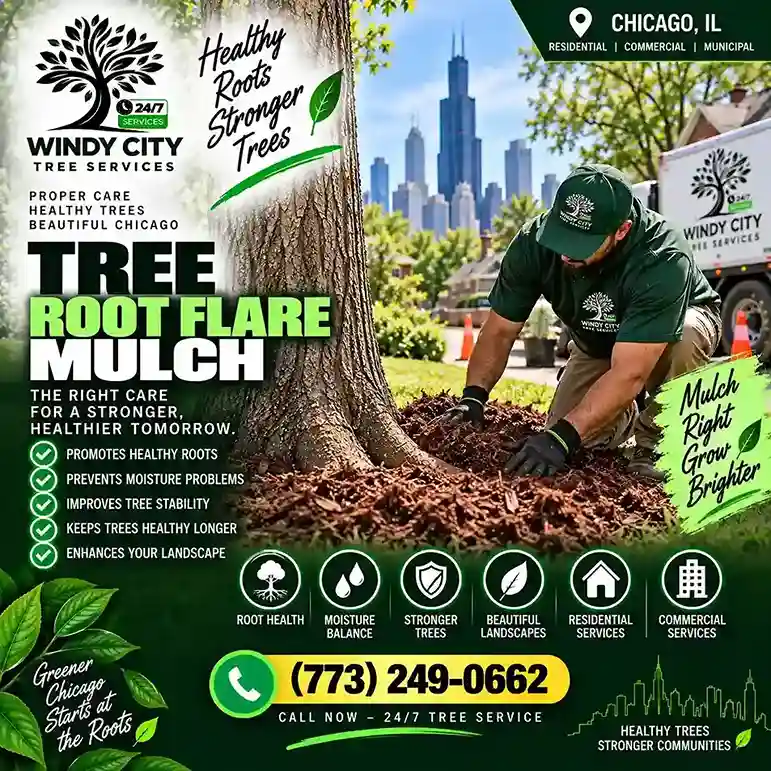
How Much Mulch Should You Put Around a Tree?
Exact recommendations can vary depending on mulch material, tree size, and soil conditions, but a practical general guideline works for most established landscape trees.
Fine-textured mulch tends to pack down and hold moisture more than coarse material, so a shallower application is usually appropriate when using it. Deeper isn’t better — piling mulch beyond a few inches doesn’t add meaningful benefit and starts working against the tree instead.
How Far Should Mulch Be From the Tree Trunk?
Mulch should never touch the trunk. That single rule prevents most volcano-mulching problems before they start.
Where more specific guidance is useful, some extension recommendations suggest several inches of clearance at minimum, while other guidance recommends an even larger clear area around the base, particularly for larger or more mature trees. There isn’t one exact number that applies to every tree — the goal is a gap you can clearly see, with the root flare exposed and the bark dry.
The Right Way to Mulch a Tree
- Remove excessive old mulch. If prior applications have built up, rake away the excess before adding anything new.
- Expose the root flare carefully. Gently pull mulch and soil back until the trunk’s natural widening is visible.
- Keep mulch away from the trunk. Leave a clear ring of open space around the bark.
- Spread mulch evenly. Aim for a consistent layer rather than mounding it in any one spot.
- Maintain an appropriate depth. Stick to roughly 2–3 inches, adjusted for mulch texture.
- Create a wide mulch ring. A broader ring benefits more of the root zone than a narrow one against the trunk.
- Extend the mulch area outward where practical. A larger, well-maintained ring reduces turf competition near the roots.
- Check the depth before adding more. Measure existing mulch each season before topping it off.
Think Donut, Not Volcano
If you only remember one phrase from this guide, make it this one: mulch wide, not deep. Think donut, not volcano.
Volcano
Tall, narrow pile stacked directly against the trunk, burying the root flare.
Donut
Wide, shallow ring with an open center that keeps the trunk and root flare visible.
Benefits of Proper Tree Mulching
None of this makes mulch the enemy. Correctly applied mulch is one of the easiest ways to improve a tree’s growing environment:
- Conserves soil moisture
- Moderates soil temperature
- Reduces competition from turf grass
- Protects soil structure
- Reduces mower and string-trimmer damage near the trunk
- Adds organic matter to the soil as it decomposes
- Improves the visual appearance of landscape beds
- Supports healthier conditions in the root zone
These benefits only hold up when mulch is applied the right way — wide, shallow, and away from the bark.
Can Too Much Mulch Kill a Tree?
Excessive or improperly placed mulch can contribute to serious tree health problems, and in severe or prolonged cases, it can contribute to tree decline or death. That said, not every mulch volcano kills the tree it surrounds.
How much it matters depends on several factors working together: the tree species, how long the mulch volcano has existed, how deep it is, the surrounding soil conditions, local climate, and the tree’s existing health going in. A young, otherwise healthy tree with a recently formed mulch volcano is in a very different position than a mature tree that’s had one for a decade.
Signs Your Tree Has Been Over-Mulched
- Trunk buried in mulch
- Root flare cannot be seen
- Mulch several inches deep or more
- Mulch touching bark
- Bark deterioration
- Soft or damaged bark
- Surface roots growing into the mulch
- Mushrooms or fungal growth near the trunk
- Pest activity at the base
- Declining canopy
- Poor overall vigor
- Abnormal root development
These signs point toward a mulch problem, but they don’t prove mulch is the only cause of a tree’s decline. Other stressors — drought, construction damage, disease — can look similar and sometimes overlap.
Is Your Tree Buried in Mulch?
If mulch has been piled against your tree for years, don’t assume the problem is only cosmetic. The root flare, bark, and surrounding root zone may need a closer look.
📞 (773) 249-0662 Schedule a Tree Health InspectionHow to Fix a Mulch Volcano
For a Recently Created Mulch Volcano
If the mound is new, excess mulch can usually be removed carefully by hand. Pull it back from the trunk gradually, re-expose the root flare, and reshape what’s left into a wide, shallow ring.
For Long-Term Over-Mulching
Professional evaluation is worth considering when:
- The root flare is deeply buried
- Large roots are exposed once mulch is pulled back
- Girdling roots may be present
- The trunk shows signs of decay
- The tree already appears to be declining
- The mulch has been repeatedly applied for years
Avoid aggressively excavating around structural roots yourself. Careful, gradual removal is safer than digging in with a shovel near roots you can’t yet see.
Can You Save a Tree After Volcano Mulching?
Recovery is possible, and many trees do bounce back once the mulch problem is corrected. Whether a specific tree recovers depends on:
- How long the over-mulching lasted
- How much mulch was involved
- The tree’s species
- The tree’s age
- Its existing health before the mulch volcano formed
- Root condition once exposed
- Bark condition
- Whether girdling roots have developed
- The extent of any decay
Correcting the mulch problem as early as possible reduces how much continued stress the tree experiences, which generally improves the odds of recovery.
Air Spade Root Flare Excavation
When mulch or soil has buried a root flare for years, simply raking it back by hand isn’t always enough to see what’s underneath, especially if roots have grown into the buried area. This is where an Air Spade comes in.
An Air Spade uses compressed air to excavate soil and mulch around tree roots without cutting or damaging them. Arborists use it for:
- Root flare excavation
- Root collar inspection
- Soil decompaction
- Root-zone assessment
- Identifying girdling roots
- Construction-related root assessment
- Tree preservation work
Learn more about the process in our guide, What Is Air Spade Root Excavation?, or see our Air Spade root excavation service page.
Need to Expose a Buried Root Flare?
Professional Air Spade excavation lets arborists inspect the root zone while avoiding unnecessary mechanical disturbance to fine roots.
📞 (773) 249-0662 Learn About Air Spade Root ExcavationVolcano Mulching and Girdling Roots
Girdling roots are roots that grow across the trunk, or across other roots, instead of outward into open soil. As the tree and root both continue to grow, the girdling root can compress the trunk’s vascular tissue, gradually restricting the movement of water and nutrients.
Volcano mulching creates conditions that make girdling roots more likely, since roots may grow up into the mulch layer instead of outward as they normally would. A buried root flare also makes girdling roots much harder to detect — you can’t see a problem you can’t see the base of the trunk for.
Not every root growing near the trunk is automatically a girdling root, though. Professional assessment is the reliable way to tell the difference between normal surface roots and a developing structural issue.
Mulch Around Newly Planted Trees
Newly planted trees need mulch just as much as mature ones, but a few extra details matter while the root ball is establishing:
- Keep mulch off the root ball’s original soil line — don’t bury it deeper than it was grown.
- Watch moisture closely; a newly planted tree’s limited root system is more sensitive to both drought and waterlogging.
- Maintain clear trunk clearance from day one, since young bark is especially vulnerable.
- Keep the root flare visible right from planting rather than “fixing” it later.
- Use a modest mulch depth rather than a thick layer meant to look finished immediately.
- Check on the tree periodically during its first year or two as it settles in.
Burying a newly planted tree deeper with mulch creates the same problems as an old mulch volcano — it just starts the clock earlier in the tree’s life.
Mulching Mature Trees
Mature trees have wide, established root zones, so a wide mulch ring benefits far more of the root system than a narrow one pressed against the trunk. Keep these points in mind:
- Extend the mulch ring outward rather than piling more depth near the trunk.
- Keep the root flare visible, even on trees that have been mulched the same way for years.
- Avoid repeated buildup — refresh existing mulch instead of always adding a new layer.
- Check old mulch depth before adding new material each season.
Mulch never needs to be piled directly against a mature tree’s trunk — the tree gets the same soil benefits from a wide ring several feet out.
What Type of Mulch Is Best for Trees?
Several organic mulch materials work well for trees, and there isn’t one option that’s universally best for every situation:
- Arborist wood chips — a coarse, varied-texture material often available locally.
- Shredded bark — widely available and commonly used in residential landscaping.
- Hardwood mulch — decomposes over time and adds organic matter to soil.
- Leaf mulch — a low-cost option for properties with significant leaf litter.
Texture, decomposition rate, moisture retention, availability, and how a bed is maintained all factor into which material makes the most sense for a given property.
Mulch vs. Wood Chips
| Feature | Mulch | Wood Chips |
|---|---|---|
| Appearance | Uniform | Natural |
| Decomposition | Varies | Often slower |
| Moisture retention | Good | Good |
| Soil organic matter | Yes | Yes |
| Availability | High | Often locally available |
| Tree beds | Suitable | Often excellent when properly applied |
Arborist wood chips can be a useful mulch material for trees, and many Chicago properties can source them locally through our wood chip supply service.
10 Tree Mulching Mistakes to Avoid
- Piling mulch against the trunk.
- Making mulch too deep.
- Covering the root flare.
- Adding new mulch without checking old mulch first.
- Creating narrow mulch volcanoes instead of wide rings.
- Using mulch to bury exposed roots rather than addressing the cause.
- Using excessive fine-textured mulch that compacts and holds moisture.
- Ignoring early signs of bark damage.
- Disturbing roots unnecessarily during cleanup.
- Failing to monitor tree health after mulching.
Chicago Tree Mulching Tips
Chicago’s climate and urban conditions make proper mulching especially useful for local trees. A wide, correctly applied mulch ring can help moderate soil conditions through:
- Chicago’s seasonal temperature swings between hot summers and freezing winters
- Winter freezing at the soil surface
- Summer heat stress on shallow roots
- Urban soil compaction common in city lots and parkways
- Root competition around mature street trees
- Turf competition in residential landscapes
- Salt exposure near sidewalks and streets
- Limited rooting areas in tree lawns and parkway strips
None of that changes the core rule, though — the mulch still needs to stay wide, shallow, and off the trunk to actually help.
Should You Call an Arborist?
A professional assessment makes sense when:
- The root flare is deeply buried
- The trunk is covered with thick mulch
- Bark is deteriorating
- Large roots are exposed
- Girdling roots are suspected
- The tree is declining
- The tree is mature or particularly valuable to the property
- Nearby construction has disturbed the root zone
- You’re unsure how much material should be removed safely
How Much Does It Cost to Fix a Mulch Volcano?
There’s no single price that applies everywhere — cost depends on several factors:
- Tree size
- Amount of mulch involved
- Depth of buried material
- Root flare condition once exposed
- Whether girdling roots are present
- Overall tree health
- Site accessibility
- Whether Air Spade excavation is needed
- Whether additional tree treatment is recommended afterward
Simple mulch removal and reshaping can be a straightforward, low-cost visit. Buried root flare problems that need excavation or a full health assessment typically call for a professional look before any price can be estimated accurately.
Frequently Asked Questions
What is volcano mulching?
Volcano mulching is the practice of piling mulch into a tall, cone-shaped mound against a tree trunk. It gets its name from the shape, which resembles a volcano with the trunk rising from the center.
Why is volcano mulching bad for trees?
Volcano mulching keeps bark constantly damp, buries the root flare, can encourage decay and pests, and may push roots to grow up into the mulch instead of down into the soil.
Is volcano mulching harmful?
Yes. Most arborists and university extension programs consider volcano mulching an improper practice because of the moisture, decay, and root problems it can create over time.
Can mulch kill a tree?
Excessive or improperly placed mulch can contribute to serious tree health problems and, in severe or prolonged cases, decline or death. It depends on species, duration, depth, and existing tree health.
Should mulch touch the tree trunk?
No. Mulch should never touch the bark. Leave a clear, visible gap around the trunk and root flare so the bark stays dry.
How much mulch should I put around a tree?
About 2 to 3 inches of mulch is commonly appropriate for established landscape trees, spread in a wide, even layer, not piled deep.
How deep should mulch be around trees?
A shallow layer, generally 2 to 3 inches, is usually enough. Going deeper, especially with fine-textured mulch, can reduce oxygen to the roots.
How far should mulch be from the trunk?
Leave several inches of clear space at minimum, with a visibly open ring around the trunk and root flare. Larger trees benefit from an even wider clear zone.
What does proper tree mulching look like?
A wide, shallow, donut-shaped ring that keeps the root flare visible and the mulch pulled back from the bark, rather than a tall cone pressed against the trunk.
What is a mulch volcano?
A mulch volcano is a tall, cone-shaped pile of mulch stacked directly against a tree’s trunk, usually built up over repeated mulch applications.
How do you fix a mulch volcano?
Carefully pull excess mulch away from the trunk by hand, expose the root flare, and re-spread the remaining mulch into a wide, shallow ring. Long-term buildup may need professional evaluation.
Can an over-mulched tree recover?
Many trees recover once mulch is corrected early, but recovery depends on how long the mulch volcano existed, the tree’s species and age, and whether decay or girdling roots have developed.
What happens if mulch covers the root flare?
A buried root flare traps moisture against the bark, hides developing problems from view, and can encourage roots to grow inward and eventually girdle the trunk.
What is a tree root flare?
The root flare is the area where the trunk widens at its base before transitioning into the main roots. It should remain visible above the soil and mulch line.
What are girdling roots?
Girdling roots are roots that grow across or around the trunk or other roots instead of outward. Over time they can restrict the flow of water and nutrients and weaken the tree’s structure.
Can mulch cause root rot?
Excess mulch piled against the trunk can trap moisture and create conditions that favor decay-causing fungal pathogens, particularly at the base of the trunk.
Does mulch attract insects around trees?
Thick mulch against the trunk can create a humid, sheltered habitat that some insects and rodents favor, which can lead to bark damage over time.
What is the best mulch for trees?
Organic mulches such as arborist wood chips or shredded bark are commonly used for trees. The best choice depends on texture, availability, and how the bed is maintained.
Are wood chips good for trees?
Arborist wood chips can be an excellent mulch material for trees when applied in a shallow, wide layer kept away from the trunk.
Should mulch be removed before adding new mulch?
Check the existing mulch depth first. If it’s already 2 to 3 inches, rake and refresh it rather than piling new mulch on top, which is how volcanoes form over time.
Can you use an Air Spade to expose tree roots?
Yes. Arborists use Air Spade equipment, which excavates soil and mulch with compressed air, to expose the root flare and inspect roots without cutting or damaging them.
When should I call an arborist about mulch around a tree?
Call an arborist if the root flare is deeply buried, bark shows decay, large roots are exposed, girdling roots are suspected, or the tree’s canopy is declining.
Professional Tree Care in Chicago
Windy City Tree Services provides professional tree care for properties across Chicago, including the assessment and correction work a mulch volcano can call for:
Related Reading
Give Your Trees the Right Kind of Mulch
Mulch can be one of the simplest ways to improve a tree’s growing environment — but only when it’s applied correctly. If your tree has a mulch volcano, buried root flare, exposed roots, bark damage, or other root-zone concerns, our ISA-certified arborists can help.
📞 (773) 249-0662 Request a Free Estimate