
We’re Based Right Here in West Loop
Windy City Tree Services operates out of Carroll Avenue, just inside the neighborhood’s northern edge. We don’t drive in from the suburbs and leave. We’re here most days, and we see exactly what West Loop’s construction pace does to trees over time: root zones cut by new utility trenches, young street trees planted without adequate soil volume, and canopies that get clipped by delivery trucks on narrow Fulton Market blocks.
We work with restaurant owners on Randolph Street, condo developers near Halsted and Washington, and commercial property managers throughout the Fulton Market corridor. If you manage a building in West Loop, we already know your neighborhood’s specific tree challenges, and we plan jobs around your loading dock schedule, patio hours, and active construction calendar.
West Loop’s tree canopy is still catching up to the pace of development here. That creates a wider range of needs than almost any other part of downtown: newly planted trees that need careful establishment care, older survivors from the industrial era that need structural attention, and everything in between. We handle all of it.
If you’re managing a restaurant, condo association, or commercial building and want a consistent crew who can show up reliably, work quickly without disrupting business operations, and give you straight answers about what your trees actually need, that’s exactly what we do. Browse our full service list or call us directly for a free walk-through of your property.
Quick Contact
Call or email for a free on-site estimate in West Loop and surrounding neighborhoods.
Phone: (773) 249-0662
Email: info@windycitytreeservices.com
Address: 323 W Carroll Ave, Chicago, IL 60612
About West Loop’s Trees and Why They’re Different
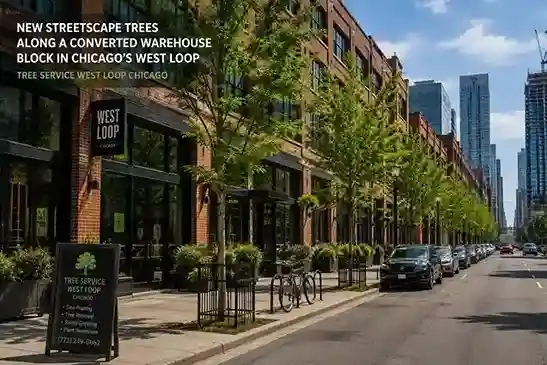
West Loop grew out of the old Fulton Street meatpacking corridor. Most of the neighborhood’s recognizable buildings are converted brick-and-timber warehouses, and the land itself sat in active industrial use until relatively recently. That history matters for trees: the soil in many West Loop parcels is highly compacted, often mixed with rubble and fill, and carries salt and chemical residue from decades of industrial activity. Newly planted street trees frequently struggle here more than in residential neighborhoods where the soil profile is cleaner.
Over the past fifteen years, the neighborhood transformed into Chicago’s top restaurant district, anchored by Randolph Street’s Restaurant Row, and it now hosts major tech and corporate offices including Google’s Chicago headquarters in the old Fulton Market Cold Storage building. Every development wave brought streetscape improvements and new tree plantings alongside construction, which explains the mixed canopy situation: a few older street trees that survived from the industrial era, and a large number of recently planted specimens still working through the establishment period.
Mary Bartelme Park and Skinner Park provide the primary green space for West Loop residents, both small relative to the neighborhood’s density and population. Both deal with heavy foot traffic and compacted soil. For most West Loop properties, street trees and private landscaping carry most of the urban canopy load, and keeping those trees healthy requires a different approach than suburban tree care.
The street tree program in West Loop has expanded considerably as part of city streetscape initiatives tied to major development projects. Newer corridors like Green Street and Morgan Street have tree pits built into the sidewalk with structural soil cells underneath, which improves root development considerably compared to older installations. But even with better engineering, the overall soil volume available to a street tree in this neighborhood is still limited, and supplemental care, particularly watering in the first three years and periodic root zone treatment afterward, makes a measurable difference in survival and canopy development over the long term.
How Chicago Weather Affects West Loop Trees
West Loop sits far enough inland that it misses the direct lake wind that batters Streeterville and the lakefront neighborhoods, but that doesn’t mean the weather is gentle here. The neighborhood’s wide, industrial-scale streets and inconsistent building height create their own wind patterns, especially under the Lake Street elevated tracks where airflow can channel and accelerate unpredictably. During severe summer storms, young trees in exposed streetscape pits take the full brunt of straight-line wind with very little protection from neighboring structures.
Summer Heat Stress
Brick and concrete warehouse facades reflect heat significantly, raising air temperatures in loading dock areas and narrow alleys to levels that stress both newly planted trees and older urban specimens during prolonged heat events.
Winter Salt Damage
Delivery-heavy streets like Randolph and Fulton receive heavy road salt applications all winter. Salt accumulates in tree pit soil and reaches root systems through spring snowmelt. Newly planted trees are especially vulnerable in their first two to three winters.
Storm Wind Exposure
Summer storm wind funnels unpredictably through the mix of low warehouses and new high-rise towers throughout West Loop. Young trees without proper staking or structural support frequently lean or partially uproot during fast-moving storm systems. We respond to these calls regularly in the 24 hours after a major storm.
Common Tree Species in West Loop
The species mix in West Loop reflects both the neighborhood’s industrial history and its recent development priorities. City streetscape planners have moved toward salt-tolerant, pollution-hardy species that can establish in challenging soil conditions, and you see that clearly in what’s planted along Fulton Market and the newer commercial corridors.
| Species | Where Found | Common Care Needs |
|---|---|---|
| Honey Locust | Default new streetscape planting throughout Fulton Market and commercial corridors | Establishment watering, structural pruning, thorn management near pedestrian areas |
| Kentucky Coffeetree | Newer commercial developments, some parkway plantings near Madison and Washington | Minimal pruning needs once established; pod cleanup in fall near patios |
| London Plane Tree | Wider plazas and park installations, including near Mary Bartelme Park | Routine crown cleaning, monitoring for anthracnose, root zone aeration |
| Linden | Some restaurant patio plantings and residential landscaping | Aphid monitoring for honeydew management; important near outdoor dining |
| Ornamental Pear | Newer residential landscaping in condo and townhome developments | Storm damage risk due to tight branch angles; structural pruning when young |
A large share of our West Loop work involves establishment care for recently planted trees, plus pruning to keep growth clear of restaurant awnings, patio umbrellas, and outdoor dining furniture. We also handle structural assessments for ornamental pears showing the tight, upright branching that tends to split in ice storms.
Species selection matters a lot at the planning stage, before a tree goes in the ground. If you’re working with a developer or landscape architect on a new project in Fulton Market, we’re happy to review proposed plantings and flag species that are likely to struggle given the site’s soil, sun exposure, and proximity to delivery traffic. That conversation is much easier before installation than after.
For trees already showing stress or structural problems, our tree health inspection service and storm prep assessments give you a documented picture of what each tree needs and how urgent it is.
Property Types We Serve in West Loop
Converted Warehouse Lofts & Offices
Historic Fulton Market buildings with exposed brick and timber construction. We use protective padding and careful rigging around landmark facades during any work near building exteriors.
New-Construction High-Rises
Towers along Halsted, Madison, and Washington with courtyard trees and streetscape plantings that are often in early establishment. We work with property managers and HOAs on maintenance programs from the first growing season forward.
Restaurants with Outdoor Patios
Tree canopy directly affects the dining experience on Randolph Street and throughout Fulton Market. We coordinate scheduling with patio hours and help operators manage linden honeydew, low limbs over umbrella heights, and storm risk before it affects service.
Corporate Offices
Tech and media tenants throughout West Loop want well-maintained grounds without service disruption. We schedule around business hours and deliver written reports when facility managers need documentation.
Active Development Sites
West Loop has ongoing construction throughout the neighborhood. We advise on tree protection during excavation and foundation work, and offer land clearing for sites where removal is necessary before breaking ground.
Parks & Public Green Space
Mary Bartelme Park and Skinner Park both deal with compacted soil and high foot traffic. We support municipal and parks maintenance work with root zone treatments, air spade service, and crown care for established park trees.
Services Available in West Loop
From routine pruning to emergency response, we offer the full range of tree care services throughout West Loop and surrounding neighborhoods.
Getting to Our West Loop Service Area
We’re based at 323 W Carroll Ave in West Loop, and we serve properties throughout the neighborhood. Here’s how to find us from surrounding areas:
- From Union Station: head west on Adams or Jackson into the West Loop grid, then north to reach Fulton Market and Carroll Avenue.
- From Willis Tower: west on Adams Street toward Halsted, then north through the commercial corridor.
- From I-290: exit east toward downtown and continue into West Loop via the Halsted or Racine approach.
- From I-90/I-94: exit toward West Loop or Fulton Market and head west from the expressway toward the neighborhood.
- From Millennium Park: west on Washington or Randolph, crossing into West Loop just past the Chicago River.
Nearby Neighborhoods We Also Serve
If your property is closer to another area, we serve these neighborhoods as well:
Why Professional Tree Care Matters More in West Loop Than Most Neighborhoods
In a residential neighborhood with large lots and setbacks, a tree failure is a serious problem but usually a contained one. In West Loop, the same failure means a limb landing on a pedestrian, a diner, a delivery vehicle, or one of the hundred people walking through Fulton Market on a busy Saturday night. The density of the neighborhood and the volume of foot and vehicle traffic mean that a structural failure that might be minor in a suburban backyard becomes a major liability event here.
That’s not meant to be alarming. It’s just the honest reason why commercial properties in this neighborhood benefit from documented, professional tree assessments rather than a visual check once a year. A written risk assessment by a qualified arborist creates a record that demonstrates due diligence, which matters both for liability management and for insurance documentation. If a tree has been professionally inspected and a known defect was addressed, that’s a fundamentally different situation than an uninspected tree that fails during a storm.
For property managers and HOA boards, the practical question is often what to budget and when. Our approach is to triage: identify the trees with the highest likelihood of failure near the highest-traffic areas first, address those on the current cycle, and build a multi-year maintenance schedule for the rest. That way you’re not reacting to every storm with emergency removal costs, and you’re not deferring everything until something breaks. Most West Loop commercial clients find a structured annual or biannual plan is both more predictable for budgeting and meaningfully better for the trees than ad-hoc service calls.
If you’d like to start with a simple consultation about the trees on your property, call us at (773) 249-0662 or use the contact form to request a free estimate. We’ll come out, walk the property with you, and give you a clear picture of what’s there and what it needs.
Frequently Asked Questions: Tree Service in West Loop
Why does West Loop have so many newly planted trees?
Most of the neighborhood was redeveloped over the past fifteen years from warehouses into restaurants, offices, and residential towers. Street trees were planted alongside that construction, so the canopy is young compared to established residential neighborhoods with decades of tree growth already in place.
Do you work around restaurant patio hours?
Yes. We coordinate scheduling with restaurant operating hours throughout Fulton Market and Randolph Street so tree work doesn’t interfere with outdoor dining or prep time. Early morning start times are common for high-traffic restaurant blocks.
Can tree roots interfere with construction near Fulton Market?
It’s possible, particularly where trees are planted close to building foundations or existing utility lines. An on-site inspection can identify whether roots pose a concern for a specific project and what protective measures or rerouting may be needed.
Do you handle land clearing for new development sites in West Loop?
Yes. We provide land clearing services for construction and redevelopment projects throughout the neighborhood, including sites with compacted fill soil and buried debris common to older industrial properties.
What’s the most common tree problem you see in West Loop?
Two issues come up most often: transplant stress on young street trees that weren’t given adequate soil volume or follow-up care, and physical damage from delivery trucks and construction equipment clipping low limbs or damaging trunks on narrow Fulton Market blocks.
Can you assess trees before a restaurant build-out or patio installation?
Yes. We assess existing trees near a planned patio or storefront addition to determine what protective barriers or pruning are needed during construction to preserve the trees through the project.
Can linden tree honeydew be controlled near outdoor dining areas?
It can be significantly reduced through aphid monitoring and treatment during peak season, though it’s difficult to eliminate entirely. We work with restaurant operators to manage the timing and impact. If the issue is severe, we can discuss whether the linden is the right species for that specific location long-term.
Do you provide emergency response for storm-damaged young trees?
Yes. We offer 24/7 emergency tree response, including support for young trees that have leaned or partially uprooted after storms, which is particularly common in West Loop after fast-moving summer storm systems.
How do you protect brick warehouse facades during tree work near Fulton Market?
We use protective padding on contact points and careful rigging systems that avoid lateral pressure against building exteriors. Historic brick-and-timber facades require extra care because the mortar and surface materials are more fragile than modern construction.
Do you offer maintenance contracts for commercial property managers?
Yes. We set up recurring inspection and pruning schedules for office buildings, retail properties, and HOAs throughout West Loop, with written reports for facility management records and insurance documentation.
What tree species work best near restaurant patios in West Loop?
Honey locust and Kentucky coffeetree are both good choices for patio settings. Both have relatively light, open canopies and produce less problematic litter than linden or ornamental pear, which matters a lot when outdoor seating is a revenue driver from April through October.
Do you remove stumps from former industrial lots?
Yes, including sites with compacted fill soil and buried debris. We check for underground obstructions before grinding so the project doesn’t encounter surprises partway through.
Is stump grinding safe near underground utilities in a converted warehouse district?
We request utility markings before any stump grinding project. This is especially important in West Loop and Fulton Market, where a long industrial history means underground infrastructure can be varied and not always mapped accurately by current records.
Do you offer air spade service for root investigation near construction sites?
Air spade excavation lets us investigate root systems and relieve soil compaction without the damage a shovel or mechanical trencher would cause. It’s particularly useful on West Loop sites where roots and utilities share tight underground space.
Can you schedule tree work during off-peak hours to avoid delivery traffic?
Yes. Early morning scheduling is standard in West Loop given how much loading dock and delivery activity happens during business hours on Fulton Market blocks. We work out the right window for your specific block before scheduling.